Scenes from the second Sitka Farmers Market of the 2016 summer

HeatherAndAllisGardenAnnaWaneTamieParkerSongHeatherHanson

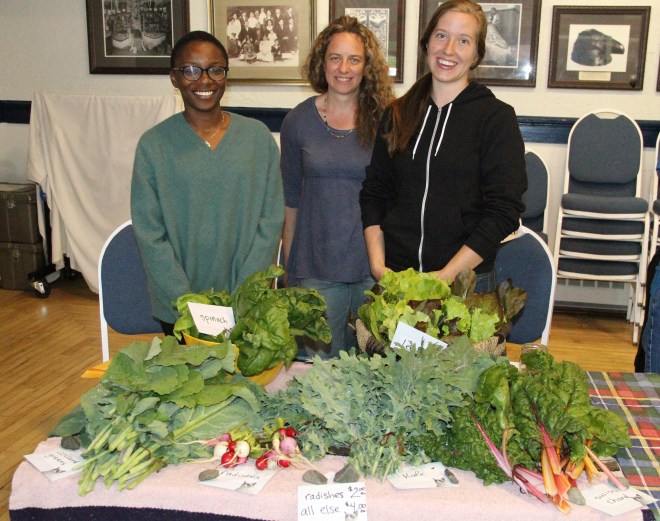
Anna Wane, Tamie Parker-Song and Heather Hanson pose with some of the produce from Heather’s and Alli’s Garden. This was one of the new booths at the market this week.

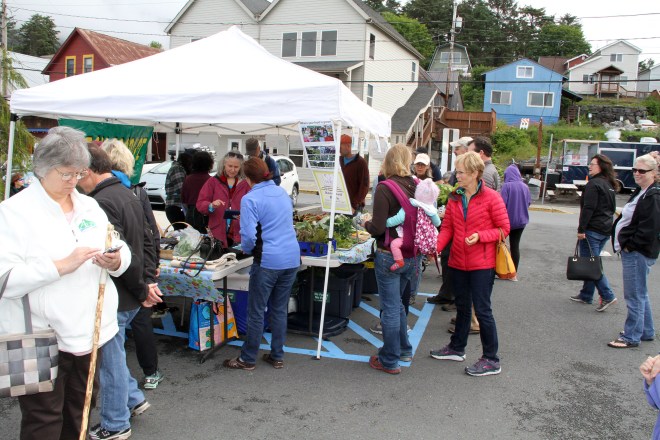
The wind was blustery, but it didn’t rain when we held the second of the seven Sitka Farmers Markets of the 2016 summer on Saturday, July 16, at the Alaska Native Brotherhood Founders Hall.

MiddleIslandOrganicProduceAndreaFragaKalebAldred

Andrea Fraga and Kaleb Aldred of Middle Island Organic Produce, another of the new booths at the market this week.

We had several new vendors at this market, but not as many customers as usual. We had four booths selling produce, two selling beach greens, another selling homemade bread, another with homemade tamales, and even some frybread.

We always welcome new vendors who want to sell produce they’ve grown, fish they’ve caught, and local cottage food products they’ve made. To learn more about how to be a vendor, contact Matthew Jackson at (907) 821-1412 or jackson.mw08@gmail.com or Brandie Cheatham at (907) 687-9927 or vista_brandie@yahoo.com.

SitkaSpruceCateringJerenSchmidtDishesUpHomemadeTamaleWithCrystal

Jeren Schmidt of Sitka Spruce Catering dishes up a homemade tamale for a customer.

The next Sitka Farmers Market will be from 10 a.m. to 1 p.m. on Saturday, July 30, at the ANB Founders Hall. The other markets this summer are on Saturdays, Aug. 13, Aug. 20, Sept. 3, and Sept. 10. The Sitka Farmers Markets receive sponsorship funding from the SouthEast Alaska Regional Health Consortium (SEARHC). Don’t forget to vote for the Sitka Farmers Market in the American Farmland Trust’s eighth annual Farmers Market Celebration.

A slideshow of scenes from the second Sitka Farmers Market of the 2016 summer is below.

This slideshow requires JavaScript.

Scenes from the first Sitka Farmers Market of the 2016 summer

SLFNBoothCrowdInFrontOfBooth

SitkaFarmersMarketSignAfter raining the night before, we ended up with some sun when we held the first of the seven Sitka Farmers Markets of the 2016 summer on Saturday, July 2, at the Alaska Native Brotherhood Founders Hall.

The market was a bit smaller than usual, partially because of competition with the Fourth of July booths at Baranof Elementary School and because of our attempts to refocus the market to put more of an emphasis on local food. We did have some new vendors at the market, and there were a couple of discussions from potential vendors asking about space at the next market.

JessicaGillMarcosMunchiesDogTreats

Jessica Gill was one of our new vendors this market with Marco’s Munchies dog treats.

We always welcome new vendors who want to sell produce they’ve grown, fish they’ve caught, and local cottage food products they’ve made. To learn more about how to be a vendor, contact Matthew Jackson at (907) 821-1412 or jackson.mw08@gmail.com or Brandie Cheatham at (907) 687-9927 or vista_brandie@yahoo.com.

The next Sitka Farmers Market will be from 10 a.m. to 1 p.m. on Saturday, July 16, at the ANB Founders Hall. The other markets this summer are on Saturdays, July 30, Aug. 13, Aug. 20, Sept. 3, and Sept. 10. The Sitka Farmers Markets receive sponsorship funding from the SouthEast Alaska Regional Health Consortium (SEARHC). Don’t forget to vote for the Sitka Farmers Market in the American Farmland Trust’s eighth annual Farmers Market Celebration.

A slideshow of scenes from the first Sitka Farmers Market of the 2016 summer is below.

This slideshow requires JavaScript.

Sitka Local Foods Network to host seven Sitka Farmers Markets this summer


2016SitkaFarmersMarketFlier2

Sitka residents might notice a few changes when the Sitka Local Foods Network opens its ninth season of Sitka Farmers Markets this Saturday. For one, there will be more markets — seven instead of the six markets hosted in recent years. Another change is a more compact market, with a revised vendor price structure and fewer special programs that put the emphasis back on local foods.

SLFNBoothAlliGabbertHelpsGuyBuyingLocalIngredientsForHalibutChowder“The Sitka Farmers Market is a community gathering as much as it is a market,” said Matthew Jackson, newly installed president of the Sitka Local Foods Network and co-manager of the Sitka Farmers Market this year with Brandie Cheatham. “It’s a great way to connect with your neighbors and support local entrepreneurs. In Alaska we know all about the leaky bucket effect, so shopping at the Sitka Farmers Market is a way to keep money circulating in our community.”

The first Sitka Farmers Market of the season takes place from 10 a.m. to 1 p.m. on Saturday, July 2, at the Alaska Native Brotherhood Founders Hall (235 Katlian St.). The other markets this summer take place from 10 a.m. to 1 p.m. on Saturdays, July 16, July 30, Aug. 13, Aug. 20, Sept. 3, and Sept. 10, at ANB Founders Hall.
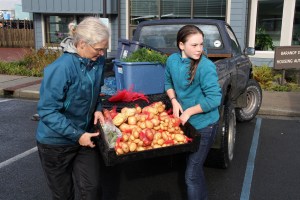
SLFNBoothLauraSchmidtAndDaughterWithPotatoesThe markets feature a variety of locally grown produce, locally harvested seafood, locally manufactured cottage foods, locally made arts and crafts, music and fun. The Sitka Farmers Market was the first market in Southeast Alaska to accept Alaska Quest (SNAP) electronic benefits transfers (EBT) and WIC coupons.

“For the last four seasons we’ve been proud to welcome Alaska Quest EBT and WIC shoppers at the market,” Jackson said. “It is so important to make sure local food is accessible to everyone.”

SLFNBoothLisaSadleirHartHelpsCustomersThe second Sitka Health Summit in April 2008 planted the seeds for the Sitka Farmers Market, as Sitka residents chose starting a local foods market as one of their community wellness initiatives for the year. About the same time, St. Peter’s By The Sea Episcopal Church was looking for a way to put some recently cleared land behind the church’s See House into use for a community project. St. Peter’s offered to lease the land to the group that became the Sitka Local Foods Network for $1 a year, and in May 2008 a group of Sitka residents built raised garden beds and planted a variety of crops. Later that summer, there was enough produce grown at St. Peter’s to supply our first three Sitka Farmers Markets starting in August 2008.

2016SitkaFarmersMarketSponsorsWe grew to five markets in 2009, followed by six markets each year from 2010-15 and now seven markets in 2016. Led by lead gardener Laura Schmidt, the production of local produce at St. Peter’s has grown each year, and there now are satellite gardens, such as the one on land owned by Pat Arvin. Most of the food grown at St. Peter’s and the satellite gardens is sold at the Sitka Farmers Market, but there has been enough for the Sitka Local Foods Network to also have a table when Chelan Produce is in town and to sell to local school lunch programs and restaurants. The money raised helps support the Sitka Local Foods Network, a 501(c)(3) nonprofit, in its mission “to increase the amount of locally produced and harvested food in the diets of Southeast Alaskans.”

To learn more about the Sitka Farmers Market and how you can become a vendor, contact Matthew Jackson at (907) 821-1412 or jackson.mw08@gmail.com. The Sitka Local Foods Network website, http://www.sitkalocalfoodsnetwork.org/, also has more info on the markets and links to vendor forms. The Sitka Farmers Market is sponsored by the SouthEast Alaska Regional Health Consortium (SEARHC).

Fifth-grade students start their own garden at Keet Gooshi Heen Elementary School

IMG_7248

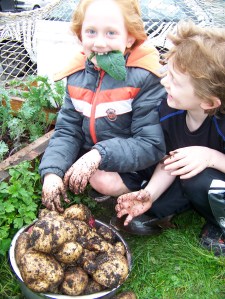
Five fifth-grade boys are growing a variety of crops this year after starting their own garden at Keet Gooshi Heen Elementary School.

The five boys who started the garden — Kyan Scudero, Bridger Bird, Takeshi Handy, Samuel Jones, and Camden Young — were assisted by their classmates, teacher Jennifer Tulloh said. They will be in sixth grade at Blatchley Middle School this fall.

The boys let student-teacher Julie Jordan know they wanted to start a garden and, with Tulloh’s blessing, Jordan contacted Sitka Local Foods Network board member Jennifer Carter for technical assistance. Jordan designed the garden beds, and her husband, Karl Jordan, had the students in his Blatchley Middle School shop class build the raised garden beds.

“You know, this started as a project for my kids that weren’t interested in band but my whole class got involved in the project,” Tulloh said. “The boys got really into the planting and enjoyed meeting with Jennifer (Carter), who was so giving of her time and resources. They started and followed the garden from beginning to end and took great pride in it.”

“The young men wanted to start a vegetable garden for their school and leave it as a parting legacy before they moved on to middle school,” Carter said. “They learned how to prepare the soil, measure for proper spacing and start their own seedlings. They have planted rhubarb, strawberries, potatoes, peas, lettuce, carrots, kale, onions, and radishes.”

A slideshow of photos of the boys and their garden (taken by Jennifer Carter) can be found below.

This slideshow requires JavaScript.

Do you need to test your soil for a better garden? Sometimes you do

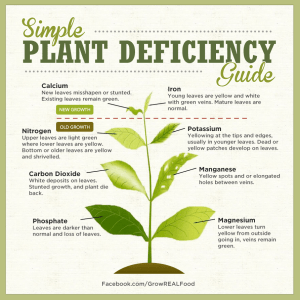
simple-plant-deficiency-guideHave you ever planted your garden and even though you’ve had plenty of sunny weather it just doesn’t seem to be growing the way it should? You might need to test your soil to see if you need to replenish some nutrients.

The University of Alaska Fairbanks Cooperative Extension Service has several publications and a video that can help you decide if you need to test your soil, and if yes, teach you how. Many gardeners test their soil at the end of the season, so they can amend their soil as needed to prepare for the next spring’s planting. But sometimes you might need to test during the growing season, which is what Sitka Local Foods Network Garden Mentor Program Coordinator Michelle Putz did last year when one of her student’s gardens wasn’t doing very well.

Soil testing is not always necessary,” Michelle said. “If you have several hours of direct sun and your garden is growing beautifully, then you may not need to test your soil. If you have sun but your garden is not doing so well, or if you have brand new soil, it might be worth testing the soil.

“One of our Garden Mentor families in 2015 grew beautiful but tiny plants that were struggling to get bigger, she added. “A simple soil test showed that their soil was low in nitrogen and needed a little acid. Once we added coffee grounds (for acid) and blood meal (for nitrogen), the plants grew substantially. Had we realized that our starting soil was so basic (not acidic enough) and nutrient poor, we could have made adjustments before the growing season and had a much more productive garden.”

In Southeast Alaska, our rain tends to wash a lot of the nutrients out of the soil. This is why it’s almost a requirement for gardeners to amend their soil with seaweed, compost, coffee grounds and other items to replenish the missing nutrients. It also helps to rotate your crops from one garden plot to the next, since different plants draw different nutrients as they grow (for example, potatoes use a lot of nitrogen while tomatoes use a lot of potassium).

To learn more about soil-testing, watch the video at the top of this story and read the three attached files below. The attached files and video will show you how to take a soil sample and how to send it to a lab for testing.

• Soil and Fertilizer Management for Healthy Gardens (UAF Cooperative Extension Service publication, HGA-0338)

• Factors to Consider in Selecting a Soil-Testing Laboratory (UAF Cooperative Extension Service publication, FGV-00045)

• Soil Sampling (UAF Cooperative Extension Service publication, FGV-00044)

Second batch of classes set for 2016 Sitka Local Foods Network garden mentor program

DSCN0338

DSCN0387The second batch of classes (Classes Three and Four) for the 2016 Sitka Local Foods Network garden mentor program are being set for our two participating first-year families and our three returning second-year families. The classes will be similar at each location, and they are open to the public.

Class Three is about garden maintenance, while Class Four is about early harvest. Class One focused on site selection, garden preparation, building planter beds, simple vegetables and soil preparation, while Class Two was about simple vegetables and planting. There are six classes in the series, with Class Five about the final harvest and Class Six about preparing the garden for winter.

Our first-year gardener families (Erin Mathes and Fran Baratki), learn how to grow four hardy crops for Sitka — kale, lettuce, potatoes and rhubarb. Our three returning families (A.J. Bastian, Rebecca Kubacki and Breezy) will be planting carrots, chard, green onions and peas this year. These four crops are slightly more difficult crops to grow that our first-year plantings of kale, lettuce, potatoes and rhubarb. Even though the crops for our second-year students are more difficult to grow, many gardeners in Sitka still have good results with these vegetables. These classes are essentially the same, so feel free to attend the Class 3 or Class 4 that best fits your schedule.

The class schedule and location for the one first-year and three second-year families is (some classes still need to be scheduled and will be announced later):


  • ERIN MATTHES (first-year family), 716 Etolin Street — CLASS 3: 3:30 p.m. on Thursday, June 2; CLASS 2: 3:30 p.m. on Tuesday, June 21.
  • FRAN BARATKI (first-year family), 180 Price Street, No. 6 (purple trailer) — CLASS 3:  7 p.m. on Tuesday, May 31; CLASS 4: TBA.
  • A.J. BASTIAN (second-year family), 207 Brady St. — CLASS 3: TBA; CLASS 4: TBA.
  • REBECCA KUBACKI (second-year family), 1202 Halibut Point Rd. — CLASS 3: 4:30 p.m. on Wednesday, June 1; CLASS 4: 4:30 p.m. on Wednesday, June 22.
  • BREEZY (second-year family), 616 Sawmill Creek Rd. — CLASS 3: 5 p.m. on Monday, June 6; CLASS 4: 5 p.m. on Monday, June 27.

This is the third year of the garden mentor program, which provides one-to-one mentoring to families who are trying to garden for the first time. In order to reach more people, our participating families allow the classes to be made public. By teaching families the basics of gardening, we are helping them improve their family nutrition, extend their family food budget, and increase food security in Sitka.

Michelle Putz has been contracted to coordinate the program and design lesson plans. We also have about a half-dozen experienced Sitka gardeners who serve as mentors for the program. For more information, please contact Michelle at 747-2708.

Celebrate local farmers and gardeners on Alaska Agriculture Day on Tuesday, May 3

AlaskaGrownImpact

AgDayProclamationMay32016Alaskans will celebrate Alaska Agriculture Day on Tuesday, May 3. On this day, Alaskans are encouraged to support local agriculture by seeking out and purchasing products produced in Alaska and educating youth about the vital role that agriculture plays in our economy.

Here are a few ideas from the Division of Agriculture on how to celebrate Alaska Agriculture Day:

  • Join the 49,005 people who “like” the Alaska Grown Facebook page at https://www.facebook.com/dnr.alaskagrown and learn about the exciting things Alaskans are producing around the state.
  • Contact your local agriculture groups/chapters (such as FFA, Farm Bureau, Agriculture in the Classroom etc.) to see if they are hosting an event in your area.
  • Sign up for a Community Supported Agriculture (CSA) program at a local farm.
  • Buy and incorporate Alaska Grown products into your meals.
  • If you are a farmer, consider asking a local school if you can visit a classroom to educate children about your operation and Alaska agriculture.
  • Visit and thank a local farmer in person. To find a farm near you, check the Alaska Grown Source Book at http://dnr.alaska.gov/ag/sourcebook/sourcebookindex2014.html.

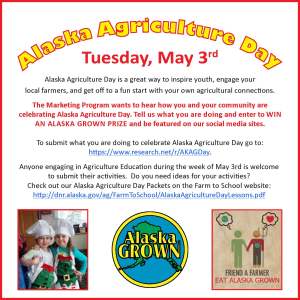
ak ag day flyerIn Sitka, you can celebrate Alaska Agriculture Day by starting a food garden (even a couple of containers on your deck can provide you with potatoes, carrots or greens). Teachers are encouraged to offer a lesson plan or two about the importance of agriculture in Alaska and in Sitka. Here’s a link to an article about how Sitka was Alaska’s original garden city back in the late 19th and early 20th Centuries. Also, click here to listen to a Sitka History Minute feature about the potato in Sitka from KCAW-Raven Radio).

During the growing season, please support the Sitka farmers and production gardeners listed in the Alaska Grown Source Book (chief contact in parentheses) — Anam Cara Family Garden (Lisa Sadleir-Hart), Blatchley Community Gardens (David Nuetzel), Down To Earth U-Pick Garden (Lori Adams), Finn Island Farm (Keith Nyitray), Sprucecot Gardens (Judy Johnstone), and St. Peter’s Fellowship Farm (Laura Schmidt). There also are a few Sitka farms and production gardens not listed in the Alaska Grown Source Book, such as Sea View Garden (Linda Wilson), The Sawmill Farm (Bobbi Daniels), Sitka Seedling Farms (Matthew Jackson) and Welsh Family Forget-Me-Not Garden (Florence Welsh). Many of these farms and gardens will be vendors during the Sitka Farmers Markets, which start on July 2 this summer.

St. Peter’s Fellowship Farm communal garden work party takes place on Saturday, May 7

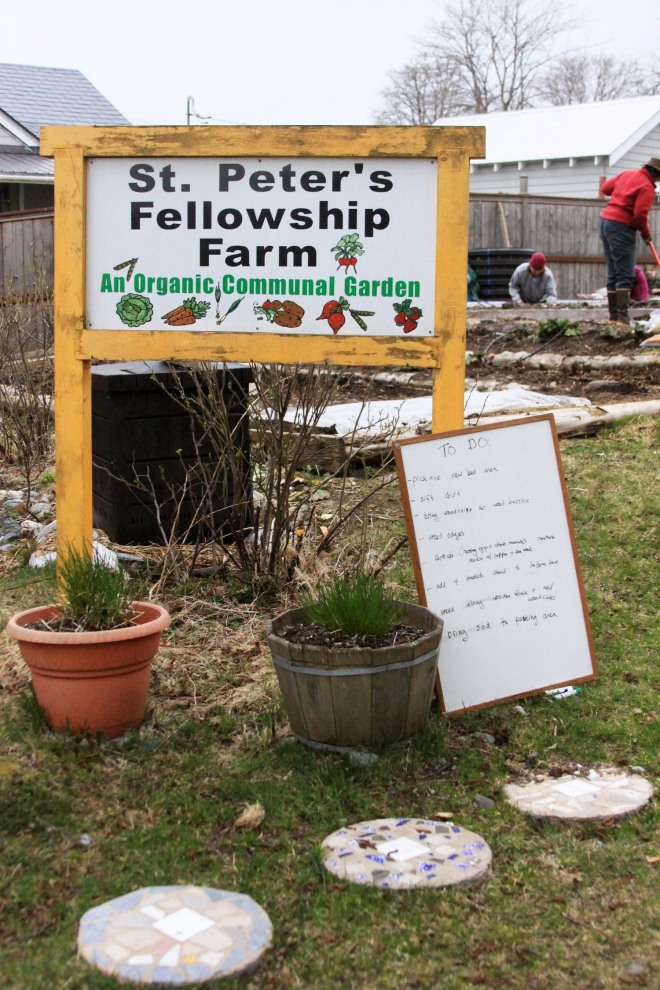
A to-do list of chores at the St. Peter's Fellowship Farm communal garden

A to-do list of chores at the St. Peter’s Fellowship Farm communal garden

A group of kids harvests garlic during an Aug. 12, 2011, work party at St. Peter's Fellowship Farm.

A group of kids harvests garlic during an Aug. 12, 2011, work party at St. Peter’s Fellowship Farm.

Are you interested in meeting other Sitka gardeners and learning about how to grow food in Sitka’s rainy climate? Then join us for a garden party from 2-4 p.m. on Saturday, May 7, at St. Peter’s Fellowship Farm.

St. Peter’s Fellowship Farm is located behind St. Peter’s By The Sea Episcopal Church, 611 Lincoln Street (the brown church with the steeple above Crescent Harbor). It is a communal garden that grows food to be sold at the Sitka Farmers Markets, at a table when Chelan Produce is in town, and used for various school lunch and hunger programs around town. This year’s Sitka Farmers Markets are from 10 a.m. to 1 p.m. on Saturdays, July 2, July 16, July 30, Aug. 13, Aug. 20, Sept. 3, and Sept. 10, at the Alaska Native Brotherhood Founders Hall (235 Katlian St.).

“We will be putting starts in the ground, weeding and prepping beds for planting,” St. Peter’s Fellowship Farm lead gardener Laura Schmidt said.

The garden work parties are kid-friendly, so feel free to bring the munchkins to help.

To learn more, call St. Peter’s Fellowship Farm lead gardener Laura Schmidt at 738-7009 or 623-7003.

First two classes set for 2016 Sitka Local Foods Network garden mentor program

DSCN0398

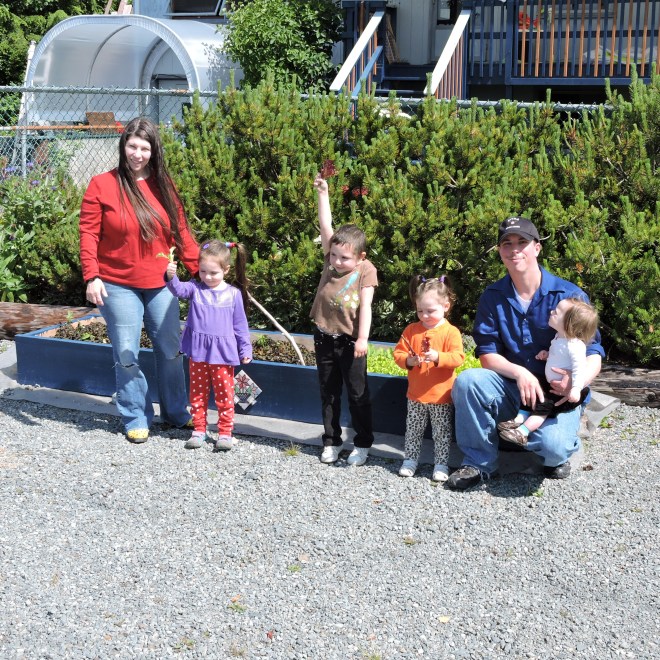
Rebecca Kubacki and her family after planting their garden bed in 2015.

DSCN0250

Breezy and her family after planting their garden bed in 2015.

The first two classes for the 2016 Sitka Local Foods Network garden mentor program have been set for our two participating first-year families and our three returning second-year families. The classes will be similar at each location, and they are open to the public. (Note: This post has been updated with our second first-year family and a new time on one of the other classes.)

For our first-year families, the first class will focus on site selection, garden preparation, building planter beds, simple vegetables and soil preparation. The second class will be about simple vegetables and planting. Our first-year gardener families (Erin Mathes and Fran Baratki), learn how to grow four hardy crops for Sitka — kale, lettuce, potatoes and rhubarb.

Our three returning families (A.J. Bastian, Rebecca Kubacki and Breezy) will be planting carrots, chard, green onions and peas this year.These four crops are slightly more difficult crops to grow that our first-year plantings of kale, lettuce, potatoes and rhubarb. Even though the crops for our second-year students are more difficult to grow, many gardeners in Sitka still have good results with these vegetables. These classes are essentially the same, so feel free to attend the Class 1 and Class 2 that best fits your schedule.

The class schedule and location for the one first-year and three second-year families is:

  • Erin Matthes (first-year family), 716 Etolin Street — CLASS 1: 3 p.m. on Wednesday, April 27; CLASS 2: 3 p.m. on Monday, May 9.
  • Fran Baratki (first-year family), 180 Price Street, No. 6 (purple trailer) — CLASS 1:  Done; CLASS 2: 4:30 p.m. on Monday, May 9.
  • A.J. Bastian, 207 Brady St. — CLASS 1: Done; CLASS 2: 3:30 p.m. on Thursday, April 28.
  • Rebecca Kubacki, 1202 Halibut Point Rd. — CLASS 1: Done; CLASS 2: 5:30 p.m. on Monday, May 2.
  • Breezy, 616 Sawmill Creek Rd. — CLASS 1: 5 p.m. on Thursday, April 28; CLASS 2: 5 p.m. on Thursday, May 5.

This is the third year of the garden mentor program, which provides one-to-one mentoring to families who are trying to garden for the first time. In order to reach more people, our participating families allow the classes to be made public. By teaching families the basics of gardening, we are helping them improve their family nutrition, extend their family food budget, and increase food security in Sitka.

Michelle Putz has been contracted to coordinate the program and design lesson plans. We also have about a half-dozen experienced Sitka gardeners who serve as mentors for the program. For more information, please contact Michelle at 747-2708.

Sitka Local Foods Network seeks two coordinators for our garden mentoring education program

KubackiFamilyVertical
IMG_0004The Sitka Local Foods Network is looking to contract with two Sitka residents to coordinate our garden mentoring education program. This year we’re splitting up the duties, so one of the coordinators will work with our returning families and the other will work with our new families (and be paid slightly more).

These contracts run from spring through fall 2016, and the coordinators will be in charge of developing curricula, teaching classes, obtaining supplies, and providing evaluation of the program. A full list of job duties and expectations can be found in the linked document at the bottom of this article.

Applicants should have at least 3-5 years of varied vegetable gardening experience, preferably in Southeast Alaska. They also should have 3-5 years of project coordination experience, as well as demonstrated communication, organizational, and teaching/mentoring skills.

100_8734BastianKidsThe garden mentoring project began in 2014 when two families of first-time gardeners were chosen to receive help planning and building a simple garden to grow four relatively easy plants for Sitka (kale, rhubarb, potatoes, lettuce). In 2015, the program was expanded to provide mentoring service to four new first-time gardening families, plus the two families from 2014 will receive a second year of mentoring as they learn to grow plants that are a bit more difficult for Sitka (carrots, peas, chard, green onions).

There are six classes with each family, and they usually are open to the public. In 2016, we expect three returning families and three new families (one of our first-year families from last year asked to repeat as a first-year family this year).

Applicants should submit a letter of interest and resume by 5 p.m. on Friday, April 8, to sitkalocalfoodsnetwork@gmail.com. Please put “Garden Mentor Coordinator” in your email subject line. The contracts pay in three installments over the summer. Questions about the contracts can be directed to sitkalocalfoodsnetwork@gmail.com.

• 2016 SLFN garden mentoring coordinator contract information