The Alaska Food Policy Council is seeking Alaska residents to participate in five workgroups to help develop action plans for certain key food issues in the state.
A group of 30 council members met on April 4-5 to develop basic action plans geared toward five priority strategies to improve food security in the state. Now they need people to begin implementing the individual action plans. The five priority strategies are part of the Alaska Food Policy Council’s three-year strategic plan developed at its Jan. 12 meeting.
The five priority strategies include:
Improving school-based programs such as Farm to Schools and Fish to Schools;
Strengthening enforcement of the state’s 7-percent bidding preference for Alaska Grown food;
Improving emergency food preparedness plans throughout the state;
Serving as a research aggregator/resource to help people get a better handle on Alaska’s food situation and supply chain; and
Supporting local food efforts throughout the state.
The Alaska Food Policy Council got its start during a May 18-19, 2010, meeting in Anchorage. Sitka Local Foods Network treasurer Lisa Sadleir-Hart, a registered dietitian and SEARHC Health Educator, is one of the 30 members of the council.
These five work groups are open to anybody who has a special interest in the various topics. To learn more about the work groups, contact Lisa Sadleir-Hart at 966-8735 or lisa.sadleir-hart@searhc.org, or contact Alaska Food Policy Council Coordinator Diane Peck with the Alaska Department of Health and Social Services Obesity Prevention and Control Program at 269-8447 or diane.peck@alaska.gov.
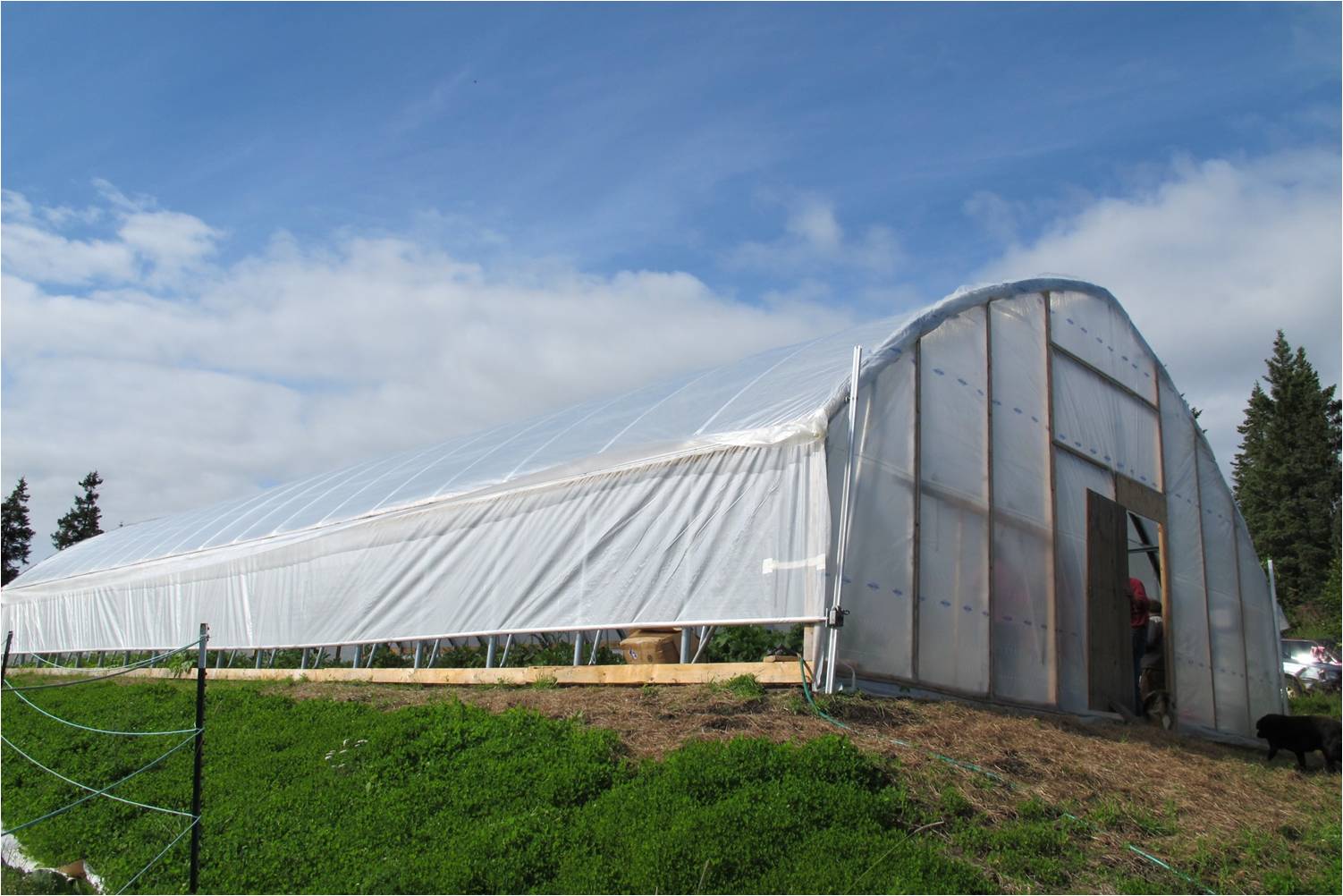
Sitka Local Foods Network President Kerry MacLane, left, and Sprucecot Garden Owner Judy Johnstone pose in front of one of the high tunnels recently erected on Judy’s land on Peterson Street. (Photo Courtesy of KCAW-Raven Radio)
Longtime Sitka gardener Judy Johnstone will be able to extend the growing season at her Sprucecot Garden on Peterson Street after a crew erected two new high tunnels on her land.
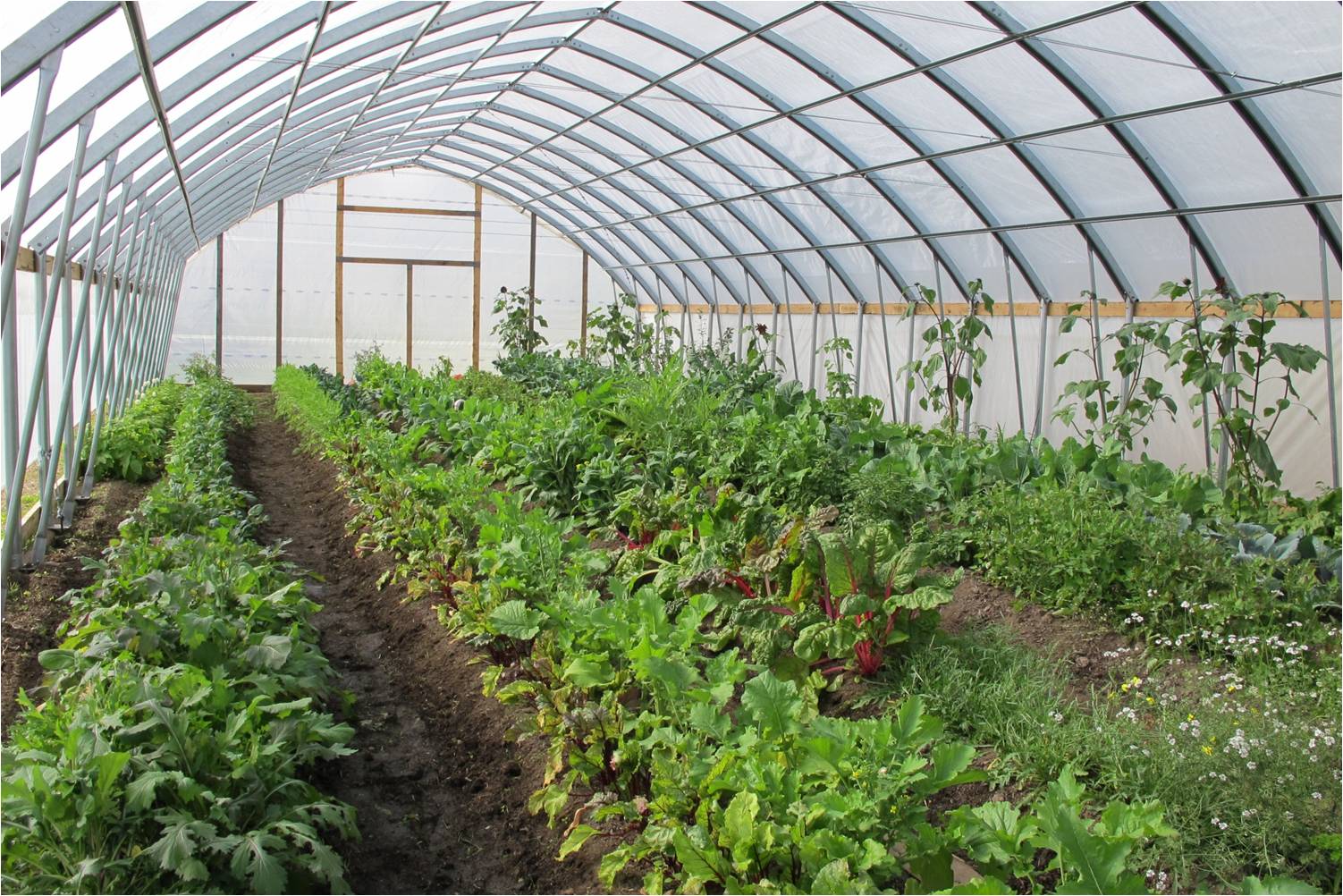
The high tunnels, which basically are temporary greenhouses with a large frame holding a transparent plastic cover and without a built-in power supply, already have raised the temperatures inside by about 15-20 degrees over the low-50s we’ve had in Sitka so far this summer. They will enable Judy to start her plants earlier in the spring and keep producing food later into the fall.
The high tunnels were funded through a cost-sharing program run by the USDA National Resources Conservation Service, which is accepting applications for new high tunnel projects through June 15.
These are the first high tunnels to go up in Sitka, but there have been several built in other parts of the state (the lower Kenai Peninsula near Homer has about 90 of them). Since these are the first high tunnels in Sitka, they’ve received lots of coverage in the local media. The Daily Sitka Sentinel featured an article on Page 1 of its Friday, June 8, 2012, edition (password required), and KCAW-Raven Radio featured Judy and Sitka Local Foods Network President Kerry MacLane in its Monday, June 11, 2012, Morning Edition show interview and in a story on its Tuesday, June 12, 2012, newscasts.
The U.S. Department of Agriculture’s Natural Resources Conservation Service (NRCA) is offering a cost-sharing program that enables qualifying landowners who produce food to build high tunnels.
High tunnels, also known as hoop houses or temporary greenhouses, can help extend the growing season at both the start and end of the season so more food is produced.
High tunnels are different than greenhouses in that they are passively heated by the sun, so they have lower energy costs than greenhouses. Food in high tunnels is planted either directly into the ground or in raised beds. To learn more about the USDA’s high tunnel program, click here. This link has frequently asked questions and answers.
NRCS will provide cost-sharing funds on structures up to 2,178 square feet (5 percent of one acre). Both the land owner and land must meet certain eligibility requirements. Funding is provided on a reimbursable status once the high tunnel is installed and certified to meet NRCS standards.
For information regarding the NRCS technical service or program participation in Southeast Alaska, please contact the Juneau field office at (907) 586-7220 or samia.savell@ak.usda.gov. Applications currently are being accepted for the 2013 fiscal year (Oct. 1, 2012, to Sept. 30, 2013) and applications must be received at the Juneau field office on or before June 15, 2012. For contact info to other Alaska field offices, click this link.
The Sitka Local Foods Network will host its first planting party of the season from 2-4 p.m on Saturday, May 5, at St. Peter’s Fellowship Farm (located behind St. Peter’s By The Sea Episcopal Church on Lincoln Street, above Crescent Harbor).
Produce grown at St. Peter’s Fellowship Farm is sold during the Sitka Farmers Markets to help fund Sitka Local Foods Network projects throughout the year. The 2012 Sitka Farmers Markets take place from 10 a.m. to 2 p.m. on alternate Saturdays starting July 7 through Sept. 15 (July 7, 21, Aug. 4, 18, Sept. 1, 15) at the Alaska Native Brotherhood Hall on Katlian Street.
Our last work party on April 21 was an absolute success (see photo slideshow above), and we’d like to continue to build on this momentum. In addition to planting crops, we’ll continue with bed building, adding amendments to the soil, laying down wood chips to prevent future weeds and lots more. Tools and teaching will be provided. Dress for the weather.
For more information, contact St. Peter’s Fellowship Farm lead gardener Laura Schmidt at 623-7003 or 738-7009. We will need a lot of bodies for this work party. We will continue planting the gardens on Saturday afternoons throughout May, now that we’re past the final freeze.
The Sitka Local Foods Network will host its second work party of the season from 2-4 p.m on Saturday, April 21, at St. Peter’s Fellowship Farm (located behind St. Peter’s By The Sea Episcopal Church on Lincoln Street, above Crescent Harbor).
Produce grown at St. Peter’s Fellowship Farm is sold during the Sitka Farmers Markets to help fund Sitka Local Foods Network projects throughout the year.
Our first work party on April 14 was an absolute success (see photo slideshow above), and we’d like to continue to build on this momentum. We’ll continue with bed building, adding amendments to the soil, laying down wood chips to prevent future weeds and lots more. Tools and teaching will be provided. Dress for the weather.
For more information, contact St. Peter’s Fellowship Farm lead gardener Laura Schmidt at 623-7003 or 738-7009. We will need a lot of bodies for this work party. We will start planting the gardens in May, once we’re past the final freeze.
(EDITOR’S NOTE: The following article first appeared on this site in April 2010. It is repeated because much of the information remains current and newsworthy.)
As you start to plan your garden for this spring and summer, don’t forget to Plant A Row For The Hungry. The Plant A Row For The Hungry program (also known as Plant A Row or PAR) is a national campaign by the Garden Writers Association of America that got its start in Alaska.
In the cold winter of 1994, Anchorage Daily News garden columnist and former Garden Writers Association of America President Jeff Lowenfels was returning to his hotel after a Washington, D.C., event when he was approached by a homeless person who asked for some money to buy food. Lowenfels said Washington, D.C., had signs saying, “Don’t give money to panhandlers,” so he shook his head and kept on walking. But the man’s reply, “I really am homeless and I really am hungry. You can come with me and watch me eat,” stayed with Lowenfels for the rest of his trip.
Jeff Lowenfels
The encounter continued to bother Lowenfels, even as he was flying back to Anchorage. During the flight, Lowenfels came up with an idea when he started writing his weekly garden column (the longest continuously running garden column in the country, with no missed weeks since it started on Nov. 13, 1976). He asked his readers to plant one extra row in their gardens to grow food to donate to Bean’s Café, an Anchorage soup kitchen. The idea took off.
When Anchorage hosted the Garden Writers Association of America convention in 1995, Lowenfels took the GWAA members to Bean’s Café to learn about the Plant A Row For Bean’s Café program. The Garden Writers Association of America liked the idea, and it became the national Plant A Row For The Hungry campaign (also known as Plant A Row or PAR). In 2002, the Garden Writers Association Foundation was created as a national 501(c)(3) nonprofit to manage the Plant A Row For The Hungry program.
“I am not surprised by the growth of PAR,” Lowenfels wrote in an e-mail to the Sitka Local Foods Network. “It is now in all 50 states and across Canada and there are thousands of variations of the original program — from prison gardens for the hungry to botanical gardens donating their produce from public display gardens. This is because gardeners always share information and extra food, so the idea was a natural.”
It took five years for the program to reach its first million pounds of donated food, but the second million only took two years and the next eight years saw a million pounds of donated food (or more) each year. Since 1995, more than 14 million pounds of food have been donated. Not only that, the program is getting ready to expand overseas to Australia, England and other countries with avid gardeners.
“We have supplied something in the vicinity of enough food for 50 million meals,” Lowenfels wrote in his e-mail. “Gardeners can solve this hunger problem without the government. And we don’t need a tea party to do it! Or chemicals, I might add, as author of a book on organic gardening (Teaming With Microbes, written with Wayne Lewis)!”
According to the U.S. Department of Agriculture, one out of every eight U.S. households experiences hunger or the risk of hunger. Many people skip meals or eat too little, sometimes going an entire day or more without food. About 33 million Americans, including 13 million children, have substandard diets or must resort to seeking emergency food because they can’t always afford to buy the food they need. In recent years the demand for hunger assistance has increased 70 percent, and research shows that hundreds of children and adults are turned away from food banks each year because of lack of resources.
While many people credit Lowenfels for creating the Plant A Row For The Hungry program, Lowenfels says the real heroes are the gardeners growing the extra food and donating it to local soup kitchens, senior programs, schools, homeless shelters and neighbors. You can hear him pass along the credit to all gardeners at the end of this interview last year with an Oklahoma television station (video also embedded below).
“One row. That’s all it takes. No rules other than the food goes to the hungry. You pick the drop-off spot or just give it to a needy friend or neighbor. Nothing slips between the lip and the cup, I say,” Lowenfels wrote in his e-mail.
The Sitka Local Foods Network also takes donations of local produce to sell at the Sitka Farmers Markets, and all proceeds from the Sitka Farmers Markets are used to help pay for Sitka Local Foods Network projects geared toward helping more people in Sitka grow and harvest local food. For more information, contact Sitka Local Foods Network President Kerry MacLane (maclanekerry@yahoo.com), Sitka Local Foods Network Vice President Linda Wilson (lawilson87@hotmail.com) or Sitka Farmers Market Coordinator Johanna Willingham-Guevin (johanna.willingham@gmail.com).
It’s still a little cold to be planting outdoors, but it’s warm enough to start getting the garden ready.
There will be a special work party from 1-3 p.m. on Saturday, April 14, to expand our gardens at the St. Peter’s Fellowship Farm communal garden (located behind St. Peter’s By The Sea Episcopal Church on Lincoln Street). Produce grown at St. Peter’s Fellowship Farm is sold during the Sitka Farmers Markets to help fund Sitka Local Foods Network projects throughout the year.
During this special work party, workers are needed to help add space to the garden. We will need people to use pick-axes to clear out salmonberry roots so we can prepare new garden beds. We also need people to shovel dirt and sift soil, among other jobs.
For those wanting to do lighter work, we need people to weed, mulch and spread fertilizer (seaweed) on the existing garden beds. Most garden tools will be provided, but we will need people to bring shovels and pick-axes if they have them.
For more information, contact St. Peter’s Fellowship Farm lead gardener Laura Schmidt at 623-7003 or 738-7009. We will need a lot of bodies for this work party. We will start planting the gardens in May, once we’re past the final freeze.
Food advocate Andrianna Natsoulas will give a free presentation about the food sovereignty movement at 5 p.m. on Sunday, March 18, at the Kettleson Memorial Library in Sitka.
Andrianna is a longtime advocate for food and environmental issues. She operates the Food Voices website, which features people from around the world (including Sitka) discussing the importance of developing a sustainable and sovereign food system. She also is writing the book, “Food Voices: Stories of the Food Sovereignty Movement.”
The food sovereignty movement is based on community-based agriculture and fishing, rather than industrial food production. More people are becoming concerned about where their food comes from and how it was produced. They are starting to recognize how local food is fresher, tastes better, puts more money back into the local economy, uses less fuel for transportation, and has fewer chemicals and pesticides.
To learn more about the food sovereignty movement, go to Andrianna’s Food Voices website or e-mail her at andrianna@foodvoices.org.
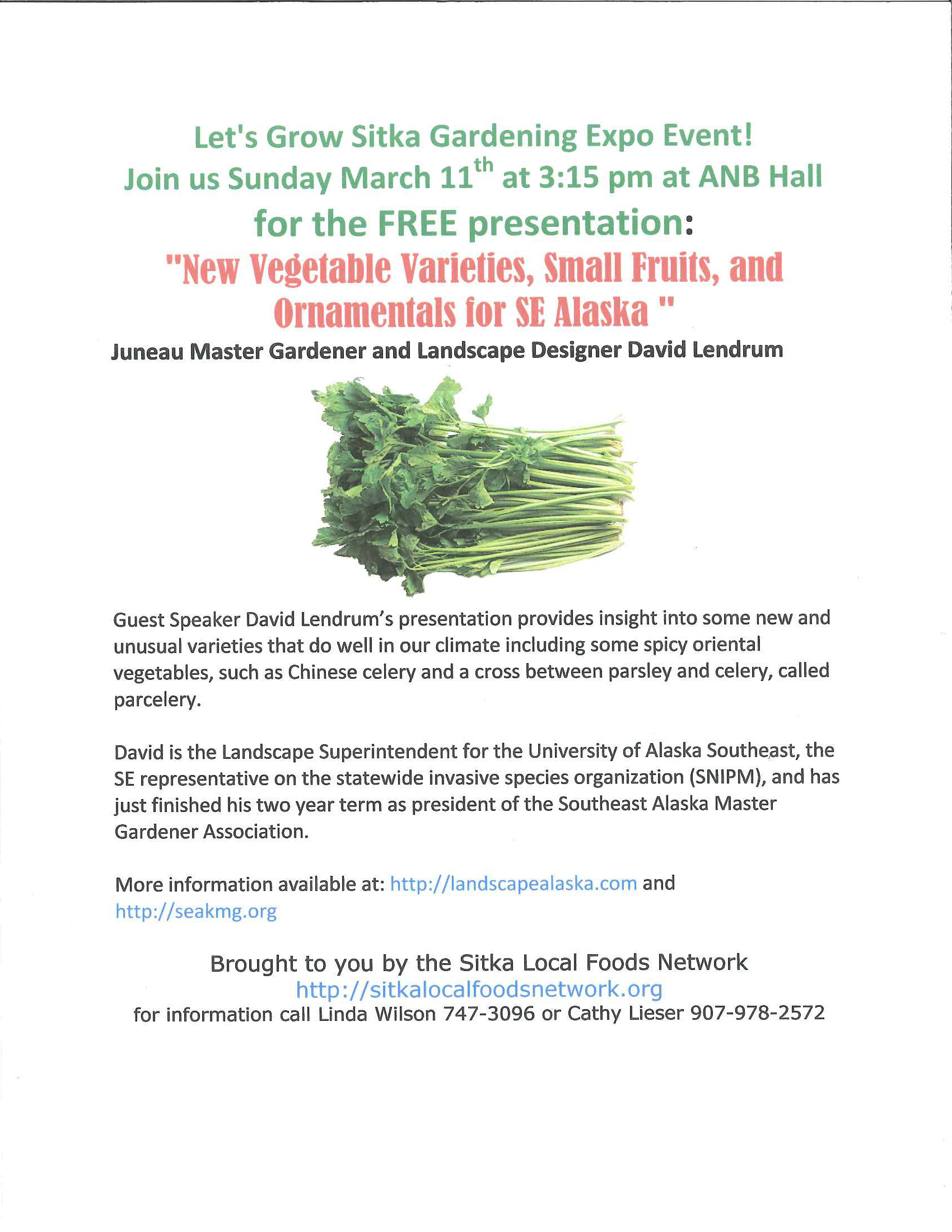
Mark your calendars, because the 2012 “Let’s Grow Sitka” gardening education event opens at noon and runs until 3 p.m. on Sunday, March 11, at the Alaska Native Brotherhood Hall on Katlian Street. Don’t forget to set your clocks to spring forward so you can get ready to grow.
This annual event brings together local garden supply stores, local gardeners, landscapers and anybody who is interested in learning how to grow food and/or flowers. Sitka Local Foods Network Vice President Linda Wilson, who is coordinating the event with SLFN Board Member Cathy Lieser, was interviewed during the Morning Edition show Thursday on KCAW-Raven Radio and she provided more details about this event (click the link to listen to the interview), which helps Sitka residents get excited about the upcoming garden season.
There will be a wide variety of individuals and businesses with booths for the event, with some booths providing gardening information geared toward and others selling gardening supplies. Lunch will be available for purchase. Here is a tentative list of some of those planning to host booths:
Linda Wilson, Sitka Farmers Market, Grow a Row for the Market
Cathy Lieser, Let’s Grow Sitka, Sitka Local Foods Network
Doug Osborne. Sitka Local Foods Network?
Johanna Willingham, Pacific H.S./Sitka Farmers Market backup.
Jud Kirkness, Sicka Waste compost project, Fruit tree map
Tom Hart, compost, NZ composter ?
Kerry MacLane. Pest management
Lisa Sadleir-Hart. St. Peter’s Fellowship Farm
Laura Schmidt, St. Peter’s Fellowship Farm/Seed swap & share
Maybelle Filler, ???
Stanley Schoening, Chickens, fig trees, UAF Cooperative Extension Service
Judy Johnstone, High Tunnel program
David Lendrum, Guest speaker 3:15, info on new/unusual varieties for Southeast Alaska
Jeren Schmidt, Sitka Spruce Catering, lunch for purchase
Robert Gorman, UAF Cooperative Extension Service, history of Experimental Station
Andrianna Natsoulas, Food Sovereignty
Tracy Gagnon, Sitka 4H Club
Eve Grutter, Chickens, produce
Adam Chinalski, Model greenhouse
Penny Brown, Garden Ventures – products for sale
Amanda Grearson, True Value – products for sale
Lowell Frank, Spenard Building Supply Garden Center ??
Rick Peterson, Gardening 101 – easiest to grow, need to amend soil, etc…
Lori Adams, Down-to-Earth U-Pick Garden – garden promotion and information
Mike Tackaberry/Robin Grewe, White’s Inc. – products for sale
Mandy Summers, Pacific High School
Kelly Smitherman, National Park Service – garden at Bishops House, etc…
Lisa Teas, Sitka Farmers Market art debut
Florence Welsh, Forget-Me-Not Gardens, local garden booklet, possible plant starts
Hope Merritt, Gimbal Botanicals herbal teas – info on wild herbs and herbs to grow
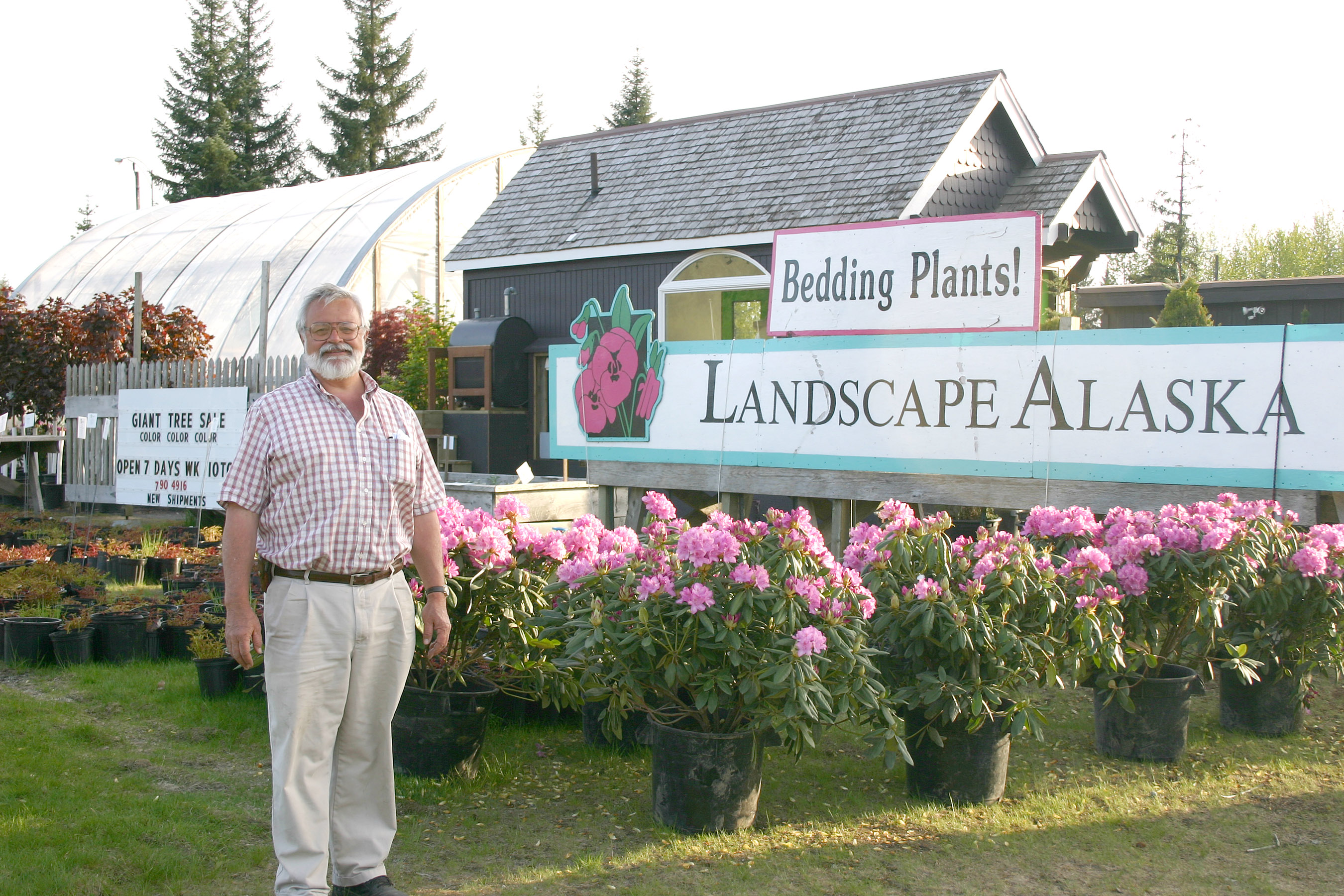
Right after the three-hour Let’s Grow Sitka event ends, guest speaker Dave Lendrum of Juneau will speak at 3:15 p.m. on “New Vegetable Varieties, Small Fruits, and Ornamentals for Southeast Alaska.” Lendrum is a landscape designer who just finished a two-year term as president of the Southeast Alaska Master Gardener Association and with his landscape architect wife, Margaret Tharp, owns Landscape Alaska.
Dave’s life has evolved in partnership with the natural world. He grew up in California on an organic u-pick vegetable farm, learning horticulture from his parents and the 4H club. He did nursery work and continued his post-college adventure in Ecuador by starting a fresh market produce business. After being a city horticulturist at the Eugene (Ore.) Parks Department, Dave started his first nursery, Western Oregon Perennials. A few years later, he found himself in a high-temperature photosynthesis lab at Stanford. In the Pacific Northwest, Dave restored old estate gardens. When he heard Alaska’s call, he moved north to Elfin Cove. Dave and his wife started Landscape Alaska in Juneau 28 years ago. They design and build landscapes on every scale and have won numerous awards both locally and nationally. In addition, Dave is the landscape superintendent for the University of Alaska Southeast and the Southeast representative on the statewide invasive species organization (SNIPM).
For more information about Let’s Grow Sitka, contact Linda Wilson at 747-3096 (evenings, weekends) or lawilson87@hotmail.com, or Cathy Lieser at 978-2572. The two event fliers for this event are posted below as Adobe Acrobat files (PDF files).
The Sitka Local Foods Network Board of Directors is recruiting for a volunteer/contract worker to serve as market manager for the 2012 Sitka Farmers Markets.
This is the fifth year of operation for the Sitka Farmers Market, which features six markets from 10 a.m. to 2 p.m. every other Saturday from July 7 through Sept. 15 (July 7, 21, Aug. 4, 18, Sept. 1 and 15) at the Alaska Native Brotherhood Hall. The farmers markets feature booths from local farmers/gardeners, local fishermen, and artisans and craftspeople. These events are great Sitka gathering places, and we promote local foods and other goods at them.
A detailed description of the market manager duties (compiled by Sitka Local Foods Network vice president Linda Wilson, who has been the market manager the past four years) can be found at the link below. For more information or to submit applications, contact Maybelle Filler at 747-2761 or mocampo25@hotmail.com, or contact Doug Osborne at 747-3752 or doug_las@live.com. Please submit a resume and interest letter to Maybelle and/or Doug by 5 p.m. on Friday, Feb. 24. The market manager of the Sitka Farmers Market reports to the Sitka Local Foods Network Board of Directors.

 The Alaska Food Policy Council is seeking Alaska residents to participate in five workgroups to help develop action plans for certain key food issues in the state.





 Sitka Local Foods Network
You must be logged in to post a comment.