• Juneau Empire features Sitka Farmers Market Table of the Day Award winners

Screenshot from Sunday's Juneau Empire with the Table of the Day Award for Hope Merritt and Judy Johnstone at the third Sitka Farmers Market of the summer (Aug. 15).

Screenshot from Sunday's Juneau Empire with the Table of the Day Award for Hope Merritt and Judy Johnstone at the third Sitka Farmers Market of the summer (Aug. 15).

Click here to see the photo in Sunday’s Juneau Empire of Sitka Farmers Market (Aug. 15) Table of the Day Award winners Hope Merritt and Judy Johnstone of Gimbal Botanicals and Sprucecot Gardens. Presenting the award is Ellen Frankenstein.

Join us for the fourth Sitka Farmers Market of the summer from 10 a.m. to 2 p.m. on Saturday, Aug. 29, at Alaska Native Brotherhood Hall, 235 Katlian St.

• Alaska Grown hosts the “Eat Local Challenge 2009” on Aug. 23-29

Flier for the Alaska Grown "Eat Local Challenge"

The Alaska Grown program will launch its “Eat Local Challenge 2009” this week, Sunday through Saturday, Aug. 23-29 (click here to read more).

During the next week, Alaska residents are encouraged to:

• Try eating at least one home-cooked meal this week, made of mostly local ingredients.
• Try to incorporate at least one never-before-used local ingredient into a meal.
• Try “brown-bagging” at least one meal this week made primarily of local ingredients.
• Try talking to at least one local food retailer and one food producer about local food options.
• Try to choose local food products whenever possible.

By the way, a good time to buy local food this week is the fourth Sitka Farmers Market of the summer, which takes place from 10 a.m. to 2 p.m. on Saturday, Aug. 29, at Alaska Native Brotherhood Hall (235 Katlian St.). We’ll see you there.

• Sitka Native Education program to host Jam and Jam on Aug. 28

The Sitka Native Education Program will host a Jam and Jam at 5 p.m. on Friday, Aug. 28, at the Alaska Native Brotherhood Hall with the Gajaa Heen Dancers and others.

The group will prepare salmonberry and rhubarb/strawberry jam in the Alaska Native Sisterhood kitchen at ANB Hall starting at 5 p.m. Following the class, all attending are invited to a campfire jam session on the Mt. Edgecumbe High School campus.

Materials will be provided for the jam-making class, which is targeted toward youth. Participants wanting to take home jam may bring their own jars, lids and berries to the class.

The Learn and Serve workshop is free. Participating youth are reminded that the final product will be for local elders. For more information, call the Sitka Native Education Program (SNEP) at 747-8561.

• Third Sitka Farmers Market takes place on Saturday (Aug. 15)

SitkaFarmersMarketSign

The third Sitka Farmers Market of the season takes place from 10 a.m. to 2 p.m. on Saturday, Aug. 15, at the Alaska Native Brotherhood Hall (235 Katlian St.) and in the adjoining parking lot owned by the Baranof Island Housing Authority.

“The Sitka Farmers Market offers unique varieties of fresh, nutritious food at the peak of flavor, creates a vibrant community gathering place, and provides the opportunity for learning about healthy life choices and local products,” says Linda Wilson, Sitka Farmers Market Co-Coordinator.

The Sitka Farmers Market features about 20-30 vendors each market who sell locally grown produce, locally harvested fish and locally made arts and crafts. Local musicians perform on the stage inside the ANB Hall and in the jam tent outside, local cooks make ready-to-eat dishes and there are activities for the children. The Sitka Farmers Market is the only farmers market in Southeast Alaska authorized to accept WIC vouchers, which can be used by WIC-eligible families to purchase produce.

Booths are available for Saturday’s market for $5 a table. For more information about this week’s market, contact Linda Wilson at 747-3096 (nights) or lawilson87@hotmail.com, or contact Kerry MacLane at maclanekerry@yahoo.com.

By the way, don’t forget to vote for the Sitka Farmers Market in the “Love Your Farmers Market” contest sponsored by Care2.com and LocalHarvest.org. The market with the most votes wins $5,000. To vote, just click on the contest logo below and follow the link.

love your farmers market contest - help your market win $5,000 - vote today!

• Tlingít potato makes a comeback in Juneau

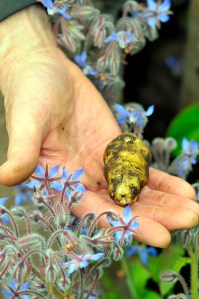
(Photo courtesy of Klas Stolpe/Juneau Empire) Bill Ehlers, assistant gardener at the Jensen-Olson Arboretum in Juneau, holds a Tlingít potato next to some borage plant flowers.

There was an interesting article in Wednesday’s edition of the Juneau Empire about the revival of a Tlingít potato that was a staple in Tlingít gardens for hundreds of years (Click here to read the Juneau Empire article by Kimberly Marquis).

Tlingít and Haida gardeners grew their own vegetables more than 200 years ago, and potatoes were one of their most important crops. In an article in the Winter 2008/2009 newsletter for Alaska EPSCoR (Experimental Program to Stimulate Competitive Research), University of Alaska Southeast social science/anthropology student Elizabeth Kunibe said residents of many Southeast Alaska villages planted gardens of root vegetables — such as potatoes, rutabagas and parsnips — on neighboring islands in the spring while they headed to their fish camps. They harvested them when they returned home in the fall (Click here to read the article on Pages 4-5).

Kunibe said many of these gardens disappeared over the past century, especially as the U.S. Forest Service parceled out some islands for homesteads or fox farms. She said Tlingíts in Sitka lost their island gardens in World War II when the government forbade private water travel. The increasing availability of imported food and other disruptions, such as tuberculosis outbreaks, also sped up the demise of the individual and community gardens found in many Native villages. Kunibe said in 1952 they grew 4,000 pounds of potatoes in Angoon, but the gardens disappeared and Angoon was without a garden until the last year or two when there was a movement to start a community garden.

The Tlingít potato is a fingerling potato with a yellowish skin and somewhat lumpy shape. They do not do well mashed or fried, but taste great in soups or roasted, said Merrill Jensen, manager of the Jensen-Olson Arboretum in Juneau where they expect to harvest about 1,500 pounds of the potatoes next month. The Tlingít potato also is known as “Maria’s Potato” in honor of the late Maria (Ackerman) Miller, the Haines woman who in 1994 gave Juneau’s Richard and Nora Dauenhauer their first seed potatoes. Miller, who died in 1995, told the Dauenhauers the potatoes had been in her family for more than 100 years.

According to Kunibe, who sent samples to a plant geneticist for DNA testing, the Tlingít potato is a distinct variety among potatoes, but they are very similar to two other varieties of Native American potatoes — the Ozette or Makah potato from Washington State’s Olympic Peninsula and the Haida potato from Kasaan on Alaska’s Prince of Wales Island. In a June 7, 2007, article in the Chilkat Valley News (click here to read it), Kunibe said potatoes arrived in Southeast Alaska aboard Spanish ships as early as 1765. She said the three Native American varieties are closely related to potatoes grown in Mexico and the Chilean coastal areas. (Most modern domestic potatoes are descended from species native to the Peruvian Andes.) The Tlingít potato grows well in our rainy climate and keeps a long time in a root cellar. Kunibe said the potatoes became a prime Southeast Alaska commerce item in the early 1800s and the Russian fleets contracted with the Tlingít and Haida tribes to grow them.

Bob Gorman, a master gardener who works with the Sitka office of the University of Alaska Fairbanks Cooperative Extension Service, said off the top of his head he didn’t know of anybody growing the potato in Sitka right now, though he did suggest several longtime gardeners who might know if people grew them in the past. Maybelle Filler, a master gardener who works with the SEARHC Diabetes Program, said they are looking to bring some seed potatoes to give to Sitka gardeners, but she had been told the potatoes can’t be sold at local markets (though they can be given away).
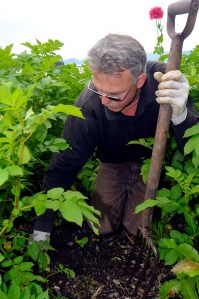
(Photo courtesy of Klas Stolpe/Juneau Empire) Bill Ehlers, assistant gardener of the Jensen-Olson Arboretum in Juneau, tends to a Tlingít potato plant on July 27, 2009. The potatoes will be used as seed stock to be distrbuted to people interested in growing the variety.

• Local foods articles in Capital City Weekly and Fairbanks Daily News-Miner

This week’s issue of Capital City Weekly, a free weekly newspaper distributed throughout Southeast Alaska, included four local food-related stories. The Fairbanks Daily News-Miner, a daily paper in Fairbanks, also has had a couple of local food-oriented stories the past couple of days. Here are some links to the articles.

Click here to read a Capital City Weekly article on a new community garden being built behind the Glory Hole homeless shelter in downtown Juneau.

Click here to read a Capital City Weekly article on the Montessori Borealis Adolescent Program’s vegetable garden project in Juneau’s Mendenhall Valley.

Click here to read a story about a couple of upcoming University of Alaska Fairbanks Cooperative Extension Service classes this weekend in Juneau about how to market specialty food products (geared toward people selling at farmers markets).

Click here to read a Capital City Weekly article on home canning of crab and geoducks by Sonja Koukel of the Juneau office of the UAF Cooperative Extension Service.

Click here to read a Fairbanks Daily News-Miner story from Wednesday’s paper from Roxie Rodgers Dinstel of the Fairbanks office of the UAF Cooperative Extension Service about how fireweed (which grows wild in Sitka) can add a subtle flavor to different meals.

Click here to read a Fairbanks Daily News-Miner story from Tuesday’s paper about how Fairbanks students are turning their schoolyards into blooming gardens as part of the EATING (Engaging Alaska Teens IN Gardening) program run by the Calypso Farm and Ecology Center. Click here to read more about the EATING program on the Calypso Farm site.

• Juneau Empire article gives uses for wild berries

Salmonberries await picking near the entrance to Sitka National Historical Park

Salmonberries await picking near the entrance to Sitka National Historical Park

This definitely has been a great years for berries in Southeast Alaska. There have been bumper crops of salmonberries and the blueberries are just starting to come in. Other types of berries also have done well, and I’ve got a friend who’s given away several Zip-Loc bags full of strawberries from her garden.

So now that you’ve picked all these berries, how do you use them? Earlier this week we had a post to a link about home canning, which had information about making jams and jellies and info about freezing the berries.

Sunday’s Juneau Empire has an article about how to use your berry booty to make two fun desserts. The article is written by Ginny Mahar, a chef who works for Rainbow Foods and also writes a blog full of recipes for locally grown food. Also, there’s a new book on Alaska’s Wild Berries from the UAF Cooperative Extension Service for sale at Old Harbor Books.

Click here to read the Juneau Empire article about using berries

Click here to read Ginny Mahar’s “Food-G” blog

• UAF Cooperative Extension Service offers online resources for home canners

Salmon ready for canning in jars (Photo courtesy of University of Alaska Fairbanks Cooperative Extension Service)

Salmon ready for canning in jars (Photo courtesy of University of Alaska Fairbanks Cooperative Extension Service)

Did you catch a lot of fish this summer and now you want to can some of them to eat this winter? Do you want to make salmonberry preserves with all those lush, ripe salmonberries you picked this week?

The University of Alaska Fairbanks Cooperative Extension Service recently launched a series of interactive online demonstrations called “Preserving Alaska’s Bounty.” Want to learn how to can salmon using jars? Click on the link and you are taken to a page with photos and short descriptions mixed in with video clips to show you how to can your fish. There is an introduction and sections on equipment, preparation, packing, canning, cooling and storage. There also are links to additional resources.

If you want to learn about making jams and jellies, there’s an online demonstration on that topic. There also are demonstrations about canner basics, acidity, canning fish using cans, canning wild meats in jars and in cans, and more. Jeff Fay from the UAF Cooperative Extension Service said there also are DVDs that cover some of the same topics, and more titles are expected to be added to the site in the next year or two.

If you do a little bit of surfing around the UAF Cooperative Extension Service’s Web site, you’ll find all kinds of how-to materials. There are materials on gardening, recipes, home construction, food safety, winterizing your house and other topics.

If you can’t find what you need on the UAF Cooperative Extension Service site, other state land grant universities have their own version of the Cooperative Extension Service and most of their materials are available for download off the Internet. One of the attachments below is to a handout from the Iowa State University Cooperative Extension Service about how to freeze a variety of fruits and vegetables to maintain freshness and nutritional value.

Click here to go to the “Preserving Alaska’s Bounty” page on the University of Alaska Fairbanks Cooperative Extension Service Web site

Click here to go to a catalog of available DVDs from the University of Alaska Fairbanks Cooperative Extension Service

Click here to go to the main page for the University of Alaska Fairbanks Cooperative Extension Service

Click here to open an Adobe Acrobat PDF file of a handout on freezing fruits and vegetables from the Iowa State University Cooperative Extension Service

A batch of fruit is ready to be canned in jars (Photo courtesy of the University of Alaska Fairbanks Cooperative Extension Service)

A batch of fruit is ready to be canned in jars (Photo courtesy of the University of Alaska Fairbanks Cooperative Extension Service)

• Nice article on blueberries in Fairbanks Daily News-Miner

It’s that time of year again, the blueberries are getting ready for picking.

The Fairbanks Daily News-Miner had a nice story on the arrival of blueberry season in Wednesday’s paper. The story includes four recipes from the University of Alaska Fairbanks Cooperative Extension Service.

Alaska has a deep and abiding love for its wild blueberries. Blueberries are on several lists of “super foods” because they have very high numbers of antioxidants, which help protect us from disease. Blueberries also have a high level of vitamin C. It’s easy to see why Alaska Natives have included blueberries in their diets for centuries.

Blueberries have all this, and they’re yummy, too.

Click here to read the Fairbanks Daily News-Miner article about the arrival of blueberry season

Click here to learn about the booklet “Collecting and Using Alaska Wild Berries and Other Wild Products,” which is available from the University of Alaska Fairbanks Cooperative Extension Service

• Healthy Wrangell Coalition hopes to build a community garden

Some of our neighbor communities also are looking for ways to get more local foods into their diets. Last week, KSTK-FM in Wrangell ran a story about the Healthy Wrangell Coalition’s goal of building a community garden in Wrangell. A couple of days later, there was a follow-up story about the project receiving a $5,000 start-up grant from the SEARHC Steps to a Healthier SE Alaska program.

Here’s wishing Wrangell well with the project. We can use more locally grown food in all Southeast Alaska communities.

By the way, Wrangell and Kake both recently launched new WISEFAMILIES Through Customary and Traditional Living health and wellness programs, which are modeled after a similar WISEFAMILIES program in Klukwan that’s been around for a couple of years. These programs feature culture camps where residents learn how to harvest and preserve traditional subsistence foods, learn Tlingít language, tell stories and learn other traditional activities such as carving and weaving. The more established program in Klukwan includes a community garden and a potato patch as part of its offerings, and Kake also is working on building a community garden. The three WISEFAMILIES programs are partnerships between the SEARHC WISEWOMAN Women’s Health Program and the local tribes in each community (Wrangell Cooperative Association, Organized Village of Kake and Chilkat Indian Village).

Click here to listen to the first KSTK-FM radio story about building a Wrangell community garden (note that link has streaming audio, so adjust your volume accordingly)

Click here to listen to the follow-up KSTK-FM radio story about the $5,000 start-up grant for the project (link also has streaming audio)

Click here to learn more about the Healthy Wrangell Coalition