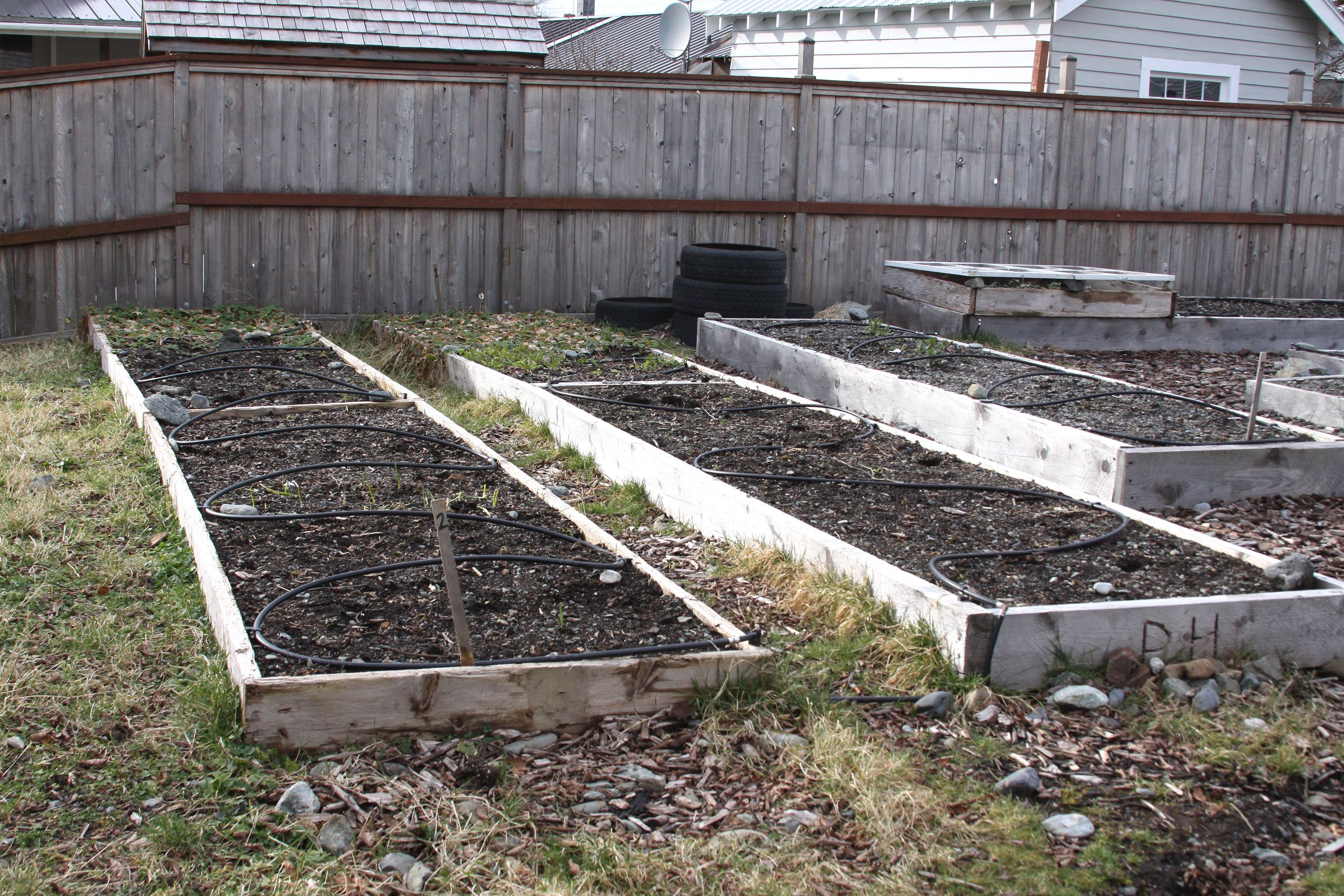
Two work parties are scheduled to prepare the St. Peter’s Fellowship Farm for planting later this spring. The work parties are from 1-3 p.m. this Saturday, April 17, and again from 2-4 p.m. on Saturday, May 1. St. Peter’s Fellowship Farm is located behind the See House behind St. Peter’s By The Sea Episcopal Church on Lincoln Street.
These work parties will focus on preparing the soil and getting the raised beds ready for spring planting. Tools and gloves will be provided. Food grown at the St. Peter’s Fellowship Farm communal garden is sold at the Sitka Farmers Markets, which start on July 17. For more information, contact Doug Osborne at 747-3752.
Planting parties at St. Peter’s Fellowship Farm take place from 2-4 p.m. on three straight Saturdays in mid-May — May 15, 22 and 29 — after the last frost. For more information on the planting parties, contact Lisa Sadleir-Hart at 747-5985 or 3akharts@acsalaska.net.
Also, a work party is scheduled for 12:30-3 p.m. on Saturday, April 24, at Seaview Gardens, a garden at 3509 Halibut Point Road owned by Sitka Local Foods Network secretary/treasurer Linda Wilson that also provides produce sold at the Sitka Farmers Markets. This work party will start off with homemade pizza, then volunteers will help Linda prepare new garden beds for planting so we have more produce to sell at the Sitka Farmers Markets. For more information on this work party, contact Linda at 747-3096 (evenings and weekends only) or send her an e-mail at lawilson87@hotmail.com.
Barren garden beds wait to be prepared for planting at St. Peter's Fellowship Farm
Click here to read the current Sitka Local Foods Network e-newsletter courtesy of Linda Wilson. Don’t forget, you can sign up for the e-newsletter by typing your e-mail address in the “Join Our Mailing List” box on bottom of the left side of the page.
This issue of the e-newsletter includes information about April being National Garden Month, about local garden work parties for gardens that help supply the Sitka Farmers Market with vegetables, growing apple trees in Sitka and growing rhubarb.
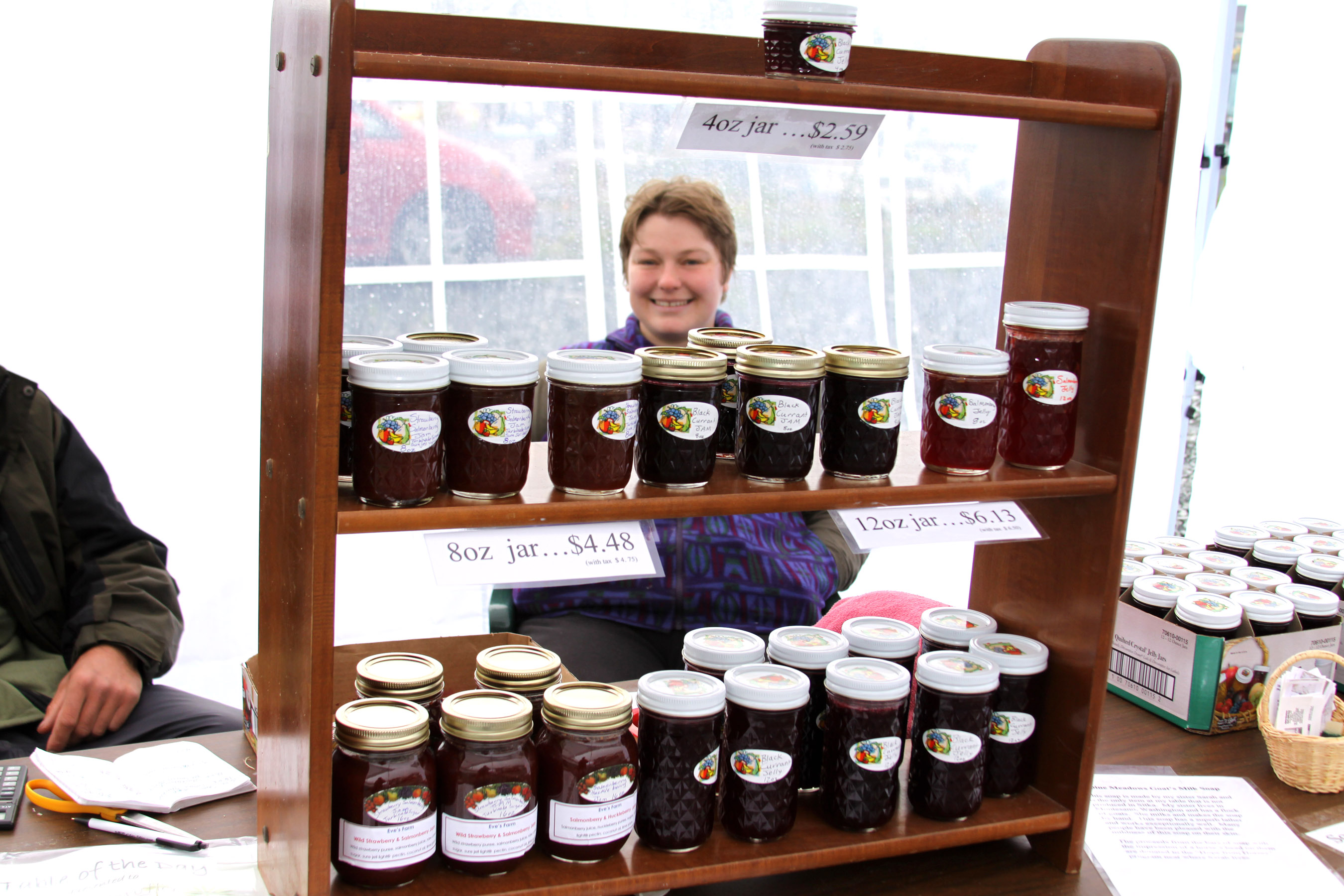
Local gardener Evening Star Grutter of Eve's Farm, shown here with some of her homemade jams during the Aug. 29, 2009, Sitka Farmers Market, will be the guest speaker at April's meeting of the Sitka Gardeners Club
The Sitka Gardeners Club’s monthly get-together takes place from 7-8:30 p.m. on Tuesday, April 20, in Room 106 at the University of Alaska Southeast-Sitka Campus on Japonski Island.
The get-together provides a venue for gardeners of all types, interests and skills to informally exchange ideas, information, seeds and growing tips. Share and learn from other gardeners with no dues or commitments other than good fellowship.
Sitka gardeners plan to meet on the third Tuesday of the month at the UAS-Sitka Campus. This month’s meeting will feature gardening tips from Evening Star Grutter of Eve’s Farm, and it is sponsored by UAS-Sitka Campus and the University of Alaska Fairbanks Cooperative Extension Service. For more information, call Cheryl Stromme at 747-9473 or Bob Gorman at 747-9413.
The next meeting of the Sitka Seafood Festival steering committee is 10 a.m. on Saturday, April 17, at Harrigan Centennial Hall.
During the April 10 meeting, the committee voted Lily Herwald in as secretary and Phyllis Hackett as bookkeeper. The committee also decided to book “NANDA: Acrobaticalist Ninja Action Heroes,” a four-man juggling, acrobatic, martial arts and comedy troupe that is performing at the Southeast Alaska State Fair on July 29-Aug. 1 in Haines, the weekend before the Sitka Seafood Festival (Aug. 6-7). A headline music group also is being booked.
Committee members will be canvassing local businesses for donations to cover the costs of hosting the inaugural Sitka Seafood Festival, and the deadline for donations is May 9 (Mother’s Day). A donation/sponsorship letter has been approved and committee members soon will distribute it to local businesses. Donations will be accepted after May 9, but that’s the deadline to be included in the event promotional materials, which uses a tier system based on the amount of the donation. Donation/sponsorship checks need to be written to the “Sitka Conservation Society” with a memo of “Sitka Seafood Festival” or “SCS/SSF” (the Sitka Conservation Society is letting us share their 501(c)(3) permit until we can get our own next year).
Also, committee members are seeking prizes for a raffle and raffle prize commitments are needed by Wednesday, April 14, to either Alicia Peavey (alaska_al33@hotmail.com or 1-928-607-4845) or Linda Olson (747-6985 or Baranof Elementary School). The raffle will feature 800 tickets at $5 each, with the drawing to take place on May 9 (Mother’s Day). Donations of merchandise, including locally caught seafood or gourmet meals of Sitka seafood, are greatly appreciated.
During the April 5 meeting, the steering committee decided to hold the inaugural Sitka Seafood Festival on Friday and Saturday, Aug. 6-7. The tentative plan is to have an opening dinner on Friday night with a guest chef and the possibility of live music. The main events will be on Saturday, with vendors set up all day, contests, a parade, cooking demos, music and educational activities. The headliner music guest will play a concert/dance on Saturday night.
To learn more about the Sitka Seafood Festival or to volunteer to help on one of the committees, e-mail sitkaseafoodfestival@gmail.com. You also can contact Alicia Peavey at alaska_al33@hotmail.com or 1-928-607-4845.
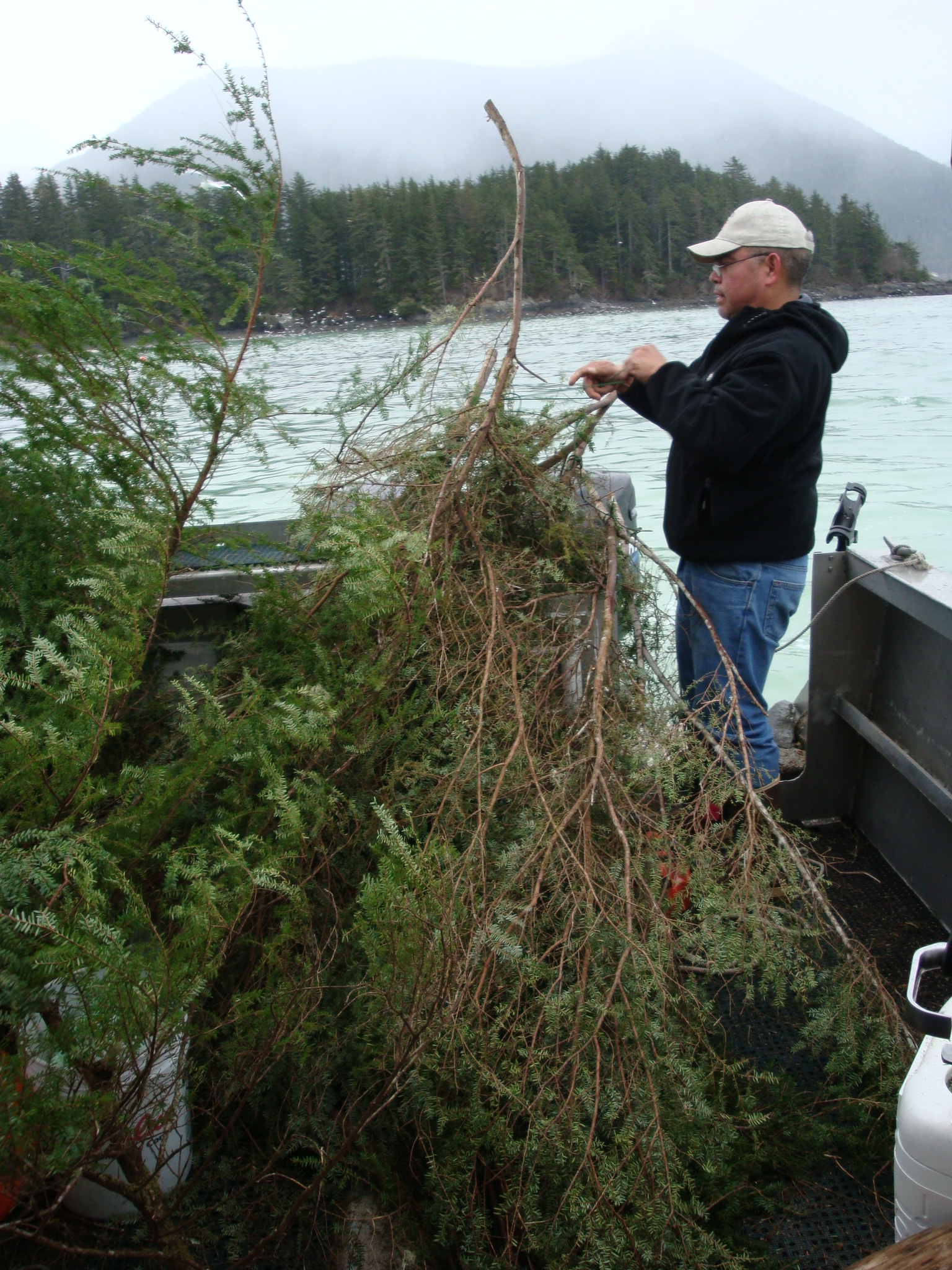
Michael Baines prepares hemlock trees and branches before they are placed in the water to catch herring spawn (Photo taken by Ed Ronco of KCAW-Raven Radio)
If it’s snowing in April, it probably means it’s time for the subsistence herring egg harvest in Sitka. This is one of the most important signs of spring in Sitka, especially for the Tlingít, Haida and Tsimshian people who lived in Southeast Alaska long before the first Europeans showed up.
On the KCAW-Raven Radio news Tuesday, KCAW reporter Ed Ronco reported on a trip he took with Sitka Tribe of Alaska Vice Chairman Michael Baines and his sister, Betty Baines, to place hemlock trees and branches into Sitka Sound, near Kasiana Island, to collect the herring spawn. The story link includes an audio postcard, where Michael Baines discusses the herring roe’s importance to the Native culture, and a few photos of the hemlock branches and trees being prepared. The herring eggs will collect on the branches, which will be pulled from the water a few days later, hopefully with a thick mass of roe. (Editor’s note: On Friday there was a follow-up story featuring the fishing vessel Julia Kae, skippered by Steve Demmert, which has been distributing herring eggs to local residents of Sitka and surrounding communities.)
The herring harvest is an amazing time in Sitka, because it seems like every species comes to town for the herring. There are more whales, eagles, sea gulls, sea lions, etc., around town, and even halibut and salmon are looking for meals of herring eggs. Pauline Duncan produced this Tlingít curriculum about herring geared toward younger students for the Alaska Native Knowledge Network. The blog Kiksadi News by Heen Kweix’ (Bob Gamble) tells how subsistence herring eggs are harvested and prepared (scroll down to the second item).
There also is a large commercial harvest of herring just before the subsistence herring roe harvest. The commercial harvest this year had a record guideline harvest of 18,293 tons, and finished just 550 tons short of that goal. The growing commercial harvest has put a lot of pressure on the relatively small subsistence harvest, in 2005 only 72,000 pounds (not tons) were taken out of a target range of 105,000 to 158,000 pounds. Sitka Tribe of Alaska regularly submits proposals to the Alaska Department of Fish and Game (which manages both the commercial and subsistence fisheries) to increase the subsistence harvest, but the proposals have not been passed. The subsistence herring eggs are used not just in Sitka, but all over the state and they are a popular trading subsistence food (for example, a Tlingít in Sitka might swap herring eggs with an Iñupiat for caribou meat from the Kotzebue area, since caribou is an item not found in Southeast Alaska).
Sockeye salmon hang in a smoker in preparation for the 2009 ANSWER Camp program
The next meeting of the Sitka Seafood Festival steering committee is 11 a.m. on Saturday, April 10, at the Bayview Wine Bar (on the second floor of the Bayview Building on Lincoln Street).
During the April 5 meeting, the steering committee decided to hold the inaugural Sitka Seafood Festival on Friday and Saturday, Aug. 6-7. The tentative plan is to have an opening dinner on Friday night with a guest chef and the possibility of live music. The main events will be on Saturday, with vendors set up all day, contests, a parade, cooking demos, music and educational activities. The headliner music guest will play a concert/dance on Saturday night.
To learn more about the Sitka Seafood Festival or to volunteer to help on one of the committees, e-mail sitkaseafoodfestival@gmail.com. You also can contact Alicia Peavey at alaska_al33@hotmail.com or 1-928-607-4845.
Grillmaster Rick DeGroot checks salmon fillets barbecuing for a 2007 prostate cancer awareness event in Sitka
The Sitka Seafood Festival steering committee will meet at 7:30 p.m. tonight (Monday, April 5) at Harrigan Centennial Hall. The meeting times have been moving around in recent weeks as they try to find a time that can get local restaurant people involved.
Tonight’s meeting will finalize a sponsorship letter for fundraising, discuss a raffle fundraiser, discuss work committees and duties, discuss budget for music and possible guest chefs, etc.
At the last meeting on April 1, the group finalized the mission statement, “The Sitka Seafood Festival’s mission is to celebrate wild Alaska seafood.” The steering committee also decided that this year’s inaugural event will focus on culinary experience, entertainment (music) and education.
To learn more about the Sitka Seafood Festival or to volunteer to help on one of the committees, e-mail sitkaseafoodfestival@gmail.com. You also can contact Alicia Peavey at alaska_al33@hotmail.com or 1-928-607-4845.
As you start to plan your garden for this spring and summer, don’t forget to Plant A Row For The Hungry. The Plant A Row For The Hungry program (also known as Plant A Row or PAR) is a national campaign by the Garden Writers Association of America that got its start in Alaska.
In the cold winter of 1994, Anchorage Daily News garden columnist and former Garden Writers Association of America President Jeff Lowenfels was returning to his hotel after a Washington, D.C., event when he was approached by a homeless person who asked for some money to buy food. Lowenfels said Washington, D.C., had signs saying, “Don’t give money to panhandlers,” so he shook his head and kept on walking. But the man’s reply, “I really am homeless and I really am hungry. You can come with me and watch me eat,” stayed with Lowenfels for the rest of his trip.
Jeff Lowenfels
The encounter continued to bother Lowenfels, even as he was flying back to Anchorage. During the flight, Lowenfels came up with an idea when he started writing his weekly garden column (the longest continuously running garden column in the country, with no missed weeks since it started on Nov. 13, 1976). He asked his readers to plant one extra row in their gardens to grow food to donate to Bean’s Café, an Anchorage soup kitchen. The idea took off.
When Anchorage hosted the Garden Writers Association of America convention in 1995, Lowenfels took the GWAA members to Bean’s Café to learn about the Plant A Row For Bean’s Café program. The Garden Writers Association of America liked the idea, and it became the national Plant A Row For The Hungry campaign. In 2002, the Garden Writers Association Foundation was created as a national 501(c)(3) nonprofit to manage the Plant A Row For The Hungry program.
“I am not surprised by the growth of PAR,” Lowenfels wrote in an e-mail to the Sitka Local Foods Network. “It is now in all 50 states and across Canada and there are thousands of variations of the original program — from prison gardens for the hungry to botanical gardens donating their produce from public display gardens. This is because gardeners always share information and extra food, so the idea was a natural.”
It took five years for the program to reach its first million pounds of donated food, but the second million only took two years and the next eight years saw a million pounds of donated food (or more) each year. Since 1995, more than 14 million pounds of food have been donated. Not only that, the program is getting ready to expand overseas to Australia, England and other countries with avid gardeners.
“We have supplied something in the vicinity of enough food for 50 million meals,” Lowenfels wrote in his e-mail. “Gardeners can solve this hunger problem without the government. And we don’t need a tea party to do it! Or chemicals, I might add, as author of a book on organic gardening (Teaming With Microbes, written with Wayne Lewis)!”
According to the U.S. Department of Agriculture, one out of every eight U.S. households experiences hunger or the risk of hunger. Many people skip meals or eat too little, sometimes going an entire day or more without food. About 33 million Americans, including 13 million children, have substandard diets or must resort to seeking emergency food because they can’t always afford to buy the food they need. In recent years the demand for hunger assistance has increased 70 percent, and research shows that hundreds of children and adults are turned away from food banks each year because of lack of resources.
While many people credit Lowenfels for creating the Plant A Row For The Hungry program, Lowenfels says the real heroes are the gardeners growing the extra food and donating it to local soup kitchens, senior programs, schools, homeless shelters and neighbors. You can hear him pass along the credit to all gardeners at the end of this interview last year with an Oklahoma television station (video also embedded below).
“One row. That’s all it takes. No rules other than the food goes to the hungry. You pick the drop-off spot or just give it to a needy friend or neighbor. Nothing slips between the lip and the cup, I say,” Lowenfels wrote in his e-mail.
For people wanting to Plant A Row For The Hungry in Sitka, there are several places that would love to help distribute some fresh locally grown veggies or berries to those who are less fortunate, such as the Salvation Army (note, the current officers are Capts. Kevin and Tina Bottjen), Sitkans Against Family Violence (SAFV), local churches, Sitka Tribe of Alaska and other organizations. The food the Sitka Local Foods Network grows at St. Peter’s Fellowship Farm communal garden goes to the Sitka Farmers Market, where people who are in the WIC (Women, Infants, Children)supplemental food program can use special farmers market vouchers to buy fresh vegetables.
The Sitka Local Foods Network also takes donations of local produce to sell at the Sitka Farmers Markets, and all proceeds from the Sitka Farmers Markets are used to help pay for Sitka Local Foods Network projects geared toward helping more people in Sitka grow and harvest local food. For more information, contact Sitka Farmers Market coordinators Linda Wilson (lawilson87@hotmail.com) or Kerry MacLane (maclanekerry@yahoo.com).







 Sitka Local Foods Network
You must be logged in to post a comment.