• Sitka Local Foods Network to host annual meeting and potluck on Saturday, Jan. 24

DisplayBasketOfCrops

The Sitka Local Foods Network will host its annual meeting and potluck dinner from 5:30-7:30 p.m. on Saturday, Jan. 24, at the Sitka Unitarian Universalist Fellowship Hall (408 Marine St., parking off of Spruce Street).

Participants are encouraged to bring a dish featuring local foods to share, and please bring your own utensils (note, this is a non-alcoholic event). This event is a good event to attend for people who want to learn more about the Sitka Local Foods Network and what we do around town.

“Attendees will hear about project updates, plus the current board will vote on by-law changes,” Sitka Local Foods Network Board President Lisa Sadleir-Hart said. “We will introduce our new board members for 2015, and we will elect officers.”

Individuals interested in learning more about the Sitka Local Foods Network can email sitkalocalfoodsnetwork@gmail.com to learn about our projects and volunteer opportunities. For more information, call Lisa at 747-5985.

• Check out the January 2015 edition of the Sitka Local Foods Network newsletter

SLFNJanuary2015NewsletterScreenshot

The Sitka Local Foods Network just sent out the January 2015 edition of its newly launched monthly newsletter. Feel free to click this link to get a copy.

This edition of the newsletter has brief stories about the 2015 Pick.Click.Give. fundraising campaign, some winter garden classes, and our upcoming annual meeting and potluck dinner on Jan. 24. Each story has links to our website for more information.

You can sign up for future editions of our newsletter by clicking on the registration form image in the right column of our website and filling in the information. If you received a copy but didn’t want one, there is a link at the bottom of the newsletter so you can unsubscribe. Our intention is to get the word out about upcoming events and not to spam people. We will not share our email list with others to protect your privacy.

• UAF Cooperative Extension Service to offer statewide online Alaska Master Gardener class

master_gardener

Are you interested in earning an Alaska Master Gardener certification? The University of Alaska Fairbanks Cooperative Extension Service is offering a statewide spring online Master Gardener class from Feb. 17 through May 18.

The Alaska Master Gardener online course is an intensive, sustainable gardening class specific to Alaska growing conditions. This is a non-credit, self-paced, online course offered through UAF eLearning using Blackboard Learn. The course fee is $375. Register here for the Spring 2015 Alaska Master Gardener online course (Course Number: CEPD F001-UX1).

This curriculum for this online course includes lessons on botany, starting plants, soil, composting, season extension, greenhouses, landscaping, house plants, entomology, pest management, plant disease diagnostics and sustainable gardening. The course also covers growing vegetables, fruits, berries and flowers. The text for the course is Sustainable Gardening: Alaska Master Gardener Manual, which can be purchased for $50 a copy from this link.

Students complete 12 self-paced lessons and quizzes, a book report, participate in ongoing discussions, and complete a final exam. On average, the course takes students approximately three hours per week to complete. The course is pass/fail and the spring course is not for credit.

In addition to the coursework, students also pledge to volunteer at least 40 hours teaching what they’ve learned in their communities. Examples of how students can volunteer include helping with local school garden programs or 4H clubs, working with local foods groups, writing gardening blogs, and more.

The classroom-based Alaska Master Gardener course hasn’t been offered in Sitka for nearly two years, so the statewide online course is the only way Sitka gardeners can obtain the training until a new Cooperative Extension Service agent is hired in Sitka. Gardeners from Sitka can contact Jasmine Shaw at the Sitka District Office of the UAF Cooperative Extension Service (jdshaw2@alaska.edu or 747-9440) to see if there will be a local classroom at the University of Alaska Southeast Sitka Campus for the online course.

For more information about the statewide online Alaska Master Gardener course, contact instructor Heidi Rader or teaching assistant Glenna Gannon in Fairbanks at 907-452-8251, Ext. 3281, or by email at master.gardener@alaska.edu

• Sitka Local Foods Network to launch monthly newsletter to help keep people updated on our activities

EmailListScreenGrab

At the Sitka Local Foods Network, we know people are busy and they don’t have time to check our website or Facebook page every day to see what’s happening. So we will be launching a monthly newsletter to give folks another way to stay up to date.

The monthly newsletter will feature some brief updates on the top stories from our website, along with information about upcoming classes, the Sitka Farmers Market, St. Peter’s Fellowship Farm garden parties, garden advice, volunteer opportunities, and more. There also will be information about local foods programs offered by other groups, such as classes from the University of Alaska Fairbanks Cooperative Extension Service or events from the Sitka Seafood Festival, that Sitkans might find interesting. We’ll try to keep things fairly short, with links in the newsletter to the longer stories on our website for those who want more info.

You can sign up for the newsletter by clicking this link and following the prompts on the sign-up form (you also can click on the newsletter image in the right column of our website to register). You should receive an email asking you to confirm your subscription, which will open a link where you can let us know more about your interests. To keep from flooding your email account, we will try to limit the newsletters to just once a month (unless there’s a major news item).

At the bottom of each newsletter is a link that allows you to unsubscribe from the newsletter at any time. We don’t want to spam anybody. Also, we won’t share our email list with outside groups because we know you value your privacy.

Sign up soon, because the January 2015 newsletter will be sent out later this week.

• UAF Cooperative Extension Service to host class on starting and operating a specialty food business

Specialty Foods Workshop Feb. 2015

SpecialtyFoodBusinessHave you ever wanted to sell your homemade breads, jams and jellies, syrups, smoked salmon, or other specialty food product? Sitka will be one of the host locations this February for a five-session distance-delivery class on starting and operating a specialty food business.

The class, which is hosted by the University of Alaska Fairbanks Cooperative Extension Service, takes place from 5:30-8 p.m. on Tuesdays and Thursdays, Feb. 3, 5, 10, 12, and 17, at the University of Alaska Southeast Sitka Campus, Room 110. Besides Sitka, the class also will be available by videoconference in Anchorage, Fairbanks, and Kodiak. There is a class fee of $50.

Students will learn about business plans and marketing, financing and accounting, permitting and feasibility assessments, promoting and pricing your products, and ways to enter the market, such as farmers markets, food trucks, wholesaling, and supermarkets. The instructors are seafood marketing specialist Quentin S.W. Fong of the Alaska Marine Advisory Program, and Kate Idzorek of the UAF Cooperative Extension Service, plus several special guests.

To learn more about the class and to register, click this link or contact Kate Idzorek at (907) 474-5391 or the UAF Cooperative Extension Service at (877) 520-5211.

• Sitka Tribe of Alaska hosts regional training on paralytic shellfish poisoning and other marine biotoxins

DSCN4202 2

Shellfish lovers in Southeast Alaska have a lot to be thankful for this year, as the Sitka Tribe of Alaska hosted a regional training on how to detect paralytic shellfish poisoning and other marine biotoxins Nov. 20-21 in Sitka.

This workshop brought to town several technicians from seven different regional tribes for the first training since the Southeast Alaska Tribal Toxins (SEATT) partnership to study harmful algal blooms (HABs) was announced in October. SEATT partners include Sitka Tribe of Alaska, the Klawock Cooperative Association, Craig Tribal Association, Yakutat Tlingít Tribe, Petersburg Indian Association, Organized Village of Kasaan, and the Central Council of Tlingít and Haida Indian Tribes of Alaska (CCTHITA). In addition to the grant to create the partnership, Sitka Tribe of Alaska also received a second grant to create a regional lab in Sitka to help monitor HABs in Southeast Alaska.

Harmful algal blooms, such as paralytic shellfish poisoning (PSP), typically have not been monitored in Southeast Alaska for subsistence and recreational harvesters of clams, mussels, oysters, cockles, and other bivalves (commercial harvests are tested). Even though many people in Southeast Alaska love to harvest shellfish, eating it comes with some risks. There have been several PSP outbreaks in recent years that sent people to the hospital, and in 2010 two deaths were attributed to PSP and other HABs, such as Alexandrium, Pseudonitzchia and Dinophysis.

Being able to put trained monitors in several Southeast Alaska communities, the hope is the health risk can be reduced. Each technician will make weekly reports to the lab, which will help harvesters have better information as to the safety of their shellfish. To learn more about the training, check out this link from the Sitka Conservation Society website and this link from the National Oceanic and Atmospheric Administration (NOAA) Coastal Science website.

This slideshow requires JavaScript.

• Sitka Local Foods Network education committee to kick off 2015 with two beginning garden classes

GreensInHoopHouseStPeters

Do you want to garden in Sitka, but need to know the basics? The Sitka Local Foods Network education committee will kick off its 2015 schedule of classes with two free classes — Vegetable Gardening 101 and Choosing What Vegetables To Grow In Sitka.

Vegetable Gardening 101 is a beginner’s gardening class taught by Michelle Putz and Linda Wilson. The class is from 6:30-8:30 p.m. on Tuesday, Jan. 27, at Harrigan Centennial Hall. Participants will learn everything they need to start an easy-to-grow vegetable garden in Sitka.

Choosing What Vegetables To Grow In Sitka is a beginner’s class taught by Lisa Sadleir-Hart and Maybelle Filler. It takes place from 6:30-8:30 p.m. on Tuesday, Feb. 3, at Harrigan Centennial Hall. In this class, which is for new gardeners and new-to-Sitka gardeners, participants will learn which vegetables grow well in Sitka, and which vegetables can be a struggle.

These two classes will kick off a year-long series of education classes on a variety of topics related to vegetable gardening in Sitka. In addition, our garden mentor program classes also will be open to the public. For more information, contact Michelle Putz at 747-2708.

• Sitka Kitch, Sitka Conservation Society to host apple tree workshop on Nov. 18

AppleTreeWorkshop

Sitka Kitch, in conjunction with the Sitka Conservation Society, will host an apple tree workshop at 6 p.m. on Tuesday, Nov. 18, at Harrigan Centennial Hall.

Jud Kirkness will give us an introduction on the how-to’s of planting your own apple tree, and attendees will have the opportunity to place a tree order at the workshop. Let’s see if we can get 15 additional apple trees planted in Sitka.

This event is the final event of Applooza 2014, which also included the Sitka 4H club harvesting apples from local trees and making apple sauce for the Swan Lake Senior Center and Salvation Army. For more information, contact the Sitka Conservation Society at 747-7509.

• ‘Building Food Security in Alaska’ report released during Alaska Food Festival and Conference

14-09-17_building-food-security-in-ak_exec-summary-recommendations_Page_01

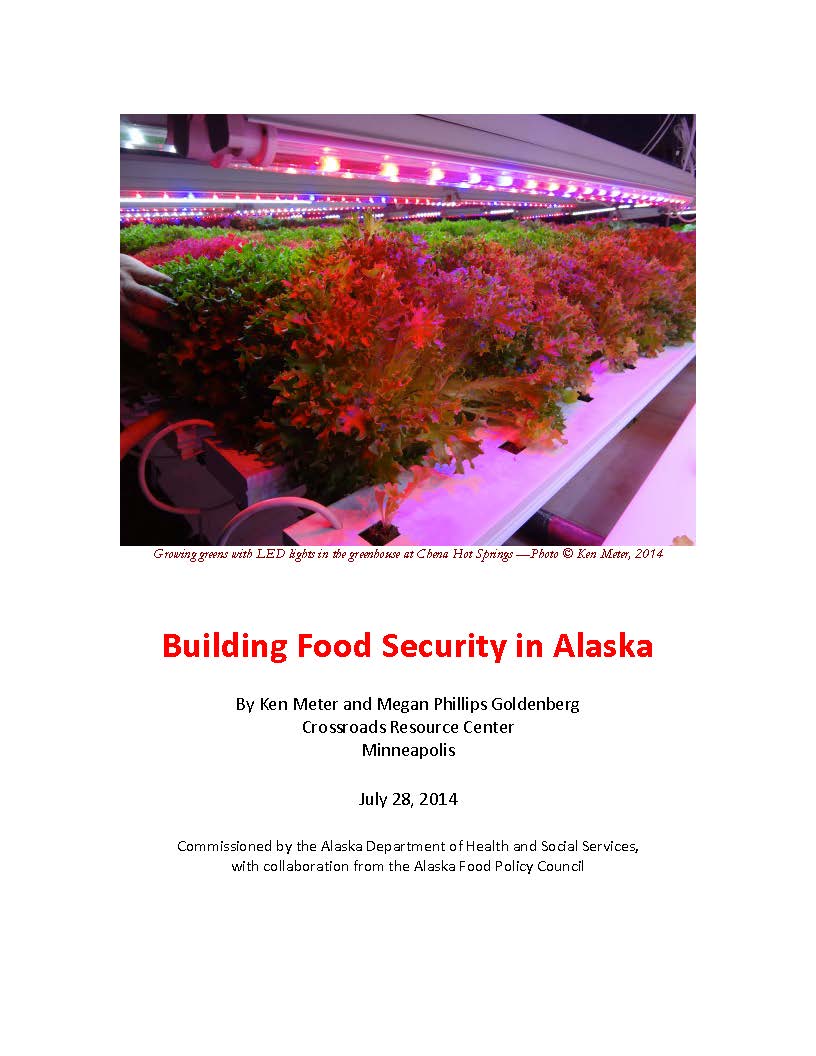
The release of a new report, “Building Food Security in Alaska,” was one of the highlights of the recent Alaska Food Festival and Conference (Nov. 7-9 at the University of Alaska Lucy Anchorage Cuddy Center). This is one of the first comprehensive statewide food security reports compiled for Alaska.

The report was written by Ken Meter and Megan Phillips Goldenberg of the Crossroads Resource Center in Minneapolis, which has done six in-depth statewide food assessments over the past five years and 14 statewide food assessments overall. The report was commissioned by the Alaska Department of Health and Social Services, with collaboration from the Alaska Food Policy Council.

The Crossroads Resource Center website provides this summary of the report:

Like most other states, Alaska imports about 95 percent of the food it purchases. Yet this state is more distant from prevailing food production regions than other states. Alaskans feel a special sense of vulnerability. Despite a rich history in dairy and cattle production, most of these foods are now imported. Much of the arable farmland has been paved over by development. Moreover, Alaskans who wish to purchase some of the $3 billion of seafood harvested from its ocean waters typically have no choice but to buy through Seattle vendors.

Still, farms produce a rich variety of crops and livestock. Direct sales from farmers to household consumers run at 13 times the national average, amounting to one of every six dollars farmers earn selling food to humans. Lettuce, peppers, and cucumbers are available year-round from indoor farms. Chickens are grown inside greenhouses that rely upon surplus heat from nearby buildings.

In no other state is harvesting wild foods as important. Subsistence and personal use hunters bring in an estimated $900 million worth of salmon, caribou, moose, foraged greens and berries, and other foods. Yet even here, hunters and gatherers face special challenges: a decline of hunting skills, weakening ice, changing migrations, and radioactive fallout.

Our study, written by Ken Meter and Megan Phillips Goldenberg, offers practical steps for building a more reliable food supply by growing, storing, and marketing more Alaska-grown food to Alaskans. Commissioned by the Alaska Department of Health and Social Services.

Copies of the full 180-page report and a shorter executive summary and recommendations are linked below. In addition, most of the presentations and panel discussions from the Alaska Food Festival and Conference can be found here. This link includes a keynote presentation by Sitka Local Foods Network Board President Lisa Sadleir-Hart about the experience of compiling the Sitka Community Food Assessment, plus Sitka residents Keith Nyitray of the Sitka Food Co-op and Gordon Blue of the Alaska Sustainable Fisheries Trust participated in panel discussions about food cooperatives and community-based fisheries, respectively.

In addition, earlier this year two locally focussed food assessments were released. Copies of the Sitka Community Food Assessment Indicators Report (released in April 2014) and the Southeast Alaska Food System Assessment (released in February 2014) can be found in the Documents section of our website.

• Building Food Security in Alaska, Executive Summary and Recommendations, by Ken Meter and Megan Phillips Goldenberg (released November 2014)

• Building Food Security in Alaska, by Ken Meter and Megan Phillips Goldenberg (released November 2014)

• Sitka Local Foods Network to host Harvest Fest Fundraiser on Thursday, Oct. 23

SLFNHarvestFestFundraiser2014Turnips2LowRez

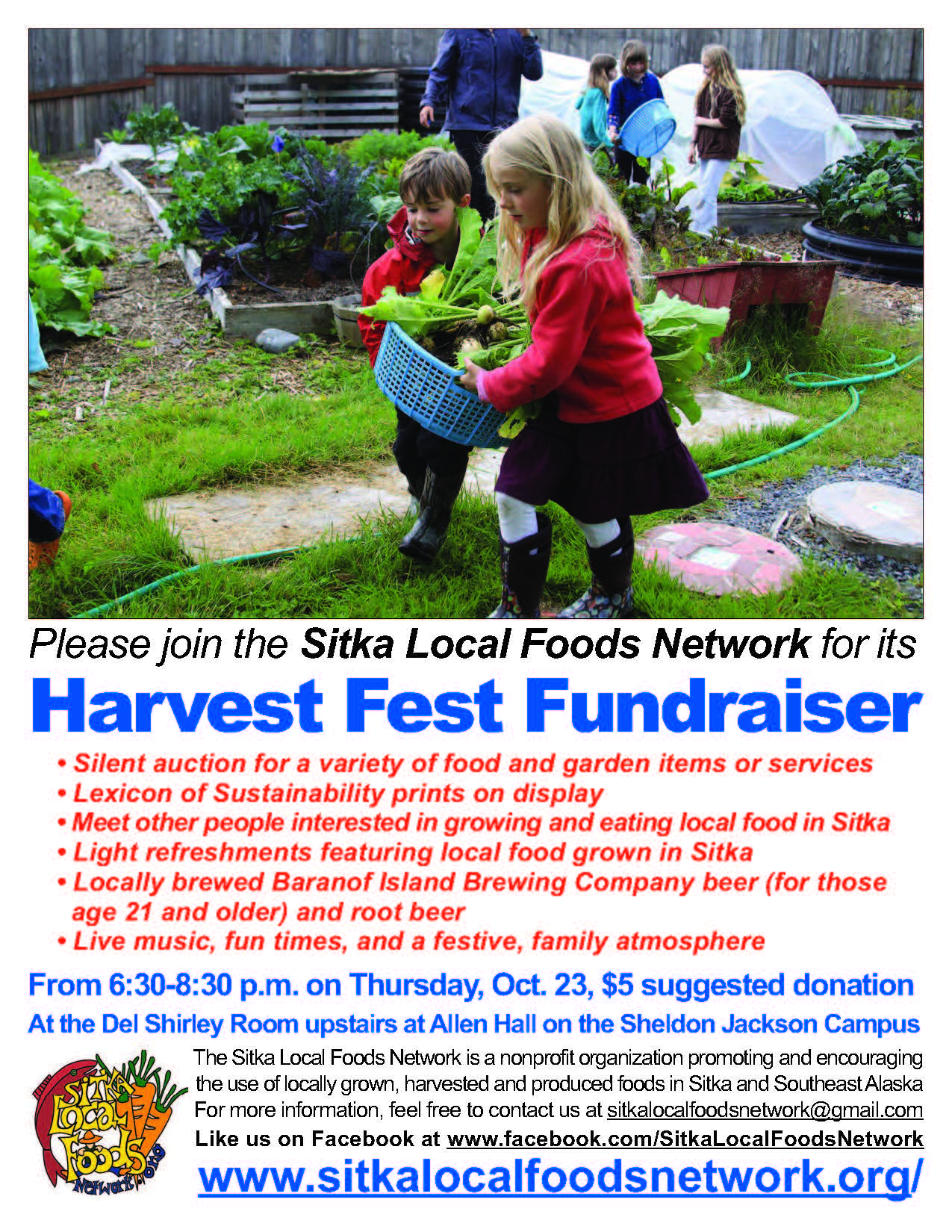
Help celebrate Food Day by joining the Sitka Local Foods Network as it hosts its inaugural Harvest Fest Fundraiser from 6:30-8:30 p.m. on Thursday, Oct. 23, at the Del Shirley Room upstairs in Allen Hall on the Sheldon Jackson Campus.

This event will feature a silent auction for a variety of local food- and garden-related items and services, including:

  • An apple tree and planting/pruning service,
  • Canning lessons,
  • 4-6 hours of work in your garden,
  • Flats of “Finn Island Farm” vegetable starts for 2015,
  • Customized local foods packages,
  • Chef services,
  • Wine-making supplies/materials/lesson,
  • Edible landscaping consultation,
  • Home-made desserts and other homegrown goodies,
  • Compost,
  • Alaska gardening books, and
  • A tour of and overnight stay at Finn Island Farm for 1-2 people, includes transportation, gourmet dinner and breakfast.

In addition, the Lexicon of Sustainability photos will be on display, we will give a short update on the state of local food in Sitka, there will be live music, light refreshments featuring local food will be served, and we will pour locally brewed beer (for those age 21 and older) and root beer from Baranof Island Brewing Company. This is a family oriented event, and there is a suggested donation of $5.

“The Sitka Local Foods Network board is excited to share the Lexicon of Sustainability photos again with the Sitka community in the context with our Harvest Fest Fundraiser,” said Lisa Sadleir-Hart, president of the Sitka Local Foods Network board of directors. “We’ve received a delicious array of donations from board members and friends for food-focused items and services for a silent auction, plus we will serve light refreshments focused on locally grown foods and hear about the state of Sitka’s foodscape. It’ll be a festive, informative event.”

The Sitka Local Foods Network is a nonprofit organization that promotes and encourages the use of locally grown, harvested and produced foods in Sitka and Southeast Alaska. Money raised at this fundraiser will support the Sitka Farmers Market, community gardens, a community greenhouse, sustainable uses of traditional subsistence foods and education for Sitka gardeners.

For more information, contact the Sitka Local Foods Network at sitkalocalfoodsnetwork@gmail.org.