• Sitka Local Foods Network gets mentions in Juneau Empire, Daily Sitka Sentinel, Capital City Weekly and on APRN’s Talk of Alaska show

The Sunday edition of the Juneau Empire and Monday edition of the Daily Sitka Sentinel (Page 4) both featured a press release about a Sitka Local Foods Network-hosted presentation about “Growing in Sitka and Southeast Alaska: The Food of Today, Tomorrow and 200 Years Ago” that takes place at 5 p.m. this Friday, Oct. 16, at the Kettleson Memorial Library. The presentation is by UAS anthropology student Elizabeth Kunibe of Juneau, who has spent the last six years researching traditional gardens in Southeast Alaska. The presentation also received a write-up in this week’s issue of Capital City Weekly that came out on Wednesday.

Monday’s issue of the Daily Sitka Sentinel also featured a press release about a put-the-garden-to-bed work party the Sitka Local Foods network is hosting from 10 a.m. to 1 p.m. on Saturday, Oct. 17, at the St. Peter’s Fellowship Farm.

On Tuesday, the Alaska Public Radio Network’s statewide call-in show “Talk of Alaska” was about food security and during the show the work of the Sitka Local Foods Network was mentioned. The Talk of Alaska topic on food security was a preview of the Bioneers In Alaska conference this weekend (Oct. 16-18) in Anchorage where food security will be one of the topics. Kerry MacLane, president of the Sitka Local Foods Network, is supposed to travel to Anchorage to participate in the conference.

In addition to the Sitka Local Foods Network mentions, there has been a lot of other local foods news around Alaska this week.

In Sunday’s Juneau Empire, Ginny Mahar (a chef at Rainbow Foods) wrote a column featuring a mac and cheese recipe with king crab. Ginny also writes the Food-G blog, which features a lot of local foods recipes for Southeast Alaska.

Also in Sunday’s Juneau Empire was an article about the Alaska Native Brotherhood/Alaska Native Sisterhood Grand Camp meeting in Juneau and discussion about subsistence fishing rights following the recent arrest of Sen. Albert Kookesh.

In this week’s Capital City Weekly, there is an article from Carla Peterson about the chocolate lily and how to prepare this edible plant for food.

In the Alaska Newsreader blog Wednesday on the Anchorage Daily News Web site was a link to a feature from TheDailyGreen.com, which listed Anchorage ninth among U.S. cities in per capita space given to community gardens. The list (opens as PDF document) was compiled by the Trust for Public Land, and it had a distinct Northwest feel with Seattle ranked No. 1 and Portland, Ore., was No. 2. Click here to learn more about Anchorage’s community gardens program.

In his Anchorage Daily News garden column last week, Jeff Lowenfels wrote about planting garlic now for spring flowers and an August crop.

The Mat-Su Frontiersman recently ran an article about a sustainability project at the University of Alaska Fairbanks Mat-Su College where students were gathering organic spuds.

Finally, while this isn’t about Alaska, you might want to read an article about efforts to preserve our biodiversity so we don’t lose more food plant varieties and why these efforts are important.
• Sitka Local Foods Network hosts historical gardening presentation on Friday, Oct. 16

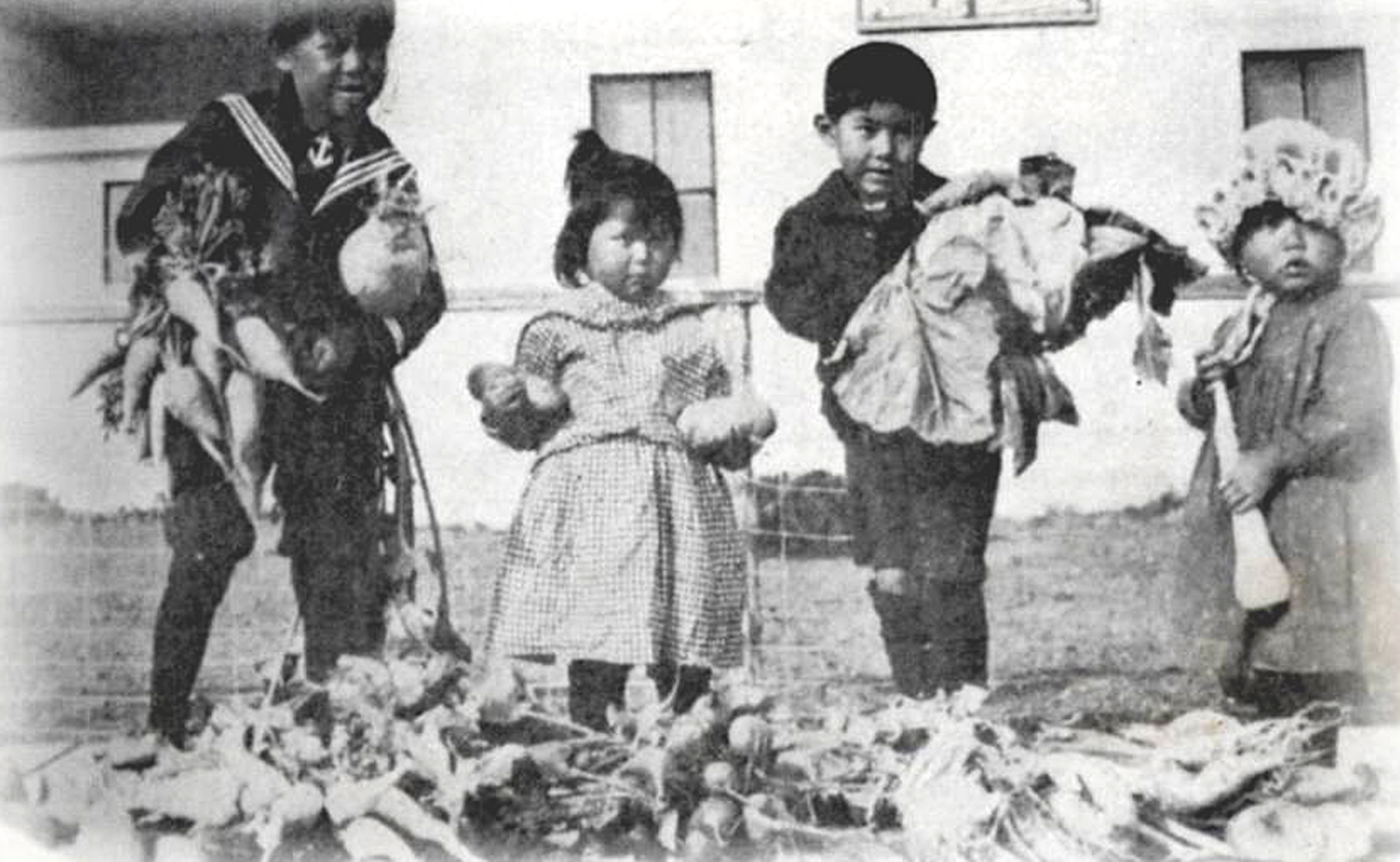
Children show off the bounty from the Klukwan School garden in 1911

Children show off the bounty from the Klukwan School garden in 1911

The Sitka Local Foods Network will host a brief historical gardening presentation by Elizabeth Kunibe, “Growing in Sitka and Southeast Alaska: Food of Today, Tomorrow and 200 Years Ago,” at 5 p.m. on Friday, Oct. 16, at the Kettleson Memorial Library. This event is free and open to all, and it should last about 45 minutes.

During her presentation, Kunibe will discuss early Tlingít gardens in Southeast Alaska, Russian gardens in Sitka in the 1800s, the first USDA Agricultural Experiment Station in Alaska comes to Sitka in 1898, an agricultural fair above the Arctic Circle in Fort Yukon, the importance of potatoes (a phytonutrient study), plant diseases and new ziplock bags made from fish gelatin. Her presentation includes a colorful slideshow that features historical information on gardening in Southeast Alaska, as well as information on what is happening in Alaska’s food systems today.

Kunibe is a University of Alaska Southeast anthropology student from Juneau who has spent the past six years researching early gardens of the Tlingít, Haida and Athabascan peoples in Alaska and the Yukon Territory. She is a 2008 and 2009 National Science Foundation EPSCoR (Experimental Program to Stimulate Competitive Research) Fellow researching food systems in Alaska.

For more information, contact Charles Bingham at 747-1065 or send e-mail to charles@sitkalocalfoodsnetwork.org/.

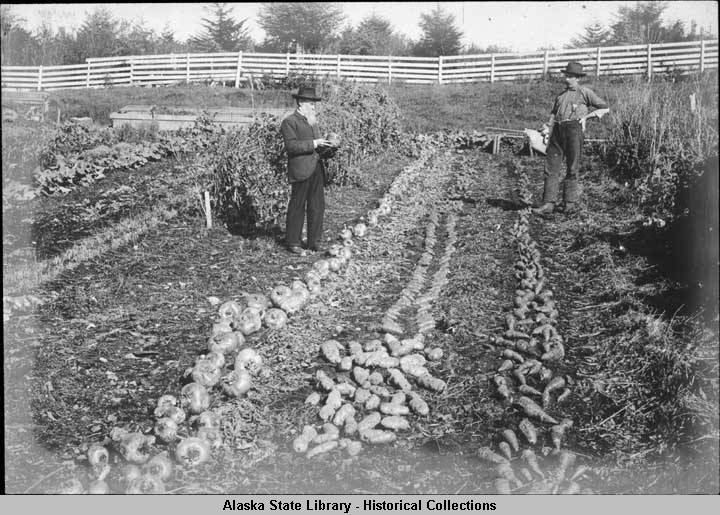
Gov. John G. Brady's garden in Sitka in 1900

Gov. John G. Brady's garden in Sitka in 1900

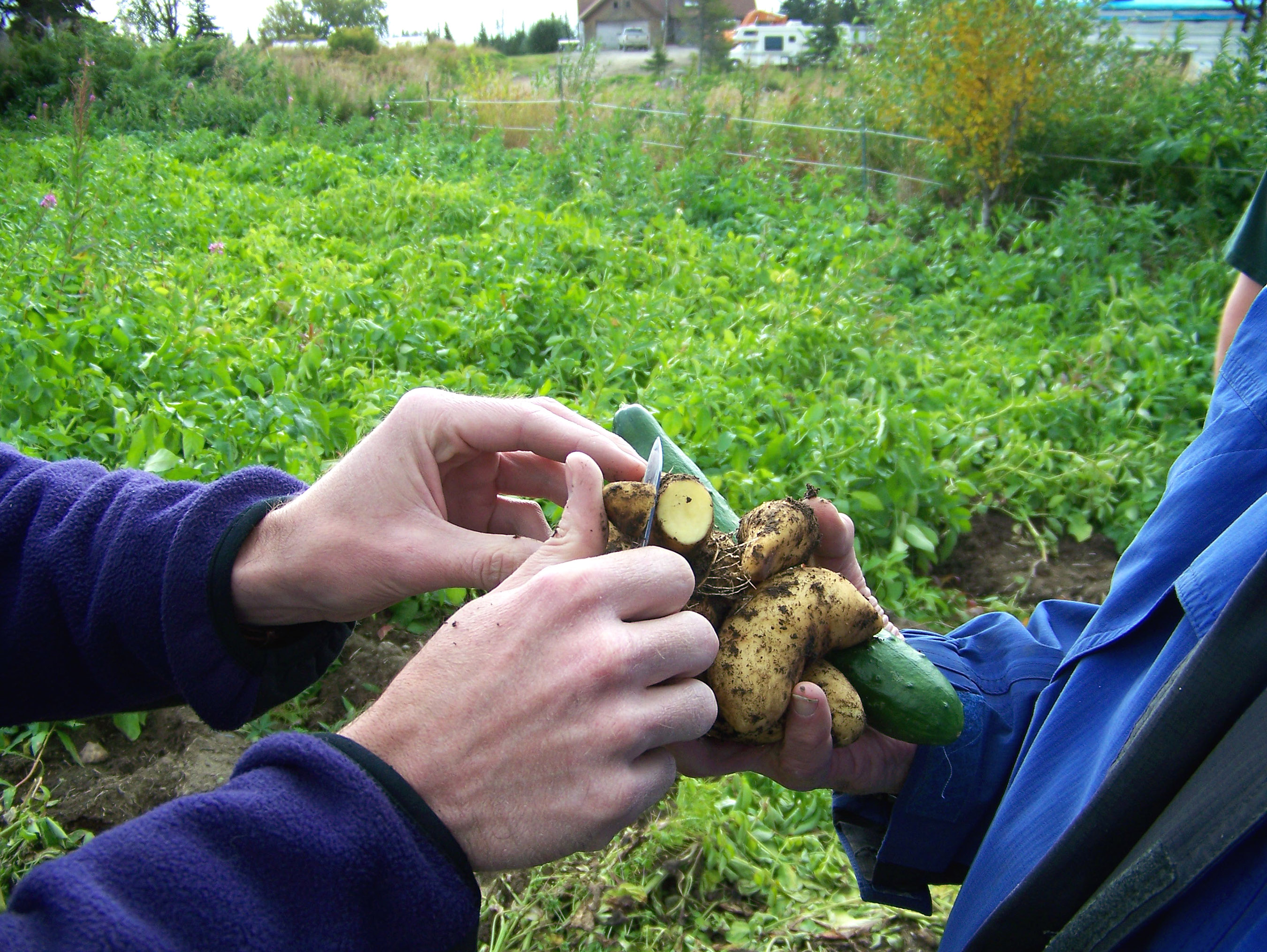
Plant geneticists Chuck Brown and Joe Kuhl of the USDA Agricultural Research Service, examine the flesh color of some potatoes being grown in Alaska. The color gives them clues to the nutrients the potatoes may contain.

Plant geneticists Chuck Brown and Joe Kuhl of the USDA Agricultural Research Service, examine the flesh color of some potatoes being grown in Alaska. The color gives them clues to the nutrients the potatoes may contain.

• Sitka Local Foods Network hosts garden work party on Oct. 17

The Sitka Local Foods Network will host a “putting the garden to rest” work party from 10 a.m. to 1 p.m. on Saturday, Oct. 17, at St. Peter’s Fellowship Farm.

The Oct. 17 work party involves a last bit of weeding, pulling out the annual plants for compost, putting mulch and protective coverings over the perennials, and getting all the tools inventoried and stored away for the winter. This will help make the garden easier to get ready for spring planting. Most of the vegetables grown at the St. Peter’s Fellowship Farm are sold at the Sitka Farmers Markets during the summer.

For more information about the work party, contact Lisa Sadleir-Hart at 747-5985 or Maybelle Filler at 738-1982.

To learn more about the Sitka Local Foods Network and how it supports community gardens and greenhouses, organizes the Sitka Farmers Market, supports traditional foods and provides education and encouragement to local gardeners, browse through this site.

• A get-together for Sitka gardeners on Sept. 15

As the growing season winds down, a group of local gardeners is starting up a monthly get-together for interested Sitka gardeners. The group meets from 7-9 p.m. on Tuesday, Sept. 15, in Room 106 of the University of Alaska Southeast-Sitka Campus on Japonski Island.

The get-together provides a venue for gardeners of all types (food and non-food), interests, and skills to informally exchange ideas, information, seeds and growing tips. Share and learn from other gardeners with no dues or commitments other than good fellowship. Sitka Gardeners plan to get together the third Tuesday of the month at UAS-Sitka. The UAS-Sitka Campus and UAF Cooperative Extension Service will organize the first gardeners’ get-together.

For more information, call 747-9473 or 747-9413.

• SEARHC, Cooperative Extension hosts free garden workshop on Sept. 9

Master gardener Bob Gorman shows off seed starts in wet paper towels during a March garden workshop

Master gardener Bob Gorman shows off seed starts in wet paper towels during a March garden workshop

Do you want to grow some of your own food this summer, so you can have more fresh food choices and eat healthier dinners? Then the fourth and final installment in a continuing series of garden workshops is for you.

The SEARHC Diabetes and Health Promotion programs have teamed up with master gardener Bob Gorman of the Sitka office of the University of Alaska Fairbanks Cooperative Extension Service to offer a series of four free garden workshops during the summer of 2009. The last workshop of the series takes place from 1:30 to 3 p.m. on Wednesday, Sept. 9.

The class will be hosted at the SEARHC Community Health Services Building third-floor conference room in Sitka (1212 Seward Dr.). But participants in other communities will join by video or audioconference from the SEARHC Juneau Administration Building Conference Room, the SEARHC Jessie Norma Jim Health Center in Angoon, the Haines Borough Library, the SEARHC Kake Health Center and the SEARHC Alicia Roberts Medical Center in Klawock.

“Even though summer is winding down, people still have a lot they can do in this year’s growing season,” said Maybelle Filler, SEARHC Diabetes Grant Coordinator. “Southeast Alaska is unique in its growing conditions, and it’s great that the SEARHC Diabetes and Health Promotion programs can partner with the Sitka office of the University of Alaska Fairbanks Cooperative Extension Service to provide information on growing things in our area.”

The first three workshops in the four-workshop series were March 11, May 6 and July 8. The topics for the remaining workshop are:

* Sept. 9 — Late-winter plantings; trees and shrubs; house plants and indoor gardening; and winterizing your garden.

For more information about this series of free workshops, contact SEARHC Diabetes Grant Coordinator Maybelle Filler at 966-8739 or maybelle.filler@searhc.org. People who aren’t able to attend at one of the listed video or audioconferencing sites, should contact Maybelle for other options. Maybelle also has extra copies of the handouts for those who miss any of the garden workshops.

• Juneau Empire spotlights harvest of Tlingít potatoes

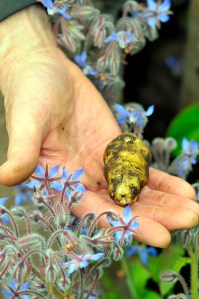
(Photo courtesy of Klas Stolpe/Juneau Empire) Bill Ehlers, assistant gardener at the Jensen-Olson Arboretum in Juneau, holds a Tlingít potato next to some borage plant flowers.

(Photo courtesy of Klas Stolpe/Juneau Empire) Bill Ehlers, assistant gardener at the Jensen-Olson Arboretum in Juneau, holds a Tlingít potato next to some borage plant flowers.

The Juneau Empire on Monday (click here) ran a nice photo package of a sustainable harvest camp at the Jensen-Olson Arboretum in Juneau that was hosted by the 4-H program run by UAF Cooperative Extension Service and the Alaska Department of Fish & Game. The photos feature several children harvesting “Maria’s Potatoes,” a type of Tlingít potato grown from seed potatoes that originally came from deceased Tlingít elder Maria Miller’s garden in Klukwan. These fingerling potatoes do well in Southeast Alaska’s rainy climate and have been around for hundreds of years. The story link above has a link to an audio slideshow by Juneau Empire photographer Michael Penn. The slideshow is worth watching.

By the way, click here to read more about the Tlingít potato posted on the Sitka Local Foods Network site about three weeks ago. Elizabeth Kunibe did want to clarify that in the link to the Chilkat Valley News story she is misquoted so it appears that she “discovered” the Ozette potato (another Native American variety). She said she is not the discoverer.

Kunibe also said the Tlingít potatoes can be sold, but for food only and not for seed. Some of them contain potato viruses, transmitted by vectors, that can affect the soil and other varieties of potatoes. She said when people buy seed potatoes, they need to make sure they have “clean seed” or “virus-free seed” before they plant. She said potato viruses do not affect humans who eat the potatoes, but we need to use clean seed to keep the viruses from destroying crops (like what happened in the Irish potato famine). She said the UAF Cooperative Extension Service, which has offices in Sitka and Juneau, may have more information on how to find virus-free seed potatoes.

Kunibe, who made a presentation on Tlingít potatoes and traditional gardening in Sitka last year, is hoping to schedule another trip to Sitka for a future presentation. Kunibe also wanted share this link from the USDA Agricultural Research Service about newly discovered nutritional benefits of potatoes, especially in regards to phytochemicals and cancer prevention.

• Sitka Farmers Market debriefing and work party on Wednesday

The Sitka Local Foods Network will host a Sitka Farmers Market debriefing and St. Peter’s Fellowship Farm work party on from 4:30-6 p.m. on Wednesday, Aug. 19, at the communal garden located behind St. Peter’s By The Sea Episcopal Church, 611 Lincoln St.

Ideas on how to improve the Sitka Farmers Markets will be discussed, and we’ll do some weeding and slug hunting. The person that catches the most slugs gets a rare, tasty, healthy prize. Volunteers are discouraged from bringing slugs from their own yards in an attempt to increase their odds of winning. This event is open to the public.

For more information, contact Linda Wilson at 747-3096 (nights and weekends).

• City offers free topsoil for Sitka gardeners

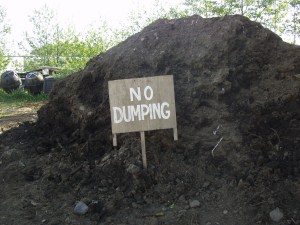
A mound of topsoil at Blatchley Community Gardens

A mound of topsoil at Blatchley Community Gardens

According to Thursday’s issue of the Daily Sitka Sentinel, the city is offering limited amounts of free topsoil for use by community gardens.

A limit of one pick-up truck-sized load per household may be had at the north side of the community garden behind Blatchley Middle School.

Gardeners also are reminded that coffee grounds are still available. They’re located on the north end of the garden.

For more information, call Sitka Community School/RecycleSITKA at 747-8670.

Doug Osborne and his daughter, Darby, shovel topsoil into a wheelbarrow while building the WISEGUYS men's health group's garden plot in May 2008 at the Blatchley Community Gardens

Doug Osborne and his daughter, Darby, shovel topsoil into a wheelbarrow while building the WISEGUYS men's health group's garden plot in May 2008 at the Blatchley Community Gardens

• Community Gardens Act of 2009 introduced in Congress

According to the Vancouver, British Columbia, blog CityFarmer.info, U.S. Rep. Jay Inslee (D-Wash.) and Rep. Eleanor Holmes Norton (D-D.C.) on July 15 introduced HR 3225 into the U.S. House of Representatives, a bill known as the Community Gardens Act of 2009 (click here to read the text of the bill).

In a nutshell, this bill creates a grant program that compensates community groups up to 80 percent of the costs of starting and maintaining a community garden (click here to read the CityFarmer.info article about the bill).

Activities eligible to receive grant assistance include acquisition of interest in real property, construction, community outreach, operations, and any other appropriate activity. When making grants, the U.S. Department of Agriculture will consider the geographic diversity among grantees and the number of individuals in a local community that are likely to participate in a community garden.

“I’ve introduced this bill to help local groups create new community gardens in neighborhoods around the country,” Inslee said in a press release posted on his Congressional Web site (click here to read it). “Community gardens provide local food sources, strengthen and beautify neighborhoods and let people in urban settings enjoy the benefits of local agriculture. As a parent, I’m also happy to note that community gardens engage families and children in growing their own vegetables, which studies have shown has increased the willingness of children to eat their veggies.”

According to a national study, 1 million households participated in community gardens in 2008, but an estimated 5 million households expressed an interest in starting a garden plot near their home. Groups eligible to apply for funds in Inslee’s new grant program include community-development organizations, schools, state and local governments, tribal organizations and other groups. By encouraging these groups to construct gardens in their communities, Inslee’s bill will promote nutrition, environmental awareness, and neighborhood development.

On the same day the Community Gardens Act of 2009 was introduced, Rep. Doris Matsui (D-Calif.) introduced a complementary resolution to designate August as “National Community Gardening Awareness Month.”

“I support the Community Gardens Act of 2009, as it will help Americans across the country establish new gardens and support those who want to take part in feeding their families and their communities,” Matsui said. “Community gardens are on the rise across the nation as Americans look to shrink their monthly grocery bills, introduce produce and more nutritious foods into their children’s diets, and as a way to create a connection between our communities and the food we feed our families.”

Encourage Rep. Don Young (R-Alaska) to support this bill, and ask him to sign on as a co-sponsor. Also, write and ask Sen. Lisa Murkowski (R-Alaska) and Sen. Mark Begich (D-Alaska) to sponsor a similar bill in the U.S. Senate. Feel free to take things a step further and notify your state representative and senator that Alaska needs a similar bill using this legislation as a model.

Click here to e-mail Rep. Don Young.

Click here to e-mail Sen. Lisa Murkowski.

Click here to e-mail Sen. Mark Begich.

• Chena Hot Springs greenhouse a model for Sitka greenhouse project

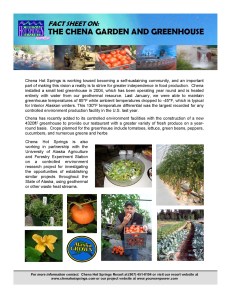
Greenhousefactsheet

One of the five focus areas for the Sitka Local Foods Network is to build a community greenhouse in Sitka. This will serve several functions, such as extending our growing season, allowing us to grow a wider variety of produce and expanding our capacity to grow fruits and vegetables in Sitka. The Sitka Local Foods Network has been looking at several locations around town and recently submitted a proposal for a possible site (more details as they become available).

Anyway, there is a model for a successful greenhouse here in Alaska, and it’s worth looking at so people from Sitka can see the possibilities.

Chena Hot Springs, located about 60 miles from Fairbanks, is working toward becoming a more sustainable community and an important element of this vision is being able to produce more of their own food locally. In 2004, Chena Hot Springs Resort installed a 1,000-square-foot test greenhouse that has become the only year-round producing greenhouse in Interior Alaska (click here to read more).

The hoop house greenhouse was able to maintain an interior temperature of 78 degrees Fahrenheit, even when outside temperatures dipped to minus-56 (the 134-degree difference is the largest ever recorded for a controlled environment facility in the U.S.). The greenhouse is heated by geothermal energy from the hot springs (165-degree water running through pipes embedded in concrete floor slabs). Click here for a downloadable report (as a PDF file) on the economic benefits of the project.

After the successful first year or two of production, Chena built a new 4,320-square-foot greenhouse to provide the resort’s restaurant with a greater variety of fresh produce on a year-round basis. Under optimal conditions the nearly 14,000 lettuce plants can grow nearly 150,000 heads of lettuce in a year. They also have 450 different tomatoes, including six Dutch varieties, a cherry tomato variety, a grape tomato variety, a beefsteak tomato variety and three intermediate cluster varieties. They also grow green beans, peppers, cucumbers and numerous greens and herbs (click here for a photo gallery). Chena Hot Springs Resort is working in partnership with the University of Alaska Fairbanks Agricultural and Forestry Experiment Station (click here for a link to the UAF AFES).

Chena Hot Springs Resort, which uses geothermal and other waste heat for power, will host the Fourth Annual Chena Renewable Energy Fair on Saturday, Aug. 22. Click here for more information.