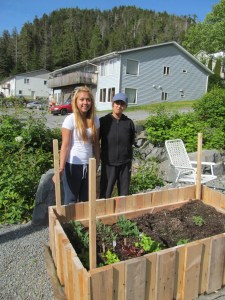
The second batch of classes (Classes Three and Four) for the 2016 Sitka Local Foods Network garden mentor program are being set for our two participating first-year families and our three returning second-year families. The classes will be similar at each location, and they are open to the public.
Class Three is about garden maintenance, while Class Four is about early harvest. Class One focused on site selection, garden preparation, building planter beds, simple vegetables and soil preparation, while Class Two was about simple vegetables and planting. There are six classes in the series, with Class Five about the final harvest and Class Six about preparing the garden for winter.
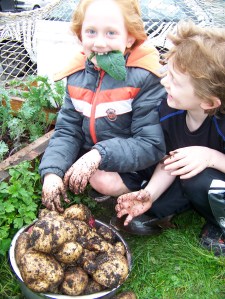
Our first-year gardener families (Erin Mathes and Fran Baratki), learn how to grow four hardy crops for Sitka — kale, lettuce, potatoes and rhubarb. Our three returning families (A.J. Bastian, Rebecca Kubacki and Breezy) will be planting carrots, chard, green onions and peas this year. These four crops are slightly more difficult crops to grow that our first-year plantings of kale, lettuce, potatoes and rhubarb. Even though the crops for our second-year students are more difficult to grow, many gardeners in Sitka still have good results with these vegetables. These classes are essentially the same, so feel free to attend the Class 3 or Class 4 that best fits your schedule.
The class schedule and location for the one first-year and three second-year families is (some classes still need to be scheduled and will be announced later):
ERIN MATTHES (first-year family), 716 Etolin Street — CLASS 3: 3:30 p.m. on Thursday, June 2; CLASS 2: 3:30 p.m. on Tuesday, June 21.
FRAN BARATKI (first-year family), 180 Price Street, No. 6 (purple trailer) — CLASS 3: 7 p.m. on Tuesday, May 31; CLASS 4: TBA.
A.J. BASTIAN (second-year family), 207 Brady St. — CLASS 3: TBA; CLASS 4: TBA.
REBECCA KUBACKI (second-year family), 1202 Halibut Point Rd. — CLASS 3: 4:30 p.m. on Wednesday, June 1; CLASS 4: 4:30 p.m. on Wednesday, June 22.
BREEZY (second-year family), 616 Sawmill Creek Rd. — CLASS 3: 5 p.m. on Monday, June 6; CLASS 4: 5 p.m. on Monday, June 27.
This is the third year of the garden mentor program, which provides one-to-one mentoring to families who are trying to garden for the first time. In order to reach more people, our participating families allow the classes to be made public. By teaching families the basics of gardening, we are helping them improve their family nutrition, extend their family food budget, and increase food security in Sitka.
Michelle Putz has been contracted to coordinate the program and design lesson plans. We also have about a half-dozen experienced Sitka gardeners who serve as mentors for the program. For more information, please contact Michelle at 747-2708.
Clam diggers work the beach at Starrigavan in this file photo. The Sitka Tribe of Alaska is warning Sitkans against harvesting clams in the area due to a harmful algae detected Tuesday, May 25, 2016. (Daily Sitka Sentinel file photo by James Poulson)
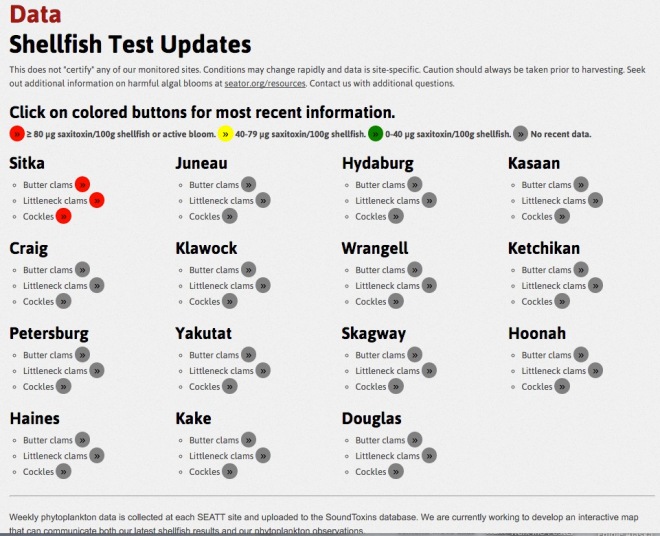
The SouthEast Alaska Tribal Ocean Research (SEATOR) project coordinated by the Sitka Tribe of Alaska on Wednesday, May 26, issued a harmful algal bloom warning for shellfish harvested in four Southeast Alaska communities. The warning is for shellfish harvested on Starrigavan Beach in Sitka, Graveyard Beach in Craig, the Klawock Boat Launch, and Sandy Beach in Petersburg.
(Editor’s Note: On Thursday, June 2, SEATOR and the University of Alaska Fairbanks School of Fisheries and Ocean Sciences in Juneau announced a similar shellfish advisory for shellfish harvested on June 1 from several beaches in the Juneau area — Auke Bay, Point Louisa/Auke Rec, Amalga Harbor and Eagle Beach. For more information on Juneau, contact Elizabeth Tobin at 1-907-796- 5455 or edtobin@alaska.edu or Chris Whitehead of SEATOR at chris.whitehead@sitkatribe-nsn.gov. On June 3, SEATOR added Cloud 9 Beach in Craig to the list of beaches affected by the shellfish advisory.)
“The Sitka Tribe of Alaska Environmental Research Lab (STAERL) has been collecting shellfish samples to test for biotoxins, specifically paralytic shellfish poisoning (PSP),” STAERL announced in a press release. “Recent samples on May 25, 2016, confirm that clams at the following beaches have elevated levels of toxins above the FDA regulatory limit of 80µg/100g and should not be harvested at this time.”
The butter clam has one set of rings that go one direction only, around the same center point (Photo courtesy of Alaska Department of Environmental Conservation)
SEATOR, the Southeast Alaska Tribal Toxins (SEATT) partnership, and the Sitka Tribe of Alaska have been monitoring saxitoxin on Starrigavan Beach in Sitka and other beaches around Southeast Alaska since late 2014. Saxitoxin is produced by the phytoplankton Alexandrium and can get highly concentrated in shellfish, leading to paralytic shellfish poisoning (PSP), which can be fatal.
SEATOR posts updates and information to its website at seator.org/data, which can help provide Southeast Alaska residents with reliable information so they can choose whether or not to harvest shellfish. On May 6, SEATOR announced an advisory for shellfish harvest on Starrigavan Beach in Sitka, when it found Alexandrium in its weekly phytoplankton samples and high levels of saxitoxin in butter clams, littleneck clams, and blue mussels. Because of the high levels, SEATOR advised Sitka residents not to harvest shellfish at the time.
Since most beaches in Alaska aren’t tested for harmful algal blooms, SEATOR and the SEATT partnership were formed in October 2014 to train people to test beaches in Southeast Alaska. In April 2015, the Sitka Tribe of Alaska opened a regional lab on Katlian Street, so samples could be tested in Sitka without having to be sent to the Lower 48, which delayed results. By testing for harmful algal blooms, SEATOR and the SEATT partnership hope to be able to provide information so people can make informed choices whether or not to harvest or eat shellfish.
Harmful algal blooms, such as paralytic shellfish poisoning (PSP), typically have not been monitored in Southeast Alaska for subsistence and recreational harvesters of clams, mussels, oysters, cockles, and other bivalves (commercial harvests are tested). Even though many people in Southeast Alaska love to harvest shellfish, eating it comes with some risks. There have been several PSP outbreaks in recent years that sent people to the hospital, and in 2010 two deaths were attributed to PSP and other HABs, such as Alexandrium, Pseudo-nitzchia and Dinophysis.
To learn more about harmful algal blooms and how they can raise the risk for PSP and ASP (amnesic shellfish poisoning, which also can be fatal), go to SEATOR’s resources page. If you have shellfish you recently harvested and want to test it, click this link to learn what you need to do to have it tested by STAERL.
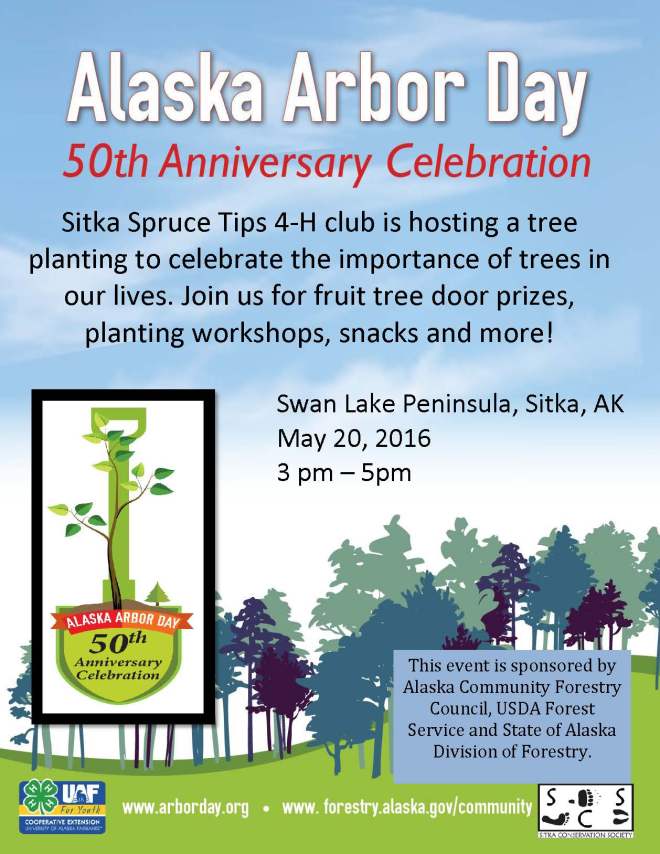
Friday, May 20, is the 50th anniversary of Arbor Day in Alaska, and the Sitka Spruce Tips 4H Club will celebrate by planting a few trees from 3-5 p.m. at the Swan Lake recreation area (near the corner of Lake Street and DeGroff).
“4H is excited to host a celebration in honor of Alaska Arbor Day to celebrate how important trees are in our lives,” Molly said. “We see the significance of trees in the clean air and great habitat they provide whenever we explore the Tongass (National Forest). This will be a fun event to honor that significance closer in town. It is a great opportunity to come together as a community and celebrate trees!”
This event is co-sponsored by the Alaska Community Forestry Council, the USDA Forest Service, and the Alaska Division of Forestry. Because of its commitment to trees in town, the City and Borough of Sitka has been recognized as one of the Tree City USA award-winners from the Arbor Day Foundation.
SEATOR, the Southeast Alaska Tribal Toxins (SEATT) partnership, and the Sitka Tribe of Alaska have been monitoring saxitoxin on Starrigavan Beach in Sitka and other beaches around Southeast Alaska since late 2014. Saxitoxin is produced by the phytoplankton Alexandrium and can get highly concentrated in shellfish, leading to paralytic shellfish poisoning (PSP), which can be fatal.
According to SEATOR, “during our weekly phytoplankton sample last week, we noticed our first Alexandrium of the year. Immediately after, we tested saxitoxin levels in butter clams, littleneck clams and blue mussels, and found them all to have elevated levels of saxitoxin. We do not recommend that Sitkans harvest shellfish at this time, and ask them to look on seator.org/data for additional updates and information.”
Since most beaches in Alaska aren’t tested for harmful algal blooms, SEATOR and the SEATT partnership were formed in October 2014 to train people to test beaches in Southeast Alaska. In April 2015, the Sitka Tribe of Alaska opened a regional lab on Katlian Street, so samples could be tested in Sitka without having to be sent to the Lower 48, which delayed results. By testing for harmful algal blooms, SEATOR and the SEATT partnership hope to be able to provide information so people can make informed choices whether or not to harvest or eat shellfish.
Harmful algal blooms, such as paralytic shellfish poisoning (PSP), typically have not been monitored in Southeast Alaska for subsistence and recreational harvesters of clams, mussels, oysters, cockles, and other bivalves (commercial harvests are tested). Even though many people in Southeast Alaska love to harvest shellfish, eating it comes with some risks. There have been several PSP outbreaks in recent years that sent people to the hospital, and in 2010 two deaths were attributed to PSP and other HABs, such as Alexandrium, Pseudo-nitzchia and Dinophysis.
Alaskans will celebrate Alaska Agriculture Day on Tuesday, May 3. On this day, Alaskans are encouraged to support local agriculture by seeking out and purchasing products produced in Alaska and educating youth about the vital role that agriculture plays in our economy.
Here are a few ideas from the Division of Agriculture on how to celebrate Alaska Agriculture Day:
Join the 49,005 people who “like” the Alaska Grown Facebook page at https://www.facebook.com/dnr.alaskagrown and learn about the exciting things Alaskans are producing around the state.
Contact your local agriculture groups/chapters (such as FFA, Farm Bureau, Agriculture in the Classroom etc.) to see if they are hosting an event in your area.
Sign up for a Community Supported Agriculture (CSA) program at a local farm.
Buy and incorporate Alaska Grown products into your meals.
If you are a farmer, consider asking a local school if you can visit a classroom to educate children about your operation and Alaska agriculture.
In Sitka, you can celebrate Alaska Agriculture Day by starting a food garden (even a couple of containers on your deck can provide you with potatoes, carrots or greens). Teachers are encouraged to offer a lesson plan or two about the importance of agriculture in Alaska and in Sitka. Here’s a link to an article about how Sitka was Alaska’s original garden city back in the late 19th and early 20th Centuries. Also, click here to listen to a Sitka History Minute feature about the potato in Sitka from KCAW-Raven Radio).
During the growing season, please support the Sitka farmers and production gardeners listed in the Alaska Grown Source Book (chief contact in parentheses) — Anam Cara Family Garden (Lisa Sadleir-Hart), Blatchley Community Gardens (David Nuetzel), Down To Earth U-Pick Garden (Lori Adams), Finn Island Farm (Keith Nyitray), Sprucecot Gardens (Judy Johnstone), and St. Peter’s Fellowship Farm (Laura Schmidt). There also are a few Sitka farms and production gardens not listed in the Alaska Grown Source Book, such as Sea View Garden (Linda Wilson), The Sawmill Farm (Bobbi Daniels), Sitka Seedling Farms (Matthew Jackson) and Welsh Family Forget-Me-Not Garden (Florence Welsh). Many of these farms and gardens will be vendors during the Sitka Farmers Markets, which start on July 2 this summer.
(EDITOR’S NOTE: The following article first appeared on this site in April 2010. It is repeated because much of the information remains current and newsworthy.)
In the cold winter of 1994, Anchorage Daily News (now called the Alaska Dispatch News) garden columnist and former Garden Writers Association of America President Jeff Lowenfels was returning to his hotel after a Washington, D.C., event when he was approached by a homeless person who asked for some money to buy food. Lowenfels said Washington, D.C., had signs saying, “Don’t give money to panhandlers,” so he shook his head and kept on walking. But the man’s reply, “I really am homeless and I really am hungry. You can come with me and watch me eat,” stayed with Lowenfels for the rest of his trip.
Jeff Lowenfels
The encounter continued to bother Lowenfels, even as he was flying back to Anchorage. During the flight, Lowenfels came up with an idea when he started writing his weekly garden column (the longest continuously running garden column in the country, with no missed weeks since it started on Nov. 13, 1976). He asked his readers to plant one extra row in their gardens to grow food to donate to Bean’s Café, an Anchorage soup kitchen. The idea took off.
When Anchorage hosted the Garden Writers Association of America convention in 1995, Lowenfels took the GWAA members to Bean’s Café to learn about the Plant A Row For Bean’s Café program. The Garden Writers Association of America liked the idea, and it became the national Plant A Row For The Hungry campaign (also known as Plant A Row or PAR). In 2002, the Garden Writers Association Foundation was created as a national 501(c)(3) nonprofit to manage the Plant A Row For The Hungry program.
“I am not surprised by the growth of PAR,” Lowenfels wrote in an e-mail to the Sitka Local Foods Network. “It is now in all 50 states and across Canada and there are thousands of variations of the original program — from prison gardens for the hungry to botanical gardens donating their produce from public display gardens. This is because gardeners always share information and extra food, so the idea was a natural.”
It took five years for the program to reach its first million pounds of donated food, but the second million only took two years and the next eight years saw a million pounds of donated food (or more) each year. Since 1995, more than 14 million pounds of food have been donated. Not only that, the program is getting ready to expand overseas to Australia, England and other countries with avid gardeners.
“We have supplied something in the vicinity of enough food for 50 million meals,” Lowenfels wrote in his e-mail. “Gardeners can solve this hunger problem without the government. And we don’t need a tea party to do it! Or chemicals, I might add, as author of a book on organic gardening!” Lowenfels is the author of Teaming With Microbes, written with Wayne Lewis. He recently released a second book, Teaming With Nutrients, which is a follow-up to his first book.
According to the U.S. Department of Agriculture, one out of every eight U.S. households experiences hunger or the risk of hunger. Many people skip meals or eat too little, sometimes going an entire day or more without food. About 33 million Americans, including 13 million children, have substandard diets or must resort to seeking emergency food because they can’t always afford to buy the food they need. In recent years, the demand for hunger assistance has increased 70 percent, and research shows that hundreds of children and adults are turned away from food banks each year because of lack of resources.
According to the 2014 Sitka Community Food Assessment Indicators Report, about one in six people in Sitka is food insecure. In 2013, there were 1,410 Sitkans (out of a population of about 9,000) and 766 families receiving food assistance (SNAP, aka food stamps). There also were 229 individuals who received food pantry assistance from the Salvation Army and 7,243 meals served through its lunch soup kitchen in 2013, and that number has grown substantially since then.
While many people credit Lowenfels for creating the Plant A Row For The Hungry program, Lowenfels says the real heroes are the gardeners growing the extra food and donating it to local soup kitchens, senior programs, schools, homeless shelters and neighbors. You can hear him pass along the credit to all gardeners at the end of this 2009 interview with an Oklahoma television station (video also embedded below).
“One row. That’s all it takes. No rules other than the food goes to the hungry. You pick the drop-off spot or just give it to a needy friend or neighbor. Nothing slips between the lip and the cup, I say,” Lowenfels wrote in his e-mail.
For people wanting to Plant A Row For The Hungry in Sitka, there are several places that would love to help distribute some fresh locally grown veggies or berries to those who are less fortunate, such as the Salvation Army, Sitkans Against Family Violence (SAFV), local churches, Sitka Tribe of Alaska and other organizations. The food the Sitka Local Foods Network grows at St. Peter’s Fellowship Farm communal garden goes to the Sitka Farmers Market, school lunches and other programs.
The Sitka Local Foods Network also takes donations of local produce to sell at the Sitka Farmers Markets, and all proceeds are used to help pay for SLFN projects geared toward helping more people in Sitka grow and harvest local food. For more information, contact the Sitka Local Foods Network board members at sitkalocalfoodsnetwork@gmail.com.
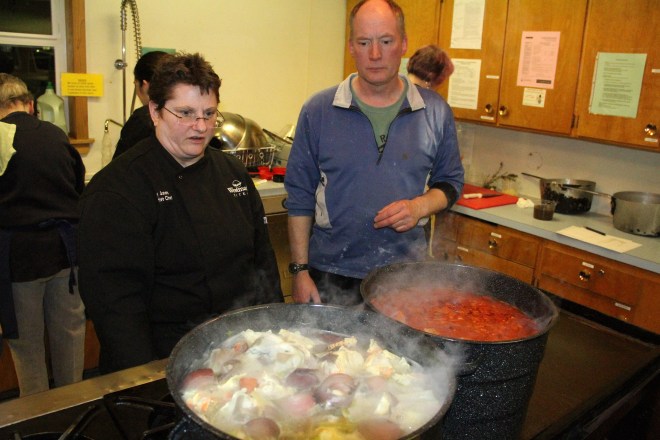
Chef Kathy Jones, left, and student Pat Hughes, watch pots boil during a recent Basic Culinary Skills class series during March 2016 at the Sitka Kitch.
The Sitka Kitch community rental commercial kitchen will host a rescheduled class on cooking soups, sauces and dressings from 6-8:30 p.m. on Monday, April 18, at the Sitka Kitch, which is located at the First Presbyterian Church (505 Sawmill Creek Road). This class originally was part of the Cooking From Scratch series in February, but had to be postponed.
This class will be taught by Kathy Jones, the executive chef at the Westmark Hotel and Totem Square Inn, with assistance from her sous chef Barbara Palacios. It is focused on preparing homemade sauces and dressings to help you lower your food costs and increase flavor.
The Sitka Kitch was a project of the 2013 Sitka Health Summit, and the project is coordinated by the Sitka Conservation Society in partnership with the Sitka Local Foods Network. The Sitka Kitch can be rented to teach cooking and food preservation classes, by local cottage food industry entrepreneurs who need a commercial kitchen to make their products, and for large groups needing a large kitchen for a community dinner. To learn more about how to rent the Sitka Kitch, please go to the website at http://www.sitkawild.org/sitka_kitch.
The cost of the class is $20, plus a food fee shared among the registered participants. Registration closes at noon on Saturday, April 16, so the instructor can purchase supplies. Please register online through our EventSmart website, but you will pay at the class with cash. For more information, email sitkakitch@sitkawild.org.
The University of Alaska FairbanksCooperative Extension Service is offering the Alaska Growers School this summer for Alaska Native-owned farms and ranches. This training is offered by webinar and is intended for Alaska Native tribes, Alaska Native corporations, or Alaska Natives who are currently farming or ranching or hope to start.
(Photo by Jeff Fay for the UAF Cooperative Extension Service) Meriam Karlsson provides a tour of the greenhouse and hydroponic system near Pike’s Waterfront Lodge.
A total of nine lessons will be offered by webinar and teleconference from noon to 1:30 p.m. on Wednesdays, June 8 to Aug. 10. Those interested should register for CEPD F001 UX1 Alaska Growers School (CRN 51871). The cost of the course is $50, however tuition waivers are available. To apply for a waiver, first you must register, then you can complete the waiver (the link is available on the registration page).
This training is non-credit and will be taught by University of Alaska Fairbanks Cooperative Extension Service experts as well as experts from Arizona and Washington who are knowledgeable about Native American farming and ranching policies. This training is intended for Alaska Native tribes, Alaska Native corporations, or Alaska Natives who are currently or hope to start farming or ranching. Representatives or employees of Alaska Native owned corporations (regional or village) are also welcome to participate in the course. The course will address opportunities available to socially disadvantaged farmers and ranchers.
There are lots of reasons to think about starting a farm or ranch. With persistent, low oil prices, agriculture could be a diversification strategy. Starting a farm in a remote village could provide fresher, healthier food for a community as well as improved food security. It also could improve local economies by providing job opportunities and keeping more money in a particular community.
This class will provide the nuts and bolts of getting started farming or ranching in Alaska and will specifically address opportunities available to Alaska Native-owned farms and ranches who are considered socially disadvantaged by the USDA. We will showcase successful Alaska Native- and Native American-owned farms and discuss some of the most promising enterprises for Alaska, such as Rhodiola and peonies.
In the Summer 2016 Alaska Growers School, you will:
Learn about important considerations for starting or expanding a farm or ranch.
Consider opportunities to improve food security in remote Alaska Native villages
Learn about business mapping and how to choose a business structure
Establish your vision, goals, values, and strengths.
Assess your resources, skills, and motivations for farming.
Understand and learn how to manage the risks of starting or expanding a farm in remote Alaska.
Learn about other training opportunities, technical assistance, and resources.
Connect and learn with other Alaska Native and Native American growers.
This material is based upon work supported by the Office of Advocacy and Outreach, U.S. Department of Agriculture, under award # 59-2501-15-045. Any opinions, findings, conclusions, or recommendations expressed in this publication are those of the author(s) and do not necessarily reflect the views of the U.S. Department of Agriculture.
The Sitka Local Foods Network is looking to contract with two Sitka residents to coordinate our garden mentoring education program. This year we’re splitting up the duties, so one of the coordinators will work with our returning families and the other will work with our new families (and be paid slightly more).
These contracts run from spring through fall 2016, and the coordinators will be in charge of developing curricula, teaching classes, obtaining supplies, and providing evaluation of the program. A full list of job duties and expectations can be found in the linked document at the bottom of this article.
Applicants should have at least 3-5 years of varied vegetable gardening experience, preferably in Southeast Alaska. They also should have 3-5 years of project coordination experience, as well as demonstrated communication, organizational, and teaching/mentoring skills.
The garden mentoring project began in 2014 when two families of first-time gardeners were chosen to receive help planning and building a simple garden to grow four relatively easy plants for Sitka (kale, rhubarb, potatoes, lettuce). In 2015, the program was expanded to provide mentoring service to four new first-time gardening families, plus the two families from 2014 will receive a second year of mentoring as they learn to grow plants that are a bit more difficult for Sitka (carrots, peas, chard, green onions).
There are six classes with each family, and they usually are open to the public. In 2016, we expect three returning families and three new families (one of our first-year families from last year asked to repeat as a first-year family this year).
Applicants should submit a letter of interest and resume by 5 p.m. on Friday, April 8, to sitkalocalfoodsnetwork@gmail.com. Please put “Garden Mentor Coordinator” in your email subject line. The contracts pay in three installments over the summer. Questions about the contracts can be directed to sitkalocalfoodsnetwork@gmail.com.
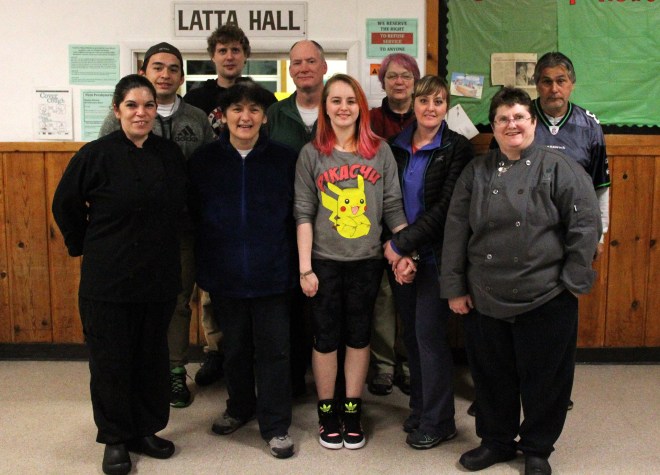
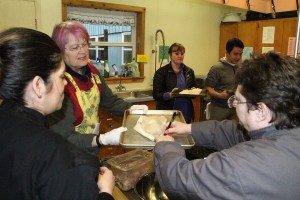
Students made rockfish in parchment paper, chicken piccata and fettucine with a Thai peanut sauce March 28 during the fourth of four Basic Culinary Skills classes offered on Mondays in March at the Sitka Kitch community rental commercial kitchen.
The class series is designed to help people gain the kitchen skills they need for restaurant jobs, but many of the students are taking the series to improve their home kitchen chops.
These classes are taught by Kathy Jones, executive chef at the Westmark Sitka Hotel and the Totem Square Inn, with assistance by her sous chef, Barbara Palacios. The classes are modeled after a similar basic culinary skills program Chef Kathy knows from Indianapolis offered by a food relief nonprofit called Second Helpings.
In the first class (March 7) the students worked on chopping skills, and also learned about basic kitchen sanitation and a variety of kitchen tools. The second class (March 14) featured basic cooking techniques, basic nutrition, and sauces, soups and stocks Part 1 (making a cucumber raita, mushroom ragout, and a Caesar dressing).
The third class on March 21 focused on sauces, soups and stocks Part 2, salads, and measurements. The fourth class on March 28 focused on poultry, meats, and the Alaska Department of Environmental Conservation (DEC) safe food handler’s card.
The Sitka Kitch was a project of the 2013 Sitka Health Summit, and the project is coordinated by the Sitka Conservation Society in partnership with the Sitka Local Foods Network. The Sitka Kitch can be rented to teach cooking and food preservation classes, by local cottage food industry entrepreneurs who need a commercial kitchen to make their products, and for large groups needing a large kitchen for a community dinner. To learn more about how to rent the Sitka Kitch, please go to the website at http://www.sitkawild.org/sitka_kitch.
For more information about the Sitka Kitch and the classes, please email sitkakitch@sitkawild.org. You also can go to our class registration page at https://sitkakitch.eventsmart.com/ to see all of the available classes (click on the class titles to register). We should announce some new classes in the next week or two, so watch the site.
A slideshow of scenes from the fourth class of the series can be found below.


 The second batch of classes (Classes Three and Four) for the 2016 Sitka Local Foods Network garden mentor program are being set for our two participating first-year families and our three returning second-year families. The classes will be similar at each location, and they are open to the public.











 Sitka Local Foods Network
You must be logged in to post a comment.