• New Sitka Local Foods Network events calendar added to site

We now have an events calendar. This link goes to a calendar for Sitka Local Foods Network and other related events in the Sitka area. You will be able to find the link under “Pages” in the right column.

This calendar will feature events such as Sitka Local Foods Network board meetings, Sitka Farmers Markets, Let’s Grow Sitka, work parties for St. Peter’s Fellowship Farm and other events sponsored by the Sitka Local Foods Network. It also will feature community events related our mission, such as UAF Cooperative Extension Service classes, Sitka Gardeners Club meetings, traditional foods classes, etc.

If you have any events you feel should be included on this calendar, please e-mail the details to charles(at)sitkalocalfoodsnetwork.org — replace the (at) with a @ symbol. Please be aware this is a work in progress, so it may take a few days to get most of our events transferred to the calendar.

• Sonja Koukel of the UAF Cooperative Extension Service writes about discovering treasures from the CES catalog

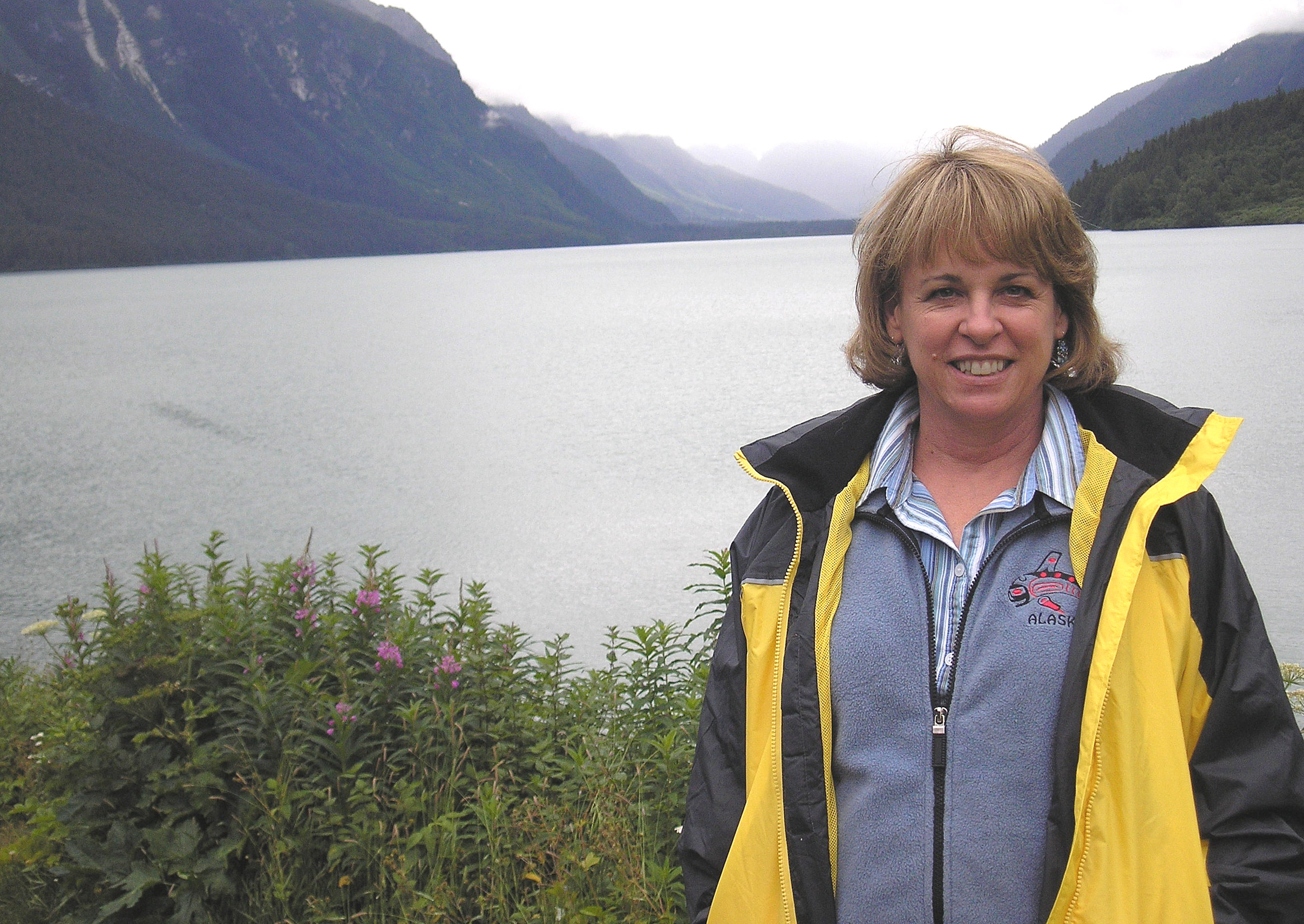
Dr. Sonja Koukel, PhD, of the UAF Cooperative Extension Service

Dr. Sonja Koukel, PhD, of the UAF Cooperative Extension Service

Discover Treasures from the UAF Cooperative Extension Service

By Dr. Sonja Koukel, PhD
Health, Home & Family Development Program
UAF Cooperative Extension Service, Juneau Office

_____

When was the last time you visited the University of Alaska Fairbanks Cooperative Extension Service (UAF CES) website? Perhaps it’s been awhile, or perhaps you’ve never taken the time to surf the site and take stock of all the treasures available in hard copy, electronic media, and on the Internet.

Every year the CES Communications Department provides a “Publications & Media” catalog listing research-based publications in the major program areas: Agriculture & Horticulture; Community Resource & Economic Development; Energy Education & Housing; and Health, Home & Family Development. Some publications are free and may be downloaded from the website. Those with a small fee can be ordered using the online form (http://www.uaf.edu/ces/pubs/), calling the toll-free number (1-877-520-5211), or contacting the local district office.

Let’s take a look at the treasure trove of information available through the Health, Home & Family Development (HHFD) program. For instance, there are a number of publications listed in the “Food, Nutrition and Health” category. Here, you will find information on storing vegetables and fruits, freezing vegetables, making fruit leather, making jerky, facts on botulism, and a variety of recipes including sourdough, rhubarb, zucchini, and wild berries. Several vegetable fact sheets provide nutrition and health guidelines (such as vitamin, mineral, and fiber content), harvesting, storage, and preparation with sample recipes included. Selected vegetables include beets, broccoli, cabbage, carrots, potatoes, squash, herbs, and chard. Bonus — all these fact sheets are free!

In my view, the most exciting new developments are the educational modules made possible through a USDA grant. Titled, “Preserving Alaska’s Bounty,” the web-based modules and DVDs were created and developed as a team effort involving HHFD faculty, program assistants, and the communications staff. The series focuses on home preservation of Alaska Native foods. Client feedback on the media, gathered from an online satisfaction survey, has been very positive.

The primary purpose for developing the modules was to provide research-based information for rural communities and areas that do not have extension faculty members on-site. The web modules are developed in a sequential manner so that each step is clearly defined and explained. There are hyperlinks within the modules that link the user to additional information. Topics are grouped into three main categories: Canning Basics, Canning Products & Methods (i.e., canning fish, meat, jams/jellies), and Meat Products & Methods (i.e., sausage, jerky). These modules are free. Locate them at (http://www.uaf.edu/ces/preservingalaskasbounty/index.html)

For those who learn best by watching demonstrations, the DVDs bring the extension experts into your home. Health, Home & Family Development program area faculty from all seven Alaska districts serve as the educators. To date, seven DVDs have been released on the following topics: Canning Basics, Canning Meat and Fish in Jars, Canning Meat and Fish in Cans, Pickling, Drying Foods, Sausage and Jerky, and the just-released, Jams and Jellies. More titles will be available in the very near future, these include: Root Cellars, Fireweed, Processing Reindeer (game meats), and Harvesting Alaska Seaweeds. The DVDs are available at a nominal fee of $5.

The Alaska Native foods preservation series is the culmination of a five-year process. It is a topic that figures into all the HHFD program areas: nutrition, food budgeting, eating locally, and energy conservation. Recently, the CES HHFD team received recognition for their work, “A Multimedia Approach to Preserving Alaska’s Bounty,” from the National Extension Honorary Society of Epsilon Sigma Phi.

In the new year, take a moment to visit the UAF Cooperative Extension Service website and discover all the treasures that await you. Contact: sdkoukel@alaska.edu or 907-796-6221.
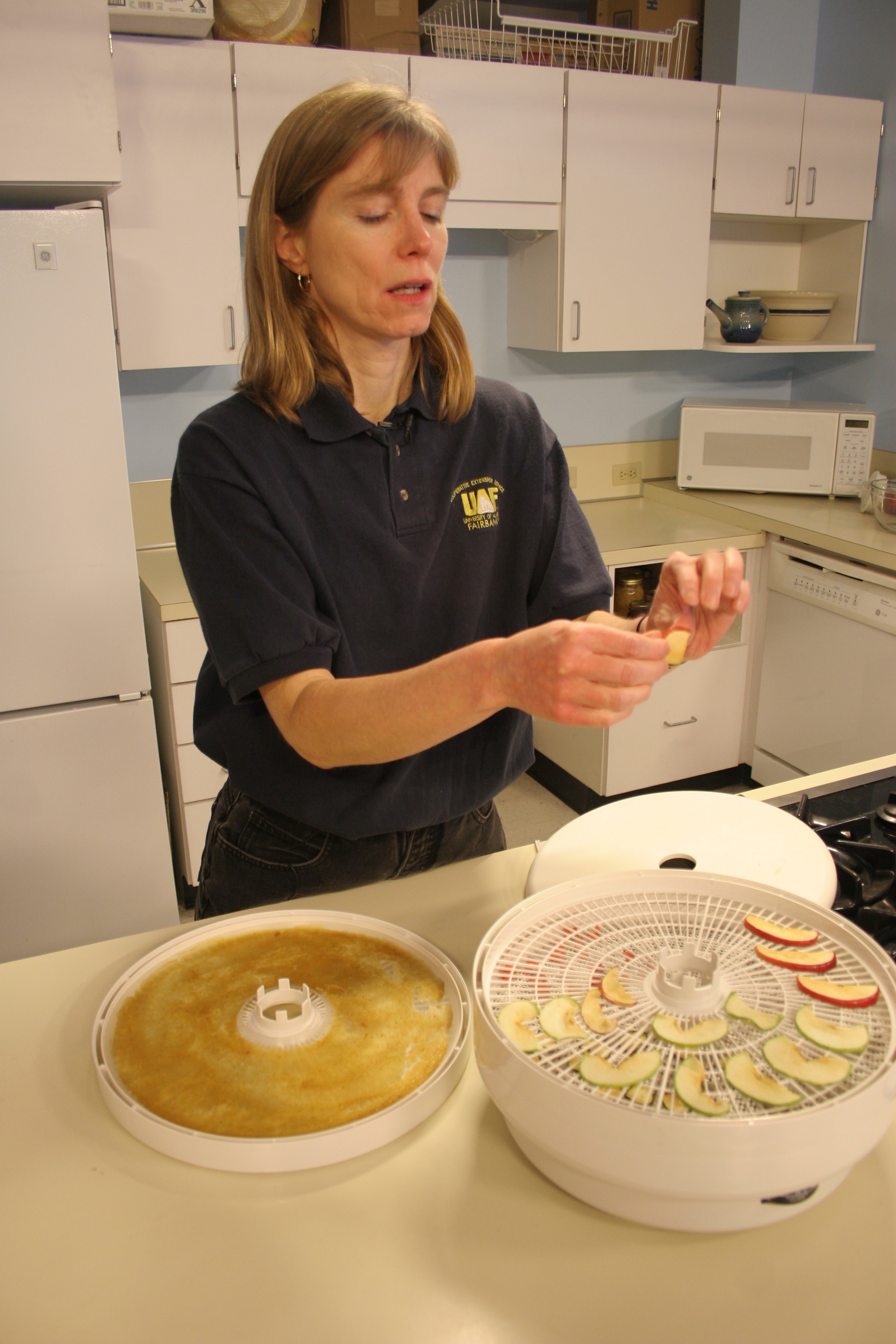
Julie Cascio of UAF Cooperative Extension Service's Health, Home and Family Development program in the Palmer/Mat-Su district demonstrates how to dry apples

Julie Cascio of UAF Cooperative Extension Service's Health, Home and Family Development program in the Palmer/Mat-Su district demonstrates how to dry apples
• Wanton waste of deer meat, a record high herring quota and other local foods stories in the news

Over the past couple of weeks, at least 10 Sitka black tail deer corpses have been found in Sitka with lots of edible meat still on the bone but the prime cuts missing. According to the Anchorage Daily News, state wildlife officials are searching for the hunters, and wanton waste charges may be coming for those involved. There were six deer found off Green Lake Road, then four deer were found near Harbor Mountain Road five days later.

The Sitka Local Foods Network encourages the responsible and sustainable harvesting of traditional subsistence foods, such as deer, but we must respect the resource and use the entire animal. Not only is leaving edible meat in the field wasteful, but the last couple of years have been down years for deer survival and the actions of these wasteful hunters may mean fewer hunting opportunities next year for hunters who need the deer to feed their families. Anyone with information about the cases is asked to call Alaska Wildlife Troopers at 747-3254 or, to remain anonymous, Wildlife Safeguard at 1-800-478-3377.

In other local foods news, the Alaska Department of Fish and Game established a record sac roe herring quota for the 2010 season, a quota of more than 18,000 tons (more than 4,000 tons higher than last year’s then-record quota). The commercial herring fleet is very happy with the higher quota, but KCAW-Raven Radio reports local subsistence gatherers worry that the record quota will harm their ability to gather herring eggs on hemlock branches, a popular subsistence and barter food for local Tlingít and Haida residents. They also worry two straight years of record quotas will hurt the resource, since herring also serves as a key forage food for salmon, halibut, whales, sea lions and other species in the region.

The Juneau Empire reported that the State of Alaska asked for an extension to reply to an inquiry on subsistence management from the federal government. The federal government took over some management of subsistence in Alaska more than a decade ago because state laws weren’t in compliance with the Alaska National Interest Lands Conservation Act (ANILCA), which calls for a rural preference on subsistence in times of shortage, and the federal government may be expanding its role in subsistence management.

The Anchorage Daily News reported on Alaska pork being ready for the freezer at A.D. Farms, and that pork will be sold at the indoor farmers market at Anchorage’s Northway Mall. The story included a wrap-up of other local foods available at the market, and it had a recipe for crock-pot cod.

Laine Welch’s Alaska fishing column was about how more local fish is appearing in school lunch menus.

The Anchorage Daily News Alaska Newsreader feature reported on several Arctic travelers getting trichinosis from eating undercooked bear meat. The National Post of Canada also had a story on travelers eating undercooked bear meat, while the New York Times had an article about how trichinosis is common in bear meat that isn’t cooked properly.

The Anchorage Daily News had an article about how Alaska’s rhubarb probably first came from Russia.

Miller-McCune magazine had an article about how Alaska’s complex salmon politics can serve as a model for sustainable fisheries elsewhere in the world.

The Alaska Public Radio Network reported on a woman from Aniak, Dee Matter, who has taken freezing her food to a new level. The story also was on APRN’s Alaska News Nightly show.

The Fairbanks Daily News-Miner had a feature article about Kotzebue hunter and trapper Ross Schafer and the “Eskimo” way of life.

The Fairbanks Daily News-Miner had an article about a conflict between farmers and hunters over the future of the Delta bison herd.

The Juneau Empire ran a story about glaciers providing an important food source.

Anchorage Daily News garden columnist Jeff Lowenfels wrote about magazine gifts for gardeners.

The Seattle Post-Intelligencer ran an Associated Press article about Monsanto’s role in the business of agriculture, especially the way it squeezes out competitors in the seed industry.

Finally, the University of Alaska Fairbanks School of Natural Resources and Agricultural Sciences blog featured an article about a new study about food security challenges in Alaska.

• ‘Encounters with Richard Nelson’ radio show features episodes on venison and salmon

For the past four years, Sitka resident Richard Nelson has hosted a radio show called “Encounters,” which airs on KCAW-Raven Radio and other public radio stations around the state.

His Nov. 23 show was about venison. The show’s description — “Look over the shoulder of host Richard Nelson as he butchers a freshly killed deer. He tells stories of his learning to hunt from his Inupiaq teachers and we learn how knowing more about the food we eat can make us feel closer to the environment.”

His Aug. 10 show was about salmon. The show’s description — “Instead of heading uptown, head upstream this week with Richard Nelson as he gets into a salmon stream to experience the amazing annual life cycle event of wild Alaskan salmon.”

The rest of his shows are about life in Alaska and other spots in the arctic, and they range from bear safety to mosquitoes. Some of his episodes also deal with Nelson’s time spent in Australia.

• Sonja Koukel of the UAF Cooperative Extension Service writes about preserving Alaska wild berries

Dr. Sonja Koukel of the UAF Cooperative Extension Service's Juneau office displays some wild berry preserves

Dr. Sonja Koukel of the UAF Cooperative Extension Service's Juneau office displays some wild berry preserves

Preserving Alaska’s Wild Berries

By Dr. Sonja Koukel, PhD
Health, Home & Family Development Program
UAF Cooperative Extension Service, Juneau Office

_____

Is your freezer teeming with berries harvested last season? If so, now is the time to preserve them in jams, jellies, or syrups. As the winter days grow darker and shorter, preserving berries provides an emotional uplift as the activity brings with it memories of sunshine and relaxing hours spent in the beauty that is Alaska.

While freezing is an acceptable preservation method for berries, it is not the most economical and there is the risk of power outages that could compromise the storage time. Freezing is the least time consuming method of food storage than canning.  However, when foods are home canned, they enjoy a longer shelf life, can be stored at room temperature, and are not affected by power outages.

Berries are a high acid food; therefore jams and jellies can be processed quickly and easily using the boiling water canning method. In this method, filled jars are covered with boiling water and heated to an internal temperature of 212 degrees (F). At this temperature, bacteria, yeasts and molds that could be a health hazard or cause the food to spoil are destroyed. Additionally, the hot water inactivates enzymes that cause foods to spoil. The canning process removes air from the jar and a vacuum seal is formed when the product cools. The seal prevents air from getting back into the product, bringing with it microorganisms that could recontaminate the food.

As mentioned, removing the air from the jar is important as microorganisms will not thrive in an anaerobic environment. Presented with these facts, some individuals question the “inversion” method that is often included along with the directions found in purchased packages of pectin. According to this method, the filled, hot jars are turned upside-down after the rings have been screwed onto the tops. After five minutes, the jar is turned upright to cool, after which it is stored on pantry shelves. The problem with this method is that the air has not been exhausted from the jar, which can encourage mold growth. To ensure food quality and safety, all jellied products are processed in a boiling water canner.

Recipes for jams and jellies are available in packages of pectin, cook books, magazines, and food preservation guides. For Alaska berries, check out the UAF Cooperative Extension Service publication, “Collecting and Using Alaska’s Wild Berries and Other Wild Products.” A best-seller, this publication provides berry facts, storage and preservation methods, and recipes. Blueberries, currants, highbush cranberries, and red huckleberries can be found along with fireweed and wild roses. Over the holiday season, the “Berry Book” is offered at the reduced rate of $7. Contact your district office or place an order online at  http://www.uaf.edu/ces/pubs

If you have never preserved jams or jellies, or would like to review the process, visit the UAF Cooperative Extension Service website for fact sheets that can be downloaded free to your home computer: http://www.uaf.edu/ces/pubs/catalog/. Newly released educational modules can be viewed online: http://www.uaf.edu/ces/preservingalaskasbounty/index.html.

Alaska wild berry preserves are a great treat

Alaska wild berry preserves are a great treat

• Hunters, do you know what’s in your ammo and how it affects your meat?

Sitka black-tailed deer (photo by U.S. Fish and Wildlife Service, Tongass National Forest)

Sitka black-tailed deer (photo by U.S. Fish and Wildlife Service, Tongass National Forest)

Hunting for wild fowl and game is a part of normal life in Alaska. It’s the way many of us fill our freezers, and it’s been part of the traditional subsistence lifestyle for centuries. Many of us feel the natural, wild fowl and game we hunt is healthier for our families than store-bought poultry, beef or pork.

In many cases the fowl and game we hunt is healthier, but our choice of ammo can negate that. Using non-toxic shot, in other words using steel shot instead of lead, has been a regulation in waterfowl hunting for many years. The Alaska Department of Fish and Game has an informational page about using non-toxic shot. The Institute for Wildlife Studies has informational pages about alternatives to lead and the California non-lead awareness program.

The reason lead shot has been banned from waterfowl hunting is because it gets into the food chain, including humans, and lead can cause major health problems if it gets into our blood streams. In November 2008, a study released by the North Dakota and Minnesota health departments detailed the affects of lead fragments in venison. The study was done after food pantries in North Dakota in March 2008 were told to no longer accept donated ground venison because of lead fragments.

Many older bullets were solid lead, or lead covered by a thin covering of copper. But there are many newer alternative types of ammo that don’t use lead, including bullets that are solid copper, copper with a tungsten alloy core and a polymer tip, and copper alloy with a polycarbonite tip. So if you’re one of those folks who have gone hunting for our local Sitka black-tailed deer in recent weeks, do you know what’s in your ammo?

• Sitka film featured in Palmer’s “Local Harvest, Local Food” film festival, a Sitka café featured for using local food and other local foods news

Food Film Fest Poster-2

Join the Palmer Arts Council for its inaugural “Local Harvest, Local Food” film fest from Thursday, Nov. 19, through Sunday, Nov. 22, at the Strangebird Consulting Office in downtown Palmer. “Good Food” screens at 7 p.m. on Thursday, Nov. 19; “Fresh” shows at 7 p.m. on Friday, Nov. 20; “Eating Alaska” by Sitka filmmaker Ellen Frankenstein screens at 7 p.m. on Saturday, Nov. 21; and “Ingredients” shows at 3 p.m. on Sunday, Nov. 22. After the Sunday showing there will be a discussion about women in agriculture with Cynthia Vignetti. Suggested donations are $10-15 for all films except for Sunday, which is free.

A Sitka restaurant, the Larkspur Café, was featured in Capital City Weekly last week. The article talks about the origins of the restaurant, which is located in the same building as KCAW-Raven Radio. It also discusses the restaurant’s use of local foods, including owners Amelia Budd and Amy Kane purchasing produce from the Sitka Farmers Market during the summer.

In other local foods news from around the state, the National Oceanic and Atmospheric Administration (NOAA) recently announced an expansion to the state’s subsistence halibut fishery to include more rural residents (this includes the Sitka area). The new rules, which take effect on Dec. 4, redefine who qualifies as a rural resident. The previous rules defined rural residents as people living in a rural community or people belonging to a Native tribe with customary and traditional uses of halibut, and the news rules try to catch subsistence halibut users who fell outside the previous definition. Click this link for more information about subsistence halibut regulations and applications.

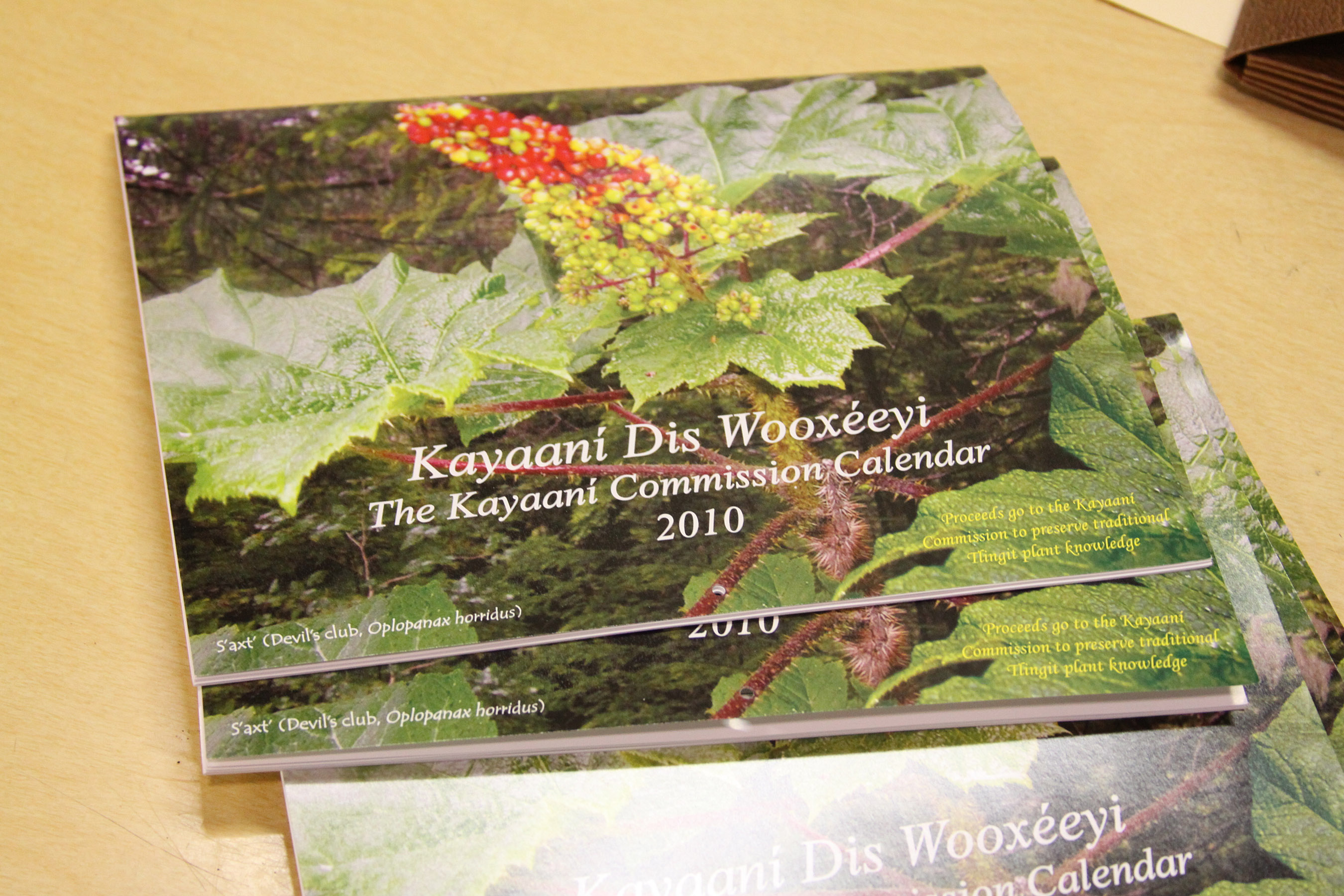
The Daily Sitka Sentinel has been running a brief announcement from the Sitka Tribe of Alaska’s Kayaaní Commission, which is selling 2010 calendars, CDRoms and field guides about traditional uses of native plants. Here is the information:

Kayaaní Native Plant Publications Available: 2010 Kayaaní Harvest Calendars featuring native plants and their traditional and cultural uses ($16, $2 postage per address); Interactive Ethnobotanical CDRoms with native species, their Tlingít, scientific and common names, and interviews with Elders on the traditional and medicinal uses of plants ($15, $1 postage per address); Ethnobotanical Field Guides ($16, $1 postage per address). We will mail to the addresses of your choice. Order by Dec. 18 for guaranteed delivery before Christmas. Call or e-mail with your order: 907-747-7178, pbass@sitkatribe.org, STA Kayaaní Commission, 456 Katlian. All proceeds will assist the nonprofit Kayaaní Commission in protecting, perpetuating and preserving knowledge of native plants.

The Chilkat Valley News weekly newspaper from Haines featured an article about sixth-graders at Haines School learning how to compost their leftover food (including leftover meat) so it can be used for gardening. The school is working with the Takshanuk Watershed Council to teach the students about composting. The students call their compost project “Marvin” because it’s a living organism.

The Alaska Dispatch recently ran a feature called “Growing Season” that discusses some of the farms in the Matanuska-Susitna valleys that grow local food. The feature includes video clips of harvest time at a couple of the farms featured.

The Mat-Su Frontiersman had a feature called “Chicken U,” which is about raising chickens in Alaska and getting them to produce eggs during the winter months.

The Anchorage Daily News also mentioned Chicken University, which will be one of several presentations at the Alaska Farm Bureau annual meeting on Friday, Nov. 13, at the Millennium Hotel in Anchorage. Other presentations are on growing apples in Alaska and preserving your harvest.

The Anchorage Daily News also had an article about how to get local produce in Anchorage during the winter, either through the Glacier Valley CSA produce boxes from Palmer or the indoor farmers market at the Northway Mall.

Anchorage Daily News garden columnist Jeff Lowenfels wrote a column about how hydroponic gardening is easier and cheaper than ever. The column includes lots of links for people who want to try this method of growing food without soil (by the way, there is a hydroponic garden at McMurdo Station in Antarctica that keeps the scientists there stocked in fresh produce in a land of ice).

Fran Durner’s “Talk Dirt To Me” blog on the Anchorage Daily News site includes a post about how snow can act as mulch for the garden.

The Ester Republic, a monthly publication for the community near Fairbanks, runs periodic articles about sustainability and local food security issues. Some of the articles are linked in the archives, and the editors are working to get more of the past articles on these topics online so more people can enjoy them.

KayaaniCommissionCalendarFront´

• Local foods a topic of several Alaska news stories over the past week or so

This has been an interesting couple of weeks, with food security being discussed at the Alaska Federation of Natives convention, subsistence rights and responsibilities in the news and other stories highlighting the local foods market in Alaska.

The Alaska Public Radio Network ran a story about food security being a hot topic at the Alaska Federation of Natives convention. One element of the discussion was a report from former state Sen. Kim Elton, now is the Interior Department’s senior advisor for Alaska Affairs, who said Interior Secretary Ken Salazar plans to upgrade subsistence management for the coming decades.

The Alaska Public Radio Network also ran a story (from KRBD-FM in Ketchikan) about an invasive plant species conference in Ketchikan and how to prevent the spread of noxious and invasive plants in Alaska.

The Fairbanks Daily News-Miner ran an article about how food grown in gardens on the University of Alaska Fairbanks campus is finding its way onto the plates of UAF students at the Lola Tilly Commons.

The Alaska Journal of Commerce had an article about how wild plant seeds from Alaska are being stored at the Kew Gardens Millennium Seed Bank (aka the Royal Botanical Gardens) southwest of London.

The Alaska Journal of Commerce also had an article about Anchorage chef Robert Kineen of Orso Ristorante and how he is incorporating more local foods into his menus.

This week’s issue of the Alaska Journal of Commerce also has several articles about various fisheries, from whitefish to salmon to crab. Included in the issue is an article about how wild-caught Alaska salmon and Pacific cod made the Monterey Bay Aquarium’s recent listing of “super green” seafoods because of their health benefits, the sustainable ways the fish are harvested and lack of contamination. Here is a link to the full list from the Monterey Bay Aquarium’s Consumer’s Guide to Sustainable Seafood.

Former Anchorage Daily News Outdoors Editor Craig Medred, who now writes for the Alaska Dispatch Web site, wrote this column about how some hunters have lost their connection to the culture of hunting.

The Alaska Dispatch also had an article about tough times at the Triple D Farm and Hatchery in Palmer. The turkey farm was made infamous during a KTUU-TV interview of then-Gov. Sarah Palin video last year, when she was pardoning a turkey as a worker in the background was butchering other turkeys (a link to the video is with the story).

The Anchorage Daily News also ran an obituary for Lawrence Clark, 94, aka “The Apple Man,” who was one of the leading apple tree growers in the Anchorage area and a member of the Alaska Pioneer’s Fruit Growers Association. Clark also was able to grow apricots on his land in the Rabbit Creek area south of Anchorage.

The Fairbanks Community Cooperative Market blog posted this essay about sustainable agriculture in Alaska from Mike Emers, the owner of Rosie Creek Farm in the Fairbanks bedroom community of Ester (Rosie Creek Farm is the northernmost certified organic farm in the country). Emers writes about how he wouldn’t have imagined his life’s direction 10-20 years ago, and how becoming a farmer is such a departure for someone who comes from a long line of Jewish tailors. By the way, while you’re done reading Emers’ essay, check out the rest of the Fairbanks Community Cooperative Market site. This is a project to build a market specializing in local foods for the Fairbanks area.

Finally, here is an article from the USDA’s Agricultural Research Service about whether or not there are regions in the country that have lost their ability to feed themselves. The article focuses on a county-by-county study in the northeast part of the U.S. about what local foods currently are available, but it sounds like similar studies are taking place across the country.

• Thanks for “Growing in Sitka and Southeast Alaska” presentation

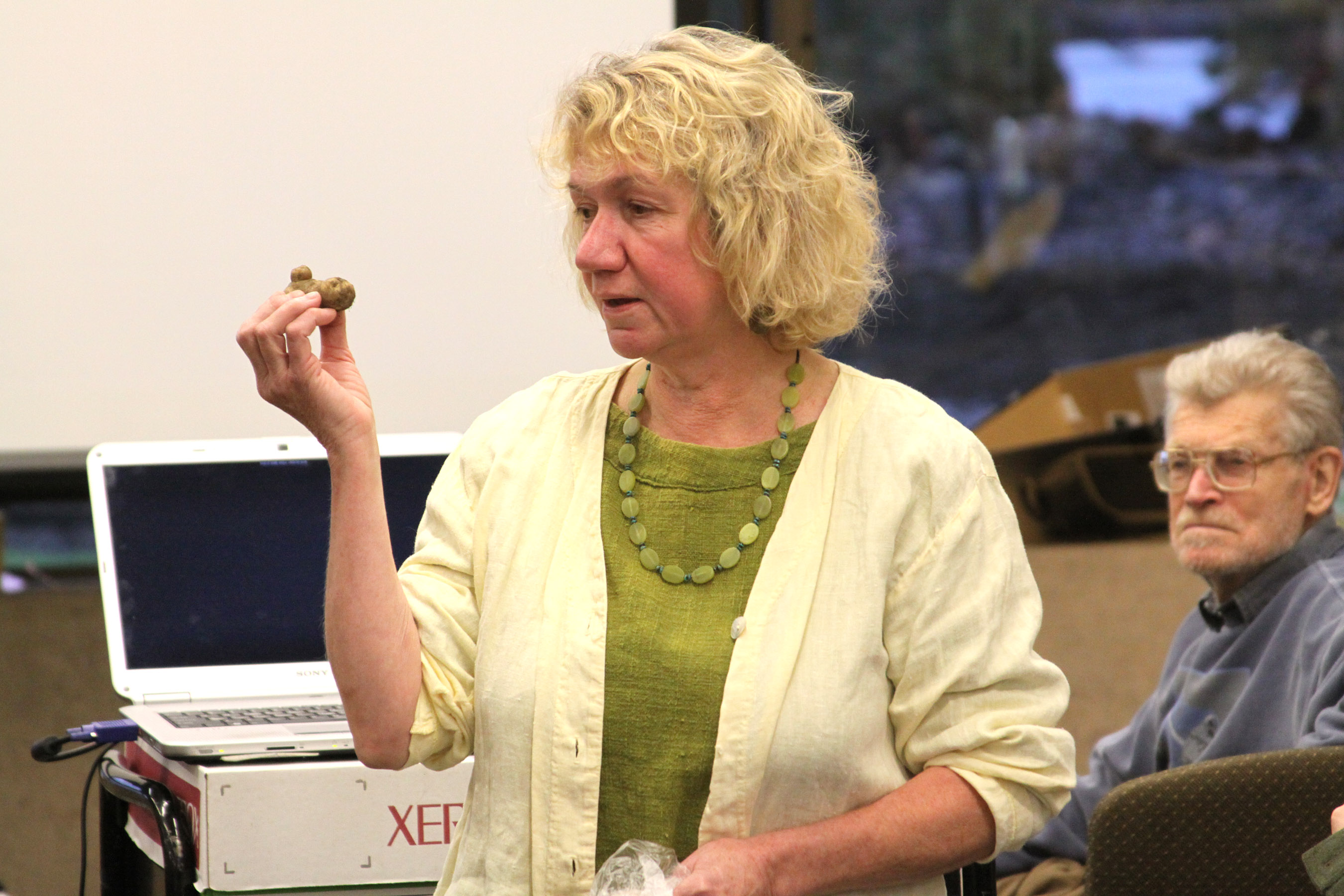
Elizabeth Kunibe shows off a Tlingít potato (also known as "Maria's potato")

On Friday afternoon, the Sitka Local Foods Network hosted anthropology student Elizabeth Kunibe of Juneau for a presentation, “Growing in Sitka and Southeast Alaska: Food of Today, Tomorrow and 200 Years Ago.” This presentation took place at the Kettleson Memorial Library and we had a standing-room-only crowd of 50-plus, despite being arranged less than a week before the event and competing with several Alaska Day happenings.

The Sitka Local Foods Network thanks Elizabeth for taking the time to make the presentation on what, for her, was a pleasure trip to Sitka for Alaska Day. We also thank the library and librarian Sarah Jones for allowing us to use Kettleson Memorial Library for the presentation.

Finally, we thank everybody who came to the presentation to hear Elizabeth discuss traditional Tlingít, Russian and American gardens in Sitka and Southeast Alaska, the Tlingít and Haida potatoes, an agricultural fair in Fort Yukon, the phytonutrients of potatoes and plant diseases.

For those people who weren’t able to attend, the presentation was recorded and it will be aired at various times this week on public access TV (Channel 11). Elizabeth said she might send over some notes from the presentation, and when those arrive they will be posted on the Sitka Local Foods Network site, http://www.sitkalocalfoodsnetwork.org/. A small gallery of photos from the presentation is posted at this link.

Thanks again,
Charles Bingham, event organizer
Sitka Local Foods Network

• Sitka Local Foods Network gets mentions in Juneau Empire, Daily Sitka Sentinel, Capital City Weekly and on APRN’s Talk of Alaska show

The Sunday edition of the Juneau Empire and Monday edition of the Daily Sitka Sentinel (Page 4) both featured a press release about a Sitka Local Foods Network-hosted presentation about “Growing in Sitka and Southeast Alaska: The Food of Today, Tomorrow and 200 Years Ago” that takes place at 5 p.m. this Friday, Oct. 16, at the Kettleson Memorial Library. The presentation is by UAS anthropology student Elizabeth Kunibe of Juneau, who has spent the last six years researching traditional gardens in Southeast Alaska. The presentation also received a write-up in this week’s issue of Capital City Weekly that came out on Wednesday.

Monday’s issue of the Daily Sitka Sentinel also featured a press release about a put-the-garden-to-bed work party the Sitka Local Foods network is hosting from 10 a.m. to 1 p.m. on Saturday, Oct. 17, at the St. Peter’s Fellowship Farm.

On Tuesday, the Alaska Public Radio Network’s statewide call-in show “Talk of Alaska” was about food security and during the show the work of the Sitka Local Foods Network was mentioned. The Talk of Alaska topic on food security was a preview of the Bioneers In Alaska conference this weekend (Oct. 16-18) in Anchorage where food security will be one of the topics. Kerry MacLane, president of the Sitka Local Foods Network, is supposed to travel to Anchorage to participate in the conference.

In addition to the Sitka Local Foods Network mentions, there has been a lot of other local foods news around Alaska this week.

In Sunday’s Juneau Empire, Ginny Mahar (a chef at Rainbow Foods) wrote a column featuring a mac and cheese recipe with king crab. Ginny also writes the Food-G blog, which features a lot of local foods recipes for Southeast Alaska.

Also in Sunday’s Juneau Empire was an article about the Alaska Native Brotherhood/Alaska Native Sisterhood Grand Camp meeting in Juneau and discussion about subsistence fishing rights following the recent arrest of Sen. Albert Kookesh.

In this week’s Capital City Weekly, there is an article from Carla Peterson about the chocolate lily and how to prepare this edible plant for food.

In the Alaska Newsreader blog Wednesday on the Anchorage Daily News Web site was a link to a feature from TheDailyGreen.com, which listed Anchorage ninth among U.S. cities in per capita space given to community gardens. The list (opens as PDF document) was compiled by the Trust for Public Land, and it had a distinct Northwest feel with Seattle ranked No. 1 and Portland, Ore., was No. 2. Click here to learn more about Anchorage’s community gardens program.

In his Anchorage Daily News garden column last week, Jeff Lowenfels wrote about planting garlic now for spring flowers and an August crop.

The Mat-Su Frontiersman recently ran an article about a sustainability project at the University of Alaska Fairbanks Mat-Su College where students were gathering organic spuds.

Finally, while this isn’t about Alaska, you might want to read an article about efforts to preserve our biodiversity so we don’t lose more food plant varieties and why these efforts are important.