• Sarah Lewis to provide free pressure canner gauge testing at Saturday’s Sitka Farmers Market

Canner

SarahLewisThis is a great time of the year to be in Sitka. The fish are running, gardens are starting to produce, and berries are ripe for the picking.

Many Sitka residents have pressure canners to preserve their harvest, and this weekend Sarah Lewis of the Juneau District Office of the University of Alaska Fairbanks Cooperative Extension Service will be in town to teach three classes about canning on Friday, Saturday and Sunday. She also provide free pressure canner gauge testing at the Sitka Farmers Market from 10 a.m. to 1 p.m. on Saturday, July 26, at the Alaska Native Brotherhood Founders Hall.

“People can bring the gauge or the lid with the gauge still attached,” Sarah said. “If they have any questions about the full canner (gaskets, damage, how to use, etc.) they can bring the whole thing.”

In addition to testing pressure canner gauges, Sarah plans to work with Jasmine Shaw of the Sitka District Office of the UAF Cooperative Extension Service to have a wide variety of publications available about home canning. In addition, the UAF Cooperative Extension Service has a series of online tutorials on its website called “Preserving Alaska’s Bounty.” Pressure canner gauges should be tested at least once a year to make sure they are hitting the right pressures for safe food preservation.

We posted earlier about Sarah’s canner classes this weekend, hosted by the Sitka Kitch project, and info can be found here. However, the location for the first two classes has been moved to the Sitka Presbyterian Church (from Sitka High School) and the topic and time have been changed for Sunday’s class (new topic is Canning Jams and Jellies, new time is noon to 3 p.m., location remains Sitka High School). The canning classes are $20 each, and preregistration is required (call Marjorie at the number below).

For more information about the Sitka Kitch project and to register for Sarah’s canning classes, contact Marjorie Hennessy of the Sitka Conservation Society at marjorie@sitkawild.org or 747-7509.

• Tickets available for fifth annual Sitka Seafood Festival; volunteers needed all week

salmon boat header

ssflogo2The fifth annual Sitka Seafood Festival is finalizing its schedule for July 31-Aug. 2 at various locations around Sitka, but tickets have gone on sale for its three main events — the VIP cocktail hour on Friday night, the five-course banquet on Friday night, and the headline entertainment concert by the Yup’ik soul group Pamyua on Saturday night (link to Pamyua’s Facebook page).

The major events for the Sitka Seafood Festival will take place on Friday and Saturday, Aug. 1-2, but there are some additional events set for July 31 (a wine bottle-signing and a garden tour). A full festival schedule is available here.

On Friday, Aug. 1, the VIP cocktail hour takes place from 5:30-6:30 p.m. at the Harrigan Centennial Hall Exhibit Room, and the cost is $35 per person. The five-course seafood banquet prepared by guest chefs starts at 7 p.m. at Harrigan Centennial Hall (doors open at 6:30 p.m.). The banquet costs $65 per person, or you can buy a whole table for $600 (10 seats per table). There are Friend of the Festival tables available for $800 that feature special bartender service, are close to the stage, and feature gift bags).

The tentative menu for Friday’s banquet features (according to an email from event founder Alicia Haseltine):

  • Amuse Bouche — herring roe, finger lime, baby fennel, cucumber, bulls blood
  • First Course — ricotta gnocchi, sea asparagus (pesto), foraged mushroom xo, tat soi oil, brown butter
  • Second Course — scallops, pistachio crumble, fromage blanc, yellow squash puree, snap pea coulis, pancetta
  • Third Course — rockfish, spruce tip nage, lemon ash marshmallow, arugula, whole barley, carrot
  • Fourth Course — salmon, tomato jam, scallion potato puree, black garlic aioli, leeks charred
  • Fifth Course — cocoa praline rocks, chocolate soil, sudachi curd, huckleberry, merlot caramel, bergamot cloud mascarpone and cream base

On Saturday, Aug. 2, the day opens with tote races at 11 a.m. at Crescent Harbor, followed by the parade at 11:30 a.m. from Crescent Harbor Shelter to the Sitka Fine Arts Camp/Sheldon Jackson Campus, and the marketplace from noon until 7 p.m. There will be a variety of entertainment from noon until 4 p.m., and the Scottish Highland Games are from noon to 6 p.m., both at the Sitka Fine Arts Camp/Sheldon Jackson Campus. The headline entertainment concert by Pamyua starts at 7 p.m. at Allen Hall at the Sitka Fine Arts Camp/Sheldon Jackson Campus, and tickets are $20 per person.

Volunteers are needed all week for the festival, which includes event set up and tear down. To learn more, contact Sitka Seafood Festival Director Carolyn Kinneen at (907) 222-8422 or email sitkaseafoodfestival@gmail.com. Parade participants should contact Linda Olson at 747-6985. Scottish Highland Games participants are welcome to practice at 5:30 p.m. on Wednesdays and Sundays at the Moller Field Track


• Vendors sought for fifth annual Sitka Seafood Festival Marketplace on Aug. 2

SitkasSignatureSeafoodOfferings

ssflogo2The Sitka Seafood Festival seeks vendors for the all-day marketplace that takes place from 11 a.m. to 7 p.m. at the Sitka Fine Arts Camp/Sheldon Jackson Campus. The all-day marketplace is one of the highlights from the fifth annual Sitka Seafood Festival, scheduled for Thursday, July 31, through Sunday, Aug. 3, at various locations in Sitka.

“Last year we had an overwhelming amount of people show up, and the vendors sold out of food early,” said festival founder Alicia Haseltine. “This year we are ready for you, Sitka! We are currently accepting vendor applications for food, merchandise, educational booths, or any other ocean- or seafood-related activity.”

The Sitka Seafood Festival helps Sitka celebrate its seafood heritage with a variety of events. The 2014 schedule still is being finalized, but in 2013 the festival included a sea poetry contest, native plants garden tour, pasta cruise, book signings, VIP banquet, marathon and half-marathon, parade through downtown, all-day marketplace, crab races, Scottish Highland games, fishhead toss, fishhead bobbing, blind-folded tote rates, live entertainment, and a golf tournament. Click this link and scroll to the bottom to see a slideshow of scenes from the 2013 Sitka Seafood Festival.

For more information or to register as a vendor, please contact Mary Helem at oceanfront@gci.net. You also can download a registration form below or at http://www.sitkaseafoodfestival.org (note, please send your forms to Mary, the Sitka Local Foods Network is a separate organization than the Sitka Seafood Festival). See you at the festival.

• Sitka Seafood Festival 2014 Marketplace Vendor App Pages 1-2

• Sitka Seafood Festival 2014 Marketplace Vendor App Page 3

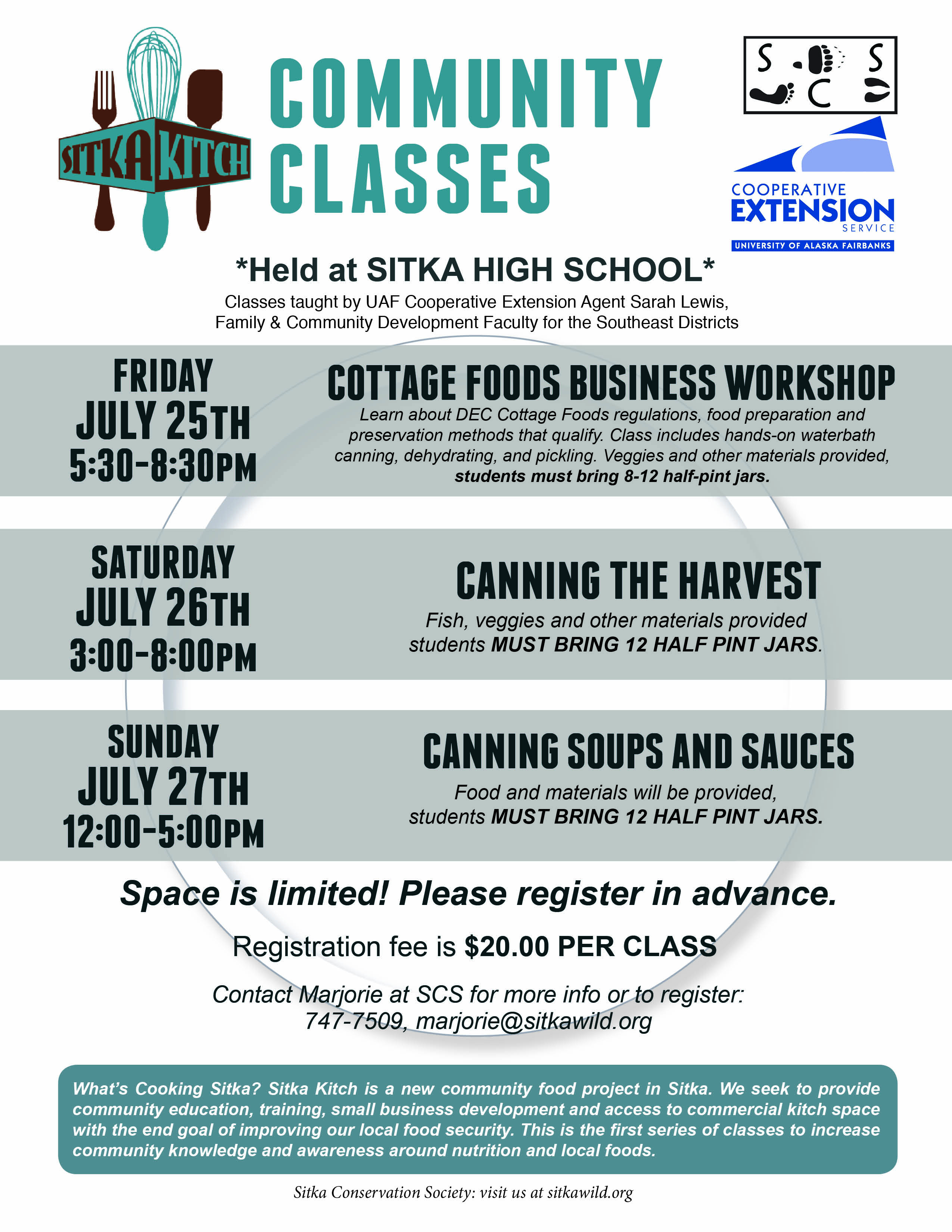
• Sitka Kitch hosts Sarah Lewis for cottage foods industry and home canning classes

kitch_flyer_july25_26

SarahLewisSitka Kitch will host Sarah Lewis, Family and Community Development Faculty from the Juneau District Office of the University of Alaska Fairbanks Cooperative Extension Service, for three classes about the cottage food industry and home canning on July 25-27 at Sitka High School. (Editor’s note: The location of the first two classes has been moved to the Sitka Presbyterian Church on Sawmill Creek Road. Sunday’s class still will take place at Sitka High School, but the topic has been changed to Canning Jams and Jellies and the time will be from noon to 3 p.m.)

The three classes cost $20 each. Space is limited, so please register in advance by calling Marjorie Hennessy of the Sitka Conservation Society at 747-7509. Students will take home the products they make. The classes are:

  • Friday, June 25, 5:30-8:30 p.m., Cottage Foods Business Workshop — Students learn about Alaska Department of Environmental Conservation cottage foods industry regulations, as well as the food preparation and food preservation techniques that qualify. Class includes hands-on water-bath canning, dehydrating and pickling instruction. Veggies and other materials will be provided. Students must bring 8-12 half-pint canning jars with lids.
  • Saturday, June 26, 3-8 p.m., Canning the Harvest — Fish, veggies and other materials provided. Students must bring 12 half-pint canning jars with lids.
  • Sunday, June 27, noon to 5 p.m., Canning Soups and Sauces — Food and materials will be provided. Students must bring 12 half-pint canning jars with lids.

In addition, Sarah will be at the Sitka Farmers Market from 10 a.m. to 1 p.m. on Saturday, July 26, at the Alaska Native Brotherhood Founders Hall, where she will be available to test canner pressure gauges and provide other resources about home canning and food preservation.

Also, Sitka Kitch will partner with Sitka Tribe of Alaska to offer a pickled salmon course in August. This class is offered free of charge, but space is extremely limited. More details on date and location will be available soon.

Sitka Kitch is a community wellness project from the 2013 Sitka Health Summit designed to improve food security in Sitka. The different parts of the project include creating a community kitchen Sitka residents can rent to prepare food for their small businesses or to preserve their family harvest of fish, game, or garden veggies; expanding Sitka’s emergency food storage capacity; and providing education about preserving food and building family emergency food pantries.

For more information about the Sitka Kitch project, contact Marjorie Hennessy at marjorie@sitkawild.org or 747-7509.


• Sitka Seafood Festival offers culinary scholarship and paid internship opportunity

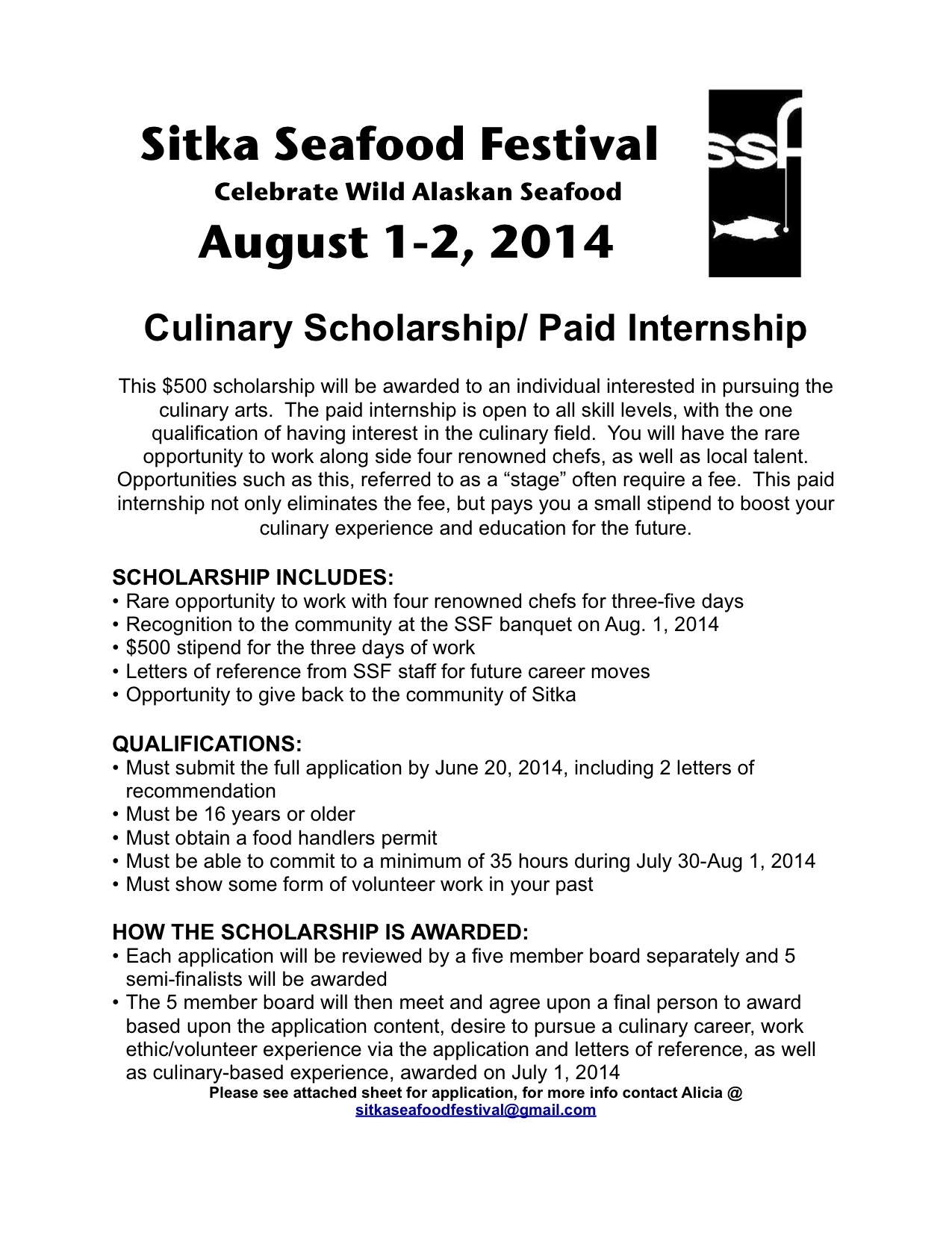
culinary scholarship description

The application deadline for the Sitka Seafood Festival culinary scholarship and paid internship is Friday, June 20.

This $500 scholarship will be awarded to an individual interested in pursuing the culinary arts. The program includes the opportunity to work with renowned chefs for 3-5 days, a $500 stipend for three days of work, letters of recommendation from Sitka Seafood Festival staff for future career moves, and recognition to the community during the Sitka Seafood Festival community banquet on Aug. 1 at Harrigan Centennial Hall. This is a great opportunity to give back to the community of Sitka.

Caleb France BioThis year’s executive guest chef is Caleb France, with returning guest chefs Seth Caswell from Seattle, Mickey Neely from Chicago, Robert Kinneen from Anchorage, and Jeren Schmidt from Sitka.

This year’s Sitka Seafood Festival takes place on Friday-Saturday, Aug. 1-2, with a variety of activities around Sitka. In addition to the community banquet featuring local seafood on Friday night, Saturday’s activities include fish-tote races at Crescent Harbor, a parade down Lincoln Street, Scottish Highland Games at the Sitka Fine Arts Camp, live music, cooking demonstrations, and a variety of food, informational and artist booths in the marketplace at the Sitka Fine Arts Camp.

For more information, go to the Sitka Seafood Festival website, or contact the festival at sitkaseafoodfestival@gmail.com. You also can contact Alicia Haseltine at (928) 607-4845.

• Click here for a detailed description of the SSF Scholarship program.

• Click here for an application to the SSF Scholarship program.

• Kake to host three-day shellfish mariculture workshop on May 1-3

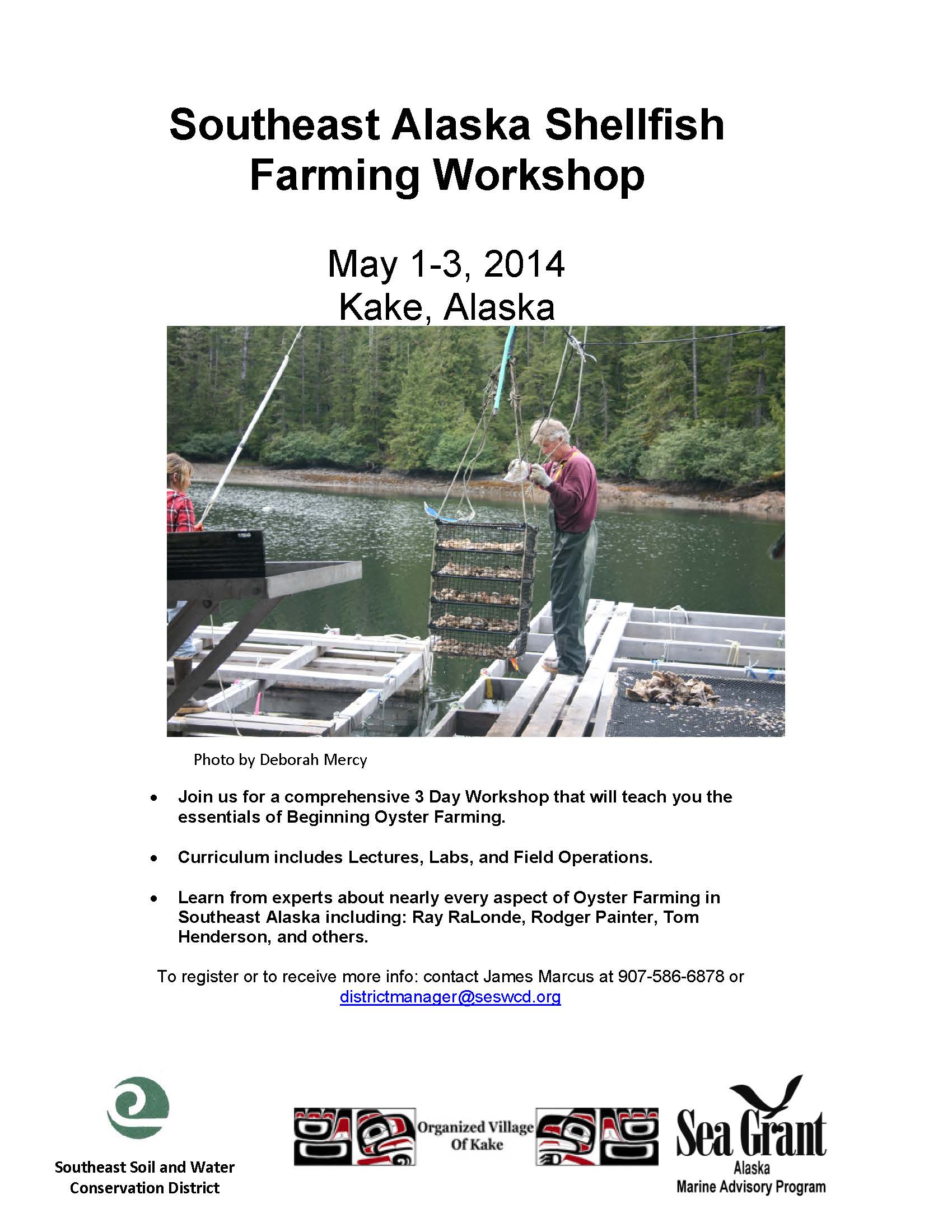
SE SWCD Shellfish Farming Brochure_draft_Page_1

The Southeast Soil and Water Conservation District (SESWCD) will host a comprehensive three-day shellfish mariculture workshop on Thursday through Saturday, May 1-3, in Kake.  (NOTE: Capital City Weekly ran an article covering this event, http://capitalcityweekly.com/stories/051414/new_1206564746.shtml).

This program will be aimed at teaching best management practices to beginning oyster farmers. The workshop curriculum will consist of lectures, labs, and hands-on field operations on working oyster farms. This workshop is open to the public and the District anticipates participation from shellfish farmers in Kake, Hoonah, and Angoon. Participants will learn from experts about nearly every aspect of oyster farming in Southeast Alaska.

The workshop also features a shellfish-oriented educational program at the Kake Community School, as well as a community presentation at 7 p.m. on Thursday, May 1, at the Kake Community Hall Kitchen. Topics at the community presentation include: food security and mariculture, shellfish enhancement activities for subsistence use, indirect economic benefits of mariculture in the community, and commercial aquaculture diversity.

The District’s partners in this project are the Organized Village of Kake and the University of Alaska Fairbanks Sea Grant Marine Advisory Program. Other participating organizations include the Hoonah Indian Association, Haa Aaní LLC, Alaska Division of Economic Development (Alaska Department of Commerce, Communities and Economic Development), and the Alaska Department of Fish and Game.

One of the SESWCD’s strategic focus areas is mariculture development (shellfish farming). The intent is to facilitate increased mariculture development in Southeast Alaska to increase food security and support rural economies. This shellfish farming workshop will be the district’s first project in its mariculture program. The Southeast Soil and Water Conservation District is a statutorily authorized quasi-state agency that leverages public funding with private sources to help the communities of Southeast Alaska become more sustainable and self-sufficient.

To register or receive more info, contact James Marcus at 1-907-586-6878 (Juneau number) or districtmanager@seswcd.org.

• Southeast Soil and Water Conservation District Shellfish Mariculture Workshop in Kake press release (with tentative schedule on second page)

• Alaskans Own community-supported fisheries program announces 2014 season subscription prices

AO flier no tags

Sitka-based Alaskans Own seafood recently announced its subscription prices for its 2014 community-supported fisheries (CSF) program in Sitka, Juneau, and Anchorage. The prices appear to have gone down a tiny bit since the 2013 season.

Alaskans Own was the first CSF program in the state, modeling its program after the successful community-supported agriculture (CSA) programs that let customers deal directly with harvesters so they can buy subscription shares to the year’s crop/catch. In addition to the CSF program, Alaskans Own usually has a table at the Sitka Farmers Markets during the summer.

ErinFultonAshiaLaneAlaskansOwnSeafoodThis is the fifth year of the Alaskans Own CSF program, and there are four-month and six-month subscriptions available. The six-month subscriptions  allow people to keep receiving freshly caught seafood through October instead of August, when the traditional four-month subscriptions end. Half-subscriptions also are available. Subscriptions include a mix of locally caught black cod (sablefish), halibut, king salmon, coho salmon, lingcod and miscellaneous rockfish, depending on the commercial fishing season and prices.

The Alaskans Own program is associated with the Alaska Sustainable Fisheries Trust. The Alaska Sustainable Fisheries Trust’s mission is to strengthen Alaskan fishing communities and marine resources through scientific research, education, and economic opportunity.

Here is Alaskans Own CSF program information for 2014 provided in a recent email sent to the program’s past subscribers and other interested folk:

Hello, Sitka!

It’s that time of year again. The days are getting longer, the herring are back, and Alaskans Own CSF is gearing up for our 2014 season.

This summer looks to be another season filled with even better quality seafood than before. We’d love to have you join us and get access to the great local seafood the Sitka has to offer.

It is difficult to tell, at this point, how prices will trend through the season. Please be assured that we will always bring you the very best value, highest quality seafood that we can, meeting or exceeding the total number of pounds for the plan that you choose. We will make adjustments in specific items to preserve this value. Our small staff gratefully receives assistance from a number of volunteers to help keep costs down. Any and all ‘profits’ go to support the scientific work of the Fishery Conservation Networks.

  • Six months, Full share: $760 (60 pounds, ~ 10 lb. /month)
  • Six months, Half share: $400 (30 pounds, ~ 5 lb./month)s
  • Four months, Full share: $520 (40 pounds, ~ 10 lb./month)
  • Four months, Half share: $280 (20 pounds, ~ 5 lb./month)

To renew your subscription with Alaskans Own, please send me an email, or give me a call on the Alaskans Own phone 907-738-2275(*). Subscriptions can be paid for using cash, check or credit card. You can learn more about what we offer and the work we do on our website: www.alaskansown.com.

Thank you for all your support. I hope you’ll join Alaskans Own again this season to enjoy the best seafood from the finest fishermen in Southeast Alaska.

Cheers,
Erin Fulton, Programs Coordinator, Alaska Sustainable Fisheries Trust

* With the Sitka Sound Science Center under construction, we won’t be in our normal office space — email and the new AO phone will be the best way to reach us, and to schedule an ‘in person’ meeting.

• Sitka Conservation Society publishes resource guide for statewide Fish to Schools programs

Serving Local Fish in School Cafeteria_Page_01

The Sitka Conservation Society, which coordinates Sitka’s Fish to Schools program, has published a new resource guide, A Guide to Serving Local Fish in School Cafeterias, to help other school districts around the state implement similar programs in their communities.

F2S_Elementary2The Sitka Fish to Schools program came out of the 2010 Sitka Health Summit, when local residents chose as one of its community wellness projects to serve more local seafood in our schools. Since then the program has grown so that all students from Grades 2-12 in Sitka have a local seafood lunch option at least twice a month. This includes the Sitka School District schools, Keet Gooshi Heen Elementary School, Blatchley Middle School, Sitka High School, and Pacific High School, plus other local schools, the state-run boarding school Mount Edgecumbe High School and the private K-8 The SEER School.

Sitka is one of the first districts in the state to serve local seafood through the National School Lunch Program and has become a leader in the State of Alaska in getting local foods into schools. In the last three years, the number of schools interested in serving local seafood has increased ten-fold. Haines, Dillingham, Kodiak, Galena, and Juneau are a few of the districts that are now serving seafood in their meal programs.

In an effort to support regional and statewide efforts to serve local foods in schools, the Sitka Conservation Society developed a “how-to” guide to serving fish in schools. Using Sitka as a case study, it outlines procurement and processing strategies, legalities, tips, and recipes. Also included are case studies from around the state that offer tips and suggestions based on the success of their programs.

F2S_Elementary3The Sitka Fish to Schools program has seen an increase in meal participation on fish lunch days, likely attributed to the participation of students who typically bring a sack lunch. One student who reported never liking fish started to eat fish after a local chef came to her classroom. Others students circle fish lunch dates on their school lunch calendar, refusing home lunch that day. And why are they so excited? A middle school student put it this way, “It’s healthy and good for you and you feel good after you eat it.” Others give reasons of wanting to become a fisherman or cite the economic value to their community.

In addition to this guide is the “Stream to Plate” curriculum, a unit of seven lessons that connect salmon to the classroom. The lessons address the ecological significance and human relationship to salmon. These lessons have been tried and refined the last three years with third graders at Keet Gooshi Heen Elementary School.

Chris Bryner, teacher and collaborator on the salmon unit said, “The Fish to Schools curriculum connects my classroom to the community. Students not only learn about a resource relevant to their daily lives, but come away with an understanding that learning happens inside and outside of school.”

As the ninth largest seafood port in the country, Sitka is paving the way for locally-sourced meals. Their efforts are part of a larger national movement, Farm to School, to get local foods in schools. The Alaska Farm to School program honored Sitka’s Fish to Schools program for its innovation a couple of years ago.
celebrate fish to state“The beauty of Fish to Schools is that it provides a practical, local solution to a multitude of current global issues,” Fish to Schools Co-Founder Lexi Fish said. Local sourcing reduces the environmental impact of foods grown and raised thousands of miles away and ultimately supports a more resilient food system.

Local fish in school lunches not only tastes “delicus” (stet), as one third grader put it, but also addresses food justice, nutrition, community sustainability, and conservation. To get a free copy of the guide and curriculum, visit http://sitkawild.org/2014/03/a-guide-to-serving-local-fish-in-school-cafeterias/ or contact Sitka Conservation Society Community Sustainability Organizer Tracy Gagnon at 747.7509 or tracy@sitkawild.org.

Also, don’t forget to stop by the Celebrate Fish to State event from 6:30-7:30 p.m. on Thursday, March 20, at Blatchley Middle School to learn more about the efforts to expand the Fish to Schools program statewide.

• Celebrate Fish to State takes place on March 20 to support statewide Fish to Schools program

celebrate fish to state

SCSCohoPortionsForCookingSitka’s Fish to Schools program has been extremely successful the past three years, and now there’s a movement to make similar programs available statewide. Join us from 6:30-7:30 p.m. on Thursday, March 20, at Blatchley Middle School as we celebrate Fish to State.

This event will celebrate the success of the Sitka Fish to Schools program, which is coordinated by the Sitka Conservation Society and other partners. The event will include short presentations from Sitka School Board President Lon Garrison, Sitka Local Foods Network President Lisa Sadleir-Hart, and Sitka Conservation Society Community Sustainability Organizer Tracy Gagnon. Light refreshments will be available.

The Sitka Fish to Schools program came out of the 2010 Sitka Health Summit, when local residents chose as one of its community wellness projects to serve more local seafood in our schools. Since then the program has grown so that all students from Grades 2-12 in Sitka have a local seafood lunch option at least twice a month. This includes the Sitka School District schools, Keet Gooshi Heen Elementary School, Blatchley Middle School, Sitka High School, and Pacific High School, plus other local schools, the state-run boarding school Mount Edgecumbe High School and the private K-8 The SEER School. The award-winning program has served as a model for a handful of other school districts in Alaska, and now there is a push to make it available statewide with a full curriculum and resource guide, plus financial support.

For more information, contact Ray Friedlander of the Sitka Conservation Society at 747-7509 or ray@sitkawild.org.


• Sitka Sound Science Center presentation will shed light on impacts of Fukushima radiation in the Pacific Ocean

cooperFukushima

People living along the Pacific Coast, including in Sitka and Southeast Alaska, have been wondering about the impacts of radiation in the food supply ever since the March 2011 earthquake in Japan and Fukushima Dai-ichi nuclear power plant meltdown.

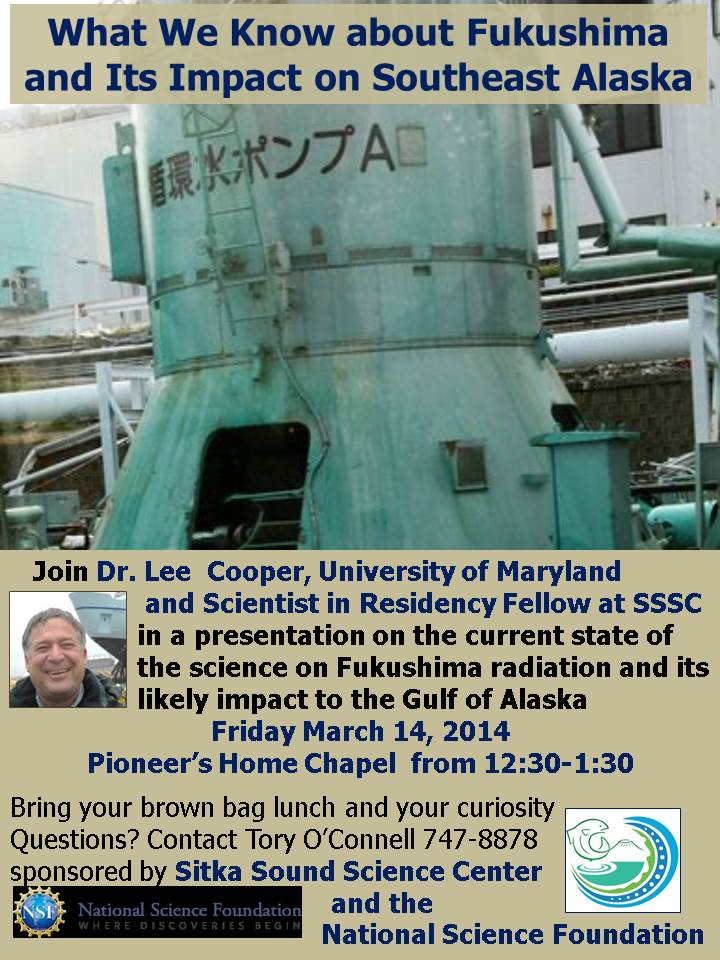
Dr. Lee Cooper of the University of Maryland, a Scientist in Residency Fellow at the Sitka Sound Science Center, will discuss the current state of the science on Fukushima radiation and its likely impact on the Gulf of Alaska during a brown-bag lunch presentation from 12:30-1:30 p.m. on Friday, March 14, at the Sitka Pioneer Home Chapel. Bring your lunch and questions to the presentation, which is sponsored by the Sitka Sound Science Center and the National Science Foundation.

According to the Sitka Sound Science Center:

It is projected that dissolved contaminants, particularly the radioactive isotopes of cesium, 137Cs and 134Cs from the Fukushima Dai-ichi Nuclear Power in Japan, will reach Southeast Alaska this year.  Because the amount of radiation released is uncertain and the accident site is still leaking to some extent, it is difficult to know exactly what the peak concentrations of radioactive cesium will be in local waters, but it is not likely to exceed levels that were observed during the bomb fallout era 40 to 50 years ago. Cesium is chemically very similar to potassium, which is a common ionic salt in seawater, so fortunately the concentration of cesium into the foodweb and into seafood harvested for food is comparatively modest.

Nevertheless, it is important to put into perspective the potential risks involved and communicate this to the public. This talk will summarize the newest scientific information that is available on the impacts of the accident, based upon a special session held in late February at the Ocean Science Meeting in Honolulu and attended by scientists studying Fukushima impacts, ranging from Japan and East Asia to the Woods Hole Oceanographic Institution.

For more information, contact Tory O’Connell at 747-8878.