Do you grow vegetables or fruit or want to? Would you like to meet and learn from other gardeners in Sitka and visit their gardens?
Then come to Sitka Local Foods Network’s first informal, unofficial Garden Club meeting from 7-9 p.m. on Friday, July 15, at 131 Shelikof Way. This is a chance for Sitka gardeners to share successes and discuss problems they may be having with their gardens.
Perry Edwards and Michelle Putz will share their garden and homemade wine (if you are older than 21). Participants will decide the next location and club meeting date (so bring your calendars). If parking looks tight, please walk up from SeaMart. For more information, contact Michelle at 747-2708.
The second batch of classes (Classes Three and Four) for the 2016 Sitka Local Foods Network garden mentor program are being set for our two participating first-year families and our three returning second-year families. The classes will be similar at each location, and they are open to the public.
Class Three is about garden maintenance, while Class Four is about early harvest. Class One focused on site selection, garden preparation, building planter beds, simple vegetables and soil preparation, while Class Two was about simple vegetables and planting. There are six classes in the series, with Class Five about the final harvest and Class Six about preparing the garden for winter.
Our first-year gardener families (Erin Mathes and Fran Baratki), learn how to grow four hardy crops for Sitka — kale, lettuce, potatoes and rhubarb. Our three returning families (A.J. Bastian, Rebecca Kubacki and Breezy) will be planting carrots, chard, green onions and peas this year. These four crops are slightly more difficult crops to grow that our first-year plantings of kale, lettuce, potatoes and rhubarb. Even though the crops for our second-year students are more difficult to grow, many gardeners in Sitka still have good results with these vegetables. These classes are essentially the same, so feel free to attend the Class 3 or Class 4 that best fits your schedule.
The class schedule and location for the one first-year and three second-year families is (some classes still need to be scheduled and will be announced later):
ERIN MATTHES (first-year family), 716 Etolin Street — CLASS 3: 3:30 p.m. on Thursday, June 2; CLASS 2: 3:30 p.m. on Tuesday, June 21.
FRAN BARATKI (first-year family), 180 Price Street, No. 6 (purple trailer) — CLASS 3: 7 p.m. on Tuesday, May 31; CLASS 4: TBA.
A.J. BASTIAN (second-year family), 207 Brady St. — CLASS 3: TBA; CLASS 4: TBA.
REBECCA KUBACKI (second-year family), 1202 Halibut Point Rd. — CLASS 3: 4:30 p.m. on Wednesday, June 1; CLASS 4: 4:30 p.m. on Wednesday, June 22.
BREEZY (second-year family), 616 Sawmill Creek Rd. — CLASS 3: 5 p.m. on Monday, June 6; CLASS 4: 5 p.m. on Monday, June 27.
This is the third year of the garden mentor program, which provides one-to-one mentoring to families who are trying to garden for the first time. In order to reach more people, our participating families allow the classes to be made public. By teaching families the basics of gardening, we are helping them improve their family nutrition, extend their family food budget, and increase food security in Sitka.
Michelle Putz has been contracted to coordinate the program and design lesson plans. We also have about a half-dozen experienced Sitka gardeners who serve as mentors for the program. For more information, please contact Michelle at 747-2708.
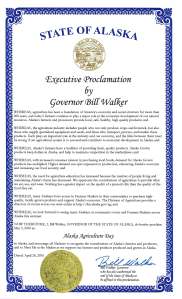
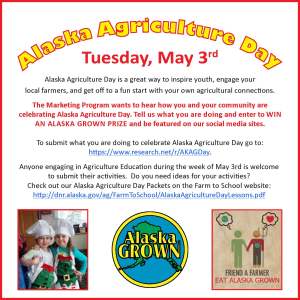
Alaskans will celebrate Alaska Agriculture Day on Tuesday, May 3. On this day, Alaskans are encouraged to support local agriculture by seeking out and purchasing products produced in Alaska and educating youth about the vital role that agriculture plays in our economy.
Here are a few ideas from the Division of Agriculture on how to celebrate Alaska Agriculture Day:
Join the 49,005 people who “like” the Alaska Grown Facebook page at https://www.facebook.com/dnr.alaskagrown and learn about the exciting things Alaskans are producing around the state.
Contact your local agriculture groups/chapters (such as FFA, Farm Bureau, Agriculture in the Classroom etc.) to see if they are hosting an event in your area.
Sign up for a Community Supported Agriculture (CSA) program at a local farm.
Buy and incorporate Alaska Grown products into your meals.
If you are a farmer, consider asking a local school if you can visit a classroom to educate children about your operation and Alaska agriculture.
In Sitka, you can celebrate Alaska Agriculture Day by starting a food garden (even a couple of containers on your deck can provide you with potatoes, carrots or greens). Teachers are encouraged to offer a lesson plan or two about the importance of agriculture in Alaska and in Sitka. Here’s a link to an article about how Sitka was Alaska’s original garden city back in the late 19th and early 20th Centuries. Also, click here to listen to a Sitka History Minute feature about the potato in Sitka from KCAW-Raven Radio).
During the growing season, please support the Sitka farmers and production gardeners listed in the Alaska Grown Source Book (chief contact in parentheses) — Anam Cara Family Garden (Lisa Sadleir-Hart), Blatchley Community Gardens (David Nuetzel), Down To Earth U-Pick Garden (Lori Adams), Finn Island Farm (Keith Nyitray), Sprucecot Gardens (Judy Johnstone), and St. Peter’s Fellowship Farm (Laura Schmidt). There also are a few Sitka farms and production gardens not listed in the Alaska Grown Source Book, such as Sea View Garden (Linda Wilson), The Sawmill Farm (Bobbi Daniels), Sitka Seedling Farms (Matthew Jackson) and Welsh Family Forget-Me-Not Garden (Florence Welsh). Many of these farms and gardens will be vendors during the Sitka Farmers Markets, which start on July 2 this summer.
The Sitka Local Foods Network just sent out the May 2016 edition of its newly launched monthly newsletter. Feel free to click this link to get a copy.
This edition of the newsletter has brief stories about our recruiting new board members, the dates for the 2016 Sitka Farmers Markets, the first classes for the garden mentor program, a garden party at St. Peter’s Fellowship Farm, and a reminder to Plant A Row for the Hungry. Each story has links to our website for more information.
You can sign up for future editions of our newsletter by clicking on the registration form image in the right column of our website and filling in the information. If you received a copy but didn’t want one, there is a link at the bottom of the newsletter so you can unsubscribe. Our intention is to get the word out about upcoming events and not to spam people. We will protect your privacy by not sharing our email list with others.
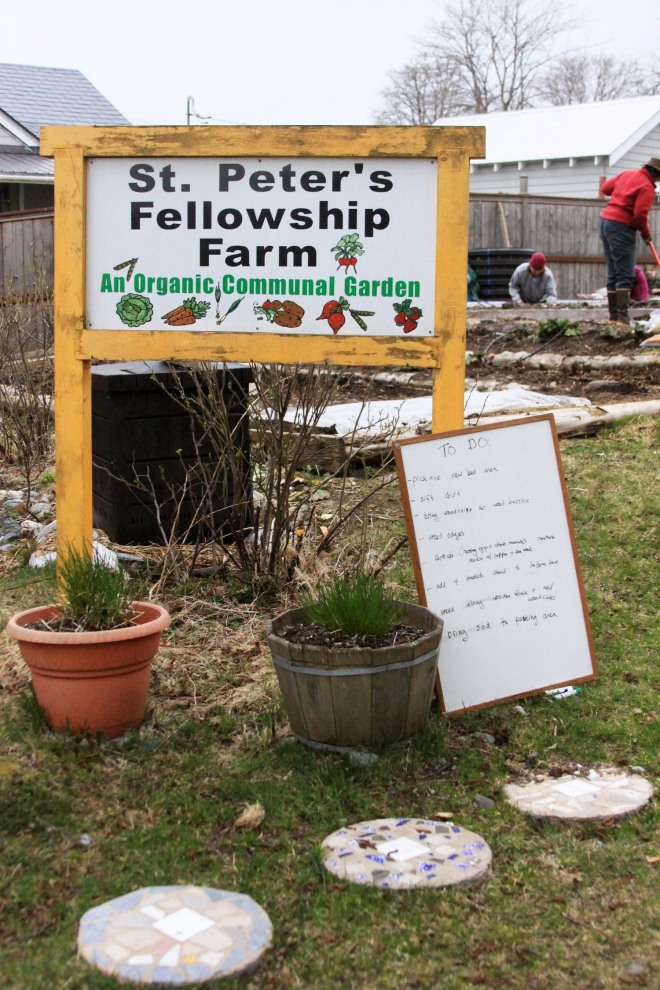
A to-do list of chores at the St. Peter’s Fellowship Farm communal garden
A group of kids harvests garlic during an Aug. 12, 2011, work party at St. Peter’s Fellowship Farm.
Are you interested in meeting other Sitka gardeners and learning about how to grow food in Sitka’s rainy climate? Then join us for a garden party from 2-4 p.m. on Saturday, May 7, at St. Peter’s Fellowship Farm.
St. Peter’s Fellowship Farm is located behind St. Peter’s By The Sea Episcopal Church, 611 Lincoln Street (the brown church with the steeple above Crescent Harbor). It is a communal garden that grows food to be sold at the Sitka Farmers Markets, at a table when Chelan Produce is in town, and used for various school lunch and hunger programs around town. This year’s Sitka Farmers Markets are from 10 a.m. to 1 p.m. on Saturdays, July 2, July 16, July 30, Aug. 13, Aug. 20, Sept. 3, and Sept. 10, at the Alaska Native Brotherhood Founders Hall (235 Katlian St.).
“We will be putting starts in the ground, weeding and prepping beds for planting,” St. Peter’s Fellowship Farm lead gardener Laura Schmidt said.
The garden work parties are kid-friendly, so feel free to bring the munchkins to help.
To learn more, call St. Peter’s Fellowship Farm lead gardener Laura Schmidt at 738-7009 or 623-7003.
(EDITOR’S NOTE: The following article first appeared on this site in April 2010. It is repeated because much of the information remains current and newsworthy.)
In the cold winter of 1994, Anchorage Daily News (now called the Alaska Dispatch News) garden columnist and former Garden Writers Association of America President Jeff Lowenfels was returning to his hotel after a Washington, D.C., event when he was approached by a homeless person who asked for some money to buy food. Lowenfels said Washington, D.C., had signs saying, “Don’t give money to panhandlers,” so he shook his head and kept on walking. But the man’s reply, “I really am homeless and I really am hungry. You can come with me and watch me eat,” stayed with Lowenfels for the rest of his trip.
Jeff Lowenfels
The encounter continued to bother Lowenfels, even as he was flying back to Anchorage. During the flight, Lowenfels came up with an idea when he started writing his weekly garden column (the longest continuously running garden column in the country, with no missed weeks since it started on Nov. 13, 1976). He asked his readers to plant one extra row in their gardens to grow food to donate to Bean’s Café, an Anchorage soup kitchen. The idea took off.
When Anchorage hosted the Garden Writers Association of America convention in 1995, Lowenfels took the GWAA members to Bean’s Café to learn about the Plant A Row For Bean’s Café program. The Garden Writers Association of America liked the idea, and it became the national Plant A Row For The Hungry campaign (also known as Plant A Row or PAR). In 2002, the Garden Writers Association Foundation was created as a national 501(c)(3) nonprofit to manage the Plant A Row For The Hungry program.
“I am not surprised by the growth of PAR,” Lowenfels wrote in an e-mail to the Sitka Local Foods Network. “It is now in all 50 states and across Canada and there are thousands of variations of the original program — from prison gardens for the hungry to botanical gardens donating their produce from public display gardens. This is because gardeners always share information and extra food, so the idea was a natural.”
It took five years for the program to reach its first million pounds of donated food, but the second million only took two years and the next eight years saw a million pounds of donated food (or more) each year. Since 1995, more than 14 million pounds of food have been donated. Not only that, the program is getting ready to expand overseas to Australia, England and other countries with avid gardeners.
“We have supplied something in the vicinity of enough food for 50 million meals,” Lowenfels wrote in his e-mail. “Gardeners can solve this hunger problem without the government. And we don’t need a tea party to do it! Or chemicals, I might add, as author of a book on organic gardening!” Lowenfels is the author of Teaming With Microbes, written with Wayne Lewis. He recently released a second book, Teaming With Nutrients, which is a follow-up to his first book.
According to the U.S. Department of Agriculture, one out of every eight U.S. households experiences hunger or the risk of hunger. Many people skip meals or eat too little, sometimes going an entire day or more without food. About 33 million Americans, including 13 million children, have substandard diets or must resort to seeking emergency food because they can’t always afford to buy the food they need. In recent years, the demand for hunger assistance has increased 70 percent, and research shows that hundreds of children and adults are turned away from food banks each year because of lack of resources.
According to the 2014 Sitka Community Food Assessment Indicators Report, about one in six people in Sitka is food insecure. In 2013, there were 1,410 Sitkans (out of a population of about 9,000) and 766 families receiving food assistance (SNAP, aka food stamps). There also were 229 individuals who received food pantry assistance from the Salvation Army and 7,243 meals served through its lunch soup kitchen in 2013, and that number has grown substantially since then.
While many people credit Lowenfels for creating the Plant A Row For The Hungry program, Lowenfels says the real heroes are the gardeners growing the extra food and donating it to local soup kitchens, senior programs, schools, homeless shelters and neighbors. You can hear him pass along the credit to all gardeners at the end of this 2009 interview with an Oklahoma television station (video also embedded below).
“One row. That’s all it takes. No rules other than the food goes to the hungry. You pick the drop-off spot or just give it to a needy friend or neighbor. Nothing slips between the lip and the cup, I say,” Lowenfels wrote in his e-mail.
For people wanting to Plant A Row For The Hungry in Sitka, there are several places that would love to help distribute some fresh locally grown veggies or berries to those who are less fortunate, such as the Salvation Army, Sitkans Against Family Violence (SAFV), local churches, Sitka Tribe of Alaska and other organizations. The food the Sitka Local Foods Network grows at St. Peter’s Fellowship Farm communal garden goes to the Sitka Farmers Market, school lunches and other programs.
The Sitka Local Foods Network also takes donations of local produce to sell at the Sitka Farmers Markets, and all proceeds are used to help pay for SLFN projects geared toward helping more people in Sitka grow and harvest local food. For more information, contact the Sitka Local Foods Network board members at sitkalocalfoodsnetwork@gmail.com.
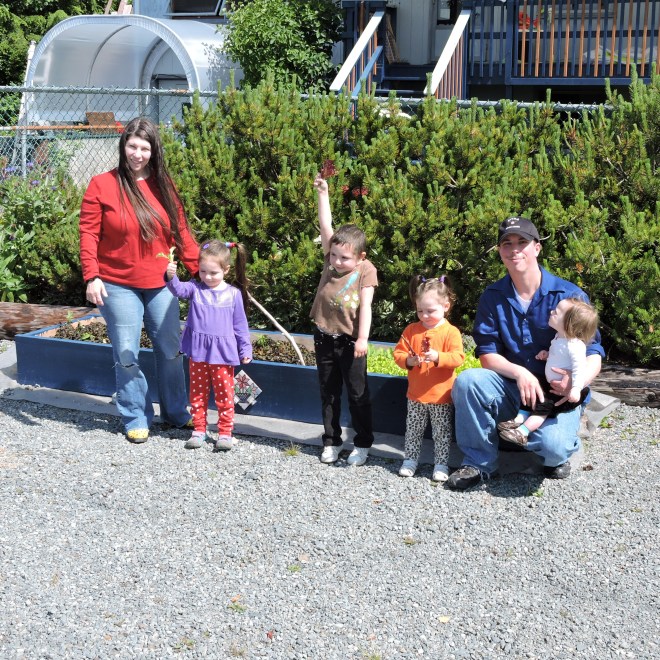
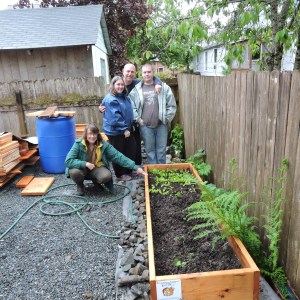
Rebecca Kubacki and her family after planting their garden bed in 2015.
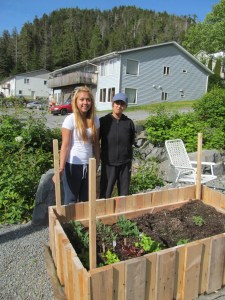
Breezy and her family after planting their garden bed in 2015.
The first two classes for the 2016 Sitka Local Foods Network garden mentor program have been set for our two participating first-year families and our three returning second-year families. The classes will be similar at each location, and they are open to the public. (Note: This post has been updated with our second first-year family and a new time on one of the other classes.)
For our first-year families, the first class will focus on site selection, garden preparation, building planter beds, simple vegetables and soil preparation. The second class will be about simple vegetables and planting. Our first-year gardener families (Erin Mathes and Fran Baratki), learn how to grow four hardy crops for Sitka — kale, lettuce, potatoes and rhubarb.
Our three returning families (A.J. Bastian, Rebecca Kubacki and Breezy) will be planting carrots, chard, green onions and peas this year.These four crops are slightly more difficult crops to grow that our first-year plantings of kale, lettuce, potatoes and rhubarb. Even though the crops for our second-year students are more difficult to grow, many gardeners in Sitka still have good results with these vegetables. These classes are essentially the same, so feel free to attend the Class 1 and Class 2 that best fits your schedule.
The class schedule and location for the one first-year and three second-year families is:
Erin Matthes (first-year family), 716 Etolin Street — CLASS 1: 3 p.m. on Wednesday, April 27; CLASS 2: 3 p.m. on Monday, May 9.
Fran Baratki (first-year family), 180 Price Street, No. 6 (purple trailer) — CLASS 1: Done; CLASS 2: 4:30 p.m. on Monday, May 9.
A.J. Bastian, 207 Brady St. — CLASS 1: Done; CLASS 2: 3:30 p.m. on Thursday, April 28.
Rebecca Kubacki, 1202 Halibut Point Rd. — CLASS 1: Done; CLASS 2: 5:30 p.m. on Monday, May 2.
Breezy, 616 Sawmill Creek Rd. — CLASS 1: 5 p.m. on Thursday, April 28; CLASS 2: 5 p.m. on Thursday, May 5.
This is the third year of the garden mentor program, which provides one-to-one mentoring to families who are trying to garden for the first time. In order to reach more people, our participating families allow the classes to be made public. By teaching families the basics of gardening, we are helping them improve their family nutrition, extend their family food budget, and increase food security in Sitka.
Michelle Putz has been contracted to coordinate the program and design lesson plans. We also have about a half-dozen experienced Sitka gardeners who serve as mentors for the program. For more information, please contact Michelle at 747-2708.
The Alaska Master Gardener online course is an intensive, sustainable gardening class specific to Alaska growing conditions. This is a non-credit, self-paced, online course offered through UAF eLearning using Blackboard Learn. The course fee is $375. Register here for the Summer 2016 Alaska Master Gardener online course — Course Number: ED F595P (50942) or NRM F595P (51014), choose either one when registering.
This curriculum for this online course includes lessons on botany, starting plants, soil, composting, season extension, greenhouses, landscaping, house plants, entomology, pest management, plant disease diagnostics and sustainable gardening. The course also covers growing vegetables, fruits, berries and flowers. The text for the course is Sustainable Gardening: Alaska Master Gardener Manual, which can be purchased for $50 a copy from this link. The text is optional for the course, but it is a good resource for any Alaska gardener even if you’re not taking the course.
Students complete 12 self-paced lessons and quizzes, a book report, participate in ongoing discussions, and complete a final exam. On average, the course takes students approximately three hours per week to complete. The course is pass/fail and the summer course is not for credit.
In addition to the coursework, students also pledge to volunteer at least 40 hours teaching what they’ve learned in their communities. Examples of how students can volunteer include helping with local school garden programs or 4H clubs, working with local foods groups, writing gardening blogs, and more.
The classroom-based Alaska Master Gardener course hasn’t been offered in Sitka for about three years, so the statewide online course is the only way Sitka gardeners can obtain the training until a new Cooperative Extension Service agent is hired in Sitka. Gardeners from Sitka can contact Jasmine Shaw at the Sitka District Office of the UAF Cooperative Extension Service (jdshaw2@alaska.edu or 747-9440) to see if there will be a local classroom at the University of Alaska Southeast Sitka Campus for the online course, otherwise they will need to take it from home.
For more information about the statewide online Alaska Master Gardener course, contact instructor Heidi Rader in Fairbanks at 907-452-8251, Ext. 3477, or by email at master.gardener@alaska.edu
The Sitka Local Foods Network is looking to contract with two Sitka residents to coordinate our garden mentoring education program. This year we’re splitting up the duties, so one of the coordinators will work with our returning families and the other will work with our new families (and be paid slightly more).
These contracts run from spring through fall 2016, and the coordinators will be in charge of developing curricula, teaching classes, obtaining supplies, and providing evaluation of the program. A full list of job duties and expectations can be found in the linked document at the bottom of this article.
Applicants should have at least 3-5 years of varied vegetable gardening experience, preferably in Southeast Alaska. They also should have 3-5 years of project coordination experience, as well as demonstrated communication, organizational, and teaching/mentoring skills.
The garden mentoring project began in 2014 when two families of first-time gardeners were chosen to receive help planning and building a simple garden to grow four relatively easy plants for Sitka (kale, rhubarb, potatoes, lettuce). In 2015, the program was expanded to provide mentoring service to four new first-time gardening families, plus the two families from 2014 will receive a second year of mentoring as they learn to grow plants that are a bit more difficult for Sitka (carrots, peas, chard, green onions).
There are six classes with each family, and they usually are open to the public. In 2016, we expect three returning families and three new families (one of our first-year families from last year asked to repeat as a first-year family this year).
Applicants should submit a letter of interest and resume by 5 p.m. on Friday, April 8, to sitkalocalfoodsnetwork@gmail.com. Please put “Garden Mentor Coordinator” in your email subject line. The contracts pay in three installments over the summer. Questions about the contracts can be directed to sitkalocalfoodsnetwork@gmail.com.
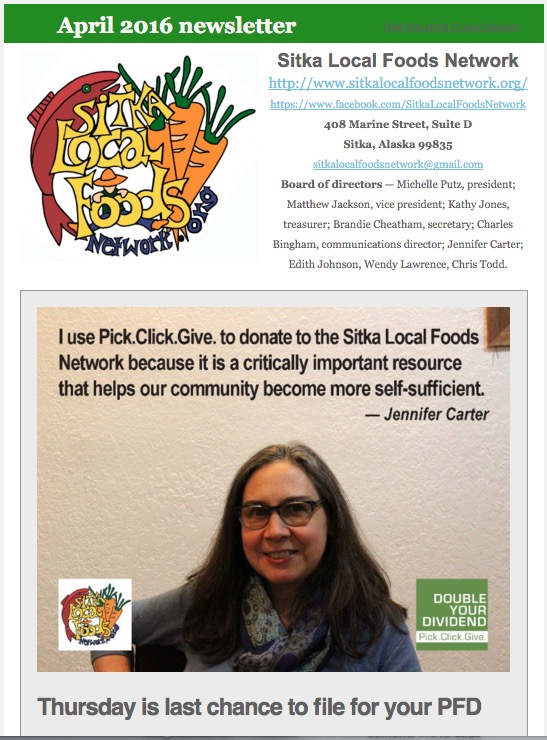
The Sitka Local Foods Network just sent out the April 2016 edition of its newly launched monthly newsletter. Feel free to click this link to get a copy.
This edition of the newsletter has brief stories about how you can donate to the Sitka Local Foods Network through the 2016 Pick.Click.Give. donation program through the Alaska Permanent Fund Dividend application (don’t forget the PFD filing deadline is March 31), a March 29 meeting to discuss changes to the Sitka Farmers Market, and an abundance of education opportunities this spring. Each story has links to our website for more information.
You can sign up for future editions of our newsletter by clicking on the registration form image in the right column of our website and filling in the information. If you received a copy but didn’t want one, there is a link at the bottom of the newsletter so you can unsubscribe. Our intention is to get the word out about upcoming events and not to spam people. We will protect your privacy by not sharing our email list with others.








 Sitka Local Foods Network
You must be logged in to post a comment.