• Sitka shows off its gardens to International Master Garden Conference cruise

StartingGroupHike

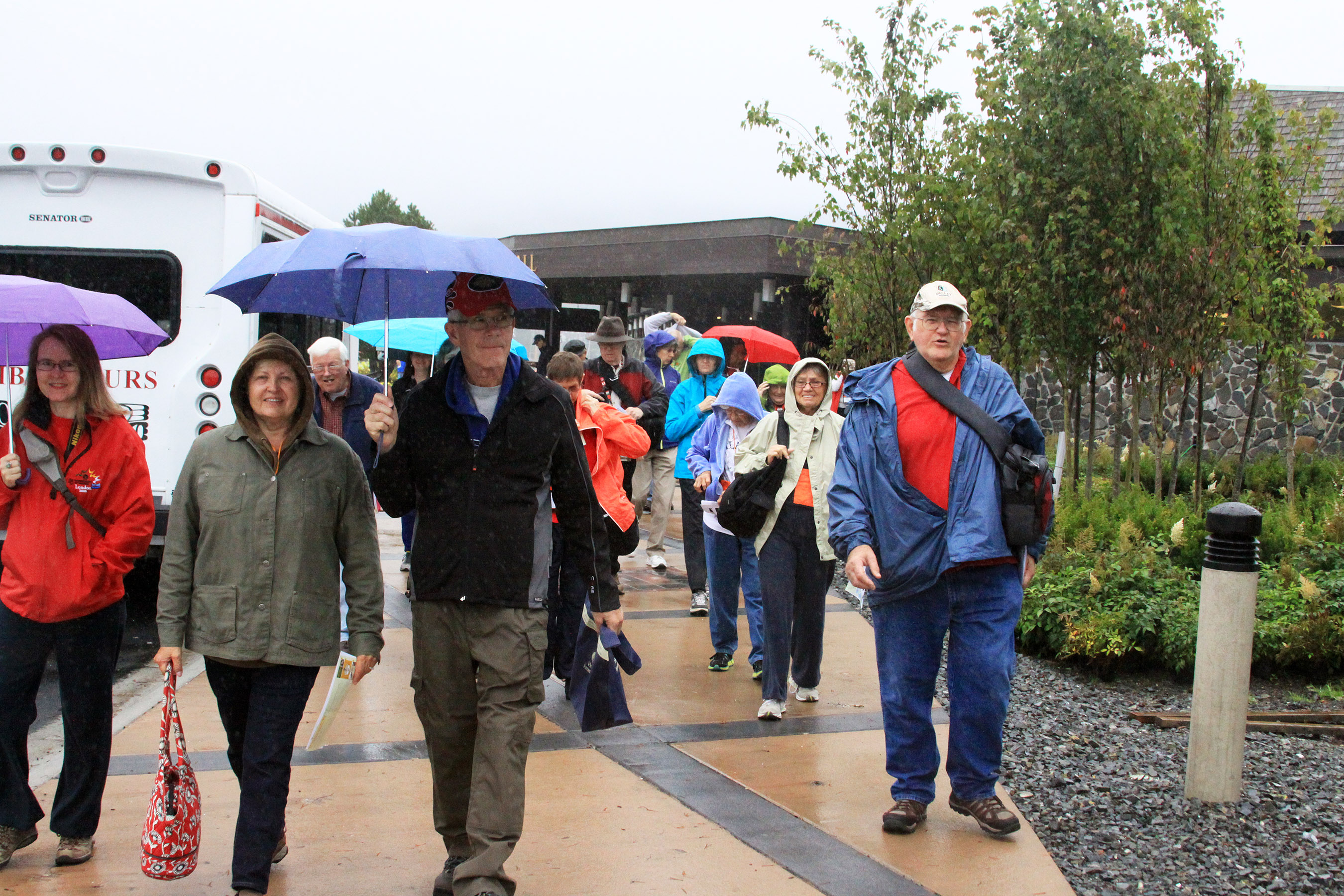
InternationalMasterGardenersConferenceLogoSome 1,100 participants in the 2013 International Master Gardeners Conference were in Sitka on Wednesday, Sept. 11, when the Holland America Lines cruise ship Westerdam docked in town.

As part of the visit, the Sitka District office of the University of Alaska Fairbanks Cooperative Extension Service prepared a walking tour for the conference participants to show off local gardens and other highlights. The walking tour was a unique opportunity to showcase the challenges and methods used to garden in Sitka as well as interact with Master Gardeners from various locales. In addition to visiting Sitka, the Sept. 7-14 cruise took the conference from Seattle to Juneau, Glacier Bay, Sitka, Ketchikan, Victoria (British Columbia) and back to Seattle.

The Sitka walking tour started at Harrigan Centennial Hall and included a stop to look at apple trees by KCAW-Raven Radio, a stop at the Sitka Pioneer Home to look at the roses and other gardens, a stop at the Russian Bishop’s House (where kindergarten students from nearby Baranof Elementary School plant vegetables in the spring and harvest them in the fall when they return as first-graders). From there the walking tour went to St. Peter’s Fellowship Farm (where the Sitka Local Foods Network grows veggies to sell at the Sitka Farmers Markets), then it was on to the Sheldon Jackson Museum and on to Sitka National Historical Park. The final two stops were at a garden on the Sheldon Jackson Campus (between the Yaw Art Center and Hames Athletic and Wellness Center), and on to the US Geological Survey Geomagnetic Station and UAF Cooperative Extension Service demonstration plots (at the site of the original USDA Sitka Experimental Farm (Page 7), which was the first in Alaska and had more than 100 acres of crops from 1898-1931).

Also at Harrigan Centennial Hall, Sitka filmmaker Ellen Frankenstein hosted a couple of showings of her movie “Eating Alaska,” which examines the food choices one makes, especially when they live in Alaska where produce can be marginal but fish and game are widely available.

UAFMasterGardenerProgramLogoThe Master Gardener (MG) program started in Seattle in the 1970s as a way to extend the horticulture resources of Washington State’s land grant university  to the urban horticulture public in Seattle. The Master Gardeners receive 40 hours of training, similar to a basic three-credit-semester-hour, college-level horticulture class.

In return for this low-cost education the MG participants provide 40 hours of service to their community using Cooperative Extension information resources from their home states. The MG service may be in food gardening, pest management, youth gardening, tree and landscape care, public gardens, etc. Since the initial Seattle project, Master Gardener programs now exist in every state in the U.S., as well as Canada, Australia, New Zealand, and other countries. A Master Gardener course was taught in Sitka in April at the University of Alaska Southeast Sitka Campus.

• Sitka garden walking tour map for 2013 International Master Gardeners Conference

This slideshow requires JavaScript.

• A 2010 Sitka Health Summit project starts to bear fruit

RedApplesKCAW

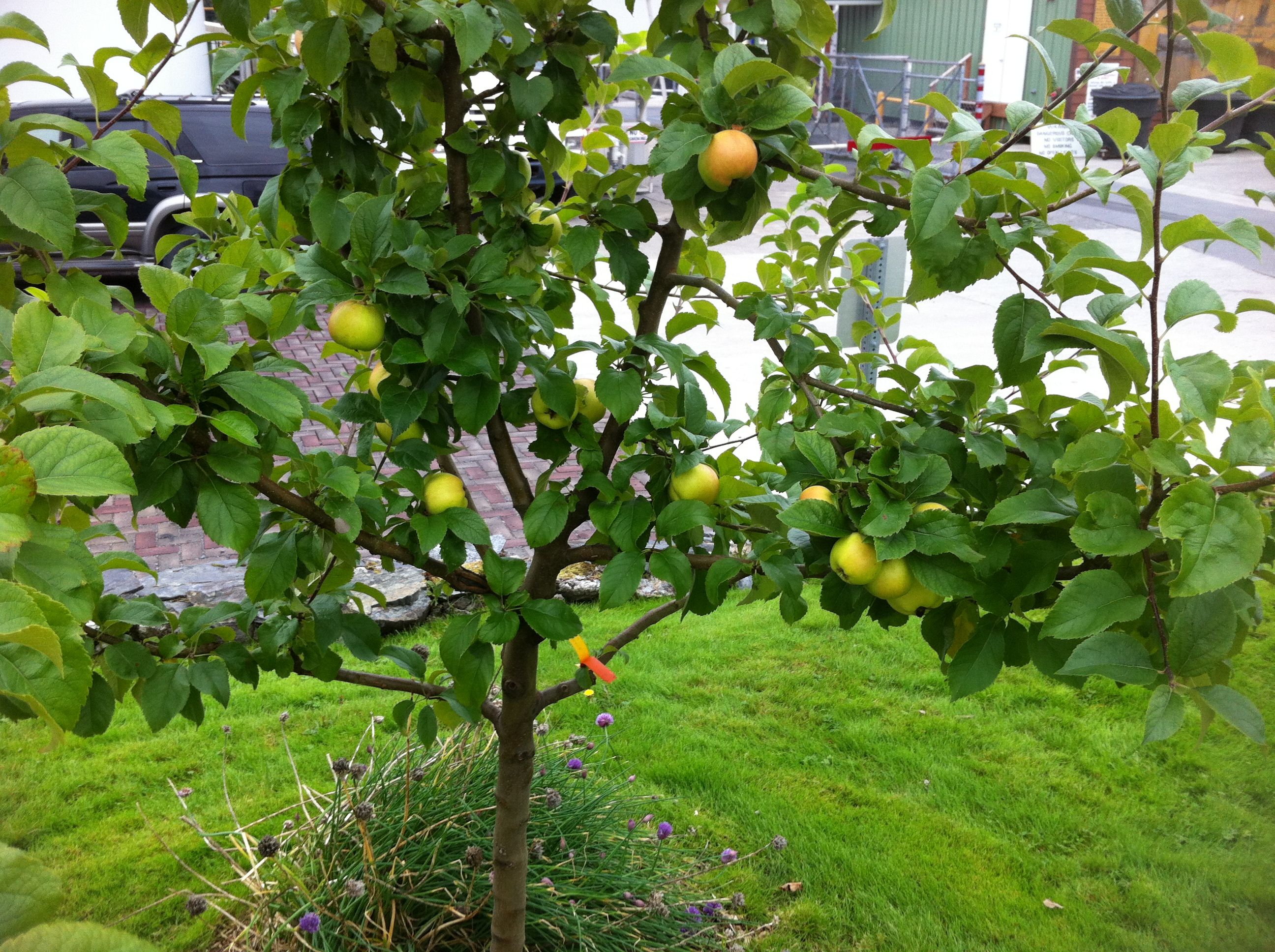
GreenApplesKCAWOne of the 2010 Sitka Health Summit community wellness projects was to plant a bunch of apple, crabapple and cherry trees around town as a way to provide fresh fruit for people as they wander about Sitka.

When we planted the trees, we knew it would take a couple of years before we started seeing any fruit. Several of the trees were planted on public land, with several Sitka residents also buying the saplings to plant at their homes and offices.

On Tuesday, Sept. 10, a couple of the trees planted in front of the historic Cable House (home of the KCAW-Raven Radio station and the Larkspur Café) were full of apples, even though a couple of weeks earlier it didn’t appear these smaller trees had any fruit.  It’s nice to see some of the trees are producing.


• Buying local food during a Southeast Alaska summer

Sitka Local Foods Network Board Vice President Cathy Lieser distributes "Alaska Grown" bumper stickers during the July Fourth parade in Sitka (Photo by Heike Hüttenkofer)

Sitka Local Foods Network Board Vice President Cathy Lieser distributes “Alaska Grown” bumper stickers during the July Fourth parade in Sitka (Photo by Heike Hüttenkofer)

By CATHY LIESER
Sitka Local Foods Network Board Vice President

I am cooking on a boat throughout Southeast Alaska this summer, so on May 5, I planted seeds in my garden, covered it with bird netting and wished it well until my return. The text from my friend read, “the weeds are winning,” luckily I have an herb garden on the boat.

I have been on the hunt for local food in the towns where we provision. It was a late spring, so early on I watched plots greening up and took mental notes. There was kale and rhubarb in Tenakee, with one grower who sells on Friday — The Party Time Bakery — which uses local produce for delicious meals. We bought a rhubarb-berry pie fresh out of the oven and took it back to the boat.

In Juneau, we stocked up at Pinkies Fish Market where the mission is to create a local food economy by sourcing local seafood and other farm fresh items. I toured the Jensen-Olson Arboretum (click here for Facebook page) with Merrill Jensen while he shared about their process toward having a certified virus-free Tlingít potato. The Wild Oven sourdough bakery found me sampling chewy and flavorful loaves that I found out got better with age. At the Second Saturday Market, I bought greenhouse-fresh basil picked that morning.

I barely missed the first Sitka Farmers Market on July 6, but did raid my garden for spinach, kale, lettuce, corn salad and miner’s lettuce. I thank those who watered for me during the hot month of June. Our next boat destination was Petersburg, where I finally arrived on a day where two growers were selling.

The Garden, which participates in the Alaska Grown program, is an abundant oasis of organic produce in the middle of town. Tonna Parker has turned a family lot into a production powerhouse using French intensive methods. For the last four years she has sold direct to the community, just stop by on a Tuesday or Saturday to see what she has available. I bought cucumbers and snap peas that did not make it home, I snacked while Tonna gave me a tour. She has beautiful raised beds, chickens, ducks and compact greenhouses where she is able to grow an astounding variety. Winter squash, pumpkins, tomatoes, cucumbers, zucchini, bok choi, kale, corn salad, arugula, carrots, beans, peas, berries, eggs, the abundance went on and on.

I was incredibly inspired by her approach toward finding varieties that thrive in her micro climate, ones that are tough and aggressive growers. She trials open-pollinated varieties and saves her own seed for many of her plantings. Freely sharing her knowledge, Tonna said she would happily work herself out of a job, she just wants folks to grow local and reap the benefits.

Farragut Farm makes the trip into Petersburg by boat to sell direct twice a month. Marja Smets and Bo Varsano had beautiful, tender and sweet produce for sale. Radishes nearly the size of golf balls, collards, kale, chard, green onions, carrots, garlic scapes, edible flowers, pea shoots, peas, Napa cabbage, turnips, beets, and lettuce. Wow, to have root crops and full-sized heads of Romaine lettuce and cabbage this early on is a testament to dedicated growing. I had heard that Farragut sells to charter boats and indeed I can place an order via email to be picked up one hour on either side of the high tide in Farragut Bay. They will row and deliver to the boat.

If you love fresh flowers, Craig Olson and Deb Hurley of the Flower Farm run a flower CSA.  For a $100 subscription they deliver six bouquets a summer.  Stunning dahlia, snapdragon, campanula, linaria, veronica, delphinum, and ageratum to name a few.  They grow in three hoophouses and three heated greenhouses that were funded with a $20,000 grant from the Petersburg Development Fund. Planting starts on Jan. 9, and 60 percent of their sales are in veggie and flower bedding plants.

Inga’s Galley (click here for Facebook page) is the Petersburg reinvention of Sitka’s late-but-beloved Two Chicks on a Kabob Stick food cart. Amyee Peeler (one of the Two Chicks from Sitka) sources local produce whenever she can, and of course all of the seafood is local.

Unfortunately, the The Market In Petersburg was not happening on the Friday while I was in town, but I hope to hit it on July 19.

I’ll keep looking over the next two months wherever we dock, I am heartened to see folks committed to growing and sourcing the best food in Southeast. If you know of anyone that I’ve missed leave me a note at sitkalocalfoodsnetwork@gmail.com (put “Attention Cathy” in the subject line).

This slideshow requires JavaScript.

• Greater Sitka Arts Council seeks entries for Sitka “state” Fair on Aug. 11

2013 Sitka State Fair flierHave you always wanted to participate in one of the official Alaska State Fairs, but didn’t have the money or time to get to Haines, Palmer or Fairbanks? The Greater Sitka Arts Council is seeking entries, including food entries, for the second annual Sitka “state” Fair, which takes place on Sunday, Aug. 11, at Harrigan Centennial Hall.

“The thinking was there are a lot of people in Sitka with a wide variety of interests and talents and a state fair would give them an opportunity to share them, show them off, and have some good old-fashioned, state-fair-type competition,” said Jeff Budd of the Greater Sitka Arts Council. “We also did it because it seemed like a lot of fun and meets our  stated Vision: Art is vital to a healthy vibrant community, and Mission: To increase awareness of the value of arts in Sitka through education, advocacy and programming. Also, as we were the first capital of Alaska that we deserved a state fair as much as Palmer or Haines.”

Entries will be taken for three age divisions — age 0-10, age 10-17, and age 18-older. Entry fees are $3 per item, with a maximum of nine total entries. Ribbons will be awarded for first, second and third place in each age division and category. Food contest entries should include two samples (one for the judges, one for display). Items are for display only, and no sales will be permitted.

Entries should be dropped off from 8-9 a.m. on Sunday, Aug. 11, at Harrigan Centennial Hall. They will be judged from 9 a.m. to noon, and the fair will be open to the public from noon to 5 p.m. All entries must remain on display until 5 p.m.

Categories to be judged include:

  • Cupcakes
  • Savory Pies
  • Sweet Pies
  • Savory Bread
  • Sweet Bread
  • Artisinal Bread
  • Scones
  • Muffins
  • Jams
  • Jellies
  • Canned Fruit
  • Canned Vegetables
  • Home-Grown Vegetables
  • Hobbies (Crsfts, Collections)
  • Flower Arranging
  • Spam Hors d’Oeuvres
  • Pickling
  • Chickens (Caged)
  • Bunnies (Caged)
  • Vegetable/Fruit Art
  • Canned Fish
  • Smoked Fish

In addition, there also is a “Sitka Tuf” photography contest hosted by the Harry Race Photo Department. To learn more about it, go to the Harry Race website or the Harry Race page on Facebook.

To learn more about the Sitka “state” Fair, go to the Greater Sitka Arts Council website (scroll down for details) or the group’s Facebook page. Entry forms can be downloaded below, or you can get copies at the GSAC office, Room 108 of the Yaw Building on the Sheldon Jackson Campus, or at the Harry Race Photo Department.

• 2013 Sitka State Fair entry form

• Deadline extended on Sitka Community Food Assessment to get more completed surveys

SitkaCommunityFoodAssessmentSign2

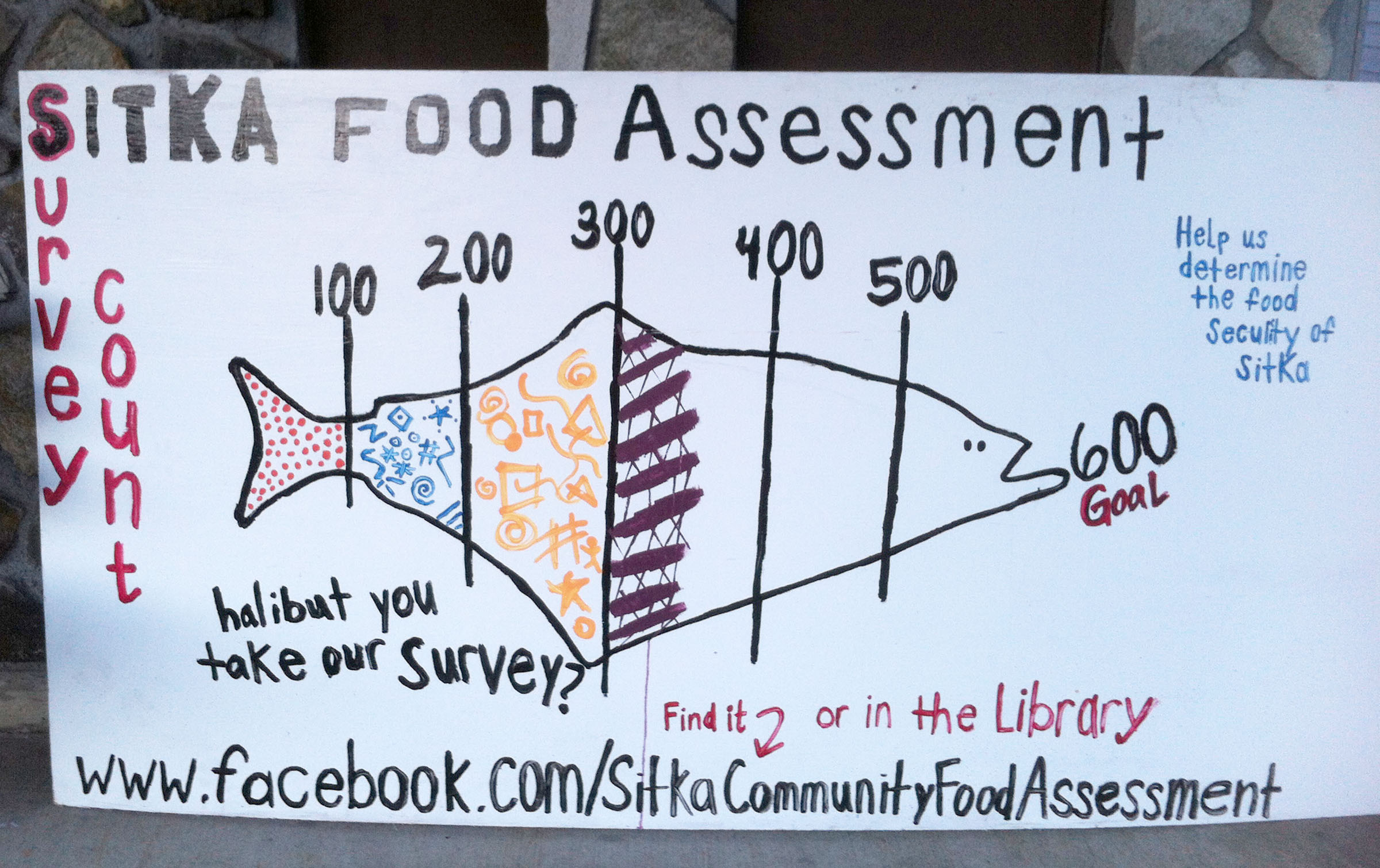
The deadline for surveys to be completed in the Sitka Community Food Assessment has been extended to the end of the month. Our goal is 600 completed surveys and as of Tuesday, May 21, we had 392 that had been recorded.

The Sitka Community Food Assessment is a 2012 Sitka Health Summit project designed to help shape food policy and improve Sitka’s food security. To learn more about the project, KCAW-Raven Radio hosted an interview with project coordinator Lisa Sadleir-Hart that aired on Monday, May 20.

Additional information can be found in this March 26 post on the Sitka Local Foods Network website, and in this April 9 article from the Daily Sitka Sentinel.

Surveys are available online at https://www.surveymonkey.com/s/MQTF22Q, or click the Sitka Community Food Assessment logo in the right column of this webpage. Printed copies are available at Kettleson Memorial Library. A sign has been posted at the corner of Lincoln and Lake streets to update people on the progress of the project.

• Alaskans Own™ community supported fisheries program announces season subscription packages for Sitka, Juneau and Anchorage

AO_LogoSitka-based Alaskans Own seafood recently announced its subscription prices for its 2013 Community Supported Fisheries (CSF) program in Sitka and Juneau, and this year the program will start delivery to Anchorage.

Alaskans Own was the first CSF program in the state, modeling its program after the successful Community Supported Agriculture (CSA) programs that let customers deal directly with harvesters so they can buy subscription shares to the year’s crop/catch.

IMG_2716 (Custom)This is the fourth year of the Alaskans Own CSF program, and this year there are four-month and six-month subscriptions. The six-month subscriptions  allow people to keep receiving freshly caught seafood through October instead of August, when the traditional four-month subscriptions end. Half-subscriptions also are available. Subscriptions include a mix of locally caught black cod (sablefish), halibut, king salmon, coho salmon, lingcod and miscellaneous rockfish, depending on the commercial fishing season. This year there also will be a bonus box of tanner crab from the partner Alaska Marine Conservation Council program in Kodiak.

The Alaskans Own expansion into Anchorage recently was featured on the Alaska Dispatch website. The Alaskans Own program is associated with the Alaska Sustainable Fisheries Trust. The Alaska Sustainable Fisheries Trust’s mission is to strengthen Alaskan fishing communities and marine resources through scientific research, education, and economic opportunity.

Here is Alaskans Own CSF program information provided in a recent e-mail sent to the program’s past subscribers and other interested folk:

Subscription shares are offered again as both a full or half share, 4 month or 6 month option. Subscriptions include a mix of black cod, halibut, king and coho salmon, lingcod and rockfish. Our approximately 1-lb. portions are flash-frozen and vacuum packed—enjoy now or keep frozen for your winter home pack. Pick-ups will take place once per month at the Mill Building/Sitka Sound Science Center in Sitka, at Reliable Transfer near the Nugget Mall in Juneau, and a location TBA in Anchorage.
  
Find all the details about our 4-month and 6-month subscriptions below.
2013 PRICES AND SPECIES MIX*
4-Month Summer Subscriptions (May, June, July, August)
 4-MONTH FULL SHARE: $535 total for 40 pounds of seafood:
Lingcod                  10 lbs.          (May)
Halibut                   4 lbs.          (May)
Black cod               2 lbs.           (June)
Misc. rockfish          8 lbs.          (June)
King salmon             6 lbs.          (July)
Coho salmon           10 lbs.         (August)
4-MONTH HALF SHARE: $290 for 20 pounds of seafood:
Lingcod                  5 lbs.          (May)
Halibut                   2 lbs.          (May)
Black cod               1 lbs.          (June)
Misc. rockfish          4 lbs.          (June)
King salmon             3 lbs.          (July)
Coho salmon            5 lbs.         (August)
 
6-Month Summer-Fall Subscriptions (May, June, July, August, September, October)
6-MONTH FULL SHARE: $795 for 60 pounds of seafood:
Lingcod                 15 lbs.          (8 lbs. May + 4 lbs. September)
Halibut                   6 lbs.          (4 lbs. May + 2 lbs. October)
Black cod               3 lbs.          (2 lbs. June + 1 lb. September)
Misc. rockfish         12 lbs.         (10 lbs. June + 5 lbs. September)
King salmon             9 lbs.          (6 lbs. July + 3 lbs. October)
Coho salmon          15 lbs.          (10 lbs. August + 5 lbs. October)
6-MONTH HALF SHARE: $415 for 30 pounds of seafood:
Lingcod                  8 lbs.          (4 lbs. May + 2 lbs. September)
Halibut                   3 lbs.          (2 lbs. May + 1 lbs. October)
Black cod                2 lbs.          (1 lb. June + 1 lb. September)
Misc. rockfish           6 lbs.         (5 lbs. June + 3 lbs. September)
King salmon             4 lbs.          (3 lbs. July + 1 lb. October)
Coho salmon            7 lbs.          (5 lbs. August + 2 lbs. October)
*The species mix outlined above is subject to change, as we are basing costs on estimated dock prices, which fluctuate throughout the season. For example, if in July king prices are higher than expected, we’ll provide a little less of that species and increase the pounds of coho you receive. Bottom line: we will ensure you get the best mix of seafood for the subscription price. Due to increased costs to shipping, labor, and other logistics, we have had to increase our subscriptions costs minimally this year.
How do you sign up for the 2013 season? Just reply to this email with your name, address, phone number and the subscription package you’d like. We’ll put you on the list and send a confirmation email along with instructions for payment. This year we will offer two different payment options: either send in a check to Alaskans Own or use PayPal on our new Alaska Sustainable Fisheries Trust website. Please do not pay for a share until you receive confirmation for your subscription.
Our first pick will be in late May, date to be announced. However, we expect our subscription slots to fill up soon–so, please don’t delay in getting your name on the list.
We appreciate your continued support of Alaskans Own.
For more information about subscribing, contact Alaskans Own at info@alaskansown.com. For information about the Alaska Sustainable Fisheries Trust, call 907-747-3477 or send e-mail to info@thealaskatrust.org.

• Sitka Community Food Assessment featured in the Tuesday, April 9, issue of the Daily Sitka Sentinel

Courtney Bobsin, a Jesuit Volunteer with the Sitka Conservation Society who is helping the Sitka Community Food Assessment collect data, has her computer logged in and ready to take the survey. (Daily Sitka Sentinel photo by James Poulson, used with permission)

Courtney Bobsin, a Jesuit Volunteer with the Sitka Conservation Society who is helping the Sitka Community Food Assessment collect data, has her computer logged in and ready to take the survey. (Daily Sitka Sentinel photo by James Poulson, used with permission)

(This article originally appeared in the Tuesday, April 9, 2013, edition of the Daily Sitka Sentinel. It is used here with permission.)

Sitkans Taking Stock of Local Food Security

By SHANNON HAUGLAND
Sentinel Staff Writer

SitkaCommunityFoodAssessmentLogoCan you afford to eat the foods you want in Sitka?

How long could you survive on the food you have in your house today?

How often do you eat foods that are gathered locally?

The Sitka Food Security Survey is trying to find the answers to these and other questions related to food security in Sitka.

The survey is one of the projects of the Sitka Community Food Assessment group that was started at the 2012 Health Summit last fall.

“Community food security is looking at how secure are we as a community if for some reason something happened in the Lower 48 and we couldn’t get barges up here,” said Lisa Sadleir-Hart, the community food assessment coordinator for the Sitka Community Food Assessment project. “Are there things we could do differently? … We’re pretty dependent on the food coming from outside.”

The group is looking at food security from both a household standpoint and a community standpoint. While some information has been collected, more is needed on a home-by-home basis, Sadleir-Hart said.

To that end, Sadleir-Hart is hoping residents go online to participate in the food security survey to document where the problems are, where the strengths are and how to start addressing the shortcomings. The assessment will make it easier to apply for grants to help the community strengthen its food security position, she said.

“Our goal is 600 completed surveys, which is about 10 percent of the adult population here,” she said. She has set a tentative deadline by the end of this month.

Among many of the issues considered, Sadleir-Hart wonders how the 44-percent increase in food prices from 2006 to 2011 is affecting choices residents are making.

“Given these increases, fuel prices, housing prices, housing costs, at some point you have to make a decision: if you pay for one you might not be able to pay for something else,” she said. “People are hurting when it comes to food.”

The survey asks whether residents are able to eat as much as they need, and eat the foods they want to eat, or if they make sacrifices or eat less in order to feed others, when they are financially strapped.

Some of the focus in the survey is whether residents take advantage of foods that are available locally, including fish, deer, mushrooms, seaweed and berries, among the dozens of possibilities. Some questions are aimed at traditional and customary foods.

From a community standpoint, some data already indicates a level of “insecurity,” since 95 percent of the food Sitkans consume is shipped in from the Lower 48.

“Does our community have the capacity to feed itself if a natural disaster left us isolated?” is one of the survey’s underlying questions.

The assessment project’s goals are to create a community food security profile; map Sitka’s existing food resources and production capacity; and assess household food security, food accessibility, and food availability and affordability.

The work group for the project said community food security is a relatively new concept that covers a variety of disciplines, including community nutrition, nutrition education, public health, sustainable agriculture, and anti-hunger and community development.

“As such, no universally accepted definition exists,” the group said in a handout.

Sadleir-Hart said community food security can be seen as an expansion of the concept of household food security.

“Whereas household food security is concerned with the ability to acquire food at the household level, community food security focuses on the underlying social, economic and institutional factors within a community that affect the quantity and quality of food available …” the handout said.

Affordability is another issue that can affect community food security, Sadleir-Hart said.

The Sitka Community Food Assessment group from the Sitka Health Summit started by collecting data already available locally. Sitka Conservation Society contributed the Jesuit Volunteer, Courtney Bobsin, to work part-time to collect data on local producers, senior and tribal food programs, food banks and other food assistance programs.

“She’s been collecting lots of great information,” Sadleir-Hart said.

The assessment team is using the Food Security Toolkit from the U.S. Department of Agriculture to guide the process. Sadleir-Hart said the local effort received a head-start on the assessment by looking at Kenai’s food security survey designed by the University of Alaska Fairbanks Cooperative Extension Service. The Sitka Local Foods Network, which runs the Sitka Farmers Market, is also involved in the project.

The Sitka Community Food Assessment project received a $15,000 SEARHC Community Transformation Grant to fund Sadleir-Hart’s part-time position, and data analysis.

The goals of the assessment are to improve Sitka’s understanding of the local food system, identify the system’s strengths and weaknesses, inform decisions about policies and ways to improve Sitka’s security, and position Sitka to access grant funding for food system improvement.

Years ago, Sadleir-Hart said, more people in Sitka had vegetable gardens and some kept milk cows and other farm animals. The potential for increasing the amount of locally produced food still exists, and with it the prospect for economic development.

“There are a lot of different angles we could explore, from a community perspective,” she said.

Focus groups are also being called to continue to collect information about food and the community.

The Sitka Community Food Assessment group is looking ahead to the first annual Sitka Food Summit in November, when citizens review the findings of the data collection and start talking about ways to improve the current food system.

The survey can be reached by typing Sitka Community Food Assessment on Facebook, and going to the “Survey Monkey” link. The survey is filled out anonymously. The direct link to the survey is: https://www.surveymonkey.com/s/MQTF22Q.

• Sitka Community Food Assessment project launches community survey to look at food security and resiliency in Sitka

SitkaCommunityFoodAssessmentLogo

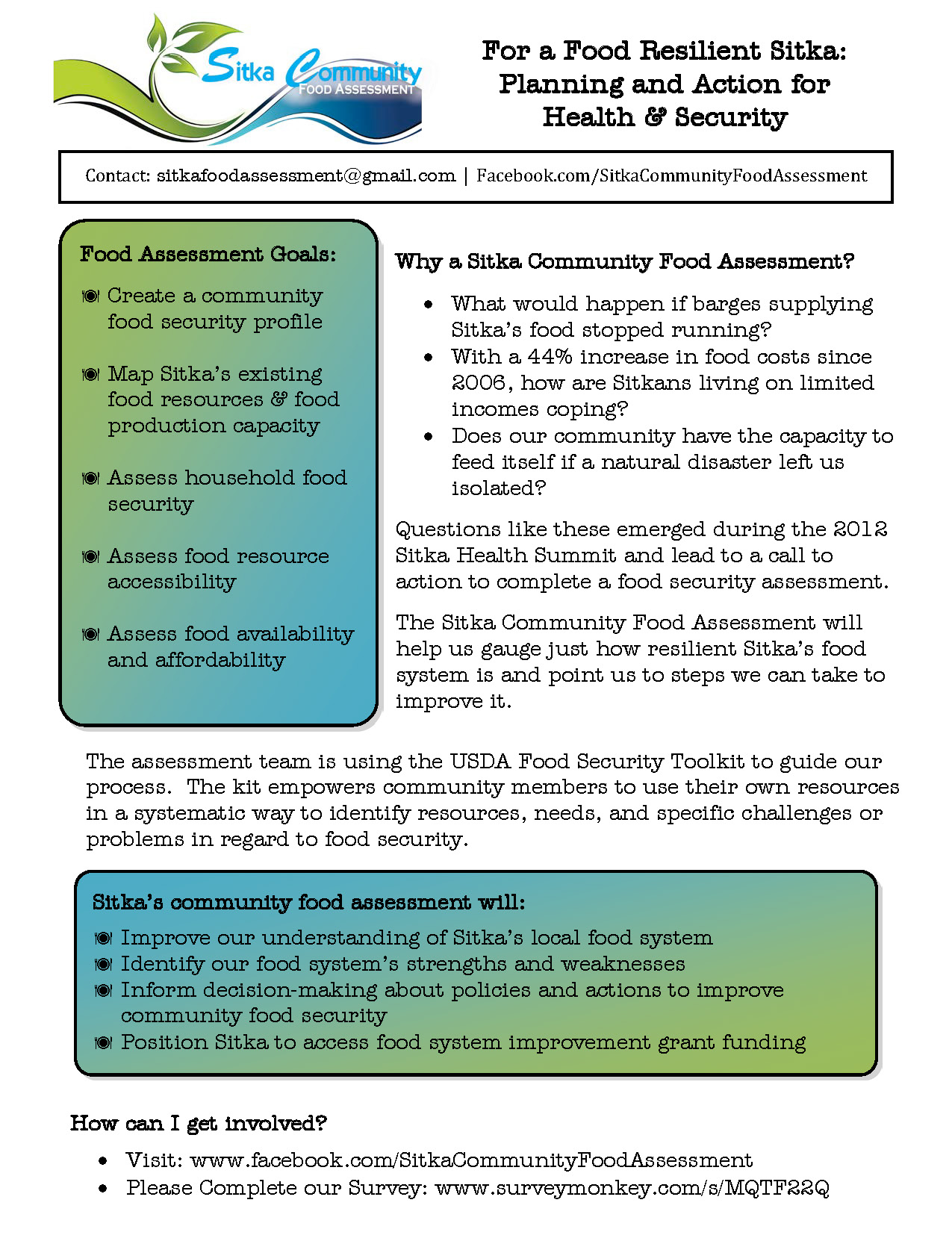
OnepagerFinalThe Sitka Community Food Assessment work group is encouraging Sitkans to complete a 36-question survey that explores questions about local, wild food, seafood, game and plants (i.e., how do you fish, hunt, gather and/or grow). It also explores issues of food security, as well as where folks shop and how much food they store.

The data collected will augment data coming from our secondary data collection efforts, which focuses on sport and subsistence harvest data for fish and game,  as well as data on food assistance programs, food producers and food costs. It also will include focus group data that we will be gathering over the next 4-6 weeks.

FoodAssessmentDefsCollectively, the work group hopes to present the findings at a Sitka Food Summit that will take place in November 2013. Then the group will begin strategic planning to address our issues and improve food access for all Sitkans.

A link to the survey can be found on the Sitka Community Food Assessment page on Facebook (https://www.facebook.com/SitkaCommunityFoodAssessment), or by going directly to the survey at https://www.surveymonkey.com/s/MQTF22Q.

Paper copies of the survey are available at the Kettleson Memorial Library.  The survey is open through the end of April.  For more information, email sitkafoodassessment@gmail.com. This is one of three community wellness projects voted on for this year by Sitka residents attending the 2012 Sitka Health Summit.

• Sitka Community Food Assessment one-page fact sheet

• Sitka Community Food Assessment food security definitions

• Sitka Local Foods Network to host March 26 meeting to discuss Sitka Community Greenhouse and Education Center

Sitka residents interested in building a Sitka Community Greenhouse and Education Center pose with Shane Smith of the Cheyenne, Wyo., Botanic Gardens (front row, second from right) after he spoke at a March 12, 2013, meeting about the greenhouse.

Sitka residents interested in building a Sitka Community Greenhouse and Education Center pose with Shane Smith of the Cheyenne, Wyo., Botanic Gardens (front row, second from right) after he spoke at a March 12, 2013, meeting about the greenhouse.

The Sitka Local Foods Network will host a meeting from 7-8:30 p.m. on Tuesday, March 26, at Harrigan Centennial Hall to continue discussions about creating a Sitka Community Greenhouse and Education Center.

The construction of a community greenhouse will help Sitka increase its access to fresh, locally grown produce all year round. The greenhouse also will serve as an education center, helping local residents learn about what it takes to grow fruits and veggies in Sitka, Alaska. This was a Sitka Health Summit project from 2008 that recently regained momentum.

The group currently is looking to build a 30-foot-by-52-foot greenhouse, possibly at the Sheldon Jackson Campus near the Hames Athletic and Wellness Center. Other locations are being considered, but this has been the best potential offer of a site since the start of the project. To learn more, contact Doug Osborne at 966-8734 or Kerry MacLane at 752-0654.

• Sitka Local Foods Network to host March 12 meeting to discuss Sitka Community Greenhouse and Education Center

Shane-SmithAre you interested in helping Sitka increase its access to fresh, locally grown produce all year round? The Sitka Local Foods Network will host a gathering from 7-8:30 p.m. on Tuesday, March 12, at Harrigan Centennial Hall to discuss plans for the Sitka Community Greenhouse and Education Center.

Building a community greenhouse and education center was a community wellness goal from the 2008 Sitka Health Summit, but over the years there were a few problems (usually with securing land) bringing the project to fruition. It now appears the Sitka Fine Arts Camp will allow us to build a 30-foot–by-52-foot greenhouse on the Sheldon Jackson Campus, next to the Hames Athletic and Wellness Center. This is the closest we’ve come to being able to start building a greenhouse.

In addition to the availability of land, we have been offered locally harvested wood to build the greenhouse frame, which will be modeled after another successful greenhouse built near Sitka in 2011.

Please join us on Tuesday to learn more about this exciting project. In addition, Shane Smith, the executive director and founder of the Cheyenne (Wyo.) Botanic Gardens and author of the Greenhouse Gardener’s Companion, will be at the meeting to provide advice based on his experiences building a similar project. Shane Smith also will give a presentation on greenhouses and high tunnels from 11 a.m. to 12:30 p.m. on Saturday, March 9, at the University of Alaska Southeast Sitka Campus Room 229, and he’ll have a booth at the Let’s Grow Sitka garden education event from noon to 3 p.m. on Sunday, March 10, at the Alaska Native Brotherhood Founders Hall, 235 Katlian St.

“The Sitka Community Greenhouse and Education Center would be a tremendous asset to our town and we’ve never been closer to making that dream become a reality,” Sitka Local Foods Network President Kerry MacLane said.  “Having Shane’s expertise and guidance to draw from just puts us that much closer to making this happen this year.”

For more information, contact Kerry MacLane at 752-0654.