• Sitka Tribe of Alaska to host inaugural Sitka Herring Festival on March 17 to April 12

Herring_Fest_Flyer

HerringBranchesThe inaugural Sitka Herring Festival will feature a variety of events from March 17 through April 12, when the herring return to Sitka to spawn. The event is sponsored by the Sitka Tribe of Alaska Resource Protection Department.

“The festival is a collaborative event to promote the importance of Pacific herring on the ecosystem and the culture of Sitka and the North Pacific Ocean,” event coordinator Jessica Gill said. “A few events to note are: kids’ herring derby, herring dip, fish printing, an educational unit in the schools, and a community potluck scheduled for April 4th. I am currently working on bringing in a scientist from Oxford to give a talk on herring for the potluck, but that will be dependent of funding.”

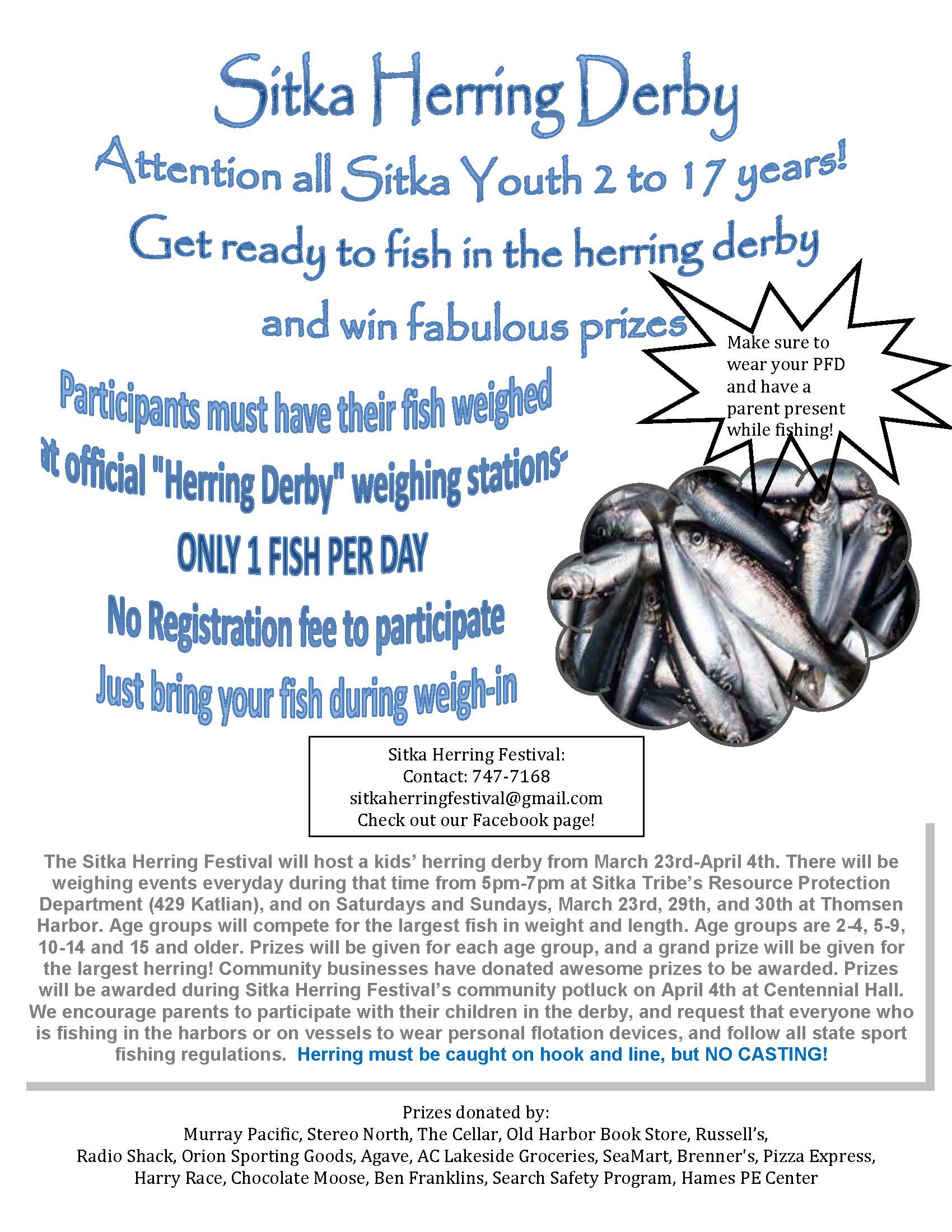
HerringFestSchedule of Events2Among the scheduled events include a blessing of herring rock on a day TBA, the Yaa Khusgé Yaaw Woogoo herring camp for middle school students from March 17-21 at Sitka National Historical Park, a herring fishing derby for kids ages 2-17 from March 23-April 4, a herring class for the Alaska Way of Life 4-H club on March 28, a herring splash swimming event on March 29, a community potluck dinner on April 4, the herring community school fun run on April 5, and a Discovery Days event on April 12 at the Sitka Sound Science Center.

To learn more, please contact Jessica Gill at 747-7168 or by email at sitkaherringfestival@gmail.com. In addition to the event’s new website, there is a Facebook page.

HerringFestDerby Flyer 2014

• Sitka Maritime Heritage Society annual meeting features stories of harvesting and sharing foods from our local waters and shores

annual meet 2014 web

Local food will be the focus when the Sitka Maritime Heritage Society holds its annual meeting on Tuesday, Feb. 25, at the Sheet’ká Kwáan Naa Kahídi. The meeting’s program topic is Harvesting and Sharing Foods from our Waters and Shores: Stories of Sitka’s Oldest Family Tradition. There will be mingling and refreshments starting at 6:30 p.m., with the program running from 7-9 p.m.

The meeting’s format, as in past years, is to have a panel of individuals with stories and experiences to share about the topic. In the second half of the program, the floor will be opened up to stories from the audience. The panel host and moderator will be longtime troller Eric Jordan.

According to the Sitka Maritime Heritage Society’s website:

Being able to get our food for our families from the ocean and shores is a big reason for living here. In fact, for many of us, it’s a big reason to live, period: the collective effort with friends and family, teaching and learning, the satisfaction of a productive day on the water (never dull!), the deep contentment of having food put up to feed our children and elders. As in past annual meetings, we are expecting a lot of laughter, and a lot of learning about our fellow Sitkans, this place we live in, family and history. Oh, and cookies.

For more information about the annual meeting, go to the group’s website, send email to sitkamaritime@gmail.com, or contact new executive director Carole Gibb at 747-3448.


• Sitka School District touts more state investment into local foods for school lunch programs

SCSCohoPortionsForCooking

During its Feb. 4 meeting, the Sitka School Board put its weight behind an effort to increase funding for locally sourced food in schools across the state.

In a resolution to the legislature, the board cited the success of Sitka’s Fish to Schools program as justification for extending a similar statewide program beyond one year. Nutritional Alaskan Food for Schools (NAFS) was introduced by Rep. Bill Stoltze (R-Anchorage) in 2012, and piloted last year. This year the governor has included funding of $3 million dollars for the program — but only for one year. All schools in Alaska will receive funding from the program, based on student population. The Sitka School District and state-run Mount Edgecumbe High School received $39,000 from the program last year, which mostly went for seafood purchases (Mount Edgecumbe did buy some potatoes from Gustavus, and Pacific High School bought some vegetables from St. Peter’s Fellowship Farm).

In late January, Tracy Gagnon, who coordinates the Fish to Schools program for the Sitka Conservation Society, submitted the following letter to the editor to the Daily Sitka Sentinel outlining the reasons to support the program.

Nutritional Alaskan Foods for Schools

Dear Editor,

Sitka is one of the first communities in Alaska to push for local foods in schools through the Fish to Schools program; now it’s time to go state-wide. The Governor has included in his FY15 budget state funding to reimburse school districts for their purchases of Alaskan grown or caught foods through the Nutritional Alaskan Foods for Schools program (NAFS). This makes it possible for schools to serve local, nutritious foods to their students, sourcing from farmers, fishermen, and processors in or around their communities. NAFS improves Alaska’s food security and helps us create a more sustainable local food system.

Representative Stoltze proposed NAFS in 2011, and more than 100 vendors and 48 school districts benefited from this legislation in the 2012-2013 school year. Nearly 90 percent of those 48 school districts purchased local seafood.

Every year food producers and school food service providers wait anxiously every spring for NAFS to pass. And usually it’s too late for farmers to meet the extra demand because they’ve already planted their crops and food service has already purchased other foods. Making this funding permanent would provide both food service and food producers the consistency necessary for advanced planning and coordination of harvest to ensure supply meets demand.

The Sitka Conservation Society thanks both the leadership of Representative Stoltze and Governor Parnell for including NAFS in his proposed budget. We urge Alaska Legislators to support the permanent funding of a program that increases Alaska’s food security, catalyzes Alaska’s food production, supports local communities, and improves the health of our students.

Tracy Gagnon
Community Sustainability Organizer
Sitka Conservation Society

• How to weed through the conflicting information about Fukushima radiation and its impacts on Alaska waters

SalmonImage

Alaskans have been worried about their seafood ever since the March 2011 Fukushima earthquake and Japanese nuclear plant problems. It’s understandable that Alaskans are concerned about the safety of the seafood, seaweed and marine mammals in the area. But Alaskans also should note that most of the information posted on social marketing sites just isn’t true.

This NOAA map has been showing up on social media posts with a note that it shows the path of 300 tons of radioactive material entering the ocean each day. This map really shows the probable tsunami paths from the 2011 Tohoku earthquake.

FALSE IMAGE: TSUNAMI WAVES, NOT RADIATION: Many people have posted on social media that this NOAA map shows the path of 300 tons of radioactive material entering the ocean each day. This map really shows the probable tsunami wave heights from the 2011 Tohoku earthquake.

One of the biggest examples of false information usually is accompanied by an official-looking map from the National Oceanic and Atmospheric Administration (NOAA) and a note that each day the map shows 300 tons of radioactive material entering the water each day. The map is an official NOAA map, but it doesn’t show radiation. It actually shows the probable tsunami paths from the 2011 Tohoku earthquake. When in doubt, or even if not, don’t be afraid to consult one of the myth-debunker sites such as Snopes.com, which has the details on the real story behind this map.

The Sitka Local Foods Network has been following the situation since it happened, and we even posted an update in March 2012 in hopes of easing people’s worries (many of the links on this page have been updated). The Alaska Department of Health and Social Services also has a site with updates.

In recent weeks, Rep. Jonathan Kreiss-Tomkins (D-Sitka) did some research, interviewing Dr. Ken Buesseler of the Woods Hole Oceanographic Institution and one of the country’s top researchers on oceanographic radiation. Rep. Kreiss-Tomkins posted his findings in his Jan. 8 constituent newsletter, and that write-up also appeared in several Alaska publications such as the Alaska Dispatch.

010714_Fukushima-Radiation-GraphAlso in January, Alaska Department of Environmental Conservation Commissioner Larry Hartig gave an update to the Alaska Senate’s Natural Resources Committee about what it’s doing to track the radiation, and he said so far the DEC hasn’t seen anything to cause concern. The Ketchikan website Stories In The News also had a follow-up story that included information from Hartic’s testimony and an update from Buesseler, who announced the launch of a new “How Radioactive Is Our Ocean?” website to help crowd-source information about what’s happening along the 5,000-mile Pacific coastline.

Taking things a step further, in January a couple of Seattle media organizations — KPLU and the Seattle Times — ran stories about Seattle fish-broker Loki Fish Co. ran its own tests on Alaska seafood. After the testing, the folks at Loki Fish Co. decided Pacific salmon is safe to eat.

• Sitka Herring Festival to host benefit dinner on Sunday, Nov. 17

Herring_Fest_Flyer

The inaugural Sitka Herring Festival will host a benefit dinner at 5:30 p.m. on Sunday, Nov. 17, at the Sitka Elks Club.

The Sitka Herring Festival will take place in the spring of 2014, when the herring return to Sitka to spawn. The event is sponsored by the Sitka Tribe of Alaska Resource Protection Department.

“The festival is a collaborative event to promote the importance of Pacific herring on the ecosystem and the culture of Sitka and the North Pacific Ocean,” event coordinator Jessica Gill said. “A few events to note are: kids’ herring derby, herring dip, fish printing, an educational unit in the schools, and a community potluck scheduled for April 4th.  I am currently working on bringing in a scientist from Oxford to give a talk on herring for the potluck, but that will be dependent of funding.”

To learn more, please contact Jessica Gill at 747-7168 or by email at sitkaherringfestival@gmail.com. In addition to the event’s new website (still under construction), there is a Facebook page.

• Sitka Community Food Assessment findings to be presented Nov. 14 at inaugural Sitka Food Summit

Sitka Food Summit Flyer

SitkaCommunityFoodAssessmentLogoThe Sitka Community Food Assessment work group will present its findings during the inaugural Sitka Food Summit, from 6-9 p.m. on Thursday, Nov. 14, at Harrigan Centennial Hall.

A 2012 Sitka Health Summit project, the Sitka Community Food Assessment has examined where Sitka residents get their food, what types they eat, what they grow, what they hunt and fish for, where they shop, what type of access people have to healthy food, and other questions about Sitka’s food supply. The findings of the food assessment will help Sitka improve its food security.

“The Sitka Community Food Assessment work group decided early on that there needed to be an opportunity for Sitka to engage with the food data and shape the writing of the food assessment indicator report,” project coordinator Lisa Sadleir-Hart said. “The inaugural Sitka Food Summit will use a format that was first tested in the late 1990s when the Island Institute was developing Sitka’s initial indicator report.  We’ll interact individually with the data, then use a conversation café model to discuss what the data brings up for us as Sitkans.  The working group wanted to create a venue that meets the needs of a wide range of citizens.”

The event sponsors include the Sitka Community Food Assessment Work Group from the Sitka Health Summit, Alaskans Own Seafood, the Sitka Food Co-op, Sitka Community Hospital, the SouthEast Alaska Regional Health Consortium (SEARHC) Community Transformation Grant and Diabetes Prevention programs, the Sitka Local Foods Network, the Southeast Soil and Water Conservation District, and Sitka Tribe of Alaska. There also will be refreshments thanks to Sitka Community Hospital’s Basement Bistro, St Peter’s Fellowship Farm and Sitka Conservation Society staff.

For more information, contact Lisa Sadleir-Hart at 747-5895 or sitkafoodassessment@gmail.com. (Editor’s note: A few photos from the Sitka Food Summit are posted below.)

This slideshow requires JavaScript.

• Fish to Schools serves up a coho lunch Wednesday to start off the school year

SCSCohoPortionsForCooking

Fish to Schools Flyer_2013-2014The Fish to Schools program kicked off its 2013-14 school year with a coho salmon lunch (baked with salt and pepper) on Wednesday, Sept. 11, at Sitka High School, Blatchley Middle School and Keet Gooshi Heen Elementary School.

The Fish to Schools program is a project that came out of the 2010 Sitka Health Summit, and now is coordinated by the Sitka Conservation Society. Local commercial fishermen have been donating fish to the program this summer, helping sustain the program through the school year.

The fish lunches are served at Sitka High School, Blatchley Middle School and Keet Gooshi Heen Elementary School on the second and fourth Wednesdays of the month. The students at Pacific High School (Sitka’s alternative high school where the students do the cooking) and Mount Edgecumbe High School also have Fish to Schools, but they are served on a different schedule at those schools. A schedule for upcoming Fish to Schools lunches is posted to the right.

For more information about the Fish To Schools program, contact Tracy Gagnon at the Sitka Conservation Society at 747-7509 or tracy@sitkawild.org. Also, the Stream to Plate program, a companion program of Fish to Schools, recently was featured on Delish.com in a feature about “Cool Cafeterias: The New Wave of School Lunch.”

• Sitka’s ‘Fish To Schools’ program puts out call to commercial fishermen for donations

Fishermen_Donation_Updated Aug2013

The Fish To Schools program in Sitka has put out the call looking for donations of commercially caught fish for the upcoming school year. Donations are being accepted from Aug. 18-25 at Sitka Sound Seafoods and Seafood Producers Cooperative. (NOTE, the time period for donations has been extended. Please call the numbers below to see if more fish still is needed.)

SCS-031_smFishToSchoolsTacoThe Sitka Fish To Schools project (click here to see short video) got its start as a community wellness project at the 2010 Sitka Health Summit, and now is managed by the Sitka Conservation Society. It started by providing a monthly fish dish as part of the school lunch as Blatchley Middle School, and since then has grown to feature regular fish dishes as part of the lunch programs at Keet Gooshi Heen Elementary School, Blatchley Middle School, Sitka High School, Pacific High School (where the alternative high school students cook the meals themselves) and Mount Edgecumbe High School.

In addition to serving locally caught fish meals as part of the school lunch program, the Fish To Schools program also brings local fishermen, fisheries biologists and chefs to the classroom to teach the kids about the importance of locally caught fish in Sitka. The program received an innovation award from the Alaska Farm To Schools program during a community celebration dinner in May 2012, and now serves as a model for other school districts from coastal fishing communities.

Due to state regulations, the Sitka Fish To Schools program can only accept donations of fish that have been commercially caught, and it cannot accept fish from sport or subsistence fishermen. The donation period is timed with the coho salmon season, and fishermen can get more information or pledge a donation by contacting Beth Short-Rhodes at 738-9942 or elianise@yahoo.com.

For more information about the Fish To Schools program, contact Tracy Gagnon at the Sitka Conservation Society at 747-7509 or tracy@sitkawild.org.

• Sitka joins communities around the world to host a local March Against Monsanto on Saturday, May 25

March Against Monsanto Yellow 72Millions of people around the world, including several in Sitka, will take a stand by hosting a local March Against Monsanto. The Sitka march takes place at 2 p.m. on Saturday, May 25, at Castle Hill. So far, more than 370 marches around the world are planned on May 25.

The Sitka March Against Monsanto is being organized by Brett Wilcox, who has created a Facebook page with more details. Brett and his 14-year-old son, David, will take things a step (OK, many steps) further when they start a transcontinental run across the country in January to raise awareness about some of the ethically challenged practices of the agri-business Monsanto. These include creating GMO (genetically modified) foods that are unlabeled and untested, putting patents on crop seed so farmers have to pay high fees to plant food, and more.

In addition to the march, various Sitka residents will speak on a variety of topics, such as how GMO-food causes health problems, the number of former Monsanto executives who now work for our government, farmer suicides in India due to Monsanto practices, the Monsanto Protection Act slipped into the recently passed US Farm Bill, etc.

This month, Brett hosted free Monsanto Movie Nights at 7 p.m. on Fridays, May 10, 17 and 24, at Harrigan Centennial Hall.

According to a press release about the event:

Sitka’s March Against Monsanto will be held on Castle Hill, the location where Russia sold the vast territory of Alaska—land it did not own—to the U.S.A.

March organizer, Brett Wilcox, chose Castle Hill for Sitka’s March Against Monsanto for its symbolic significance. “There are many similarities between the original ‘Land Grab’ that took place with the first European expansion and Monsanto’s current global ‘Seed Grab,'” Wilcox states. “Both involve the privatization of Nature, a concept that was largely foreign to Native Americans and Alaska Natives. And both have resulted in loss of freedom and loss of life. The difference is that Monsanto’s seed grab not only further disenfranchises Native Americans; it disenfranchises all nations and all people. The citizens of the world are, as it were, sitting in our canoes in Sitka Sound, watching powerful people and corporations claim and repackage life as their own, thereby stealing our seed sovereignty and seed freedom.”

Chuck Miller, a Tlingit “Elder in Training”, will preside at the event. “My grandmother used to teach my family that we need to treat our food with respect or it will not provide for us,” Miller states. “My ancestors’ teachings are still a very big part of my life and I want to be able to pass that on to my children, grandchildren and those yet to come. GMOs are not the way to treat Mother Earth and the generations yet to come. I urge all the Native people of Alaska and our non-Native brothers and sisters to come and support this cause.”

“Sitka’s March Against Monsanto will not be a traditional march,” says Wilcox. “Sitka’s event will be a ceremony to honor nature as well as the indigenous people of Alaska and the Americas. We will stand on Castle Hill united with the people of the world in defense and protection of life and nature.”

For more information about the Sitka March Against Monsanto, contact Brett Wilcox at 747-7437 or brett@runningthecountry.com, or contact Chuck Miller at 752-9955 or cohomojo25@yahoo.com. KCAW-Raven Radio aired a story on Tuesday, May 21, about Brett’s and David’s plans to run across the country and to host this march. Brett also recorded a commentary for KCAW-Raven Radio.

• Alaskans Own™ community supported fisheries program announces season subscription packages for Sitka, Juneau and Anchorage

AO_LogoSitka-based Alaskans Own seafood recently announced its subscription prices for its 2013 Community Supported Fisheries (CSF) program in Sitka and Juneau, and this year the program will start delivery to Anchorage.

Alaskans Own was the first CSF program in the state, modeling its program after the successful Community Supported Agriculture (CSA) programs that let customers deal directly with harvesters so they can buy subscription shares to the year’s crop/catch.

IMG_2716 (Custom)This is the fourth year of the Alaskans Own CSF program, and this year there are four-month and six-month subscriptions. The six-month subscriptions  allow people to keep receiving freshly caught seafood through October instead of August, when the traditional four-month subscriptions end. Half-subscriptions also are available. Subscriptions include a mix of locally caught black cod (sablefish), halibut, king salmon, coho salmon, lingcod and miscellaneous rockfish, depending on the commercial fishing season. This year there also will be a bonus box of tanner crab from the partner Alaska Marine Conservation Council program in Kodiak.

The Alaskans Own expansion into Anchorage recently was featured on the Alaska Dispatch website. The Alaskans Own program is associated with the Alaska Sustainable Fisheries Trust. The Alaska Sustainable Fisheries Trust’s mission is to strengthen Alaskan fishing communities and marine resources through scientific research, education, and economic opportunity.

Here is Alaskans Own CSF program information provided in a recent e-mail sent to the program’s past subscribers and other interested folk:

Subscription shares are offered again as both a full or half share, 4 month or 6 month option. Subscriptions include a mix of black cod, halibut, king and coho salmon, lingcod and rockfish. Our approximately 1-lb. portions are flash-frozen and vacuum packed—enjoy now or keep frozen for your winter home pack. Pick-ups will take place once per month at the Mill Building/Sitka Sound Science Center in Sitka, at Reliable Transfer near the Nugget Mall in Juneau, and a location TBA in Anchorage.
  
Find all the details about our 4-month and 6-month subscriptions below.
2013 PRICES AND SPECIES MIX*
4-Month Summer Subscriptions (May, June, July, August)
 4-MONTH FULL SHARE: $535 total for 40 pounds of seafood:
Lingcod                  10 lbs.          (May)
Halibut                   4 lbs.          (May)
Black cod               2 lbs.           (June)
Misc. rockfish          8 lbs.          (June)
King salmon             6 lbs.          (July)
Coho salmon           10 lbs.         (August)
4-MONTH HALF SHARE: $290 for 20 pounds of seafood:
Lingcod                  5 lbs.          (May)
Halibut                   2 lbs.          (May)
Black cod               1 lbs.          (June)
Misc. rockfish          4 lbs.          (June)
King salmon             3 lbs.          (July)
Coho salmon            5 lbs.         (August)
 
6-Month Summer-Fall Subscriptions (May, June, July, August, September, October)
6-MONTH FULL SHARE: $795 for 60 pounds of seafood:
Lingcod                 15 lbs.          (8 lbs. May + 4 lbs. September)
Halibut                   6 lbs.          (4 lbs. May + 2 lbs. October)
Black cod               3 lbs.          (2 lbs. June + 1 lb. September)
Misc. rockfish         12 lbs.         (10 lbs. June + 5 lbs. September)
King salmon             9 lbs.          (6 lbs. July + 3 lbs. October)
Coho salmon          15 lbs.          (10 lbs. August + 5 lbs. October)
6-MONTH HALF SHARE: $415 for 30 pounds of seafood:
Lingcod                  8 lbs.          (4 lbs. May + 2 lbs. September)
Halibut                   3 lbs.          (2 lbs. May + 1 lbs. October)
Black cod                2 lbs.          (1 lb. June + 1 lb. September)
Misc. rockfish           6 lbs.         (5 lbs. June + 3 lbs. September)
King salmon             4 lbs.          (3 lbs. July + 1 lb. October)
Coho salmon            7 lbs.          (5 lbs. August + 2 lbs. October)
*The species mix outlined above is subject to change, as we are basing costs on estimated dock prices, which fluctuate throughout the season. For example, if in July king prices are higher than expected, we’ll provide a little less of that species and increase the pounds of coho you receive. Bottom line: we will ensure you get the best mix of seafood for the subscription price. Due to increased costs to shipping, labor, and other logistics, we have had to increase our subscriptions costs minimally this year.
How do you sign up for the 2013 season? Just reply to this email with your name, address, phone number and the subscription package you’d like. We’ll put you on the list and send a confirmation email along with instructions for payment. This year we will offer two different payment options: either send in a check to Alaskans Own or use PayPal on our new Alaska Sustainable Fisheries Trust website. Please do not pay for a share until you receive confirmation for your subscription.
Our first pick will be in late May, date to be announced. However, we expect our subscription slots to fill up soon–so, please don’t delay in getting your name on the list.
We appreciate your continued support of Alaskans Own.
For more information about subscribing, contact Alaskans Own at info@alaskansown.com. For information about the Alaska Sustainable Fisheries Trust, call 907-747-3477 or send e-mail to info@thealaskatrust.org.