• UAF Cooperative Extension Service releases new guide for home-based food businesses

Home-BasedFoodBusinessPhoto

Photo courtesy of UAF Cooperative Extension Service

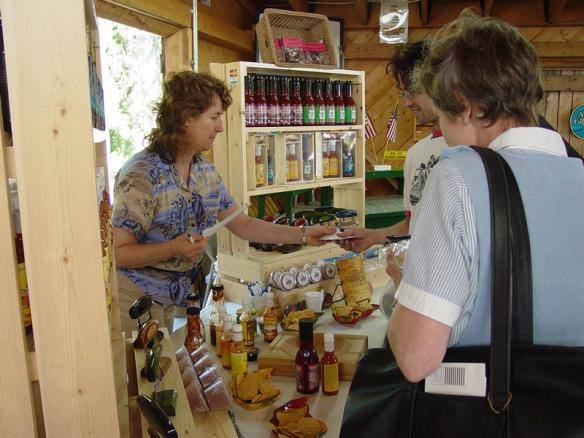
The Sitka District office and other regional offices of the University of Alaska Fairbanks Cooperative Extension Service now have on hand a new publication, “Guide to Operating a Successful Home-Based Food Business.”

Have questions about Alaska Food Code exemption requirements? Want to know more about recipe formulation, product testing, labeling, safe preparation packaging, or starting your own business? Are you curious which homemade foods can be sold at farmers markets and festivals, and which ones require a commercial kitchen?

The 12-page handout features the answers to these questions and many other topics discussed during the training sessions about food regulations for farmers markets, hosted in February by Kate Idzorek with the UAF Cooperative Extension Service, and by Lorinda Lhotka and Morgan Poloni with the Alaska DEC Food Safety and Sanitation office.

View and download a copy of the publication online, or contact the UAF Cooperative Extension Service’s Sitka office at 747-9440 for a hard copy.

• State grants available for summer ‘Chef at the Market’ program at local farmers markets

Suzan Brawnlyn, the Chef at the Market, holds a sample cup of honey miso-glazed black cod with broccoli and bok choy stir fry during a cooking demonstration on July 21, 2012, at the second Sitka Farmers Market of the season.

Suzan Brawnlyn, the Chef at the Market, holds a sample cup of honey miso-glazed black cod with broccoli and bok choy stir fry during a cooking demonstration on July 21, 2012, at the second Sitka Farmers Market of the season.

The state’s Chef at the Market program is accepting grant applications from Alaska chefs interested in providing demonstrations at local farmers markets between May and September this year, according to a press release in the Juneau Empire.

The Chef at the Market program began in 2011 to promote fresh Alaska Grown specialty crops and teach Alaskans new ways to prepare them. The program has also provided a new opportunity for chefs to develop relationships with the local food vendors who supply restaurants and with Alaskans interested in cooking Alaska Grown at home.

In the summer of 2013, six Alaska chefs performed a total of 27 demonstrations at nine local farmers markets and special events.

Suzan Brawnlyn hosted four Chef at the Market presentations during the 2012 Sitka Farmers Market season, but wasn’t able to renew her grant last year because the kitchen was closed due to construction at the Alaska Native Brotherhood Founders Hall in 2013. The construction is finished and the kitchen is open again, so Sitka chefs are encouraged to apply for 2014. In addition to hosting demonstrations at the Sitka Farmers Market, Suzan prepared recipes and other information about how to use the local produce she highlighted each week.

To apply for a 2014 summer program grant, go to
http://dnr.alaska.gov/ag/ag_grants.htm. Grant applications are due on Wednesday, April 30.

To find out more information about Chef at the Market demonstrations, contact Jacquelyn Schade at jacquelyn.schade@alaska.gov or 907-761-3858.

• Gordon Wrobel to give presentation on building local food systems in Elfin Cove

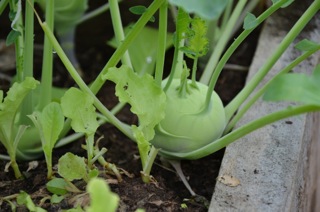
KohlrabiGordon Wrobel will give a presentation at 1 p.m. on Saturday, April 12, in Room 106 (note room change from original post) at the University of Alaska Southeast Sitka Campus about gardening in Southeast Alaska, in particular in Elfin Cove where he is completing a three-year USDA project to improve local food systems.

Gordy will provide an overview of his project, including the challenges and opportunities (such as available land, soils, pests/diseases, climate/temperature, markets, and crop/seed selection). His project objectives and results included creating access to fresh produce in the rural Southeast Alaska community of Elfin Cove, evaluating the economic viability of a floating island garden, evaluating the strategies of a floating island, container, hoop garden and greenhouse, creating a composting program for the community of Elfin Cove, and evaluating the potential for a sustainable produce business in Elfin Cove. There will be a short question-and-answer session after his presentation.

For more information, contact Sitka Local Foods Network board members Michelle Putz at 747-2708 or Charles Bingham at 738-8875.

This slideshow requires JavaScript.

• Support the Sitka Local Foods Network when you shop using the AmazonSmile program

amazonsmile-620x330

At the Sitka Local Foods Network, we encourage Sitka residents to shop from local businesses first. But when you live in rural Alaska you sometimes can’t find what you need in town, so many people end up shopping online. Now you can support your Sitka Local Foods Network every time you shop using the AmazonSmile program.

lookforamazonsmileLaunched in October, the AmazonSmile program allows shoppers to pick a charity of their choice to receive a small portion (0.5 percent) of every eligible purchase they make in the program. Even though the shared percentage is small, the way people in rural Alaska shop online it quickly can add up to significant support for local foods in Sitka. Nearly all purchases qualify for AmazonSmile (except for some digital products), and all you have to do is look for the eligibility logo by each item (see logo in upper right corner of this paragraph).

Shopping using the AmazonSmile program is simple, just type “smile.amazon.com” into your browser’s address bar instead of the usual “www.amazon.com.” When you get to the page, you will be asked to select your favorite charity, so make sure to type “Sitka Local Foods Network” into the search bar. There are thousands of large national, state, and local 501(c)(3) nonprofit organizations in the program, so make sure your page says “Supporting Sitka Local Foods Network” next to the AmazonSmile logo in the top left corner.

The only drawback to AmazonSmile is remembering to type smile.amazon.com
when you shop instead of the usual amazon.com. Luckily, both Google Chrome and Mozilla Firefox browsers have extension programs to help take you directly to AmazonSmile:

These browser extension programs simply redirect you to smile.amazon.com when you forget and just type amazon.com (or click a link or use a bookmark).

So don’t forget to shop with local businesses in Sitka first. But if you can’t find what you need in town and decide to shop online, please use the AmazonSmile program and support your Sitka Local Foods Network.

• It’s time to … plant your cold frames class/open discussion on Sunday, April 6

DougOsbornePutsNewspapersByColdFrame

Doug Osborne prepares a cold frame for spring planting during a 2012 work party at St. Peter’s Fellowship Farm.

The Sitka Local Foods Network reminds you that it’s time to get out in the garden and plant your cold frames. Michelle Putz will present a free, short, on-the-ground cold frame planting class and open discussion at 3 p.m. on Sunday, April 6. A cold frame is like a miniature greenhouse, usually a raised garden bed with a glass or fiberglass cover that helps warm the plants to extend the growing season.

Due to limited space, those interested in participating in this class need to pre-register by calling Michelle Putz at 747-2708. They will be told the event’s location when they call.

The Sitka Local Foods Network will be hosting a series of “It’s time to …” workshops this spring and summer designed to help local residents with various aspects of vegetable gardening and fruit growing. Many of these classes will be informal get-togethers at various gardens around town.

In addition, don’t forget the Sitka Local Foods Network education committee will meet from 5:30-7 p.m. on Monday, April 7, at Harrigan Centennial Hall to discuss future workshops and classes for the upcoming spring and summer.

We are still looking to expand our network of local volunteers who can teach classes (formal and informal) this year about growing food, so please attend if you’re interested. If you can’t attend, please email Charles Bingham at charleswbingham3@gmail.com with info about what topics you can teach, your gardening experience, and contact information so we can add you to our database of instructors.

(Editor’s note: A series of photos from the class is posted below, as are two handouts about cold frames from the Purdue and Cornell Cooperative Extension Service programs.)

• Hot Beds And Cold Frames handout from the Purdue Cooperative Extension program

• Hot Beds and Cold Frames handout from the Cornell Cooperative Extension Service

This slideshow requires JavaScript.

• Sitka Local Foods Network education committee recruiting families for garden mentor program

PotatoesAtUAFHoopHouse

The Sitka Local Foods Network education committee wants to help families in Sitka learn how easy it can be to grow some of their own food. We are looking for two families of novice gardeners who want to learn about and try vegetable gardening in their own backyard through our new Family Garden Mentor project.

Through a series of six or seven workshops that will be held at the families’ homes, Sitka Local Foods Network volunteers will help the families:

  • Choose a location for a vegetable bed (learning about sun, drainage, etc.),
  • Build a raised bed, and acquire soil and soil amendments,
  • Learn about soil and prepare the soil for planting
  • Plant 2-4 easy-to-grow plants – specifically potatoes, lettuce, kale, and maybe a perennial edible like rhubarb or fruit bushes
  • Learn to take care of their plants over the summer — teaching how to care for and pick the vegetables (without killing the plant),
  • Harvest potatoes, and
  • Cook a meal using the vegetables they have grown

GreensInHoopHouseStPetersThe Sitka Local Foods Network will provide all materials — soil, lumber, seeds, etc. — free to the participating families. Families will be expected to provide the labor and enthusiasm for gardening.

Interested families must meet four requirements: 1) they must be first-time vegetable gardeners (this project is meant to help people who are just starting to garden), 2) they must want to try vegetable gardening and be committed to participating throughout the summer, 3) they must own their own property, and 4) they must agree to let others come and attend classes at their property. Other criteria will also be used to help select the final two families. Families that are not selected will be placed on a waiting list in the hope of future continuation and expansion of this project.

Workshops will start in April with selecting the site and run through September’s late harvest. Classes will focus on some of the easiest-to-grow vegetables (and fruit) in Sitka — potatoes, lettuce, kale, and rhubarb.

Families interested in participating should contact Michelle Putz at 747-2708 and provide a name, address, and contact phone number.

• Alaskans Own community-supported fisheries program announces 2014 season subscription prices

AO flier no tags

Sitka-based Alaskans Own seafood recently announced its subscription prices for its 2014 community-supported fisheries (CSF) program in Sitka, Juneau, and Anchorage. The prices appear to have gone down a tiny bit since the 2013 season.

Alaskans Own was the first CSF program in the state, modeling its program after the successful community-supported agriculture (CSA) programs that let customers deal directly with harvesters so they can buy subscription shares to the year’s crop/catch. In addition to the CSF program, Alaskans Own usually has a table at the Sitka Farmers Markets during the summer.

ErinFultonAshiaLaneAlaskansOwnSeafoodThis is the fifth year of the Alaskans Own CSF program, and there are four-month and six-month subscriptions available. The six-month subscriptions  allow people to keep receiving freshly caught seafood through October instead of August, when the traditional four-month subscriptions end. Half-subscriptions also are available. Subscriptions include a mix of locally caught black cod (sablefish), halibut, king salmon, coho salmon, lingcod and miscellaneous rockfish, depending on the commercial fishing season and prices.

The Alaskans Own program is associated with the Alaska Sustainable Fisheries Trust. The Alaska Sustainable Fisheries Trust’s mission is to strengthen Alaskan fishing communities and marine resources through scientific research, education, and economic opportunity.

Here is Alaskans Own CSF program information for 2014 provided in a recent email sent to the program’s past subscribers and other interested folk:

Hello, Sitka!

It’s that time of year again. The days are getting longer, the herring are back, and Alaskans Own CSF is gearing up for our 2014 season.

This summer looks to be another season filled with even better quality seafood than before. We’d love to have you join us and get access to the great local seafood the Sitka has to offer.

It is difficult to tell, at this point, how prices will trend through the season. Please be assured that we will always bring you the very best value, highest quality seafood that we can, meeting or exceeding the total number of pounds for the plan that you choose. We will make adjustments in specific items to preserve this value. Our small staff gratefully receives assistance from a number of volunteers to help keep costs down. Any and all ‘profits’ go to support the scientific work of the Fishery Conservation Networks.

  • Six months, Full share: $760 (60 pounds, ~ 10 lb. /month)
  • Six months, Half share: $400 (30 pounds, ~ 5 lb./month)s
  • Four months, Full share: $520 (40 pounds, ~ 10 lb./month)
  • Four months, Half share: $280 (20 pounds, ~ 5 lb./month)

To renew your subscription with Alaskans Own, please send me an email, or give me a call on the Alaskans Own phone 907-738-2275(*). Subscriptions can be paid for using cash, check or credit card. You can learn more about what we offer and the work we do on our website: www.alaskansown.com.

Thank you for all your support. I hope you’ll join Alaskans Own again this season to enjoy the best seafood from the finest fishermen in Southeast Alaska.

Cheers,
Erin Fulton, Programs Coordinator, Alaska Sustainable Fisheries Trust

* With the Sitka Sound Science Center under construction, we won’t be in our normal office space — email and the new AO phone will be the best way to reach us, and to schedule an ‘in person’ meeting.

• USDA Natural Resources Conservation Service offers funding support program for high tunnels

picture8

The U.S. Department of Agriculture’s Natural Resources Conservation Service (NRCA) has revamped its cost-sharing program that enables qualifying landowners who produce food to build high tunnels.

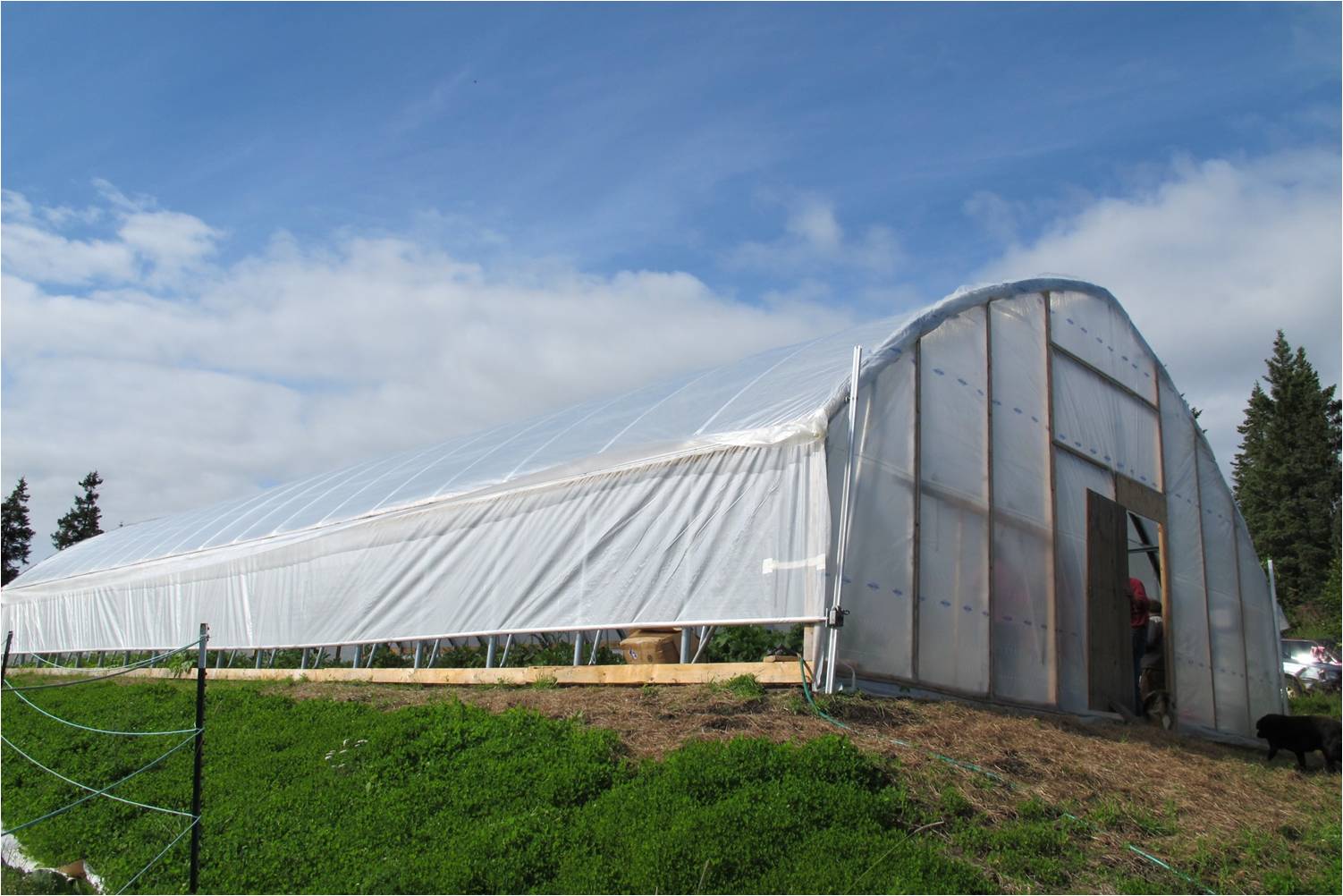
High tunnels, also known as hoop houses or temporary greenhouses, extend the growing season so more food is produced before and after the traditional dates for growing stuff outdoors.

High tunnels are different than greenhouses in that they are passively heated by the sun, so they have lower energy costs than greenhouses. High tunnels are at least six-feet tall, and low tunnels aren’t eligible in this program. Food in high tunnels is planted either directly into the ground or in raised beds. To learn more about the USDA’s high tunnel program, click here (note, link is to FY2013 program information, there have been updates for FY2015 but no link was available). This link has frequently asked questions and answers about seasonal high tunnel systems for crops.

Picture10This program started a couple of years ago as a pilot program, but now is a permanent part of of the NRCS EQIP (Environmental Quality Incentive Programs). One major change is there now is no size restriction on the size of structures NRCS will provide cost-sharing funds (previously it was limited to up to 2,178 square feet, or 5 percent of one acre). Also, geodesic domes are now eligible. Both the land owner and land must meet certain eligibility requirements. Funding is provided on a reimbursable status once the high tunnel is installed and certified to meet NRCS standards. In previous years only a couple of Sitka residents have taken advantage of the program, but other areas of the state, such as Homer, have built dozens of high tunnels through the program.

For information regarding the NRCS technical service or program participation in Southeast Alaska, please contact Samia Savella at the Juneau field office at (907) 586-7220 or samia.savell@ak.usda.gov. Applications currently are being accepted for the 2015 fiscal year (Oct. 1, 2014, to Sept. 30, 2015) and applications must be received at the Juneau field office on or before June 15, 2014. Click here for a link to the Alaska NRCS page.

• High Tunnel Fact Sheet March 2014

• Flier about Southeast Alaska cost-sharing program March 2014

• It’s time to … prune your fruit trees workshop on Saturday, March 22

RedApplesKCAW

The Sitka Local Foods Network reminds you that it’s time to get out in the garden and prune your fruit trees. Jud Kirkness will present a free, short, on-the-ground fruit tree pruning workshop at 9 a.m. on Saturday, March 22, at St. Peter’s Fellowship Farm (located behind St. Peter’s By The Sea Episcopal Church on Lincoln Street). 

Due to limited space, those interested in participating need to pre-register by calling Michelle Putz at 747-2708.

The Sitka Local Foods Network will be hosting a series of “It’s time to …” workshops this spring and summer designed to help local residents with various aspects of vegetable gardening and fruit growing. Many of these classes will be informal get-togethers at various gardens around town.

In addition, don’t forget the Sitka Local Foods Network education committee will meet from 5:30-7 p.m. on Monday, March 17, at Harrigan Centennial Hall to discuss future workshops and classes for the upcoming spring and summer.

We are still looking to expand our network of local volunteers who can teach classes (formal and informal) this year about growing food, so please attend if you’re interested. If you can’t attend, please email Charles Bingham at charleswbingham3@gmail.com with info about what topics you can teach, your gardening experience, and contact information so we can add you to our database of instructors.

• Sitka Conservation Society publishes resource guide for statewide Fish to Schools programs

Serving Local Fish in School Cafeteria_Page_01

The Sitka Conservation Society, which coordinates Sitka’s Fish to Schools program, has published a new resource guide, A Guide to Serving Local Fish in School Cafeterias, to help other school districts around the state implement similar programs in their communities.

F2S_Elementary2The Sitka Fish to Schools program came out of the 2010 Sitka Health Summit, when local residents chose as one of its community wellness projects to serve more local seafood in our schools. Since then the program has grown so that all students from Grades 2-12 in Sitka have a local seafood lunch option at least twice a month. This includes the Sitka School District schools, Keet Gooshi Heen Elementary School, Blatchley Middle School, Sitka High School, and Pacific High School, plus other local schools, the state-run boarding school Mount Edgecumbe High School and the private K-8 The SEER School.

Sitka is one of the first districts in the state to serve local seafood through the National School Lunch Program and has become a leader in the State of Alaska in getting local foods into schools. In the last three years, the number of schools interested in serving local seafood has increased ten-fold. Haines, Dillingham, Kodiak, Galena, and Juneau are a few of the districts that are now serving seafood in their meal programs.

In an effort to support regional and statewide efforts to serve local foods in schools, the Sitka Conservation Society developed a “how-to” guide to serving fish in schools. Using Sitka as a case study, it outlines procurement and processing strategies, legalities, tips, and recipes. Also included are case studies from around the state that offer tips and suggestions based on the success of their programs.

F2S_Elementary3The Sitka Fish to Schools program has seen an increase in meal participation on fish lunch days, likely attributed to the participation of students who typically bring a sack lunch. One student who reported never liking fish started to eat fish after a local chef came to her classroom. Others students circle fish lunch dates on their school lunch calendar, refusing home lunch that day. And why are they so excited? A middle school student put it this way, “It’s healthy and good for you and you feel good after you eat it.” Others give reasons of wanting to become a fisherman or cite the economic value to their community.

In addition to this guide is the “Stream to Plate” curriculum, a unit of seven lessons that connect salmon to the classroom. The lessons address the ecological significance and human relationship to salmon. These lessons have been tried and refined the last three years with third graders at Keet Gooshi Heen Elementary School.

Chris Bryner, teacher and collaborator on the salmon unit said, “The Fish to Schools curriculum connects my classroom to the community. Students not only learn about a resource relevant to their daily lives, but come away with an understanding that learning happens inside and outside of school.”

As the ninth largest seafood port in the country, Sitka is paving the way for locally-sourced meals. Their efforts are part of a larger national movement, Farm to School, to get local foods in schools. The Alaska Farm to School program honored Sitka’s Fish to Schools program for its innovation a couple of years ago.
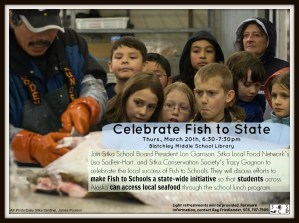
celebrate fish to state“The beauty of Fish to Schools is that it provides a practical, local solution to a multitude of current global issues,” Fish to Schools Co-Founder Lexi Fish said. Local sourcing reduces the environmental impact of foods grown and raised thousands of miles away and ultimately supports a more resilient food system.

Local fish in school lunches not only tastes “delicus” (stet), as one third grader put it, but also addresses food justice, nutrition, community sustainability, and conservation. To get a free copy of the guide and curriculum, visit http://sitkawild.org/2014/03/a-guide-to-serving-local-fish-in-school-cafeterias/ or contact Sitka Conservation Society Community Sustainability Organizer Tracy Gagnon at 747.7509 or tracy@sitkawild.org.

Also, don’t forget to stop by the Celebrate Fish to State event from 6:30-7:30 p.m. on Thursday, March 20, at Blatchley Middle School to learn more about the efforts to expand the Fish to Schools program statewide.