• Rep. Jonathan Kreiss-Tomkins of Sitka introduces bill to allow donations of fish and game to nonprofit meal programs

041614_JKT_house-floor

Rep. Jonathan Kreiss-Tomkins (D-Sitka) is the prime sponsor of a tripartisan bill that will allow nonprofit meal programs — such as those found at schools, hospitals and senior centers — to serve donated fish and game from sport and subsistence harvesters.

The bill, HB 179, is co-sponsored by seven other legislators — four Republicans (Cathy Muñoz of Juneau, Charisse Millett of Anchorage, Louise Stutes of Kodiak and Tammie Wilson of North Pole), two Democrats (Neal Foster of Nome and Sam Kito III of Juneau), and an Independent (Dan Ortiz of Ketchikan). The was introduced on April 1 and already has hearings set for next week in the resources (Monday, April 6) and fisheries (Tuesday, April 7) committees. If those committees pass the bill, it could go before the House floor for a vote as early as late next week.

“Because of that broad support, this bill is in not just the fast lane, but in the Autobahn-style fast lane,” Kreiss-Tomkins told the Daily Sitka Sentinel. “This bill could go from being introduced to a vote on the floor in eight or nine days.”

Kreiss-Tomkins said the bill was inspired in part by Sitka’s Fish to Schools program, which allows commercial fishermen to donate locally caught seafood to local schools so it can be served in student lunches. However, many parts of the state don’t have commercial fisheries, and Alaska law currently bars food service organizations funded by state or federal meal programs from serving subsistence- and sport-harvested fish and game, even if it is donated.

In the sponsor statement for the bill, Kreiss-Tomkins writes:

Hunting and fishing is at the heart of our shared heritage as Alaskans. Every Alaskan looks forward to the season he or she can again fill the freezer with salmon, moose, caribou, seal, or berries. Alaskans happily share this food with family, children, and elders.

This sharing is not possible in our public institutions, however. Well-meaning state laws intended to prevent the commercialization of wild game have also largely prevented children in schools and elders in hospitals and senior centers from eating the traditional Alaska foods that we treasure. As a result, even though we are surrounded by some of the best food in the world, our children eat corndogs rather than caribou at school lunch; our elders are served spaghetti rather than seal.

This action follows a 2013 amendment U.S. Rep. Don Young (R-Alaska) included in an agriculture bill that removed barriers that previously prohibited American Indians and Alaska Natives from serving traditional foods in hospitals, elder care facilities and schools. The amendment authorized the U.S. Department of Agriculture to allow for the donation and serving of traditional foods, which meet specific safety standards, in public facilities that primarily serve American Indians and Alaska Natives.

In his sponsor statement, Kreiss-Tomkins writes:

The bill also ensures traditional wild foods donated to and served by food service programs are safe to eat. The Department of Environmental Conservation already has regulations in place providing for the safe handling and processing of many traditional wild foods. HB 179 affirms the Department’s authority to oversee the safety of these foods.

HB 179 will nourish Alaska’s children and elders, both physically and spiritually. It will limit the amount of expensive and unhealthy processed food shipped to communities that have incredible food available just a short boat or snowmachine ride away. Children will develop an appreciation where their food comes from and elders will be able to keep eating the foods they love.

• HB 179 — Traditional Foods Bill

• HB 179 — Traditional Foods Bill Sponsor Statement

• Sitka Assembly to give second reading Dec. 9 on plan to allow home horticulture stands

Sitka Local Foods Network President Lisa Sadleir-Hart works in Anam Cara Garden, which she and husband Tom Hart cultivate.

Sitka Local Foods Network President Lisa Sadleir-Hart works in Anam Cara Garden, which she and husband Tom Hart cultivate.

The Sitka Assembly will take up a plan to allow temporary home horticulture stands in residential areas during its Dec. 9 meeting at Harrigan Centennial Hall. This will be the second reading for the proposal, which passed unanimously on first reading during the Sitka Assembly’s Nov. 25 meeting. (EDITOR’S NOTE: This ordinance passed 6-0 on second reading Dec. 9, with one member absent, and will now be added to the Sitka General Code. There was some discussion about the business license requirement, but the Assembly left the requirement in.)

Ordinance 2014-38 streamlines the permitting process for home gardeners who want to set up a temporary produce stand in front of their homes to sell their extra veggies. Instead of having to go all the way to the Assembly for approval, under this proposal the Sitka Planning Commission can make the decision.

“This is an example of something that we can do very specifically to improve our food system here in Sitka,” said Sitka Local Foods Network Lisa Sadleir-Hart, who first proposed the change to the Planning Commission this summer with her husband Tom Hart. “Secondly, it’ll increase economic opportunities for Sitkans who garden or are in small farm production. Third, it’ll keep produce dollars circulating locally. Fourth, it increases neighborhood access to fresh fruits and vegetables. And fifth, it may spur other Sitkans to consider growing for more than their families and lead to further increases in our food security.”

The ordinance will allow garden stands in residential areas, but they’d be limited to six feet by eight feet. And to reduce the impact on neighbors, stands can only operate four hours a day, two days a week, between May and October. The ordinance specifically doesn’t include livestock or animal products. Home gardeners who set up produce stands in front of their homes will be required to have a business license and pay city sales tax.

• Sitka Assembly to hear proposal to allow temporary front-yard produce stands for local gardeners

Tom Hart at Anam Cara Garden

Tom Hart at Anam Cara Garden

The Sitka Assembly is scheduled at its Tuesday, Nov. 25, meeting a proposal that will allow local gardeners to host temporary front-yard produce stands in residential areas.

Lisa Sadeir-Hart works in Anam Cara Garden

Lisa Sadeir-Hart works in Anam Cara Garden

The proposal will modify city code to change commercial use horticulture from a conditional use in residential and island zones to a permitted use. It was passed unanimously by the Sitka Planning Commission during that group’s Oct. 21 meeting, with a change that will allow an expedited review and permitting process from the Planning Commission, so home gardeners don’t have to go all the way to the Assembly for a permit. The current zoning code allows for you-pick gardens, such as Down-To-Earth U-Pick Garden, but doesn’t allow for temporary home produce stands.

Sitka Local Foods Network Board President Lisa Sadleir-Hart and her husband, Tom Hart, who operate Anam Cara Garden, first proposed the idea in August. They felt home gardeners can go through the permitting process during the winter, so they can operate their front-yard produce stands during the summer. The Planning Commission included a variety of rules on size, hours, neighbor notification, parking needs, etc., and it will review each proposed produce stand.

“I believe the public collaboration process works — it was good being able to work with the commission to make adjustments it was concerned about,” Sadleir-Hart said, according to an Oct. 22 article in the Daily Sitka Sentinel. “It will move us closer in terms of increasing the presence of locally produced food in our community. It will give Sitkans an opportunity to sell their produce to their neighbors, and benefit their pocketbooks as well.”

• Baranof Elementary School first-graders harvest their kindergarten plantings at Russian Bishop’s House garden

gardenharvest14ws

BIG HARVESTBaranof Elementary School first-grader Marley Bayne, 6, holds up a large carrot and a beet next to the Russian Bishop’s House garden Wednesday. The entire first-grade class harvested the vegetables they helped plant in the spring when they were kindergartners. This year’s growing season was especially good for the garden crops, which children are using to make soup in class. Sitka National Historical Park rangers organize the gardening activities with the help of school staff and parent volunteers. (Daily Sitka Sentinel Photo By James Poulson)

• Panel looks at allowing garden sales at homes

Tom Hart at Anam Cara Garden

Tom Hart at Anam Cara Garden

(The following article appeared in the Wednesday, Sept. 3, edition of the Daily Sitka Sentinel.)

By TOM HESSE
Sentinel Staff Writer

A potential zoning change that would allow gardeners to sell their extra produce from home started to take shape at Tuesday night’s Planning Commission meeting.

Lisa Sadleir-Hart works in Anam Cara Garden

Lisa Sadeir-Hart works in Anam Cara Garden

The proposal was brought forth by Lisa Sadleir-Hart and Thomas Hart [who own Anam Cara Garden] during an August meeting. The idea is to allow Sitkans with large gardens to sell their produce from their homes, which would include those in R-1, R-1 MH, R-2, R-2 MHP, GI and LI zoned districts. Since the zoning revision was first proposed, the city planning department has been trying to shape the rules, and Planning Director Wells Williams told commission members that there are a number of forms they could take.

“Like anything else, it’s a fairly simple concept but it gets complicated fairly quickly,” Williams said.

Currently, you-pick style gardens are allowed under a conditional use permit. Williams said the new proposal, which is being called commercial home horticulture, could follow a similar path. The big difference would be that gardeners could sell their produce and have a small stand in their yards where they could sell it. Those differences could be an issue in some neighborhoods, said commissioner Chris Spivey.

“There are definitely a lot of concerns about the sheer fact of having anything commercial in an R-1,” Spivey said.

Because of that, requests for commercial home horticulture permits would be done on a case-by-case basis under the proposals now being considered. Planning staff tentatively proposed a conditional use system whereby applicants would need to notify neighbors and take their applications through the planning process.

Sadleir-Hart said a four-week process to obtain a permit would be appropriate for gardeners who are looking ahead to the next growing season.

“Most people who would be moving through this process would be moving fall through winter,” she said. “To me that would be plenty of time and just being a good neighbor.”

Some of the issues commission members raised were about the days and times when sales would be allowed, how large garden stands could be, and how best to handle applications.

After a discussion, the commissioners decided the best system may be to set hours on a permit-to-permit basis.

“It’s that way with a lot of conditional use permits that we do. It varies from neighborhood to neighborhood,” commission member Richard Parmalee said.

Specifics are far from being concrete, but stands 6 feet by 8 feet in size, with an awning, are in the current proposal. They would be temporary, so they would be up only during the growing season.

“You’re going to have people in the neighborhood that want something that is aesthetically pleasing or temporary and easily broken down,” Spivey said.

Commissioners did take out a items from the original proposal, regarding greenhouses and sheds.

Williams said the planning office would take the comments from Tuesday night’s meeting and start drawing up a draft proposal with more specifics. The issue will be discussed further when the panel meets on Sept. 16.

• Lori Adams’ contribution to Sitka gardening featured on Sitka Conservation Society website

Lori Adams poses with some of the ducks she keeps to help keep slugs at bay at her Down-To-Earth U-Pick Garden. (Photo Courtesy of Sitka Conservation Society)

Lori Adams poses with some of the ducks she keeps to help keep the slugs at bay at her Down-To-Earth U-Pick Garden. (Photo Courtesy of Sitka Conservation Society)

If you haven’t seen it yet, check out this recent feature story about Sitka gardener Lori Adams on the Sitka Conservation Society‘s website.

Lori Adams is owner of Down-To-Earth U-Pick Garden (located at 2103 Sawmill Creek Road), and the author of “How to Grow Vegetables in Sitka, Alaska” (a collection of her 2012 Gardening in Southeast Alaska columns originally published in the Daily Sitka Sentinel). Lori also is a regular vendor at the Sitka Farmers Market.

The feature tells the story about how Lori wanted to start a you-pick garden at her house in 2007, but city code at the time didn’t allow people to grow food and then sell it directly to people from her private property. Lori worked with the city planning department and Sitka Assembly to rewrite the code so Sitka residents can apply for a special permit to sell food grown in their home gardens. The article also features several photos from her garden.

• It’s time to … learn how to amend your soil and increase your production — free workshops

LoriAdamsWithBook

Your Sitka Local Foods Network reminds Sitkans that now is a great time to think about scaling up vegetable garden production with local soil amendments. Large scale production in your garden takes some forethought and requires good, productive, healthy soil. Local amendments such as seaweed, fish parts, chicken and duck manure, and other materials can help boost the production in your garden.

Lori Adams, owner and manager of Down-to-Earth U-Pick Garden, will host two discussions and hands-on workshops on large-scale garden production using local amendments at her u-pick garden at 2103 Sawmill Creek Road (across from the Mormon church). Classes will be held from 3-4 p.m. on Sunday, July 27, or at 10 a.m. on Monday, July 28.  All are welcome to come and attend these free classes.

Other topics that may be discussed include using ducks in the garden, organizing and simplifying techniques to keep costs down, and proven seed varieties for success.

Lori grew up on a farm in Oregon, and has gardened in Sitka for 20 years. Her u-pick garden has been in production for about six years. In 2012, Lori wrote a series of garden columns for the Daily Sitka Sentinel (and reprinted on the Sitka Local Foods Network website), and in 2013 she produced a book of those columns, “How to Grow Vegetables in Sitka, Alaska,” which she sells for $20 a copy at her Sitka Farmers Market booth. For information or directions to the garden, call Lori at 747-6108 or 738-2241.

The Sitka Local Foods Network education committee has been hosting a series of “It’s time to …” workshops this spring and summer designed to help local residents learn about various aspects of vegetable gardening and fruit growing. Many of these classes will be informal get-togethers at various gardens around town. Please watch our website, Facebook pageFacebook group, and local news media for information about upcoming classes. If you have an “It’s time to …” workshop you’d like to teach, contact Michelle Putz at 747-2708.

The SLFN education committee is still looking to expand our network of local volunteers who can teach classes (formal and informal) this year about growing food, please email Charles Bingham at charleswbingham3@gmail.com with info about what topics you can teach, your gardening experience, and contact information so we can add you to our database of instructors.

• Sitka Local Foods Network to host six Sitka Farmers Markets in 2014

The Sitka Local Foods Network will host its seventh summer of Sitka Farmers Markets this year. The first of the six markets is from 10 a.m. to 1 p.m. on Saturday, June 28, at Alaska Native Brotherhood Founders Hall (235 Katlian St.), with the other markets on July 12, July 26, Aug. 9, Aug. 23, and Sept. 6. From left are Sitka Local Foods Network board members Charles Bingham, Maybelle Filler and Michelle Putz, Sitka Farmers Market co-managers Ellexis Howey and Debe Brincefield, vendors Linda Wilson and Pat Hanson, and helper D.J. Brincefield. (Daily Sitka Sentinel Photo by James Poulson).

The Sitka Local Foods Network will host its seventh summer of Sitka Farmers Markets this year. The first of the six markets is from 10 a.m. to 1 p.m. on Saturday, June 28, at Alaska Native Brotherhood Founders Hall (235 Katlian St.), with the other markets on July 12, July 26, Aug. 9, Aug. 23, and Sept. 6. From left are Sitka Local Foods Network board members Charles Bingham, Maybelle Filler and Michelle Putz, Sitka Farmers Market co-managers Ellexis Howey and Debe Brincefield, vendors Linda Wilson and Pat Hanson, and helper D.J. Brincefield. (Daily Sitka Sentinel Photo by James Poulson).

SitkaFarmersMarketSignThe Sitka Local Foods Network will host its seventh summer of Sitka Farmers Markets with six markets this year starting on June 28 and taking place on alternate Saturdays through Sept. 6. The Sitka Farmers Markets give Sitka residents a chance to buy and sell locally produced food and crafts.

The Sitka Farmers Markets take place from 10 a.m. to 1 p.m. on Saturday, June 28, July 12, July 26, Aug. 9, Aug. 23, and Sept. 6 at the Alaska Native Brotherhood Founders Hall (235 Katlian St.). The markets feature local seafood (fresh, frozen, and cooked, ready to eat), locally grown and harvested fruits and vegetables, baked goods, locally made jams and jellies, live entertainment and music, local arts and crafts, and a variety of other items gathered or made in Sitka. We emphasize local products and lots of fun. We were the first farmers market in Southeast Alaska to accept WIC coupons and Alaska Quest EBT for SNAP (food stamp) users. We also plan scheduled transportation from Sitka Tours for the last five markets (details coming soon), and don’t forget to support the Sitka Farmers Market in the I Love My Farmers Market Celebration (click logo) at http://www.sitkalocalfoodsnetwork.org/.

“The Sitka Farmers Market is a great way to connect with community members and support local entrepreneurs,” Sitka Local Foods Network Board President Lisa Sadleir-Hart said. “Circulating your dollars locally also has a multiplying effect and helps your neighbors.”

2014 Quest Flyer SitkaThe Sitka Farmers Market started as a community wellness project that came out of a health priority planning meeting at the 2008 Sitka Health Summit. The markets are sponsored by the Sitka Local Foods Network, Alaska Native Brotherhood Camp No. 1, Alaska Native Sisterhood Camp No. 4, Baranof Island Housing Authority, the Alaska Farmers Market Association, the Alaska Division of Public Health Cancer Control Program, and the SEARHC Health Promotion and Diabetes Prevention programs.

“We are excited to have Ellexis Howey and Debe Brincefield working as a team as our new market co-managers,” Sadleir-Hart said. “Ellexis and Debe bring loads of enthusiasm and some new ideas to the market, and they are focused on creating a sustainable market that can be in Sitka for the duration. As always, the market will be a place to support the growing local food movement in Sitka and learn more about how to eat more sustainably.”

Vendor fees are $30 for a 6-foot table, $40 for an 8-foot table and $20 for a 4-foot table. Vendors with their own tents pay $5 per foot. As always, we offer cost incentives for vendors growing locally produced food. The fees will help us cover the costs of renting ANB Founders Hall and its kitchen, hiring musicians and other expenses. To learn more about being a vendor or to sign up for a table, contact Sitka Farmers Market Co-Managers, Ellexis Howey and Debe Brincefield at 738-8683 or by e-mail sitkafarmersmarket@gmail.com. Vendor rules, registration forms and other info for potential vendors can be found on the Documents page at http://www.sitkalocalfoodsnetwork.org/.

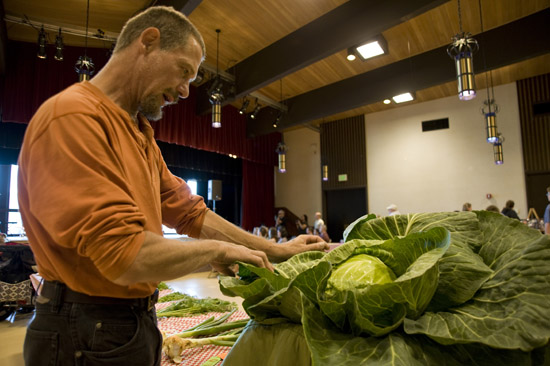
• Daily Sitka Sentinel features Keith Nyitray with his winning cabbage from the Sitka ‘state’ Fair

BIG PRODUCE – Sitka gardener Keith Nyitray arranges the leaves on his 17-pound cabbage Sunday during the second annual Sitka “State” Fair at Harrigan Centennial Hall. The cabbage earned a blue ribbon at the fair, which had categories for vegetables, jams, hobbies, crafts, photography and spam hors d’oeuvres, among others. The event included music by the SitNiks and performances by Celtic dancers. (Daily Sitka Sentinel Photo by James Poulson)

BIG PRODUCE – Sitka gardener Keith Nyitray arranges the leaves on his 17-pound cabbage Sunday during the second annual Sitka “State” Fair at Harrigan Centennial Hall. The cabbage earned a blue ribbon at the fair, which had categories for vegetables, jams, hobbies, crafts, photography and Spam hors d’oeuvres, among others. The event included music by the SitNiks and performances by Celtic dancers. (Daily Sitka Sentinel Photo by James Poulson)

The Monday, Aug. 12, 2013, edition of the Daily Sitka Sentinel included a photo of local gardener Keith Nyitray with his winning cabbage from the Sitka “state” Fair held Sunday, Aug. 11, at Harrigan Centennial Hall.

The second annual Sitka “state” Fair was hosted by the Greater Sitka Arts Council. More details about the event and some of its contests can be found here.

• Lori Adams offers copies of her Sitka gardening book for sale

LoriAdamsWithBook

As the owner of Down-To-Earth U-Pick Garden, Lori Adams has learned a lot about vegetable gardening in Sitka. Now she  is sharing what she learned with a new book, “How to Grow Vegetables in Sitka, Alaska.”

“‘How To Grow Vegetables In Sitka, Alaska,’ is an edited and revised compilation of the Gardening In Sitka column that appeared in the 2012 editions of the Daily Sitka Sentinel (and repeated on this site),” Adams said. “It’s organized in a user-friendly format with room for you own notes with a yearly planner in the back. This book teaches you to successfully grow vegetables outside in Sitka’s difficult climate.”

The book costs $20, plus tax, and Adams has been selling copies at her booth at the Sitka Farmers Market. In addition, people wanting books can contact her from 11 a.m. to 6 p.m. on Mondays through Saturdays at the Down-To-Earth U-Pick Garden, 2103 Sawmill Creek Road. She can be reached at 738-2241.