• New high tunnels at Judy Johnstone’s Sprucecot Garden get media attention

Sitka Local Foods Network President Kerry MacLane, left, and Sprucecot Garden Owner Judy Johnstone pose in front of one of the high tunnels recently erected on Judy's land on Peterson Street. (Photo Courtesy of KCAW-Raven Radio)

Sitka Local Foods Network President Kerry MacLane, left, and Sprucecot Garden Owner Judy Johnstone pose in front of one of the high tunnels recently erected on Judy’s land on Peterson Street. (Photo Courtesy of KCAW-Raven Radio)

Longtime Sitka gardener Judy Johnstone will be able to extend the growing season at her Sprucecot Garden on Peterson Street after a crew erected two new high tunnels on her land.

The high tunnels, which basically are temporary greenhouses with a large frame holding a transparent plastic cover and without a built-in power supply, already have raised the temperatures inside by about 15-20 degrees over the low-50s we’ve had in Sitka so far this summer. They will enable Judy to start her plants earlier in the spring and keep producing food later into the fall.

The high tunnels were funded through a cost-sharing program run by the USDA National Resources Conservation Service, which is accepting applications for new high tunnel projects through June 15.

These are the first high tunnels to go up in Sitka, but there have been several built in other parts of the state (the lower Kenai Peninsula near Homer has about 90 of them). Since these are the first high tunnels in Sitka, they’ve received lots of coverage in the local media. The Daily Sitka Sentinel featured an article on Page 1 of its Friday, June 8, 2012, edition (password required), and KCAW-Raven Radio featured Judy and Sitka Local Foods Network President Kerry MacLane in its Monday, June 11, 2012, Morning Edition show interview and in a story on its Tuesday, June 12, 2012, newscasts.

• Lori Adams discusses maximizing small garden spaces in her latest Daily Sitka Sentinel garden column

(Lori Adams, who owns Down-To-Earth U-Pick Garden and is a frequent vendor at the Sitka Farmers Market, will be writing a regular garden column in the Daily Sitka Sentinel this summer. The Sentinel is allowing us to reprint the columns on this site after they first appear in the newspaper. This column appeared on Page 4 of the Wednesday, June 6, 2012, edition of the Daily Sitka Sentinel.)

GARDENING IN SITKA

By Lori Adams

MAXIMIZING SPACE IN A SMALL GARDEN

Make beds wide and pathways narrow. A raised bed is effective as long as it is no wider than 48 inches. Many people don’t like beds this wide because they can’t straddle them, but the effort it takes to walk around the row is worth it if you get more vegetables. My pathways are wider than I’d like because I need room for groups of people, but for most gardens the pathways only need to be wide enough for a small wheelbarrow.

Go vertical.  Build trellises and chose varieties that take advantage of vertical space.  For instance,  tomatoes can be grown in cages, zucchini and cucumber plants can be trained to grow up trellises, plants like strawberries can be grown in hanging pots, and tall varieties of peas and beans will easily  climb up fencing. Hill up potato plants for more spuds and leeks for longer blanched stalks.

Choose varieties that give you the most bang for your buck. Many broccoli varieties continue to produce sprouts long after you have harvested the central head. I have harvested fresh broccoli from the garden for Thanksgiving dinner. Grow leaf lettuce instead of head lettuce for multiple harvests, and edible podded peas (snap and snow peas) rather than shelling peas for more poundage. Choose hard-neck rather than soft-neck garlic so you can harvest the scapes for summer garlic flavor in stir fries, in addition to the bulbs you harvest in the fall. There are beet and radish varieties that are cylindrical rather than round, and if you have deep sifted soil you can choose extra long carrot varieties. Choose cabbage varieties that produce dense, heavy heads. Also, choose both early and late varieties of each crop to assure a continuous supply.

Use harvest methods that encourage more growth.  Leaf lettuce will tolerate up to three harvests if you cut it 2-3 inches from the ground instead of harvesting the entire plant. Peas, cucumbers, beans, radish pods, berries and tomatoes all benefit from frequent pickings. Most will stop producing if you don’t keep up with them. I have seen pea pods mature overnight. Pea pods must be picked EVERY DAY. If possible, celery, Swiss chard and rhubarb should be harvested a few stalks at a time rather than all at once. The plants recover faster if they still have two-thirds of their foliage. Harvest only outer stalks and use a pulling, twisting motion rather than cutting the stalks. When cutting fennel bulbs leave a generous amount of root and it will sprout with multiple baby fennel plants. Rather than pulling up green onions, cut them off 2-3 inches above the soil line and they will continue to grow more greens all season. I believe you could do the same thing with leeks but I have never tried it. Harvest root crops from crowded areas first to encourage surrounding plants to bulk up.

Pruning is important.  Herb plants that are shooting up and trying to go to seed should be pinched back to encourage branching out. The same holds true with spinach. Pruning off dead leaves and rotten vegetables or fruit keeps all plants healthier and producing longer. Pea plants can be topped once they have reached the desired height and they will branch out resulting in more peas. Don’t forget that many pea tops are edible. Prune excess broccoli and cauliflower leaves because they take a lot of energy. Target leaves that are diseased, touching the ground, touching other plants or shading surrounding vegetables. Just don’t remove more that one-third of the leaves on any one plant. Don’t forget that broccoli and cauliflower leaves are edible. Raspberries can be successfully topped to prevent them from falling over or breaking. They will also branch out and you can end up with more berries. Each raspberry clump should have all dead stalks removed and have no more than 3-5 live stalks remaining. As Brussels sprouts reach the size of marbles, start breaking off leaves starting from the bottom to send more energy into the sprouts. Toward the end of the season pinch out the top of the plant for really large sprouts. Don’t forget that Brussels sprout tops and leaves are edible. Remove strawberry runners so more energy goes into the berries.

Use floating row cover.  Using a row cover such as “remay” or “agribond” can extend your season by as much as 3-4 months. It keeps the soil and crops about 10 degrees warmer than the outside temperature. Ideally you should keep your vegetables covered all year, but at the very least you should keep all brassica crops covered until July 15th to protect them from root maggot flies. Supports are not necessary but beneficial — they protect the plants and extend the life of the cover.

Plant seeds at the recommended spacing.  More does not always mean more. If plants are too crowded they will not produce as well as they should. Broccoli, cauliflower and cabbages that are planted too closely together produce small heads. Consider placing seeds or transplants rather than sprinkling seeds, or better yet purchase a seeder. The extra time that it takes to carefully place your seeds ensures that every square inch of a small garden is utilized.

Plant in blocks rather than rows. A row of broccoli can leaf out over a row of beets next to it and shade it out. A block of broccoli planted on the north side of a block of beets will have no negative affects.

Practice successive plantings. About 1-2 months (depending on the crop) after you plant crops like spinach, fennel, cilantro, kohlrabi, napa cabbage, lettuce or cauliflower, you can start a second set of them indoors. The second set will be ready to plant out about the time you harvest the first set. With some crops you can do this several times during the season. Don’t forget to amend the soil between each successive planting.

Consider pulling up some of your flowers. This last idea is not a very popular one. It is pleasant to have ornamentals in your yard, but consider scaling back, mixing vegetables in amongst your flowers or even replacing ornamentals with edibles that are pretty, such as sunflowers, nasturtiums, flowering kale, chives, cabbage, herbs or rainbow Swiss chard.

Brought to you by Down-To-Earth U-Pick Garden

2103 Sawmill Creek Road

Open June-August / Monday to Saturday, 11 a.m. to 6 p.m.

747-6108 or 738-2241

http://downtoearthupick.blogspot.com/

• Lori Adams discusses growing spinach and lettuce in her latest Daily Sitka Sentinel garden column

(Lori Adams, who owns Down-To-Earth U-Pick Garden and is a frequent vendor at the Sitka Farmers Market, will be writing a regular garden column in theDaily Sitka Sentinel this summer. The Sentinel is allowing us to reprint the columns on this site after they first appear in the newspaper. This column appeared on Page 4 of the Wednesday, May 30, 2012, edition of the Daily Sitka Sentinel.)

GARDENING IN SITKA

By Lori Adams

EVERYTHING I’VE LEARNED ABOUT GROWING

SPINACH AND LETTUCE

For years I tried to grow lettuce and spinach and had terrible luck. But the last few years I’ve made some major changes and have been thrilled with the results.

Prepping the bed for greens starts the previous fall. I put a layer of salmon carcasses over the bed, pile on a foot of seaweed/leaf mulch, dump about an inch of seashell sand over the top and cover the whole bed with black plastic. The plastic keeps the nutrients from being washed away.

Seeds are started around mid-March. I count out the number of seeds for proper spacing in the bed (6-9 inches) and start the seeds indoors. I know that seems tedious, but it is crucial for success. In the past I would simply broadcast the seeds, but there were bare spots and the seedlings that did come up were too close together.

In April I uncover the row, run a tiller through it and let the ducks work it over really good, getting all the slugs and slug eggs. In mid-April, when the seedlings have at least two true leaves, I shoo the ducks out and transplant the greens into half of the bed with the proper spacing, covering the other half with black plastic again to save the space for a second planting later in the year. Finally I cover the whole bed with row cover.

Taking care of the greens is easy. Just provide adequate moisture and pull the weeds. The tender transplants will not grow much for a while, but once they recover from transplant shock they will show signs of growth. They are surprisingly hardy.

Harvesting can begin once the plants have about six true leaves.  I just take a few here and there by clipping them from the plants with a scissors.

  • SPINACH: Once spinach plants get too tall I top them and they branch out with more stalks. Last year the stems got HUGE. They were hollow and filled with rain but the plants stayed healthy and the leaves did not get bitter for months!  I have friends who wait until their spinach plants have 16 leaves and then they pull the entire plant, throw a handful of compost in the empty spot and plant another seed. They have never had their spinach bolt using this method and have a continuous supply all season.
  • LETTUCE: I only grow loose-eaf varieties of lettuce. Down To Earth U-Pick Garden customers just harvest by cutting the entire plant about two inches from the ground.  The plants grow back and provide two more cuttings by using this method.

Eating greens is the best part.  Some people do not like home-grown lettuce because of its bitter taste. But if you soak the leaves in a sink full of cold water for about 15 minutes this bitter taste is eliminated and the leaves get sweet and crisp.  Greens can be kept stems-down in a container of water like a bouquet of flowers in the fridge, or on the back deck of the boat, without wilting or turning brown for days — just change the water daily.

Brought to you by Down-To-Earth U-Pick Garden

2103 Sawmill Creek Road

Open June-August / Monday to Saturday, 11 a.m. to 6 p.m.

747-6108 or 738-2241

http://downtoearthupick.blogspot.com/

• Sitka herring researcher Heather Meuret-Woody makes her case for better management

(EDITOR’S NOTE: On Tuesday, May 15, the Sitka Tribe of Alaska hosted the Sitka Herring Summit to discuss issues regarding the management, or mismanagement, of herring stocks in Southeast Alaska. Sitka herring researcher Heather Meuret-Woody made this presentation, which also appeared as a shorter letter to the editor in the Daily Sitka Sentinel on May 18. The opinions expressed are Heather’s alone, though the Sitka Local Foods Network has written letters supporting the Sitka Tribe of Alaska in its bid to get the Alaska Department of Fish and Game to reduce the commercial quota for herring in Sitka Sound.)

Sitka Sound Herring Summit

May 15, 2012

Heather Meuret-Woody

Sitka Sound Herring Researcher

I have been a Sitka Sound herring researcher for about 10 years. I have decided to share my few thoughts on the Sitka Sound herring population. With this said, in my opinion there was not 144,143 tons of the predicted mature herring biomass returning to Sitka Sound. An overestimate of the biomass seems to be the suspect.

Managers of forage fish know that traditional stock management techniques do not work well with forage fish. The reason for the failure of traditional stock assessment techniques is that the “catchability” of forage fish increases as the stock declines. However, due to the schooling nature of forage fish and their vulnerability to modern acoustics and fishing gear, catch rates remain constant, even when the stock is rapidly falling in size (Beverton, 1990). Thus declines in stock size will not be apparent to managers or to the fishing industry, based on catch per unit effort statistics. Management of forage fish stocks requires direct measurement of stock size. This can be accomplished by surveying fish abundance during the spawning season, or by conducting scientifically designed acoustic surveys of schools of forage fish. Failure to monitor the stock directly will result in the inability to determine changes, even severe declines, in forage fish abundance. With that said, ADF&G does not measure the Sitka Sound herring stock directly. They may do acoustic surveys and aerial surveys but the data is not used for determining stock size in the ASA model. ADF&G relies almost entirely upon spawn deposition estimates to determine the spawning biomass. Hebert, 2010 states, “Estimates of total egg deposition on Macrocystis kelp may be highly variable, and transects that cross Macrocystis kelp beds could result in very high egg deposition estimates, resulting in high uncertainty around total estimates of egg deposition.” ADF&G also notes in this report that they have issues with diver calibration. One diver may visually estimate more or less eggs compared to another diver. Individual calibration factors can have a potentially large impact on spawn deposition estimates of biomass.
Accurate and regular estimates of fecundity are important for “ground-truthing” assumptions used by ADF&G. Fecundity estimates are used to convert estimates of herring egg deposition into mature biomass, and is used quite commonly among world-wide herring managers. ADF&G has only measured fecundity 4 times since the 1970s (Hulson et al., 2008). Since then, they just estimate fecundity based on weights, so large female herring lay approximately 40,000 eggs and small female herring lay approximately 20,000 eggs. Using un-validated parameters is extremely risky. For example, a 10% change in the egg per gram measurement used to convert spawn to fish, can result in a 20% change in the number of fish estimated.

In 2007, 2008, and 2009, spawning herring were sampled for Ichthyophonus prevalences in Sitka Sound. The results showed that 27% – 40% were positive for Ichthyophonus. All of this data is provided by Hershberger, Winton, and Purcell, from USGS Marrowstone Marine Field Station. The results of the 2010 and 2011 data from this ongoing research were not available at the time of this letter. Sitka Sound herring have had the Ichthyophonus disease for years and ADF&G has not incorporated this data into their current management. The ASA model does not account for disease, just “natural mortality.” However, this “natural mortality” is not based on observed data, but has been estimated by picking a random, but “conservative” number and applying it to the herring stock.

Sitka Sound herring follow the Pacific Decadal Oscillation (PDO) which is a 14-year oscillatory cycle and is highly correlated with an annual index of zooplankton biomass. Strong negative values of the PDO were observed in autumn 2011: “If these values persist through winter and early spring 2011-2012, they could result in the best ocean conditions observed in decades,” according to the 2011 annual update for the Ocean Ecosystem Indicators of Salmon Marine Survival in the Northern California Current research project, which has been ongoing since 1998. Additionally, “These negative values are expected to continue into spring 2012, which suggests that the northern North Pacific Ocean will also remain cold through spring 2012, giving rise to continuation of good ocean conditions.” So it is hard to imagine with this optimal ocean condition that Sitka Sound herring experienced mass mortality since last year. This winter we experienced the Arctic Oscillation which is essentially a pressure pattern that drives the jet stream, and controls how strong its winds are and where the jet stream position is. This winter, the jet stream trough, which tends to push the jet stream far to the north, helped drive storms into Alaska.

From 2006-2010, ADF&G has been trying to convince the public that the Sitka Sound herring had changed their maturation rates. They claimed that the herring were maturing later. Instead of herring reaching maturity at age-3 and age-4 they were not maturing until age-5, age-6, and age-7. Of course this was not actual observed data. ADF&G did not base this on ovarian histology or anything concrete, instead the changes were based on a number estimate to make the ASA model fit the data rather than using field data to fix the model. No other herring stocks along the Pacific Coast have herring delaying maturation, so it shouldn’t surprise anyone that Sitka’s herring are maturing at their usual rate. Additionally, ADF&G claimed that the herring were surviving longer, and the survivability rate they have been using is 87%. Again this was not based on anything managers actually observed, but was again a random number forced to make the ASA model fit the data. Even Hebert, 2010 states “External estimates of age-specific survival would improve the ASA model and provide more accurate forecasts of spawning biomasses.” If the Sitka Sound herring actually had 87% survivability rate, then the only way herring could have died was to be eaten by a predator or get caught in a purse seine net.

In 2008, I did a co-study with the ADF&G Age Determination Laboratory in Juneau. ADF&G collected 50 herring from the winter bait fishery and aged the herring via scale reading. I then received those 50 herring and aged them via otolith aging – and this is not the break and burn method, this is the thin-sectioning method that is widely recognized world-wide and even used by the California Department of Fish and Game on herring stocks. The herring aged via otolith actually aged 2 years younger on the average than the scale aging methodology. If you recall, ADF&G announced 12/16/2010 that their aging assessments were wrong for the period of 1999-2010. Once they re-aged all of the archived samples, they too came up with an average of 2 years difference. Additionally, because the ASA model used by ADF&G to forecast the mature biomass requires a long time series of reliable age estimates, the department chose not to use the ASA model, but instead relied on a biomass accounting model to forecast the 2011 Sitka Sound mature herring population.

Significant fisheries-induced evolutionary change has been researched in Norway in Baltic herring and has lead to the entrainment hypothesis: an explanation for the persistence and innovation in spawning herring migrations and life cycle spatial patterns (Petitgas et al. 2006). This research is quite intriguing and deserves more consideration. In 2008, the commercial fishery occurred along the entire Kruzof Island shore line in very shallow water. While the herring schools were being fished upon, a large percentage of the spawning biomass seemed to avoid the purse seiners and hit the first shoreline available, Kruzof, and spawned. Now if you review ADF&G spawn maps that go back to 1964 you will know that there has been less than 15 times that the herring biomass used the Kruzof shoreline as spawning habitat. The Kruzof Island shoreline is not very suitable spawning habitat as newly hatched larvae would be swept up in the currents and advected out of Sitka Sound, causing low survivability (Sundberg, 1981). However, if herring spawn on the islands, i.e. Middle Island, Kasiana, or along the road system, the currents in Sitka Sound keep the hatched larvae in the inner bays and water ways which are excellent for retention and increases survivability. Keeping in mind that herring recruit into a mature cohort at around age-4, the 2008 commercial sac roe fishery may have reduced the amount of recruits that we would have seen this year in 2012. Unfortunately we will never know because ADF&G does not measure immature herring. I have researched juvenile herring populations in Sitka Sound for several years and found that one of the most important rearing areas is along the Halibut Point Road shoreline from Katlian Bay and Nakwasina in the north to Halibut Point Marine and Cove Marina in the south (Meuret-Woody and Bickford, 2009). Unfortunately, the new dock at Halibut Point Marine will soon become a place for net pen-rearing of hatchery salmon smolts – with no consideration on the impacts it could have on juvenile herring populations.

Finally I’d like to point out that ADF&G staff has been quoted saying that herring only seem to spawn in Salisbury Sound when there is such a large biomass that extra spawning habitat is needed. So basically they claim Salisbury Sound is a spill-over spawning habitat, although they have no data to support this assertion. If this were actually true, based on biomass size, then where was the huge spill-over of spawning biomass in Salisbury Sound in 2011 and 2012 – both of which were huge forecast biomass years? In my published paper, Identifying Essential Habitat (Source vs. Sink Habitat) for Pacific Herring in Sitka Sound Using Otolith Microchemistry (Meuret-Woody and Bickford, 2009) it appears that Salisbury Sound actually supports a small discrete population of herring (10%), separate from Sitka Sound herring. Salisbury Sound may also be a source population for Hoonah Sound, supplying approximately 14% of the population for Hoonah Sound. Why doesn’t ADF&G rely on published data instead of relying on guesses made by their managers?

• Alaskans Own™ community supported fisheries program announces season subscriptions for Sitka and Juneau

Sitka-based Alaskans Own seafood recently announced its subscription prices for its 2012 Community Supported Fisheries (CSF) program in Sitka and Juneau. Alaskans Own was the first CSF program in the state, modeling its program after the successful Community Supported Agriculture (CSA) programs that let customers deal directly with harvesters so they can buy subscription shares to the year’s crop/catch.

This is the third year of the Alaskans Own CSF program, and this year there are four-month and six-month subscriptions. The six-month subscriptions are new this year, and they will allow people to keep receiving freshly caught seafood through October instead of August. Half-subscriptions also are available. Subscriptions include a mix of locally caught black cod (sablefish), halibut, king salmon, coho salmon, lingcod and miscellaneous rockfish, depending on the commercial fishing season.

In Sitka, pick-ups take place on the fourth Wednesday of the month (May through August for four-month subscriptions, May through October for six-month subscriptions) at the Mill Building at the Sitka Sound Science Center. A pick-up location for Juneau will be announced at a later date. Registration for 2012 subscriptions opened on April 13, and the first pick-up is scheduled for Wednesday, May 23. Subscriptions are limited, so sign up early. For those who miss out on subscriptions, Alaskans Own frequently has a booth at the Sitka Farmers Markets.

The four-month summer subscription price (May through August) is $430 plus tax for 40 pounds of seafood total, while the half-subscription price is $230 plus tax for 20 pounds. The four-month share will have two pounds of blackcod and 10 pounds of miscellaneous rockfish in May, eight pounds of lingcod and four pounds of halibut in June, six pounds of king salmon in July and 10 pounds of coho salmon in August. The half-subscription has half shares of each fish species.

The six-month summer subscription price (May through October) is $635 plus tax for 60 pounds of seafood, while the half-subscription price is $335 plus tax for 30 pounds of seafood. The six-month share will be the same as the four-month share for May through August, with September adding one pound of blackcod, five pounds of miscellaneous rockfish and four pounds of lingcod, and October including two pounds of halibut, three pounds of king salmon and five pounds of coho salmon. The half-subscription matches the four-month half-subscription through August, then adds one pound of black cod, three pounds of miscellaneous rockfish and two pounds of lingcod in September, and one pound of halibut, one pound of king salmon and two pounds of coho salmon in October.

The mix outlined is subject to change, as Alaskans Own bases its costs on estimated dock prices that can fluctuate throughout the season. For example, if July king salmon prices are higher than expected, you’ll receive a little bit less of that species and get additional pounds of coho salmon. The bottom line is you get the best mix of seafood possible for the subscription price.

For more information, go to the CSF page on the Alaskans Own website, or call 738-3360 in Sitka. You can contact Alaskans Own by e-mail in Sitka at info@alaskansown.com or in Juneau at alaskansown@gmail.com.

• As you build your garden this spring, don’t forget to Plant A Row For The Hungry

(EDITOR’S NOTE: The following article first appeared on this site in April 2010. It is repeated because much of the information remains current and newsworthy.)

As you start to plan your garden for this spring and summer, don’t forget to Plant A Row For The Hungry. The Plant A Row For The Hungry program (also known as Plant A Row or PAR) is a national campaign by the Garden Writers Association of America that got its start in Alaska.

In the cold winter of 1994, Anchorage Daily News garden columnist and former Garden Writers Association of America President Jeff Lowenfels was returning to his hotel after a Washington, D.C., event when he was approached by a homeless person who asked for some money to buy food. Lowenfels said Washington, D.C., had signs saying, “Don’t give money to panhandlers,” so he shook his head and kept on walking. But the man’s reply, “I really am homeless and I really am hungry. You can come with me and watch me eat,” stayed with Lowenfels for the rest of his trip.

Jeff Lowenfels

Jeff Lowenfels

The encounter continued to bother Lowenfels, even as he was flying back to Anchorage. During the flight, Lowenfels came up with an idea when he started writing his weekly garden column (the longest continuously running garden column in the country, with no missed weeks since it started on Nov. 13, 1976). He asked his readers to plant one extra row in their gardens to grow food to donate to Bean’s Café, an Anchorage soup kitchen. The idea took off.

When Anchorage hosted the Garden Writers Association of America convention in 1995, Lowenfels took the GWAA members to Bean’s Café to learn about the Plant A Row For Bean’s Café program. The Garden Writers Association of America liked the idea, and it became the national Plant A Row For The Hungry campaign (also known as Plant A Row or PAR). In 2002, the Garden Writers Association Foundation was created as a national 501(c)(3) nonprofit to manage the Plant A Row For The Hungry program.

“I am not surprised by the growth of PAR,” Lowenfels wrote in an e-mail to the Sitka Local Foods Network. “It is now in all 50 states and across Canada and there are thousands of variations of the original program — from prison gardens for the hungry to botanical gardens donating their produce from public display gardens. This is because gardeners always share information and extra food, so the idea was a natural.”

It took five years for the program to reach its first million pounds of donated food, but the second million only took two years and the next eight years saw a million pounds of donated food (or more) each year. Since 1995, more than 14 million pounds of food have been donated. Not only that, the program is getting ready to expand overseas to Australia, England and other countries with avid gardeners.

“We have supplied something in the vicinity of enough food for 50 million meals,” Lowenfels wrote in his e-mail. “Gardeners can solve this hunger problem without the government. And we don’t need a tea party to do it! Or chemicals, I might add, as author of a book on organic gardening (Teaming With Microbes, written with Wayne Lewis)!”

According to the U.S. Department of Agriculture, one out of every eight U.S. households experiences hunger or the risk of hunger. Many people skip meals or eat too little, sometimes going an entire day or more without food. About 33 million Americans, including 13 million children, have substandard diets or must resort to seeking emergency food because they can’t always afford to buy the food they need. In recent years the demand for hunger assistance has increased 70 percent, and research shows that hundreds of children and adults are turned away from food banks each year because of lack of resources.

While many people credit Lowenfels for creating the Plant A Row For The Hungry program, Lowenfels says the real heroes are the gardeners growing the extra food and donating it to local soup kitchens, senior programs, schools, homeless shelters and neighbors. You can hear him pass along the credit to all gardeners at the end of this interview last year with an Oklahoma television station (video also embedded below).

“One row. That’s all it takes. No rules other than the food goes to the hungry. You pick the drop-off spot or just give it to a needy friend or neighbor. Nothing slips between the lip and the cup, I say,” Lowenfels wrote in his e-mail.

For people wanting to Plant A Row For The Hungry in Sitka, there are several places that would love to help distribute some fresh locally grown veggies or berries to those who are less fortunate, such as the Salvation Army, Sitkans Against Family Violence (SAFV), local churches, Sitka Tribe of Alaska and other organizations. The food the Sitka Local Foods Network grows at St. Peter’s Fellowship Farm communal garden goes to the Sitka Farmers Market, where people who are in the WIC (Women, Infants, Children) supplemental food program (operated in Southeast Alaska by the SouthEast Alaska Regional Health Consortium or SEARHC) can use special farmers market vouchers to buy fresh vegetables.

The Sitka Local Foods Network also takes donations of local produce to sell at the Sitka Farmers Markets, and all proceeds from the Sitka Farmers Markets are used to help pay for Sitka Local Foods Network projects geared toward helping more people in Sitka grow and harvest local food. For more information, contact Sitka Local Foods Network President Kerry MacLane (maclanekerry@yahoo.com), Sitka Local Foods Network Vice President Linda Wilson (lawilson87@hotmail.com) or Sitka Farmers Market Coordinator Johanna Willingham-Guevin (johanna.willingham@gmail.com).

• 2010 Plant A Row For The Hungry marketing brochure

• 2009 Start a local Plant A Row For The Hungry campaign brochure

• Food advocate Andrianna Natsoulas to discuss the food sovereignty movement on Sunday, March 18

Food advocate Andrianna Natsoulas will give a free presentation about the food sovereignty movement at 5 p.m. on Sunday, March 18, at the Kettleson Memorial Library in Sitka.

Andrianna is a longtime advocate for food and environmental issues. She operates the Food Voices website, which features people from around the world (including Sitka) discussing the importance of developing a sustainable and sovereign food system. She also is writing the book, “Food Voices: Stories of the Food Sovereignty Movement.”

The food sovereignty movement is based on community-based agriculture and fishing, rather than industrial food production. More people are becoming concerned about where their food comes from and how it was produced. They are starting to recognize how local food is fresher, tastes better, puts more money back into the local economy, uses less fuel for transportation, and has fewer chemicals and pesticides.

To learn more about the food sovereignty movement, go to Andrianna’s Food Voices website or e-mail her at andrianna@foodvoices.org.

• Let’s Grow Sitka garden education event is Sunday, March 11, at ANB Hall

Mark your calendars, because the 2012 “Let’s Grow Sitka” gardening education event opens at noon and runs until 3 p.m. on Sunday, March 11, at the Alaska Native Brotherhood Hall on Katlian Street. Don’t forget to set your clocks to spring forward so you can get ready to grow.

This annual event brings together local garden supply stores, local gardeners, landscapers and anybody who is interested in learning how to grow food and/or flowers. Sitka Local Foods Network Vice President Linda Wilson, who is coordinating the event with SLFN Board Member Cathy Lieser, was interviewed during the Morning Edition show Thursday on KCAW-Raven Radio and she provided more details about this event (click the link to listen to the interview), which helps Sitka residents get excited about the upcoming garden season.

There will be a wide variety of individuals and businesses with booths for the event, with some booths providing gardening information geared toward and others selling gardening supplies. Lunch will be available for purchase. Here is a tentative list of some of those planning to host booths:

  • Linda Wilson, Sitka Farmers Market, Grow a Row for the Market
  • Cathy Lieser, Let’s Grow Sitka, Sitka Local Foods Network
  • Doug Osborne. Sitka Local Foods Network?
  • Johanna Willingham, Pacific H.S./Sitka Farmers Market backup.
  • Jud Kirkness, Sicka Waste compost project, Fruit tree map
  • Tom Hart, compost, NZ composter ?
  • Kerry MacLane. Pest management
  • Lisa Sadleir-Hart. St. Peter’s Fellowship Farm
  • Laura Schmidt, St. Peter’s Fellowship Farm/Seed swap & share
  • Maybelle Filler, ???
  • Stanley Schoening, Chickens, fig trees, UAF Cooperative Extension Service
  • Judy Johnstone, High Tunnel program
  • David Lendrum, Guest speaker 3:15, info on new/unusual varieties for Southeast Alaska
  • Jeren Schmidt, Sitka Spruce Catering, lunch for purchase
  • Robert Gorman, UAF Cooperative Extension Service, history of Experimental Station
  • Andrianna Natsoulas, Food Sovereignty
  • Tracy Gagnon, Sitka 4H Club
  • Eve Grutter, Chickens, produce
  • Adam Chinalski, Model greenhouse
  • Penny Brown, Garden Ventures – products for sale
  • Amanda Grearson, True Value – products for sale
  • Lowell Frank, Spenard Building Supply Garden Center ??
  • Michelle Putz, Locally grown environmental benefits?
  • Rick Peterson, Gardening 101 – easiest to grow, need to amend soil, etc…
  • Lori Adams, Down-to-Earth U-Pick Garden – garden promotion and information
  • Mike Tackaberry/Robin Grewe, White’s Inc. – products for sale
  • Mandy Summers, Pacific High School
  • Kelly Smitherman, National Park Service – garden at Bishops House, etc…
  • Lisa Teas, Sitka Farmers Market art debut
  • Florence Welsh, Forget-Me-Not Gardens, local garden booklet, possible plant starts
  • Hope Merritt, Gimbal Botanicals herbal teas – info on wild herbs and herbs to grow

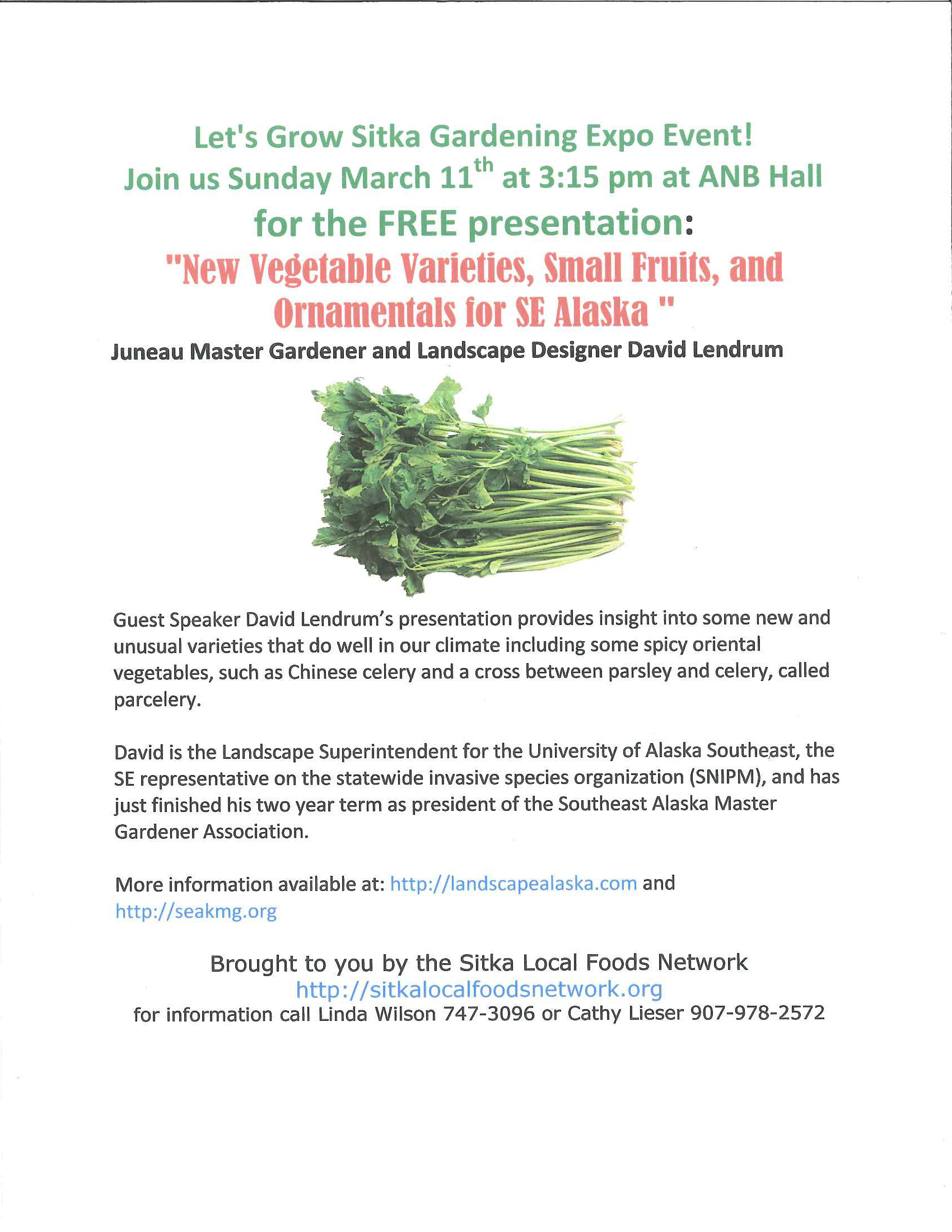
Right after the three-hour Let’s Grow Sitka event ends, guest speaker Dave Lendrum of Juneau will speak at 3:15 p.m. on “New Vegetable Varieties, Small Fruits, and Ornamentals for Southeast Alaska.” Lendrum is a landscape designer who just finished a two-year term as president of the Southeast Alaska Master Gardener Association and with his landscape architect wife, Margaret Tharp, owns Landscape Alaska.

Dave’s life has evolved in partnership with the natural world. He grew up in California on an organic u-pick vegetable farm, learning horticulture from his parents and the 4H club. He did nursery work and continued his post-college adventure in Ecuador by starting a fresh market produce business. After being a city horticulturist at the Eugene (Ore.) Parks Department, Dave started his first nursery, Western Oregon Perennials. A few years later, he found himself in a high-temperature photosynthesis lab at Stanford. In the Pacific Northwest, Dave restored old estate gardens. When he heard Alaska’s call, he moved north to Elfin Cove. Dave and his wife started Landscape Alaska in Juneau 28 years ago. They design and build landscapes on every scale and have won numerous awards both locally and nationally. In addition, Dave is the landscape superintendent for the University of Alaska Southeast and the Southeast representative on the statewide invasive species organization (SNIPM).

For more information about Let’s Grow Sitka, contact Linda Wilson at 747-3096 (evenings, weekends) or lawilson87@hotmail.com, or Cathy Lieser at 978-2572. The two event fliers for this event are posted below as Adobe Acrobat files (PDF files).

• Main flier for 2012 Let’s Grow Sitka event

• Flier for Dave Lendrum presentation after Let’s Grow Sitka event ends

• Alaska Food Policy Council releases its 2012-15 strategic plan

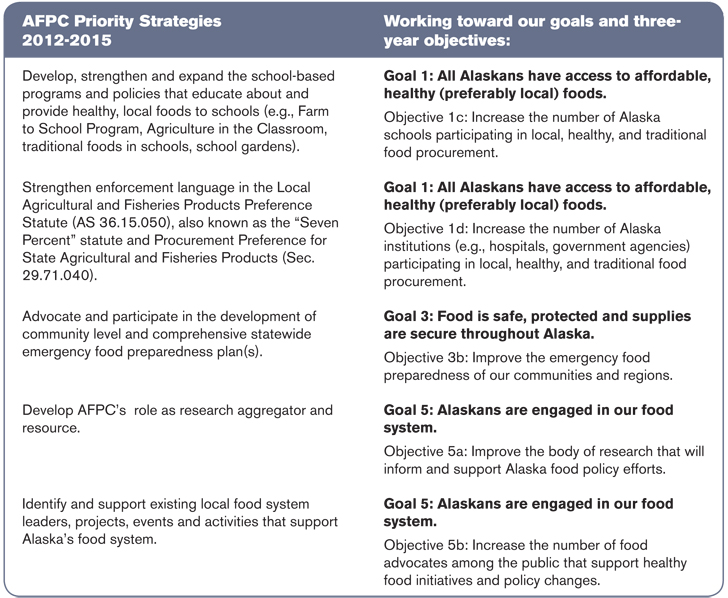
The Alaska Food Policy Council recently released its 2012-15 Alaska Food Policy Strategic Plan, which was about a year in development.

This spring, the council will work on action-planning on its top five priority strategies:

  1. Develop, strengthen and expand the school-based programs and policies that educate about and provide healthy, local foods to schools (e.g., Farm to School Program, Agriculture in the Classroom, traditional foods in schools, school gardens).
  2. Strengthen enforcement language in the Local Agricultural and Fisheries Products Preference Statute (AS 36.15.050), also known as the “Seven Percent” statute and Procurement Preference for State Agricultural and Fisheries Products (Sec. 29.71.040).
  3. Advocate and participate in the development of community level and comprehensive statewide emergency food preparedness plan(s).
  4. Develop AFPC’s role as research aggregator and resource.
  5. Identify and support existing local food system leaders, projects, events, and activities that support Alaska’s food system.

“The Alaska Food Policy Council has been working toward this strategic plan since May 2010,” said Diane Peck, MPH, RD, a community and evaluation specialist with the Alaska Obesity Prevention and Control Program who leads the council. “Initial committees worked to identify Alaska’s food system issues and concerns and then the strategic planning group worked to turn those into our goals and strategies. It’s exciting to see such a broad spectrum of food system stakeholders come together to develop a clear and concise plan that will help guide local, regional and statewide food systems planning in Alaska.”

“The Alaska Food Policy Council works to strengthen Alaska’s food systems to spur local economic development, increase food security, and improve nutrition and health,” according to the council’s website. “The council serves as a resource for information on local and state food systems, and works to identify and propose policy and environmental changes that can improve the production, processing, distribution, health, security and safety of our food.”

According to the council’s website, “the long-term goals of the Alaska Food Policy Council are to identify barriers to building a viable Alaska food system, create a strategic plan to address these barriers, and make the necessary recommendations to decision makers to implement this plan. Diverse stakeholders from around the state have been invited to participate, including representatives for commercial farmers, farmers’ markets and CSAs; fisheries and fish processors; distributors; institutional purchasers; private-sector businesses; legislators; consumers; Alaska Native tribal organizations; food security organizations; environmental organizations; and local, state, and federal government agencies.

”

The Sitka Local Foods Network is represented on the Alaska Food Policy Council by Lisa Sadleir-Hart, MPH, RD, CHES, ACE, community nutrition department manager for SEARHC Health Promotion and the treasurer of the Sitka Local Foods Network.

“Being involved in the Alaska Food Policy Council has deepened my commitment to making local food a reality in Sitka,” Lisa said. “It’s also made me realize that we are already a community ‘on the map’ when it comes to food issues and creative responses. Sitka is considered to be one of the leading communities in the state, on par with Fairbanks/Ester/Delta Junction and Homer.”

The Alaska Food Policy Council will meet April 4-5 in Anchorage for a face-to-face meeting to action-plan the five priority strategies. People interested in providing feedback on the plan should contact Diane Peck at diane.peck@alaska.gov.

• 2012-15 Alaska Food Policy Council Strategic Plan

• Sitka Local Foods Network seeks market manager for 2012 Sitka Farmers Markets

The Sitka Local Foods Network Board of Directors is recruiting for a volunteer/contract worker to serve as market manager for the 2012 Sitka Farmers Markets.

This is the fifth year of operation for the Sitka Farmers Market, which features six markets from 10 a.m. to 2 p.m. every other Saturday from July 7 through Sept. 15 (July 7, 21, Aug. 4, 18, Sept. 1 and 15) at the Alaska Native Brotherhood Hall. The farmers markets feature booths from local farmers/gardeners, local fishermen, and artisans and craftspeople. These events are great Sitka gathering places, and we promote local foods and other goods at them.

A detailed description of the market manager duties (compiled by Sitka Local Foods Network vice president Linda Wilson, who has been the market manager the past four years) can be found at the link below. For more information or to submit applications, contact Maybelle Filler at 747-2761 or mocampo25@hotmail.com, or contact Doug Osborne at 747-3752 or doug_las@live.com. Please submit a resume and interest letter to Maybelle and/or Doug by 5 p.m. on Friday, Feb. 24. The market manager of the Sitka Farmers Market reports to the Sitka Local Foods Network Board of Directors.

• Description of duties for market manager of the Sitka Farmers Market