• Sitka Health Summit presents seed money check to Community Food Assessment for a Food Resilient Sitka project

FOOD ASSESSMENT DOUGH: From left, Sitka Health Summit Steering Committee members Ellen Daly, Elisabeth Crane and Penny Lehmann present a check for project seed money to representatives from the Community Food Assessment for a Food Resilient Sitka community wellness project, Renae Mathson (fourth from left), Sabrina Cimerol, Garrett Bauer and Courtney Bobsin.

FOOD ASSESSMENT DOUGH: From left, Sitka Health Summit Steering Committee members Ellen Daly, Elisabeth Crane and Penny Lehmann present a check for project seed money to representatives from the Community Food Assessment for a Food Resilient Sitka community wellness project, Renae Mathson (fourth from left), Sabrina Cimerol, Garrett Bauer and Courtney Bobsin.

Representatives from the Sitka Health Summit recently presented a check for seed money to the Community Food Assessment for a Food Resilient Sitka project. The project is one of three community wellness projects that came out of the 2012 Sitka Health Summit in October, and the food assessment will help Sitka improve its food security.

The food assessment will take various forms, from polling local grocery stores and shipping companies to try and gauge how much food comes into the community to developing a survey for community members and families about how much food they consume. The project will look at the food needs in our community, as well as what’s available. It also will include a survey about how much fish and game is used in Sitka, as well as how many people gather seaweed and berries or raise food in gardens.

The community food assessment recognizes that everybody in Sitka has access to affordable, quality food from stable food systems. The group meets on the second Wednesday each month, and the next meeting is from 5:30-7 p.m. on Wednesday, Feb. 13, at the Sitka Sound Science Center.

For more information, contact Renae Mathson at 966-8797 or renae.mathson@searhc.org, or contact Andrianna Natsoulas at 747-3477 or anatsoulas@thealaskatrust.org. Sitka residents can ask to join the Google Groups e-mail list for the project to keep up to date with what’s happening.

• Sitka community food assessment project to hold kick-off meeting on Monday, Oct. 29

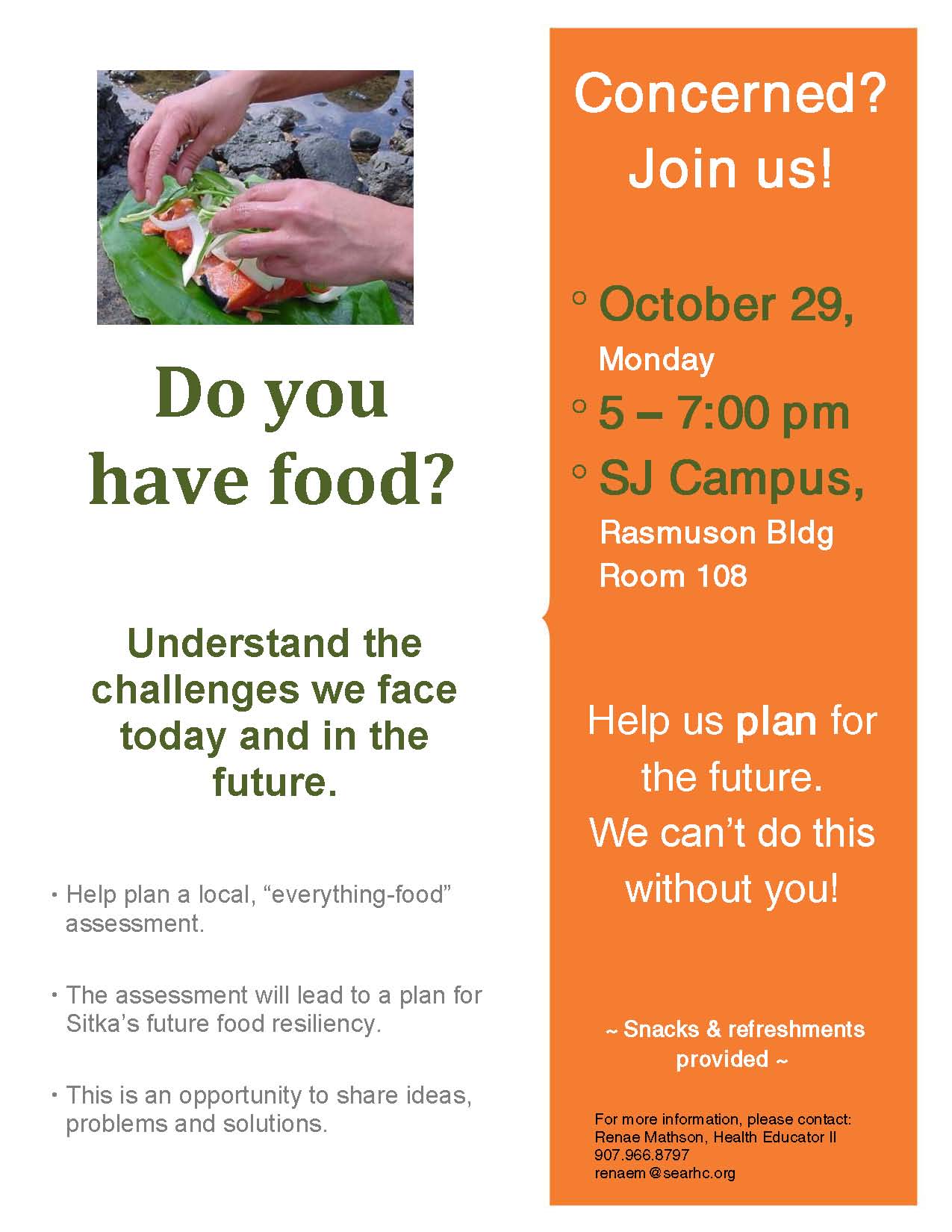
At the 2012 Sitka Health Summit, “Developing a Community Food Assessment for a Food Resilient Sitka” was selected as one of the top three goals for 2012-2013. All members of the public who are interested in this initiative are cordially invited to a kick-off gathering from 5-7 p.m. on Monday, Oct. 29, in Room 108 at the Rasmuson Building located on the Sheldon Jackson campus.

Are you concerned about where your food comes from and how it gets to Sitka? Have you ever wondered what happens if the barge doesn’t arrive? Are you worried about rising food prices and do you worry about the future of Sitka’s food needs? What percentage of Sitka’s food is locally harvested? Do you feel the fish and game food resources you harvest are adequately protected?

Those and other questions will be asked as part of the community food assessment. All members of Sitka’s community have a need for and a right to healthy, stable, affordable food. We are interested in finding community groups and individuals who can help us in the planning stages of this assessment.

Snacks and refreshments will be provided. For more information, contact Renae Mathson at 966-8797 or renae.mathson@searhc.org.

• ‘Getting Real About Food and the Future’ film explains the importance of local food

Why is it so important to promote local foods and local foods systems? This 30-minute video by Christopher B. Bedford explains some of the reasons why local food is so important.

According to the brief synopsis, “The growing oil, water, and climate crises threaten food security in all communities. This new film by Chris Bedford looks at the deeper issues of food security and community survival in this new age of global chaos and scarcity. ‘Getting Real About Food and the Future’ features the wisdom of John McKnight, Bill McDonough, Lester Brown, Bob Costanza, and David Korten in a 30 minute film designed for use in classrooms, meetings, and conferences.”

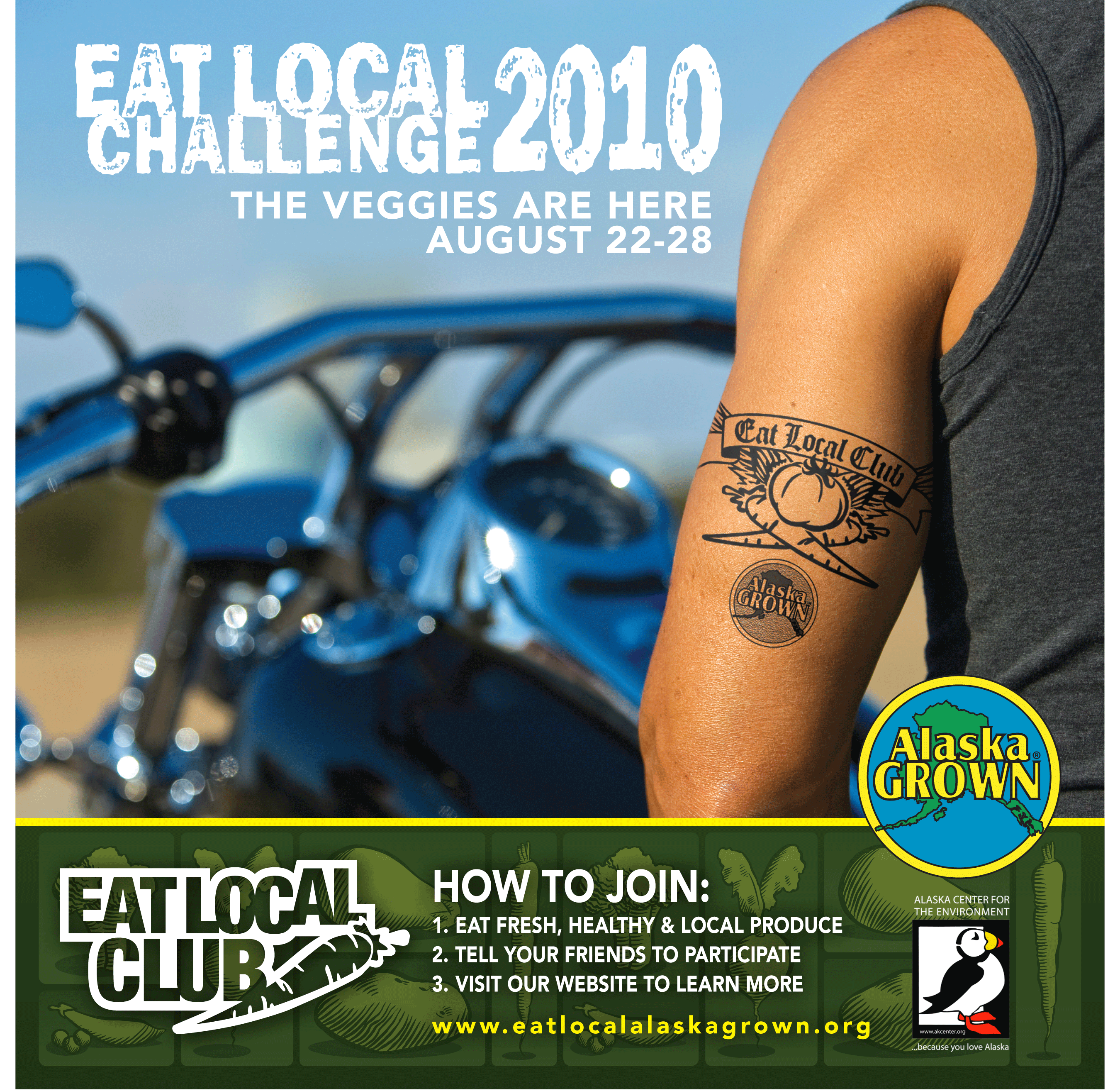
• Alaska Grown, Alaska Center For The Environment team up to host the Eat Local Challenge 2010 on Aug. 22-28

The state’s Alaska Grown program will host its “Eat Local Challenge 2010” on Sunday through Saturday, Aug. 22-28 (click here to read more). This year, the Alaska Center for the Environment, has joined Alaska Grown as a sponsor as part of the center’s local foods and sustainable communities program.

Alaskans have many ways to eat local, from veggies they grow in their own gardens or buy from Alaska farmers, berries they pick, fish they catch, game meat they hunt, seaweed and other beach greens they gather, etc. The benefit of eating local food is it’s fresher so it tastes better and has more nutrients, and you cut out the thousands of miles of transportation costs needed to ship food from the Lower 48 and other countries to Alaska. Growing local food makes a community more sustainable.

During the week of Aug. 22-28, Alaska residents are encouraged to:

  • Try eating at least one home-cooked meal this week, made of mostly local ingredients.
  • Try to incorporate at least one never-before-used local ingredient into a meal.
  • Try “brown-bagging” at least one meal this week made primarily of local ingredients.
  • Try talking to at least one local food retailer and one food producer about local food options.
  • Try to choose local food products whenever possible.

By the way, a good time to buy local food for the Eat Local Challenge is during the third Sitka Farmers Market of the summer on Saturday, Aug. 14, and during the fourth market on Saturday, Aug. 28. The Sitka Farmers Markets take place from 10 a.m. to 2 p.m. on alternate Saturdays (through Sept. 11) at historic Alaska Native Brotherhood Hall, 235 Katlian St. We’ll see you there.

• Sitka represented at first meeting of new Alaska Food Policy Council

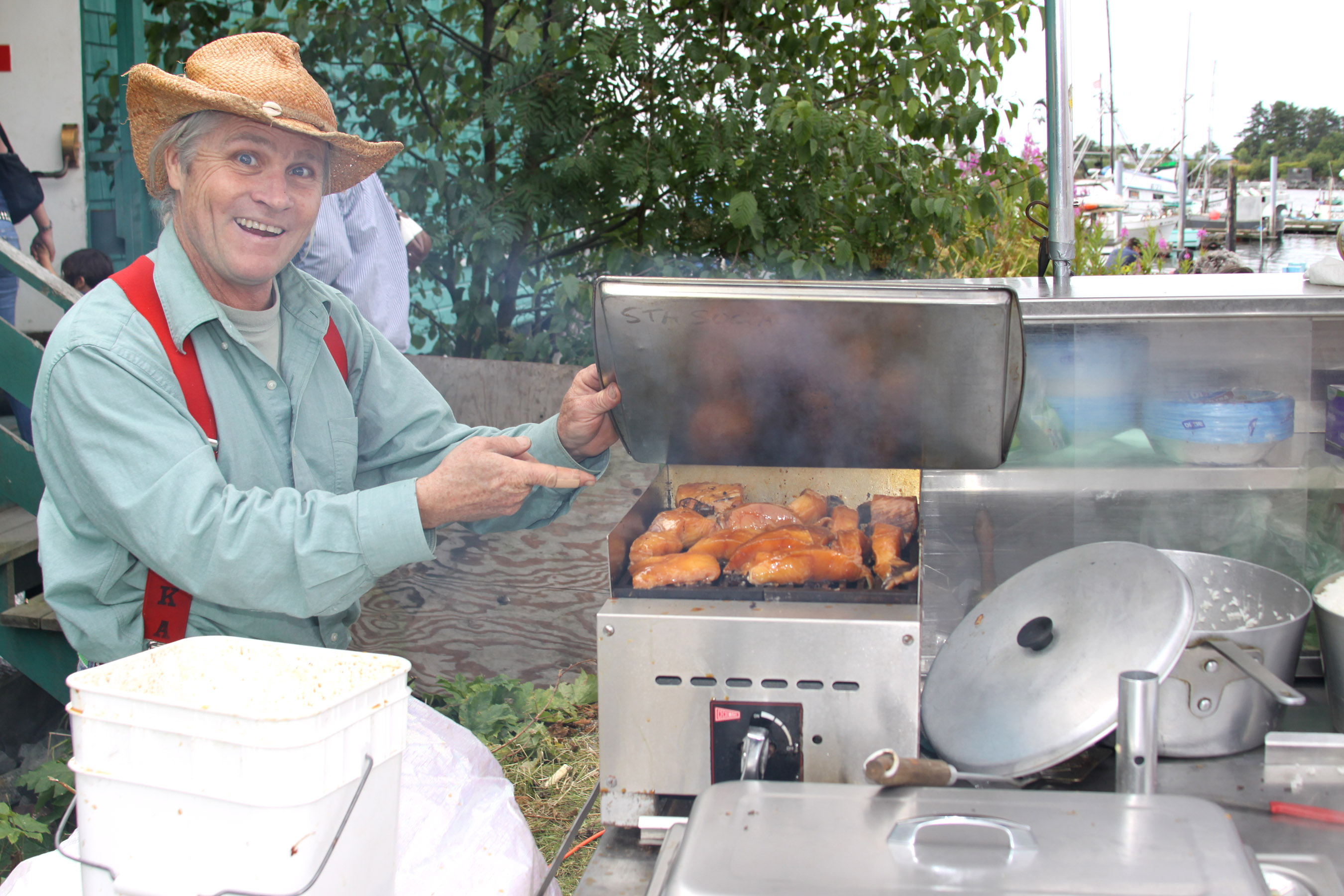
Kerry MacLane grills black cod for the Alaska Longline Fisherman's Association booth at an August 2009 Sitka Farmers Market

Kerry MacLane grills black cod for the Alaska Longline Fisherman's Association booth at an August 2009 Sitka Farmers Market

When the new Alaska Food Policy Council held its first meeting in Anchorage last month, Sitka Local Foods Network president Kerry MacLane was among the 80 or so people in attendance.

“There were nutritionists, politicians, state and federal government folks galore, Native groups, Alaska ranchers (of reindeer, musk ox, elk, goats and even cows), our one creamery, schools, WIC (Women, Infants, Children supplemental nutrition program), restaurants, truckers, a food wholesaler and even some people growing fruits and vegetables,” said Kerry, whose meeting notes are linked as a PDF file at the bottom of this story. “I was honored to represent Sitka at the first meeting of the Alaska Food Policy Council.”

The Alaska Food Policy Council is a new venture in Alaska, but food policy councils are becoming more common around the country at the state and regional level, especially as more people are becoming concerned about where their food comes from and what’s in it. The first meeting of the Alaska Food Policy Council featured guest speaker Mark Winne of the Community Food Security Coalition, who discussed what food policy councils do, and there was a panel of experts from around the state who gave brief presentations about different parts of Alaska’s food system. Many of the participants also took an online survey about Alaska’s food system, which helped provide guidance for the two-day meeting.

“This group will take a critical look at our current food system and start thinking about ideas for building a stronger regional system,” Daniel Consenstein, executive director of the U.S. Department of Agriculture’s Alaska Farm Service Agency, wrote about the meeting. “Most of these stakeholders know that keeping more of our food dollars in Alaska will help create jobs and spur economic development. They know that if Alaska can produce more of its own food, we can build healthier communities and be less vulnerable to food disruptions in times of emergencies. The long-term goals of the Food Policy Council will be to identify barriers to building a viable Alaskan food system, create a strategic plan to address these barriers, and make the necessary recommendations to decision makers to implement this plan. Over the next year, this group will develop an action plan to make Alaska more food secure.”

Photo courtesy of USDA Agricultural Research Service Image Gallery / Photo by Scott Bauer -- The average American eats 142 pounds of potatoes a year, making the tubers the vegetable of choice in this country

Photo courtesy of USDA Agricultural Research Service Image Gallery / Photo by Scott Bauer -- The average American eats 142 pounds of potatoes a year, making the tubers the vegetable of choice in this country

Diane Peck of the Alaska Division of Public Health is coordinating the Alaska Food Policy Council, which is having its creation funded by a grant from the U.S. Department of Agriculture and from a two-year grant from the Alaska Department of Health and Social Services Obesity Prevention and Control Program (grant originally provided through the U.S. Centers of Disease Control and Prevention). Detailed meeting minutes and a purpose and next steps document are linked below as PDF files.

The University of Alaska Fairbanks School of Natural Resources and Agricultural Sciences posted a good, detailed wrap-up of the first meeting on its blog, and the University of Alaska’s “Statewide Voice” also had an article about the meeting.

The creation of the Alaska Food Policy Council has sparked regional interest in Southeast Alaska. The Health, Education and Social Services committee of the Southeast Conference will meet by teleconference at 10 a.m. on Tuesday, June 22, to discuss the Alaska Food Policy Council (click Calendar and Events on the link to get call-in numbers and codes). “We have opportunity to advance our local food production and utilize the bounty of our region to sustain our people and improve our health,” Southeast Conference executive director Shelly Wright wrote about the Alaska Food Policy Council.

“There are numerous benefits that food policy changes could mean for residents of Southeast Alaska,” Kerry MacLane said. “The bycatch regulations could be modified to encourage great recovery, processing and distribution. This would result in affordable fish in local markets, schools, health institutions and statewide. Federal, state and local government institutions would have more incentives and few restrictions to include local food in their purchases. More economic development funds could be made available to food system-related entrepreneurs. State and federal storage of (Alaska) emergency food supplies could be in our communities instead of in Portland, Ore. The Alaska Food Policy Council can help Alaskans increase our self-reliance and be more prepared for the coming rise in fuel costs.”

To learn more about the Alaska Food Policy Council, contact Diane Peck with the Alaska Division of Public Health at 1-907-269-8447 (Anchorage) or by e-mail at diane.peck@alaska.gov. Most of the council’s communication and meetings will be by e-mail and teleconference.

Minutes from the May 18-19, 2010, first meeting of the Alaska Food Policy Council

Purpose and next steps for Alaska Food Policy Council

Kerry MacLane’s notes on the first meeting of the Alaska Food Policy Council

• Fast Food Nation author encourages Alaskans to grow their own local food

Fast Food Nation author Eric Schlosser, second from left, visits with University of Alaska Fairbanks School of Natural Resources and Agricultural Sciences associate professor Joshua Greenberg, left, student Charles Caster, third from left, and professor Milan Shipka, right, during a May 27 visit to speak at UAF. (Photo courtesy of the UAF School of Natural Resources and Agricultural Sciences blog)

Fast Food Nation author Eric Schlosser, second from left, visits with University of Alaska Fairbanks School of Natural Resources and Agricultural Sciences associate professor Joshua Greenberg, left, student Charles Caster, third from left, and professor Milan Shipka, right, during a May 27 visit to speak at UAF. (Photo courtesy of the UAF School of Natural Resources and Agricultural Sciences blog)

Eric Schlosser, the author of “Fast Food Nation” and “Chew On This,” encouraged Alaskans to grow their own local foods during a May 27 lunch of Alaska-grown food with University of Alaska Fairbanks (UAF) School of Natural Resources and Agricultural Sciences (SNRAS) students, faculty and staff involved with food security and food production.

Schlosser, who also co-produced the films “Food, Inc.” and “There Will Be Blood,” was in Fairbanks to give a lecture that night as part of UAF’s Summer Sessions. Stories about his lecture can be found on the SNRAS blog and in the UAF Sun Star student newspaper, and a preview story was in the Fairbanks Daily News-Miner.

During his free lecture, Schlosser discussed the recent changes to how our food is grown and prepared, and about how we are losing contact with how our food gets to our plates. He focused on many of the industrial agriculture themes highlighted in his more popular book, “Fast Food Nation,” and some of the resulting problems, such as the low wages and vulnerable workforce in fast food production and the use of hormones in feedlot cattle and issues with antibiotics given feedlot animals.

He also delved into some of the resulting health issues from eating too much fast food, a topic he discussed in his book “Chew On This,” which was written for older children. (Editor’s note: “Chew On This” has a section about the Stop The Pop movement by schools in rural Alaska to eliminate soda pop from their school vending machines.) According to the SNRAS blog, Schlosser discussed the connections between our highly processed, industrial food and diseases such as diabetes.

The people most at risk are children and the elderly. Fast food, which is high in fat, sugar, starch, and salt, compromises the health of these vulnerable citizens. “These are ideal foods to make you unhealthy,” Schlosser said. “And they sell tons of soda because it is the most profitable thing they sell.”

While people in the US used to be some of the most fit people now they are terribly unfit. The obesity rate has nearly doubled for toddlers and tripled for children ages 6 to 11. “Alaska has one of the highest obesity rates in the US,” Schlosser said. “Alaska has more in common with Alabama and Mississippi than western states when it comes to obesity.”

Diabetes is another concern, with one in three children born in 2000 destined to develop diabetes. Among poor people the number is one in two.

“What is to be done?” Schlosser asked. “That all sounds really grim but an entirely different system is possible and necessary.” He stressed organic foods, buying local food, and reconnecting people with where food comes from. He said he is encouraged by the interest in sustainability found on college campuses.

“The fast food system exploits the weak and the poor and threatens our entire democratic system,” he said. “We need an agricultural system based on social policies and access to healthy, nutritional food for every member of society.”

Schlosser also noted how dependent Alaska has become on imported food, and how that impacts food security.

“Hey, you guys in Alaska gotta grow your own. You need to remember where food comes from. Alaska is the most food insecure state; that is not good.” He said Alaska has 15 million acres suitable for agriculture, yet only 30,000 acres are cultivated. (See addendum below.) “Rhode Island has twice as many farms as you and their value of agricultural products is twice as big. Now come on, you guys need to grow food in your back yards, have school gardens, and buy food grown in this state.”

(Addendum — From SNRAS Dean and AFES Director Carol Lewis, June 1, 2010: The 15 million acres is a wonderful quote, but if you look at Roeger (1958), you’ll see the rest of the story. Only 500,000 are accessible by road or rail. There are opportunities to use non-agricultural lands if we use controlled environments and composting, however. There are more than 30,000 acres actually cleared and in Delta alone there are about 100,000 acres.)

• Alaska Food Policy Council created to examine how our food system relates to our economy, security and health

In response to concerns by Alaskans about food security, health and job creation, the Alaska Food Policy Council is being formed and it will host a meeting on May 18-19 at a location TBA in Anchorage.

“This will be a chance for Alaskans to come together and develop a plan to produce more food for our communities,” said Danny Consenstein, the Executive Director of the USDA Alaska Farm Service Agency in Palmer.

The Alaska Food Policy Council wants your help in examining how our food system relates to our economy, our security and our health. The meeting will provide an opportunity for the wide variety of food system stakeholders to connect, so they can begin to develop comprehensive solutions toward building a stronger Alaska food system.

The first face-to-face meeting takes place from noon to 5 p.m. on Tuesday, May 18, and from 8 a.m. to noon on Wednesday, May 19, at a location TBA in Anchorage. Mark Winne of the Community Food Security Coalition will facilitate the meeting. The goal will be to learn about food policy councils (which exist in many states and local communities), consult with experts to establish the lay of the land in Alaska, and to begin to set the direction for the Alaska Food Policy Council to take. Sitka Local Foods Network President Kerry MacLane has been asked to represent our group on this council, and he said he plans to attend the May meeting.

Seating is limited for this meeting, so please contact Public Health Specialist Diane Peck, MPH, RD, with the Alaska Department of Health and Social Services by May 1 to RSVP or request more information. Diane can be reached at 269-8447 (Anchorage) or diane.peck@alaska.gov. The Alaska Center for the Environment’s local food project page has more information about the creation of the Alaska Food Policy Council.

Alaska Food Policy Council meeting flier for May 18-19 in Anchorage

• Sitka film featured in Palmer’s “Local Harvest, Local Food” film festival, a Sitka café featured for using local food and other local foods news

Food Film Fest Poster-2

Join the Palmer Arts Council for its inaugural “Local Harvest, Local Food” film fest from Thursday, Nov. 19, through Sunday, Nov. 22, at the Strangebird Consulting Office in downtown Palmer. “Good Food” screens at 7 p.m. on Thursday, Nov. 19; “Fresh” shows at 7 p.m. on Friday, Nov. 20; “Eating Alaska” by Sitka filmmaker Ellen Frankenstein screens at 7 p.m. on Saturday, Nov. 21; and “Ingredients” shows at 3 p.m. on Sunday, Nov. 22. After the Sunday showing there will be a discussion about women in agriculture with Cynthia Vignetti. Suggested donations are $10-15 for all films except for Sunday, which is free.

A Sitka restaurant, the Larkspur Café, was featured in Capital City Weekly last week. The article talks about the origins of the restaurant, which is located in the same building as KCAW-Raven Radio. It also discusses the restaurant’s use of local foods, including owners Amelia Budd and Amy Kane purchasing produce from the Sitka Farmers Market during the summer.

In other local foods news from around the state, the National Oceanic and Atmospheric Administration (NOAA) recently announced an expansion to the state’s subsistence halibut fishery to include more rural residents (this includes the Sitka area). The new rules, which take effect on Dec. 4, redefine who qualifies as a rural resident. The previous rules defined rural residents as people living in a rural community or people belonging to a Native tribe with customary and traditional uses of halibut, and the news rules try to catch subsistence halibut users who fell outside the previous definition. Click this link for more information about subsistence halibut regulations and applications.

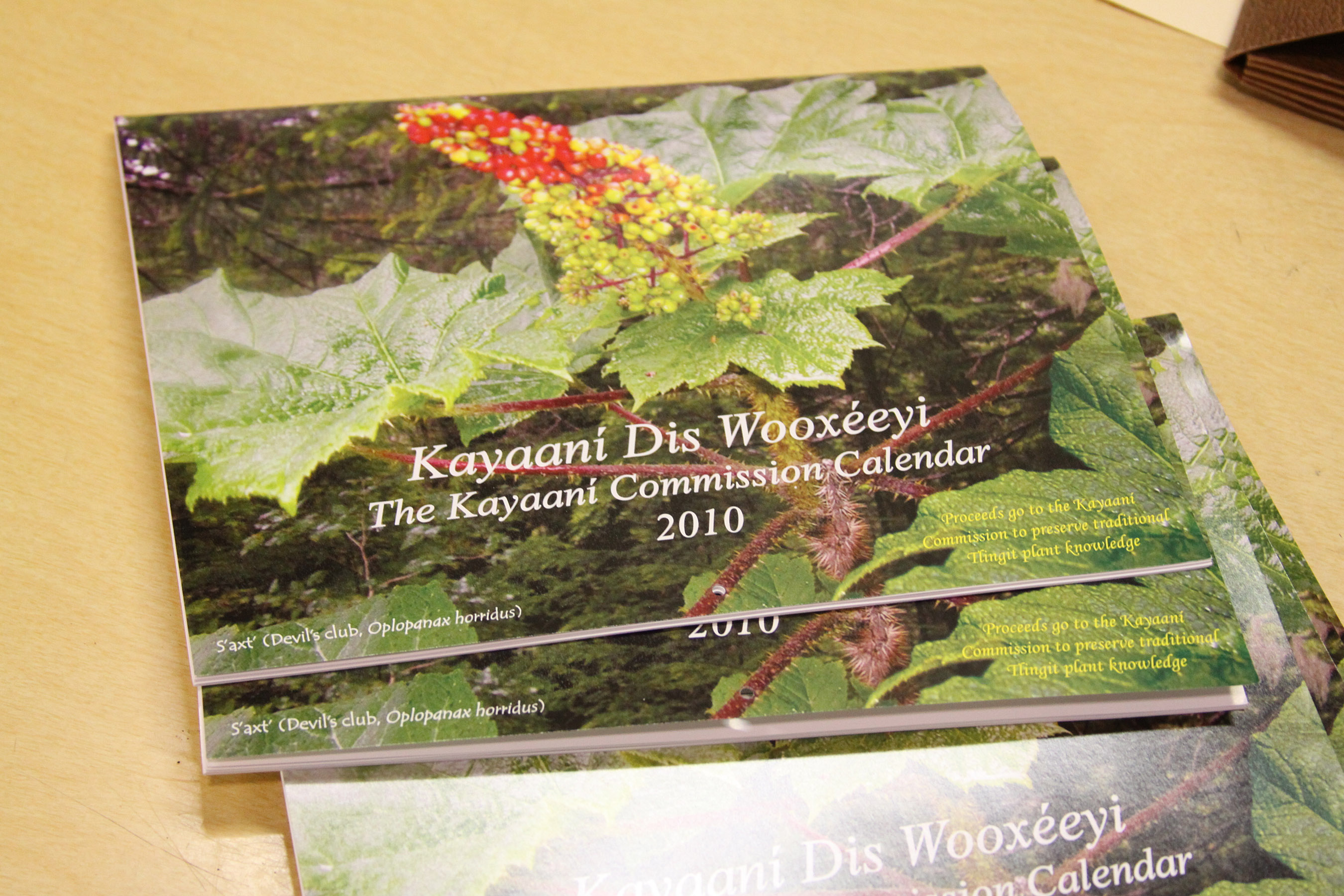
The Daily Sitka Sentinel has been running a brief announcement from the Sitka Tribe of Alaska’s Kayaaní Commission, which is selling 2010 calendars, CDRoms and field guides about traditional uses of native plants. Here is the information:

Kayaaní Native Plant Publications Available: 2010 Kayaaní Harvest Calendars featuring native plants and their traditional and cultural uses ($16, $2 postage per address); Interactive Ethnobotanical CDRoms with native species, their Tlingít, scientific and common names, and interviews with Elders on the traditional and medicinal uses of plants ($15, $1 postage per address); Ethnobotanical Field Guides ($16, $1 postage per address). We will mail to the addresses of your choice. Order by Dec. 18 for guaranteed delivery before Christmas. Call or e-mail with your order: 907-747-7178, pbass@sitkatribe.org, STA Kayaaní Commission, 456 Katlian. All proceeds will assist the nonprofit Kayaaní Commission in protecting, perpetuating and preserving knowledge of native plants.

The Chilkat Valley News weekly newspaper from Haines featured an article about sixth-graders at Haines School learning how to compost their leftover food (including leftover meat) so it can be used for gardening. The school is working with the Takshanuk Watershed Council to teach the students about composting. The students call their compost project “Marvin” because it’s a living organism.

The Alaska Dispatch recently ran a feature called “Growing Season” that discusses some of the farms in the Matanuska-Susitna valleys that grow local food. The feature includes video clips of harvest time at a couple of the farms featured.

The Mat-Su Frontiersman had a feature called “Chicken U,” which is about raising chickens in Alaska and getting them to produce eggs during the winter months.

The Anchorage Daily News also mentioned Chicken University, which will be one of several presentations at the Alaska Farm Bureau annual meeting on Friday, Nov. 13, at the Millennium Hotel in Anchorage. Other presentations are on growing apples in Alaska and preserving your harvest.

The Anchorage Daily News also had an article about how to get local produce in Anchorage during the winter, either through the Glacier Valley CSA produce boxes from Palmer or the indoor farmers market at the Northway Mall.

Anchorage Daily News garden columnist Jeff Lowenfels wrote a column about how hydroponic gardening is easier and cheaper than ever. The column includes lots of links for people who want to try this method of growing food without soil (by the way, there is a hydroponic garden at McMurdo Station in Antarctica that keeps the scientists there stocked in fresh produce in a land of ice).

Fran Durner’s “Talk Dirt To Me” blog on the Anchorage Daily News site includes a post about how snow can act as mulch for the garden.

The Ester Republic, a monthly publication for the community near Fairbanks, runs periodic articles about sustainability and local food security issues. Some of the articles are linked in the archives, and the editors are working to get more of the past articles on these topics online so more people can enjoy them.

KayaaniCommissionCalendarFront´

• Alaska Center for the Environment launches local food campaign

AlaskaCenterForTheEnvironmentLogo

The Alaska Center for the Environment is launching a new campaign to teach Alaskans about the importance of local food. This campaign is just getting going, and there’s a lot of work needed to flesh out all of the elements. But it’s good to see someone looking a local food security issues on a statewide level.

Click here to read the main information page about the campaign, which includes facts such as Alaskans spent $2.6 billion on food each year and in 2007 only 0.13 percent of that money went to agricultural products grown in Alaska. Click here to read the campaign’s Frequently Asked Questions page. Click here to read about a proposed “Alaska Food, Farms and Jobs Act” that is based on legislation out of Illinois that ACE hopes to find an Alaska legislator willing to introduce.

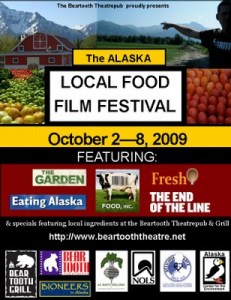
Finally, click here to read about the Alaska Local Food Film Festival that takes place Oct. 2-8 at the Bear Tooth Theatrepub and Grill in Anchorage. Each day during the festival the Bear Tooth will show a local food-related movie at 5:30 p.m. The films include “Food, Inc.,” “The Garden,” “Eating Alaska,” “Fresh” and “The End of the Line.” Sitka filmmaker Ellen Frankenstein will lead a discussion after her film, “Eating Alaska,” is shown on Sunday, Oct. 4.

AlaskaLocalFoodFilmFestivalPoster