• Sitka Seafood Festival steering committee to meet on April 1

Salmon ready for canning in jars (Photo courtesy of University of Alaska Fairbanks Cooperative Extension Service)

Salmon ready for canning in jars (Photo courtesy of University of Alaska Fairbanks Cooperative Extension Service)

The Sitka Seafood Festival steering committee will meet at 6 p.m. on Thursday, April 1, at the Sitka Economic Development Association (SEDA)/Greater Sitka Chamber of Commerce office on the second floor of the Troutte Center Building on Lincoln Street (above Seasons card store).

The meeting agenda will finalize the event’s mission statement and the vision for the festival, set committee members and leads, and take care of other business related to creating a new festival of this nature. The Sitka Seafood Festival tentatively is scheduled for Friday through Sunday, Aug. 6-8, at various locations in Sitka.

Notes from the March 24 meeting and an initial breakdown of committees are attached as PDF documents. For more information about the festival, contact Alicia Peavey at alaska_al33@hotmail.com or 1-928-607-4845. (Editor’s note: The next meeting will be at 7:30 p.m. on Monday, April 5, at Harrigan Centennial Hall.)

Notes from March 24, 2010, Sitka Seafood Festival steering committee meeting and vision session

Sitka Seafood Festival committees

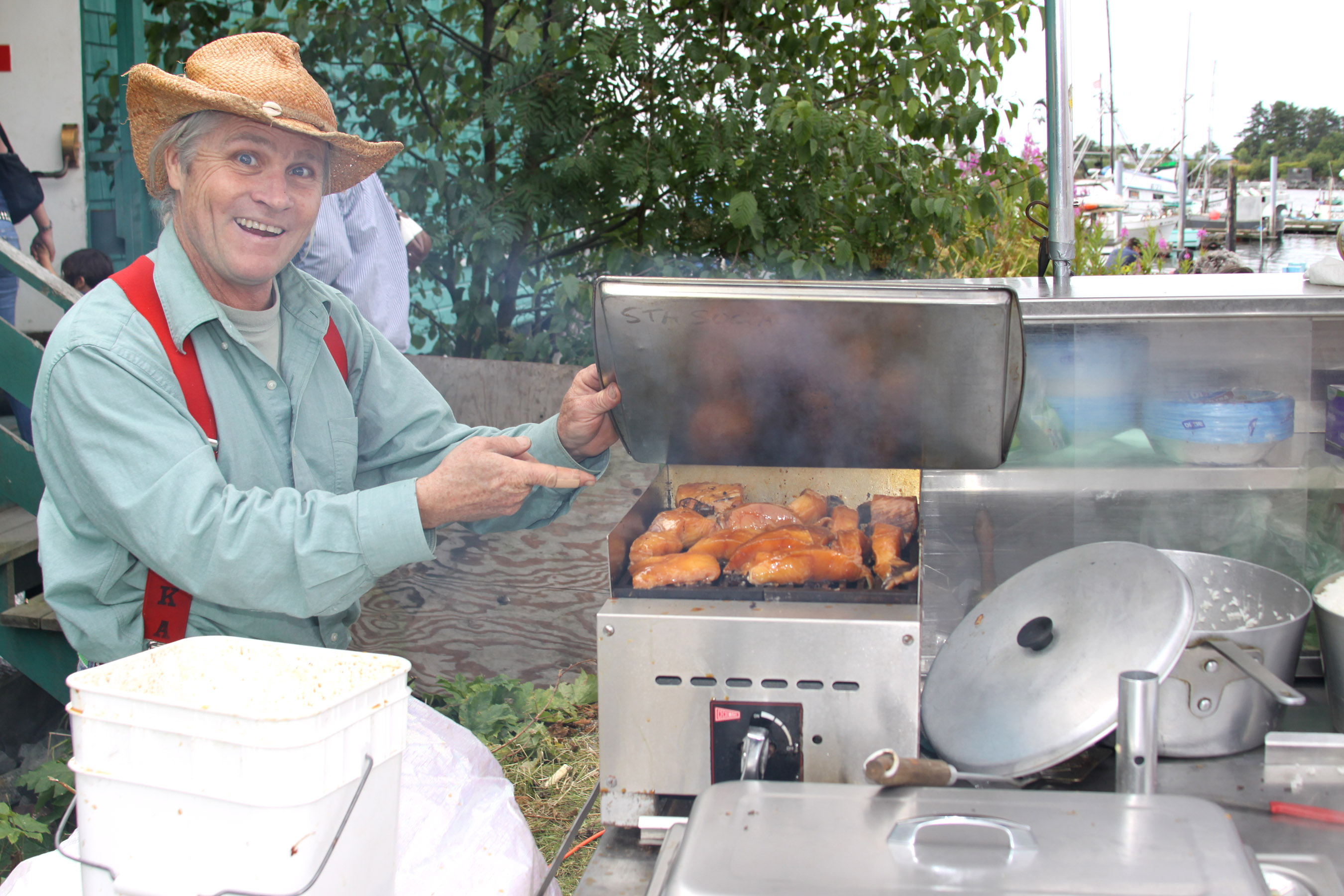
Kerry MacLane grills black cod for the Alaska Longline Fisherman's Association booth at the Sitka Farmers Market

Kerry MacLane grills black cod for the Alaska Longline Fisherman's Association booth at the Sitka Farmers Market

• Group to meet about organizing a Sitka Seafood Festival this summer

Black cod (aka sablefish) on the grill from the Alaska Longline Fisherman's Association booth at the Sitka Farmers Market

Black cod (aka sablefish) on the grill from the Alaska Longline Fisherman's Association booth at the Sitka Farmers Market

A group in Sitka will meet at 6 p.m. tonight, Wednesday, March 24, at the Sitka Economic Development Association’s conference room (second floor of the Troutte Center building on Lincoln Street, the Sitka Chamber of Commerce office above Seasons card store) to plan the inaugural Sitka Seafood Festival.

The group first met on Saturday afternoon, March 20, to brainstorm ideas for the event. The group discussed the event’s mission, name, slogan location, music, the scope of the event (just salmon or multi species, very local or grander scale, etc.), committees, funding, event partners and other organizational aspects. Suggestions from the first meeting included having local and/or regional chefs provide cooking demonstrations, honoring the life cycle of the salmon (or featured species of the year), etc. The tentative dates for the first Sitka Seafood Festival are Aug. 6-8, 2010.

If you have any questions about the Sitka Seafood Festival, contact Alicia Peavey at alaska_al33@yahoo.com. (Editor’s note: The next Sitka Seafood Festival steering committee meeting will be at 6 p.m. on Thursday, April 1, at the Sitka Economic Development Association office in the Troutte Center building on Lincoln Street.)

Sitka Seafood Festival steering committee meeting notes from March 20, 2010

Sitka Seafood Festival steering committee meeting agenda, March 24, 2010

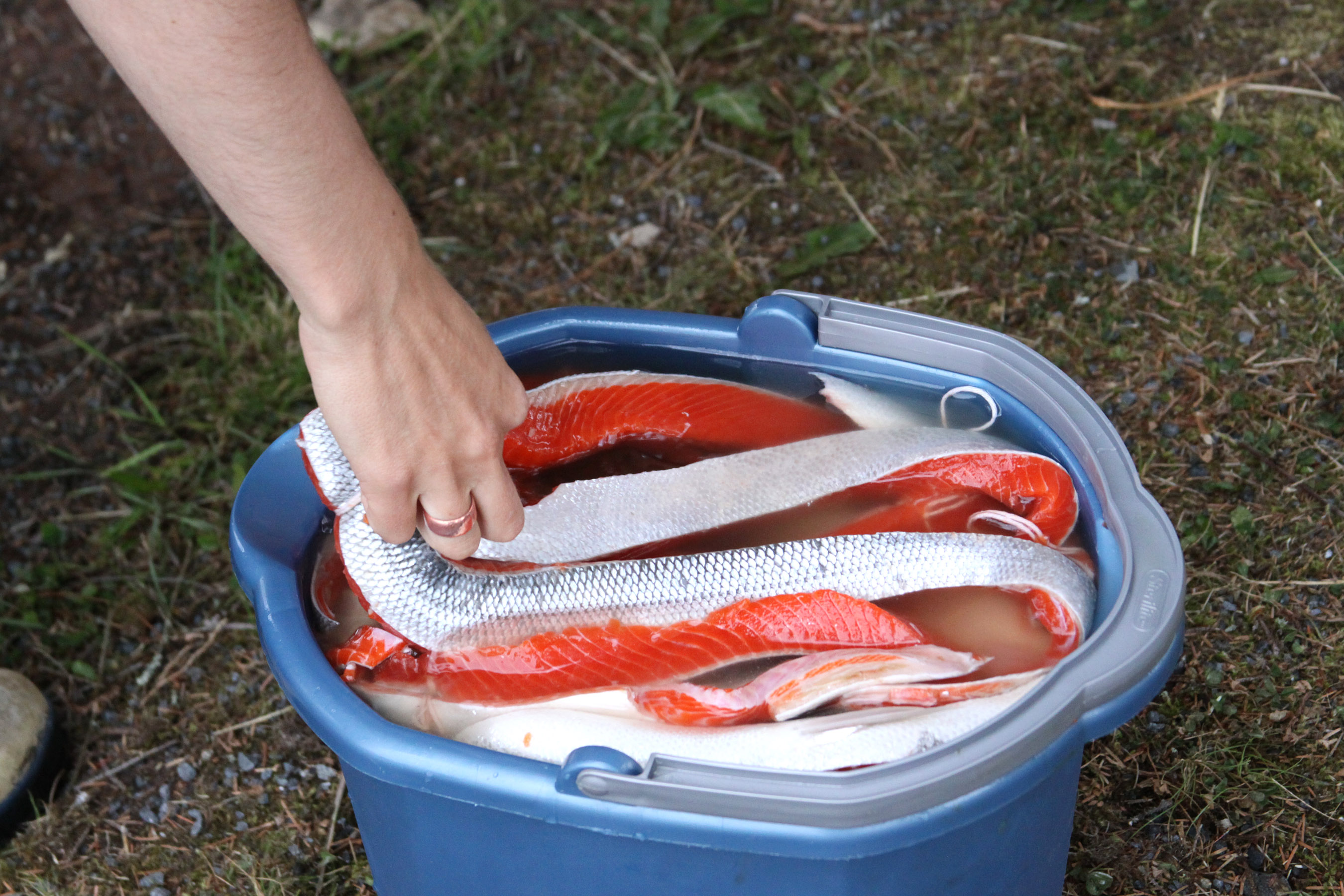
Chohla Moll grabs some sockeye salmon out of the brine mixture so she can hang it in the smoker.

• The new Sitka Local Foods Network e-newsletter (Feb. 28)

Click here to read the current Sitka Local Foods Network e-newsletter courtesy of Linda Wilson. Don’t forget, you can sign up for the e-newsletter by typing your e-mail address in the “Join Our Mailing List” box on bottom of the left side of the page.

• New feature added — Sitka Local Foods Marketplace (for in-season local food in Sitka)

There have been some requests for a Sitka Local Foods Marketplace, where local gardeners and fishermen can post notes when they have in-season local food available in Sitka. So we’ve added a Sitka Local Foods Marketplace page (please click this link), and the marketplace page can be found at the top of our main Sitka Local Foods Network gateway page.

The Sitka Local Foods Marketplace will give local gardeners and fishermen a place to let people know when local food is available, and this will be an all-year marketplace for local food. The way this will work is people with local food for sale will use the comments to post the news about their extra heads of lettuce or fresh king salmon available for sale. Sellers will be responsible for all licensing required before they can sell fish or cooked goods. Please no selling of subsistence or sport-caught fish due to Alaska Department of Fish & Game licensing regulations.

When posting your comment about local food you have available for sale, please use this format:

Your name (first and last names, please)
Your contact information (phone number and/or e-mail address)
What type of food is available (for example, fresh-caught winter king salmon with most fish in the 12-16 pound range)
Your price (both single item and any quantity discounts)
Expected time items will be available (one week, two weeks, all summer, etc.)
Any other comments about your local food

Please be aware that all comments are moderated on this site (thank the spammers), so it may take a day or two to be posted. If you posted a marketplace comment that didn’t show up on the page within a day or two, please send me an e-mail at charles(at)sitkalocalfoodsnetwork.org — replace (at) with the @ symbol. Also, if you have your own Web site for your local food products, send me the link and I will add it to the Sitka Commercial Food Producers category (toward the bottom of the long list of links on the right side of the Web page).

• Two associated with Sitka Local Foods Network win awards at Alaska Health Summit

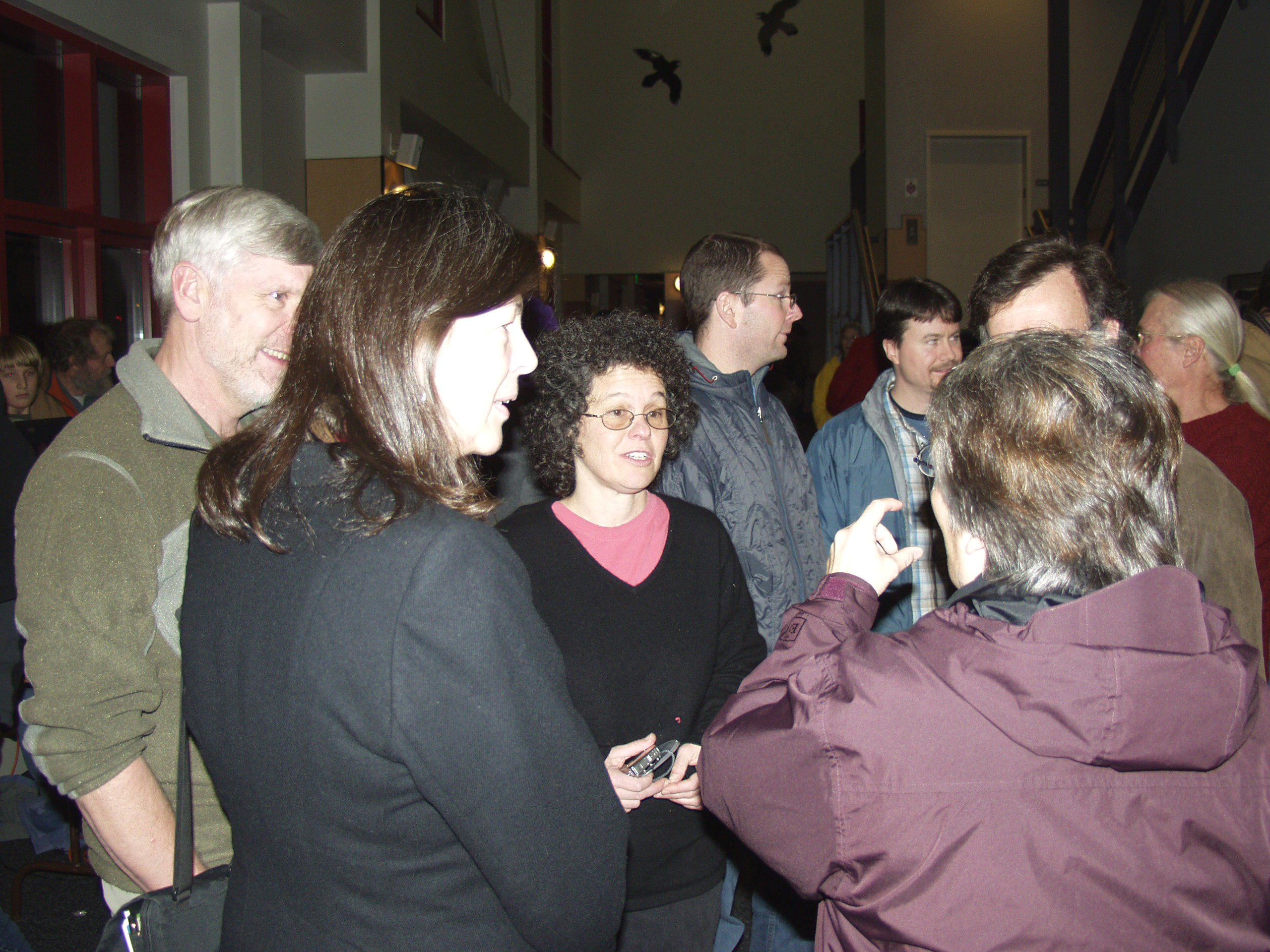
Sitka filmmaker Ellen Frankenstein, center, of Frankenstein Productions, greets fans after the Sitka premiere of her film "Eating Alaska" in October 2008

Sitka filmmaker Ellen Frankenstein, center, of Frankenstein Productions, greets fans after the Sitka premiere of her film "Eating Alaska" in October 2008

The Alaska Public Health Association (ALPHA) honored two programs with ties to the Sitka Local Foods Network during the Alaska Health Summit banquet on Dec. 9. Sitka filmmaker Ellen Frankenstein (and her Frankenstein Productions company) and the SouthEast Alaska Regional Health Consortium (SEARHC) Steps to a Healthier SE Alaska program both won the Alaska Community Service Award. According to ALPHA, the Alaska Community Service Award “recognizes an organization, business or group making a significant contribution to improving the health of Alaskans. It is ALPHA’s intent that nominees outside the public health tradition be considered for this award. A nominee does not need to be an ALPHA member.”

Frankenstein has produced several documentary films over the years, including “Eating Alaska,” which focuses on how we choose the food we eat. Eating Alaska debuted in the fall of 2008, and Frankenstein has taken it to film festivals all over the state and country. “Eating Alaska” received funding support from the SEARHC Steps to a Healthier SE Alaska program and other funders, plus technical support was provided by SEARHC health educators, physicians and dietitians. Some of Frankenstein’s other films include “No Loitering,” “Carved from the Heart,” “A Matter of Respect,” and “Miles from the Border.” She currently is working on a documentary film project with Haida weaver Dolores Churchill.

“As someone who fills in the occupation blank on forms with ‘filmmaker/artist,’ this award represents the fact that labels and lines don’t matter when it comes to social change and to making our lives healthier,” Frankenstein wrote from Austin, Texas, where she was attending a screening of Eating Alaska. “It not only validates my work, but represents your open-mindedness to the potential of working collaboratively and creatively with kids and adults, using art, media and storytelling to influence well-being and healthy communities.”

Frankenstein also sent this note to her e-mail group:

EATING ALASKA: ART AND HEALTH!
We just got the news the project has been awarded The Alaska Public Health Association’s 2009 Community Service Award for Health. In the process of making this film and in its use we’ve worked with nutritionists, health educators, medical and public health practitioners to add to the conversation about what we can do to make our homes, workplaces, schools and communities healthier and more sustainable. We appreciate the help everyone has given to the project to help us “contribute to improving the health of Alaskans” and others far beyond.

The SEARHC Steps to a Healthier SE Alaska program, which closes this month, was honored for the work it did over the life of its five-year grant (the national Steps to a Healthier US grant has ended, so that means all of the local grants that were part of the national grant also are ending). The Steps program funded 77 projects worth just over $1.1 million in 12 Southeast Alaska communities. Steps was one of the major funders and organizers of the Sitka Health Summit, which is where the Sitka Local Foods Network originated.

The Steps program’s goals were to increase opportunities for physical activity, improve nutrition and reduce the impact of tobacco in Southeast Alaska. The program also worked to reduce diabetes, obesity and asthma in Southeast communities. To accomplish its goals, Steps developed partnerships with schools, worksites, tribes and other community groups so they could change social norms and policies, and make evidence-based and culturally relevant interventions. In addition to the projects, Steps also hosted conferences and workshops to help programs learn how to work in collaboration.

The Steps program used the socio-ecological model, which emphasizes that an individual’s health status is influenced not only by his or her attitudes and practices, but also by personal relationships and community and societal factors. Nearly half of the 77 Steps grants (37) went to community projects, with the others geared toward schools and worksites. More than three-quarters of the grants (60) focused on improving nutrition and/or increasing physical activity. Together, the projects reached 128,000 people (with many people reached by multiple projects) in the communities of Angoon, Craig, Haines, Hoonah, Hydaburg, Juneau, Kake, Kasaan, Klawock, Klukwan, Sitka and Wrangell.

“Overall, the Steps initiative helped build capacity within communities, worksites and schools to work collaboratively, to plan evidence-based programs, and to monitor and evaluate program success,” said Grace Brooks, Steps Grant Manager. “Steps also contributed to an overall increased understanding of the importance of policy in supporting community, school and workplace health.”

In other local foods news from around the state this past week, the Alaska Dispatch ran an article about an indoors farmers market this winter at Anchorage’s Northway Mall.

Capital City Weekly featured a story by Carla Petersen about how the search for elusive cranberries is worth the challenge.

The National Oceanic and Atmospheric Administration (NOAA) announced last week that it is encouraging the use of catch shares to preserve the remaining stocks of halibut (the article features a photo from Sitka).

The Anchorage Daily News featured a story about Gov. Sean Parnell proposing to spend $1.3 million to research declining Yukon River salmon runs.

The Juneau Empire had a story about how an arts advocacy group in Juneau, Arts for Kids, has teamed up with Sitka-based Theobroma Chocolate Co. to offer SmART bars as a fundraiser for art scholarships for graduating seniors in Juneau.

The publicity poster for the movie Eating Alaska

• ‘Encounters with Richard Nelson’ radio show features episodes on venison and salmon

For the past four years, Sitka resident Richard Nelson has hosted a radio show called “Encounters,” which airs on KCAW-Raven Radio and other public radio stations around the state.

His Nov. 23 show was about venison. The show’s description — “Look over the shoulder of host Richard Nelson as he butchers a freshly killed deer. He tells stories of his learning to hunt from his Inupiaq teachers and we learn how knowing more about the food we eat can make us feel closer to the environment.”

His Aug. 10 show was about salmon. The show’s description — “Instead of heading uptown, head upstream this week with Richard Nelson as he gets into a salmon stream to experience the amazing annual life cycle event of wild Alaskan salmon.”

The rest of his shows are about life in Alaska and other spots in the arctic, and they range from bear safety to mosquitoes. Some of his episodes also deal with Nelson’s time spent in Australia.

• Local foods a topic of several Alaska news stories over the past week or so

This has been an interesting couple of weeks, with food security being discussed at the Alaska Federation of Natives convention, subsistence rights and responsibilities in the news and other stories highlighting the local foods market in Alaska.

The Alaska Public Radio Network ran a story about food security being a hot topic at the Alaska Federation of Natives convention. One element of the discussion was a report from former state Sen. Kim Elton, now is the Interior Department’s senior advisor for Alaska Affairs, who said Interior Secretary Ken Salazar plans to upgrade subsistence management for the coming decades.

The Alaska Public Radio Network also ran a story (from KRBD-FM in Ketchikan) about an invasive plant species conference in Ketchikan and how to prevent the spread of noxious and invasive plants in Alaska.

The Fairbanks Daily News-Miner ran an article about how food grown in gardens on the University of Alaska Fairbanks campus is finding its way onto the plates of UAF students at the Lola Tilly Commons.

The Alaska Journal of Commerce had an article about how wild plant seeds from Alaska are being stored at the Kew Gardens Millennium Seed Bank (aka the Royal Botanical Gardens) southwest of London.

The Alaska Journal of Commerce also had an article about Anchorage chef Robert Kineen of Orso Ristorante and how he is incorporating more local foods into his menus.

This week’s issue of the Alaska Journal of Commerce also has several articles about various fisheries, from whitefish to salmon to crab. Included in the issue is an article about how wild-caught Alaska salmon and Pacific cod made the Monterey Bay Aquarium’s recent listing of “super green” seafoods because of their health benefits, the sustainable ways the fish are harvested and lack of contamination. Here is a link to the full list from the Monterey Bay Aquarium’s Consumer’s Guide to Sustainable Seafood.

Former Anchorage Daily News Outdoors Editor Craig Medred, who now writes for the Alaska Dispatch Web site, wrote this column about how some hunters have lost their connection to the culture of hunting.

The Alaska Dispatch also had an article about tough times at the Triple D Farm and Hatchery in Palmer. The turkey farm was made infamous during a KTUU-TV interview of then-Gov. Sarah Palin video last year, when she was pardoning a turkey as a worker in the background was butchering other turkeys (a link to the video is with the story).

The Anchorage Daily News also ran an obituary for Lawrence Clark, 94, aka “The Apple Man,” who was one of the leading apple tree growers in the Anchorage area and a member of the Alaska Pioneer’s Fruit Growers Association. Clark also was able to grow apricots on his land in the Rabbit Creek area south of Anchorage.

The Fairbanks Community Cooperative Market blog posted this essay about sustainable agriculture in Alaska from Mike Emers, the owner of Rosie Creek Farm in the Fairbanks bedroom community of Ester (Rosie Creek Farm is the northernmost certified organic farm in the country). Emers writes about how he wouldn’t have imagined his life’s direction 10-20 years ago, and how becoming a farmer is such a departure for someone who comes from a long line of Jewish tailors. By the way, while you’re done reading Emers’ essay, check out the rest of the Fairbanks Community Cooperative Market site. This is a project to build a market specializing in local foods for the Fairbanks area.

Finally, here is an article from the USDA’s Agricultural Research Service about whether or not there are regions in the country that have lost their ability to feed themselves. The article focuses on a county-by-county study in the northeast part of the U.S. about what local foods currently are available, but it sounds like similar studies are taking place across the country.

• Sitka Local Foods Network gets mentions in Juneau Empire, Daily Sitka Sentinel, Capital City Weekly and on APRN’s Talk of Alaska show

The Sunday edition of the Juneau Empire and Monday edition of the Daily Sitka Sentinel (Page 4) both featured a press release about a Sitka Local Foods Network-hosted presentation about “Growing in Sitka and Southeast Alaska: The Food of Today, Tomorrow and 200 Years Ago” that takes place at 5 p.m. this Friday, Oct. 16, at the Kettleson Memorial Library. The presentation is by UAS anthropology student Elizabeth Kunibe of Juneau, who has spent the last six years researching traditional gardens in Southeast Alaska. The presentation also received a write-up in this week’s issue of Capital City Weekly that came out on Wednesday.

Monday’s issue of the Daily Sitka Sentinel also featured a press release about a put-the-garden-to-bed work party the Sitka Local Foods network is hosting from 10 a.m. to 1 p.m. on Saturday, Oct. 17, at the St. Peter’s Fellowship Farm.

On Tuesday, the Alaska Public Radio Network’s statewide call-in show “Talk of Alaska” was about food security and during the show the work of the Sitka Local Foods Network was mentioned. The Talk of Alaska topic on food security was a preview of the Bioneers In Alaska conference this weekend (Oct. 16-18) in Anchorage where food security will be one of the topics. Kerry MacLane, president of the Sitka Local Foods Network, is supposed to travel to Anchorage to participate in the conference.

In addition to the Sitka Local Foods Network mentions, there has been a lot of other local foods news around Alaska this week.

In Sunday’s Juneau Empire, Ginny Mahar (a chef at Rainbow Foods) wrote a column featuring a mac and cheese recipe with king crab. Ginny also writes the Food-G blog, which features a lot of local foods recipes for Southeast Alaska.

Also in Sunday’s Juneau Empire was an article about the Alaska Native Brotherhood/Alaska Native Sisterhood Grand Camp meeting in Juneau and discussion about subsistence fishing rights following the recent arrest of Sen. Albert Kookesh.

In this week’s Capital City Weekly, there is an article from Carla Peterson about the chocolate lily and how to prepare this edible plant for food.

In the Alaska Newsreader blog Wednesday on the Anchorage Daily News Web site was a link to a feature from TheDailyGreen.com, which listed Anchorage ninth among U.S. cities in per capita space given to community gardens. The list (opens as PDF document) was compiled by the Trust for Public Land, and it had a distinct Northwest feel with Seattle ranked No. 1 and Portland, Ore., was No. 2. Click here to learn more about Anchorage’s community gardens program.

In his Anchorage Daily News garden column last week, Jeff Lowenfels wrote about planting garlic now for spring flowers and an August crop.

The Mat-Su Frontiersman recently ran an article about a sustainability project at the University of Alaska Fairbanks Mat-Su College where students were gathering organic spuds.

Finally, while this isn’t about Alaska, you might want to read an article about efforts to preserve our biodiversity so we don’t lose more food plant varieties and why these efforts are important.

• Recent articles highlight food security issue in rural Alaska

The New York Times on Saturday ran a lengthy article by former Fairbanks Daily News-Miner reporter Stefan Milkowski about how weak runs of king salmon are hurting Yukon River communities. The article is datelined from the village of Marshall, near the mouth of the Yukon River, where villagers already are feeling the pinch of no salmon to fill their freezers for the winter.

This is a region where heating oil costs $7 a gallon and a can of condensed milk goes for nearly $4. It also is a region that last year faced critical food shortages last year, with many faith groups from around the country sending food to help tide the residents through the winter. Click here to read accounts from “Anonymous Bloggers” about last year’s airlift and what villagers are doing to prepare for this winter.

The food shortages resulted in some July protest fisheries, which resulted in the arrest of the only police officer in Marshall, Jason Isaac, who joined other villagers in claiming state and federal fish and wildlife officials were more concerned with a Canadian fish treaty than they were about rural Alaskans. The Tundra Drums reports that 67,000 Yukon kings reached Canada, about 10,000 to 13,000 more than the treaty called for.

In relatively close-by Bethel, Tim Meyers and his wife Lisa have helped their communities food security with Meyer’s Farm, which is growing enough fruits and vegetables that Bethel residents can buy weekly boxes of locally grown produce for $30. This shows that local produce can be grown in rural Alaska to reduce our dependency on store-bought food.

Food security also hits closer to home, where state Sen. Albert Kookesh of Angoon faces a trial over subsistence fishing practices near his home village.

Not all of the local foods news in Alaska is gloom and doom this week. The Fairbanks Daily News-Miner featured a story on Monday about the growth of the Delta Meat and Sausage plant in Delta Junction, which processes locally raised Galloway cattle and game meat shot by local hunters.

Also, this week’s Chilkat Valley News (Haines weekly) included a brief item about a Haines moose hunter who was the beneficiary of a snow goose dropped by a hawk that didn’t have the strength to carry its prey.

Finally, the Alaska Dispatch site includes an update on the inaugural Alaska Local Food Film Festival, which runs from Oct. 2-8 at the Beartooth Theatrepub and Grill in Anchorage. Sitka filmmaker Ellen Frankenstein presented her movie “Eating Alaska” on Sunday, Oct. 4.

• Daily Sitka Sentinel features Running of the Boots preview, plus other news about local foods from around the region

Celebration_Logo-forever

Runners hit the trail during the 14th Annual Running of the Boots race on Sept. 27, 2008, in Sitka.

Runners hit the trail during the 14th Annual Running of the Boots race on Sept. 27, 2008, in Sitka.

The Friday issue of the Daily Sitka Sentinel featured an article and photo previewing the 15th annual Running of the Boots on Saturday (Page 9), which is a fundraiser for the Sitka Local Foods Network. Unfortunately, the announcement did not make onto the Sentinel’s Web site. The Running of the Boots starts at 11 a.m. on Saturday, Sept. 26, at the Crescent Harbor shelter (registration opens at 10 a.m.). The entry fee is $5 per person, or $20 per family, and there is a lip-synch contest after the race that costs $10 to enter. Click here for all the details about Running of the Boots.

In other news about local food around the region, the Juneau Empire ran several stories in its Outdoors section on Friday.

Click here to read the On The Trails column by Mary Willson, who writes about picking berries this late in the season.

Click here to read a brief item about some gardening presentations hosted by the Juneau Garden Club from 1-4:30 p.m. on Saturday, Sept. 26, at Centennial Hall in Juneau.

Click here to read a story by Kwame Diehl about a fishing trip in Juneau to catch some halibut.

Click here to read a story by Abby Lowell about where to catch silver (coho) salmon in the Juneau area.

Click here to read Anchorage Daily News photographer Fran Durner’s “Talk Dirt To Me” garden blog, who writes about growing organic produce and a potato dig in Palmer this weekend.