• Meet your vendors: Erin Fulton of Alaskans Own Seafood and the Alaska Sustainable Fisheries Trust

ErinFultonAlaskansOwnSeafood

SitkaFarmersMarketSign(This is part of a new series of “Meet your vendors” articles, where Sitka Local Foods Network Intern McLane Ritzel is writing features about our regular Sitka Farmers Market vendors.) 

Walking past the Alaskans Own Seafood booth at the farmers market, you may have noticed a kind and bright-eyed brunette with black-rimmed glasses selling extra frozen fish from the first community supported fishery (CSF) program in Alaska. 

Alaskans Own Seafood is similar to a community supported agriculture organization, or “CSA program,” where on the last Wednesday of each month, they ship fish to participating individuals or families in Seattle, Wash., Juneau, Anchorage, and host a pick-up day for members from Sitka. 

ErinFultonAlaskansOwnSeafoodErin is program coordinator of the Alaska Sustainable Fisheries Trust, but her job entails working with many fishery organizations around Sitka, including the Alaska Longline Fishermen’s Association (ALFA) and their Fishery Conservation Networks (FCN) which engage fishermen in both research and conservation initiatives. Alaskans Own Seafood is part of the Alaska Sustainable Fisheries Trust.

Sitka had always been at the back of her mind as her family took a cruise around Alaska 10 years ago. Despite the fact that they were only in town for one day, they kayaked Sitka Sound and determined it their favorite spot on the trip. Laughing, Fulton says, “I need space. I need more trees than people.”

Most of her family still lives in her hometown of Mahtomedi, Minn., a suburb of St. Paul. Her father is the president of a steel-casting firm and works with the mining industry, and her mother stayed home to raise her and her younger brother, Alex. Alex attended Duke University for graduate school and is now a mechanical engineer for Polaris Industries. 

ErinFultonAshiaLaneAlaskansOwnSeafoodIn 2009, Fulton graduated from St. Olaf College in Northfield, Minn., with two degrees in biology and environmental studies. When she wasn’t studying, she played the contra alto clarinet for the St. Olaf band (“a 90-member family”) when it went on 10-day tours around the United States. Concerned about the environmental effects of their carbon footprint while traveling around the country, Fulton began a carbon-offset initiative for local farmers. 

After St. Olaf, Fulton attended graduate school at Duke University’s Nicholas School of the Environment and graduated with two master’s degrees in environmental management and forestry. According to Fulton, at Duke, there are 7,000 acres of timberland. Her master’s thesis involved getting carbon-offset, surveying the forest, and examining afforestation, reforestation, improved forest management, and avoided deforestation. 

AO_LogoHaving never worked in or pursued an education in the fisheries industry, Fulton took a job in Sitka as a Tongass Forest Resident with the Sitka Conservation Society. She was very interested in resource management in Alaska, because unlike the Lower 48 which is “locked in” with strict laws and regulations, Alaska is an active and dynamic place with constantly changing laws and continued resource extraction. Also, given her background in forest management, she is fascinated by the life cycle of salmon and its role as a “great fertilizer for the trees and forest.” She drove from her home in Minnesota to Alaska with a friend, through the Canadian Rockies and took a ferry to Sitka from Prince Rupert, British Columbia. 

Here in Sitka, Fulton is a member of the local roller derby team Sitka Sound Slayers. Last year, she broke her leg twice, but is looking forward to getting back to the sport stronger than ever this season. And from 9-10 a.m. on Friday mornings, you can catch Erin on KCAW-Raven Radio’s Good Day Show.

Come meet Erin and check out Alaska’s Own at the next Sitka Farmers Market from 10 a.m. to 1 p.m. on Saturday, Aug. 23, at the Alaska Native Brotherhood Founders Hall (235 Katlian St.).

• Meet your vendors: Lori Adams of Down-to-Earth U-Pick Garden

LoriAdamsAndGuyBuyingJelly

SitkaFarmersMarketSign(This is part of a new series of “Meet your vendors” articles, where Sitka Local Foods Network Intern McLane Ritzel is writing features about our regular Sitka Farmers Market vendors.) 

A couple of miles outside of town, up Sawmill Creek Road, there is a thriving garden with everything from fennel and radishes to kohlrabi and raspberries. Lori Adams operates the Down-to-Earth U-Pick Garden at 2103 Sawmill Creek Rd.

Adams grew up on a farm in Oregon and met her husband Dale in high school through the church community. The couple came to Sitka in 1986 and worked as commercial fishermen. They now have two sons, Ben, 24, and Levi, 18. Ben has a degree in biology and fisheries, and works at the Sitka Sound Science Center as a Chum Resource Coordinator. Levi is studying foreign languages at the University of Alaska Anchorage. The family lived on a boat for 11 years (as Adams says, “It’s a great way to start out here.”) and moved around before settling down on Sawmill Creek Road.

In 2009, Adams started Down-to-Earth U-Pick, shortly after the Sitka Local Foods Network started the Sitka Farmers Market. Adams credits Florence Welsh, the “matriarch of the Sitka gardening community,” for teaching her much of the gardening knowledge she knows today. They were neighbors on Halibut Point Road before Adams moved up Sawmill Creek Road with her family.

LoriAdamsGiftBasketAdams had a serious passion for gardening from the beginning, but was frustrated that fruits and vegetables would come and go, and were not consumed. She wanted to share her produce with others. She contacted Wells Williams in the Sitka Planning Department with her idea and he responded, “You want to do WHAT?” Perplexed at first, Williams soon jumped onboard. He helped to rewrite the city bylaws so Adams would be able to start the U-Pick, and she was approved.

Although the garden requires a lot of upkeep, she loves it and spends hours every day tending to it. Dale, a hunting guide, often asks her, “Why can’t you just be a carrot lady?” And she answers that providing the community with diverse locally grown produce is her true passion. Adams likes to provide a variety of vegetables so that people can see what grows well in this climate. “There is always something someone can pick.” Sometimes one thing will get over-picked, but it’s never been a real problem. Her garden is so successful in part because she is particular in her composting. “I know what’s here, and I bring in the cleanest possible [additions].” She has a family of ducks on the property that help perform slug control and add fertilizer to the beds.

In operating the only registered U-Pick garden in Sitka, Adams has overcome many obstacles. Despite the fact that locals are positive towards her about what she’s doing, she says, “People who are really into local food aren’t my regular customers because they grow their own food, but they do support me.” She has some regulars to the garden, but often her clientele consists of families with kids who usually get their produce from the grocery store, but like to tour the garden. Adams tries her best to keep up with what the grocery stores are charging and seems to be doing a great job. “I’m not a making a living here, but it pays for itself.” Her fennel runs $4 each, peapods are $5 per plastic crate, and carrots are 20 cents each, no matter the size.

She encourages anyone and everyone to start a U-Pick and would love to help them with the venture. “It would be great if we could have U-Picks like this become more of a feasible option for the community [through having more people start them].”

LoriAdamsWithBookIn the future, Adams hopes to expand into all of her usable property, and either continue with her U-Pick garden or possibly transition to farming and supply for restaurants and other similar institutions.

You might have recently spotted Lori driving down the road in the newest addition to her family: a 1946 Chevy pickup with running gear from a 1991 Caprice. A few years back while in her late 40s, she decided that for her 50th birthday, she was going to buy herself an old truck. She has always loved them. “I grew up on a farm. I think it’s just part of the nostalgia.” Her and Dale drove all the way from Kentucky, where they bought the truck, to Seattle, to send it home on the barge.

When she’s not gardening or driving her sweet new ride, Adams likes to crochet and design patterns, scrapbook, and when traveling, watch the Food Network show “Diners, Drive-Ins and Dives” with Guy Fieri, as there isn’t a television at home. One of her favorite go-to breakfast meals consists of a toasted bagel (she used cranberry-orange the other day) with real butter, garlic scape pesto, a fried egg, and locally smoked salmon. She loves garlic scapes. She puts them on everything — even into her vanilla smoothies!

Follow her two-week-long road trip journey with Dale from Kentucky to Seattle in her new vintage pickup, as well as her life at the U-Pick Garden on her blog at http://downtoearthupick.blogspot.com/. In addition, Adams sells copies of her book, “How to Grow Vegetables in Sitka, Alaska,” a collection of her 2012 Daily Sitka Sentinel “Gardening in Southeast Alaska” columns, for $20 each.

Come visit Lori and pick some produce from her beautiful garden Monday through Saturday between noon to 6:30 p.m. She will be at the next three Sitka Farmers Markets (Aug. 9, Aug. 23, and Sept. 6) with samples of her produce, but is also at the garden by 3 p.m. on those Saturdays. A few weeks ago, she came to the market with garlic scapes pulverized with olive oil and spread on a cracker. The combination was a HUGE hit. At the last market, she brought her Down-to-Earth peapods and homemade jams. Come visit her at the market this Saturday!

• Scenes from the Sitka Kitch class on canning the harvest


SarahLewisWatchesBetsyDeckerAddWaterToCooker

Sarah Lewis, right, watches as Betsy Decker adds water to a pressure cooker before jars of produce are added to start the canning process.

kitch_logo_mainOn July 25-27, the Sitka Kitch project hosted Sarah Lewis of the Juneau District Office of the University of Alaska Fairbanks Cooperative Extension Service to host three classes in Sitka on the cottage food industry and home canning. In addition, Sarah had a table at the Sitka Farmers Market on July 26 where she tested pressure canner gauges.

The slideshow below features photos from Saturday’s Canning The Harvest class at First Presbyterian Church. For those who missed the classes and want to learn more about home canning, the UAF Cooperative Extension Service has a series of online tutorials on its website called “Preserving Alaska’s Bounty.” Pressure canner gauges should be tested at least once a year to make sure they are hitting the right pressures for safe food preservation. The Sitka District Office of the UAF Cooperative Extension Service also has a variety of resources on home canning, gardening and other topics.

Sitka Kitch is a community wellness project from the 2013 Sitka Health Summit designed to improve food security in Sitka. The different parts of the project include creating a community kitchen Sitka residents can rent to prepare food for their small businesses or to preserve their family harvest of fish, game, or garden veggies; expanding Sitka’s emergency food storage capacity; and providing education about preserving food and building family emergency food pantries.

For more information about the Sitka Kitch project, contact Marjorie Hennessy at marjorie@sitkawild.org or 747-7509.

This slideshow requires JavaScript.


• Meet your vendors: Kerry MacLane and his barbecued blackcod tips

KerryMacLaneWithBlackcodCollars

SitkaFarmersMarketSign(This is part of a new series of “Meet your vendors” articles, where Sitka Local Foods Network Intern McLane Ritzel is writing features about our regular Sitka Farmers Market vendors.) 

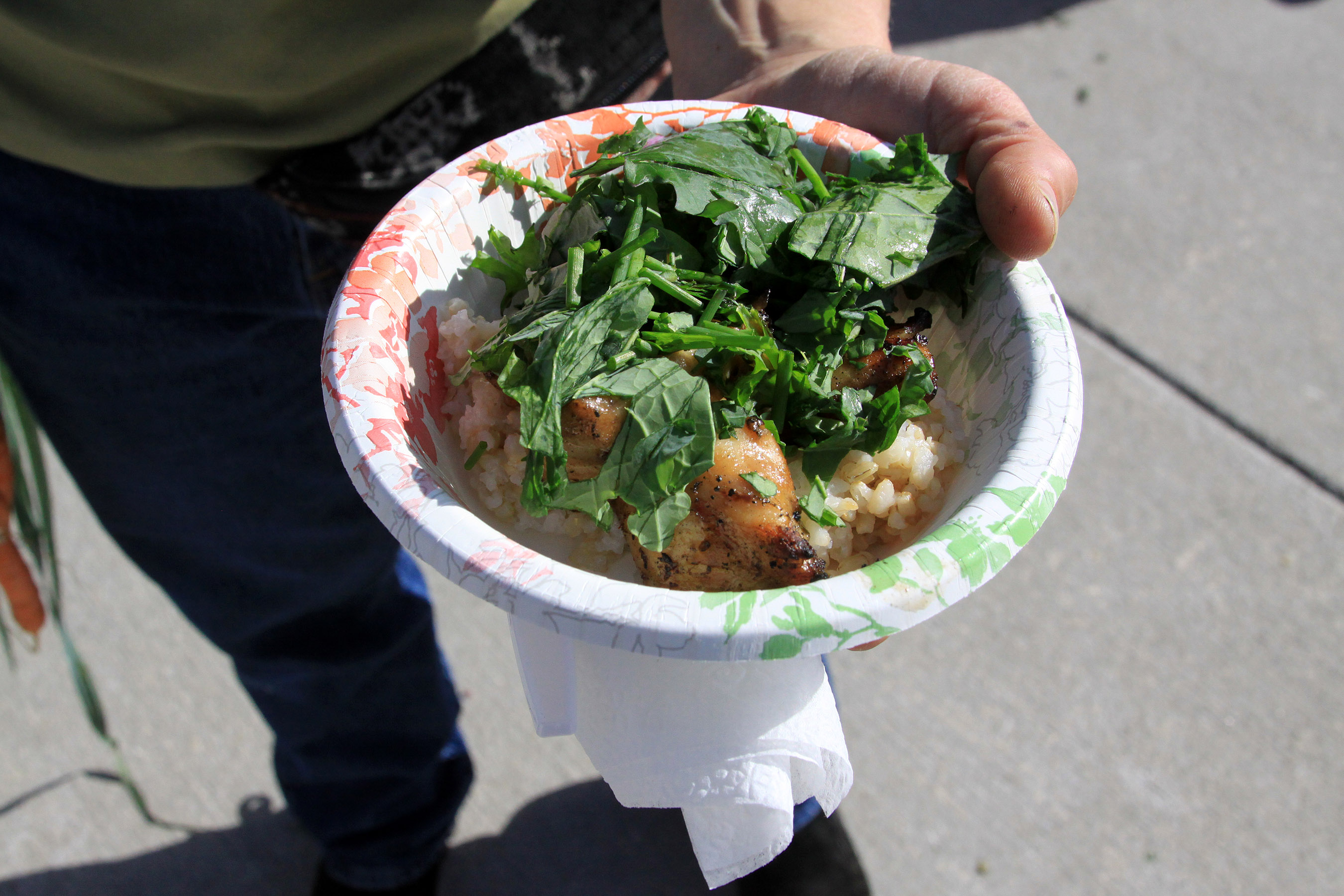
On Saturday mornings at the Sitka Farmers Market, the smell of slightly singed, brown-sugar, soy-sauce blackcod tips fills the air. Wandering Sitkans are lured to 235 Katlian St. in search of the origin of this barbecued aroma. Outside of the Alaska Native Brotherhood Founders Hall, visitors to the Sitka Farmers Market can find a bearded man in overalls and a straw hat cooking freshly caught and deliciously marinated black cod tips.

Kerry MacLane is a familiar face in the food community here in Sitka and we’re thrilled to see him cooking up his black cod tips at each farmers market. After blackening the tips, he takes them fresh off the grill and lays them on brown or white rice. He offers shredded kale and soy sauce as condiments for the steaming hot bowl of pure goodness. It’s not uncommon for a line to accumulate at MacLane’s booth, because his blackcod tips are wildly popular.

BlackcodCollarsRiceGreensMacLane is originally from Montana, where he worked as an organic farm inspector. Today his children (and now grandchildren!) still live in Missoula, but after going through a divorce, he decided to venture off to Alaska and fell in love with the state. He saw Alaska as Montana 30 years ago before large investors came in, such as Charles Schwab, who bought out his property there. In Tok, he first worked harvesting mushrooms. Throughout most of his life he has always been getting himself into trouble, being jailed time and again for civil disobedience. (Today on his property stands a sign that reads “WAR IS NOT THE ANSWER.”)

After Tok, he worked in Fairbanks as a teacher, and wrote a curriculum for a sustainable agriculture track. In 2007, he made his way down to Sitka, working as a deck hand. There, he was able to sample a lot of fish and gain knowledge of varying species and cleaning techniques.

“If you live long enough and are poor enough, you learn skills.” He decided to stay in Sitka and “reinvent himself,” as the “The Harbor Handyman” and was just that. Many people called for his help and he came to realize the need for reconstructive handy help on the island.

He lived on John Zarley’s Shamrock boat for the first years after his arrival in Sitka. Both Zarley and MacLane were born the same hour of the same day in the same year, though as MacLane says, “He’s a wealthy doctor and I have more hair.” The boat is a Monk design from 1940. Ed Monk was a famous shipwright and naval architect in the Pacific Northwest, who designed commercial and pleasure vessels, power or sail.

Within a year of his time in Sitka, MacLane became involved in the Sitka Health Summit during the program’s early years. He had worked in and helped build community gardens and grow local farmers markets in the past, but had never built his own community greenhouse. At the time, he was also working at SEARHC as a grant writer, and thanks to the Economic Stimulus Act of 2008, he was able to write $10 million in grants in his first year.

After the 2008 Sitka Health Summit, he helped form the Sitka Local Foods Network into a 501(c)(3) nonprofit organization, with the help of Linda Wilson (try her fabulous homemade rhubarb pie at the market) and other local food-interested individuals. MacLane served as the first president of the Sitka Local Foods Network.

BlackcodCollarsOnGrillHe met his girlfriend, Sherie Mayo, a commercial fisherman working on her family’s boat called Coralee, here in Sitka and Kerry is able to operate his blackcod prepared food business with her help. He discovered the tasty benefits of blackcod tips nearly by chance. Mayo had always thrown out the tips under the blackcod gills until she met a few Russian women who taught her the importance of saving the decadent tips. As a result, MacLane’s blackcod recipe was featured on the Cooking Channel television show, “Hook, Line and Dinner,” where they contacted him to share his knowledge of cooking blackcod tips and other Sitkan delicacies. (Note, blackcod is not a true cod, and also is known as sablefish or butterfish for its high oil content.)

Together, Mayo and MacLane are buying a beautiful boat called the Blue Merlin, so named for its exterior blue tinge, and the infamous story of fisherman Ward Eldridge’s boat Merlin from 1999. On July 7 of that year, the Merlin sunk in Whale Bay after a whale poked its head through the hull. Before Mayo and MacLane started dating, MacLane hired Eldridge to take his son, daughter and himself to Goddard Hot Springs. MacLane remembers that trip as “magical,” and says that he himself is “turning into the little old man that Ward is now… [And] it is a pretty good place to age into.” According to MacLane, the Blue Merlin, Ward, Mayo and Kerry are like family now.

Someday, MacLane wants to learn to sail his boat to Hawai’i.

This coming Saturday, Aug. 9, come out to the Sitka Farmers Market and taste Kerry MacLane’s locally harvested and barbecued blackcod tips!

• Fish to Schools program seeks donations of coho salmon from commercial fishermen

SCS-031_smFishToSchoolsTaco

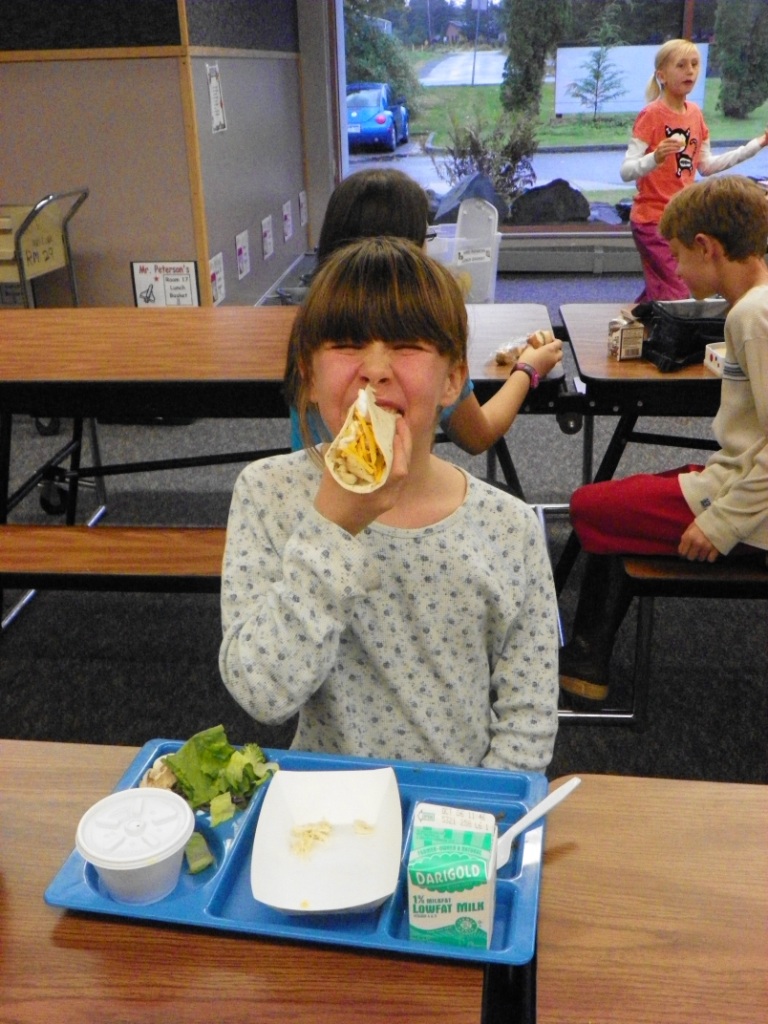
The Fish to Schools program needs help from Sitka’s commercial fishermen. The program needs 500 pounds of coho salmon to help make Fish to Schools meals for Sitka students during the upcoming school year.

“Please donate a few of your fish at the closure of the second king opener to Fish to Schools this August and help us meet our goal to get locally caught coho in all Sitka schools,” Fish to Schools program coordinator Tracy Gagnon said. “We’re also collecting photos of you (fishermen) in action — please email a photo of you on the water.”

The Sitka Fish To Schools project (click here to see short video) got its start as a community wellness project at the 2010 Sitka Health Summit, and now is managed by the Sitka Conservation Society. It started by providing a monthly fish dish as part of the school lunch as Blatchley Middle School, and since then has grown to feature regular fish dishes as part of the lunch programs at Baranof Elementary School, Keet Gooshi Heen Elementary School,Blatchley Middle School, Sitka High School, Pacific High School (where the alternative high school students cook the meals themselves), the SEER School, and Mount Edgecumbe High School.

In addition to serving locally caught fish meals as part of the school lunch program, the Fish To Schools program also brings local fishermen, fisheries biologists and chefs to the classroom to teach the kids about the importance of locally caught fish in Sitka. The program received an innovation award from the Alaska Farm To Schools program during a community celebration dinner in May 2012, and now serves as a model for other school districts from coastal fishing communities. In May 2014, the Fish to Schools program released a guidebook so other school districts in Alaska could create similar programs.

To donate, sign up in the main offices at Seafood Producers Cooperative or Sitka Sound Seafoods. The program can only accept commercially caught fish (no sport or subsistence fish).

For more information, contact Tracy Gagnon at Sitka Conservation Society, tracy@sitkawild.org or 747-7509.

• Sarah Lewis to provide free pressure canner gauge testing at Saturday’s Sitka Farmers Market

Canner

SarahLewisThis is a great time of the year to be in Sitka. The fish are running, gardens are starting to produce, and berries are ripe for the picking.

Many Sitka residents have pressure canners to preserve their harvest, and this weekend Sarah Lewis of the Juneau District Office of the University of Alaska Fairbanks Cooperative Extension Service will be in town to teach three classes about canning on Friday, Saturday and Sunday. She also provide free pressure canner gauge testing at the Sitka Farmers Market from 10 a.m. to 1 p.m. on Saturday, July 26, at the Alaska Native Brotherhood Founders Hall.

“People can bring the gauge or the lid with the gauge still attached,” Sarah said. “If they have any questions about the full canner (gaskets, damage, how to use, etc.) they can bring the whole thing.”

In addition to testing pressure canner gauges, Sarah plans to work with Jasmine Shaw of the Sitka District Office of the UAF Cooperative Extension Service to have a wide variety of publications available about home canning. In addition, the UAF Cooperative Extension Service has a series of online tutorials on its website called “Preserving Alaska’s Bounty.” Pressure canner gauges should be tested at least once a year to make sure they are hitting the right pressures for safe food preservation.

We posted earlier about Sarah’s canner classes this weekend, hosted by the Sitka Kitch project, and info can be found here. However, the location for the first two classes has been moved to the Sitka Presbyterian Church (from Sitka High School) and the topic and time have been changed for Sunday’s class (new topic is Canning Jams and Jellies, new time is noon to 3 p.m., location remains Sitka High School). The canning classes are $20 each, and preregistration is required (call Marjorie at the number below).

For more information about the Sitka Kitch project and to register for Sarah’s canning classes, contact Marjorie Hennessy of the Sitka Conservation Society at marjorie@sitkawild.org or 747-7509.

• Sitka Kitch hosts Sarah Lewis for cottage foods industry and home canning classes

kitch_flyer_july25_26

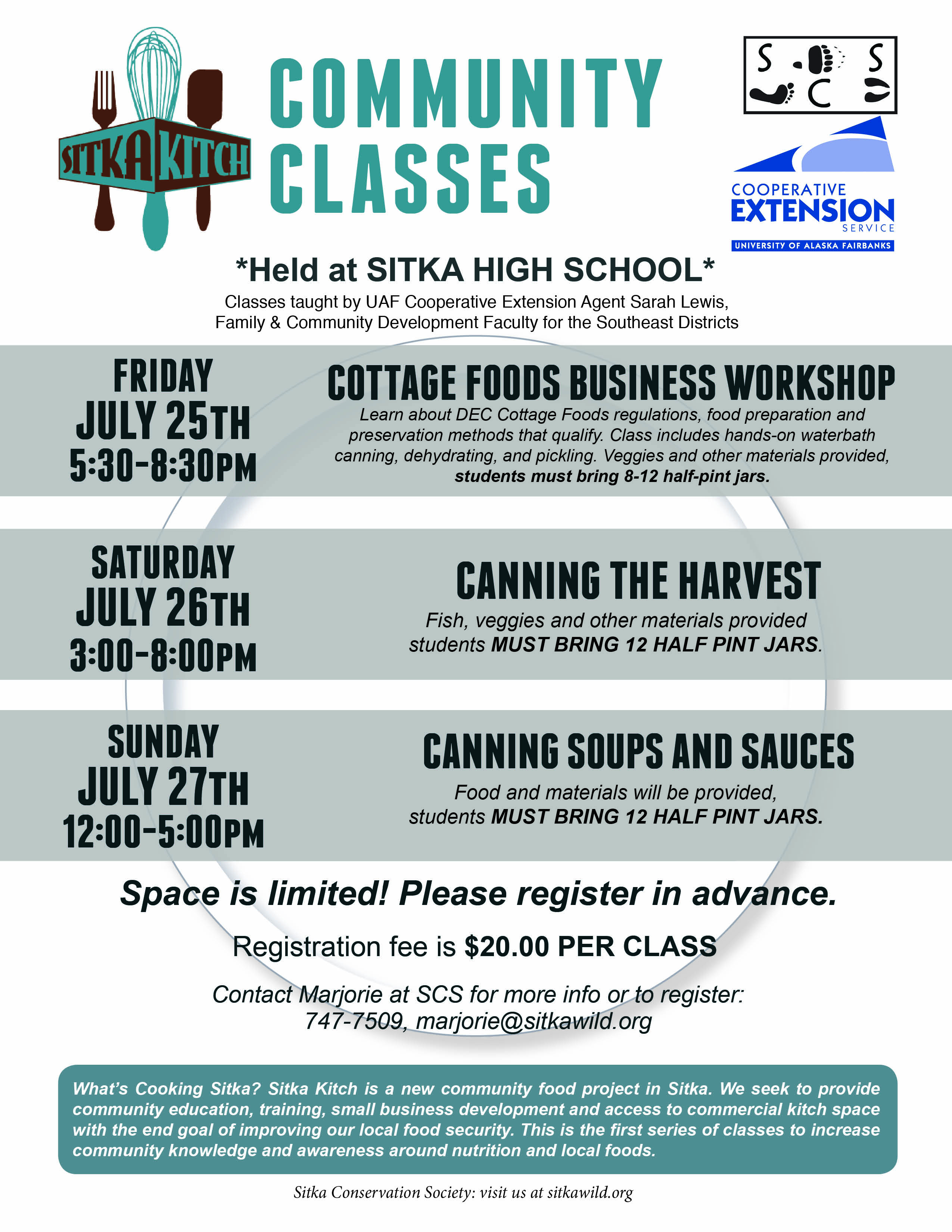
SarahLewisSitka Kitch will host Sarah Lewis, Family and Community Development Faculty from the Juneau District Office of the University of Alaska Fairbanks Cooperative Extension Service, for three classes about the cottage food industry and home canning on July 25-27 at Sitka High School. (Editor’s note: The location of the first two classes has been moved to the Sitka Presbyterian Church on Sawmill Creek Road. Sunday’s class still will take place at Sitka High School, but the topic has been changed to Canning Jams and Jellies and the time will be from noon to 3 p.m.)

The three classes cost $20 each. Space is limited, so please register in advance by calling Marjorie Hennessy of the Sitka Conservation Society at 747-7509. Students will take home the products they make. The classes are:

  • Friday, June 25, 5:30-8:30 p.m., Cottage Foods Business Workshop — Students learn about Alaska Department of Environmental Conservation cottage foods industry regulations, as well as the food preparation and food preservation techniques that qualify. Class includes hands-on water-bath canning, dehydrating and pickling instruction. Veggies and other materials will be provided. Students must bring 8-12 half-pint canning jars with lids.
  • Saturday, June 26, 3-8 p.m., Canning the Harvest — Fish, veggies and other materials provided. Students must bring 12 half-pint canning jars with lids.
  • Sunday, June 27, noon to 5 p.m., Canning Soups and Sauces — Food and materials will be provided. Students must bring 12 half-pint canning jars with lids.

In addition, Sarah will be at the Sitka Farmers Market from 10 a.m. to 1 p.m. on Saturday, July 26, at the Alaska Native Brotherhood Founders Hall, where she will be available to test canner pressure gauges and provide other resources about home canning and food preservation.

Also, Sitka Kitch will partner with Sitka Tribe of Alaska to offer a pickled salmon course in August. This class is offered free of charge, but space is extremely limited. More details on date and location will be available soon.

Sitka Kitch is a community wellness project from the 2013 Sitka Health Summit designed to improve food security in Sitka. The different parts of the project include creating a community kitchen Sitka residents can rent to prepare food for their small businesses or to preserve their family harvest of fish, game, or garden veggies; expanding Sitka’s emergency food storage capacity; and providing education about preserving food and building family emergency food pantries.

For more information about the Sitka Kitch project, contact Marjorie Hennessy at marjorie@sitkawild.org or 747-7509.


• Sitka Kitch, First Presbyterian Church announce grant to renovate kitchen for classes, rentals

The Sitka Health Summit congratulates the folks at Sitka Kitch and First Presbyterian Church on their $13,000 grant. The funds will go a long way towards renovation of their community kitchen. "Sitka Kitch is a community collaboration to augment and strengthen Sitka's workforce through the development of food-based curriculum and training." It is an initiative of the Sitka Health Summit. From left are Patrick Williams, Marjorie Hennessy, Clara Gray, Cheri Hample, Martina Kurzer, Suzan Brawnlyn, Cyndy Gibson, and Betsy Decker. (Photo Courtesy of the Sitka Health Summit)

The Sitka Health Summit congratulates the folks at Sitka Kitch and First Presbyterian Church on their $13,000 grant. The funds will go a long way towards renovation of their community kitchen. “Sitka Kitch is a community collaboration to augment and strengthen Sitka’s workforce through the development of food-based curriculum and training.” It is an initiative of the Sitka Health Summit. From left are Patrick Williams, Marjorie Hennessy, Clara Gray, Cheri Hample, Martina Kurzer, Suzan Brawnlyn, Cyndy Gibson, and Betsy Decker. (Photo Courtesy of the Sitka Health Summit)

kitch_logo_mainSitka Kitch is the community food project that arose from the 2013 Sitka Health Summit. The overall goal of Sitka Kitch is to improve community capacity and community development through the lens of food security.

The Sitka Kitch will start with food-based education and emergency preparedness at the household level. As it grows, the Sitka Kitch seeks to provide career and technical training, and entrepreneurial development opportunities. This will be achieved through a shared-use community kitchen and will work to educate, incubate and cultivate community sustainability.

Sitka Kitch also has a sub-group that is currently working to improve storage of emergency food with the Salvation Army. Eventually the kitchen would also like to generate a food ‘income’ stream to augment immediate relief efforts by local food banks and soup kitchens.

Sitka Kitch is pleased to announce a new partnering with the Sitka First Presbyterian Church to kick off its first year through the use of kitchen space. The groups collaborated in April to prepare an application to the Northwest Coast Presbytery Community Blessings Grant. The proposal outlined a budget to renovate the church’s existing kitchen to meet the requirements of becoming an Alaska Department of Environmental Conservation (DEC)-certified kitchen and thus meet the needs of Sitka Kitch users.

The church and Sitka Kitch were awarded the grant, in the amount of $13,000, and the funds will go towards renovating and improving functionality of the kitchen. These renovations will begin in June and Sitka Kitch plans to start offering classes in July.

For more information, contact Marjorie Hennessy at the Sitka Conservation Society (marjorie@sitkawild.org or 747-7509). Click here to listen to a KCAW-Raven Radio morning interview with Marjorie and Suzan Brawnlyn to learn more about Sitka Kitch.

• Sitka Community Food Assessment Indicators Report helps define Sitka’s food culture

Food Assessment Indicator Report web version_Page_01

SitkaCommunityFoodAssessmentLogoThe Sitka Community Food Assessment Indicators Report was released on Monday, and the findings will help guide future food system planning in Sitka.

A 2012 Sitka Health Summit project, the Sitka Community Food Assessment has examined where Sitka residents get their food, what types they eat, what they grow, what they hunt and fish for, where they shop, what type of access people have to healthy food, and other questions about Sitka’s food supply. The findings of the food assessment will help Sitka improve its food security.

After Sitka residents chose the Sitka Community Food Assessment as a project at the September 2012 Sitka Health Summit, the work group received a grant to hire a coordinator and contract with a data person. A revised version of a questionnaire from a similar project on the Kenai Peninsula was posted online, available at the library, and discussed in focus groups, with more than 400 residents answering the 36 questions. In November 2013, some of the initial data was presented at the Sitka Food Summit, where about 60 residents discussed the results and noted any further research that needed to be done. Since then, the work group, in partnership with The Island Institute and others, fine-tuned the data before writing and editing the indicators report.

“We hope the Sitka Community Food Assessment Indicators Report can guide future food system planning and plant seeds for innovative responses that will strengthen Sitka’s food landscape,” project coordinator Lisa Sadleir-Hart wrote in the 26-page document’s introduction. “The Sitka Community Food Assessment Indicators Report uncovers many weaknesses in our food system as well as some incredible assets that define Sitka’s food culture — a rich ecosystem filled with nutritious gems from the land and sea plus a generous spirit of sharing with our neighbors. Now that we’ve defined the current foodscape in Sitka, let’s work together to build a more resilient food system that can deeply nourish the entire community for generations to come.”

The Sitka Community Food Assessment Indicators Report opens with Sitka’s demographics and several Sitka food facts. It then features data about how many people in Sitka hunt, fish, gather, and/or grow their own food, as well as some barriers. Next is information about where people in Sitka shop for their food, followed by how many people in Sitka are on some form of food assistance. The report also includes information about food in the schools, and local food manufacturing.

The findings will be presented to the community during an upcoming meeting of the Sitka Assembly, and the report will be posted online here (see below) and on The Island Institute’s website.

• Sitka Community Food Assessment Indicator Report (April 14, 2014, opens as PDF file)

• Sitka Conservation Society publishes resource guide for statewide Fish to Schools programs

Serving Local Fish in School Cafeteria_Page_01

The Sitka Conservation Society, which coordinates Sitka’s Fish to Schools program, has published a new resource guide, A Guide to Serving Local Fish in School Cafeterias, to help other school districts around the state implement similar programs in their communities.

F2S_Elementary2The Sitka Fish to Schools program came out of the 2010 Sitka Health Summit, when local residents chose as one of its community wellness projects to serve more local seafood in our schools. Since then the program has grown so that all students from Grades 2-12 in Sitka have a local seafood lunch option at least twice a month. This includes the Sitka School District schools, Keet Gooshi Heen Elementary School, Blatchley Middle School, Sitka High School, and Pacific High School, plus other local schools, the state-run boarding school Mount Edgecumbe High School and the private K-8 The SEER School.

Sitka is one of the first districts in the state to serve local seafood through the National School Lunch Program and has become a leader in the State of Alaska in getting local foods into schools. In the last three years, the number of schools interested in serving local seafood has increased ten-fold. Haines, Dillingham, Kodiak, Galena, and Juneau are a few of the districts that are now serving seafood in their meal programs.

In an effort to support regional and statewide efforts to serve local foods in schools, the Sitka Conservation Society developed a “how-to” guide to serving fish in schools. Using Sitka as a case study, it outlines procurement and processing strategies, legalities, tips, and recipes. Also included are case studies from around the state that offer tips and suggestions based on the success of their programs.

F2S_Elementary3The Sitka Fish to Schools program has seen an increase in meal participation on fish lunch days, likely attributed to the participation of students who typically bring a sack lunch. One student who reported never liking fish started to eat fish after a local chef came to her classroom. Others students circle fish lunch dates on their school lunch calendar, refusing home lunch that day. And why are they so excited? A middle school student put it this way, “It’s healthy and good for you and you feel good after you eat it.” Others give reasons of wanting to become a fisherman or cite the economic value to their community.

In addition to this guide is the “Stream to Plate” curriculum, a unit of seven lessons that connect salmon to the classroom. The lessons address the ecological significance and human relationship to salmon. These lessons have been tried and refined the last three years with third graders at Keet Gooshi Heen Elementary School.

Chris Bryner, teacher and collaborator on the salmon unit said, “The Fish to Schools curriculum connects my classroom to the community. Students not only learn about a resource relevant to their daily lives, but come away with an understanding that learning happens inside and outside of school.”

As the ninth largest seafood port in the country, Sitka is paving the way for locally-sourced meals. Their efforts are part of a larger national movement, Farm to School, to get local foods in schools. The Alaska Farm to School program honored Sitka’s Fish to Schools program for its innovation a couple of years ago.

celebrate fish to state“The beauty of Fish to Schools is that it provides a practical, local solution to a multitude of current global issues,” Fish to Schools Co-Founder Lexi Fish said. Local sourcing reduces the environmental impact of foods grown and raised thousands of miles away and ultimately supports a more resilient food system.

Local fish in school lunches not only tastes “delicus” (stet), as one third grader put it, but also addresses food justice, nutrition, community sustainability, and conservation. To get a free copy of the guide and curriculum, visit http://sitkawild.org/2014/03/a-guide-to-serving-local-fish-in-school-cafeterias/ or contact Sitka Conservation Society Community Sustainability Organizer Tracy Gagnon at 747.7509 or tracy@sitkawild.org.

Also, don’t forget to stop by the Celebrate Fish to State event from 6:30-7:30 p.m. on Thursday, March 20, at Blatchley Middle School to learn more about the efforts to expand the Fish to Schools program statewide.