• Save the dates for 2010 Sitka Local Foods Network events

It’s time to mark a few Sitka Local Foods Network dates on the 2010 calendar.

The first date to mark is Sunday, March 14, when the second annual “Let’s Grow Sitka” event takes place from noon to 3 p.m. at the Alaska Native Brotherhood Hall. This event is associated with Sitka’s Artigras music and arts festival. Let’s Grow Sitka has a lot of information for gardeners as they prepare for spring plantings, and it’s a good place for new gardeners to learn what they need to start growing their own food. Booths on any garden-related topic are welcome, and space needs to be reserved as soon as possible (for information, call Linda Wilson at 747-3096, nights and weekends). This also is an event where people can talk about their local garden experiences, provide demonstrations and help get the community excited about the upcoming growing season.

Also, we have five of our six Sitka Farmers Market dates set for 2010. The Sitka Farmers Market takes place from 10 a.m. to 2 p.m. on the following Saturdays at the Alaska Native Brotherhood Hall:

  • July 17
  • July 31
  • Aug. 14
  • Aug. 28
  • Sept. 11

The last Sitka Farmers Market date will be discussed at the January board meeting (at noon on Monday, Jan. 4, at the See House behind the St. Peter’s By The Sea Episcopal Church). Under consideration are markets on July 3 or Sept. 25 (with the Running of the Boots). We need a sixth market to qualify to accept WIC coupons like we did last year. Vendors wanting to host booths at the Sitka Farmers Market should contact Linda Wilson for more information (2009 booth rules are posted in the Pages section under “Sitka Local Foods Network meeting minutes, other notes” and 2010 booth rules will be posted when they are available).

Also, be watching for details about two potential education events this spring when we hope to have guest speakers in town (one about Earth Day on April 22 and the other sometime around Memorial Day in May). Hopefully we’ll have event details soon.

• Change of venue for monthly Sitka Local Foods Network board meeting

Just a note that the location for the January meeting of the Sitka Local Foods Network board has been moved to the undercroft (basement) of the See House behind St. Peter’s By The Sea Episcopal Church on Lincoln Street. The January meeting is at noon on Monday, Jan. 4.

The Sitka Local Foods Network board of directors meets at noon on the first Monday of the month, usually at the Bayview Restaurant, during months when we aren’t hosting the Sitka Farmers Market.

• Two associated with Sitka Local Foods Network win awards at Alaska Health Summit

Sitka filmmaker Ellen Frankenstein, center, of Frankenstein Productions, greets fans after the Sitka premiere of her film "Eating Alaska" in October 2008

Sitka filmmaker Ellen Frankenstein, center, of Frankenstein Productions, greets fans after the Sitka premiere of her film "Eating Alaska" in October 2008

The Alaska Public Health Association (ALPHA) honored two programs with ties to the Sitka Local Foods Network during the Alaska Health Summit banquet on Dec. 9. Sitka filmmaker Ellen Frankenstein (and her Frankenstein Productions company) and the SouthEast Alaska Regional Health Consortium (SEARHC) Steps to a Healthier SE Alaska program both won the Alaska Community Service Award. According to ALPHA, the Alaska Community Service Award “recognizes an organization, business or group making a significant contribution to improving the health of Alaskans. It is ALPHA’s intent that nominees outside the public health tradition be considered for this award. A nominee does not need to be an ALPHA member.”

Frankenstein has produced several documentary films over the years, including “Eating Alaska,” which focuses on how we choose the food we eat. Eating Alaska debuted in the fall of 2008, and Frankenstein has taken it to film festivals all over the state and country. “Eating Alaska” received funding support from the SEARHC Steps to a Healthier SE Alaska program and other funders, plus technical support was provided by SEARHC health educators, physicians and dietitians. Some of Frankenstein’s other films include “No Loitering,” “Carved from the Heart,” “A Matter of Respect,” and “Miles from the Border.” She currently is working on a documentary film project with Haida weaver Dolores Churchill.

“As someone who fills in the occupation blank on forms with ‘filmmaker/artist,’ this award represents the fact that labels and lines don’t matter when it comes to social change and to making our lives healthier,” Frankenstein wrote from Austin, Texas, where she was attending a screening of Eating Alaska. “It not only validates my work, but represents your open-mindedness to the potential of working collaboratively and creatively with kids and adults, using art, media and storytelling to influence well-being and healthy communities.”

Frankenstein also sent this note to her e-mail group:

EATING ALASKA: ART AND HEALTH!
We just got the news the project has been awarded The Alaska Public Health Association’s 2009 Community Service Award for Health. In the process of making this film and in its use we’ve worked with nutritionists, health educators, medical and public health practitioners to add to the conversation about what we can do to make our homes, workplaces, schools and communities healthier and more sustainable. We appreciate the help everyone has given to the project to help us “contribute to improving the health of Alaskans” and others far beyond.

The SEARHC Steps to a Healthier SE Alaska program, which closes this month, was honored for the work it did over the life of its five-year grant (the national Steps to a Healthier US grant has ended, so that means all of the local grants that were part of the national grant also are ending). The Steps program funded 77 projects worth just over $1.1 million in 12 Southeast Alaska communities. Steps was one of the major funders and organizers of the Sitka Health Summit, which is where the Sitka Local Foods Network originated.

The Steps program’s goals were to increase opportunities for physical activity, improve nutrition and reduce the impact of tobacco in Southeast Alaska. The program also worked to reduce diabetes, obesity and asthma in Southeast communities. To accomplish its goals, Steps developed partnerships with schools, worksites, tribes and other community groups so they could change social norms and policies, and make evidence-based and culturally relevant interventions. In addition to the projects, Steps also hosted conferences and workshops to help programs learn how to work in collaboration.

The Steps program used the socio-ecological model, which emphasizes that an individual’s health status is influenced not only by his or her attitudes and practices, but also by personal relationships and community and societal factors. Nearly half of the 77 Steps grants (37) went to community projects, with the others geared toward schools and worksites. More than three-quarters of the grants (60) focused on improving nutrition and/or increasing physical activity. Together, the projects reached 128,000 people (with many people reached by multiple projects) in the communities of Angoon, Craig, Haines, Hoonah, Hydaburg, Juneau, Kake, Kasaan, Klawock, Klukwan, Sitka and Wrangell.

“Overall, the Steps initiative helped build capacity within communities, worksites and schools to work collaboratively, to plan evidence-based programs, and to monitor and evaluate program success,” said Grace Brooks, Steps Grant Manager. “Steps also contributed to an overall increased understanding of the importance of policy in supporting community, school and workplace health.”

In other local foods news from around the state this past week, the Alaska Dispatch ran an article about an indoors farmers market this winter at Anchorage’s Northway Mall.

Capital City Weekly featured a story by Carla Petersen about how the search for elusive cranberries is worth the challenge.

The National Oceanic and Atmospheric Administration (NOAA) announced last week that it is encouraging the use of catch shares to preserve the remaining stocks of halibut (the article features a photo from Sitka).

The Anchorage Daily News featured a story about Gov. Sean Parnell proposing to spend $1.3 million to research declining Yukon River salmon runs.

The Juneau Empire had a story about how an arts advocacy group in Juneau, Arts for Kids, has teamed up with Sitka-based Theobroma Chocolate Co. to offer SmART bars as a fundraiser for art scholarships for graduating seniors in Juneau.

The publicity poster for the movie Eating Alaska

• Thanks for “Growing in Sitka and Southeast Alaska” presentation

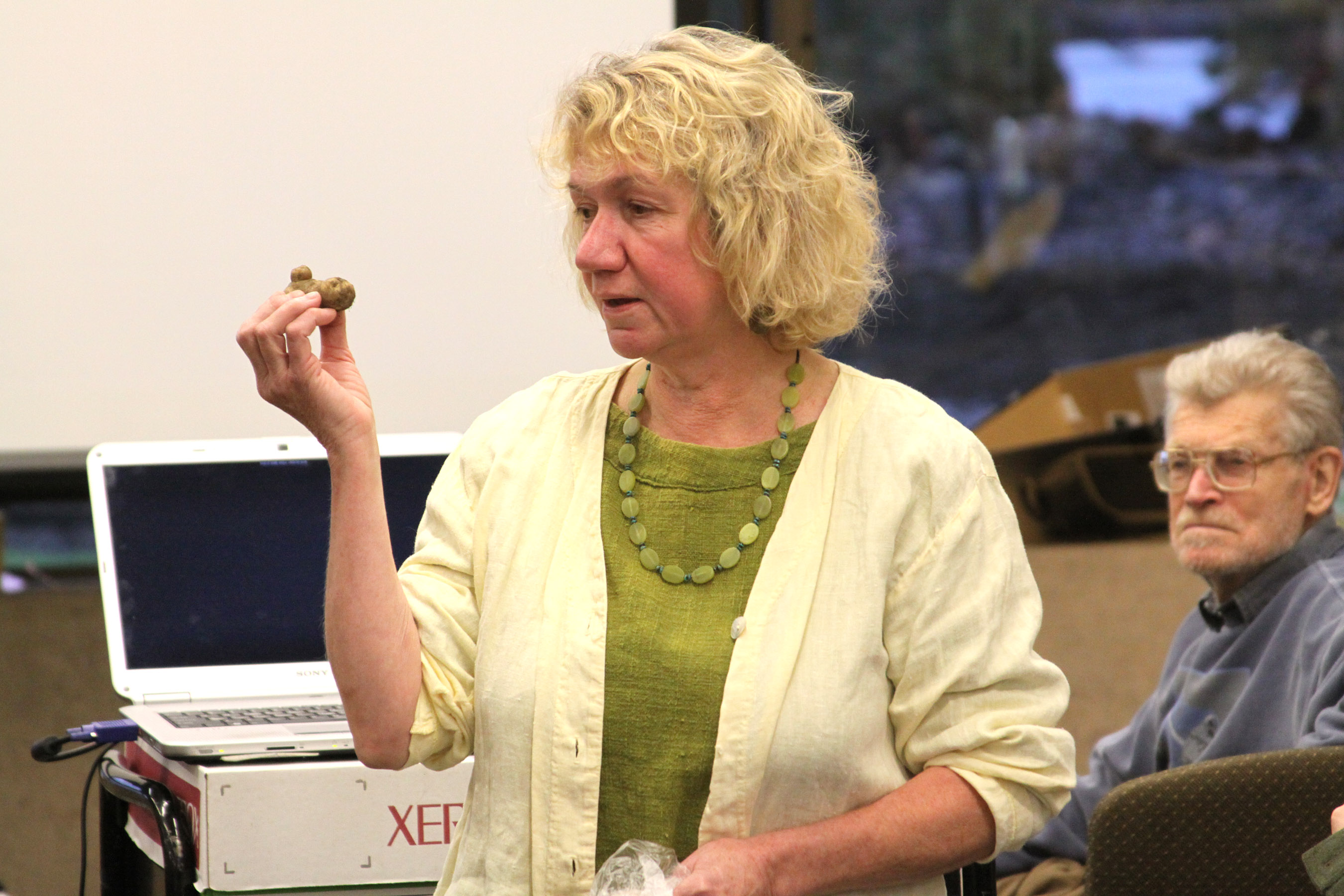
Elizabeth Kunibe shows off a Tlingít potato (also known as "Maria's potato")

On Friday afternoon, the Sitka Local Foods Network hosted anthropology student Elizabeth Kunibe of Juneau for a presentation, “Growing in Sitka and Southeast Alaska: Food of Today, Tomorrow and 200 Years Ago.” This presentation took place at the Kettleson Memorial Library and we had a standing-room-only crowd of 50-plus, despite being arranged less than a week before the event and competing with several Alaska Day happenings.

The Sitka Local Foods Network thanks Elizabeth for taking the time to make the presentation on what, for her, was a pleasure trip to Sitka for Alaska Day. We also thank the library and librarian Sarah Jones for allowing us to use Kettleson Memorial Library for the presentation.

Finally, we thank everybody who came to the presentation to hear Elizabeth discuss traditional Tlingít, Russian and American gardens in Sitka and Southeast Alaska, the Tlingít and Haida potatoes, an agricultural fair in Fort Yukon, the phytonutrients of potatoes and plant diseases.

For those people who weren’t able to attend, the presentation was recorded and it will be aired at various times this week on public access TV (Channel 11). Elizabeth said she might send over some notes from the presentation, and when those arrive they will be posted on the Sitka Local Foods Network site, http://www.sitkalocalfoodsnetwork.org/. A small gallery of photos from the presentation is posted at this link.

Thanks again,
Charles Bingham, event organizer
Sitka Local Foods Network

• Sitka Conservation Society hosts Wild and Scenic Environmental Film Festival

91

The largest environmental film festival in North America is coming to Sitka. Sitka Conservation Society is hosting the second annual Sitka tour stop of the Wild and Scenic Environmental Film Festival on Saturday, Oct. 24, at the Sitka Performing Arts Center.

Doors will open at 6 p.m. with informative and action booths hosted by local community groups and organizations, including a booth from the Sitka Local Foods Network. The films will begin at 6:30 p.m.

“The films include narratives coming directly from people throughout the world engaged in protecting our natural resources and wild places,” says tour manager Susie Sutphin. “The films highlight the ‘tipping point’ that the planet is reaching. Yet portrays the ‘turning of the tides,’ as communities realize what needs to change and how they are responding with creativity, resolve and heart.”

One of the films scheduled to be shown on Saturday, Homegrown Revolution, deals with the local food movement. This film examines a family’s efforts at growing all their own food in the midst of a densely urban setting in downtown Pasadena, Calif. For over twenty years, the Dervaes family has transformed their home into an urban homestead. As a family for this new paradigm, they harvest nearly three tons of organic food from their one-10th-of-an-acre garden plot while incorporating many back-to-basics practices, as well as solar energy and biodiesel.

A new film trailer by local filmmaker Ellen Frankenstein — who made the film, Eating Alaska — will be shown during the festival as well as several other films from around the world.

Tickets are $15 for adults and $10 for students and seniors. They are available at Old Harbor Books, Mountain Miss or at the door. Discounted and free tickets are available for individuals and families that sign up to be a Sitka Conservation Society member.

The film festival also will include door prizes and Young Alaskans Building Affordable Housing will sell concessions during intermission. For more information, go to http://www.sitkawild.org/ (note, site down for maintenance this week) or call 747-7509.

• Sitka Local Foods Network gets mentions in Juneau Empire, Daily Sitka Sentinel, Capital City Weekly and on APRN’s Talk of Alaska show

The Sunday edition of the Juneau Empire and Monday edition of the Daily Sitka Sentinel (Page 4) both featured a press release about a Sitka Local Foods Network-hosted presentation about “Growing in Sitka and Southeast Alaska: The Food of Today, Tomorrow and 200 Years Ago” that takes place at 5 p.m. this Friday, Oct. 16, at the Kettleson Memorial Library. The presentation is by UAS anthropology student Elizabeth Kunibe of Juneau, who has spent the last six years researching traditional gardens in Southeast Alaska. The presentation also received a write-up in this week’s issue of Capital City Weekly that came out on Wednesday.

Monday’s issue of the Daily Sitka Sentinel also featured a press release about a put-the-garden-to-bed work party the Sitka Local Foods network is hosting from 10 a.m. to 1 p.m. on Saturday, Oct. 17, at the St. Peter’s Fellowship Farm.

On Tuesday, the Alaska Public Radio Network’s statewide call-in show “Talk of Alaska” was about food security and during the show the work of the Sitka Local Foods Network was mentioned. The Talk of Alaska topic on food security was a preview of the Bioneers In Alaska conference this weekend (Oct. 16-18) in Anchorage where food security will be one of the topics. Kerry MacLane, president of the Sitka Local Foods Network, is supposed to travel to Anchorage to participate in the conference.

In addition to the Sitka Local Foods Network mentions, there has been a lot of other local foods news around Alaska this week.

In Sunday’s Juneau Empire, Ginny Mahar (a chef at Rainbow Foods) wrote a column featuring a mac and cheese recipe with king crab. Ginny also writes the Food-G blog, which features a lot of local foods recipes for Southeast Alaska.

Also in Sunday’s Juneau Empire was an article about the Alaska Native Brotherhood/Alaska Native Sisterhood Grand Camp meeting in Juneau and discussion about subsistence fishing rights following the recent arrest of Sen. Albert Kookesh.

In this week’s Capital City Weekly, there is an article from Carla Peterson about the chocolate lily and how to prepare this edible plant for food.

In the Alaska Newsreader blog Wednesday on the Anchorage Daily News Web site was a link to a feature from TheDailyGreen.com, which listed Anchorage ninth among U.S. cities in per capita space given to community gardens. The list (opens as PDF document) was compiled by the Trust for Public Land, and it had a distinct Northwest feel with Seattle ranked No. 1 and Portland, Ore., was No. 2. Click here to learn more about Anchorage’s community gardens program.

In his Anchorage Daily News garden column last week, Jeff Lowenfels wrote about planting garlic now for spring flowers and an August crop.

The Mat-Su Frontiersman recently ran an article about a sustainability project at the University of Alaska Fairbanks Mat-Su College where students were gathering organic spuds.

Finally, while this isn’t about Alaska, you might want to read an article about efforts to preserve our biodiversity so we don’t lose more food plant varieties and why these efforts are important.

• Sitka Local Foods Network hosts historical gardening presentation on Friday, Oct. 16

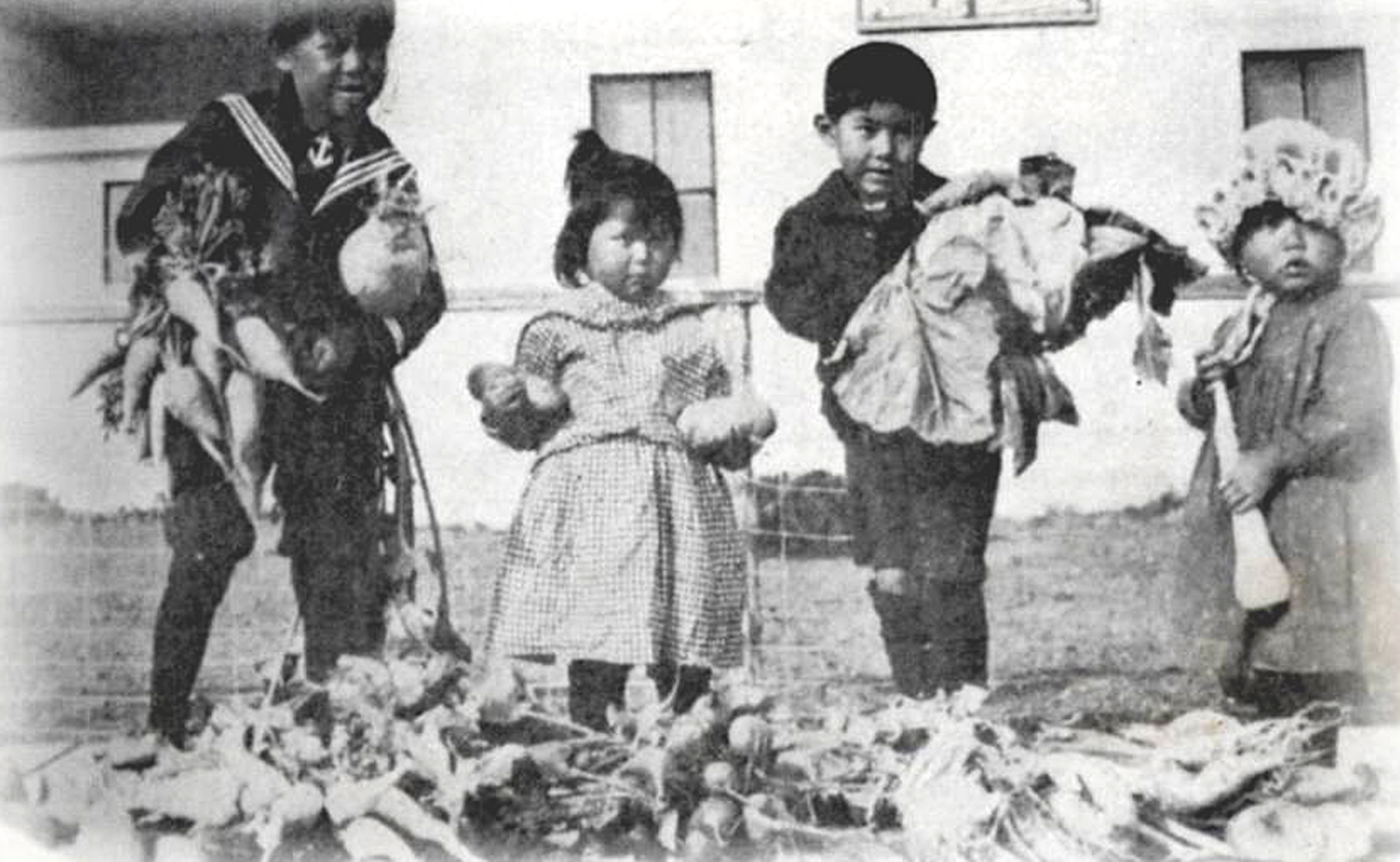
Children show off the bounty from the Klukwan School garden in 1911

Children show off the bounty from the Klukwan School garden in 1911

The Sitka Local Foods Network will host a brief historical gardening presentation by Elizabeth Kunibe, “Growing in Sitka and Southeast Alaska: Food of Today, Tomorrow and 200 Years Ago,” at 5 p.m. on Friday, Oct. 16, at the Kettleson Memorial Library. This event is free and open to all, and it should last about 45 minutes.

During her presentation, Kunibe will discuss early Tlingít gardens in Southeast Alaska, Russian gardens in Sitka in the 1800s, the first USDA Agricultural Experiment Station in Alaska comes to Sitka in 1898, an agricultural fair above the Arctic Circle in Fort Yukon, the importance of potatoes (a phytonutrient study), plant diseases and new ziplock bags made from fish gelatin. Her presentation includes a colorful slideshow that features historical information on gardening in Southeast Alaska, as well as information on what is happening in Alaska’s food systems today.

Kunibe is a University of Alaska Southeast anthropology student from Juneau who has spent the past six years researching early gardens of the Tlingít, Haida and Athabascan peoples in Alaska and the Yukon Territory. She is a 2008 and 2009 National Science Foundation EPSCoR (Experimental Program to Stimulate Competitive Research) Fellow researching food systems in Alaska.

For more information, contact Charles Bingham at 747-1065 or send e-mail to charles@sitkalocalfoodsnetwork.org/.

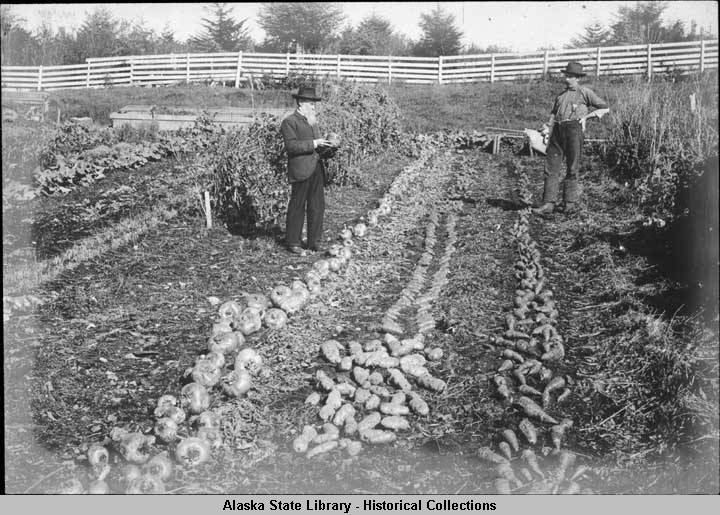
Gov. John G. Brady's garden in Sitka in 1900

Gov. John G. Brady's garden in Sitka in 1900

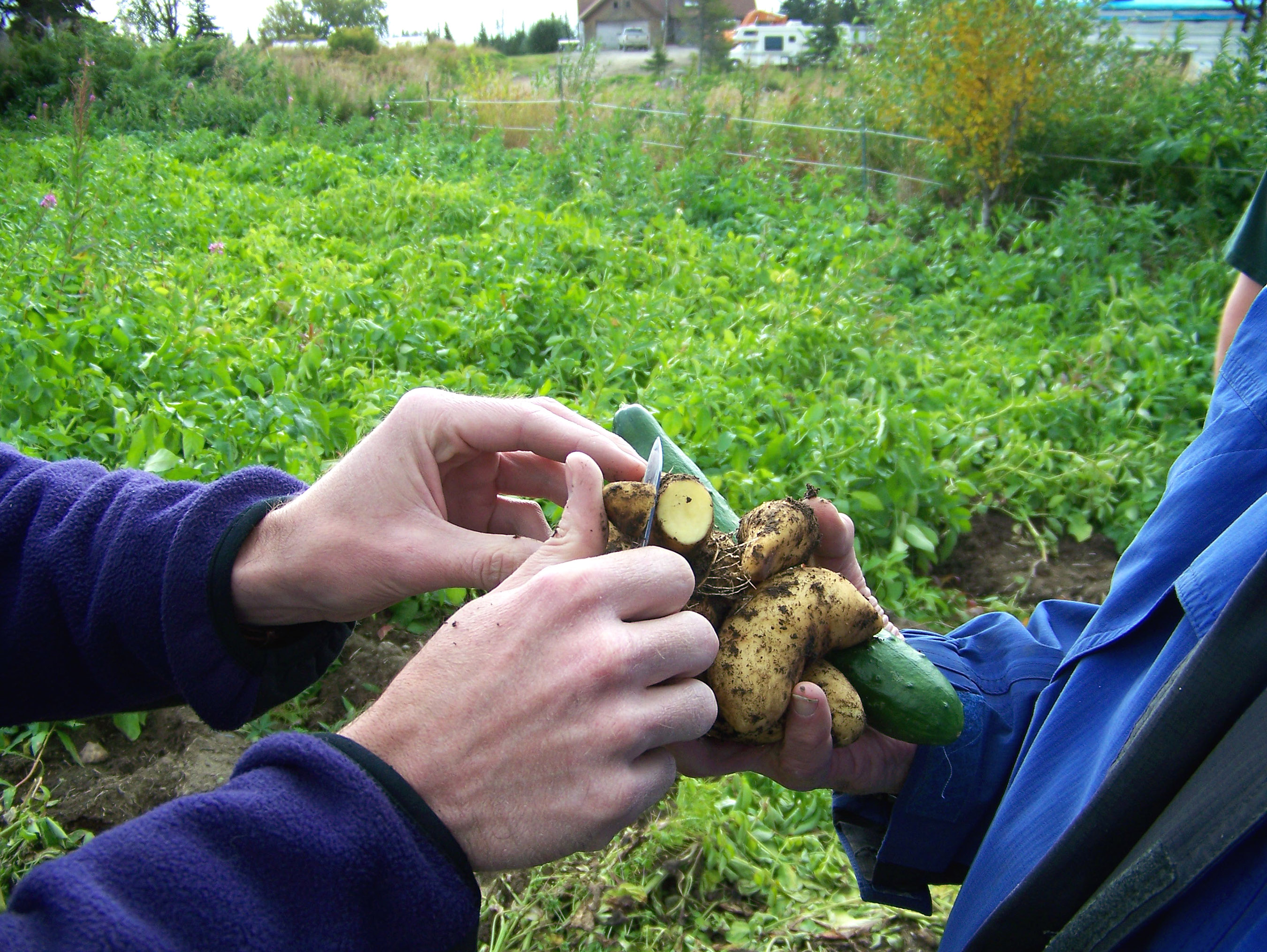
Plant geneticists Chuck Brown and Joe Kuhl of the USDA Agricultural Research Service, examine the flesh color of some potatoes being grown in Alaska. The color gives them clues to the nutrients the potatoes may contain.

Plant geneticists Chuck Brown and Joe Kuhl of the USDA Agricultural Research Service, examine the flesh color of some potatoes being grown in Alaska. The color gives them clues to the nutrients the potatoes may contain.

• Sitka Local Foods Network hosts garden work party on Oct. 17

The Sitka Local Foods Network will host a “putting the garden to rest” work party from 10 a.m. to 1 p.m. on Saturday, Oct. 17, at St. Peter’s Fellowship Farm.

The Oct. 17 work party involves a last bit of weeding, pulling out the annual plants for compost, putting mulch and protective coverings over the perennials, and getting all the tools inventoried and stored away for the winter. This will help make the garden easier to get ready for spring planting. Most of the vegetables grown at the St. Peter’s Fellowship Farm are sold at the Sitka Farmers Markets during the summer.

For more information about the work party, contact Lisa Sadleir-Hart at 747-5985 or Maybelle Filler at 738-1982.

To learn more about the Sitka Local Foods Network and how it supports community gardens and greenhouses, organizes the Sitka Farmers Market, supports traditional foods and provides education and encouragement to local gardeners, browse through this site.

• Recent articles highlight food security issue in rural Alaska

The New York Times on Saturday ran a lengthy article by former Fairbanks Daily News-Miner reporter Stefan Milkowski about how weak runs of king salmon are hurting Yukon River communities. The article is datelined from the village of Marshall, near the mouth of the Yukon River, where villagers already are feeling the pinch of no salmon to fill their freezers for the winter.

This is a region where heating oil costs $7 a gallon and a can of condensed milk goes for nearly $4. It also is a region that last year faced critical food shortages last year, with many faith groups from around the country sending food to help tide the residents through the winter. Click here to read accounts from “Anonymous Bloggers” about last year’s airlift and what villagers are doing to prepare for this winter.

The food shortages resulted in some July protest fisheries, which resulted in the arrest of the only police officer in Marshall, Jason Isaac, who joined other villagers in claiming state and federal fish and wildlife officials were more concerned with a Canadian fish treaty than they were about rural Alaskans. The Tundra Drums reports that 67,000 Yukon kings reached Canada, about 10,000 to 13,000 more than the treaty called for.

In relatively close-by Bethel, Tim Meyers and his wife Lisa have helped their communities food security with Meyer’s Farm, which is growing enough fruits and vegetables that Bethel residents can buy weekly boxes of locally grown produce for $30. This shows that local produce can be grown in rural Alaska to reduce our dependency on store-bought food.

Food security also hits closer to home, where state Sen. Albert Kookesh of Angoon faces a trial over subsistence fishing practices near his home village.

Not all of the local foods news in Alaska is gloom and doom this week. The Fairbanks Daily News-Miner featured a story on Monday about the growth of the Delta Meat and Sausage plant in Delta Junction, which processes locally raised Galloway cattle and game meat shot by local hunters.

Also, this week’s Chilkat Valley News (Haines weekly) included a brief item about a Haines moose hunter who was the beneficiary of a snow goose dropped by a hawk that didn’t have the strength to carry its prey.

Finally, the Alaska Dispatch site includes an update on the inaugural Alaska Local Food Film Festival, which runs from Oct. 2-8 at the Beartooth Theatrepub and Grill in Anchorage. Sitka filmmaker Ellen Frankenstein presented her movie “Eating Alaska” on Sunday, Oct. 4.

• Sonja Koukel of the UAF Cooperative Extension Service writes about home canning crab and shrimp

Dr. Sonja Koukel of the UAF Cooperative Extension Service
Dr. Sonja Koukel of the UAF Cooperative Extension Service

2814027500088610947sTovNd_ph

The following column originally appeared in the Sept. 30-Oct. 6, 2009, issue of Capital City Weekly and was made available to the Sitka Local Foods Network site. This column runs monthly.

More on Home Canning Seafood: Crab and Shrimp

By Dr. Sonja Koukel, PhD
Health, Home & Family Development Program
UAF Cooperative Extension Service

For the Aug. 5 Capital City Weekly issue, I submitted an article focusing on home canning seafood, specifically crab and geoducks. I was pleased to receive an e-mail from a reader asking for more information. As many of you may have had the same questions I’m sharing my responses here.

To refresh: In the article, I provided the guideline for freezing crab as that is the best preservation method for this food. Experts recommend boiling the live crab for five minutes -– at which time the crab is considered “cooked.”

Our reader asked two questions.

The first:

“Please let me know if this [recommended time] is a misprint. All the people I know who cook crab heat water in a crab cooking vessel until the water boils, then they boil the crab a minimum of 15 minutes before cooling it. I have often wondered if the 15-minute boiling period is too long, but have always deferred to the locals with crab experience. What is the critical issue in crab cooking?”

The second question:

“When cooking shrimp, on the other hand, the accepted practice seems to be: put the critters in a pot, bring the water to boil, then remove the shrimp when they float to the surface, which does not take very long.”

My responses to these two questions follow.

Dear Capital City Weekly Reader,

In regards to your questions, I did some further research over the weekend on the topics of cooking crab and shrimp. Here is what I found.

Crab:

The University of Alaska Fairbanks Cooperative Extension Service uses the University of Georgia Extension publication, “So Easy to Preserve,” as the main resource for home canning and food preservation information. Much of the information in this publication is based on the USDA, “Complete Guide to Home Canning,” as well as research from Extension Services across the US. In fact, Alaska Cooperative Extension is represented in the publication for the processing times for canning fish in quart jars (Kristy Long, Foods Specialist UAF CES).

For more information, I resourced other Extension websites and found a variety of cooking times for preparing crab for freezing. Oregon State University Extension publication, “home freezing of seafood” (PNW0586), recommends the following for whole crab: [after preparing crab] Cook in boiling salt water (2-4 Tbsp. per gallon, according to your taste preference) for 12-15 minutes. If the back is left intact, add 10 minutes to the cooking time. Add 2-3 minutes to the cooking time if the water doesn’t boil within a few minutes after adding the crab.

This from the Sea Grant Extension Program, UC Davis, “Freezing Seafood at Home”: You can either freeze crabmeat in the shell or as picked crabmeat. Cook crab before freezing to prevent discoloration of the crabmeat. Drop live crabs into enough boiling water to cover the crabs. Cover and return water to a boil. Boil for about 25 minutes. Remove crabs from boiling water and cool them immediately in cold water. Let crabs cool for several minutes and then drain.

One purpose served by boiling the crab prior to freezing is that the process makes the meat easier to remove from the shell. As far as food safety, boiling will kill any parasites and/or bacteria that contribute to the decay of the shellfish. My sources claim that this is done after one minute in the boiling water. A celebrity chef wrote on his website that the cooking time for crab is not based on food safety but on the product being undercooked, cooked, and overcooked. A good guideline for cooking crab is to check the color of the shell. When the crab is done, the shell turns an orange/red color.

Something to take into consideration when looking at information on the Internet, many sources group all types of crab into one category. On the East Coast, most crab will be Maryland blue crab which are smaller than the Dungeness crab normally consumed in the Northwest. Just keep in mind that you have a safe and easy to handle product when the crab is boiled at least five minutes prior to freezing.

Now, the reply to the shrimp question.

The Sea Grant Extension Program, University of Delaware, instructs cooking the live shrimp just to the point of being done (the flesh turns from translucent to opaque). The cooking method you describe — putting live shrimp in a pot of boiling water and removing when they float to the top — is right on. If you were to time this procedure you probably will find that it takes approximately 3-5 minutes to boil one pound of medium sized shrimp.

I appreciate input from readers and welcome all suggestions, inquiries, and ideas. Please contact me via email: sdkoukel@alaska.edu or phone: 907-796-6221.

Sonja Koukel, PhD, is an assistant professor in the Health, Home & Family Development Program for the Juneau District office of the UAF Cooperative Extension Service. Reach her at sdkoukel@alaska.edu or 907-796-6221.