• It’s time to … harvest and store your potatoes, and to plant garlic

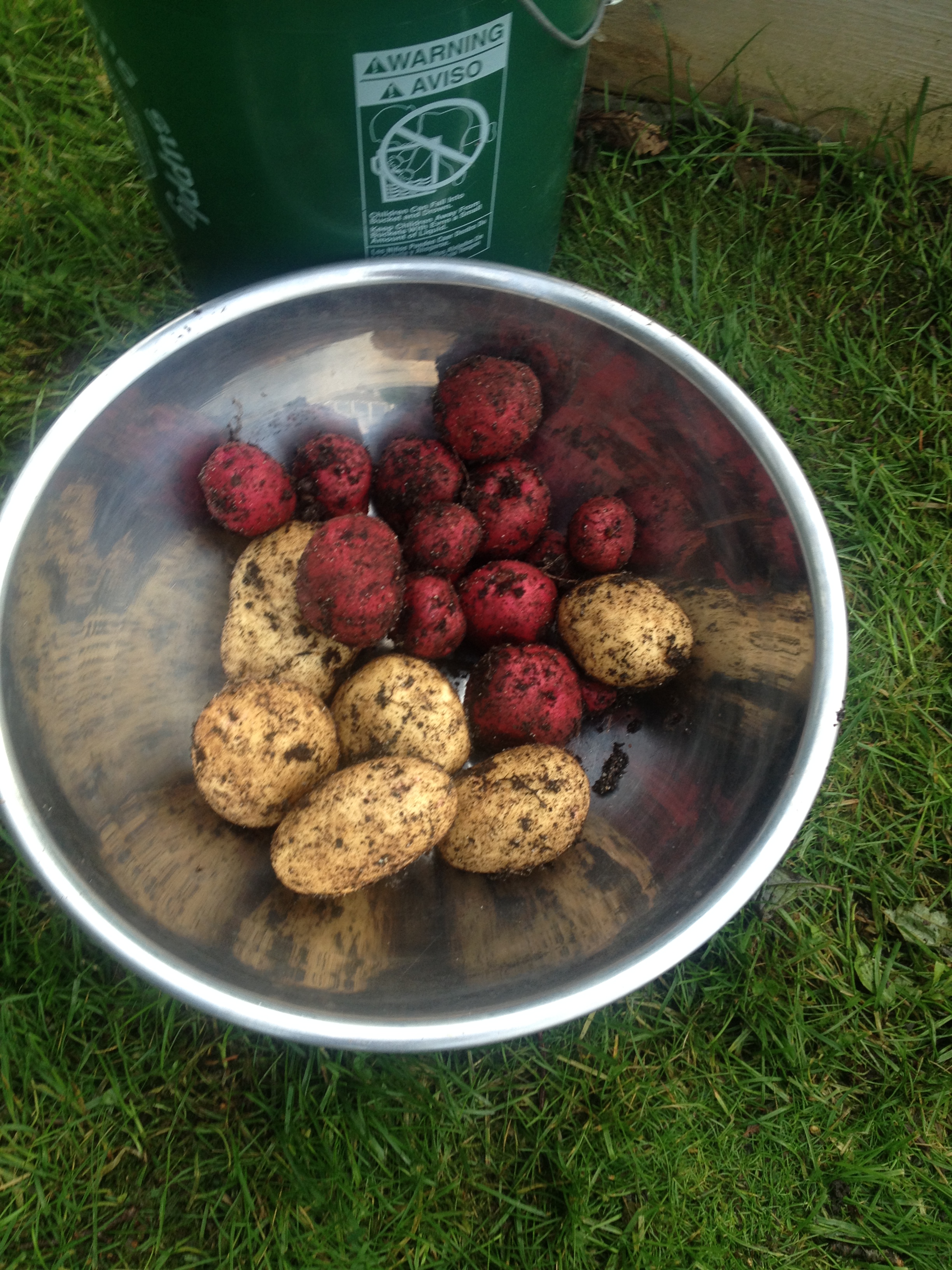
tamispotatoes

Your Sitka Local Foods Network reminds you that it’s time to get out in the garden and harvest and store your potatoes.

The Sitka Local Foods Network education committee encourages people to come and get their hands dirty as you learn how to harvest potatoes. Participants will also learn what they need to do to keep those potatoes fresh and ready to eat from now until May.

Michelle Putz will present three short hands-on potato harvesting and storage workshops at 9 a.m. on Thursday, Oct. 8, at 4 p.m. on Thursday, Oct. 15, and at 4 p.m. on Sunday, Oct. 25, all at her home at 131 Shelikof Way. The classes are free and open to everyone.

In addition, she will lead a short class on planting garlic at 3 p.m. on Sunday, Oct. 25, just before her third potato-harvesting class. Garlic is best planted in the fall.

The Sitka Local Foods Network education committee has been hosting a series of “It’s time to …” workshops this year designed to help local residents learn about various aspects of vegetable gardening and fruit growing. Many of these classes will be informal get-togethers at various gardens around town. Please watch our website, Facebook pageFacebook group, and local news media for information about upcoming classes. If you have an “It’s time to …” workshop you’d like to teach, contact Michelle Putz at 747-2708.

• Sitka Kitch to offer ‘Cooking From Scratch’ series of classes

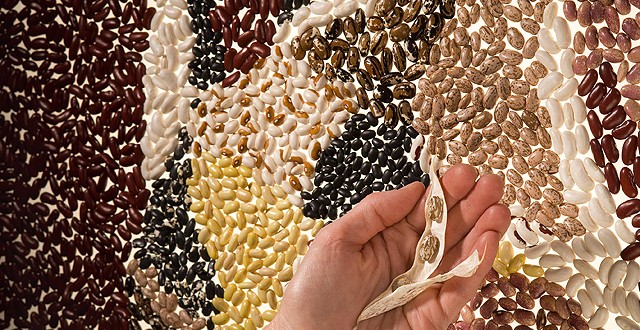
dry-beans-2-e1411748636858-640x330

kitch_logo_mainEver wanted to learn how to cook more and better food for less money?
Join us for a Cooking from Scratch series of cooking classes at the Sitka Kitch community rental commercial kitchen, which is located in the First Presbyterian Church (505 Sawmill Creek Road).
The series will kick off with Beans 101 taught by Lisa Sadleir-Hart, MPH, RDN, CHES, who loves the versatility of legumes at 6:30 p.m. on Monday, Oct. 19.
“Beans are a terrific source of low cost protein plus loaded with vitamins, minerals and fiber,” Sadleir-Hart said. “Using them regularly not only helps you control your food budget but also improves your health.”
The second Sitka Kitch Cooking from Scratch class is at 6 p.m. on Monday, Nov. 2, and will focus on basic whole-grain breads (registration link) using the Tassajara bread technique. It also will be taught by Lisa Sadleir-Hart.
The third Cooking from Scratch class will focus on gluten-free holiday baking and will be taught at 6 p.m. on Monday, Nov. 16, by Bridget Kauffman, an extraordinary gluten-free baker in Sitka.
The final class in the fall series will focus on how to make yogurt using nonfat dried milk. It will be offered at 6:30 p.m. on Monday, Dec. 7, and it will be taught by Lisa Sadleir-Hart.
The Cooking from Scratch series goal is to teach basic cooking skills using high-quality ingredients, and to help Sitkans take back their kitchens and reduce their food budgets. Interested individuals can register at https://sitkakitch.eventsmart.com/ (click on the event title to register, and pay when you attend the class). We need at least six students registered for each class to guarantee they happen.
Class size is limited so register early. The cost is $20 per class, plus a food fee that will be divided among registered participants. For more information about the class series, call Lisa Sadleir-Hart at 747-5985.

• Sitka Farmers Market earns top ranking from Alaska in American Farmland Trust’s Farmers Market Celebration

SnapshotFarmersMarketStandings

FARMMARKETCELEB_LOGO_DThank you to everybody who supported the Sitka Farmers Market in the seventh annual American Farmland Trust‘s Farmers Market Celebration, which ended on Wednesday, Sept. 23.

Your votes helped the Sitka Farmers Market rank as the top farmers market in Alaska in all five categories — People’s Choice, Focus on Farmers, Healthy Food For All, Pillar of the Community, and Champion for the Environment. We ranked 49th nationally in Champion of the Environment, 55th in People’s Choice, 57th in Healthy Food For All, 57th in Pillar of the Community, and 58th in the Focus on Farmers categories.

SitkaFarmersMarketSignIf you’re not familiar with the American Farmland Trust’s Farmers Market Celebration, you can learn more here. The Sitka Local Foods Network hosted six Sitka Farmers Markets this summer — on Saturdays, July 4, July 18, Aug. 1, Aug. 15, Aug. 29, and Sept. 12, at the Alaska Native Brotherhood Founders Hall.

While our markets are over for the summer, the Sitka Local Foods Network will host a fresh produce booth from 10 a.m. to noon this Saturday, Sept. 26, downtown near St. Michael’s Russian Orthodox Cathedral at our 21st annual Running of the Boots fundraiser.

• Sitka Economic Development Association to host Sitka Seafood Innovation Summit

INVITATION SSIS poster_web

The Sitka Economic Development Association (SEDA) invites anyone interested in developing the opportunities of our local and regional seafood industry to attend the Sitka Seafood Innovation Summit at 6:30 p.m. on Thursday, Oct. 1, in the Sheet’ka Kwáan Naa Kahídi.

Presenters will provide examples of some innovative products and processes now being developed and marketed. Learn how the Iceland Ocean Cluster model is working, and how Iceland, despite a 60 percent reduction in their codfish harvest, has used innovation to increase the value of each pound of fish harvested by more than 400 percent.

Want to learn more? Then come to this free event sponsored and hosted by the Sitka Economic Development Association. For more information, contact Garry White, 747-2660.

• Alaska’s potential for increasing agricultural potential immense; hard work, clear vision needed

AlaskaFoodPolicyCouncilLogo

(The following is a commentary about increasing Alaska’s access to local food by Alaska Food Policy Council co-chairs Liz Snyder and Victoria Briggs. It originally ran in the Sept. 10, 2015, edition of the Homer News.)


If you’ve visited a local farmers market recently, you’ll appreciate the bounty of delicious, healthy food that Alaska can produce when cultivated by knowledgeable, dedicated hands.

The prospects for increasing this bounty are immense. To take full advantage of our agricultural potential, we will need political will, consumer advocacy, recruitment and education of new farmers, financial support and incentives and a long-term vision. This vision, of course, will also need to take into account the changing climate in which Alaska farmers grow our food.

Imagine a glacier that retreats, then expands for several years, only to retreat again, repeating this process over and over. Such has been the history of agriculture in Alaska. We’ve experienced several booms and busts of both enthusiasm and productivity since the early 1900s.

Booms were the result of such things as co-development with gold mining, collaboration with local businesses, federal support of farming settlements and agricultural innovations. Busts came when challenges (that still exist today) got the better of farmers — the temptation to grow too big too fast, unsustainable and mismanaged support mechanisms, high costs and resulting debt; competition from the Lower 48, infrastructure designed for resource development instead of agriculture, inexperience and being far from home, a lack of replacements for retiring farmers, and, of course, climate.

Today, farmers and consumers are enjoying a boom of interest and enthusiasm around local foods. While it’s true that we send about 1.9 billion Alaska dollars out of the state each year to import food (which supplements the impressive $900 million worth of subsistence and personal-use foods), the good news is that direct sales between farmers and consumers are strong (13 times greater than the national average), Alaska farmers are notoriously tenacious and innovative, and demand continues to motivate increases in supply.

What we have now is a fantastic opportunity to throw a wrench into the boom/bust cycle, expand on the status quo and ultimately pump about $2 billion into, instead of out of, the Alaska economy each year — in effect, supporting the local farmers we know and love, strengthening our food system, lowering food costs, and increasing food security and resilience.

Of course, strengthening our food system will require both short-term goals and long-term planning. When it comes to climate change and agriculture, we’ve got three courses of action to consider:

  1. reduce our impact;
  2. respond to current changes; and
  3. prepare for future changes.

In the Lower 48, agriculture is a major contributor to climate change with high fossil fuel use (to manufacture pesticides and fertilizers, and to operate machinery) and greenhouse gas emissions from concentrated animal feeding operations (CAFOs).

In Alaska, however, the relative scales of agriculture and pest pressure are small. Our primary agriculturally related contribution to climate change is through the importation of approximately 95 percent of our food, which requires the burning of fossil fuels to power transport. Just think of the impact we could have if we expanded Alaska agriculture in thoughtful, sustainable ways to simultaneously produce more food and reduce total greenhouse gas emissions.

With respect to responding to current changes in Alaska’s climate and preparing for the future, we have a host of actions that are either already being taken or need to be taken. These actions should use the best natural, economic and social science information available.

Such preparations include the conservation of arable land; crop diversification and expansion into new growing zones; anticipation of changes in water distribution and quality; measures to address changes in pest, disease and invasive species pressures; education and support of new farmers focused on sustainable agricultural development, and construction of weather-resistant food caches and transportation routes.

Of course, in reality there is an even longer list of recommendations that can be made to strengthen Alaska’s food system, but all of these recommendations will need to be made in light of the climate changes we’re experiencing now and those that lie ahead. The Alaska Food Policy Council is dedicated to helping develop, share and advocate for policies that will result in an Alaska food system that is sustainable, resilient and healthy — and we ask our local, state, and federal leaders to tune in to the issues of food security and climate change and make them a priority. The health of our great state depends on it.

Liz Snyder and Victoria Briggs are co-chairs of the Alaska Food Policy Council, or AFPC. To learn more about food security in Alaska, find the following research resources on the AFPC webpage (akfoodpolicycouncil.wordpress.com):

Building Food Security in Alaska (a report commissioned by AFPC).

• A three-part series of articles (Part I, Part II, Part III) on circumpolar agriculture by Stevenson et al. (2014) and

• An article entitled “Food in the Last Frontier” by Snyder and Meter (2015).

• Final classes set for 2015 Sitka Local Foods Network garden mentor program

TamiONeillGarden 2015

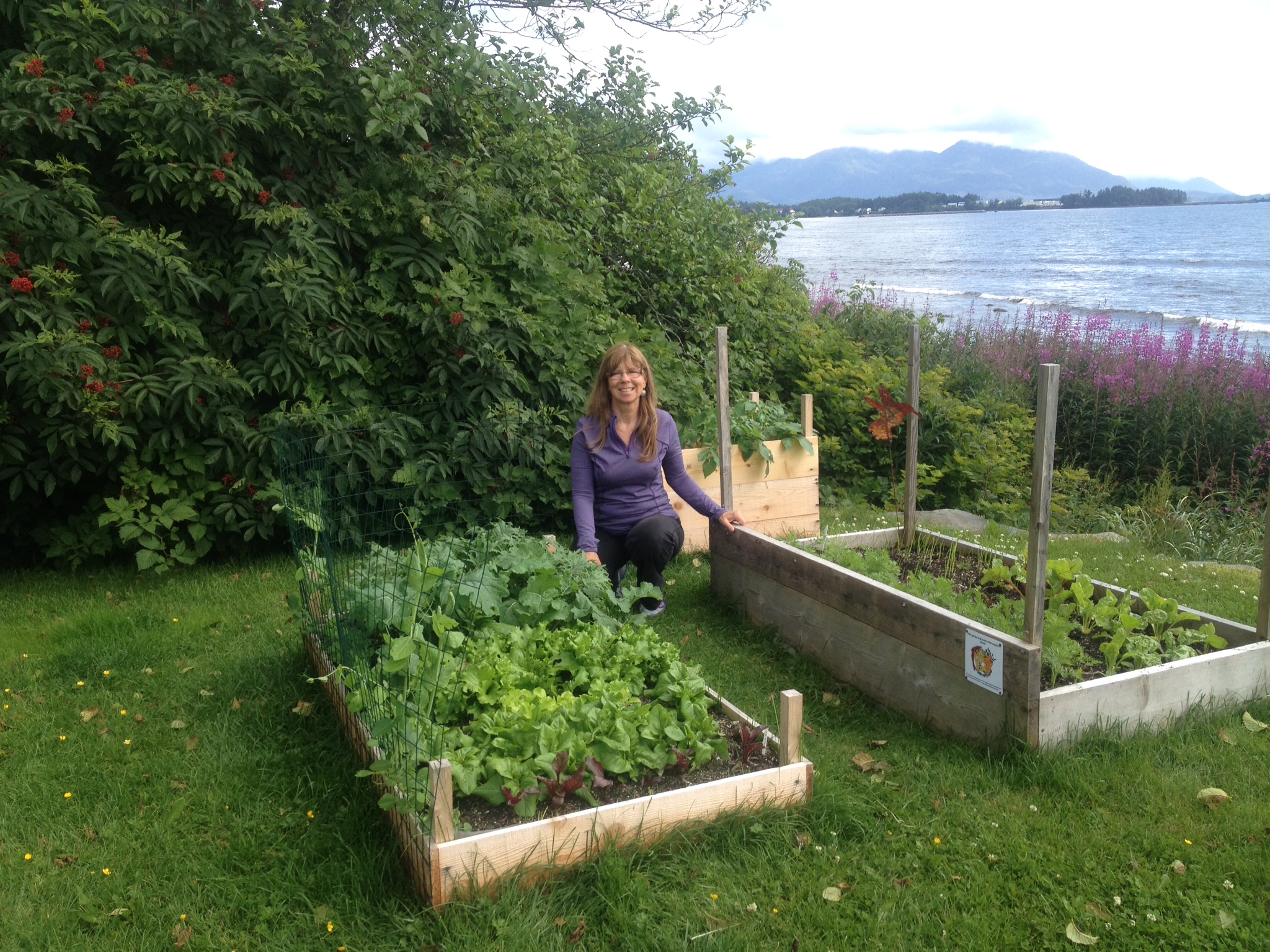
Tammy O’Neill shows off her garden from the Sitka Local Foods Network’s garden mentoring program. After growing in just one garden bed last year, she added new garden beds this year for her second year of the program.

Tammy O'Neill with her first carrot

Tammy O’Neill with her first carrot.

The 2015 gardening season is coming to a close, and the Sitka Local Foods Network garden mentor program is scheduling its final classes of the season to teach novice gardeners how to harvest their produce and winterize their gardens so they are ready for next spring.

So far classes have been set for four of our six garden mentor program students, with the other two TBA. Our four first-year students (A.J. Bastian, Rebecca Kubacki, Breezy and Josephine Dasalla) have been growing lettuce, kale, potatoes and rhubarb, four crops that grow well here in Sitka without a lot of fuss. Our two second-year students (Tammy O’Neill and Anna Bradley) have grown carrots, chard, green onions and peas, four crops that can grow well in Sitka but need a bit more loving care.

In addition to having experienced gardeners mentor them, all six students agreed to allow the classes taught at their garden plots be open to the public. The classes scheduled so far are:

  • A.J. Bastian, 207 Brady St. — noon, Wednesday, Sept. 23.
  • Rebecca Kubacki, 1202 Halibut Point Rd. — noon, Tuesday, Sept. 29.
  • Anna Bradley, 4764 Halibut Point Road, 1 p.m. on Tuesday, Sept. 29.
  • Tammy O’Neill, 2309 Merganser Drive, 1 p.m. on Thursday, Oct. 8.
DSCN0398

Rebecca Kubacki and her family with their garden.

Our two second-year students had never gardened for food before they started the program. They said they learned a lot and recommend the program to other new gardeners.

“I have so much more confidence and appreciate all the hands-on (help) I received,” O’Neill said, adding that her garden helped her save a lot of money on vegetables. “I don’t think I would have done it without the help and encouragement I had. I now have a network of people I can call to help with any questions or concerns I may have. I love eating local, fresh organic produce.”

After having a successful growing season last year, our returning students and a couple of the new ones had some soil problems this year. The gardens grew well in May and June, but in mid-July the plants seemed to stop growing even though the plants were well-formed. After some soil tests, it was discovered that some of the purchased compost was lower in nutrients than listed and the soil was more alkaline than normal (most soil in Sitka tends to be acidic).

DSCN0250

A.J. Bastian and her family with their newly planted garden.

“I learned that mostly the grade of the soil is important,” Bradley said. “We did a lot of work gathering the soil and beach herring, only to have maybe not enough fertilizer. The only thing we did different this year is not put in store bought soil. I look forward to gathering my potatoes and plan to read up more on gardening. Hopefully next year we will be more successful.”

Michelle Putz has been contracted to coordinate the program and design lesson plans, after the Sitka Local Foods Network received a community development grant from First Bank. We also have about a half-dozen experienced Sitka gardeners who serve as mentors for the program. Also, we have started to recruit for 2-3 participants to join next year’s first-year program.

For more information about the garden mentor program, please contact Michelle Putz at 747-2708.

IMG_0022

Garden mentor Linda Wilson with Anna Bradley and Anna’s daughter in 2014.

• Sitka Local Foods Network receives 2015 Community Impact Grant

GreensInHoopHouseStPeters

UnitedWayOfSoutheastAlaskaLogoThe Sitka Local Foods Network has been awarded a 2015 Community Impact Grant from the United Way of Southeast Alaska in the amount of $1,765 to assist with the network’s garden education program.

These funds will be used to create a downtown teaching garden (hopefully at Baranof Elementary School), creating a centralized garden that can be used to teach a variety of garden education classes throughout the year. The United Way of Southeast Alaska awarded Community Impact Grants to 11 Southeast nonprofit organizations in the areas of health, education, and income.

“The Sitka Local Foods Network appreciates the support of the United Way of Southeast Alaska,” said Michelle Putz, a Sitka Local Foods Network board member and member of the network’s education committee. “We look forward to developing a centrally located instructional food garden and a community education program that acts as a center of learning. This garden space will give us a new opportunity to teach local beginner gardeners of different ages how to produce their own food using the garden as an outdoor classroom. Next year we will be able to invite the community and gardeners of Sitka to an open, public location for bi-weekly classes for children and adults throughout the gardening year, focusing on different topics.”

“We always have more demand and requests for funding than we are able to give but in this competitive grant process the Sitka Local Foods Network ranked high in meeting targeted needs in the community,” said Rustan Burton, Chair of United Way of Southeast Alaska. “We are happy to partner with the Sitka Local Foods Network to meet this/these community need(s).”

United Way of Southeast Alaska is an independently governed, non-profit organization dedicated to strengthening lives, helping people, and improving community conditions in Southeast Alaska. United Way of Southeast Alaska and its partner agencies work to create real, lasting change by addressing the underlying causes of problems within our communities. Additionally, United Way of Southeast supports community programs and initiatives that help those in need and also prevent problems from happening in the first place.

The Sitka Local Foods Network’s mission is to increase the amount of locally produced and harvested food in the diets in Southeast Alaskans. To accomplish this, the Sitka Local Foods Network hosts the annual Sitka Farmers Market in the summer, operates the St. Peter’s Fellowship Farm communal garden (which grows produce to sell at the Sitka Farmers Market), and offers a variety of garden and food preservation classes throughout the year (including an innovative garden mentoring project for beginning gardeners).

To learn more about the Sitka Local Foods Network, go to http://www.sitkalocalfoodsnetwork.org/. You also can like our Facebook page at https://www.facebook.com/SitkaLocalFoodsNetwork, and you can follow us on Twitter at https://www.twitter.com/SitkaLocalFoods (@SitkaLocalFoods). For more information about the United Way of Southeast Alaska, go to http://www.unitedwayseak.org/

• Baranof Elementary students pick veggies they grew at the Russian Bishop’s House garden

CABBAGE PATCH KIDS- Baranof Elementary School first-grader Alice Ann Ricketts, 6, carries a cabbage out of the Russian Bishop’s House garden Friday, Sept. 11, 2015. First-graders were harvesting the vegetables they planted last spring when they were kindergartners during the annual event. Teachers and students were planning on making a soup with their harvested vegetables. (Daily Sitka Sentinel Photo by James Poulson)

CABBAGE PATCH KIDS — Baranof Elementary School first-grader Alice Ann Ricketts, 6, carries a cabbage out of the Russian Bishop’s House garden Friday, Sept. 11, 2015. First-graders were harvesting the vegetables they planted last spring when they were kindergartners during the annual event. Teachers and students were planning on making a soup with their harvested vegetables. (Daily Sitka Sentinel Photo by James Poulson, this photo appeared on Page 1 of the Monday, Sept. 14, 2015, edition)

• Scenes from the sixth and final Sitka Farmers Market of the 2015 summer

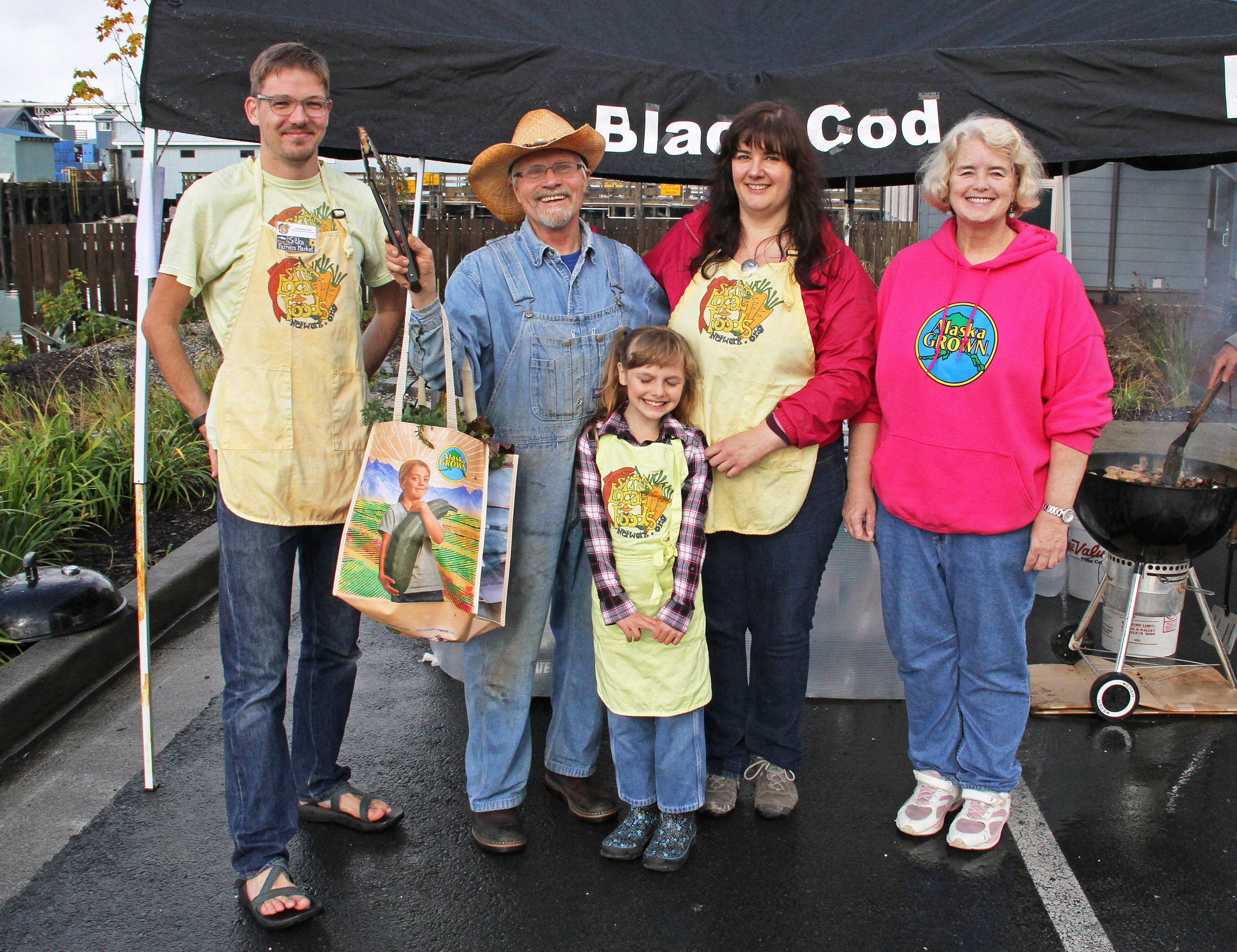
Sitka Farmers Market Assistant Manager Francis Wegman-Lawless, left, and Sitka Farmers Market Manager Debe Brincefield, right, present the Table Of The Day Award to Kerry MacLane, second from left, and his Sitka's Blackcod Collars helpers Autumn Mayo, center, and Ilona Mayo, second from right, at the sixth and final Sitka Farmers Market of the 2015 summer on Saturday, Sept. 12, at the Alaska Native Brotherhood Founders Hall in Sitka. MacLane is a regular participant at the Sitka Farmers Market with his grilled blackcod collars/tips served over rice with beach asparagus, kale, and other greens for a garnish. This was the eighth year of Sitka Farmers Markets, hosted by the Sitka Local Foods Network. While the Sitka Farmers Markets are over for 2015, the Sitka Local Foods Network will host a produce booth at the Running of the Boots on Saturday, Sept. 26, near St. Michael's Russian Orthodox Church. The Running of the Boots is a costumed fun run fundraiser for the Sitka Local Foods Network, where people run a short race in their XtraTufs (aka Sitka Sneakers). Registration opens at 10 a.m., with costume judging about 10:30 a.m. and the race start at 11 a.m. For more information about the Sitka Farmers Markets, Running of the Boots, and Sitka Local Foods Network, go to http://www.sitkalocalfoodsnetwork.org/, check out our Facebook page at https://www.facebook.com/SitkaLocalFoodsNetwork, or follow us on Twitter at https://www.twitter.com/SitkaLocalFoods. (PHOTO COURTESY OF SITKA LOCAL FOODS NETWORK)

Sitka Farmers Market Assistant Manager Francis Wegman-Lawless, left, and Sitka Farmers Market Manager Debe Brincefield, right, present the Table Of The Day Award to Kerry MacLane, second from left, and his Sitka’s Blackcod Collars helpers Autumn Mayo, center, and Ilona Mayo, second from right, at the sixth and final Sitka Farmers Market of the 2015 summer on Saturday, Sept. 12, at the Alaska Native Brotherhood Founders Hall in Sitka. MacLane is a regular participant at the Sitka Farmers Market with his grilled blackcod collars/tips served over rice with beach asparagus, kale, and other greens for a garnish. This was the eighth year of Sitka Farmers Markets, hosted by the Sitka Local Foods Network. While the Sitka Farmers Markets are over for 2015, the Sitka Local Foods Network will host a produce booth at the Running of the Boots on Saturday, Sept. 26, near St. Michael’s Russian Orthodox Church. The Running of the Boots is a costumed fun run fundraiser for the Sitka Local Foods Network, where people run a short race in their XtraTufs (aka Sitka Sneakers). Registration opens at 10 a.m., with costume judging about 10:30 a.m. and the race start at 11 a.m. For more information about the Sitka Farmers Markets, Running of the Boots, and Sitka Local Foods Network, go to http://www.sitkalocalfoodsnetwork.org/, check out our Facebook page at https://www.facebook.com/SitkaLocalFoodsNetwork, or follow us on Twitter at https://www.twitter.com/SitkaLocalFoods. (PHOTO COURTESY OF SITKA LOCAL FOODS NETWORK)

For our final Sitka Farmers Market of the 2015 season we had our usual fall Sitka weather — if you don’t like it right now wait 15 minutes and it will change.

We had torrential downpours early in the morning as we were setting up the market, but the rains stopped in time for the market to open and the sun even came out for a bit. We had more rainfall about halfway through the market, but it cleared up and was partly sunny for the end of the market and we even had a brief but large rainbow overhead.

While Saturday’s Sitka Farmers Market was the last one of the summer, there will be another chance to get some local veggies. The Sitka Local Foods Network will host a produce stand at its annual Running of the Boots costume run fundraiser on Saturday, Sept. 26, near St. Michael’s Russian Orthodox Cathedral. Running of the Boots registration and the produce booth open at 10 a.m., with costume judging about 10:30 a.m. and the fun run at 11 a.m. Dress up your XtraTufs and come on down for the fun.

A slideshow from the sixth Sitka Farmers Market of 2015 is posted below.

This slideshow requires JavaScript.

• New Silver Bay Seafoods cannery gives bonus to Sitka Sound Science Center

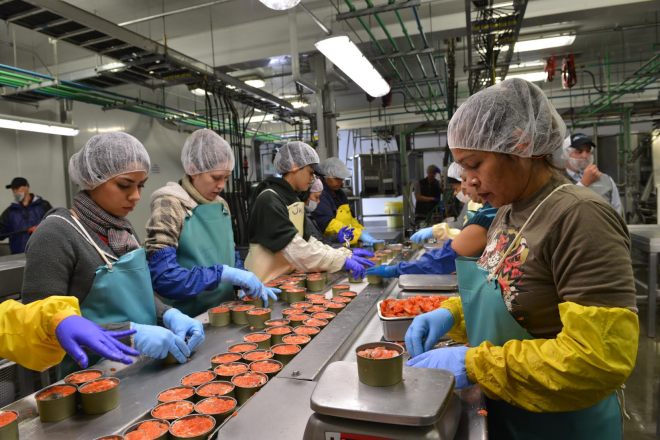
Workers pack sockeye salmon on the final day of seasonal canning operations Tuesday (Sept. 8, 2015) at Silver Bay Seafoods. (Daily Sitka Sentinel Photo by James Poulson)

Workers pack sockeye salmon on the final day of seasonal canning operations Tuesday (Sept. 8, 2015) at Silver Bay Seafoods. (Daily Sitka Sentinel Photo by James Poulson)

(Note: The following article ran on Pages 1 and 10 of the Friday, Sept. 11, 2015, edition of the Daily Sitka Sentinel. It is reprinted here with permission.)

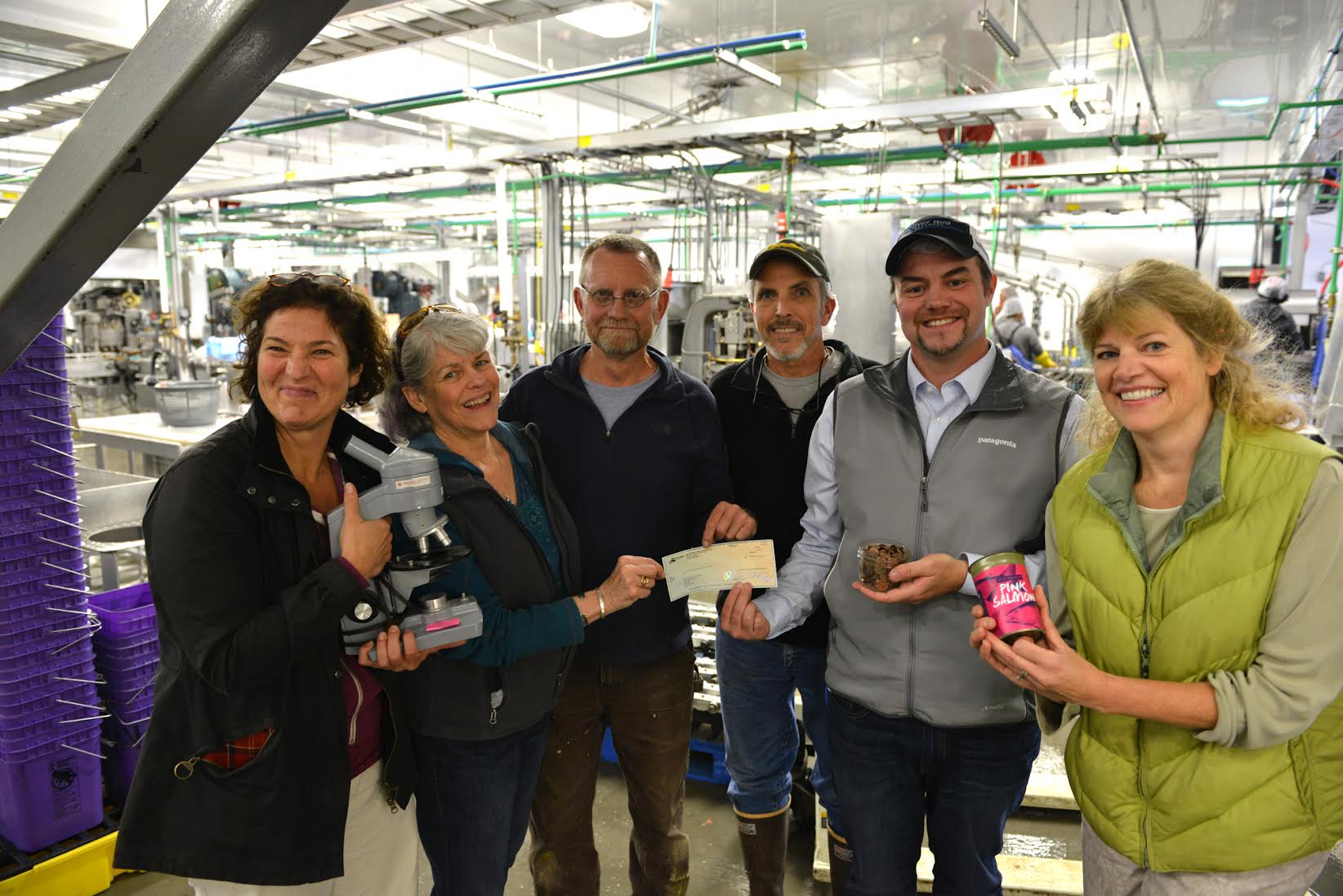
Sitka Sound Science Center Director Lisa Busch, left, and the center’s board of directors receive a $75,000 check from Silver Bay Seafoods CEO Rich Riggs and plant manager Wayne Unger recently at SBS’s new canning facility. From left are Busch, Linda Waller, Steve Clayton, Unger, Riggs, and Trish White. (Daily Sitka Sentinel Photo by James Poulson)

Sitka Sound Science Center Director Lisa Busch, left, and the center’s board of directors receive a $75,000 check from Silver Bay Seafoods CEO Rich Riggs and plant manager Wayne Unger recently at SBS’s new canning facility. From left are Busch, Linda Waller, Steve Clayton, Unger, Riggs, and Trish White. (Daily Sitka Sentinel Photo by James Poulson)

By TOM HESSE
Daily Sitka Sentinel Staff Writer

In a story that’s going to have a lot of digits, the number 12 might be the most important.

All canned goods have a coded number on the bottom that gives the location of where the food came from, when it was canned and who packaged it.

If the code on the bottom of canned salmon starts with a number 12, it means it was canned in Sitka. It also means the Sitka Sound Science Center received a one-cent donation for the production of that can of salmon.

And — if you’re Silver Bay Seafoods CEO Rich Riggs — it’s also a call-out to the fans of your favorite football team.

“So if you’re a (Seattle) Seahawks fan, that’s good news,” Riggs said.

Silver Bay has just wrapped up the inaugural year of its canning operation. The $7 million capital investment was the latest expansion of the Sitka-based company, founded in 2007 at the old Alaska Pulp Corp. mill site where it processed salmon for the fresh and frozen fish market.

Before Silver Bay Seafoods started canning fish there hadn’t been a cannery in Sitka for more than 50 years.

Earlier this week Riggs gave a tour of the canning line to the Sitka Sound Science Center board of directors. It was to celebrate a partnership between the two in which Silver Bay donated one cent for every can that rolled off the line.

Sitka Sound Science Center Director Lisa Busch said it’s one of the best examples there is of an industry supporting research in its own field of business.

“We are linked with the fishing industry and we really wanted to find some stable support, basically from the fishing industry,” Busch said. “We want to be partnered with fishermen and the fishing industry.”

Riggs said the rationale for that connection is obvious at any fish hatchery in the state. And then there’s the fact that the Sitka Sound Science Center is heir to the fishery science program pioneered by Sheldon Jackson College, which closed in 2007.

“You look and a lot of managers in the state have had some educational component at SJ. We firmly believe that sustainable fisheries are critical to Alaska’s communities and Alaska fishermen,” Riggs said.

Canning operations started in the second week of July, with three lines for three different sized cans. The largest cans run through the system at a rate of around 250 per minute, and the other sizes at around 215 cans per minute.

To the Sitka Sound Science Center, 60 minutes of canning results in a donation about equal to the hourly rate of some attorneys.

“I’m really excited that they’re so into this idea,” Busch said. “I feel like it’s really going to allow us to move forward to have somewhat stable funding from the fishing industry.”

Because of business interests, Silver Bay Seafoods won’t disclose how many cans it produced this year, but the first payment to the Sitka Sound Science Center was for $75,000.

The new canning line expands the total Silver Bay Seafoods warehouse footprint to more than 80,000 square feet, Riggs said.

The expansion was headed up by Mike Duckworth, who has 34 years of experience building and maintaining canning lines. One of the first things he had to do was acquire all the pieces, because most of the key elements for canning salmon date back to before his career even started.

“The filling machine has actually not been replicated the same,” Duckworth said. “There have been companies that’s tried to replicate them, but they found out it’s not feasible. They literally put millions of dollars into it and just couldn’t make money off of them.”

The technology dates back to the 1930s and ’40s, and Duckworth said the last major production of filling machines ended in the ’60s.

“Our equipment was probably cast in the late ’40s to the ’50s,” Duckworth said, adding that rebuilding those filling machines is a key piece of canning salmon in Alaska.

“It’s something everybody does. If you’re going to be in the industry then once every 7-10 years you completely rebuild these things,” Duckworth said. “We spent the last year (rebuilding). We had a crew of seasoned, Alaska canning machinists that were working with me in rebuilding and setting up the equipment and getting it ready for installation.”

The old equipment is then blended with new systems to create the modern canning system.

“That plant, it’s just a good blend of the old technology and the new,” Duckworth said.

A special slime line handles the salmon destined for canning, processing them in the usual manner. The fish are fed into one of the three canning lines where more than a dozen employees help monitor the process.

As salmon move along the line, they are packaged in cans that drop down a track from a room in the second story of the warehouse. A machine fills the can while employees check for bones and quality. Between the machine that affixes the lid and the track that kicks out defective cans is a printer that marks each can with a code, all of which start with the number 12.

Once sealed, the cans are loaded onto carts and taken to a separate station to cook before being stacked, wrapped and loaded into trucks to send them as far away as Australia.

Despite a low salmon year, Riggs said the canning operation was close to its projected target this season and there’s room to grow next year.

Tuesday (Sept. 8) was the last day of canning for the year, and it was frozen Bristol Bay sockeye that went through the process. The majority of the fish processed this year, however, cam from Southeast Alaska.

“The concept is the salmon season is over in Southeast, but then we can continue to operate the plant with the sockeye season in Bristol Bay going on,” Riggs said. “So we wanted to increase our capacity to process local fish as well as pick up some of those other Alaska fisheries, and the canning line allows us to do that.”

And if things continue to run as they did this year, the canning line also will allow for continued research into fisheries at the Sitka Sound Science Center.

“It funds all science center things,” Busch said. “So it goes toward research and education programs here in town and also toward our hatchery.”

Funding for independent science centers in Alaska can be tough to come by, and Busch said it can often be from unrelated industries, such as oil. Silver Bay Seafoods has worked with the Sitka Sound Science Center in the past, for example in the center’s cost-recovery fishery, and this new program is a logical continuation of their partnership, Busch said.

“We’re doing stuff that the fishermen are interested in,” Busch said. “To me this is so great that a big company, and a local company at that, are this invested in what we’re doing.”

Or, as Silver Bay Seafoods and the Sitka Sound Science Center are putting it, salmon makes cents.