• UAF Cooperative Extension Service offers Certified Food Protection Manager class by videoconference March 3 in Sitka

CFPM flyer 3-3-16-b

Wednesday, Feb. 17, is the registration deadline for a certified food protection manager workshop being taught on Thursday, March 3, by University of Alaska Fairbanks Cooperative Extension Service. This is an all-day statewide class that will be offered by videoconferencing to Fairbanks, Palmer, Juneau, Petersburg, Sitka, Craig, Angoon, Klukwan, and Tenakee.

A certified food protection manager (CFPM) is responsible for monitoring and managing all food establishment operations to ensure that the facility is operating in compliance with food establishment regulations.

A CFPM is knowledgeable about food safety practices and uses this knowledge to provide consumers with safe food, protect public health and prevent food-borne illnesses. Alaska regulations require food establishments to have at least one CFPM on staff.

This course takes place from 8:30 a.m. to 5 p.m. (with a half-hour lunch), and participants will take a computer-based exam at the end of the class. The reason the deadline is two weeks before the class is to guarantee course materials reach all the students in time for the class. The cost is $200, and the course will be taught by Julie Cascio of Palmer. Students can register here.

The Sitka videoconference for the class will take place in Room 110 at the University of Alaska Southeast Sitka Campus. To learn more, contact Jasmine Shaw at the Sitka District Office of the UAF Cooperative Extension Service at 747-9440, or contact Kathy McDougall at (907) 474-2420 (Fairbanks number) or kmmcdougall@alaska.edu. Note, this class is taught in English but textbooks are available in Korean, Chinese and Spanish, just contact Kathy at least three weeks before the class.

Also, the ServSafe book ($60) and certification exam ($75) now are available online, if people want to order the book and study independently without taking the class. Just go to this website and purchase the book and exam items.

• UAF Cooperative Extension Service, Alaska Sea Grant team up to offer online course on the specialty food business

Specialty food business March 2016

Are you interested in starting a specialty food business? The University of Alaska Fairbanks Cooperative Extension Service and the UAF Alaska Sea Grant program are teaming up to offer a five-class online course about how to start a specialty foods course in March.

The class is only available online and it will be from 5:30-8 p.m. on March 1, 3, 8, 10 and 15. You must attend all five classes during the times they are offered. The course costs $50 and is limited to the first 25 who register from around the state. More details about the class and its technology requirements can be found here. The instructors will be Quentin Fong of the Alaska Sea Grant program and Kate Idzorek of the UAF Cooperative Extension Service.

This course is intended for individuals interested in starting and operating a specialty food business to sell foods under the DEC Cottage Foods Exemption, a temporary DEC permit, DEC-permitted food production businesses to sell wholesale in Alaska or DEC-permitted Mobile Food Units (food trucks). This course is NOT intended for individuals starting or operating a restaurant or starting an interstate or international wholesale food business. It is for people who want to make specialty food products, such as jams and jellies, handmade chocolates, salsa, pickled fish, or operate a food truck. Many specialty food products are perfect for selling at the Sitka Farmers Market.

To register online, go to http://bit.ly/ces-workshops. For more information, contact Kate Idzorek of the UAF Cooperative Extension Service at 1-907-474-5391 (Fairbanks number).

• Sitka Kitch to offer Basic Culinary Skills classes in March for those seeking restaurant work

IMG_0861

Chef Kathy Jones holds up a fresh king crab.

kitch_logo_mainAre you seeking work in the restaurant or catering industry this summer but feel you need to beef up your skills? The Sitka Kitch community rental commercial kitchen will offer a series of four Basic Culinary Skills classes in March designed to help you develop the skills you need to work in the field.

These classes will be taught by Kathy Jones, executive chef at the Westmark Sitka Hotel and the Totem Square Inn. They are modeled after a similar basic culinary skills program Chef Kathy knows from Indianapolis offered by a food relief nonprofit called Second Helpings.

Cutting slices of fresh cucumber. Cucumbes, food prep, knife, cooking, vegetables. UF/IFAS Photo by Tyler Jones.

The classes take place from 6-8:30 p.m. on each Monday in March (March 7, 14, 21, and 28) at the Sitka Kitch, which is located inside the First Presbyterian Church (505 Sawmill Creek Road). Each class costs $25, plus a small materials fee. There is a $20 discount for those students who register for all four classes and pay at the first class. To learn more about each class, click the class titles below (which will take you to our registration page; you pay with cash or check at the class, with checks made out to the Sitka Conservation Society).

Since class size is limited, we ask anybody who can’t make the class to please let us know so we can let someone from the waiting list into the class. Registration for each class closes at 5 p.m. the Friday before each class so supplies can be purchased, or the class can be canceled if not enough people sign up, so please register early.

  • Basic Culinary Skills 1 — 6-8:30 p.m., Monday, March 7, this class will focus on basic kitchen sanitation, beginning knife skills and basic kitchen tools.
  • Basic Culinary Skills 2 — 6-8:30 p.m., Monday, March 14, this class will focus on basic cooking techniques, basic nutrition, and sauces, soups and stocks part 1.
  • Basic Culinary Skills 3 — 6-8:30 p.m., Monday, March 21, the class will focus on sauces, soups and stocks part 2, salads, and measurements.
  • Basic Culinary Skills 4 — 6-8:30 p.m., Monday, March 28, the class will focus on poultry, meats, and the Alaska DEC safe food handler’s card.

The Basic Culinary Skills class series is supported by a grant from the Northwest Farm Credit Services rural community grant program.

In addition to the Basic Culinary Skills class series, there still are spots open in the Sitka Kitch’s winter Cooking From Scratch series of classes in February. All of the classes are open to the general public.

The Sitka Kitch was a project of the 2013 Sitka Health Summit, and the project is coordinated by the Sitka Conservation Society in partnership with the Sitka Local Foods Network. The Sitka Kitch can be rented to teach cooking and food preservation classes, by local cottage food industry entrepreneurs who need a commercial kitchen to make their products, and for large groups needing a large kitchen for a community dinner. To learn more about how to rent the Sitka Kitch, please go to the website at http://www.sitkawild.org/sitka_kitch.

For more information about the Sitka Kitch and the classes, please email sitkakitch@sitkawild.org. You also can go to our class registration page at https://sitkakitch.eventsmart.com/ to see all of the available classes (click on the class titles to register).

• Check out the December 2015 edition of the Sitka Local Foods Network newsletter

SLFNDecember2015NewsletterScreenshot

The Sitka Local Foods Network just sent out the December 2015 edition of its newly launched monthly newsletter. Feel free to click this link to get a copy.

This edition of the newsletter has brief stories about how one 140-character tweet won the Sitka Local Foods Network $20,000 from Tom’s of Maine, how the opening of the new Sitka Biotoxin Lab on Katlian Street will mean safer shellfish in Southeast Alaska, and an appeal for new first-year gardening families for the garden mentor program. Each story has links to our website for more information.

You can sign up for future editions of our newsletter by clicking on the registration form image in the right column of our website and filling in the information. If you received a copy but didn’t want one, there is a link at the bottom of the newsletter so you can unsubscribe. Our intention is to get the word out about upcoming events and not to spam people. We will protect your privacy by not sharing our email list with others.

• New biotoxin lab in Sitka allows for quicker, better monitoring of harmful algal blooms in Southeast Alaska

MichaelJamrosChrisWhiteheadEstherKennedyJohnDorothyOrbisonDeanOrbison

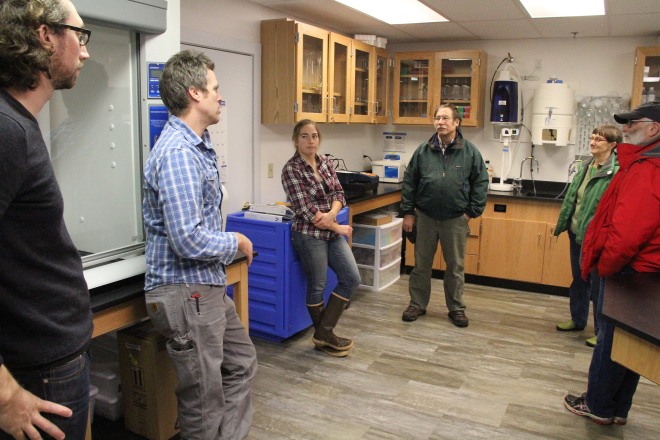
From left, Sitka Tribe of Alaska Environmental Lab Manager Michael Jamros, STA Environmental Program Manager Chris Whitehead, and STA Environmental Specialist Esther Kennedy discuss the new Sitka Biotoxin Lab with visitors to an open house on Monday, Nov. 30, 2015. The new lab will help Southeast subsistence and sport shellfish harvesters learn about harmful algal blooms in the region so they can avoid paralytic shellfish poisoning (PSP) or amnesic shellfish poisoning (ASP).

Most shellfish eaters are aware of the massive algal bloom that shut down many shellfish operations on the Pacific Coast this summer. The algal bloom even reached Sitka’s Starrigavan Beach with the June discovery of Pseudo-nitzchia, a species of plankton that sometimes produces domoic acid which can cause amnesic shellfish poisoning (ASP). ASP causes gastrointestinal issues in mild cases, such as nausea, vomiting, diarrhea, and abdominal cramps. In more severe cases there will be neurological problems, such as headaches, confusion, hallucinations, short-term memory loss, respiratory difficulty, seizures, coma, and in extreme cases, death.
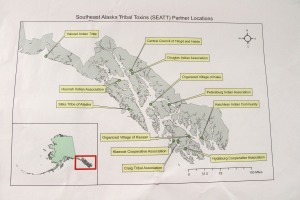
SEAKTribalToxinsSEATTPartnerLocationsUntil two years ago, Southeast Alaska beaches and subsistence- and sport-harvested shellfish weren’t tested for harmful biotoxins. That changed with the Southeast Alaska Tribal Testing (SEATT) program, a partnership of regional tribes coordinated by Sitka Tribe of Alaska, that began training technicians from six villages (now 12 villages) in the region on how to gather water samples so they could be tested. SEATT is part of a program called Southeast Alaska Tribal Ocean Research (SEATOR).

Now the project has moved to the next phase, the creation of a Sitka Biotoxin Lab, located at 429 Katlian Street, that can provide quicker and better testing results to people in the region who want to eat shellfish. Instead of sending samples to the Lower 48 for testing, which can take more than a week or two, samples from Southeast Alaska can be tested in Sitka and data can be available in less than 24 hours, Sitka Tribe of Alaska Environmental Program Manager Chris Whitehead said during an open house at the lab on Monday, Nov. 30. Before the lab opened, the program just took water samples. But now it will be able to actually test the shellfish for biotoxins.

Whitehead said one of the purposes of the lab is to give shellfish harvesters as much information as possible about possible harmful algal blooms so they can make informed decisions about if they still want to harvest and eat local shellfish. Harmful algal blooms spread a variety of biotoxins, such as domoic acid and saxitoxin, which can cause paralytic shellfish poisoning (PSP) and amnesic shellfish poisoning (ASP). PSP and ASP can be deadly, and in 2010 there were two people in Southeast Alaska who died from PSP.

Cockles-Alaska-Department-of-Health-and-Social-Services“The toxins can stay in butter clams for 2 1/2 to three years,” Whitehead said, disproving the common local myth that shellfish is safe to eat in months with R in the name. “We’re still seeing blooms in December.”

Whitehead said he’s hoping to eventually be able to do baseline sampling of a variety of beaches in Southeast Alaska. He said they are sampling bays for cyst beds by digging cores in the beach soil, and they’ve found cysts 3-4 meters (9-13 feet) below the surface. While the beach might be safe for now, if people start building piers or docks it can stir up the cyst beds and launch a harmful algal bloom.

The lab and testing program is funded by the Environmental Protection Agency (EPA) Indian Environmental General Assistance Program, the Bureau of Indian Affairs (BIA) and Tribal Cooperative Landscape Conservation Program, and the Administration for Native Americans’Environmental Regulatory Enhancement program. The National Oceanic and Atmospheric Administration (NOAA) Marine Biotoxin Programs from Seattle, Wash., and Charleston, S.C., provided training through workshops to help develop the SEATT program.

raw-clams-350Michael Jamros, PhD, was hired in October as the STA Environmental Lab Manager, and he will be handling most of the actual testing and diagnosis of the seawater and shellfish. He said right now the lab is focused on subsistence and sports harvests, but down the road it’s hoping to become FDA-certified so it can test commercial harvests.

Esther Kennedy is the STA Environmental Specialist, and she said “every week I go plankton hunting.” This summer all of her tests were at Starrigavan State Recreation Area, but now that the lab is open she will be able to test in more areas, “wherever you think people might harvest shellfish.”
pe-fig1“I think this will help our food security,” Kennedy said. “People will be able to see this abundant resource of shellfish, and now they’ll have better information about whether it’s safe to harvest.”

In addition to the Sitka staff, the program also trains monitors from 12 partner villages to test in their areas, which range from Ketchikan on the south to Yakutat on the north. These monitors come to Sitka twice a year for training, with their most recent training in early November. A slideshow of photos from the training is posted below.

This slideshow requires JavaScript.

• Scenes from a series of Sitka Seafood Festival food preservation classes at the Sitka Kitch

JasmineShawMichellePutzLeslieShallcrossConsult

ssflogo2On Aug. 6-8, the Sitka Seafood Festival hosted Leslie Shallcross from the Anchorage District Office of the University of Alaska Fairbanks Cooperative Extension Service to teach a series of food preservation classes at the Sitka Kitch community rental commercial kitchen (Aug. 6-7) and Sweetland Hall on Sheldon Jackson Campus (Aug. 8).

Leslie taught a class on Thursday at the Sitka Kitch about how to make low-sugar jams and jellies (a class on preserving local garden greens was canceled), and on Friday she taught a class on making kelp pickles and sauerkraut and a class on canning salmon. On Saturday, she moved over to the Sweetland Hall to be closer to the Sitka Seafood Festival events and she taught another canning salmon class and a class on the process of smoking salmon.

For those who missed the classes but still want to learn more about home canning, the UAF Cooperative Extension Service has a series of online tutorials on its website called “Preserving Alaska’s Bounty.”

Also, don’t forget to make sure your pressure canner gauge is tested at least once a year. Jasmine Shaw from the Sitka District Office of the UAF Cooperative Extension Service has a tester in her office and you can call her at 747-9440 to schedule a test.

kitch_logo_mainSitka Kitch is a community wellness project from the 2013 Sitka Health Summit designed to improve food security in Sitka. The different parts of the project include creating a community kitchen Sitka residents can rent to prepare food for their small businesses or to preserve their family harvest of fish, game, or garden veggies; expanding Sitka’s emergency food storage capacity; and providing education about preserving food and building family emergency food pantries.

For more information about the Sitka Kitch project, go to the Sitka Kitch website or Facebook page. For rental information, contact Kristy Miller at sitkakitch@sitkawild.org. Click this link to take a quick tour of the facility.

A slideshow with scenes from the various classes is posted below.

This slideshow requires JavaScript.

• Food preservation classes to be offered in conjunction with Sitka Seafood Festival

Sitka food preservation classes

ssflogo2Leslie Shallcross from the University of Alaska Fairbanks Cooperative Extension Service‘s Anchorage District Office will be in Sitka to offer a series of food preservation classes on Aug. 6-8 as part of the Sitka Seafood Festival.

The classes on Thursday and Friday, Aug. 6-7, will take place at the Sitka Kitch community rental commercial kitchen (inside First Presbyterian Church, 505 Sawmill Creek Road), while the Saturday, Aug. 8, classes will be at Sweetland Hall on the Sheldon Jackson Campus. Each of the classes will cost $15, but jars and other materials will be provided by the Sitka Seafood Festival.

The class schedule is:

  • Thursday, Aug. 6, 2-4:30 p.m., at Sitka Kitch — Low-sugar jams and jellies — Learn how to use a boiling water bath canner for preserving fruit by making low-sugar jams and jellies.
  • Thursday, Aug. 6, 6-8 p.m., at Sitka Kitch — Local garden greens — Learn how to cook with and preserve your garden greens.
  • Friday, Aug. 7, 10 a.m. to noon, at Sitka Kitch — Kelp pickles and sauerkraut — Learn how to make kelp pickles. You will “start” some sauerkraut as well as learn some of the science of fermentation.
  • Friday, Aug. 7, 3-5 p.m., at Sitka Kitch — Canning salmon — Learn how to use a pressure canner for preserving fresh, frozen or smoked fish.
  • Saturday, Aug. 8, 10 a.m. to noon, at Sweetland Hall — Canning salmon — Learn how to use a pressure canner for preserving fresh, frozen or smoked fish.
  • Saturday, Aug. 8, 1-2:30 p.m., at Sweetland Hall — Process of smoking salmon — Learn the steps in smoking fish.

kitch_logo_mainFor those who might miss the classes but still want to learn more about home canning, the UAF Cooperative Extension Service has a series of online tutorials on its website called “Preserving Alaska’s Bounty.” Also, don’t forget to make sure your pressure canner gauge is tested at least once a year. Jasmine Shaw from the Sitka District Office of the UAF Cooperative Extension Service has a tester in her office and you can call her at 747-9440 to schedule a test.

To register for the classes, please contact Jasmine Shaw at 747-9440 or jdshaw2@alaska.edu.


• A quick tour of the Sitka Kitch community rental commercial kitchen

Sitka Kitch Advisory Team Members, from left, Lisa Sadleir-Hart, Kristy Miller, Sarah Lewis, and Dorrie Farrell go through the orientation packet before a recent series of canning and cottage foods classes taught by Lewis.

Sitka Kitch Advisory Team Members, from left, Lisa Sadleir-Hart, Kristy Miller, Sarah Lewis, and Dorrie Farrell go through the orientation packet before a recent series of canning and cottage foods classes taught by Lewis.

kitch_logo_mainDid you know Sitka has a community rental commercial kitchen?

The Sitka Kitch, located inside First Presbyterian Church at 505 Sawmill Creek Road, officially opened in March and is available for cottage food businesses needing a commercial kitchen, people wanting to put up their own harvest, cooking and canning classes, and even groups who want to cook a dinner for friends and family that’s too large to hold in someone’s home.

The Sitka Kitch is a rental community commercial kitchen project coordinated by the Sitka Conservation Society, in partnership with the Sitka Local Foods Network, located inside the First Presbyterian Church. The Sitka Kitch was a project from the 2013 Sitka Health Summit designed to improve food security in Sitka while also providing a space for people wanting to get into the cottage food business or wanting to preserve their harvest for storage in the home pantry. Sitka Kitch (Facebook page) officially opened after a series of renovations to make the church kitchen pass Alaska Department of Environmental Conservation commercial kitchen food safety standards.

The Sitka Food Co-op and Everything Organic Sitka regularly use the facility for deliveries and distribution.

Kristy Miller, the facilities manager for First Presbyterian Church, serves as the manager of Sitka Kitch and helps with scheduling and communal supplies. If you are interested in learning more about how to rent the Sitka Kitch, please go to this website, http://www.sitkawild.org/sitka_kitch, and the best way to schedule a rental is by email at sitkakitch@sitkawild.org.

The slideshow below provides a quick tour of the facility.

This slideshow requires JavaScript.

• UAF Cooperative Extension Service offers Certified Food Protection Manager class by videoconference July 29 in Sitka

CFPM flyer 7-29-15

Thursday, July 17, is the registration deadline for a certified food protection manager workshop being taught on Wednesday, July 29, by University of Alaska Fairbanks Cooperative Extension Service. This is an all-day statewide class that will be offered by videoconferencing to Fairbanks, Palmer, Juneau, Valdez, and Sitka.

A certified food protection manager (CFPM) is responsible for monitoring and managing all food establishment operations to ensure that the facility is operating in compliance with food establishment regulations.

A CFPM is knowledgeable about food safety practices and uses this knowledge to provide consumers with safe food, protect public health and prevent food-borne illnesses. Alaska regulations require food establishments to have at least one CFPM on staff.

This course takes place from 8:30 a.m. to 5 p.m. (with a half-hour lunch), and participants will take a computer-based exam at the end of the class. The reason the deadline is two weeks before the class is to guarantee course materials reach all the students in time for the class. The cost is $200, and the course will be taught by Marsha Munsell of Fairbanks and Julie Cascio of Palmer. Students can register here (scroll down and select the July 29 item).

The Sitka videoconference for the class will take place in Room 110 at the University of Alaska Southeast Sitka Campus. To learn more, contact Jasmine Shaw at the Sitka District Office of the UAF Cooperative Extension Service at 747-9440, or contact Kathy McDougall at (907) 474-2420 (Fairbanks number) or kmmcdougall@alaska.edu. Note, this class is taught in English but textbooks are available in Korean, Chinese and Spanish, just contact Kathy at least three weeks before the class.

Jasmine does have one extra book in her office, so she can accommodate one late registration from Sitka for the July 29 class. The next class will be Sept. 30, and Sitka is a tentative site for the videoconference. Also, the ServSafe book ($60) and certification exam ($75) now are available online, if people want to order the book and study independently without taking the class. Just go to this website and purchase the book and exam items.

• Free pressure canner gauge testing offered at the Sitka Farmers Market on Saturday, July 18

Canner

SarahLewisTestsCannerGaugeThis is a great time of the year to be in Sitka. The fish are running, gardens are starting to produce, and berries are ripe for the picking.

Many Sitka residents have pressure canners to preserve their harvest, and this weekend Sarah Lewis of the Juneau District Office of the University of Alaska Fairbanks Cooperative Extension Service is in town to teach four classes about canning on Thursday, Friday and Saturday at the Sitka Kitch (a rental community commercial kitchen at First Presbyterian Church, 505 Sawmill Creek Road, note, all classes are full). She also provide free pressure canner gauge testing at the Sitka Farmers Market from 10 a.m. to 1 p.m. on Saturday, July 18, at the Alaska Native Brotherhood Founders Hall.

“People can bring the gauge or the lid with the gauge still attached,” Sarah said about the pressure canner gauge testing. “If they have any questions about the full canner (gaskets, damage, how to use, etc.) they can bring the whole thing.”

In addition to testing pressure canner gauges, Sarah plans to work with Jasmine Shaw of the Sitka District Office of the UAF Cooperative Extension Service to have a wide variety of publications available about home canning. In addition, the UAF Cooperative Extension Service has a series of online tutorials on its website called “Preserving Alaska’s Bounty.” Pressure canner gauges should be tested at least once a year to make sure they are hitting the right pressures for safe food preservation.

A reminder about the Sitka Farmers Market, due to health codes we can’t allow any pets other than licensed service dogs in the ANB Hall or the parking lot. We also don’t allow smoking at the Sitka Farmers Market (in ANB Hall or the parking lot) because this is a health event.

Also, if you are in Sitka and you can’t make the pressure canner gauge testing event at the Sitka Farmers Market, you can call Jasmine Shaw at 747-9440 at the Sitka office of the UAF Cooperative Extension Service to set up a time when you can stop by and have her test your gauge in the office. She now has a gauge and is trained on using it.