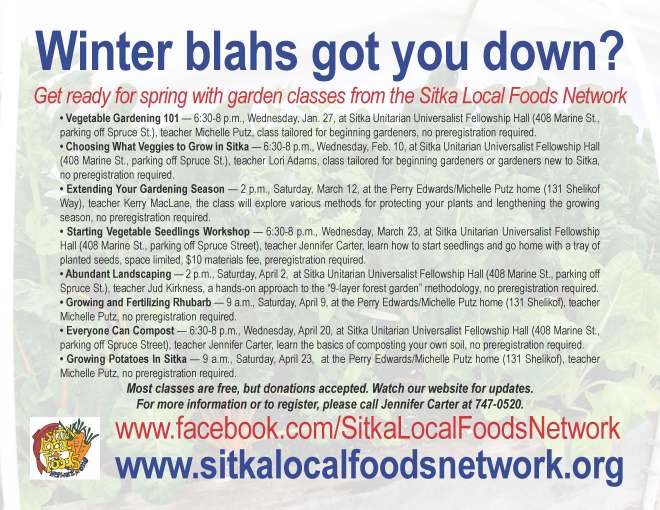
• It’s time … get ready for spring vegetable gardening with classes from the Sitka Local Foods Network

SLFNSpringGardenClasses2016

Thinking about your garden, especially with our warm winter weather? It’s time to mark your calendars with several upcoming Spring 2016 garden classes offered by the Sitka Local Foods Network Education Committee.

GreensInHoopHouseStPetersThese classes will cover a variety of topics, from gardening basics and choosing what veggies to grow in Sitka to extending your gardening season, composting and seed-starting. But wait, there’s more. There’s also a class on abundant landscaping, plus classes on growing rhubarb and potatoes. Some of the classes have limited space and require preregistration, so sign up early. Most of the classes are free, but we accept donations. There is one class with a minimal materials fee.

We will be adding more classes to this list as they become available, so check the website for updates. We plan to post individual class announcements as we get closer to the actual class dates.

And now, here’s the list of classes so far:

  • Vegetable Gardening 101 — 6:30-8 p.m., Wednesday, Jan. 27, at Sitka Unitarian Universalist Fellowship Hall (408 Marine St., parking off Spruce St.), teacher Michelle Putz, class tailored for beginning gardeners, no preregistration required.
  • Choosing What Veggies to Grow in Sitka — 6:30-8 p.m., Wednesday, Feb. 10, at Sitka Unitarian Universalist Fellowship Hall (408 Marine St., parking off Spruce St.), teacher Lori Adams, class tailored for beginning gardeners or gardeners new to Sitka, no preregistration required.
  • Extending Your Gardening Season — 2 p.m., Saturday, March 12, at the Perry Edwards/Michelle Putz home (131 Shelikof Way), teacher Kerry MacLane, the class will explore various methods for protecting your plants and lengthening the growing season, no preregistration required.
  • Starting Vegetable Seedlings Workshop — 6:30-8 p.m., Wednesday, March 23, at Sitka Unitarian Universalist Fellowship Hall (408 Marine St., parking off Spruce Street), teacher Jennifer Carter, learn how to start seedlings and go home with a tray of planted seeds, space limited, $10 materials fee, preregistration required.
  • Abundant Landscaping — 2 p.m., Saturday, April 2,  at Sitka Unitarian Universalist Fellowship Hall (408 Marine St., parking off Spruce St.), teacher Jud Kirkness, a hands-on approach to the “9-layer forest garden” methodology, no preregistration required.
  • Growing and Fertilizing Rhubarb — 9 a.m., Saturday, April 9, at the Perry Edwards/Michelle Putz home (131 Shelikof), teacher Michelle Putz, no preregistration required.
  • Everyone Can Compost — 6:30-8 p.m., Wednesday, April 20, at Sitka Unitarian Universalist Fellowship Hall (408 Marine St., parking off Spruce Street), teacher Jennifer Carter, learn the basics of composting your own soil, no preregistration required.
  • Growing Potatoes In Sitka — 9 a.m., Saturday, April 23,  at the Perry Edwards/Michelle Putz home (131 Shelikof), teacher Michelle Putz, no preregistration required.

In addition, we’ll be launching our new downtown teaching garden as we get closer to growing season and all of those classes will be open to the public. Feel free to help the Sitka Local Foods Network education committee plan new programming at its next monthly meeting, from 6:30-8 p.m. on Thursday, Jan. 28, at the Sitka Unitarian Universalist Fellowship Hall (408 Marine Street, parking off Spruce Street).

For more information or to sign up for classes requiring preregistration, contact Jennifer Carter at 747-0520 or 1-850-491-2666 (cell).

• Spring 2016 garden education classes from the Sitka Local Foods Network (opens as PDF)

• Sitka Local Foods Network education committee to meet on Thursday, Jan. 28

GreensInHoopHouseStPeters

The Sitka Local Foods Network education committee will host its monthly meeting from 6:30-8 p.m. on Thursday, Jan. 28, at the Sitka Unitarian Universalist Fellowship Hall (408 Marine Street, parking is off Spruce Street).

During this meeting we will go over our spring schedule of gardening classes, select our new garden mentor program families, get updates on our new downtown teaching garden program, get an update on upcoming Sitka Kitch cooking classes, and look into other educational opportunities we can offer in Sitka (such as a garden tour or local foods directory).

This meeting is open to the public and all are invited. We also need volunteers who can help with our classes. For more information, contact Jennifer Carter at 747-0520.

• Did you file for your PFD? Add a Pick.Click.Give. donation to the Sitka Local Foods Network

2016PickClickGiveFlier

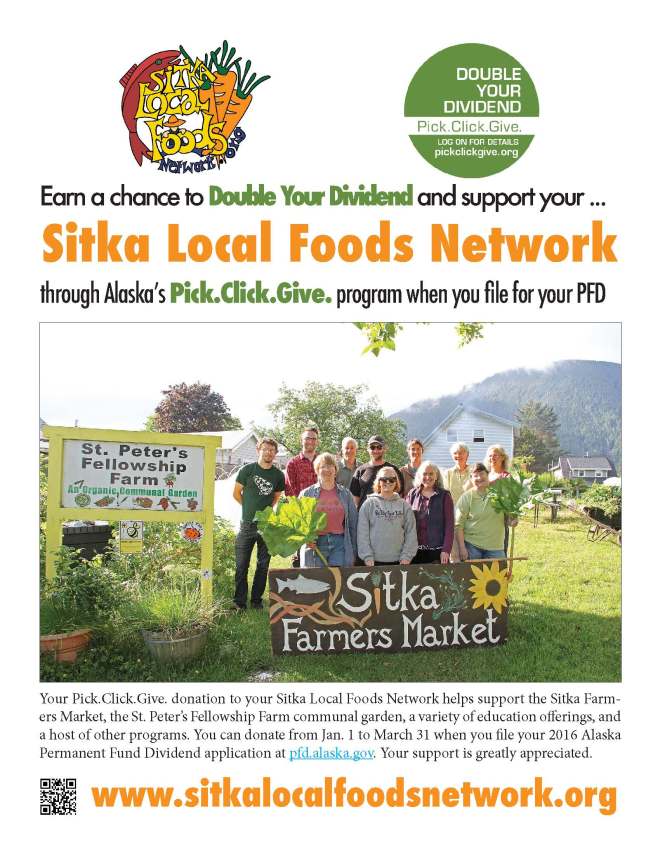
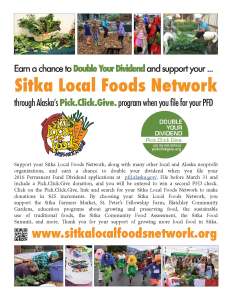
Now that it’s January, many Alaskans already are applying for their 2016 Alaska Permanent Fund Dividends. As usual, Alaskans can share their wealth with a variety of Alaska nonprofits, including the Sitka Local Foods Network, through the PFD’s Pick.Click.Give. program.

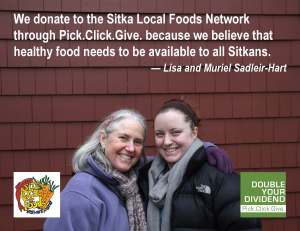
PCGTestemonialLisaAndMurielSadleirHart2016This is the third year the Sitka Local Foods Network will participate in the Pick.Click.Give. program, which allows people to donate in $25 increments to their favorite statewide and local 501(c)(3) nonprofit organizations when they file their PFD applications from Jan. 1 through March 31. We thank the 64 donors who pledged $3,350 to the Sitka Local Foods Network in 2015, and we appreciate your support again in 2016.

When you choose to donate part of your PFD to the Sitka Local Foods Network, you support the Sitka Farmers Market, St. Peter’s Fellowship Farm, education programs about growing and preserving food, the Sitka Kitch community rental commercial kitchen, Blatchley Community Gardens, the sustainable use of traditional foods, the Sitka Community Food Assessment, the Sitka Food Summit, and a variety of other projects designed to increase access to healthy local foods in Sitka.

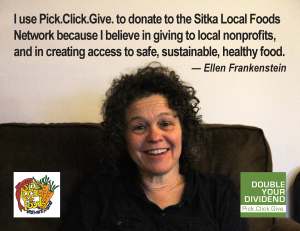
PCGTestemonialEllenFrankenstein2016In 2015 a record 33,421 Alaskans made 53,851 pledges of $3,329,575 to their favorite nonprofit organizations, up from $545,000 donated by 5,175 people in the program’s first year of 2009. Some Alaskans choose to donate to just one group, while others may spread several donations around to many groups. There now are more than 500 total 501(c)(3) nonprofit organizations participating in Pick.Click.Give. for 2016 (including multi-location nonprofits), including 24 from Sitka.

To encourage more Alaskans to donate through the Pick.Click.Give. program, this will be the second year of the Double Your Dividend contest. Anybody who makes a non-anonymous Pick.Click.Give. donation to at least one of the registered nonprofits will be entered into a contest where 10 lucky Alaskans will win a second PFD check. The winners will be announced in October, about the time the PFDs start hitting bank accounts.

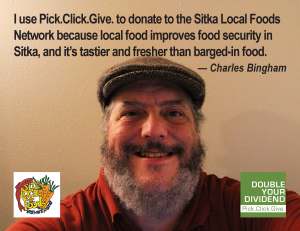
PCGTestemonialCharlesBingham2016So how do you make a donation to the Sitka Local Foods Network through the Pick.Click.Give. program? First, go fill out your Alaska Permanent Fund Dividend application at http://pfd.alaska.gov/. When you get to the section of the application asking if you want to participate in Pick.Click.Give. Charitable Contributions program, click on the PCG link and search for the Sitka Local Foods Network. You also can look for us by using the town search for Sitka.

The Pick.Click.Give. program is available only to people who file their PFD applications online, and not to those who file by mail. Even though you can’t file a new PFD application after March 31, you can go back into your application and update your Pick.Click.Give. donations through Aug. 31 each year.

PCGFarmersMarket2016NEWYou still can donate to the Sitka Local Foods Network if you aren’t from Alaska or aren’t eligible for a 2016 PFD. To donate, send your check to the Sitka Local Foods Network, 408D Marine St., Sitka, Alaska, 99835. You also can donate online by going to our online fundraising page on Razoo.com, and clicking the Donate button to make an online contribution. Please let us know if you need a receipt for tax purposes. For more information about donating, you can send an email to sitkalocalfoodsnetwork@gmail.com.

Thank you for supporting our mission of promoting and encouraging the growing, harvesting and eating of local foods in Sitka and Southeast Alaska.

• Sitka Kitch and local chefs to host winter Cooking From Scratch class series

IMG_20151130_230013

kitch_logo_mainDo you want to learn how to cook a few new dishes and improve your kitchen skills? The Sitka Kitch community rental commercial kitchen and local chefs will offer four classes in the winter Cooking From Scratch class series this February.

This series is modeled after our fall Cooking From Scratch class series, but this time the teachers will be local chefs Edith Johnson, Dr. Julien Naylor, Kathy Jones and Barbara Palacios. Students will learn how to make pasta, use ancient grains (while learning how they improve gut health), make sauces and dressings, and make two types of empanadas.

IMG_2886Each class costs $20, plus a food and equipment fee split between students (usually about $5-$10). All of the classes will be taught at the Sitka Kitch, which is located in the First Presbyterian Church (505 Sawmill Creek Road). To learn more about each class, click the class titles below (which will take you to our registration page; you pay with cash or check at the class, with checks made out to the Sitka Conservation Society).

Since class size is limited, we ask anybody who can’t make the class to please let us know so we can let someone from the waiting list into the class. Registration for each class closes at 5 p.m. the Friday before each class so supplies can be purchased, or the class can be canceled if not enough people sign up, so please register early.

  • Homemade Pasta — 6-8:30 p.m., Monday, Feb. 1, taught by Edith Johnson (chef at the Fly-In Fish Inn and consultant for the Sitka Hotel). This is a beginning class on how to make homemade pasta taught by a chef who takes pride in using local ingredients. Registration closes on Jan. 29.
  • Ancient Grains and Gut Health — 6-8:30 p.m., Tuesday, Feb. 9, taught by Dr. Julien Naylor (an internal medicine specialist and chef). This class is focused on how to prepare ancient grains and include more of them in your diet to improve gut health. Registration closes on Feb. 5.
  • Sauces and Dressings — 6-8:30 p.m., Monday, Feb. 15, taught by Kathy Jones (executive chef at the Westmark Sitka and Dock Shack). This class is focused on preparing homemade sauces and dressings to help you lower your food costs and increase flavor. Registration closes on Feb. 12.
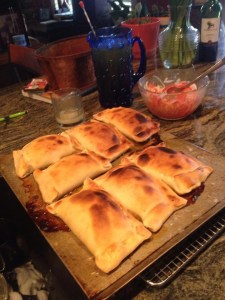
  • Homemade Empanadas — 6-8:30 p.m., Monday, Feb. 29, taught by Barbara Palacios (sous chef at the Westmark Sitka). A favorite food of Latin America, Barbara will draw on her Chilean background to teach this delicious homemade empanada class. Empanadas can be savory or sweet, and filled with meats, vegetables or sweet ingredients. In this class, students will make salmon (baked) and/or cheese (deep-fried) empanadas. Registration closes on Feb. 26.

IMG_20150325_164419The Sitka Kitch was a project of the 2013 Sitka Health Summit, and the project is coordinated by the Sitka Conservation Society in partnership with the Sitka Local Foods Network. The Sitka Kitch can be rented to teach cooking and food preservation classes, by local cottage food industry entrepreneurs who need a commercial kitchen to make their products, and for large groups needing a large kitchen for a community dinner. To learn more about how to rent the Sitka Kitch, please go to the website at http://www.sitkawild.org/sitka_kitch.

For more information about the class series, please email sitkakitch@sitkawild.org. Also, watch for information soon on our Basic Culinary Skills class series in March, which is designed to help people who want to find work in the restaurant or catering fields improve their kitchen skills (these classes also will be open to people who want to improve their home cooking skills).

• Check out the January 2016 edition of the Sitka Local Foods Network newsletter

SLFNNewsletterJanuary2016Screenshot

The Sitka Local Foods Network just sent out the January 2016 edition of its newly launched monthly newsletter. Feel free to click this link to get a copy.

This edition of the newsletter has brief stories about how you can donate to the Sitka Local Foods Network through the 2016 Pick.Click.Give. donation program through the Alaska Permanent Fund Dividend application, information about our upcoming annual meeting and potluck on Jan. 30, and an appeal for new first-year gardening families for the garden mentor program. Each story has links to our website for more information.

You can sign up for future editions of our newsletter by clicking on the registration form image in the right column of our website and filling in the information. If you received a copy but didn’t want one, there is a link at the bottom of the newsletter so you can unsubscribe. Our intention is to get the word out about upcoming events and not to spam people. We will protect your privacy by not sharing our email list with others.

• Friday’s the day to start filing your PFD applications with Pick.Click.Give. donations

2016PickClickGiveFlier

As 2015 winds to a close, many Alaskans already are thinking about applying for their 2016 Alaska Permanent Fund Dividend check in January. As usual, Alaskans can share their wealth with a variety of Alaska nonprofits, including the Sitka Local Foods Network, through the PFD’s Pick.Click.Give. program.

PCGKidsHarvest2016This is the third year the Sitka Local Foods Network will participate in the Pick.Click.Give. program, which allows people to donate in $25 increments to their favorite statewide and local 501(c)(3) nonprofit organizations when they file their PFD applications from Jan. 1 through March 31. We thank the 64 donors who pledged $3,350 to the Sitka Local Foods Network in 2015, and we appreciate your support again in 2016.

When you choose to donate part of your PFD to the Sitka Local Foods Network, you support the Sitka Farmers Market, St. Peter’s Fellowship Farm, education programs about growing and preserving food, the Sitka Kitch community rental commercial kitchen, Blatchley Community Gardens, the sustainable use of traditional foods, the Sitka Community Food Assessment, the Sitka Food Summit, and a variety of other projects designed to increase access to healthy local foods in Sitka.

Lovalaska FB Square PhotoGrid Tag (1)In 2015 a record 33,421 Alaskans made 53,851 pledges of $3,329,575 to their favorite nonprofit organizations, up from $545,000 donated by 5,175 people in the program’s first year of 2009. Some Alaskans choose to donate to just one group, while others may spread several donations around to many groups. There now are more than 500 total 501(c)(3) nonprofit organizations participating in Pick.Click.Give. for 2016 (including multi-location nonprofits), including 24 from Sitka.

To encourage more Alaskans to donate through the Pick.Click.Give. program, this will be the second year of the Double Your Dividend contest. Anybody who makes a non-anonymous Pick.Click.Give. donation to at least one of the registered nonprofits will be entered into a contest where 10 lucky Alaskans will win a second PFD check. The winners will be announced in October, about the time the PFDs start hitting bank accounts.

PCGFarmersMarket2016NEWSo how do you make a donation to the Sitka Local Foods Network through the Pick.Click.Give. program? First, go fill out your Alaska Permanent Fund Dividend application at http://pfd.alaska.gov/. When you get to the section of the application asking if you want to participate in Pick.Click.Give. Charitable Contributions program, click on the PCG link and search for the Sitka Local Foods Network. You also can look for us by using the town search for Sitka.

The Pick.Click.Give. program is available only to people who file their PFD applications online, and not to those who file by mail. Even though you can’t file a new PFD application after March 31, you can go back into your application and update your Pick.Click.Give. donations through Aug. 31 each year.

PickClickGiveFlier3DYDPRINTYou still can donate to the Sitka Local Foods Network if you aren’t from Alaska or aren’t eligible for a 2016 PFD. To donate, send your check to the Sitka Local Foods Network, 408D Marine St., Sitka, Alaska, 99835. You also can donate online by going to our online fundraising page on Razoo.com, and clicking the Donate button to make an online contribution. You also can send in a check or make an online donation if you are trying to make nonprofit donations before the end of the 2015 tax year. Please let us know if you need a receipt for tax purposes. For more information about donating, you can send an email to sitkalocalfoodsnetwork@gmail.com.

Thank you for supporting our mission of promoting and encouraging the growing, harvesting and eating of local foods in Sitka and Southeast Alaska.

• Sitka Local Foods Network to host annual meeting and potluck on Thursday, Feb. 11 (NOTE NEW DATE)

DisplayBasketOfCrops

The Sitka Local Foods Network will host its annual meeting and potluck dinner from 5:30-7:30 p.m. on Thursday, Feb. 11, at the Sitka Unitarian Universalist Fellowship Hall (408 Marine St., parking off of Spruce Street). Please note that this event has been rescheduled from its original time and date.

Participants are encouraged to bring a dish featuring local foods to share, and please bring your own utensils (note, this is a non-alcoholic event). This event is a good event to attend for people who want to learn more about the Sitka Local Foods Network and what we do around town. In addition, we will host a small fundraising auction for a variety of local-food-related items.

Attendees will hear about project updates, plus the current board will vote on by-law changes. We will introduce our new board members for 2016, and we will confirm the election of our officers.

Individuals interested in learning more about the Sitka Local Foods Network can email sitkalocalfoodsnetwork@gmail.com to learn about our projects and volunteer opportunities. For more information, call Michelle Putz at 747-2708.

• Highlights from 2015 for your Sitka Local Foods Network

Some carrots grown at St. Peter's Fellowship Farm communal garden on sale at the Sitka Farmers Market

Some carrots grown at St. Peter’s Fellowship Farm communal garden on sale at the Sitka Farmers Market

As 2015 comes to a close, here are some highlights from the past year for your Sitka Local Foods Network. We are looking forward to a lot of new adventures in 2016, and encourage people to join us. We always need new volunteers, and please donate to us through Pick.Click.Give. when you file for your Alaska Permanent Fund Dividend starting on Jan. 1 and ending March 31. Your donations help fund a variety of Sitka Local Foods Network programs, such as the Sitka Farmers Market, St. Peter’s Fellowship Farm communal garden, and a host of garden and food education opportunities.

Our annual meeting and potluck will be from 5:30-8 p.m. on Saturday, Jan. 30, at the Sitka Unitarian Universalist Fellowship Hall (408 Marine Street, parking is off Spruce Street). This event is open to the public, just bring a dish (preferably with local foods) to share with everybody. We usually introduce new board members, confirm our new officers, and give an update on our finances and programs.

And now here are those 2015 highlights from your Sitka Local Foods Network:

Grew food at St. Peter’s Fellowship Farm and extension gardens

St. Peter's Fellowship Farm communal garden

St. Peter’s Fellowship Farm communal garden

For the eighth straight year, the Sitka Local Foods Network expanded its produce-growing operations at the St. Peter’s Fellowship Farm communal garden and our extension gardens, such as the one on land owned by Pat Arvin. The food grown from these gardens is sold at the Sitka Farmers Market, where Sitka residents, including people with SNAP (food stamps) and WIC (supplemental nutrition program for women, infants and children) benefits, have access to fresh local produce. In addition to supplying the Sitka Farmers Market, this year we grew enough to sell to some school lunch programs, at the Sitka Seafood Festival, at the Running of the Boots costumed fun run, and at a booth on days when Chelan Produce was in Sitka.

Hosted six Sitka Farmers Market events

Some of the booths at the Sitka Farmers Market

Some of the booths at the Sitka Farmers Market

We hosted the Sitka Farmers Market for the eighth straight summer, and this year there were six markets on alternate Saturdays from July 4 through Sept. 12. In addition to selling produce from St. Peter’s Fellowship Farm and our extension gardens, the Sitka Farmers Market serves as a business incubator where budding entrepreneurs sell jams/jellies, baked goods, fish, prepared food ready to eat, and a variety of local arts and crafts. Our emphasis is on local products always. The Sitka Farmers Market also provides a venue for local musicians (we hire a few to play at each market). One of the highlights this year was a brief performance by the students involved in the musical with the Sitka Fine Arts Camp. Another highlight was the inaugural Sitka Slug Races, where Sitka residents brought their own slugs (or rented ones we harvested) for a series of races on a glass table.

Taught a variety of garden education classes and mentored some novice gardeners

Tammy O'Neill, a student in the garden mentor program, poses with her garden beds after her second year in the program

Tammy O’Neill, a student in the garden mentor program, poses with her garden beds during her second year in the program

The Sitka Local Foods Network education committee hosted a variety of classes this year for local food gardeners. We started out with a couple of classes about basic gardening in Sitka, and followed those with classes on starting seeds, composting, chickens, rabbits, fruit trees, potatoes, carrots, rhubarb, and more. In addition, we hosted the second year of our family garden mentoring program with funding from First Bank. In this program we provided one-on-one mentoring for four families of novice gardeners and two families returning for a second year of the program. We are hoping to bring this innovative program back in 2016 and we are recruiting for new families. This fall we received a small grant from the United Way of Southeast Alaska that we will use to develop a teaching garden at Baranof Elementary School near downtown Sitka.

Partnered with several organizations to launch and operate the Sitka Kitch

LisaSadleirHartHelpsRebaAndRobertScoopCultureStarterIntoMilk

Sitka Kitch “Cooking From Scratch” instructor Lisa Sadleir-Hart, center, helps Reba Traini and Robert Baines make homemade yogurt

This year we partnered with the Sitka Conservation Society, UAF Cooperative Extension Service, First Presbyterian Church, Sitka Food Co-op, and other organizations to help launch the Sitka Kitch community rental commercial kitchen, which officially opened in March 2015. The Sitka Kitch is available for cottage food entrepreneurs to rent as they make their products, plus we have been offering a variety of food preservation and cooking classes. The Sitka Kitch also is available for people to rent who need a larger kitchen to cook a community meal.

Helped launch the Sitka Food Collaborative

Toward the end of the year, the Sitka Local Foods Network, Sitka Conservation Society, Sitka Kitch, Sitka Food Co-op, Sitka Seedling Farms, and other food groups created the Sitka Food Collaborative and then submitted an application for a USDA grant to conduct a Sitka Food Systems Assessment. This will build on the work done in 2013-14 with the Sitka Community Food Assessment, but will look at ways we can improve our local food system so we have better food security.

Fundraising and strategic planning

50-states-logoThe Sitka Local Foods Network is maturing as an organization, and this year we decided we needed to start raising money so we eventually can hire a part-time director to take care of some of the daily chores dealt with by our volunteer board of directors. We have started to set aside a little bit of money, still have a ways to go. This year we received a grant from the Alaska Community Foundation that will allow us to work with the Foraker Group in 2016 to create a fundraising and long-term strategic plan. We participated in the Pick.Click.Give. program for the second year, and we are preparing for our third year of receiving donations from Alaskans when they file for their Permanent Fund Dividends. We launched an online donation page on Razoo.com (a donation website for nonprofit groups), and hosted fundraisers for St. Peter’s Fellowship Farm, the Sitka Sound Suppers (with a totally local meal) and #GivingTuesday (#GivingTuesdayAK in Alaska). This fall we received a small grant from the United Way of Southeast Alaska that we will use to develop a teaching garden at Baranof Elementary School near downtown Sitka. In December, the Sitka Local Foods Network was named Alaska’s winner in the 50 States For Good contest, hosted by Tom’s of Maine. Each of the winning community nonprofits from each state won $20,000 to improve their programming, which we should receive in January.

• USDA Natural Resources Conservation Service offers funding support program for high tunnels

picture8

The deadline has been set for the next round of applications for the U.S. Department of Agriculture’s Natural Resources Conservation Service (NRCA) cost-sharing program. This program enables qualifying landowners who produce food to build high tunnels with financial assistance from the USDA.

The next NRCS Alaska program deadline is June 15, 2016. However, the program usually sets two applications deadlines a year so applications can be batched and ranked. Applications that miss the June 15 deadline will be held for the next deadline (usually about Oct. 15, but it hasn’t yet been posted online for 2016). Applicants are encouraged to apply outside two deadline cycles, because sometimes funding is available.

“The next deadline is June 15, 2016 – for funding in the 2017 fiscal year,” said Samia Savell, of the Juneau Field Office of the USDA-NRCS. “However, we often get additional funding in the current fiscal year and have the opportunity to fund applications that have been submitted past the prior deadlines. In other words, if you know of people who are interested in the program, please have them contact me to get the application materials. We do accept applications at any time.”

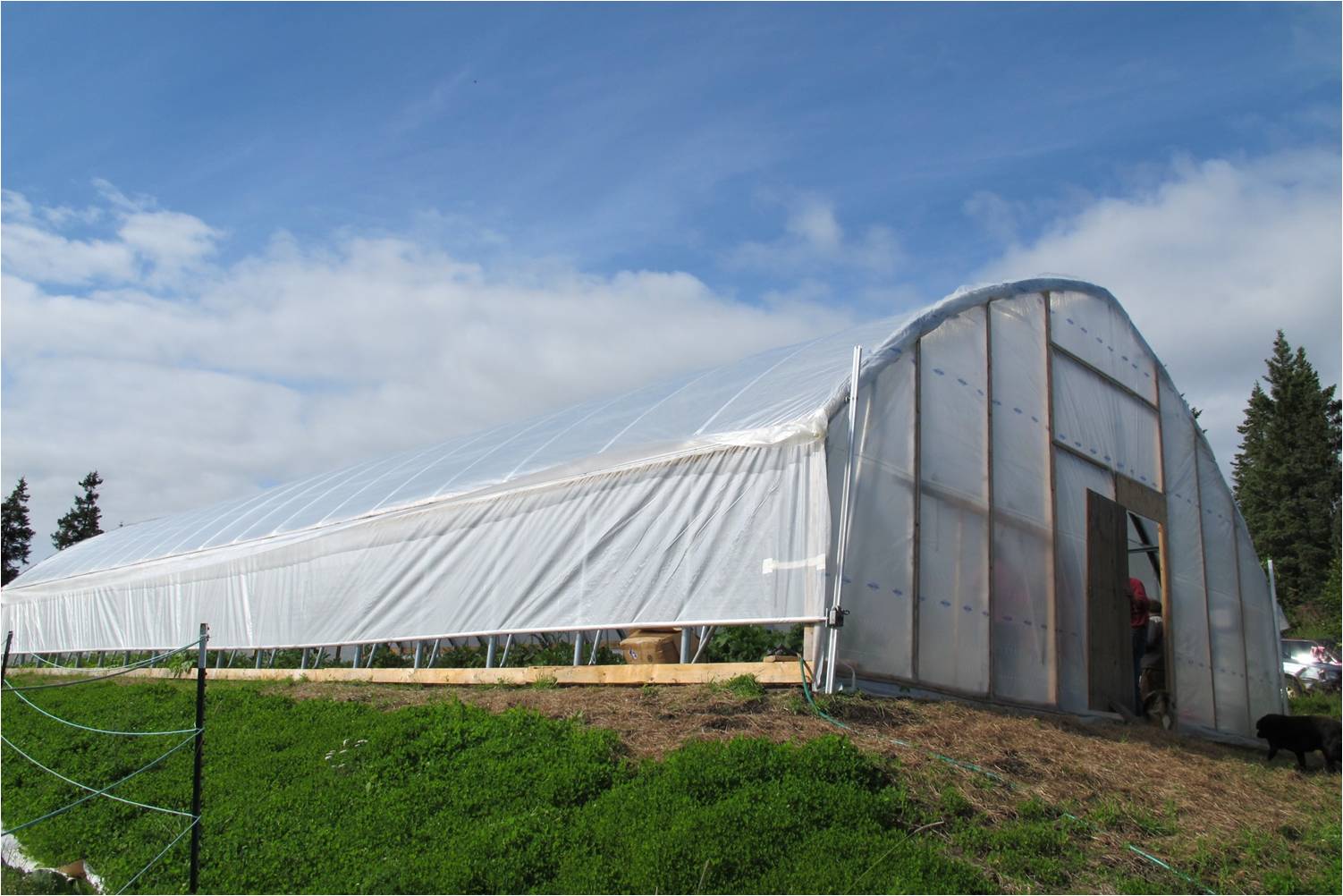
High tunnels, also known as hoop houses or temporary greenhouses, extend the growing season so more food is produced before and after the traditional weather dates for growing stuff outdoors. They also can help with irrigation and drainage, and with pest control.

High tunnels are different than greenhouses in that they are passively heated by the sun, so they have lower energy costs than greenhouses. High tunnels are at least nine feet tall (an increase from six feet tall in recent years), so people can walk upright in them. Low tunnels, which usually involve some PVC pipe bent over a garden bed and covered with row cover, aren’t eligible in this program. Food in high tunnels is planted either directly into the ground or in raised beds, not in containers. To learn more about the USDA’s high tunnel program, click here, and click here to get information about the application procedure. This link has frequently asked questions and answers about seasonal high tunnel systems for crops.

Picture10This program started a couple of years ago as a pilot program, but now is a permanent part of of the NRCS EQIP (Environmental Quality Incentive Programs). The program recently was revamped, and one major change is there now is no size restriction on the structures NRCS provides cost-sharing funds (previously it was limited to up to 2,178 square feet, or 5 percent of one acre). Also, geodesic domes are now eligible. Both the land owner and land must meet certain eligibility requirements.

Funding is provided on a reimbursable status once the high tunnel is installed and certified to meet NRCS standards. In 2012 there was just one high tunnel in Sitka, but in 2013 there were six. Other areas of the state, such as Homer, have built dozens of high tunnels through the program.

For information regarding the NRCS technical service or program participation in Southeast Alaska, please contact Samia Savell or Will Murray at the Juneau field office at (907) 586-7220 or 586-7208, or send email to samia.savell@ak.usda.gov or william.murray@ak.usda.gov. The June 15, 2016, deadline is the first deadline for the Fiscal Year 2017 funding cycle. Click here for a link to the Alaska NRCS page. Click here for an interview with Samia Savell on KRBD-FM (Ketchikan) about the program.

• High Tunnels In Alaska Fact Sheet (October 2015)

• Flier about Southeast Alaska cost-sharing program for FY2016 (March 2015, note, information should be similar for FY2017)

• The Inuit Circumpolar Council-Alaska (ICC-AK) releases report on Inuit food security

Food Security Summary and Reccomendations Report _Page_01
Drastic changes are occurring within the Arctic and Inuit are on the forefront of these changes. In recent years food security has increasingly become a topic of conversation and is gaining more attention. But what does food security mean to those that call the Arctic home?

Through this Inuit Circumpolar Council-Alaska (ICC-AK) project led by the Alaskan Inuit (Iñupiaq, St. Lawrence Island Yupik, Central Yup’ik and Cup’ik), the Alaskan Inuit Food Security Conceptual Framework: How to Access the Arctic from an Inuit Perspective report illuminates the meaning of Alaskan Inuit food security and lay out an assessment process.

In the report it is clear that Inuit food security is more than calories, more than nutrients, as explained by a contributing author:  “We are speaking about the entire Arctic ecosystem and the relationships between all components within; we are talking about how our language teaches us when, where and how to obtain, process, store and consume food; we are talking about the importance of dancing and potlucks to share foods and how our economic system is tied to this; we are talking about our rights to govern how we obtain, process, store and consume food; about our Indigenous knowledge and how it will aid in illuminating these changes that are occurring. We are talking about what food security means to us, to our people, to our environment and how we see this environment; we are talking about our culture.” — Executive Summary

The report is the product of 146 contributing Inuit authors, a 12-member advisory committee, ICC-AK and their membership organizations. A summary and recommendations report was created for those who are looking for a quick glimpse at what food security means to Alaskan Inuit, what it means to apply a food security lens to assessments, and recommendations for strengthening food security. For a deeper understanding and more in-depth discussion, a technical report has been created. Within both reports you will find: 1) recommendations, 2) key barriers, 3) the food security conceptual framework, and 4) drivers of food security and insecurity. The technical report also lays out a food security assessment process.

“To look at environmental health through an Inuit food security lens requires one to undergo a paradigm shift. One must be willing to attempt to understand the Inuit culture to know what Inuit mean when they talk about food security.” — James Stotts

ICC-Alaska hopes that the report will be of use to a broad spectrum of people. Villages may use the report to aid in communicating with those from outside their communities. Decision-makers, academics, environmentalists, policy-makers and industry may use the reports as a tool to enhance their understanding of the Arctic. The report is accessible on the ICC-Alaska website.

The food security report also is linked below:

• Inuit Circumpolar Council-Alaska Food Security Summary and Recommendations Report

• Inuit Circumpolar Council-Alaska Food Security Technical Report