• Sitka Herring Festival to host benefit dinner on Sunday, Nov. 17

Herring_Fest_Flyer

The inaugural Sitka Herring Festival will host a benefit dinner at 5:30 p.m. on Sunday, Nov. 17, at the Sitka Elks Club.

The Sitka Herring Festival will take place in the spring of 2014, when the herring return to Sitka to spawn. The event is sponsored by the Sitka Tribe of Alaska Resource Protection Department.

“The festival is a collaborative event to promote the importance of Pacific herring on the ecosystem and the culture of Sitka and the North Pacific Ocean,” event coordinator Jessica Gill said. “A few events to note are: kids’ herring derby, herring dip, fish printing, an educational unit in the schools, and a community potluck scheduled for April 4th.  I am currently working on bringing in a scientist from Oxford to give a talk on herring for the potluck, but that will be dependent of funding.”

To learn more, please contact Jessica Gill at 747-7168 or by email at sitkaherringfestival@gmail.com. In addition to the event’s new website (still under construction), there is a Facebook page.

• Registration deadline Wednesday, Sept. 18, for upcoming certified food protection manager workshop on Oct. 18

CFPM flyer 10-2-13

Wednesday, Sept. 18, is the registration deadline for a certified food protection manager workshop being taught on Wednesday, Oct. 2, by University of Alaska Fairbanks Cooperative Extension Service. This is an all-day statewide class that will be offered live in Fairbanks and Palmer, and by videoconferencing to Sitka, Nome, Kodiak and Dillingham.

A certified food protection manager (CFPM) is responsible for monitoring and managing all food establishment operations to ensure that the facility is operating in compliance with food establishment regulations.

A CFPM is knowledgeable about food safety practices and uses this knowledge to provide consumers with safe food, protect public health and prevent food-borne illnesses. Alaska regulations require food establishments to have at least one CFPM on staff.

This course takes place from 9 a.m. to 5 p.m. (with a half-hour lunch), and participants will take a computer-based exam at the end of the class. The reason the deadline is two weeks before the class is to guarantee course materials reach all the students in time for the class. The cost is $175, and the course will be taught by Kate Idzorek of Fairbanks and Julie Cascio of Palmer. Students can register here.

The Sitka videoconference for the class will take place in Room 110 at the University of Alaska Southeast Sitka Campus. To learn more, contact the Sitka District Office of the UAF Cooperative Extension Service at 747-9440, or contact Kate Idzorek at 907-474-5391 (toll-free, 1-877-520-5211) or kjidzorek@alaska.edu in Fairbanks.

• Sitka’s ‘Fish To Schools’ program puts out call to commercial fishermen for donations

Fishermen_Donation_Updated Aug2013

The Fish To Schools program in Sitka has put out the call looking for donations of commercially caught fish for the upcoming school year. Donations are being accepted from Aug. 18-25 at Sitka Sound Seafoods and Seafood Producers Cooperative. (NOTE, the time period for donations has been extended. Please call the numbers below to see if more fish still is needed.)

SCS-031_smFishToSchoolsTacoThe Sitka Fish To Schools project (click here to see short video) got its start as a community wellness project at the 2010 Sitka Health Summit, and now is managed by the Sitka Conservation Society. It started by providing a monthly fish dish as part of the school lunch as Blatchley Middle School, and since then has grown to feature regular fish dishes as part of the lunch programs at Keet Gooshi Heen Elementary School, Blatchley Middle School, Sitka High School, Pacific High School (where the alternative high school students cook the meals themselves) and Mount Edgecumbe High School.

In addition to serving locally caught fish meals as part of the school lunch program, the Fish To Schools program also brings local fishermen, fisheries biologists and chefs to the classroom to teach the kids about the importance of locally caught fish in Sitka. The program received an innovation award from the Alaska Farm To Schools program during a community celebration dinner in May 2012, and now serves as a model for other school districts from coastal fishing communities.

Due to state regulations, the Sitka Fish To Schools program can only accept donations of fish that have been commercially caught, and it cannot accept fish from sport or subsistence fishermen. The donation period is timed with the coho salmon season, and fishermen can get more information or pledge a donation by contacting Beth Short-Rhodes at 738-9942 or elianise@yahoo.com.

For more information about the Fish To Schools program, contact Tracy Gagnon at the Sitka Conservation Society at 747-7509 or tracy@sitkawild.org.

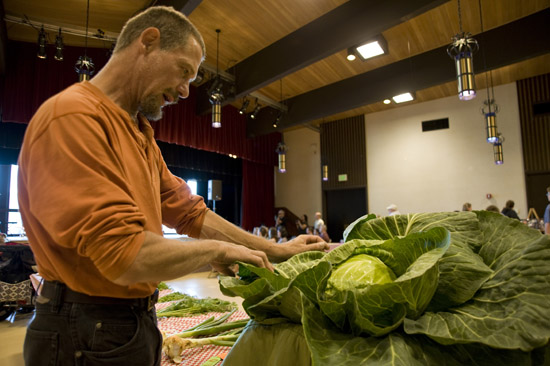
• Daily Sitka Sentinel features Keith Nyitray with his winning cabbage from the Sitka ‘state’ Fair

BIG PRODUCE – Sitka gardener Keith Nyitray arranges the leaves on his 17-pound cabbage Sunday during the second annual Sitka “State” Fair at Harrigan Centennial Hall. The cabbage earned a blue ribbon at the fair, which had categories for vegetables, jams, hobbies, crafts, photography and spam hors d’oeuvres, among others. The event included music by the SitNiks and performances by Celtic dancers. (Daily Sitka Sentinel Photo by James Poulson)

BIG PRODUCE – Sitka gardener Keith Nyitray arranges the leaves on his 17-pound cabbage Sunday during the second annual Sitka “State” Fair at Harrigan Centennial Hall. The cabbage earned a blue ribbon at the fair, which had categories for vegetables, jams, hobbies, crafts, photography and Spam hors d’oeuvres, among others. The event included music by the SitNiks and performances by Celtic dancers. (Daily Sitka Sentinel Photo by James Poulson)

The Monday, Aug. 12, 2013, edition of the Daily Sitka Sentinel included a photo of local gardener Keith Nyitray with his winning cabbage from the Sitka “state” Fair held Sunday, Aug. 11, at Harrigan Centennial Hall.

The second annual Sitka “state” Fair was hosted by the Greater Sitka Arts Council. More details about the event and some of its contests can be found here.

• KCAW-Raven Radio reports on how Sitka residents can double down on EBT benefits at the Sitka Farmers Market

Mira Vale staffs the EBT Quest Card table at the Aug. 3, 2013, Sitka Farmers Market

Mira Vale staffs the Alaska Quest Card/EBT benefits table at the Aug. 3, 2013, Sitka Farmers Market

The Friday, Aug. 9, 2013, newscast on KCAW-Raven Radio featured a story about how Sitka residents on food stamps can double their Alaska Quest Card/EBT benefits at the Sitka Farmers Market.

The Alaska Quest Card is an EBT, or Electronic Benefits Transfer, program that helps people on food stamps pay for food at local grocery stores. Their monthly EBT benefits are loaded onto their Alaska Quest Card, and an amount is deducted from the card each time they buy food.

Starting last year, the Sitka Farmers Market joined several Alaska farmers markets in accepting Alaska Quest Cards/EBT benefits, and this year the number of markets accepting EBT has grown to 11 markets in Alaska. Since many farmers market vendors aren’t set up to accept charge cards, people on EBT benefits can use their cards to buy tokens (wooden nickels) at a booth at the Sitka Farmers Market, and they then can use the tokens to purchase fresh food from participating vendors.

The Alaska Quest Card/EBT booth also sells a second type of token that people not on EBT benefits can use to purchase food and other items (including arts and crafts) from participating vendors. This second token allows vendors who aren’t set up for credit/debit cards to still make sales.

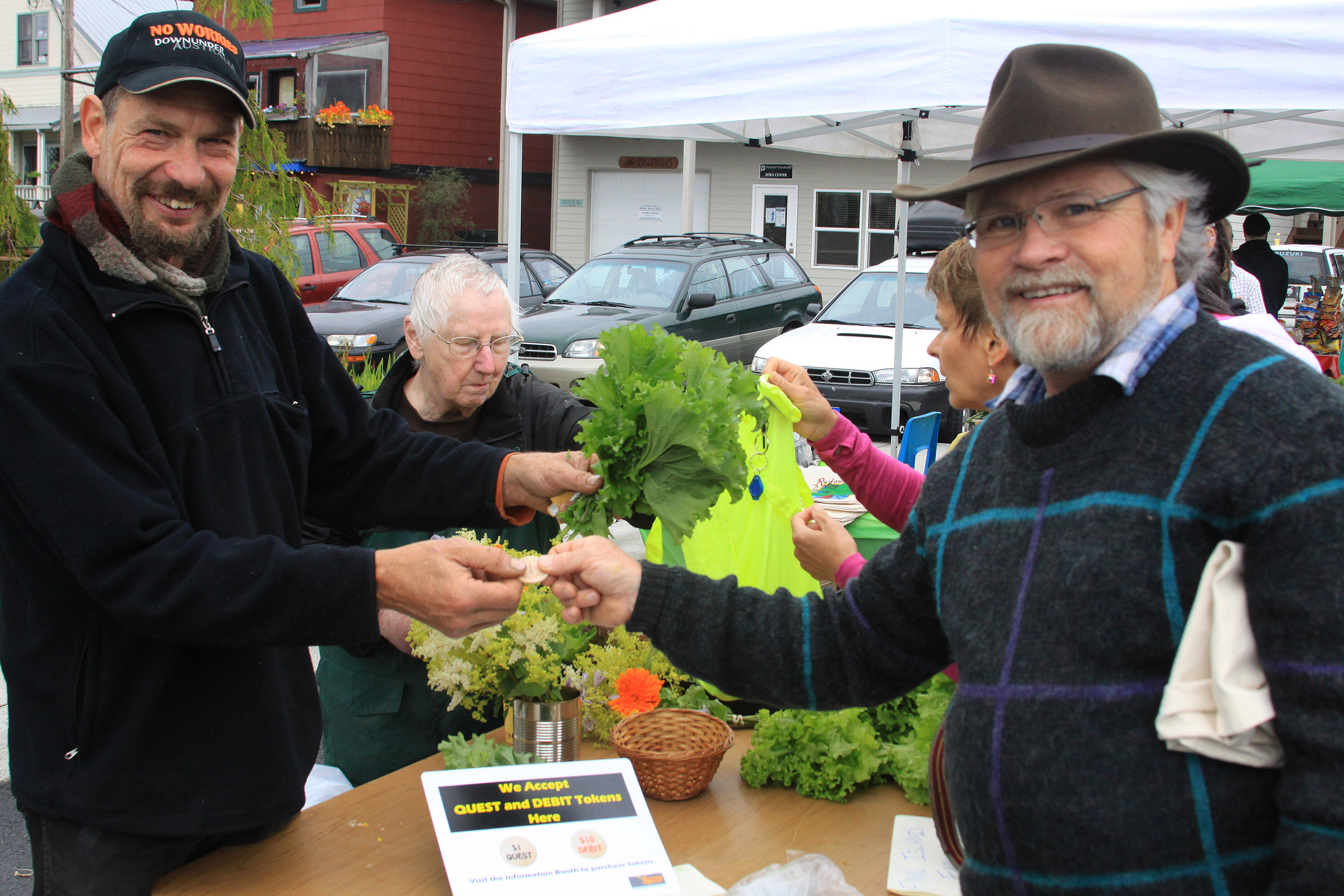
Kerry MacLane uses a token to purchase produce from Sitka Farmers Market vendor Keith Nyitray during the Aug. 3, 2013, Sitka Farmers Market.

Kerry MacLane uses a token to purchase produce from Sitka Farmers Market vendor Keith Nyitray during the Aug. 3, 2013, Sitka Farmers Market.

The KCAW story focused on Sitka resident Stacie Joseph, who uses EBT benefits to help pay for her food for her four kids while she attends school. Because of a grant from the state, various Alaska farmers markets are able to provide double the benefits for people using EBT benefits. For example, if someone wants to use $20 of their EBT benefits, they’ll receive $40 worth of tokens. Joseph said the doubled benefits mean that in addition to providing healthy fresh produce for her family, she can have more money available to use on her health management classes at the University of Alaska Southeast-Sitka Campus, helping her improve her earning potential.

“This program improves access to fresh, local foods to community members who are struggling financially.  Additionally, the program helps increase understanding of food insecurity issues in our community and how produce and other food vendors can be part of the solution,” said Lisa Sadlier-Hart, president of the Sitka Local Foods Network board of directors, which hosts the Sitka Farmers Markets.

• Pledge to spend at least $10 at the Sitka Farmers Market as part of the ‘I Love My Farmers Market’ celebration

LoveMyFarmersMarketApples

SaveFamilyFarmersInfoChartHow well do you love the Sitka Farmers Market? You can show your love by clicking this link and pledging to spend at least $10 at the next Sitka Farmers Market as part of the “I Love My Farmers Market” celebration sponsored by the American Farmland Trust.

According to the American Farmland Trus:

AFT’s I Love My Farmers Market Celebration is raising national awareness about local farmers markets and putting money directly in the pockets of family farmers.

Throughout the celebration, consumers will pledge dollars they intend to spend at their local farmers markets. A pledge is a commitment to spend $10 at your farmers market. Pledges can be cast once a day, and farmers market shoppers can pledge to support more than one farmers market.

Each week, one lucky participant and their favorite farmer will receive a free No Farms No Food® hat.

The Top 100 most celebrated markets will receive a special logo honoring their achievement, “No Farms, No Food”® gear, and recognition on the Celebration’s website, www.lovemyfarmersmarkets.org/.

The 2013 celebration started on May 28 and will end at midnight EST on Sept. 9.

The Farmers Market Coalition, which provides technical resources for farmers markets and sponsors National Farmers Market Week on Aug. 4-10, recently released a report about the benefits of farmers markets. Some of the findings included:

  • There were more than 7,800 farmers markets in the US in 2012—an increase of nearly 10% in just one year.
  • For every $100 spent at a farmers market, $62 stays in the local economy, and $99 stays in-state.
  • People who shop at farmers markets have 15-20 social interactions per visit, while they would only have one or two at the grocery store.

SitkaFarmersMarketSignThere will be six Sitka Farmers Markets this year. The first one took place on Saturday, July 6, and the next Sitka Farmers Market is from 10 a.m. to 1 p.m. on Saturday, July 20, at the Alaska Native Brotherhood Founders Hall (235 Katlian St.). The other Sitka Farmers Markets will be on Saturdays, Aug. 3, 17, 31, and Sept. 14.

• Buying local food during a Southeast Alaska summer

Sitka Local Foods Network Board Vice President Cathy Lieser distributes "Alaska Grown" bumper stickers during the July Fourth parade in Sitka (Photo by Heike Hüttenkofer)

Sitka Local Foods Network Board Vice President Cathy Lieser distributes “Alaska Grown” bumper stickers during the July Fourth parade in Sitka (Photo by Heike Hüttenkofer)

By CATHY LIESER
Sitka Local Foods Network Board Vice President

I am cooking on a boat throughout Southeast Alaska this summer, so on May 5, I planted seeds in my garden, covered it with bird netting and wished it well until my return. The text from my friend read, “the weeds are winning,” luckily I have an herb garden on the boat.

I have been on the hunt for local food in the towns where we provision. It was a late spring, so early on I watched plots greening up and took mental notes. There was kale and rhubarb in Tenakee, with one grower who sells on Friday — The Party Time Bakery — which uses local produce for delicious meals. We bought a rhubarb-berry pie fresh out of the oven and took it back to the boat.

In Juneau, we stocked up at Pinkies Fish Market where the mission is to create a local food economy by sourcing local seafood and other farm fresh items. I toured the Jensen-Olson Arboretum (click here for Facebook page) with Merrill Jensen while he shared about their process toward having a certified virus-free Tlingít potato. The Wild Oven sourdough bakery found me sampling chewy and flavorful loaves that I found out got better with age. At the Second Saturday Market, I bought greenhouse-fresh basil picked that morning.

I barely missed the first Sitka Farmers Market on July 6, but did raid my garden for spinach, kale, lettuce, corn salad and miner’s lettuce. I thank those who watered for me during the hot month of June. Our next boat destination was Petersburg, where I finally arrived on a day where two growers were selling.

The Garden, which participates in the Alaska Grown program, is an abundant oasis of organic produce in the middle of town. Tonna Parker has turned a family lot into a production powerhouse using French intensive methods. For the last four years she has sold direct to the community, just stop by on a Tuesday or Saturday to see what she has available. I bought cucumbers and snap peas that did not make it home, I snacked while Tonna gave me a tour. She has beautiful raised beds, chickens, ducks and compact greenhouses where she is able to grow an astounding variety. Winter squash, pumpkins, tomatoes, cucumbers, zucchini, bok choi, kale, corn salad, arugula, carrots, beans, peas, berries, eggs, the abundance went on and on.

I was incredibly inspired by her approach toward finding varieties that thrive in her micro climate, ones that are tough and aggressive growers. She trials open-pollinated varieties and saves her own seed for many of her plantings. Freely sharing her knowledge, Tonna said she would happily work herself out of a job, she just wants folks to grow local and reap the benefits.

Farragut Farm makes the trip into Petersburg by boat to sell direct twice a month. Marja Smets and Bo Varsano had beautiful, tender and sweet produce for sale. Radishes nearly the size of golf balls, collards, kale, chard, green onions, carrots, garlic scapes, edible flowers, pea shoots, peas, Napa cabbage, turnips, beets, and lettuce. Wow, to have root crops and full-sized heads of Romaine lettuce and cabbage this early on is a testament to dedicated growing. I had heard that Farragut sells to charter boats and indeed I can place an order via email to be picked up one hour on either side of the high tide in Farragut Bay. They will row and deliver to the boat.

If you love fresh flowers, Craig Olson and Deb Hurley of the Flower Farm run a flower CSA.  For a $100 subscription they deliver six bouquets a summer.  Stunning dahlia, snapdragon, campanula, linaria, veronica, delphinum, and ageratum to name a few.  They grow in three hoophouses and three heated greenhouses that were funded with a $20,000 grant from the Petersburg Development Fund. Planting starts on Jan. 9, and 60 percent of their sales are in veggie and flower bedding plants.

Inga’s Galley (click here for Facebook page) is the Petersburg reinvention of Sitka’s late-but-beloved Two Chicks on a Kabob Stick food cart. Amyee Peeler (one of the Two Chicks from Sitka) sources local produce whenever she can, and of course all of the seafood is local.

Unfortunately, the The Market In Petersburg was not happening on the Friday while I was in town, but I hope to hit it on July 19.

I’ll keep looking over the next two months wherever we dock, I am heartened to see folks committed to growing and sourcing the best food in Southeast. If you know of anyone that I’ve missed leave me a note at sitkalocalfoodsnetwork@gmail.com (put “Attention Cathy” in the subject line).

This slideshow requires JavaScript.

• Gov. Parnell signs executive order creating the Alaska Food Resource Working Group

AlaskaFoodPolicyCouncilLogoThe following is a note sent to members of the Alaska Food Policy Council listserv by Diane Peck, MPH, RD, a public health nutritionist with the Alaska Department of Health and Social Services Obesity Prevention and Control Program. Diane also is one of the lead contacts for the Alaska Food Policy Council.

Last Friday (June 28, 2013), at the Palmer Farmers Market, Gov. Sean Parnell signed Administrative Order No. 265 (http://gov.state.ak.us/admin-orders/265.html) to establish the Alaska Food Resource Working Group (AFRWG) to recommend policies and measures to increase the purchase and consumption of local wild seafood and farm products. This is a bit different than HCR 01. The AFRWG is composed of eight state agency commissioners or their designee. “The AFRWG shall collaborate with the Alaska Food Policy Council . . . and shall invite a member of the AFPC governing board to represent the AFPC at scheduled meetings.”

The goals of the group are:

  • Develop a mission statement that promotes increased use of locally grown and harvested foods within state and local agencies, institutions, and schools;
  • Identify factors that might discourage or prevent locally harvested and produced food from being purchased by federal, state and local agencies, institutions, and schools;
  • Review existing or proposed programs, policies, statutes, and regulations that impact the state’s food system and recommend to policymakers methods to improve coordination and implementation;
  • Identify research needed to support and encourage increased consumption and production of local foods within the state; and
  • Engage with the public to seek additional input on ways to promote the above-listed goals.

Lots of legislators and several commissioners were at the signing.  The governor said this elevates the group to “sub-cabinet” status.

To learn more about the Alaska Food Policy Council, go to its website or like its Facebook page. Sitka Local Foods Network board president Lisa Sadleir-Hart represents Sitka on the Alaska Food Policy Council.

• Alaska Food Policy Council press release about the executive order

• Sitka Farmers Market among 11 farmers markets accepting Alaska Quest Cards

(The following is from a press release from the Alaska Department of Natural Resources Division of Agriculture)

EBTattheFarmersMarketPALMER, Alaska – Eleven farmers markets throughout Alaska, including the Sitka Farmers Market, are now accepting Quest Cards, enhancing the state’s efforts to make healthy, locally-grown food available to Alaska households. Six markets (including Sitka) accepted the cards in 2012, and two markets accepted them in 2011, according to the Division of Agriculture.

The Alaska Quest Card is used by households qualified through the Alaska Food Stamp Program to purchase food from farmers markets and grocery stores.

“This program improves access to fresh, local foods to community members who are struggling financially.  Additionally, the program helps increase understanding of food insecurity issues in our community and how produce and other food vendors can be part of the solution,” said Lisa Sadlier-Hart, manager of the Sitka Farmers Market (Editor’s note: A correction, Sadleir-Hart is president of the Sitka Local Foods Network board of directors, which hosts the Sitka Farmers Markets; Bridget Kauffman is the market manager).

Quest cards are accepted in the following locations:

Anchorage

  • Spenard Farmers Market; the Anchorage Farmers Market; and the South Anchorage Farmers Markets (Saturday and Wednesday)

Kenai Peninsula

  • Anchor Point Saturday Farmers Market & Swap Meet, and the Homer Farmers Market

Western Alaska

  • The Bethel Farm Stand and the Dillingham Farmers Market

Fairbanks

  • Downtown Fairbanks Market and Calypso School Garden Farm Stands

Southeast Alaska

  • Sitka Farmers Market

These markets will also host Match Days, when Quest card holders can get twice the amount of fresh, local food for the first $20 spent with their cards.   Match Days are listed below:

Anchorage and Kenai Peninsula

  • First market of the month (markets happening twice a week will have matching both days);

Western Alaska, Fairbanks and Southeast Alaska

  • Throughout the summer until funds run out.

Check the Alaska Division of Agriculture website at http://www.dnr.alaska.gov/ag/ag_FMI.htm for more information on Alaska’s farmers markets, including those that accept Quest Cards.  For more information on the Alaska Quest Card, go to http://www.akquest.alaska.gov.

See you at the market, where it’s Closer. Fresher. Better.

• Deadline extended on Sitka Community Food Assessment to get more completed surveys

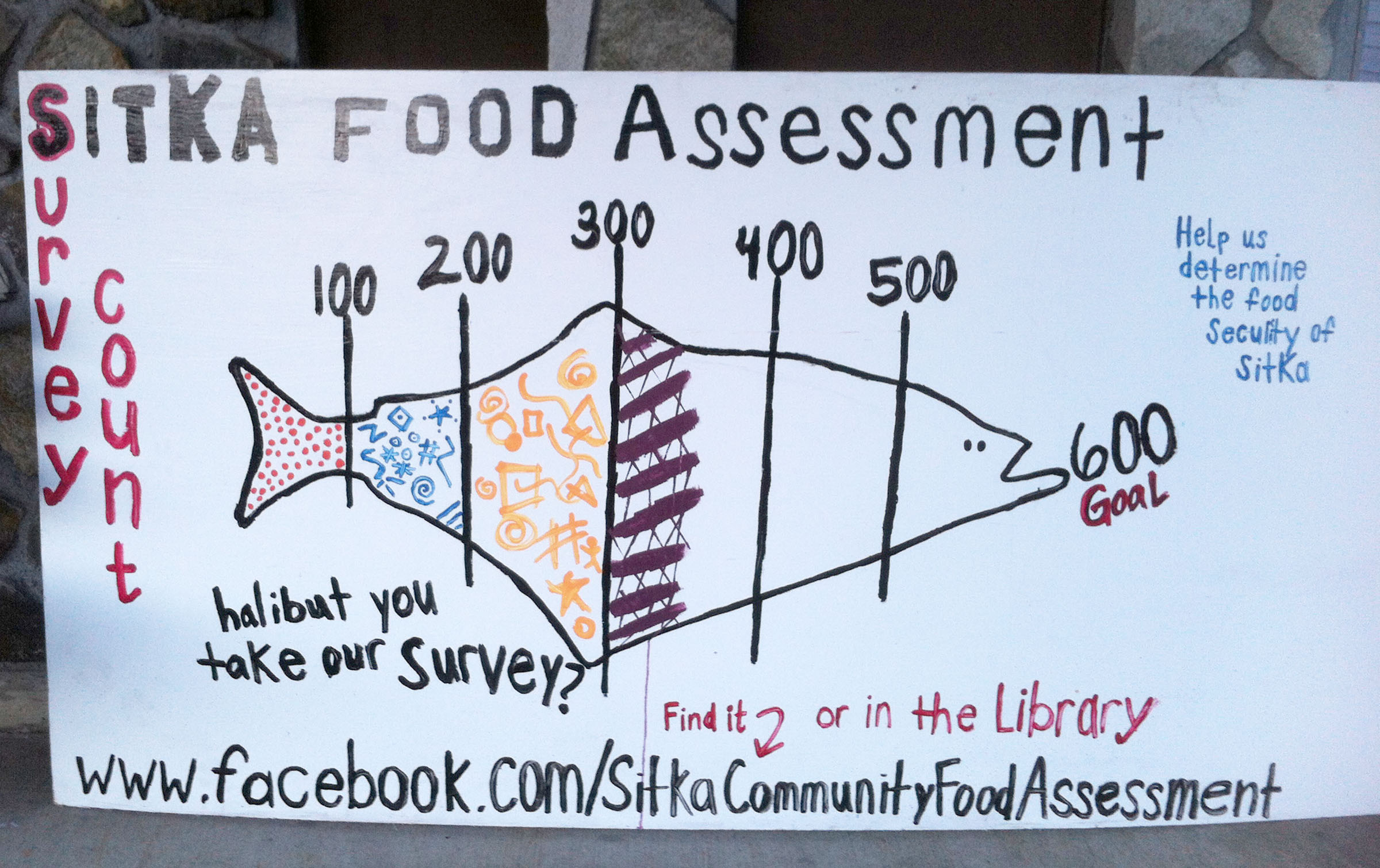
SitkaCommunityFoodAssessmentSign2

The deadline for surveys to be completed in the Sitka Community Food Assessment has been extended to the end of the month. Our goal is 600 completed surveys and as of Tuesday, May 21, we had 392 that had been recorded.

The Sitka Community Food Assessment is a 2012 Sitka Health Summit project designed to help shape food policy and improve Sitka’s food security. To learn more about the project, KCAW-Raven Radio hosted an interview with project coordinator Lisa Sadleir-Hart that aired on Monday, May 20.

Additional information can be found in this March 26 post on the Sitka Local Foods Network website, and in this April 9 article from the Daily Sitka Sentinel.

Surveys are available online at https://www.surveymonkey.com/s/MQTF22Q, or click the Sitka Community Food Assessment logo in the right column of this webpage. Printed copies are available at Kettleson Memorial Library. A sign has been posted at the corner of Lincoln and Lake streets to update people on the progress of the project.