• Sitka Fruit Tree Initiative to meet on Monday, Dec. 13

Apples are still on the tree in front of a house on Sawmill Creek Road in early December 2010.

Apples are still on the tree in front of a house on Sawmill Creek Road in early December 2010.

Folks working on the Sitka Fruit Tree Initiative will meet at 7 p.m. on Monday, Dec. 13, at Harrigan Centennial Hall.

The Sitka Fruit Tree Initiative hopes to plant 200 apple, crabapple or cherry trees in Sitka before the next Sitka Health Summit on Sept. 30-Oct. 1, 2011. The group just turned in an order of 40 “project” apple trees — 30 Williams Pride and 10 Pristine — with Garden Ventures. Penny Brown, owner of Garden Ventures, also has an order of 60 fruit trees coming for her regular supply.

In the meantime, the Sitka Fruit Tree Initiative continues to host fundraising events where Sitka residents can buy shares of fruit trees for $100 (full), $50 (half) or $25 (quarter). They also can buy shares in fruit-producing berry bushes ($25). The fruit tree shares make nice alternative gifts this holiday season, and purchasers receive a certificate to place under the Christmas tree. To learn more, contact Lisa Sadleir-Hart of the Sitka Local Foods Network at 747-5985. The gift information brochure is posted below as a PDF file.

• Sitka Fruit Tree Project gift information brochure

• UAF Cooperative Extension Service conducts Southeast Alaska Food Security Survey

A display shows the typical mileages food needs to travel to get to Sitka stores. The mileages are for several vegetables that are easy to grow right here in Sitka.

A display shows the typical mileages food needs to travel to get to Sitka stores. The mileages are for several vegetables that are easy to grow right here in Sitka.

Bob Gorman, the Sitka-based Natural Resource and Community Development faculty member for the University of Alaska Fairbanks Cooperative Extension Service, sent this e-mail out last week to local food people, health professionals and others interested in food security issues.

Please feel free to send this survey request around to other Southeast residents so they can complete it, too.

Subject: Southeast Alaska Food Security Survey

Dear Southeasterners,

Does everyone in your community have access to good, healthy food?  Will this always be true?  Do you have questions or concerns about your personal or community’s food security?

Southeast extension agents of the University of Alaska Fairbanks Cooperative Extension Service (CES) and Marine Advisory Program (MAP) are looking to engage university resources in addressing research based questions about Southeast Alaska’s food security situation.  Before CES and MAP can initiate this work, we need to determine if there is a real need and interest.

Please take a moment to fill out the online survey at http://www.surveymonkey.com/s/foodsecurity

If you have any questions about filling out the survey or need a hard copy sent to you, please call Linda Watson at 796-6221 or email ljwatson@alaska.edu.

If you know others interested in this issue and would care to forward this email, it appreciated.  We will wrap up this survey by the end of December, so please don’t delay.

Thank you for helping on this effort.

• Sitka Fruit Tree Planting Work Group to sell shares of fruit trees at SCAPS Christmas Bazaar

Crabapples growing on a tree

Crabapples growing on a tree

The Sitka Fruit Tree Planting Work Group will host a booth to sell fruit tree shares at the Sitka Counseling And Prevention Services (SCAPS) Christmas Bazaar from 9 a.m. to 3 p.m. on Saturday, Nov. 27, at Harrigan Centennial Hall.

The work group will be selling shares in fruit trees, which is a fundraiser to get the money the group needs to purchase the 200 apple, crabapple and cherry trees it plans to plant in Sitka before the next Sitka Health Summit (Sept. 30-Oct. 1, 2011). The tree shares will be sold as quarter shares ($25), half shares ($50) and full shares ($100). People also can buy a share in fruit-bearing bushes ($25 each). This is one of four community health priority projects decided at the 2010 Sitka Health Summit on Oct. 4-5, 2010.

People who buy shares in the fruit trees will receive a gift certificate that can be given as an alternate present this holiday season. The trees will be planted around town this spring, with the idea that not only will the fruit trees beautify Sitka but they also will provide people with a tasty treat as they walk by. Once the trees are planted and start bearing fruit, a portion of the fruit will be donated to local organizations that provide free or reduced-cost meals to people in need.

For more information, contact Lisa Sadleir-Hart of the Sitka Local Foods Network at 747-5985. For those who can’t attend Saturday’s bazaar, the PDF file posted below has information on how to order tree shares.

• Sitka Fruit Tree Project gift information brochure

• Sitka Health Summit project to get more fish in school lunches to start pilot study

From left, Lexi Fish, Linda Wilson and Kerry MacLane serve up fish tacos at Pacific High recently. At right are Sitka School Board President Lon Garrison and Superintendent Steve Bradshaw. The Sitka School District is considering adding locally caught fish to the school lunch program. (Daily Sitka Sentinel photo by James Poulson)

From left, Lexi Fish, Linda Wilson and Kerry MacLane serve up fish tacos at Pacific High recently. At right are Sitka School Board President Lon Garrison and Superintendent Steve Bradshaw. The Sitka School District is considering adding locally caught fish to the school lunch program. (Daily Sitka Sentinel photo by James Poulson)

Members of the Sitka Health Summit group trying to get more locally caught wild fish served in school lunches met with Sitka school officials Friday, Nov. 19, over a meal of fish tacos and agreed to a pilot study to see how many students will choose fish for lunch.

The project is one of four community health priorities/goals to come out of the 2010 Sitka Health Summit this October. Community members want to have more locally caught wild fish served in school lunches because the food is healthier than the usual school-lunch fare, especially with the Omega 3 fatty acids found in most finfish. Also, by using local fish will help the local commercial fishing industry and there is less of an environmental impact because there are fewer transportation miles used to get the food to Sitka.

On Friday, Nov. 19, members of the project task force — called FISH!, or Fish In Schools, Hooray! — met with Sitka School District Superintendent Steve Bradshaw and other school officials, including NANA Management Services, which has the food service contract for the school district. Representatives from several of Sitka’s fish processors and commercial fishing organizations also attended the fish taco lunch at the Southeast Alaska Career Center (located behind Pacific High School). One of the key issues is trying to find reasonably priced fish that doesn’t exceed the school district’s budget for protein.

During the meeting, the school district and FISH! decided to run a pilot project at Blatchley Middle School starting in January and running through the end of the school year. During the test program, fresh fish (starting with Pacific cod) will be served once a month as one of the four options available to students. If enough of the students select the fish, then the project will spread to all schools next year. The task force will promote the fish through the school newspaper, school newsletter and other local media. The task force will sponsor the cost difference during the first month of the project, with other groups picking up the cost difference in following months.

In addition to the Sitka School District, the task force also is working with Pacific High School (which creates its own menus separate from the district), Mt. Edgecumbe High School (which is run by the Alaska Department of Education and Early Development) and the Sitka Pioneer Home to get more locally caught wild fish into their menus.

(EDITOR’s NOTE: The Wednesday, Nov. 24, 2010, edition of the Daily Sitka Sentinel included a story about the project. The story is posted below as a PDF file, since the Sentinel’s site requires a password.)

• Daily Sitka Sentinel article from Nov. 24, 2010 — Schools Hope to Hook Students on Fish

• Sitka Conservation Society hosts wild foods potluck and annual meeting on Saturday, Nov. 13

The Sitka Conservation Society, which helps sponsor the Sitka Local Foods Network, is hosting its community wild foods potluck and annual meeting from 5-8 p.m. on Saturday, Nov. 13, at Harrigan Centennial Hall.

This annual event gives Sitka residents a chance to share meals made with locally foraged food, from fish and wild game to seaweed, berries and other traditional subsistence foods. Doors open at 5 p.m., with food service starting at 5:30 p.m. Families are asked to bring in dishes that feature local wild foods, and if you can’t bring in a dish that features wild foods you can use a wild plant to garnish a dish made with store-bought foods. Local cooks can enter their dishes in a wild foods contest, too. The event also features live music from the SitNiks and a short presentation on the Tongass Wilderness. There also will be booths about local programs and projects before food is served.

This event kicks off the Sitka Conservation Society’s “Wild Week,” which features events from Nov. 13-20. Another local foods-oriented event is the “Eat Wild” benefit dinner that takes place on Wednesday, Nov. 17, at the New Bayview Restaurant and Wine Bar. Hors d’oeurves start at 6 p.m., with dinner at 7 p.m. Bayview chef Josh Peavey will prepare the meal, which also includes a sampling of locally produced beer from Baranof Island Brewing Company. Tickets for this special event are $60 each and available from Old Harbor Books and the Sitka Conservation Society.

• Two FDA committees hear testimony about genetically modified salmon

Size comparison of an AquAdvantage® Salmon (background) vs. a non-transgenic Atlantic salmon sibling (foreground) of the same age. (CREDIT AquaBounty)

Size comparison of an AquAdvantage® Salmon (background) vs. a non-transgenic Atlantic salmon sibling (foreground) of the same age. (CREDIT AquaBounty)

This week, two different U.S. Food and Drug Administration committees have been taking testimony about the future of genetically modified salmon. On Monday, one committee — the FDA’s Center for Veterinary Medicine — heard testimony about whether genetically modified salmon is safe to eat and if it should be approved. Tuesday, the other committee — the FDA’s Center for Food Safety and Applied Nutrition — heard testimony about whether or not genetically modified salmon should have special labeling.

The issue is over a genetically modified Atlantic salmon produced by the Massachusetts firm AquaBounty Technologies, known as AquAdvantage®. The AquAdvantage® fish not only includes a growth gene from a chinook salmon, which makes it reach market size in 16-18 months instead of the usual three years, plus there is a gene from an eel-like fish known as an ocean pout. According to AquaBounty, all of the commercialized fish will be female and sterile, and the fish are designed to be raised in fresh-water pens or tanks on land instead of the usual salt-water pens where most farmed Atlantic salmon are raised.

Many in the biotech, food and other industries are pushing for the FDA to quickly approve the commercial production of this fish. But some consumer groups, food safety experts and others want the FDA to slow or end the approval process until more is known about the fish.

On Tuesday’s Alaska News Nightly show, the Alaska Public Radio Network reported that it may be some time before genetically modified salmon reach the market. However, the Los Angeles Times reported that the FDA seemed to give preliminary approval to the fish’s safety and the main issue was who is responsible for telling the consumer the fish has been genetically altered.

AquAdvantage salmon eggs are grown in incubator jars in a laboratory. (CREDIT AquaBounty)

AquAdvantage salmon eggs are grown in incubator jars in a laboratory. (CREDIT AquaBounty)

The idea of a genetically modified Atlantic salmon is of special concern to Alaska’s fishermen. Many fish farms in British Columbia raise Atlantic salmon, and there have been times when Atlantic salmon have escaped from the fish farm pens and mixed with wild Pacific salmon, including in Alaska. The Alaska Department of Fish and Game considers Atlantic salmon an invasive species, and already requests fishermen turn any Atlantic salmon caught in Alaska in to the nearest ADF&G office without being cleaned. According to ADF&G, there are concerns that Atlantic salmon might bring diseases to the five species of Pacific salmon and compete for food.

In addition to more recent cases of diseases among farmed fish and a high use of antibiotics, farmed Atlantic salmon also harmed the markets for Alaska fishermen trying to sell wild salmon (fish farming is banned in Alaska), and prices for Alaska fish dropped substantially when fish farms became more popular in the late 1980s and early 1990s. It’s only been in recent years that Alaska fishermen have started to regain some of their lost market share.

Sitka Conservation Society intern Molly Andrews has been keeping a blog this summer on the genetically modified salmon issue and what the fish could mean to Sitka. Molly’s blog has links to several stories about genetically modified salmon (recently called “Frankenfish” by U.S. Sen. Mark Begich, D-Alaska). The blog also has contact information if people want to contact the FDA or other officials to make comments about genetically modified salmon.

• Bridget Kauffman wins Table of the Day Award for her baked goods during fourth Sitka Farmers Market of the summer

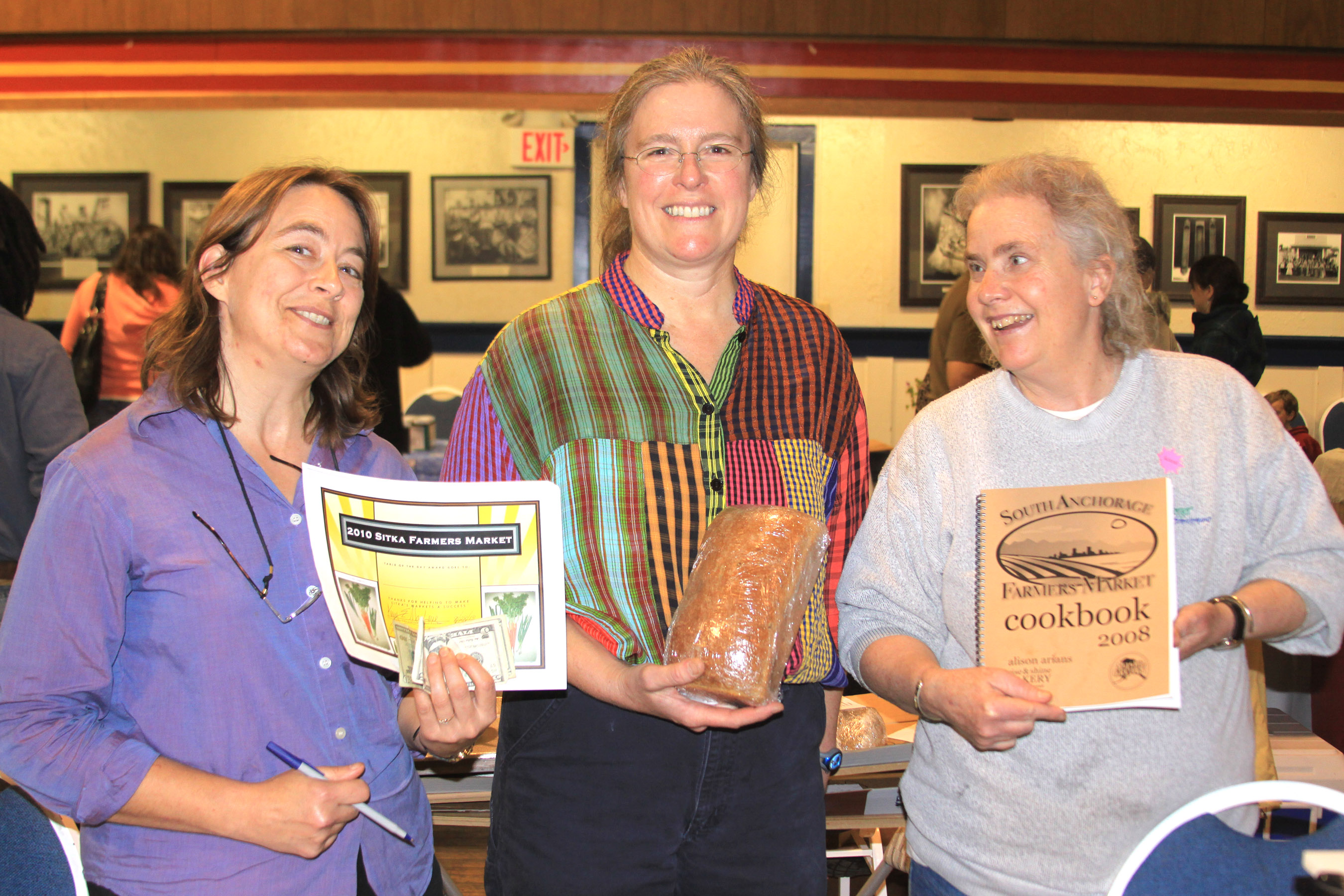
Sitka Local Foods Network board members Linda Wilson, left, and Lynnda Strong, right, present home baker Bridget Kauffman with the Table of the Day Award for the fourth Sitka Farmers Market of the summer on Aug. 28, 2010.

Sitka Local Foods Network board members Linda Wilson, left, and Lynnda Strong, right, present home baker Bridget Kauffman with the Table of the Day Award for the fourth Sitka Farmers Market of the summer on Aug. 28, 2010.

Bridget Kauffman won the Table of the Day award at the fourth Sitka Farmers Market of the summer on Saturday, Aug. 28, at Alaska Native Brotherhood Hall.

The local home baker was presented with a certificate, $25 cash and a farmers market cookbook by Sitka Local Foods Network board secretary/treasurer Linda Wilson and board member Lynnda Strong. Bridget has been at every market this year, one of many new bakers who have signed up to be vendors at the markets. Bridget bakes a variety of breads, from whole wheat and rye to specialty breads with nuts, seeds and other flavors. She made 40 loaves to sell at the first market, and sold out of them before the first hour was over. She has doubled her production, and still sells out before the market ends.

One vendor at each of the five scheduled Sitka Farmers Markets this season will receive a similar prize. The last big market of the summer is from 10 a.m. to 2 p.m. on Saturday, Sept. 11, at historic ANB Hall. We look forward to seeing you there.

Also, don’t forget the 16th annual Running of the Boots fundraiser for the Sitka Local Foods Network takes place at 11 a.m. (registration opens at 10 a.m.) on Saturday, Sept. 25, as part of the third annual Summer’s End Celebration hosted by the Greater Sitka Chamber of Commerce and the Alaska Cruise Association. This fun run for people sporting XtraTufs rubber boots features a run from the Crescent Harbor shelter through downtown Sitka and around St. Michael’s Russian Orthodox Cathedral. There usually are one or two small tables with late produce, but not as many vendors as a regular market. More details on the Running of the Boots will be available later this month.

A slideshow of photos from the fourth Sitka Farmers Market is posted below, and a similar slideshow can be found on our Shutterfly site.

This slideshow requires JavaScript.

• Sitka-based film, ‘Eating Alaska,’ goes international for screenings, national for PBS premieres

“Eating Alaska,” a film by Sitka filmmaker Ellen Frankenstein about local food and how Alaskans make their food choices, is going international with screenings in Poland, Croatia, Scotland and Canada in the next two months. The film also will be making its PBS premiere with broadcasts on various public television stations around the country during September, including two in Alaska (one with a live Skype interview).

The international screenings will be highlighted when Frankenstein and associate producer Valerie Lipinski attend the Kuchnia TV Food Film Festival and National Broadcast Sept. 30-Oct. 9 in Warsaw, Poland.

The film also will be shown (without the filmmaker in attendance) Sept. 16-19 at KinoOkus (Cinetaste), which is Croatia’s first gastronomic film festival that will focus on food education, environmental protection and sustainable development. Eating Alaska will be shown on Sept. 30 as part of the Reel Food Film Festival sponsored by the Ottawa Main Public Library in Ottawa, Ontario, Canada. During September and October, “Eating Alaska” will be shown as part of the Cineco Environmental Film Festival sponsored by the University of Edinburgh, Scotland.

In addition to the international showings, “Eating Alaska” will be shown for two live audiences in New York — on Oct. 5 as part of the Meet the Filmmaker Series at the Hewlett/Woodmere Public Library (Nassau) and on Oct. 6 at the Port Washington Public Library. “Eating Alaska” also will be shown a little bit closer to home, on Nov. 5-7 in Fairbanks, at the Far North Conservation Film Festival for those people looking for a live screening in Alaska.

While it won’t be broadcast nationally, “Eating Alaska” will make several premieres on local public broadcasting TV stations around the country during the month of September (click here for full schedule). The film will be aired in Houston, Texas; Evansville, Ind.; Austin, Minn.; Broomfield, Colo.; Charleston, Columbia, Spartanburg, Allendale, Beaufort, Florence, Sumter, Greenwood, Conway, Greenville and Rock Hill, S.C.; Greenville, N.C.; Anchorage, Alaska (at 7 p.m. on Tuesday, Sept. 14, on KAKM Channel 7, featuring a live Skype online video interview with Ellen Frankenstein); Durham, N.H.; Keene, N.H.; Littleton, N.H.; Eureka, Calif.; Elmira, Syracuse and Utica, N.Y.; East Lansing, Mich.; Milwaukee, Wis.; and Fairbanks (KUAC), Bethel (KYUK), Juneau (KTOO) and other Southeast Alaska communities including Sitka (at 9 p.m. on Thursday, Sept. 30, and again at 3 a.m. on Friday, Oct. 1, on AlaskaOne).

• A reminder about Saturday’s Sitka Farmers Market and other items

Don’t forget, we have a Sitka Farmers Market from 10 a.m. to 2 p.m. on Saturday, Aug. 28, at ANB Hall (235 Katlian St.). We’re getting a little bit later in the summer, so hopefully we’ll have some root vegetables available this week, such as potatoes, carrots and turnips, that weren’t available earlier this summer.

Also, this is the last week to vote in the America’s Favorite Farmers Market contest. Voting closes at midnight (Eastern time, 8 p.m. Alaska time) on Tuesday, Aug. 31. Click the logo in the right column or click the link above and vote for the Sitka Farmers Market.

Finally, Saturday is the last day of the Alaska Grown Eat Local Challenge. This event runs from Aug. 22-28 and encourages Alaskans to eat meals made with local food. We live in an area with lots of salmon, halibut and other fish, plus people with gardens should have lots of greens, potatoes and other veggies in season right now, with lots of berries for dessert.

If you don’t have your own garden, there will be lots of local veggies and fish for sale at Saturday’s Sitka Farmers Market. Eating local food means the food is fresher, so it tastes better and it has more nutrients. Also by eating local food you eliminate thousands of miles of transportation costs bringing your food to your plate.

• Feedback provided during debriefing meeting for inaugural Sitka Seafood Festival

Here is a run-down of the Tuesday, Aug. 17, debriefing meeting for the Sitka Seafood Festival. The following notes were provided by Alicia Peavey, who chaired the steering committee that organized the festival.

Thank you to those of you who were able to make the debriefing meeting for SSF. It went fairly well, and we were able to discuss quite a few aspects that we liked, or want to change about next year. I will list the highlights below. The biggest topics discussed were our first
meeting for next year’s festival, and our celebration/party for all
volunteers for this year’s event.

The celebration will be held on Sunday, Aug. 29th (EDITOR’S NOTE: Event postponed to a time TBA). SSF will provide drinks and some food. The Rec is already reserved, so we are looking into the Fly In Fish Inn or Talon Lodge. If anyone else has ideas let me know, and I will let everyone know as soon as I hear.

The first committee meeting will be held at 7 p.m. on Monday, Oct. 4, at Harrigan Centennial Hall. We will discuss next year’s event, but a
large part of the meeting will be devoted to figuring out committee
chair positions. Everyone who is interested at all in helping next
year should TRY their hardest to make this meeting please.
Thanks again to everyone who helped this year, what a fantastic event!!!

  • Not enough food vendors during the Saturday event
  • The fishing community was not asked about a specific date (we did try to address this, and we were told they did not know when the closure would be, but we are sending out info to all the fishing community now for next year’s event, and if you know anyone please ask their opinion on a date)
  • We are leaning toward the first week in August again for 2 reasons: 1) there are no other large events going on at this time other than Coast Guard Day and 2) We can piggyback off the Haines fair again and fiscally this is the only way we will be able to pull larger name people up
  • Need to advertise/organize salmon canning class better, and have a sign-up so people aren’t filtering in and out
  • We played with the idea of paying the head organizer position, or possibly paying a couple positions…we will talk more about this during the first meeting in October
  • We discussed continuing to use Sitka Conservation Society as a non-profit umbrella or trying to form our own. I am checking if we can use SCS again in that this seems like the easiest choice for this next year.
  • We need a head of the culinary committee position (hopefully someone involved in the culinary profession, but not actively cooking during the summer so they have the time for the festival)
  • We need to have solid committee chair people for each committee
  • We also discussed the budget, which was amazing!!!! We did such a fantastic job for the first year…I attached this, but as of now, we grossed about $12,000. You can look through and see what were the best money makers: the banquet brought in the most money, followed by the passport event. NANDA didn’t bring in any money, but I have not stopped hearing people talking about how great they were and how it was such a highlight. We decided something like that was the point of
    our festival, to offer an affordable celebration for all to take part in. So, although this didn’t make money, we decided it was an important part of the festival.

Much more was discussed, but these were some of the main topics.
Hope to see everyone at the party…you all deserve a LARGE celebration!

• Sitka Seafood Festival budget for 2010 festival