The Sitka Community Food Assessment Indicators Report was released on Monday, and the findings will help guide future food system planning in Sitka.
A 2012 Sitka Health Summit project, the Sitka Community Food Assessment has examined where Sitka residents get their food, what types they eat, what they grow, what they hunt and fish for, where they shop, what type of access people have to healthy food, and other questions about Sitka’s food supply. The findings of the food assessment will help Sitka improve its food security.
After Sitka residents chose the Sitka Community Food Assessment as a project at the September 2012 Sitka Health Summit, the work group received a grant to hire a coordinator and contract with a data person. A revised version of a questionnaire from a similar project on the Kenai Peninsula was posted online, available at the library, and discussed in focus groups, with more than 400 residents answering the 36 questions. In November 2013, some of the initial data was presented at the Sitka Food Summit, where about 60 residents discussed the results and noted any further research that needed to be done. Since then, the work group, in partnership with The Island Institute and others, fine-tuned the data before writing and editing the indicators report.
“We hope the Sitka Community Food Assessment Indicators Report can guide future food system planning and plant seeds for innovative responses that will strengthen Sitka’s food landscape,” project coordinator Lisa Sadleir-Hart wrote in the 26-page document’s introduction. “The Sitka Community Food Assessment Indicators Report uncovers many weaknesses in our food system as well as some incredible assets that define Sitka’s food culture — a rich ecosystem filled with nutritious gems from the land and sea plus a generous spirit of sharing with our neighbors. Now that we’ve defined the current foodscape in Sitka, let’s work together to build a more resilient food system that can deeply nourish the entire community for generations to come.”
The Sitka Community Food Assessment Indicators Report opens with Sitka’s demographics and several Sitka food facts. It then features data about how many people in Sitka hunt, fish, gather, and/or grow their own food, as well as some barriers. Next is information about where people in Sitka shop for their food, followed by how many people in Sitka are on some form of food assistance. The report also includes information about food in the schools, and local food manufacturing.
The findings will be presented to the community during an upcoming meeting of the Sitka Assembly, and the report will be posted online here (see below) and on The Island Institute’s website.
(EDITOR’S NOTE: The following article first appeared on this site in April 2010. It is repeated because much of the information remains current and newsworthy.)
As you start to plan your garden for this spring and summer, don’t forget to Plant A Row For The Hungry. The Plant A Row For The Hungry program (also known as Plant A Row or PAR) is a national campaign by the Garden Writers Association of America that got its start in Alaska.
In the cold winter of 1994, Anchorage Daily News garden columnist and former Garden Writers Association of America President Jeff Lowenfels was returning to his hotel after a Washington, D.C., event when he was approached by a homeless person who asked for some money to buy food. Lowenfels said Washington, D.C., had signs saying, “Don’t give money to panhandlers,” so he shook his head and kept on walking. But the man’s reply, “I really am homeless and I really am hungry. You can come with me and watch me eat,” stayed with Lowenfels for the rest of his trip.
Jeff Lowenfels
The encounter continued to bother Lowenfels, even as he was flying back to Anchorage. During the flight, Lowenfels came up with an idea when he started writing his weekly garden column (the longest continuously running garden column in the country, with no missed weeks since it started on Nov. 13, 1976). He asked his readers to plant one extra row in their gardens to grow food to donate to Bean’s Café, an Anchorage soup kitchen. The idea took off.
When Anchorage hosted the Garden Writers Association of America convention in 1995, Lowenfels took the GWAA members to Bean’s Café to learn about the Plant A Row For Bean’s Café program. The Garden Writers Association of America liked the idea, and it became the national Plant A Row For The Hungry campaign (also known as Plant A Row or PAR). In 2002, the Garden Writers Association Foundation was created as a national 501(c)(3) nonprofit to manage the Plant A Row For The Hungry program.
“I am not surprised by the growth of PAR,” Lowenfels wrote in an e-mail to the Sitka Local Foods Network. “It is now in all 50 states and across Canada and there are thousands of variations of the original program — from prison gardens for the hungry to botanical gardens donating their produce from public display gardens. This is because gardeners always share information and extra food, so the idea was a natural.”
It took five years for the program to reach its first million pounds of donated food, but the second million only took two years and the next eight years saw a million pounds of donated food (or more) each year. Since 1995, more than 14 million pounds of food have been donated. Not only that, the program is getting ready to expand overseas to Australia, England and other countries with avid gardeners.
“We have supplied something in the vicinity of enough food for 50 million meals,” Lowenfels wrote in his e-mail. “Gardeners can solve this hunger problem without the government. And we don’t need a tea party to do it! Or chemicals, I might add, as author of a book on organic gardening (Teaming With Microbes, written with Wayne Lewis)!” (Lowenfels recently released a second book, Teaming With Nutrients, which is a follow-up to his first book).
According to the U.S. Department of Agriculture, one out of every eight U.S. households experiences hunger or the risk of hunger. Many people skip meals or eat too little, sometimes going an entire day or more without food. About 33 million Americans, including 13 million children, have substandard diets or must resort to seeking emergency food because they can’t always afford to buy the food they need. In recent years the demand for hunger assistance has increased 70 percent, and research shows that hundreds of children and adults are turned away from food banks each year because of lack of resources.
While many people credit Lowenfels for creating the Plant A Row For The Hungry program, Lowenfels says the real heroes are the gardeners growing the extra food and donating it to local soup kitchens, senior programs, schools, homeless shelters and neighbors. You can hear him pass along the credit to all gardeners at the end of this interview last year with an Oklahoma television station (video also embedded below).
“One row. That’s all it takes. No rules other than the food goes to the hungry. You pick the drop-off spot or just give it to a needy friend or neighbor. Nothing slips between the lip and the cup, I say,” Lowenfels wrote in his e-mail.
For people wanting to Plant A Row For The Hungry in Sitka, there are several places that would love to help distribute some fresh locally grown veggies or berries to those who are less fortunate, such as the Salvation Army, Sitkans Against Family Violence (SAFV), local churches, Sitka Tribe of Alaska and other organizations. The food the Sitka Local Foods Network grows at St. Peter’s Fellowship Farm communal garden goes to the Sitka Farmers Market.
The Sitka Local Foods Network also takes donations of local produce to sell at the Sitka Farmers Markets, and all proceeds are used to help pay for SLFN projects geared toward helping more people in Sitka grow and harvest local food. For more information, contact SLFN President Lisa Sadleir-Hart or one of the other board members at sitkalocalfoodsnetwork@gmail.com.
Gordon Wrobel will give a presentation at 1 p.m. on Saturday, April 12, in Room 106 (note room change from original post) at the University of Alaska Southeast Sitka Campus about gardening in Southeast Alaska, in particular in Elfin Cove where he is completing a three-year USDA project to improve local food systems.
Gordy will provide an overview of his project, including the challenges and opportunities (such as available land, soils, pests/diseases, climate/temperature, markets, and crop/seed selection). His project objectives and results included creating access to fresh produce in the rural Southeast Alaska community of Elfin Cove, evaluating the economic viability of a floating island garden, evaluating the strategies of a floating island, container, hoop garden and greenhouse, creating a composting program for the community of Elfin Cove, and evaluating the potential for a sustainable produce business in Elfin Cove. There will be a short question-and-answer session after his presentation.
For more information, contact Sitka Local Foods Network board members Michelle Putz at 747-2708 or Charles Bingham at 738-8875.
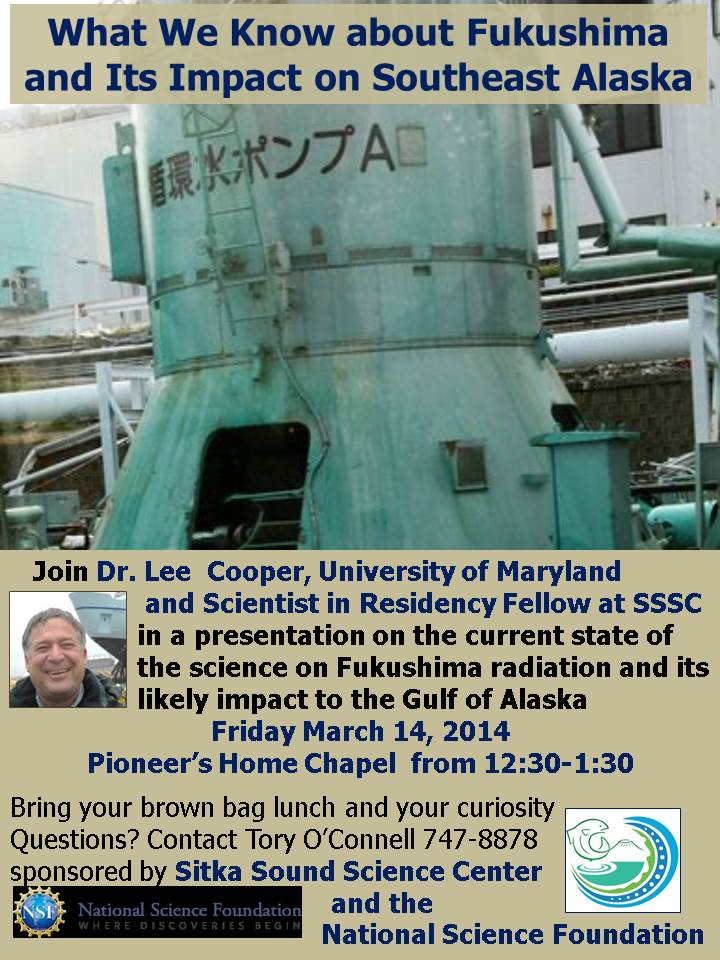
People living along the Pacific Coast, including in Sitka and Southeast Alaska, have been wondering about the impacts of radiation in the food supply ever since the March 2011 earthquake in Japan and Fukushima Dai-ichi nuclear power plant meltdown.
Dr. Lee Cooper of the University of Maryland, a Scientist in Residency Fellow at the Sitka Sound Science Center, will discuss the current state of the science on Fukushima radiation and its likely impact on the Gulf of Alaska during a brown-bag lunch presentation from 12:30-1:30 p.m. on Friday, March 14, at the Sitka Pioneer Home Chapel. Bring your lunch and questions to the presentation, which is sponsored by the Sitka Sound Science Center and the National Science Foundation.
According to the Sitka Sound Science Center:
It is projected that dissolved contaminants, particularly the radioactive isotopes of cesium, 137Cs and 134Cs from the Fukushima Dai-ichi Nuclear Power in Japan, will reach Southeast Alaska this year. Because the amount of radiation released is uncertain and the accident site is still leaking to some extent, it is difficult to know exactly what the peak concentrations of radioactive cesium will be in local waters, but it is not likely to exceed levels that were observed during the bomb fallout era 40 to 50 years ago. Cesium is chemically very similar to potassium, which is a common ionic salt in seawater, so fortunately the concentration of cesium into the foodweb and into seafood harvested for food is comparatively modest.
Nevertheless, it is important to put into perspective the potential risks involved and communicate this to the public. This talk will summarize the newest scientific information that is available on the impacts of the accident, based upon a special session held in late February at the Ocean Science Meeting in Honolulu and attended by scientists studying Fukushima impacts, ranging from Japan and East Asia to the Woods Hole Oceanographic Institution.
For more information, contact Tory O’Connell at 747-8878.
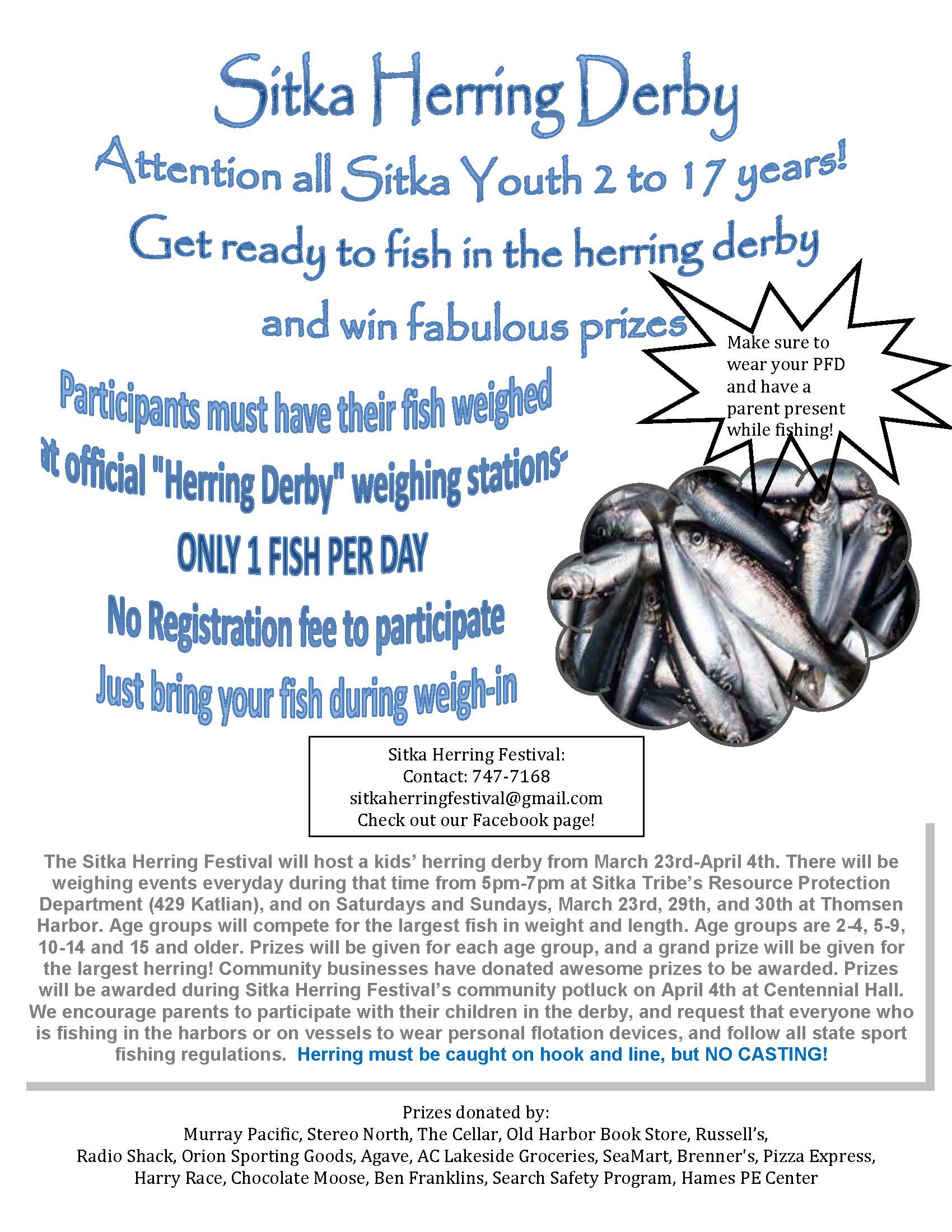
The inaugural Sitka Herring Festival will feature a variety of events from March 17 through April 12, when the herring return to Sitka to spawn. The event is sponsored by the Sitka Tribe of Alaska Resource Protection Department.
“The festival is a collaborative event to promote the importance of Pacific herring on the ecosystem and the culture of Sitka and the North Pacific Ocean,” event coordinator Jessica Gill said. “A few events to note are: kids’ herring derby, herring dip, fish printing, an educational unit in the schools, and a community potluck scheduled for April 4th. I am currently working on bringing in a scientist from Oxford to give a talk on herring for the potluck, but that will be dependent of funding.”
To learn more, please contact Jessica Gill at 747-7168 or by email at sitkaherringfestival@gmail.com. In addition to the event’s new website, there is a Facebook page.
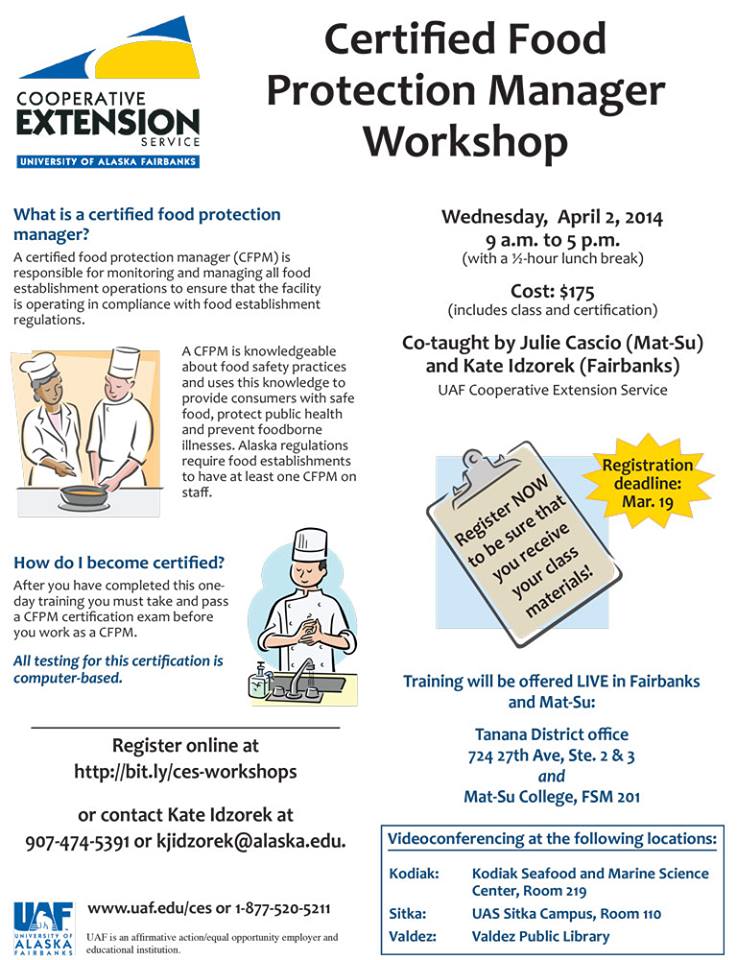
Wednesday, March 19, is the registration deadline for a certified food protection manager workshop being taught on Wednesday, April 2, by University of Alaska Fairbanks Cooperative Extension Service. This is an all-day statewide class that will be offered live in Fairbanks and Palmer, and by videoconferencing to Sitka, Kodiak and Valdez.
A certified food protection manager (CFPM) is responsible for monitoring and managing all food establishment operations to ensure that the facility is operating in compliance with food establishment regulations.
A CFPM is knowledgeable about food safety practices and uses this knowledge to provide consumers with safe food, protect public health and prevent food-borne illnesses. Alaska regulations require food establishments to have at least one CFPM on staff.
This course takes place from 9 a.m. to 5 p.m. (with a half-hour lunch), and participants will take a computer-based exam at the end of the class. The reason the deadline is two weeks before the class is to guarantee course materials reach all the students in time for the class. The cost is $175, and the course will be taught by Kate Idzorek of Fairbanks and Julie Cascio of Palmer. Students can register here (scroll down and select the April 2 item)
The Sitka videoconference for the class will take place in Room 110 at the University of Alaska Southeast Sitka Campus. To learn more, contact the Sitka District Office of the UAF Cooperative Extension Service at 747-9440, or contact Kate Idzorek at 907-474-5391 (toll-free, 1-877-520-5211) or kjidzorek@alaska.edu in Fairbanks.
The report looks at what foods are being grown in several communities and who’s growing them. It also weighs the strengths and weaknesses of the different food systems in the region, with a special wild food focus group hosted by the Organized Village of Kake. For more information, check out the report link below.
The two sub-committees from the Sitka Food Hub project of the 2013 Sitka Health Summit will host meetings in the next week. The project has two main focus groups — to increase Sitka’s capacity for emergency food storage, and to create a community commercial kitchen that can be rented to local start-up businesses and residents who need a place to preserve food they’ve harvested.
The emergency food storage group will meet at noon on Friday, Feb. 14, at Harrigan Centennial Hall. This group is looking for ways to help improve and expand community food storage for disaster preparedness. It also will be looking for ways to help educate Sitka residents about how to improve their own family food storage to be better prepared for emergencies.
The community commercial kitchen group will meet at 6:30 p.m. on Monday, Feb. 17, at Blatchley Middle School, Room 208. This group is trying to gauge the interest of local residents in having a rental commercial kitchen available for use. It also is looking at examples from other communities at how community commercial kitchens helped educate residents on food preservation, incubated local small businesses, and cultivated new opportunities for the community.
The next meeting for both groups combined is at 6:30 p.m on Thursday, March 6, at Harrigan Centennial Hall. Fo more information about the project, contact Marjorie Hennessy at marjorie@sitkawild.org.
The Sitka Food Co-op will host its second annual membership meeting at 10 a.m. on Saturday, Feb. 22, at Harrigan Centennial Hall. The meeting should last until about 11:30 a.m. and is open to all Sitka residents, regardless of co-op membership.
This meeting will give members and prospective members a chance to learn what the co-op is doing, where its going and how it plans to get there. There also will be elections for the board of directors (three seats are open, must be a co-op member to run), amendments to the by-laws, and there will be several new and important committees created. Co-op officers encourage people to attend and take part in building the co-op to the next level.
The Sitka Food Co-op was incorporated on Sept. 26, 2011, as a way to bring good food and community together. The purposes of the Sitka Food Co-op are to:
Create a community-based, member-owned buying service;
Make available wholesome natural and organic foods and products as inexpensively as possible;
Support and encourage local growing of fresh organic foods;
Purchase and purvey, whenever feasible, the goods or services of local and regional growers and producers; and
Serve as a center for activities and services which otherwise enrich the life of the community.
Please note that the Sitka Food Co-op is a separate organization than the Sitka Local Foods Network, even though we share some of the same goals.
To learn more about the Sitka Food Co-op and its annual meeting, email sitkafoodcoop@gmail.com or go to http://sitkafoodcoop.org/.
Former Sitka resident Nicolaas “Nic” Mink — now the Urban Sustainable Foods Fellow at Butler University, Indianapolis — recently published the book Salmon: A Global History that highlights salmon in Sitka, Alaska, and the world.
The book is published by Reaktion Books, LTD, as part of The Edible Series, which features books about different types of food from around the world. The small hardback book is 127 pages with 49 illustrations (30 in color), recipes, bibliography, and index. It costs $18 in the United States ($9.99 on Kindle).
Nic used to lead the now-defunct Sitka Salmon Tours, which took visitors on a walking tour around Sitka to show them the different stages of salmon growth and processing, during the two-plus years he lived in Sitka and worked with the Sitka Conservation Society. He said many of the scripts he developed for the tours were incorporated into the book, which isn’t much longer than a traditional academic paper. Now that he lives in Indiana, Nic still has connections to Sitka’s salmon through a company he started called Sitka Salmon Shares, which markets sustainably caught salmon, halibut, sablefish (black cod), and other fish from Sitka and Juneau to residents of the Midwest United States.
While exploring the state of salmon throughout the world, Nic said he centered a lot of the book on Sitka’s salmon because of its place in the history of the fish. In addition to looking at the natural history of salmon eating, the book also examines cured, canned, and fresh salmon, plus the future of edible salmon. He writes about the role of salmon with Alaska Native cultures, how Alaska’s salmon industry was impacted when a British boy died from botulism after eating canned salmon from Ketchikan in the 1980s, the differences between wild Alaska salmon and farmed salmon, and more.
The book’s description, from the book jacket:
The story of salmon takes readers on a culinary journey from the coast of Alaska to the rivers of Scotland, tracing salmon’s history from the earliest known records to the present. He tells the story of how the salmon was transformed from an abundant fish found seasonally along coastal regions to a mass-produced canned food and a highly prized culinary delight.
Rich in omega-3 fatty acids, cheap, and widely available, salmon is often listed as an essential part of any diet. A delicious and versatile fish, it can be used to make sashimi, cold smoked for lox, or shaped into a fishcake as an alternative to hamburgers. But while salmon is enjoyed all over the globe, it also swims at the center of controversy, with commercial fishing, global warming, and loss of freshwater habitats all threatening salmon populations and the ecological and health impacts of intense salmon farming under fire.


 The Sitka Community Food Assessment Indicators Report was released on Monday, and the findings will help guide future food system planning in Sitka.





 Sitka Local Foods Network
You must be logged in to post a comment.