• Alaska Food Policy Council asks state legislators to return Farm to School program funds to the budget

FTSLogo

(Editor’s note: The following item is a letter to the editor from the Alaska Food Policy Council sent to several newspapers around Alaska regarding cuts to the Farm to School Program. One of the three signers to the letter is Sitka Local Foods Network Board President Lisa Sadleir-Hart, who also serves on the Alaska Food Policy Council governing board. To learn more about the Alaska Farm to School Program, check out the brochure below or contact Program Coordinator Johanna Herron at 907-761-3870 or johanna.herron@alaska.gov.)

As the legislature continues swinging its scythe at the state budget, one of the programs about to be felled is Farm to School. And in case you don’t have kids that can tell you firsthand the benefits of the program, or if you’re not an Alaska grower that finds a market in supplying school cafeterias with Alaska Grown produce, let us tell you what the Department of Natural Resources, Division of Agriculture, Farm to School Program does: It provides expertise and support for those working to increase the connection of students, teachers, and school food service providers with products grown and produced in Alaska. This connection most commonly happens in the school lunchroom or in a school garden.

Yet, in a state that prides itself in self-reliance, consider these striking facts:

  1. Alaskans spend $1.5 BILLION dollars on imported food each year.
  2. Only 5-10 percent of food consumed is produced or harvested in state, but great swaths of arable land remain uncultivated.
  3. About 15 percent of Alaska households are food insecure.
  4. Alaskans spend about $450 million dollars on treating diet-related medical conditions.
  5. We have a population that is largely disconnected from the food system – most kids can’t tell you what lies beneath the frilly green of a carrot top coming out of the soil.

These figures might sound gloomy, but they highlight the immense opportunity that we have to become healthier, wealthier, and more food secure. What if we spent that $1.5 billion on Alaska Grown products and kept that money in local economies? What if we produced more healthy foods in quantities that could meet the demands of our school cafeterias? What if we provided our children with the tools and knowledge necessary to make healthy food choices and maintain a healthy weight?

WhatIsAlaskaFarmToSchoolWe already have a key mechanism to achieving these goals – it’s the Farm to School Program. The Farm to School Program helps to prioritize getting locally produced, healthy goods into cafeterias; raise a generation of food leaders and smart consumers; and create a large, reliable market for increased in-state food production.

In three short years, the number of Alaska School Districts involved in Farm to School has grown from zero to 68 percent! There’s been an 11-percent increase in school gardens state-wide. One-hundred percent of the school districts are now serving at least one local food item in their meal programs and there’s still tremendous room for growth. In five years, the program has leveraged over $1 million dollars from partner agencies. This is just the shortlist of accomplishments.

All of this and more has been achieved with an annual budget of about $190,000. Talk about bang for your buck! If the legislature eliminates or cuts funding to the Farm to School Program, they aren’t cutting the fat out of the budget. They are cutting the carrots, the potatoes, the greens, and even the local fish out of your children’s lunches, and they’re cutting supports necessary to expand in-state production.

We implore the legislature not to eliminate or reduce the funding for our Farm to School Program. It is an incredibly efficient use of a small amount of funds that has proven itself over the past five years and is one of the shining pillars of a state food system that is becoming stronger, more sustainable, and more resilient. Don’t let the legislature undo our current progress, and don’t let it stand in the way of what more can be done.

Signed,

Liz Snyder, Victoria Briggs, and Lisa Sadleir-Hart
Present and Past Board Co-Chairs, Alaska Food Policy Council (AFPC)

• Alaska Farm to School Brochure

• State grants available for summer ‘Chef at the Market’ program at 2015 local farmers markets

Suzan Brawnlyn, the Chef at the Market, holds a sample cup of honey miso-glazed black cod with broccoli and bok choy stir fry during a cooking demonstration on July 21, 2012, at the second Sitka Farmers Market of the season.

Suzan Brawnlyn, the Chef at the Market, holds a sample cup of honey miso-glazed black cod with broccoli and bok choy stir fry during a cooking demonstration on July 21, 2012, at the second Sitka Farmers Market of the season.

The state’s Chef at the Market program is accepting grant applications from Alaska chefs interested in providing demonstrations at local farmers markets between May and September this year.

The Chef at the Market program began in 2011 to promote fresh Alaska Grown specialty crops and teach Alaskans new ways to prepare them. The program has also provided a new opportunity for chefs to develop relationships with the local food vendors who supply restaurants and with Alaskans interested in cooking Alaska Grown at home.

In the summer of 2013, six Alaska chefs performed a total of 27 demonstrations at nine local farmers markets and special events. In 2014 there were 39 demonstrations at nine local farmers markets around the state. In addition to hosting demonstrations at the local farmers markets, chefs prepare recipes and other information about how to use the local produce they highlighted each week.

The Sitka Farmers Market hasn’t had a Chef at the Market since 2012, when Suzan Brawnlyn hosted four Chef at the Market presentations. We weren’t able to host a chef in 2013 because the kitchen was closed due to construction at the Alaska Native Brotherhood Founders Hall, and no Sitka chefs applied in 2014. The ANB Hall construction is finished and the kitchen is open again, so Sitka chefs are encouraged to apply for 2015.

The Chef at the Market program is part of the federal Specialty Crop Block Grant administered by the Alaska Division of Agriculture, so it will have 2015 funding (despite budget cuts to other state-run programs). To apply for a 2015 summer program grant, go to http://dnr.alaska.gov/ag/ag_grants.htm or download the application at http://dnr.alaska.gov/ag/Grants/2015CATMRFP.pdf. Grant applications are due on Tuesday, March 31.

To find out more information about the Chef at the Market grants and demonstrations, contact Jacquelyn Schade at jacquelyn.schade@alaska.gov or 907-761-3858.

• Participants selected for Sitka Local Foods Network’s 2015 garden mentoring program

IMG_0022

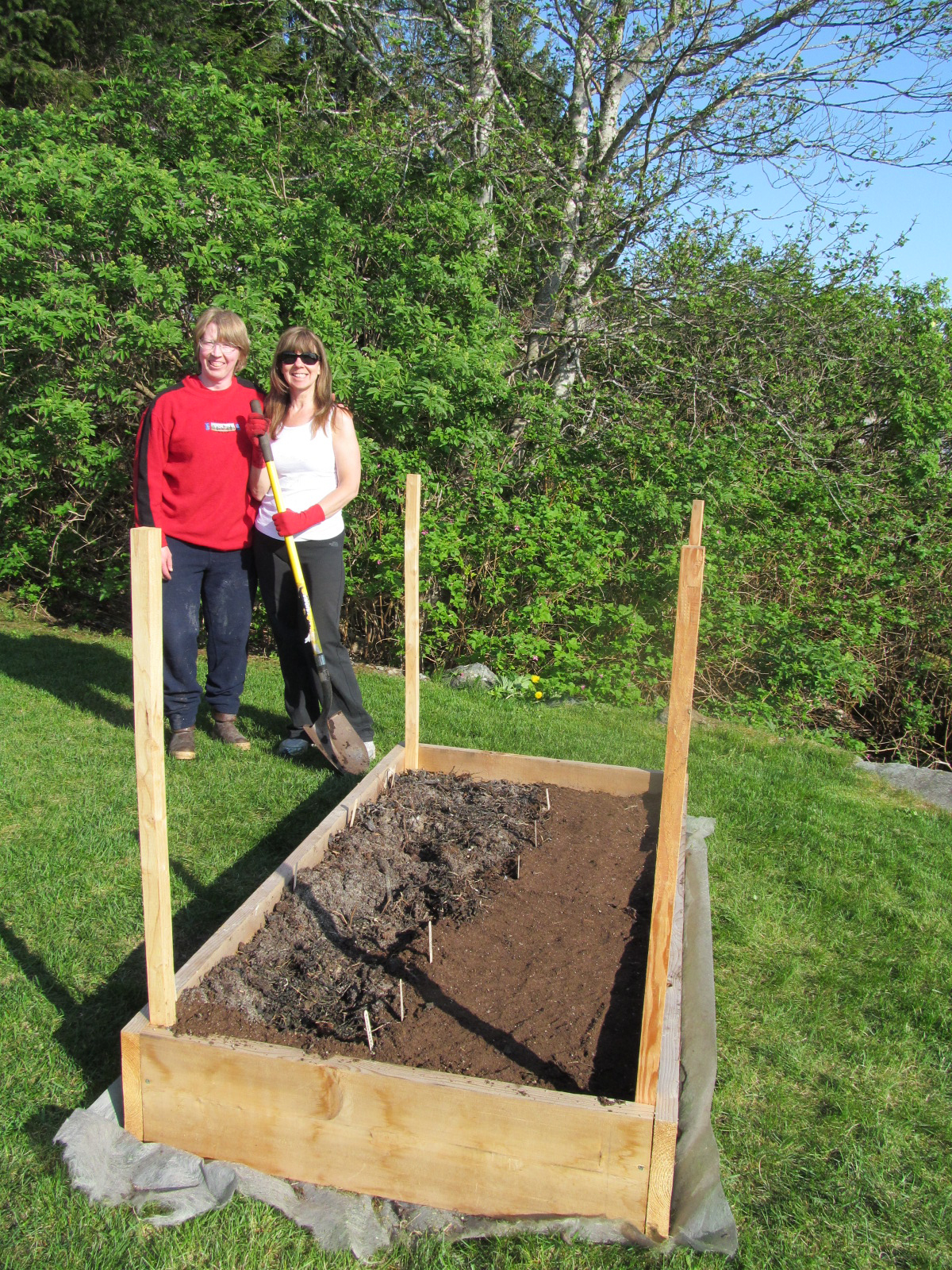
The Sitka Local Foods Network has selected the 2015 participants for its garden mentoring program, and plans are being made for six classes each this summer at the homes of our four new participants and two returning families.

This is the second year of the program, which launched last year with two participants — the families of Tami O’Neill and Anna Bradley. This year our program expands with four new families (Josephine Dasalla, A.J. Bastian, Rebecca Kubacki, and Breezy), and our two 2014 families are back for a second year. Michelle Putz has been contracted to coordinate the program and design lesson plans, after the Sitka Local Foods Network received a community development grant from First Bank.

The Sitka Local Foods Network garden mentoring program is designed for first-time gardeners, and the first year of the program involves participants learning how to grow four simple crops that grow well in Sitka (lettuce, kale, rhubarb and potatoes). The participating families learn how to find the best spot on their land (for sun and drainage), how to build raised garden beds, how to amend the soil, how to plant, how to maintain their garden, and how to harvest their crops.

The two returning families will learn how to grow more difficult crops, such as carrots and onions, plus they’ll have refreshers on their first-year crops. The goal of the program is to teach people low-cost ways to grow healthy food in Sitka. When selecting our families, we wanted to make sure there were multiple generations involved, especially kids. The classes, when announced starting in mid-April, will be open to the public. Several experienced gardeners volunteer as mentors for the selected families.


• HB92 will require labeling of GMOs for food sold in Alaska

GMOOMGflier

As a food consumer you want to know what’s in your food. Has it been soaked with chemical pesticides? Was it created using genetically modified organisms (GMOs)? How nutritious is it? Unfortunately, current laws don’t require labeling of GMOs, so you don’t know if you’re buying Frankenfoods.

Rep. Geran Tarr, along with co-sponsors Rep. Scott Kawasaki and Rep. Chris Tuck, introduced a bill, HB92, to require labeling of genetically modified food. HB 92 is being heard by the House Resources Committee on Monday, March 9, and Rep. Tarr needs you to provide a letter of support. Can you send Rep. Tarr a letter of support for GMO labels?

Please email a short, from-the-heart letter about why you want the right to know about GMOs to Rep. Tarr at Rep.Geran.Tarr@akleg.gov. She’ll forward it along to the committee members.

Also, the timing is great because this week Rep. Tarr is sponsoring “Alaska Food Security Awareness Week,” with special showings of the movie, GMO OMG, in Anchorage, Juneau, Sitka and Fairbanks. GMO OMG is a film that addresses how GMOs affect our children, the health of our planet, and our freedom of choice when it comes to the foods we eat.

Join us to watch GMO OMG in:

  • FAIRBANKS – Tuesday, March 10, 5:30 p.m. at the Blue Loon
  • ANCHORAGE – Wednesday, March 11, 7 p.m. at the Anchorage Museum
  • SITKA – Thursday, March 12, 5:30 p.m. at the Coliseum Theater, Downtown
  • JUNEAU – Friday, March 13, noon-1 p.m., Lunch and Learn at the State Capitol, Butrovich Room, GMO OMG film screening, Butrovich Room, 6-8 p.m.

Here is the link to the Facebook invite. If you could share this with your friends, that would be great.

Rep. Tarr was the sponsor of HJR 5, passed in 2013, to oppose GMO salmon. With your help, she can win the right to know about GMOs for Alaska. Please email her your letter of support today at Rep.Geran.Tarr@akleg.gov.

• Second annual Sitka Herring Festival kicks off March 16 with month of events

Festival Flyer

You feel it in the air; you see it in the lengthening days; you smell it with the changing tides. That’s right, herring season (and Spring!) is right around the corner. And with the arrival of the herring comes the Sitka Tribe of Alaska‘s second annual Sitka Herring Festival, a month of fantastic event for adults and kids alike.

First, for the adults. This year, we’ve been able to bring an excellent speaker from Stonybrook University in New York thanks to a generous donation from Sealaska. At the community potluck from 6-9 p.m. on Tuesday, April 7, at Harrigan Centennial Hall, Dr. Ellen Pikitch will present on herring management and conservation throughout the world. Dr. Pikitch was one of the leading scientists on the Lenfest Forage Fish Task Force, is a pioneer in ocean conservation, and is a leader in ecosystem-based management of fisheries. This event will be a potluck style, so please bring a dish to share. We’re very excited to have her here during the herring season.

In addition to the community potluck, there will be a talk at the University of Alaska Southeast Sitka Campus from Dr. Shingo Hamada. Dr. Hamada is an anthropologist at the Research Institute for Humanity and Nature in Kyoto, Japan. His talk will be on Herring Fisheries and Food Culture in Japan. Mark your calendars for 7:30 p.m. on Monday, March 23, in UAS Sitka Campus Room 218. This is a partnership from the Natural History Seminar Series with UAS and the Sitka Sound Science Center. All are welcome, but be sure to bring your questions.

But what would a festival be without fun activities for the kids? This year’s festival will also include Yaa Khusgé Yaaw Woogoo — The Knowledge of Herring Camp, hosted by the Sitka School District and the Outdoor Foundation, in partnership with Sitka Tribe of Alaska and Sitka National Historical Park. This is a free, hands-on spring break camp connecting kids to culture that will take place from March 16-20 at Sitka National Historical Park. Middle school youth (grades 6-8) are welcome and encouraged to participate in this free camp. More information can be found at Sitka National Historical Park. Feel free to or pick up an application at the main office of STA or at the Sitka National Historical Park Visitor Center.

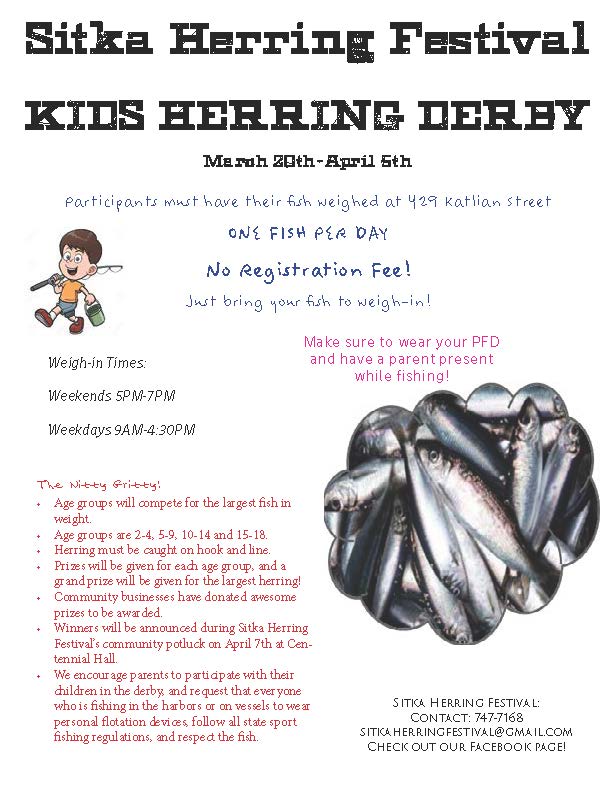
Derby FlyerFor those who like a little competition, there’s the Herring Derby and the Herring Run. Like last year, the Herring Derby will be a fun event for kids and parents. The Derby starts on Friday, March 20, and continues through Monday, April 6. Weigh your biggest fish every day (from 9 a.m. to 4:30 p.m. on Monday through Friday and from 5-7 p.m. on Saturday and Sunday) at the Sitka Tribe of Alaska Resources Production Office at 429 Katlian Street. May the best (biggest) fish win. Also like last year, Sitka Community Schools will host the Herring Run. The run will start at 11 a.m. on Saturday, April 4, at Harrigan Centennial Hall and will wind through the Totem Park trails before returning to Centennial Hall. Herring swim in schools, so bring your friends.

There will be more fun and educational events during the Festival, including a 4-H class through Sitka Conservation Society, Herring in the Hallway at Keet Gooshi Heen Elementary School, Discovery Days at the Sitka Sound Science Center, and the showing of a herring film showing at 7 p.m. on Friday, March 27, and at 2 p.m. on Saturday, March 28, at the Sitka National Historical Park  For the dancers among us, there will also be a Herring Hop from 6-11 p.m. on Saturday, March 28, at the Alaska Native Brotherhood Fellowship Hall. The Herring Hop is a fundraiser for the Cape Decision Lighthouse Society. The Herring Festival will also feature a Food Web Cruise on Saturday, March 21, as a fundraiser for another fantastic festival, the Sitka Whalefest.

More info for all these events can be found online at http://sitkaherringfestival.wordpress.com or at our Facebook page. Or you can email sitkaherringfestival@gmail.com or call 747-7168.

• 2015 Sitka Herring Fest calendar of events

• Two new books from UAF Cooperative Extension Service encourage kids to eat more veggies

FNH-00540KaleRecipes_Page_01 FNH-00557AKkidsVeggieCookbook_Page_01So you’ve got a nice garden but your kids don’t want to eat their veggies? What is a parent to do? Two new books by Sarah Lewis of the Juneau District Office of the University of Alaska Fairbanks Cooperative Extension Service can help get your kids eating their veggies. And they’re available for free downloads.

Sarah is the Family and Community Development Agent for Southeast Alaska, she travels throughout the region giving cooking and canning classes. She will be back in Sitka in mid-July to test pressure canner gauges and teach several classes yet to be determined.

“Sitka’s 4-H Cloverbuds Club helped me refine a few of the recipes after we had a wonderful time in the kitchen together last year,” Sarah said. “Talk about some fun publications to do research for.” (Note: contact the Sitka Conservation Society for more information about Sitka 4-H clubs.)

The first book is Time for a Kale-abration! Introducing the wonders of kale to Alaskan kids. The free 12-page booklet is all about a garden plant that grows well in Sitka, but one some people have trouble eating. The book features information about the varieties of kale, nutritional info, and several kid-friendly recipes from main courses to desserts.

The second book is The Alaska Kids’ Healthy Harvest Cookbook: Alaska kids grow, cook, eat and love vegetables. This free 12-page booklet lists several common vegetables found in Alaska gardens (kale, carrots, peas, zucchini and potatoes) and provides a variety of recipes using these veggies. It also includes recipes for venison stew and salmon chowder (both heavy with Alaska veggies).

According to the UAF Cooperative Extension Service, “Research shows that helping kids have fun with vegies, even ones they say ‘eeewww’ to, increases the chance they’ll try and like then as they get older. For this reason, our very own Sarah Lewis, Family and Community Development Agent for Southeast Alaska, has written two publications to introduce veggies (especially Alaska Grown ones!) to kids. Time for a Kale-abration and Alaska Kids’ Healthy Harvest Cookbook offer simple and tasty recipes that can be cooked with or by kids, with a menu for a kale-themed party or a harvest festival. Sarah has held local food parties and festivals with 4-H kids and Girl Scouts throughout Southeast Alaska, and now you can hold some with your kids, class, or youth group.”

• UAF Cooperative Extension Service offers Certified Food Protection Manager class by videoconference April 1 in Sitka

CFPM flyer 4-1-15

Friday, March 20, is the registration deadline for a certified food protection manager workshop being taught on Wednesday, April. 1, by University of Alaska Fairbanks Cooperative Extension Service. This is an all-day statewide class that will be offered by videoconferencing to Fairbanks, Palmer, Barrow, Kotzebue, and Sitka.

A certified food protection manager (CFPM) is responsible for monitoring and managing all food establishment operations to ensure that the facility is operating in compliance with food establishment regulations.

A CFPM is knowledgeable about food safety practices and uses this knowledge to provide consumers with safe food, protect public health and prevent food-borne illnesses. Alaska regulations require food establishments to have at least one CFPM on staff.

This course takes place from 9 a.m. to 5 p.m. (with a half-hour lunch), and participants will take a computer-based exam at the end of the class. The reason the deadline is two weeks before the class is to guarantee course materials reach all the students in time for the class. The cost is $200, and the course will be taught by Marsha Munsell of Fairbanks and Julie Cascio of Palmer. Students can register here (scroll down and select the April 1 item).

The Sitka videoconference for the class will take place in Room 218 at the University of Alaska Southeast Sitka Campus. To learn more, contact Jasmine Shaw at the Sitka District Office of the UAF Cooperative Extension Service at 747-9440, or contact Kathy McDougall at (907) 474-2420 (Fairbanks number) or kmmcdougall@alaska.edu. Note, this class is taught in English but textbooks are available in Korean, Chinese and Spanish, just contact Kathy at least three weeks before the class.

• Check out the March 2015 edition of the Sitka Local Foods Network newsletter

March2015SLFNNewsletterScreenshot

The Sitka Local Foods Network just sent out the March 2015 edition of its newly launched monthly newsletter. Feel free to click this link to get a copy.

This edition of the newsletter has brief stories about Sitka neighbors forming chicken coop co-ops, our open manager and assistant manager positions for the Sitka Farmers Market, some upcoming spring garden and livestock classes, and the 2015 Pick.Click.Give. fundraising campaign. Each story has links to our website for more information.

You can sign up for future editions of our newsletter by clicking on the registration form image in the right column of our website and filling in the information. If you received a copy but didn’t want one, there is a link at the bottom of the newsletter so you can unsubscribe. Our intention is to get the word out about upcoming events and not to spam people. We will not share our email list with others to protect your privacy.

• Ribbon-cutting event March 9 to celebrate launch of Sitka Kitch community kitchen at First Presbyterian Church


The Sitka Health Summit congratulates the folks at Sitka Kitch and First Presbyterian Church on their $13,000 grant. The funds will go a long way towards renovation of their community kitchen. "Sitka Kitch is a community collaboration to augment and strengthen Sitka's workforce through the development of food-based curriculum and training." It is an initiative of the Sitka Health Summit. From left are Patrick Williams, Marjorie Hennessy, Clara Gray, Cheri Hample, Martina Kurzer, Suzan Brawnlyn, Cyndy Gibson, and Betsy Decker. (Photo Courtesy of the Sitka Health Summit)

The Sitka Health Summit congratulates the folks at Sitka Kitch and First Presbyterian Church on their $13,000 grant. The funds will go a long way towards renovation of their community kitchen. “Sitka Kitch is a community collaboration to augment and strengthen Sitka’s workforce through the development of food-based curriculum and training.” It is an initiative of the Sitka Health Summit. From left are Patrick Williams, Marjorie Hennessy, Clara Gray, Cheri Hample, Martina Kurzer, Suzan Brawnlyn, Cyndy Gibson, and Betsy Decker. (Photo Courtesy of the Sitka Health Summit)

kitch_logo_mainThe Sitka First Presbyterian Church and the Sitka Conservation Society are pleased to announce the official opening of the Sitka Kitch, a new community commercial kitchen for Sitka.

Please join us to commemorate this exciting event. A ribbon-cutting ceremony will be held at 6 p.m. on Monday, March 9, at the Sitka Kitch, in the First Presbyterian Church, 505 Sawmill Creek Road. Light refreshments courtesy of the Back Door Café will be served.

Sitka Kitch is a community initiative that arose from the 2013 Sitka Health Summit, and is a truly collaborative and partner-rich project. The Sitka Conservation Society, First Presbyterian Church, Sitka Local Foods Network, Sitka Food Co-op, Sitka District Office of the University of Alaska Fairbanks Cooperative Extension Service, and the Sustainable Southeast Partnership have all contributed to turn Sitka’s dream of a community kitchen into reality. Sitka Kitch received $13,000 from the Northwest Coast Presbytery Community Blessings Grant. These funds went directly towards renovating the church’s kitchen so that ‘Sitka Kitch’ could meet the requirements of becoming an Alaska Department of Environmental Conservation (DEC)-certified commercial kitchen.

sikta_kitch_sheet-791x1024The Sitka Kitch now is ready to function as a shared-use community kitchen. Our goal is to provide food-based education, at various levels, to the greater Sitka community. With these renovations completed, the Kitch can offer a DEC-certified commercial kitchen to local entrepreneurs and small businesses for an affordable hourly rate. Instructors interested in developing and offering food-based classes may also rent the kitchen and space. The Kitch also hopes to develop and provide career and technical training, and community canning events.

Through multi-use access to a commercial kitchen, Sitka Kitch’s goals are to support a sustainable local foods culture, spark local foods entrepreneurship and empower the community to become more independent and food secure. This will continue to be the delivery location for the Sitka Food Co-op and Everything Organic Sitka. Sitka Farmers Market and other cottage food industry vendors who need to process food products in a commercial kitchen now will have a place they can rent.

For more information on using Sitka Kitch, please contact sitkakitch@sitkawild.org.

• ‘Flora of Southeast Alaska’ class offered by UAS Sitka Campus to be a hybrid

Salmonberries await picking near the entrance to Sitka National Historical Park

Salmonberries await picking near the entrance to Sitka National Historical Park

A new biology class by University of Alaska Southeast Sitka Campus associate professor Kitty LaBounty will itself be a “hybrid”.

klabountyThe DNA of most traditional botany classes is to gather students around a table of samples and look at them in a face-to-face classroom setting. By offering Flora of Southeast Alaska as both a local and distance class, students from anywhere can get up to speed on how to identify the common native trees, shrubs and herbs of southeast and south central Alaska. Local students can participate in the lectures on campus, while students across Alaska can see the imagery online and hear the lectures either live or via digital recording.

Flora of Southeast Alaska is a one-credit, seven-week workshop. The focus will be on identification of common species and attaining an understanding of their place in the ecosystem of Southeast Alaska. Students will discover how these plants interact with other plants and animals, and how humans use these plants for food, fuel, medicine, or simply enjoyment.

In addition to illustrated weekly lectures, there will be written exercises and “check for understanding” activities. The class is available to any student without prerequisites. It does not count as credit toward a biology major at UAS.

Professor LaBounty brings her lifelong passion as a gardener and scientist to this topic, along with more than 25 years experience working on plant identification for state, federal and non-profit agencies in Alaska.

The class will meet from 5:30-7 p.m. on Thursdays from March 5 to April 30 — with March 19th off for spring break. The cost is $187 for local students and $227 for eLearning (distance) students.

For more information, contact Kitty LaBounty at UAS Sitka Campus. 747-9432. To register, call 747-7700. or toll-free, 800-478-6653.