The fifth annual Sitka Seafood Festival is finalizing its schedule for July 31-Aug. 2 at various locations around Sitka, but tickets have gone on sale for its three main events — the VIP cocktail hour on Friday night, the five-course banquet on Friday night, and the headline entertainment concert by the Yup’ik soul group Pamyua on Saturday night (link to Pamyua’s Facebook page).
The major events for the Sitka Seafood Festival will take place on Friday and Saturday, Aug. 1-2, but there are some additional events set for July 31 (a wine bottle-signing and a garden tour). A full festival schedule is available here.
On Friday, Aug. 1, the VIP cocktail hour takes place from 5:30-6:30 p.m. at the Harrigan Centennial Hall Exhibit Room, and the cost is $35 per person. The five-course seafood banquet prepared by guest chefs starts at 7 p.m. at Harrigan Centennial Hall (doors open at 6:30 p.m.). The banquet costs $65 per person, or you can buy a whole table for $600 (10 seats per table). There are Friend of the Festival tables available for $800 that feature special bartender service, are close to the stage, and feature gift bags).
The tentative menu for Friday’s banquet features (according to an email from event founder Alicia Haseltine):
Fifth Course — cocoa praline rocks, chocolate soil, sudachi curd, huckleberry, merlot caramel, bergamot cloud mascarpone and cream base
On Saturday, Aug. 2, the day opens with tote races at 11 a.m. at Crescent Harbor, followed by the parade at 11:30 a.m. from Crescent Harbor Shelter to the Sitka Fine Arts Camp/Sheldon Jackson Campus, and the marketplace from noon until 7 p.m. There will be a variety of entertainment from noon until 4 p.m., and the Scottish Highland Games are from noon to 6 p.m., both at the Sitka Fine Arts Camp/Sheldon Jackson Campus. The headline entertainment concert by Pamyua starts at 7 p.m. at Allen Hall at the Sitka Fine Arts Camp/Sheldon Jackson Campus, and tickets are $20 per person.
Volunteers are needed all week for the festival, which includes event set up and tear down. To learn more, contact Sitka Seafood Festival Director Carolyn Kinneen at (907) 222-8422 or email sitkaseafoodfestival@gmail.com. Parade participants should contact Linda Olson at 747-6985. Scottish Highland Games participants are welcome to practice at 5:30 p.m. on Wednesdays and Sundays at the Moller Field Track
Sitka Farmers Market Co-Manager Ellexis Howey, left, and Sitka Local Foods Network Intern McLane Ritzel, right, present the Table Of The Day Award to Hope Merritt of Gimbal Botanicals, second from left, and her assistant Brenon Littlefield at the first market of the 2014 summer on Saturday, June 28, at the Alaska Native Brotherhood Founders Hall in Sitka. Hope has been a regular vendor at the Sitka Farmers Market since it started, selling herbal teas, herbs, and beach greens. She received a gift bag with fresh greens, fresh rhubarb, earrings, and a copy of the Alaska Farmers Market Cookbook. This is the seventh year of Sitka Farmers Markets, hosted by the Sitka Local Foods Network. The next market is from 10 a.m. to 1 p.m. on Saturday, July 12, at the Alaska Native Brotherhood Founders Hall, 235 Katlian St. For more information about the Sitka Farmers Markets and Sitka Local Foods Network, go to http://www.sitkalocalfoodsnetwork.org/ or check out our Facebook page at https://www.facebook.com/SitkaLocalFoodsNetwork. (PHOTO COURTESY OF SITKA LOCAL FOODS NETWORK)
The first Sitka Farmers Market of the 2014 summer took place on Saturday, June 28, at the Alaska Native Brotherhood Founders Hall, 235 Katlian St.
This market kicked off our seventh summer, and it was the first time we’d hosted a market in June. After a week of rainy weather, we wound up with a nice overcast day with no moisture. We had a nice crowd, and several new booths.
The second Sitka Farmers Market of the season takes place from 10 a.m. to 1 p.m. on Saturday, July 12, at ANB Founders Hall. This will be our first market with free transportation from Sitka Tours. To learn more, watch this site for updates. A slideshow with scenes from the first market is below.
The Sitka Seafood Festival seeks vendors for the all-day marketplace that takes place from 11 a.m. to 7 p.m. at the Sitka Fine Arts Camp/Sheldon Jackson Campus. The all-day marketplace is one of the highlights from the fifth annual Sitka Seafood Festival, scheduled for Thursday, July 31, through Sunday, Aug. 3, at various locations in Sitka.
“Last year we had an overwhelming amount of people show up, and the vendors sold out of food early,” said festival founder Alicia Haseltine. “This year we are ready for you, Sitka! We are currently accepting vendor applications for food, merchandise, educational booths, or any other ocean- or seafood-related activity.”
The Sitka Seafood Festival helps Sitka celebrate its seafood heritage with a variety of events. The 2014 schedule still is being finalized, but in 2013 the festival included a sea poetry contest, native plants garden tour, pasta cruise, book signings, VIP banquet, marathon and half-marathon, parade through downtown, all-day marketplace, crab races, Scottish Highland games, fishhead toss, fishhead bobbing, blind-folded tote rates, live entertainment, and a golf tournament. Click this link and scroll to the bottom to see a slideshow of scenes from the 2013 Sitka Seafood Festival.
For more information or to register as a vendor, please contact Mary Helem at oceanfront@gci.net. You also can download a registration form below or at http://www.sitkaseafoodfestival.org (note, please send your forms to Mary, the Sitka Local Foods Network is a separate organization than the Sitka Seafood Festival). See you at the festival.
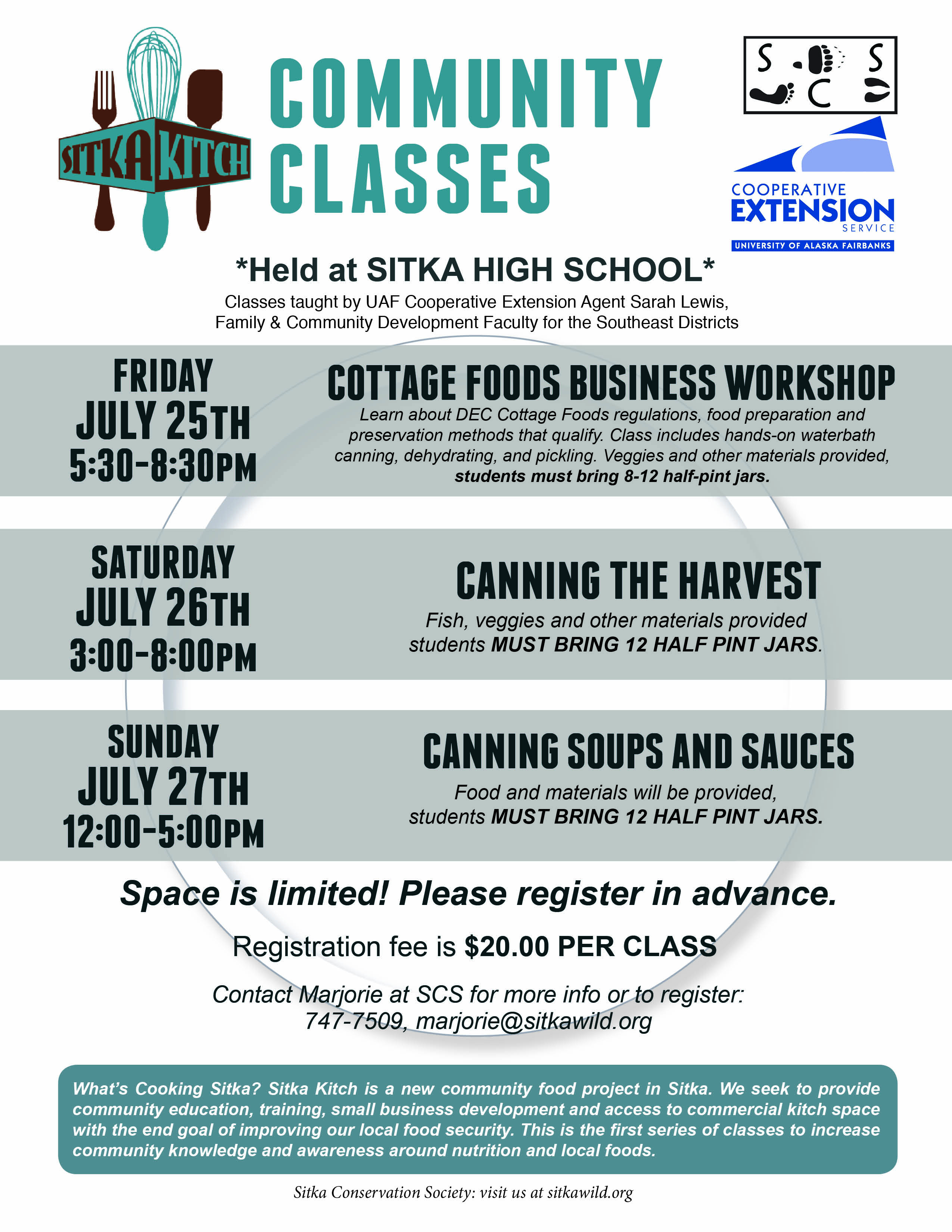
The three classes cost $20 each. Space is limited, so please register in advance by calling Marjorie Hennessy of the Sitka Conservation Society at 747-7509. Students will take home the products they make. The classes are:
Friday, June 25, 5:30-8:30 p.m., Cottage Foods Business Workshop — Students learn about Alaska Department of Environmental Conservation cottage foods industry regulations, as well as the food preparation and food preservation techniques that qualify. Class includes hands-on water-bath canning, dehydrating and pickling instruction. Veggies and other materials will be provided. Students must bring 8-12 half-pint canning jars with lids.
Saturday, June 26, 3-8 p.m., Canning the Harvest — Fish, veggies and other materials provided. Students must bring 12 half-pint canning jars with lids.
Sunday, June 27, noon to 5 p.m., Canning Soups and Sauces — Food and materials will be provided. Students must bring 12 half-pint canning jars with lids.
In addition, Sarah will be at the Sitka Farmers Market from 10 a.m. to 1 p.m. on Saturday, July 26, at the Alaska Native Brotherhood Founders Hall, where she will be available to test canner pressure gauges and provide other resources about home canning and food preservation.
Also, Sitka Kitch will partner with Sitka Tribe of Alaska to offer a pickled salmon course in August. This class is offered free of charge, but space is extremely limited. More details on date and location will be available soon.
Sitka Kitch is a community wellness project from the 2013 Sitka Health Summit designed to improve food security in Sitka. The different parts of the project include creating a community kitchen Sitka residents can rent to prepare food for their small businesses or to preserve their family harvest of fish, game, or garden veggies; expanding Sitka’s emergency food storage capacity; and providing education about preserving food and building family emergency food pantries.
For more information about the Sitka Kitch project, contact Marjorie Hennessy at marjorie@sitkawild.org or 747-7509.
The Sitka Local Foods Network will host its seventh summer of Sitka Farmers Markets this year. The first of the six markets is from 10 a.m. to 1 p.m. on Saturday, June 28, at Alaska Native Brotherhood Founders Hall (235 Katlian St.), with the other markets on July 12, July 26, Aug. 9, Aug. 23, and Sept. 6. From left are Sitka Local Foods Network board members Charles Bingham, Maybelle Filler and Michelle Putz, Sitka Farmers Market co-managers Ellexis Howey and Debe Brincefield, vendors Linda Wilson and Pat Hanson, and helper D.J. Brincefield. (Daily Sitka Sentinel Photo by James Poulson).
The Sitka Local Foods Network will host its seventh summer of Sitka Farmers Markets with six markets this year starting on June 28 and taking place on alternate Saturdays through Sept. 6. The Sitka Farmers Markets give Sitka residents a chance to buy and sell locally produced food and crafts.
The Sitka Farmers Markets take place from 10 a.m. to 1 p.m. on Saturday, June 28, July 12, July 26, Aug. 9, Aug. 23, and Sept. 6 at the Alaska Native Brotherhood Founders Hall (235 Katlian St.). The markets feature local seafood (fresh, frozen, and cooked, ready to eat), locally grown and harvested fruits and vegetables, baked goods, locally made jams and jellies, live entertainment and music, local arts and crafts, and a variety of other items gathered or made in Sitka. We emphasize local products and lots of fun. We were the first farmers market in Southeast Alaska to accept WIC coupons and Alaska Quest EBT for SNAP (food stamp) users. We also plan scheduled transportation from Sitka Tours for the last five markets (details coming soon), and don’t forget to support the Sitka Farmers Market in the I Love My Farmers Market Celebration (click logo) at http://www.sitkalocalfoodsnetwork.org/.
“The Sitka Farmers Market is a great way to connect with community members and support local entrepreneurs,” Sitka Local Foods Network Board President Lisa Sadleir-Hart said. “Circulating your dollars locally also has a multiplying effect and helps your neighbors.”
The Sitka Farmers Market started as a community wellness project that came out of a health priority planning meeting at the 2008 Sitka Health Summit. The markets are sponsored by the Sitka Local Foods Network, Alaska Native Brotherhood Camp No. 1, Alaska Native Sisterhood Camp No. 4, Baranof Island Housing Authority, the Alaska Farmers Market Association, the Alaska Division of Public Health Cancer Control Program, and the SEARHC Health Promotion and Diabetes Prevention programs.
“We are excited to have Ellexis Howey and Debe Brincefield working as a team as our new market co-managers,” Sadleir-Hart said. “Ellexis and Debe bring loads of enthusiasm and some new ideas to the market, and they are focused on creating a sustainable market that can be in Sitka for the duration. As always, the market will be a place to support the growing local food movement in Sitka and learn more about how to eat more sustainably.”
Vendor fees are $30 for a 6-foot table, $40 for an 8-foot table and $20 for a 4-foot table. Vendors with their own tents pay $5 per foot. As always, we offer cost incentives for vendors growing locally produced food. The fees will help us cover the costs of renting ANB Founders Hall and its kitchen, hiring musicians and other expenses. To learn more about being a vendor or to sign up for a table, contact Sitka Farmers Market Co-Managers, Ellexis Howey and Debe Brincefield at 738-8683 or by e-mail sitkafarmersmarket@gmail.com. Vendor rules, registration forms and other info for potential vendors can be found on the Documents page at http://www.sitkalocalfoodsnetwork.org/.
The Sitka Conservation Society is offering an adult 4-H program, with the first offering a backcountry cooking class series in June and July. We’ll be teaching you how to cook delicious meals for your next camping or backpacking trip following Leave No Trace (LNT)principles.
Classes are from 5:30-7:30 p.m. on Thursdays, June 19, June 26, July 10, and July 17. The first class is required — you’ll learn backcountry cooking basics and LNT principles. The following three classes you can pick and choose from. We’ll focus on a different meal each evening, but you can expect things like pizza, cinnamon rolls, and home-made dehydrated meals.
Space is limited and registration is required. The class location will be given when you register. Classes are $6 for Sitka Conservation Society members, and $10 for non-SCS members. For more information, call the Sitka Conservation Society at 747-7509, or contact Mary Wood at mary@sitkawild.org or Tracy Gagnon at tracy@sitkawild.org.
The Sitka Health Summit congratulates the folks at Sitka Kitch and First Presbyterian Church on their $13,000 grant. The funds will go a long way towards renovation of their community kitchen. “Sitka Kitch is a community collaboration to augment and strengthen Sitka’s workforce through the development of food-based curriculum and training.” It is an initiative of the Sitka Health Summit. From left are Patrick Williams, Marjorie Hennessy, Clara Gray, Cheri Hample, Martina Kurzer, Suzan Brawnlyn, Cyndy Gibson, and Betsy Decker. (Photo Courtesy of the Sitka Health Summit)
Sitka Kitch is the community food project that arose from the 2013 Sitka Health Summit. The overall goal of Sitka Kitch is to improve community capacity and community development through the lens of food security.
The Sitka Kitch will start with food-based education and emergency preparedness at the household level. As it grows, the Sitka Kitch seeks to provide career and technical training, and entrepreneurial development opportunities. This will be achieved through a shared-use community kitchen and will work to educate, incubate and cultivate community sustainability.
Sitka Kitch also has a sub-group that is currently working to improve storage of emergency food with the Salvation Army. Eventually the kitchen would also like to generate a food ‘income’ stream to augment immediate relief efforts by local food banks and soup kitchens.
Sitka Kitch is pleased to announce a new partnering with the Sitka First Presbyterian Church to kick off its first year through the use of kitchen space. The groups collaborated in April to prepare an application to the Northwest Coast Presbytery Community Blessings Grant. The proposal outlined a budget to renovate the church’s existing kitchen to meet the requirements of becoming an Alaska Department of Environmental Conservation (DEC)-certified kitchen and thus meet the needs of Sitka Kitch users.
The church and Sitka Kitch were awarded the grant, in the amount of $13,000, and the funds will go towards renovating and improving functionality of the kitchen. These renovations will begin in June and Sitka Kitch plans to start offering classes in July.
For more information, contact Marjorie Hennessy at the Sitka Conservation Society (marjorie@sitkawild.org or 747-7509). Click here to listen to a KCAW-Raven Radio morning interview with Marjorie and Suzan Brawnlyn to learn more about Sitka Kitch.
Are you interested in seeing year-round produce and flower production in Sitka? The Sitka Community Greenhouse and Education Center ad-hoc committee will give a project update to the City and Borough of Sitka Parks and Recreation Committee at noon on Thursday, May 1, at the Harrigan Centennial Hall Exhibit Room.
The Sitka Community Greenhouse and Education Center idea started off as a project from the 2008 Sitka Health Summit, but problems acquiring land kept the center from advancing much beyond the concept stage. In recent months, the project gained some new momentum when city officials suggested using land at the city’s Turnaround Park (the old amphibious plane turnaround near the corner of Halibut Point Road and Katlian Street, where the Sitka Skatepark and Sitka Trail Works office are located).
The current proposal is to build a 25-foot-diameter geodesic dome in the middle of the site’s current parking lot. As the project grows, the plan is to build a 90-foot-diameter geodesic dome in the center (the smaller geodesic dome will be moved to another location), with two conventional greenhouses along the ridge by Katlian Street and by the guardrail by the Sitka Trail Works building. There also are plans for some garden landscaping around the site to help clean it up and make it a more attractive place to visit. The greenhouse project will not impede the use of the Sitka Skatepark.
The slideshow below includes several concept drawings by James Patterson. These plans are subject to change, but they help give people an idea of where the project stands right now. Another option is to start off with a high tunnel greenhouse and build around it.
Sitka residents are encouraged to attend the meeting Thursday to show their support for the project. “If we don’t make it through this committee meeting it be ‘back to the drawing board,'” project coordinator Kerry MacLane said. “Your appearance for even a few minutes from 12:10 12:30 p.m. would mean a lot.”
The project was presented to the Sitka Historic Preservation Commission in mid April (the Sitka Turnaround Park is a historic site). If the greenhouse concept is approved by the Parks and Rec Committee on Thursday, it then will be presented to the Sitka Planning Commission on May 6. After that, the proposal will go to the Sitka Assembly to approve a lease to use the property.
Linked below are some concept points and a response to some questions by Parks and Rec’s partner, the Alaska Department of Natural Resources. For more information, contact Kerry MacLane at 747-7888.
The Sitka Community Food Assessment Indicators Report was released on Monday, and the findings will help guide future food system planning in Sitka.
A 2012 Sitka Health Summit project, the Sitka Community Food Assessment has examined where Sitka residents get their food, what types they eat, what they grow, what they hunt and fish for, where they shop, what type of access people have to healthy food, and other questions about Sitka’s food supply. The findings of the food assessment will help Sitka improve its food security.
After Sitka residents chose the Sitka Community Food Assessment as a project at the September 2012 Sitka Health Summit, the work group received a grant to hire a coordinator and contract with a data person. A revised version of a questionnaire from a similar project on the Kenai Peninsula was posted online, available at the library, and discussed in focus groups, with more than 400 residents answering the 36 questions. In November 2013, some of the initial data was presented at the Sitka Food Summit, where about 60 residents discussed the results and noted any further research that needed to be done. Since then, the work group, in partnership with The Island Institute and others, fine-tuned the data before writing and editing the indicators report.
“We hope the Sitka Community Food Assessment Indicators Report can guide future food system planning and plant seeds for innovative responses that will strengthen Sitka’s food landscape,” project coordinator Lisa Sadleir-Hart wrote in the 26-page document’s introduction. “The Sitka Community Food Assessment Indicators Report uncovers many weaknesses in our food system as well as some incredible assets that define Sitka’s food culture — a rich ecosystem filled with nutritious gems from the land and sea plus a generous spirit of sharing with our neighbors. Now that we’ve defined the current foodscape in Sitka, let’s work together to build a more resilient food system that can deeply nourish the entire community for generations to come.”
The Sitka Community Food Assessment Indicators Report opens with Sitka’s demographics and several Sitka food facts. It then features data about how many people in Sitka hunt, fish, gather, and/or grow their own food, as well as some barriers. Next is information about where people in Sitka shop for their food, followed by how many people in Sitka are on some form of food assistance. The report also includes information about food in the schools, and local food manufacturing.
The findings will be presented to the community during an upcoming meeting of the Sitka Assembly, and the report will be posted online here (see below) and on The Island Institute’s website.
(EDITOR’S NOTE: The following article first appeared on this site in April 2010. It is repeated because much of the information remains current and newsworthy.)
As you start to plan your garden for this spring and summer, don’t forget to Plant A Row For The Hungry. The Plant A Row For The Hungry program (also known as Plant A Row or PAR) is a national campaign by the Garden Writers Association of America that got its start in Alaska.
In the cold winter of 1994, Anchorage Daily News garden columnist and former Garden Writers Association of America President Jeff Lowenfels was returning to his hotel after a Washington, D.C., event when he was approached by a homeless person who asked for some money to buy food. Lowenfels said Washington, D.C., had signs saying, “Don’t give money to panhandlers,” so he shook his head and kept on walking. But the man’s reply, “I really am homeless and I really am hungry. You can come with me and watch me eat,” stayed with Lowenfels for the rest of his trip.
Jeff Lowenfels
The encounter continued to bother Lowenfels, even as he was flying back to Anchorage. During the flight, Lowenfels came up with an idea when he started writing his weekly garden column (the longest continuously running garden column in the country, with no missed weeks since it started on Nov. 13, 1976). He asked his readers to plant one extra row in their gardens to grow food to donate to Bean’s Café, an Anchorage soup kitchen. The idea took off.
When Anchorage hosted the Garden Writers Association of America convention in 1995, Lowenfels took the GWAA members to Bean’s Café to learn about the Plant A Row For Bean’s Café program. The Garden Writers Association of America liked the idea, and it became the national Plant A Row For The Hungry campaign (also known as Plant A Row or PAR). In 2002, the Garden Writers Association Foundation was created as a national 501(c)(3) nonprofit to manage the Plant A Row For The Hungry program.
“I am not surprised by the growth of PAR,” Lowenfels wrote in an e-mail to the Sitka Local Foods Network. “It is now in all 50 states and across Canada and there are thousands of variations of the original program — from prison gardens for the hungry to botanical gardens donating their produce from public display gardens. This is because gardeners always share information and extra food, so the idea was a natural.”
It took five years for the program to reach its first million pounds of donated food, but the second million only took two years and the next eight years saw a million pounds of donated food (or more) each year. Since 1995, more than 14 million pounds of food have been donated. Not only that, the program is getting ready to expand overseas to Australia, England and other countries with avid gardeners.
“We have supplied something in the vicinity of enough food for 50 million meals,” Lowenfels wrote in his e-mail. “Gardeners can solve this hunger problem without the government. And we don’t need a tea party to do it! Or chemicals, I might add, as author of a book on organic gardening (Teaming With Microbes, written with Wayne Lewis)!” (Lowenfels recently released a second book, Teaming With Nutrients, which is a follow-up to his first book).
According to the U.S. Department of Agriculture, one out of every eight U.S. households experiences hunger or the risk of hunger. Many people skip meals or eat too little, sometimes going an entire day or more without food. About 33 million Americans, including 13 million children, have substandard diets or must resort to seeking emergency food because they can’t always afford to buy the food they need. In recent years the demand for hunger assistance has increased 70 percent, and research shows that hundreds of children and adults are turned away from food banks each year because of lack of resources.
While many people credit Lowenfels for creating the Plant A Row For The Hungry program, Lowenfels says the real heroes are the gardeners growing the extra food and donating it to local soup kitchens, senior programs, schools, homeless shelters and neighbors. You can hear him pass along the credit to all gardeners at the end of this interview last year with an Oklahoma television station (video also embedded below).
“One row. That’s all it takes. No rules other than the food goes to the hungry. You pick the drop-off spot or just give it to a needy friend or neighbor. Nothing slips between the lip and the cup, I say,” Lowenfels wrote in his e-mail.
For people wanting to Plant A Row For The Hungry in Sitka, there are several places that would love to help distribute some fresh locally grown veggies or berries to those who are less fortunate, such as the Salvation Army, Sitkans Against Family Violence (SAFV), local churches, Sitka Tribe of Alaska and other organizations. The food the Sitka Local Foods Network grows at St. Peter’s Fellowship Farm communal garden goes to the Sitka Farmers Market.
The Sitka Local Foods Network also takes donations of local produce to sell at the Sitka Farmers Markets, and all proceeds are used to help pay for SLFN projects geared toward helping more people in Sitka grow and harvest local food. For more information, contact SLFN President Lisa Sadleir-Hart or one of the other board members at sitkalocalfoodsnetwork@gmail.com.


 The fifth annual Sitka Seafood Festival is finalizing its schedule for July 31-Aug. 2 at various locations around Sitka, but tickets have gone on sale for its three main events — the VIP cocktail hour on Friday night, the five-course banquet on Friday night, and the headline entertainment concert by the Yup’ik soul group Pamyua on Saturday night (link to Pamyua’s Facebook page).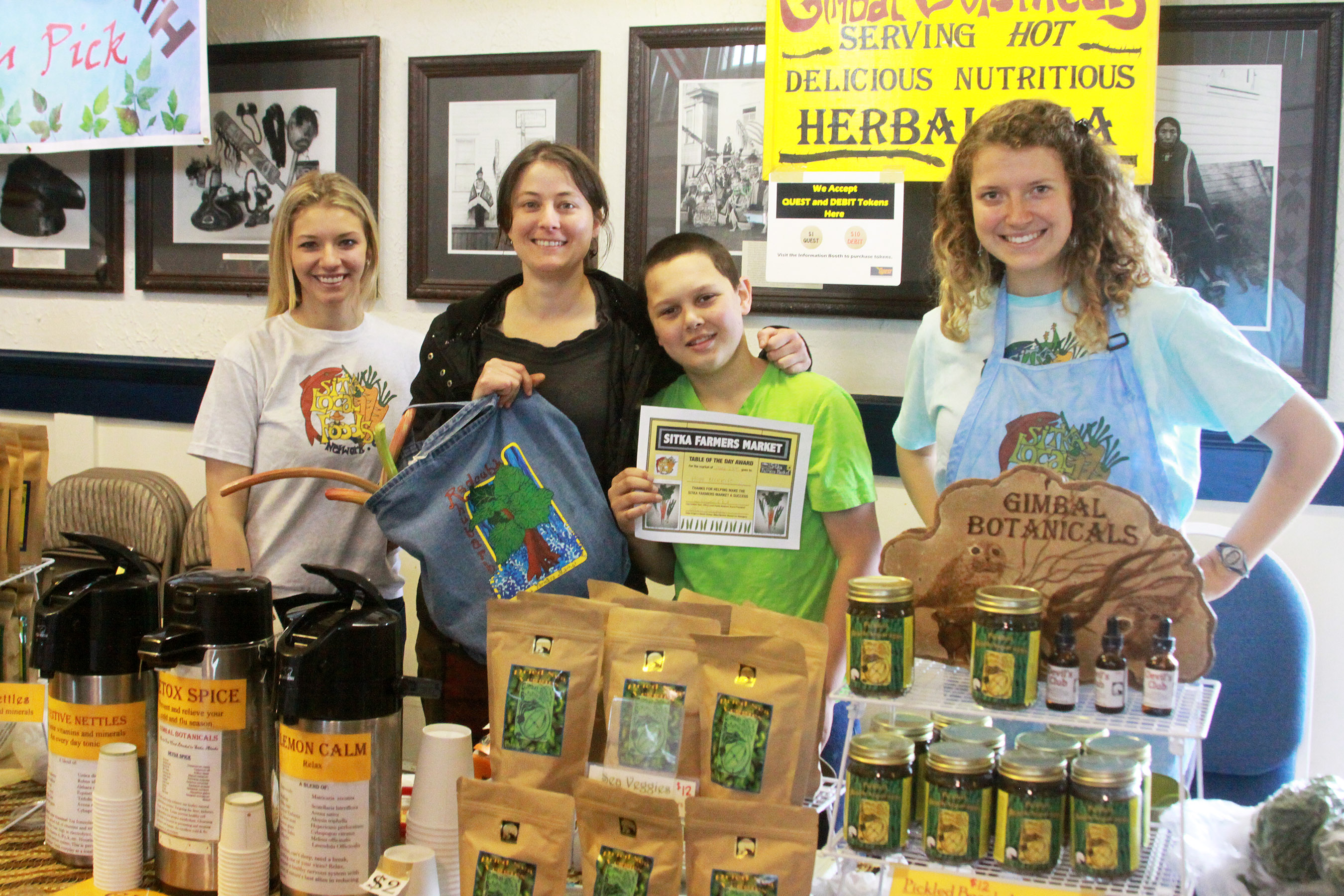











 Sitka Local Foods Network
You must be logged in to post a comment.