• Scenes from the second Sitka Farmers Market of the season

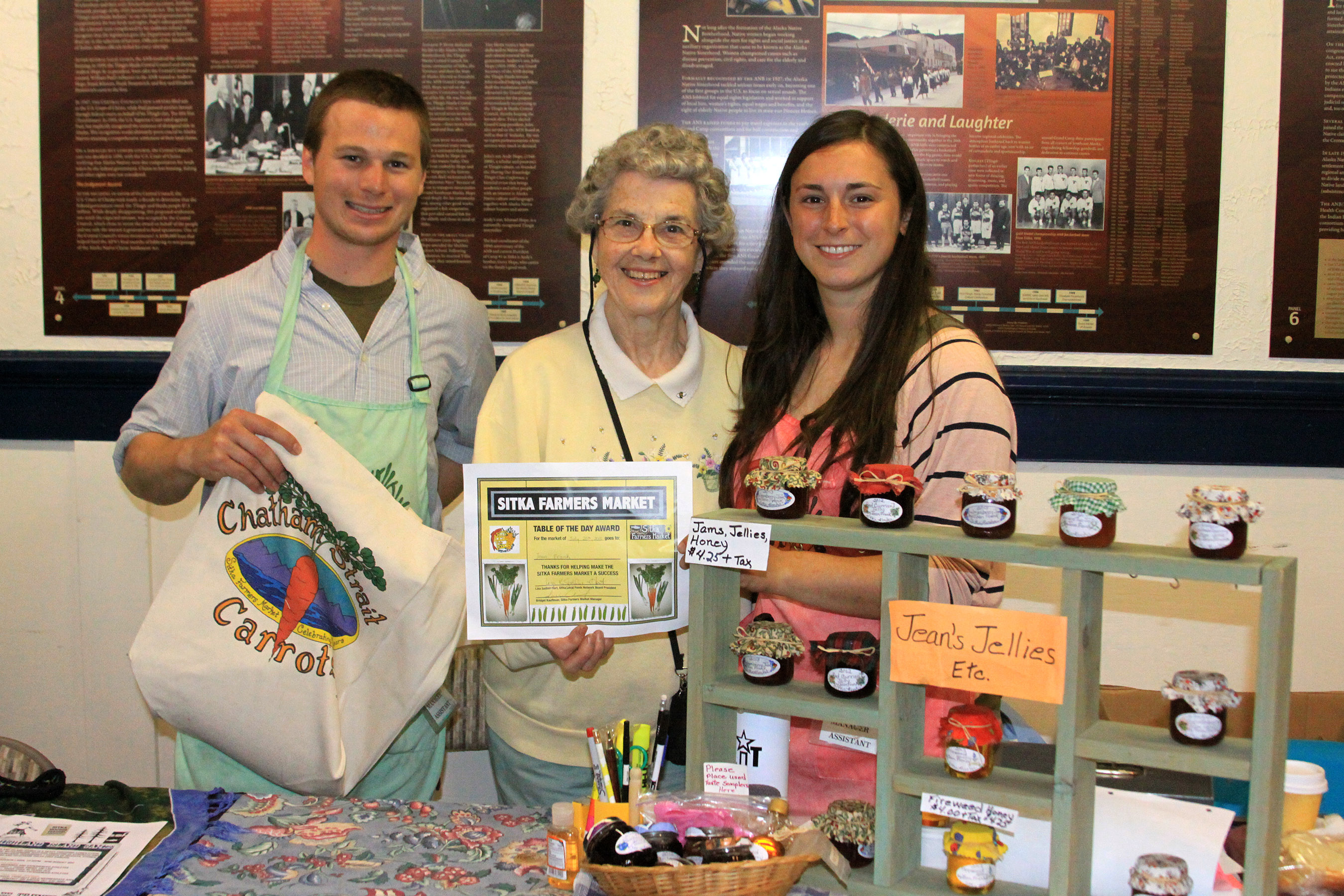
PHOTO COURTESY OF SITKA LOCAL FOODS NETWORK Sitka Farmers Market Co-Managers Garrett Bauer, left, and Sabrina Cimerol, right, present the Table Of The Day Award to Jean Frank of Jeans Jellies Etc. at the second market of the season on Saturday, July 20, at the Alaska Native Brotherhood Founders Hall in Sitka. Jean has been a regular vendor at the Sitka Farmers Market since it started, selling jellies, jams, honey and more. She received a gift bag with fresh produce, fresh rhubarb jam and a copy of the Alaska Farmers Market Cookbook. This is the sixth year of Sitka Farmers Markets, hosted by the Sitka Local Foods Network. The next market is from 10 a.m. to 1 p.m. on Saturday, Aug. 3, at the Alaska Native Brotherhood Founders Hall, 235 Katlian St. For more information about the Sitka Farmers Markets and Sitka Local Foods Network, go to http://www.sitkalocalfoodsnetwork.org/.

PHOTO COURTESY OF SITKA LOCAL FOODS NETWORK
Sitka Farmers Market Co-Managers Garrett Bauer, left, and Sabrina Cimerol, right, present the Table Of The Day Award to Jean Frank of Jeans Jellies Etc. at the second market of the season on Saturday, July 20, at the Alaska Native Brotherhood Founders Hall in Sitka. Jean has been a regular vendor at the Sitka Farmers Market since it started, selling jellies, jams, honey and more. She received a gift bag with fresh produce, fresh rhubarb jam and a copy of the Alaska Farmers Market Cookbook. This is the sixth year of Sitka Farmers Markets, hosted by the Sitka Local Foods Network. The next market is from 10 a.m. to 1 p.m. on Saturday, Aug. 3, at the Alaska Native Brotherhood Founders Hall, 235 Katlian St. For more information about the Sitka Farmers Markets and Sitka Local Foods Network, go to http://www.sitkalocalfoodsnetwork.org/.

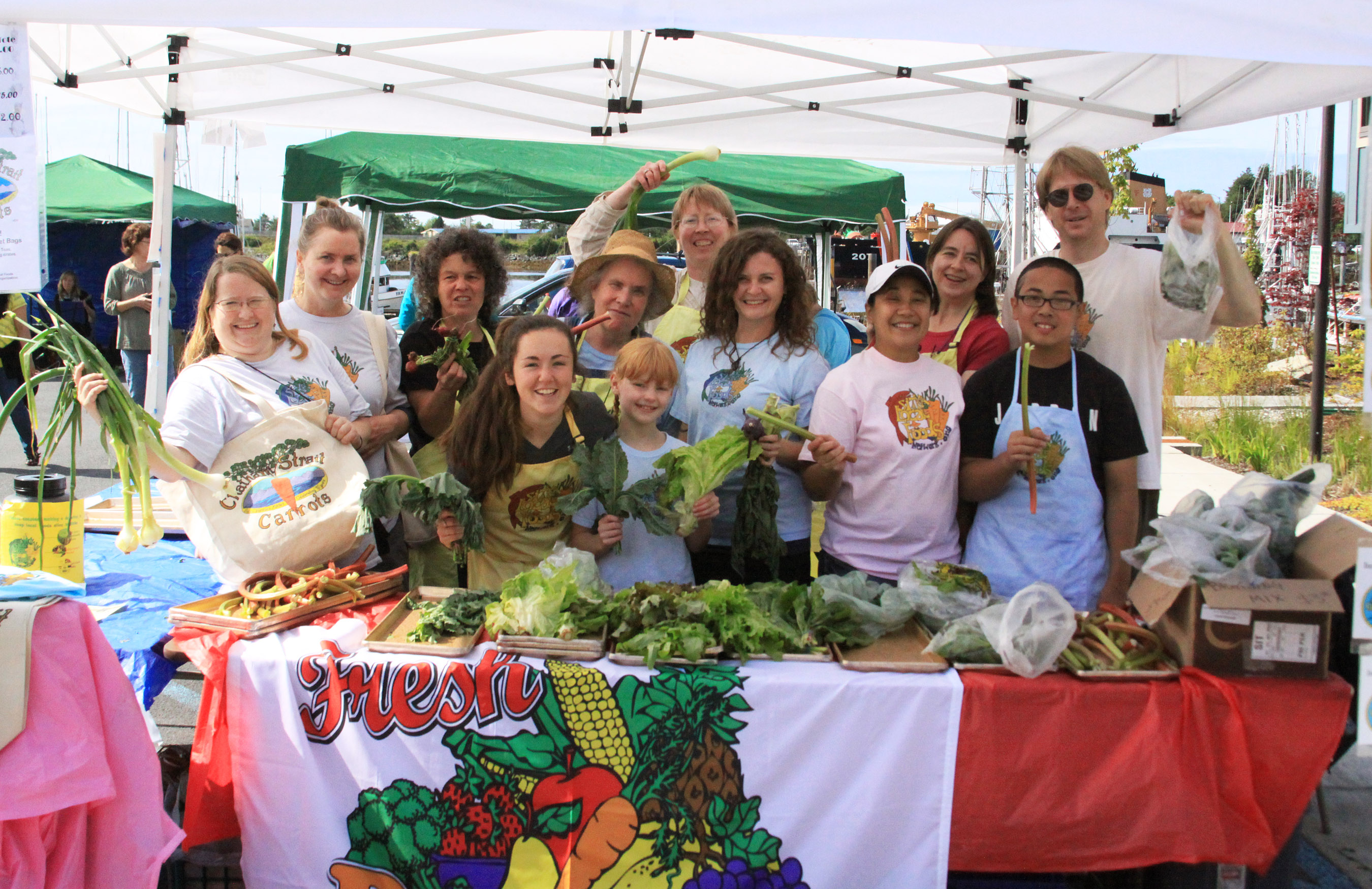
SitkaFarmersMarketSignThe second Sitka Farmers Market of the season took place on Saturday, July 20, at the Alaska Native Brotherhood Founders Hall, 235 Katlian St.

We again lucked into a break in the rain and there was a pretty good crowd for the second market of the season. We had a lot of familiar booths selling fresh veggies, fish, baked goods, arts and crafts, plus some new faces joining the vendors.

The third market of the six planned this summer will be from 10 a.m. to 1 p.m. on Saturday, Aug. 3, at ANB Founders Hall. To learn more, keep watching this site. A slideshow of scenes from the second market is below.

This slideshow requires JavaScript.

• Scenes from the first Sitka Farmers Market of the summer

PHOTO COURTESY OF SITKA LOCAL FOODS NETWORK Sitka Farmers Market Manager Bridget Kauffman, left, and co-managers Garrett Bauer, second from left, and Sabrina Cimerol, right, present the Table Of The Day Award to Erin Keenan of Bear Buns. Erin makes cloth diapers and similar products for babies. She received a gift bag with fresh produce, chocolate and a copy of the Alaska Farmers Market Cookbook. This is the sixth year of Sitka Farmers Markets, hosted by the Sitka Local Foods Network. The next market is from 10 a.m. to 1 p.m. on Saturday, July 20, at the Alaska Native Brotherhood Founders Hall, 235 Katlian St. For more information about the Sitka Farmers Markets and Sitka Local Foods Network, go to http://www.sitkalocalfoodsnetwork.org/.

PHOTO COURTESY OF SITKA LOCAL FOODS NETWORK
Sitka Farmers Market Manager Bridget Kauffman, left, and co-managers Garrett Bauer, second from left, and Sabrina Cimerol, right, present the Table Of The Day Award to Erin Keenan of Bear Buns during the first market of the summer on July 6 at the Alaska Native Brotherhood Founders Hall. Erin makes cloth diapers and similar products for babies. She received a gift bag with fresh produce, chocolate and a copy of the Alaska Farmers Market Cookbook. This is the sixth year of Sitka Farmers Markets, hosted by the Sitka Local Foods Network. The next market is from 10 a.m. to 1 p.m. on Saturday, July 20, at the ANB Founders Hall, 235 Katlian St. For more information about the Sitka Farmers Markets and Sitka Local Foods Network, go to http://www.sitkalocalfoodsnetwork.org/.

SitkaFarmersMarketSignThe Sitka Farmers Market kicked off its sixth season on Saturday, July 6, at the Alaska Native Brotherhood Founders Hall, 235 Katlian St.

We lucked into a break in the rain and there was a pretty good crowd for the first market of the season. We had a lot of familiar booths selling fresh veggies, fish, baked goods, arts and crafts, plus some new faces joining the vendors.

The second market of the six planned this summer will be from 10 a.m. to 1 p.m. on Saturday, July 20, at ANB Founders Hall. To learn more, keep watching this site. A slideshow of scenes from the first market is below.

This slideshow requires JavaScript.

• Gov. Parnell signs executive order creating the Alaska Food Resource Working Group

AlaskaFoodPolicyCouncilLogoThe following is a note sent to members of the Alaska Food Policy Council listserv by Diane Peck, MPH, RD, a public health nutritionist with the Alaska Department of Health and Social Services Obesity Prevention and Control Program. Diane also is one of the lead contacts for the Alaska Food Policy Council.

Last Friday (June 28, 2013), at the Palmer Farmers Market, Gov. Sean Parnell signed Administrative Order No. 265 (http://gov.state.ak.us/admin-orders/265.html) to establish the Alaska Food Resource Working Group (AFRWG) to recommend policies and measures to increase the purchase and consumption of local wild seafood and farm products. This is a bit different than HCR 01. The AFRWG is composed of eight state agency commissioners or their designee. “The AFRWG shall collaborate with the Alaska Food Policy Council . . . and shall invite a member of the AFPC governing board to represent the AFPC at scheduled meetings.”

The goals of the group are:

  • Develop a mission statement that promotes increased use of locally grown and harvested foods within state and local agencies, institutions, and schools;
  • Identify factors that might discourage or prevent locally harvested and produced food from being purchased by federal, state and local agencies, institutions, and schools;
  • Review existing or proposed programs, policies, statutes, and regulations that impact the state’s food system and recommend to policymakers methods to improve coordination and implementation;
  • Identify research needed to support and encourage increased consumption and production of local foods within the state; and
  • Engage with the public to seek additional input on ways to promote the above-listed goals.

Lots of legislators and several commissioners were at the signing.  The governor said this elevates the group to “sub-cabinet” status.

To learn more about the Alaska Food Policy Council, go to its website or like its Facebook page. Sitka Local Foods Network board president Lisa Sadleir-Hart represents Sitka on the Alaska Food Policy Council.

• Alaska Food Policy Council press release about the executive order

• Deadline extended on Sitka Community Food Assessment to get more completed surveys

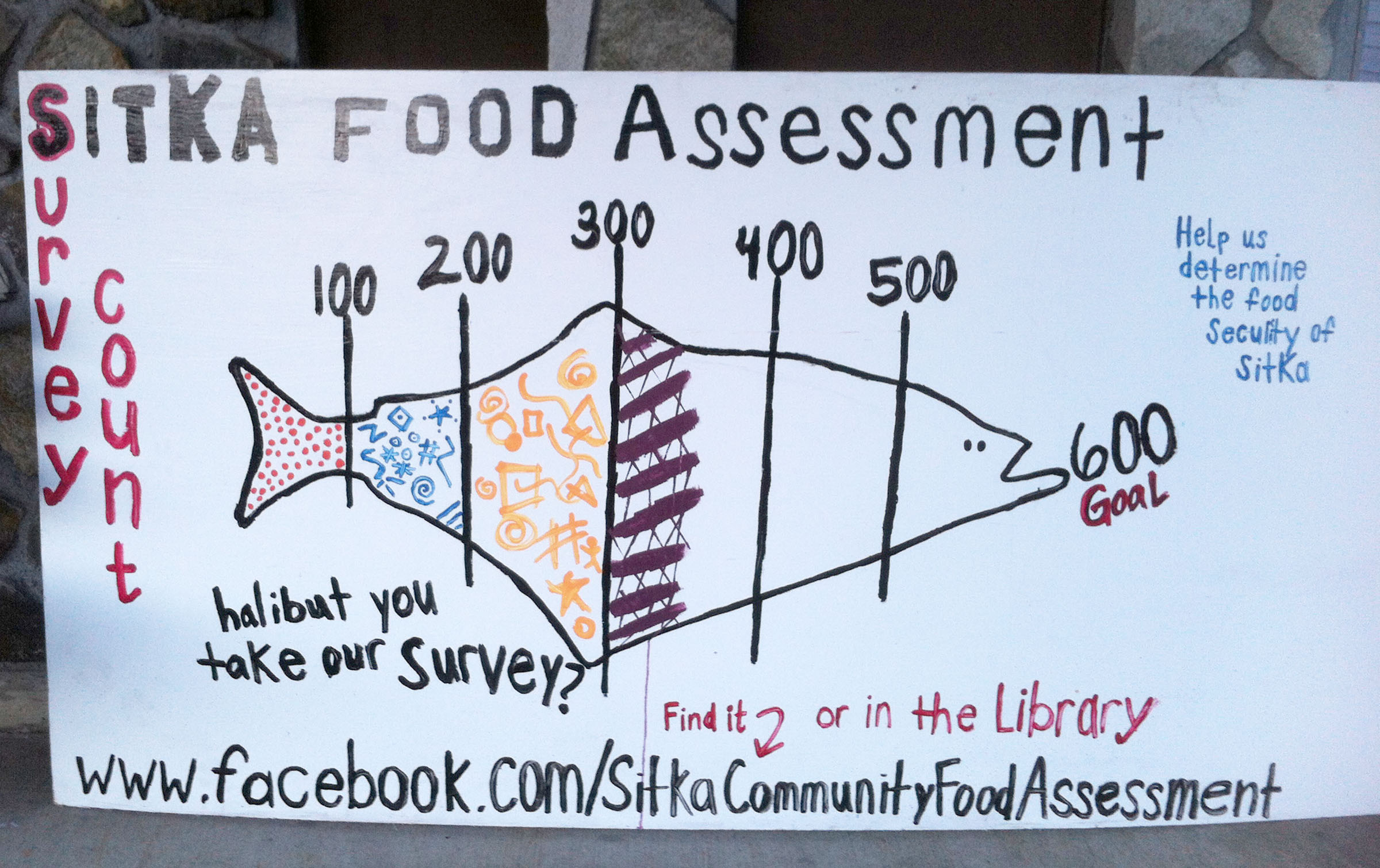
SitkaCommunityFoodAssessmentSign2

The deadline for surveys to be completed in the Sitka Community Food Assessment has been extended to the end of the month. Our goal is 600 completed surveys and as of Tuesday, May 21, we had 392 that had been recorded.

The Sitka Community Food Assessment is a 2012 Sitka Health Summit project designed to help shape food policy and improve Sitka’s food security. To learn more about the project, KCAW-Raven Radio hosted an interview with project coordinator Lisa Sadleir-Hart that aired on Monday, May 20.

Additional information can be found in this March 26 post on the Sitka Local Foods Network website, and in this April 9 article from the Daily Sitka Sentinel.

Surveys are available online at https://www.surveymonkey.com/s/MQTF22Q, or click the Sitka Community Food Assessment logo in the right column of this webpage. Printed copies are available at Kettleson Memorial Library. A sign has been posted at the corner of Lincoln and Lake streets to update people on the progress of the project.

• Sitka joins communities around the world to host a local March Against Monsanto on Saturday, May 25

March Against Monsanto Yellow 72Millions of people around the world, including several in Sitka, will take a stand by hosting a local March Against Monsanto. The Sitka march takes place at 2 p.m. on Saturday, May 25, at Castle Hill. So far, more than 370 marches around the world are planned on May 25.

The Sitka March Against Monsanto is being organized by Brett Wilcox, who has created a Facebook page with more details. Brett and his 14-year-old son, David, will take things a step (OK, many steps) further when they start a transcontinental run across the country in January to raise awareness about some of the ethically challenged practices of the agri-business Monsanto. These include creating GMO (genetically modified) foods that are unlabeled and untested, putting patents on crop seed so farmers have to pay high fees to plant food, and more.

In addition to the march, various Sitka residents will speak on a variety of topics, such as how GMO-food causes health problems, the number of former Monsanto executives who now work for our government, farmer suicides in India due to Monsanto practices, the Monsanto Protection Act slipped into the recently passed US Farm Bill, etc.

This month, Brett hosted free Monsanto Movie Nights at 7 p.m. on Fridays, May 10, 17 and 24, at Harrigan Centennial Hall.

According to a press release about the event:

Sitka’s March Against Monsanto will be held on Castle Hill, the location where Russia sold the vast territory of Alaska—land it did not own—to the U.S.A.

March organizer, Brett Wilcox, chose Castle Hill for Sitka’s March Against Monsanto for its symbolic significance. “There are many similarities between the original ‘Land Grab’ that took place with the first European expansion and Monsanto’s current global ‘Seed Grab,'” Wilcox states. “Both involve the privatization of Nature, a concept that was largely foreign to Native Americans and Alaska Natives. And both have resulted in loss of freedom and loss of life. The difference is that Monsanto’s seed grab not only further disenfranchises Native Americans; it disenfranchises all nations and all people. The citizens of the world are, as it were, sitting in our canoes in Sitka Sound, watching powerful people and corporations claim and repackage life as their own, thereby stealing our seed sovereignty and seed freedom.”

Chuck Miller, a Tlingit “Elder in Training”, will preside at the event. “My grandmother used to teach my family that we need to treat our food with respect or it will not provide for us,” Miller states. “My ancestors’ teachings are still a very big part of my life and I want to be able to pass that on to my children, grandchildren and those yet to come. GMOs are not the way to treat Mother Earth and the generations yet to come. I urge all the Native people of Alaska and our non-Native brothers and sisters to come and support this cause.”

“Sitka’s March Against Monsanto will not be a traditional march,” says Wilcox. “Sitka’s event will be a ceremony to honor nature as well as the indigenous people of Alaska and the Americas. We will stand on Castle Hill united with the people of the world in defense and protection of life and nature.”

For more information about the Sitka March Against Monsanto, contact Brett Wilcox at 747-7437 or brett@runningthecountry.com, or contact Chuck Miller at 752-9955 or cohomojo25@yahoo.com. KCAW-Raven Radio aired a story on Tuesday, May 21, about Brett’s and David’s plans to run across the country and to host this march. Brett also recorded a commentary for KCAW-Raven Radio.

• As you build your garden this spring, don’t forget to Plant A Row For The Hungry

(EDITOR’S NOTE: The following article first appeared on this site in April 2010. It is repeated because much of the information remains current and newsworthy.)

As you start to plan your garden for this spring and summer, don’t forget to Plant A Row For The Hungry. The Plant A Row For The Hungry program (also known as Plant A Row or PAR) is a national campaign by the Garden Writers Association of America that got its start in Alaska.

In the cold winter of 1994, Anchorage Daily News garden columnist and former Garden Writers Association of America President Jeff Lowenfels was returning to his hotel after a Washington, D.C., event when he was approached by a homeless person who asked for some money to buy food. Lowenfels said Washington, D.C., had signs saying, “Don’t give money to panhandlers,” so he shook his head and kept on walking. But the man’s reply, “I really am homeless and I really am hungry. You can come with me and watch me eat,” stayed with Lowenfels for the rest of his trip.

Jeff Lowenfels

Jeff Lowenfels

The encounter continued to bother Lowenfels, even as he was flying back to Anchorage. During the flight, Lowenfels came up with an idea when he started writing his weekly garden column (the longest continuously running garden column in the country, with no missed weeks since it started on Nov. 13, 1976). He asked his readers to plant one extra row in their gardens to grow food to donate to Bean’s Café, an Anchorage soup kitchen. The idea took off.

When Anchorage hosted the Garden Writers Association of America convention in 1995, Lowenfels took the GWAA members to Bean’s Café to learn about the Plant A Row For Bean’s Café program. The Garden Writers Association of America liked the idea, and it became the national Plant A Row For The Hungry campaign (also known as Plant A Row or PAR). In 2002, the Garden Writers Association Foundation was created as a national 501(c)(3) nonprofit to manage the Plant A Row For The Hungry program.

“I am not surprised by the growth of PAR,” Lowenfels wrote in an e-mail to the Sitka Local Foods Network. “It is now in all 50 states and across Canada and there are thousands of variations of the original program — from prison gardens for the hungry to botanical gardens donating their produce from public display gardens. This is because gardeners always share information and extra food, so the idea was a natural.”

It took five years for the program to reach its first million pounds of donated food, but the second million only took two years and the next eight years saw a million pounds of donated food (or more) each year. Since 1995, more than 14 million pounds of food have been donated. Not only that, the program is getting ready to expand overseas to Australia, England and other countries with avid gardeners.

“We have supplied something in the vicinity of enough food for 50 million meals,” Lowenfels wrote in his e-mail. “Gardeners can solve this hunger problem without the government. And we don’t need a tea party to do it! Or chemicals, I might add, as author of a book on organic gardening (Teaming With Microbes, written with Wayne Lewis)!” (Lowenfels recently released a second book, Teaming With Nutrients, which is a follow-up to his first book).

According to the U.S. Department of Agriculture, one out of every eight U.S. households experiences hunger or the risk of hunger. Many people skip meals or eat too little, sometimes going an entire day or more without food. About 33 million Americans, including 13 million children, have substandard diets or must resort to seeking emergency food because they can’t always afford to buy the food they need. In recent years the demand for hunger assistance has increased 70 percent, and research shows that hundreds of children and adults are turned away from food banks each year because of lack of resources.

While many people credit Lowenfels for creating the Plant A Row For The Hungry program, Lowenfels says the real heroes are the gardeners growing the extra food and donating it to local soup kitchens, senior programs, schools, homeless shelters and neighbors. You can hear him pass along the credit to all gardeners at the end of this interview last year with an Oklahoma television station (video also embedded below).

“One row. That’s all it takes. No rules other than the food goes to the hungry. You pick the drop-off spot or just give it to a needy friend or neighbor. Nothing slips between the lip and the cup, I say,” Lowenfels wrote in his e-mail.

For people wanting to Plant A Row For The Hungry in Sitka, there are several places that would love to help distribute some fresh locally grown veggies or berries to those who are less fortunate, such as the Salvation Army, Sitkans Against Family Violence (SAFV), local churches, Sitka Tribe of Alaska and other organizations. The food the Sitka Local Foods Network grows at St. Peter’s Fellowship Farm communal garden goes to the Sitka Farmers Market.

People who participate in the Alaska Food Stamp program can use their Alaska Quest Cards to purchase produce and fish at the Sitka Farmers Market and other farmers markets around the state. People who participate in the  WIC (Women, Infants, Children) supplemental food program (operated in Southeast Alaska by the SouthEast Alaska Regional Health Consortium or SEARHC) also can use special farmers market vouchers to buy fresh vegetables at the Sitka Farmers Market and other farmers markets in Alaska (this is part of the national WIC Farmers Market Nutrition Program).

The Sitka Local Foods Network also takes donations of local produce to sell at the Sitka Farmers Markets, and all proceeds are used to help pay for SLFN projects geared toward helping more people in Sitka grow and harvest local food. For more information, contact SLFN President Lisa Sadleir-Hart or one of the other board members at sitkalocalfoodsnetwork@gmail.com.

• 2011 Plant A Row For The Hungry marketing brochure

• 2009 Start a Local Plant A Row For The Hungry campaign brochure

• Sitka Local Foods Network board reorganizes; recruiting three new board members and other volunteers

The 2011-12 Sitka Local Foods Network Board of Directors at its winter board retreat on Dec. 3, 2011. From left are Lisa Sadleir-Hart, Doug Osborne, Maybelle Filler, Cathy Lieser, Robin Grewe, Linda Wilson and Kerry MacLane. Not pictured is Tom Crane.

The 2011-12 Sitka Local Foods Network Board of Directors at its winter board retreat on Dec. 3, 2011. From left are Lisa Sadleir-Hart, Doug Osborne, Maybelle Filler, Cathy Lieser, Robin Grewe, Linda Wilson and Kerry MacLane. Not pictured is Tom Crane.

The Sitka Local Foods Network Board of Directors has a new president. Lisa Sadleir-Hart has taken the spot following the recent resignation by founding president Kerry MacLane, who wants to devote more time to getting the Sitka Community Greenhouse and Education Center built and other projects.

Joining Lisa as board officers for 2013 are Cathy Lieser as vice president, Linda Wilson as secretary and Maybelle Filler as treasurer. Kerry remains on the board, for now, but will leave the board once replacement board members are found. The Sitka Local Foods Network currently needs three new board members to complete the board of directors. In addition to Kerry’s planned departure, we recently had two board members move out of town.

Board members are concerned about increasing access to local food for all Sitka residents. They also are concerned about rising food prices in Sitka, and they want to advocate for more community and family gardens in Sitka.

Board members help direct the Sitka Local Foods Network, a non-profit that promotes the harvest and use of local food in Sitka. In addition to setting the focus of the group, board members also help on a wide variety of projects such as the Sitka Farmers Market, St. Peter’s Fellowship Farm, Blatchley Community Garden, Let’s Grow Sitka, the Sick-A-Waste compost project, the Sitka Community Food Assessment project, Sitka Fish-To-Schools, other school education projects and more.

To apply for a spot on the board, please fill out the attached application and submit it to sitkalocalfoodsnetwork@gmail.org. For more information, contact Lisa Sadleir-Hart at 747-5985.

We also are looking to increase our pool of volunteers who will help out during the various projects hosted by the network each year (no formal application needed, just send us your name/contact info and what types of projects you enjoy).

The next Sitka Local Foods Network board meeting is at 6:30 p.m. on Tuesday, May 14, at the Sitka Unitarian Universalists Fellowship Hall (408 Marine St.). The board generally meets from 6:30-8 p.m. on the first Tuesday of each month, except during the summer when board members are busy working with the Sitka Farmers Market and St. Peter’s Fellowship Farm communal garden.

• Sitka Local Foods Network board of directors application

• Sitka Local Foods Network seeks manager and co-manager for 2013 Sitka Farmers Markets

SitkaFarmersMarketSignThe Sitka Local Foods Network is looking for a manager and co-manager to coordinate the 2013 Sitka Farmers Markets this summer. These are contract positions, and the manager and co-manager (who reports to the manager) receive small stipends for their work organizing the six scheduled farmers markets this summer.

This is the sixth year of operation for the Sitka Farmers Market, which features six markets from 10 a.m. to 2 p.m. every other Saturday from July through September at the Alaska Native Brotherhood Founders Hall (this year’s dates are July 6, 20, Aug. 3, 17, 31, and Sept. 14). SLFNGroupwLindaThe farmers markets feature booths from local farmers/gardeners, local fishermen, and artisans and craftspeople. These events are great Sitka gathering places, and we promote local foods and other local goods at them.

A detailed description of the market manager duties can be found at the link below. For more information or to submit applications, contact Maybelle Filler at 747-2761 or 738-2761, or e-mail the Sitka Local Foods Network Board of Directors at sitkalocalfoodsnetwork@gmail.com. The market manager of the Sitka Farmers Market reports to the Sitka Local Foods Network Board of Directors.

• Description of duties for market manager of the Sitka Farmers Market Manager (2013)

• Alaskans Own™ community supported fisheries program announces season subscription packages for Sitka, Juneau and Anchorage

AO_LogoSitka-based Alaskans Own seafood recently announced its subscription prices for its 2013 Community Supported Fisheries (CSF) program in Sitka and Juneau, and this year the program will start delivery to Anchorage.

Alaskans Own was the first CSF program in the state, modeling its program after the successful Community Supported Agriculture (CSA) programs that let customers deal directly with harvesters so they can buy subscription shares to the year’s crop/catch.

IMG_2716 (Custom)This is the fourth year of the Alaskans Own CSF program, and this year there are four-month and six-month subscriptions. The six-month subscriptions  allow people to keep receiving freshly caught seafood through October instead of August, when the traditional four-month subscriptions end. Half-subscriptions also are available. Subscriptions include a mix of locally caught black cod (sablefish), halibut, king salmon, coho salmon, lingcod and miscellaneous rockfish, depending on the commercial fishing season. This year there also will be a bonus box of tanner crab from the partner Alaska Marine Conservation Council program in Kodiak.

The Alaskans Own expansion into Anchorage recently was featured on the Alaska Dispatch website. The Alaskans Own program is associated with the Alaska Sustainable Fisheries Trust. The Alaska Sustainable Fisheries Trust’s mission is to strengthen Alaskan fishing communities and marine resources through scientific research, education, and economic opportunity.

Here is Alaskans Own CSF program information provided in a recent e-mail sent to the program’s past subscribers and other interested folk:

Subscription shares are offered again as both a full or half share, 4 month or 6 month option. Subscriptions include a mix of black cod, halibut, king and coho salmon, lingcod and rockfish. Our approximately 1-lb. portions are flash-frozen and vacuum packed—enjoy now or keep frozen for your winter home pack. Pick-ups will take place once per month at the Mill Building/Sitka Sound Science Center in Sitka, at Reliable Transfer near the Nugget Mall in Juneau, and a location TBA in Anchorage.
  
Find all the details about our 4-month and 6-month subscriptions below.
2013 PRICES AND SPECIES MIX*
4-Month Summer Subscriptions (May, June, July, August)
 4-MONTH FULL SHARE: $535 total for 40 pounds of seafood:
Lingcod                  10 lbs.          (May)
Halibut                   4 lbs.          (May)
Black cod               2 lbs.           (June)
Misc. rockfish          8 lbs.          (June)
King salmon             6 lbs.          (July)
Coho salmon           10 lbs.         (August)
4-MONTH HALF SHARE: $290 for 20 pounds of seafood:
Lingcod                  5 lbs.          (May)
Halibut                   2 lbs.          (May)
Black cod               1 lbs.          (June)
Misc. rockfish          4 lbs.          (June)
King salmon             3 lbs.          (July)
Coho salmon            5 lbs.         (August)
 
6-Month Summer-Fall Subscriptions (May, June, July, August, September, October)
6-MONTH FULL SHARE: $795 for 60 pounds of seafood:
Lingcod                 15 lbs.          (8 lbs. May + 4 lbs. September)
Halibut                   6 lbs.          (4 lbs. May + 2 lbs. October)
Black cod               3 lbs.          (2 lbs. June + 1 lb. September)
Misc. rockfish         12 lbs.         (10 lbs. June + 5 lbs. September)
King salmon             9 lbs.          (6 lbs. July + 3 lbs. October)
Coho salmon          15 lbs.          (10 lbs. August + 5 lbs. October)
6-MONTH HALF SHARE: $415 for 30 pounds of seafood:
Lingcod                  8 lbs.          (4 lbs. May + 2 lbs. September)
Halibut                   3 lbs.          (2 lbs. May + 1 lbs. October)
Black cod                2 lbs.          (1 lb. June + 1 lb. September)
Misc. rockfish           6 lbs.         (5 lbs. June + 3 lbs. September)
King salmon             4 lbs.          (3 lbs. July + 1 lb. October)
Coho salmon            7 lbs.          (5 lbs. August + 2 lbs. October)
*The species mix outlined above is subject to change, as we are basing costs on estimated dock prices, which fluctuate throughout the season. For example, if in July king prices are higher than expected, we’ll provide a little less of that species and increase the pounds of coho you receive. Bottom line: we will ensure you get the best mix of seafood for the subscription price. Due to increased costs to shipping, labor, and other logistics, we have had to increase our subscriptions costs minimally this year.
How do you sign up for the 2013 season? Just reply to this email with your name, address, phone number and the subscription package you’d like. We’ll put you on the list and send a confirmation email along with instructions for payment. This year we will offer two different payment options: either send in a check to Alaskans Own or use PayPal on our new Alaska Sustainable Fisheries Trust website. Please do not pay for a share until you receive confirmation for your subscription.
Our first pick will be in late May, date to be announced. However, we expect our subscription slots to fill up soon–so, please don’t delay in getting your name on the list.
We appreciate your continued support of Alaskans Own.
For more information about subscribing, contact Alaskans Own at info@alaskansown.com. For information about the Alaska Sustainable Fisheries Trust, call 907-747-3477 or send e-mail to info@thealaskatrust.org.

• Sitka Community Food Assessment featured in the Tuesday, April 9, issue of the Daily Sitka Sentinel

Courtney Bobsin, a Jesuit Volunteer with the Sitka Conservation Society who is helping the Sitka Community Food Assessment collect data, has her computer logged in and ready to take the survey. (Daily Sitka Sentinel photo by James Poulson, used with permission)

Courtney Bobsin, a Jesuit Volunteer with the Sitka Conservation Society who is helping the Sitka Community Food Assessment collect data, has her computer logged in and ready to take the survey. (Daily Sitka Sentinel photo by James Poulson, used with permission)

(This article originally appeared in the Tuesday, April 9, 2013, edition of the Daily Sitka Sentinel. It is used here with permission.)

Sitkans Taking Stock of Local Food Security

By SHANNON HAUGLAND
Sentinel Staff Writer

SitkaCommunityFoodAssessmentLogoCan you afford to eat the foods you want in Sitka?

How long could you survive on the food you have in your house today?

How often do you eat foods that are gathered locally?

The Sitka Food Security Survey is trying to find the answers to these and other questions related to food security in Sitka.

The survey is one of the projects of the Sitka Community Food Assessment group that was started at the 2012 Health Summit last fall.

“Community food security is looking at how secure are we as a community if for some reason something happened in the Lower 48 and we couldn’t get barges up here,” said Lisa Sadleir-Hart, the community food assessment coordinator for the Sitka Community Food Assessment project. “Are there things we could do differently? … We’re pretty dependent on the food coming from outside.”

The group is looking at food security from both a household standpoint and a community standpoint. While some information has been collected, more is needed on a home-by-home basis, Sadleir-Hart said.

To that end, Sadleir-Hart is hoping residents go online to participate in the food security survey to document where the problems are, where the strengths are and how to start addressing the shortcomings. The assessment will make it easier to apply for grants to help the community strengthen its food security position, she said.

“Our goal is 600 completed surveys, which is about 10 percent of the adult population here,” she said. She has set a tentative deadline by the end of this month.

Among many of the issues considered, Sadleir-Hart wonders how the 44-percent increase in food prices from 2006 to 2011 is affecting choices residents are making.

“Given these increases, fuel prices, housing prices, housing costs, at some point you have to make a decision: if you pay for one you might not be able to pay for something else,” she said. “People are hurting when it comes to food.”

The survey asks whether residents are able to eat as much as they need, and eat the foods they want to eat, or if they make sacrifices or eat less in order to feed others, when they are financially strapped.

Some of the focus in the survey is whether residents take advantage of foods that are available locally, including fish, deer, mushrooms, seaweed and berries, among the dozens of possibilities. Some questions are aimed at traditional and customary foods.

From a community standpoint, some data already indicates a level of “insecurity,” since 95 percent of the food Sitkans consume is shipped in from the Lower 48.

“Does our community have the capacity to feed itself if a natural disaster left us isolated?” is one of the survey’s underlying questions.

The assessment project’s goals are to create a community food security profile; map Sitka’s existing food resources and production capacity; and assess household food security, food accessibility, and food availability and affordability.

The work group for the project said community food security is a relatively new concept that covers a variety of disciplines, including community nutrition, nutrition education, public health, sustainable agriculture, and anti-hunger and community development.

“As such, no universally accepted definition exists,” the group said in a handout.

Sadleir-Hart said community food security can be seen as an expansion of the concept of household food security.

“Whereas household food security is concerned with the ability to acquire food at the household level, community food security focuses on the underlying social, economic and institutional factors within a community that affect the quantity and quality of food available …” the handout said.

Affordability is another issue that can affect community food security, Sadleir-Hart said.

The Sitka Community Food Assessment group from the Sitka Health Summit started by collecting data already available locally. Sitka Conservation Society contributed the Jesuit Volunteer, Courtney Bobsin, to work part-time to collect data on local producers, senior and tribal food programs, food banks and other food assistance programs.

“She’s been collecting lots of great information,” Sadleir-Hart said.

The assessment team is using the Food Security Toolkit from the U.S. Department of Agriculture to guide the process. Sadleir-Hart said the local effort received a head-start on the assessment by looking at Kenai’s food security survey designed by the University of Alaska Fairbanks Cooperative Extension Service. The Sitka Local Foods Network, which runs the Sitka Farmers Market, is also involved in the project.

The Sitka Community Food Assessment project received a $15,000 SEARHC Community Transformation Grant to fund Sadleir-Hart’s part-time position, and data analysis.

The goals of the assessment are to improve Sitka’s understanding of the local food system, identify the system’s strengths and weaknesses, inform decisions about policies and ways to improve Sitka’s security, and position Sitka to access grant funding for food system improvement.

Years ago, Sadleir-Hart said, more people in Sitka had vegetable gardens and some kept milk cows and other farm animals. The potential for increasing the amount of locally produced food still exists, and with it the prospect for economic development.

“There are a lot of different angles we could explore, from a community perspective,” she said.

Focus groups are also being called to continue to collect information about food and the community.

The Sitka Community Food Assessment group is looking ahead to the first annual Sitka Food Summit in November, when citizens review the findings of the data collection and start talking about ways to improve the current food system.

The survey can be reached by typing Sitka Community Food Assessment on Facebook, and going to the “Survey Monkey” link. The survey is filled out anonymously. The direct link to the survey is: https://www.surveymonkey.com/s/MQTF22Q.