• Fish to Schools serves up a coho lunch Wednesday to start off the school year

SCSCohoPortionsForCooking

Fish to Schools Flyer_2013-2014The Fish to Schools program kicked off its 2013-14 school year with a coho salmon lunch (baked with salt and pepper) on Wednesday, Sept. 11, at Sitka High School, Blatchley Middle School and Keet Gooshi Heen Elementary School.

The Fish to Schools program is a project that came out of the 2010 Sitka Health Summit, and now is coordinated by the Sitka Conservation Society. Local commercial fishermen have been donating fish to the program this summer, helping sustain the program through the school year.

The fish lunches are served at Sitka High School, Blatchley Middle School and Keet Gooshi Heen Elementary School on the second and fourth Wednesdays of the month. The students at Pacific High School (Sitka’s alternative high school where the students do the cooking) and Mount Edgecumbe High School also have Fish to Schools, but they are served on a different schedule at those schools. A schedule for upcoming Fish to Schools lunches is posted to the right.

For more information about the Fish To Schools program, contact Tracy Gagnon at the Sitka Conservation Society at 747-7509 or tracy@sitkawild.org. Also, the Stream to Plate program, a companion program of Fish to Schools, recently was featured on Delish.com in a feature about “Cool Cafeterias: The New Wave of School Lunch.”

• A 2010 Sitka Health Summit project starts to bear fruit

RedApplesKCAW

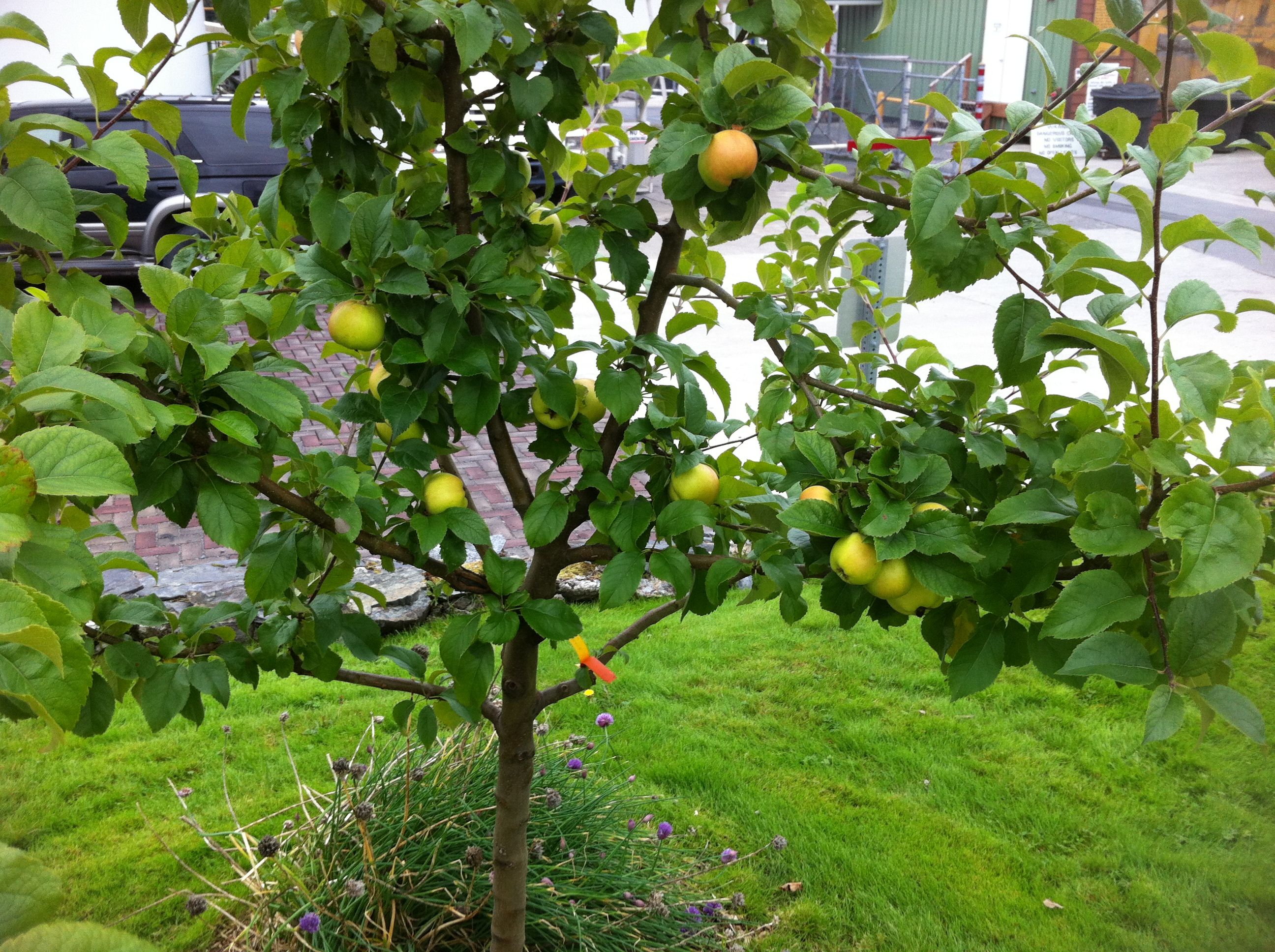
GreenApplesKCAWOne of the 2010 Sitka Health Summit community wellness projects was to plant a bunch of apple, crabapple and cherry trees around town as a way to provide fresh fruit for people as they wander about Sitka.

When we planted the trees, we knew it would take a couple of years before we started seeing any fruit. Several of the trees were planted on public land, with several Sitka residents also buying the saplings to plant at their homes and offices.

On Tuesday, Sept. 10, a couple of the trees planted in front of the historic Cable House (home of the KCAW-Raven Radio station and the Larkspur Café) were full of apples, even though a couple of weeks earlier it didn’t appear these smaller trees had any fruit.  It’s nice to see some of the trees are producing.


• Sitka’s ‘Fish To Schools’ program puts out call to commercial fishermen for donations

Fishermen_Donation_Updated Aug2013

The Fish To Schools program in Sitka has put out the call looking for donations of commercially caught fish for the upcoming school year. Donations are being accepted from Aug. 18-25 at Sitka Sound Seafoods and Seafood Producers Cooperative. (NOTE, the time period for donations has been extended. Please call the numbers below to see if more fish still is needed.)

SCS-031_smFishToSchoolsTacoThe Sitka Fish To Schools project (click here to see short video) got its start as a community wellness project at the 2010 Sitka Health Summit, and now is managed by the Sitka Conservation Society. It started by providing a monthly fish dish as part of the school lunch as Blatchley Middle School, and since then has grown to feature regular fish dishes as part of the lunch programs at Keet Gooshi Heen Elementary School, Blatchley Middle School, Sitka High School, Pacific High School (where the alternative high school students cook the meals themselves) and Mount Edgecumbe High School.

In addition to serving locally caught fish meals as part of the school lunch program, the Fish To Schools program also brings local fishermen, fisheries biologists and chefs to the classroom to teach the kids about the importance of locally caught fish in Sitka. The program received an innovation award from the Alaska Farm To Schools program during a community celebration dinner in May 2012, and now serves as a model for other school districts from coastal fishing communities.

Due to state regulations, the Sitka Fish To Schools program can only accept donations of fish that have been commercially caught, and it cannot accept fish from sport or subsistence fishermen. The donation period is timed with the coho salmon season, and fishermen can get more information or pledge a donation by contacting Beth Short-Rhodes at 738-9942 or elianise@yahoo.com.

For more information about the Fish To Schools program, contact Tracy Gagnon at the Sitka Conservation Society at 747-7509 or tracy@sitkawild.org.

• Sitka to host six farmers markets in 2013 starting on Saturday, July 6

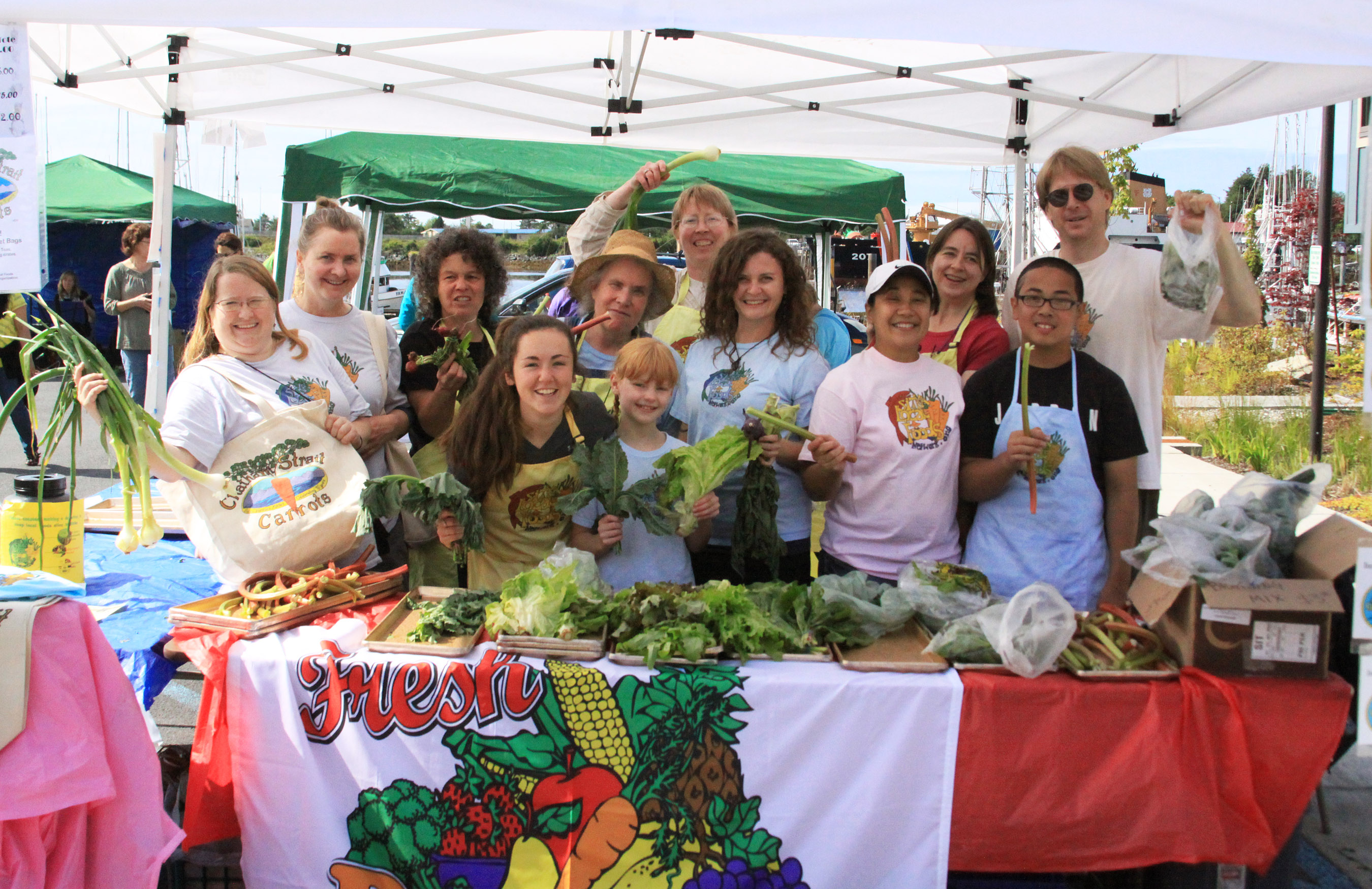
SitkaFarmersMarketSignThe Sitka Local Foods Network will host its sixth summer of Sitka Farmers Markets with six markets this year starting on July 6 and taking place on alternate Saturdays through Sept. 14. The Sitka Farmers Markets give Sitka residents a chance to buy and sell locally produced food and crafts.

The Sitka Farmers Markets take place from 10 a.m. to 1 p.m. on Saturday, July 6, 20, Aug. 3, 17, 31, and Sept. 14 at the Alaska Native Brotherhood Founders Hall (235 Katlian St.). The markets feature local seafood (fresh, frozen, and cooked, ready to eat), locally grown and harvested fruits and vegetables, baked goods, locally made jams and jellies, live entertainment, locally brewed and roasted coffee, music, local arts and crafts, and a variety of other items gathered or made in Sitka. We emphasize local products and lots of fun. We are the first farmers market in Southeast Alaska to accept WIC coupons and Quest EBT for Food Stamps. You also can vote for the Sitka Farmers Market in the America’s Favorite Farmers Markets contest by following the links at http://www.sitkalocalfoodsnetwork.org/.

“The Sitka Farmers Market is a great way to connect with community members and support local entrepreneurs,” Sitka Local Foods Network Board President Lisa Sadleir-Hart said. “Circulating your dollars locally also has a multiplying effect and helps your neighbors.”

SLFNGroupwLindaThe Sitka Farmers Market started as a community wellness project that came out of a health priority planning meeting at the 2008 Sitka Health Summit. These events are sponsored by the Sitka Local Foods Network, Alaska Native Brotherhood Camp No. 1, Alaska Native Sisterhood Camp No. 4, Baranof Island Housing Authority, the Alaska Farmers Market Association and the SEARHC Health Promotion and Diabetes Prevention programs.

“We are excited to have Bridget Kaufmann, bread-baker extraordinaire and former vendor, as our new market manager,” Sadleir-Hart said. “Bridget brings loads of enthusiasm and some new ideas to the market and is focused on creating a sustainable market that can be in Sitka for the duration.” AmeriCorps volunteers Sabrina Cimerol and Garrett Bauer will assist Bridget and share co-market managing duties. “As always the market will be a place to support the growing local food movement in Sitka and learn more about how to eat more sustainably.”

Vendor fees are $30 for a 6-foot table, $40 for an 8-foot table and $20 for a 4-foot table. Vendors with their own tents pay $5 per foot. As always, we offer cost incentives for vendors growing locally produced food. The fees will help us cover the costs of renting ANB Founders Hall and its kitchen, hiring musicians and other expenses. To learn more about being a vendor or to sign up for a table, contact Sitka Farmers Market Coordinator, Bridget Kauffman at 738-8683 or by e-mail sitkafarmersmarket@gmail.com. Vendor rules, registration forms and other information for potential vendors can be found on the Documents page at http://www.sitkalocalfoodsnetwork.org/.

• Deadline extended on Sitka Community Food Assessment to get more completed surveys

SitkaCommunityFoodAssessmentSign2

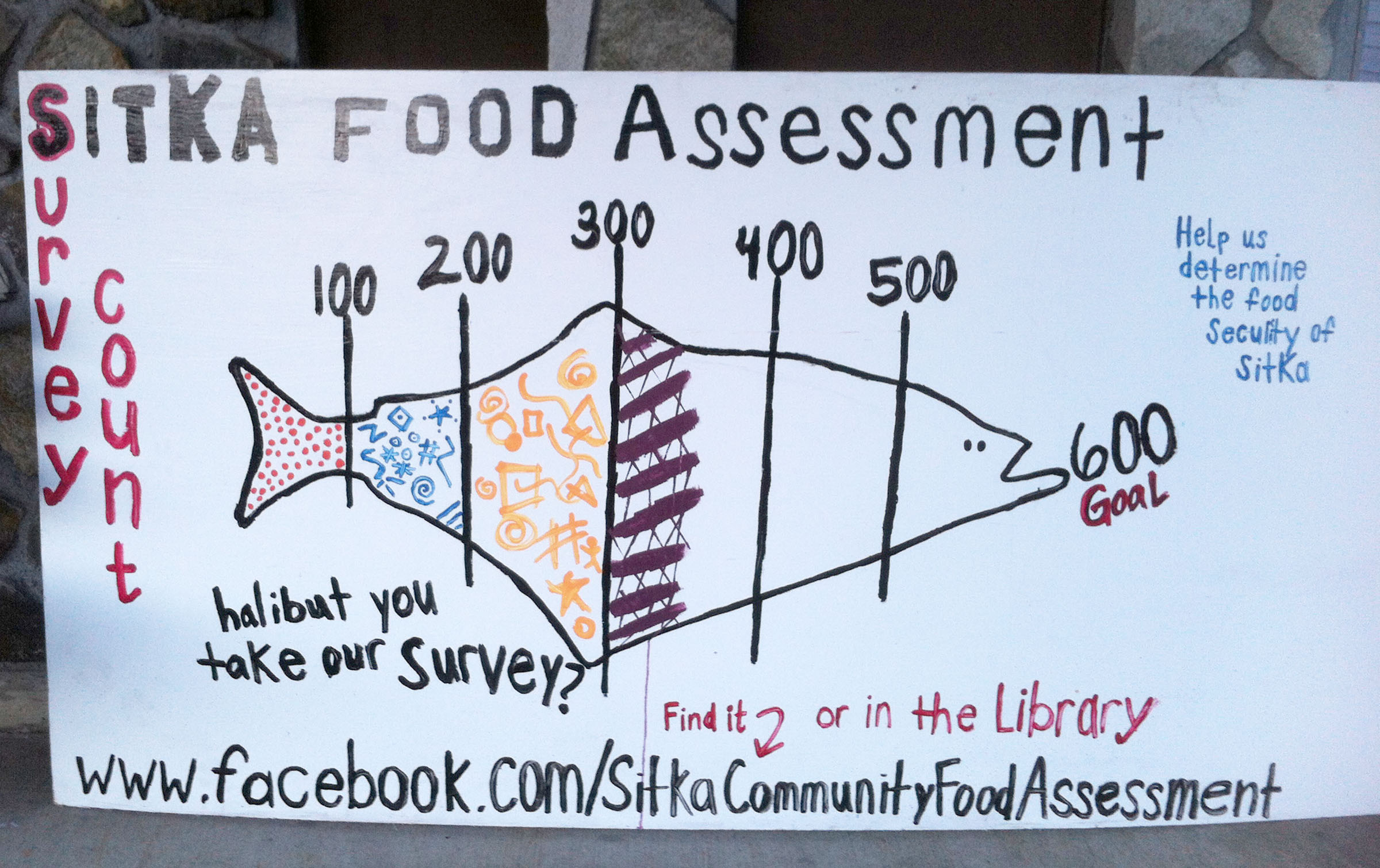
The deadline for surveys to be completed in the Sitka Community Food Assessment has been extended to the end of the month. Our goal is 600 completed surveys and as of Tuesday, May 21, we had 392 that had been recorded.

The Sitka Community Food Assessment is a 2012 Sitka Health Summit project designed to help shape food policy and improve Sitka’s food security. To learn more about the project, KCAW-Raven Radio hosted an interview with project coordinator Lisa Sadleir-Hart that aired on Monday, May 20.

Additional information can be found in this March 26 post on the Sitka Local Foods Network website, and in this April 9 article from the Daily Sitka Sentinel.

Surveys are available online at https://www.surveymonkey.com/s/MQTF22Q, or click the Sitka Community Food Assessment logo in the right column of this webpage. Printed copies are available at Kettleson Memorial Library. A sign has been posted at the corner of Lincoln and Lake streets to update people on the progress of the project.

• Sitka Community Food Assessment featured in the Tuesday, April 9, issue of the Daily Sitka Sentinel

Courtney Bobsin, a Jesuit Volunteer with the Sitka Conservation Society who is helping the Sitka Community Food Assessment collect data, has her computer logged in and ready to take the survey. (Daily Sitka Sentinel photo by James Poulson, used with permission)

Courtney Bobsin, a Jesuit Volunteer with the Sitka Conservation Society who is helping the Sitka Community Food Assessment collect data, has her computer logged in and ready to take the survey. (Daily Sitka Sentinel photo by James Poulson, used with permission)

(This article originally appeared in the Tuesday, April 9, 2013, edition of the Daily Sitka Sentinel. It is used here with permission.)

Sitkans Taking Stock of Local Food Security

By SHANNON HAUGLAND
Sentinel Staff Writer

SitkaCommunityFoodAssessmentLogoCan you afford to eat the foods you want in Sitka?

How long could you survive on the food you have in your house today?

How often do you eat foods that are gathered locally?

The Sitka Food Security Survey is trying to find the answers to these and other questions related to food security in Sitka.

The survey is one of the projects of the Sitka Community Food Assessment group that was started at the 2012 Health Summit last fall.

“Community food security is looking at how secure are we as a community if for some reason something happened in the Lower 48 and we couldn’t get barges up here,” said Lisa Sadleir-Hart, the community food assessment coordinator for the Sitka Community Food Assessment project. “Are there things we could do differently? … We’re pretty dependent on the food coming from outside.”

The group is looking at food security from both a household standpoint and a community standpoint. While some information has been collected, more is needed on a home-by-home basis, Sadleir-Hart said.

To that end, Sadleir-Hart is hoping residents go online to participate in the food security survey to document where the problems are, where the strengths are and how to start addressing the shortcomings. The assessment will make it easier to apply for grants to help the community strengthen its food security position, she said.

“Our goal is 600 completed surveys, which is about 10 percent of the adult population here,” she said. She has set a tentative deadline by the end of this month.

Among many of the issues considered, Sadleir-Hart wonders how the 44-percent increase in food prices from 2006 to 2011 is affecting choices residents are making.

“Given these increases, fuel prices, housing prices, housing costs, at some point you have to make a decision: if you pay for one you might not be able to pay for something else,” she said. “People are hurting when it comes to food.”

The survey asks whether residents are able to eat as much as they need, and eat the foods they want to eat, or if they make sacrifices or eat less in order to feed others, when they are financially strapped.

Some of the focus in the survey is whether residents take advantage of foods that are available locally, including fish, deer, mushrooms, seaweed and berries, among the dozens of possibilities. Some questions are aimed at traditional and customary foods.

From a community standpoint, some data already indicates a level of “insecurity,” since 95 percent of the food Sitkans consume is shipped in from the Lower 48.

“Does our community have the capacity to feed itself if a natural disaster left us isolated?” is one of the survey’s underlying questions.

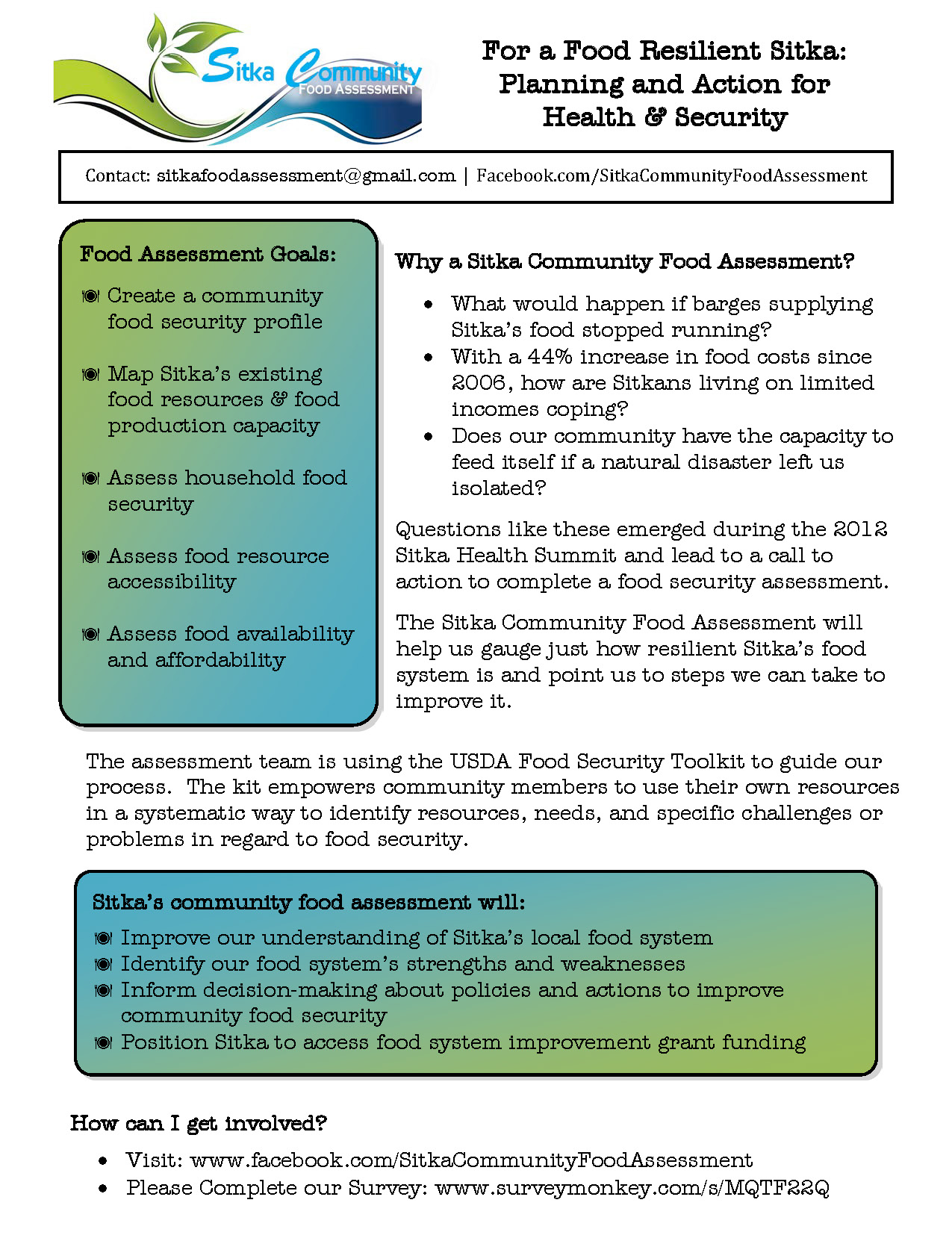
The assessment project’s goals are to create a community food security profile; map Sitka’s existing food resources and production capacity; and assess household food security, food accessibility, and food availability and affordability.

The work group for the project said community food security is a relatively new concept that covers a variety of disciplines, including community nutrition, nutrition education, public health, sustainable agriculture, and anti-hunger and community development.

“As such, no universally accepted definition exists,” the group said in a handout.

Sadleir-Hart said community food security can be seen as an expansion of the concept of household food security.

“Whereas household food security is concerned with the ability to acquire food at the household level, community food security focuses on the underlying social, economic and institutional factors within a community that affect the quantity and quality of food available …” the handout said.

Affordability is another issue that can affect community food security, Sadleir-Hart said.

The Sitka Community Food Assessment group from the Sitka Health Summit started by collecting data already available locally. Sitka Conservation Society contributed the Jesuit Volunteer, Courtney Bobsin, to work part-time to collect data on local producers, senior and tribal food programs, food banks and other food assistance programs.

“She’s been collecting lots of great information,” Sadleir-Hart said.

The assessment team is using the Food Security Toolkit from the U.S. Department of Agriculture to guide the process. Sadleir-Hart said the local effort received a head-start on the assessment by looking at Kenai’s food security survey designed by the University of Alaska Fairbanks Cooperative Extension Service. The Sitka Local Foods Network, which runs the Sitka Farmers Market, is also involved in the project.

The Sitka Community Food Assessment project received a $15,000 SEARHC Community Transformation Grant to fund Sadleir-Hart’s part-time position, and data analysis.

The goals of the assessment are to improve Sitka’s understanding of the local food system, identify the system’s strengths and weaknesses, inform decisions about policies and ways to improve Sitka’s security, and position Sitka to access grant funding for food system improvement.

Years ago, Sadleir-Hart said, more people in Sitka had vegetable gardens and some kept milk cows and other farm animals. The potential for increasing the amount of locally produced food still exists, and with it the prospect for economic development.

“There are a lot of different angles we could explore, from a community perspective,” she said.

Focus groups are also being called to continue to collect information about food and the community.

The Sitka Community Food Assessment group is looking ahead to the first annual Sitka Food Summit in November, when citizens review the findings of the data collection and start talking about ways to improve the current food system.

The survey can be reached by typing Sitka Community Food Assessment on Facebook, and going to the “Survey Monkey” link. The survey is filled out anonymously. The direct link to the survey is: https://www.surveymonkey.com/s/MQTF22Q.


• Sitka Community Food Assessment project launches community survey to look at food security and resiliency in Sitka

SitkaCommunityFoodAssessmentLogo

OnepagerFinalThe Sitka Community Food Assessment work group is encouraging Sitkans to complete a 36-question survey that explores questions about local, wild food, seafood, game and plants (i.e., how do you fish, hunt, gather and/or grow). It also explores issues of food security, as well as where folks shop and how much food they store.

The data collected will augment data coming from our secondary data collection efforts, which focuses on sport and subsistence harvest data for fish and game,  as well as data on food assistance programs, food producers and food costs. It also will include focus group data that we will be gathering over the next 4-6 weeks.

FoodAssessmentDefsCollectively, the work group hopes to present the findings at a Sitka Food Summit that will take place in November 2013. Then the group will begin strategic planning to address our issues and improve food access for all Sitkans.

A link to the survey can be found on the Sitka Community Food Assessment page on Facebook (https://www.facebook.com/SitkaCommunityFoodAssessment), or by going directly to the survey at https://www.surveymonkey.com/s/MQTF22Q.

Paper copies of the survey are available at the Kettleson Memorial Library.  The survey is open through the end of April.  For more information, email sitkafoodassessment@gmail.com. This is one of three community wellness projects voted on for this year by Sitka residents attending the 2012 Sitka Health Summit.

• Sitka Community Food Assessment one-page fact sheet

• Sitka Community Food Assessment food security definitions

• Sitka Health Summit presents seed money check to Community Food Assessment for a Food Resilient Sitka project

FOOD ASSESSMENT DOUGH: From left, Sitka Health Summit Steering Committee members Ellen Daly, Elisabeth Crane and Penny Lehmann present a check for project seed money to representatives from the Community Food Assessment for a Food Resilient Sitka community wellness project, Renae Mathson (fourth from left), Sabrina Cimerol, Garrett Bauer and Courtney Bobsin.

FOOD ASSESSMENT DOUGH: From left, Sitka Health Summit Steering Committee members Ellen Daly, Elisabeth Crane and Penny Lehmann present a check for project seed money to representatives from the Community Food Assessment for a Food Resilient Sitka community wellness project, Renae Mathson (fourth from left), Sabrina Cimerol, Garrett Bauer and Courtney Bobsin.

Representatives from the Sitka Health Summit recently presented a check for seed money to the Community Food Assessment for a Food Resilient Sitka project. The project is one of three community wellness projects that came out of the 2012 Sitka Health Summit in October, and the food assessment will help Sitka improve its food security.

The food assessment will take various forms, from polling local grocery stores and shipping companies to try and gauge how much food comes into the community to developing a survey for community members and families about how much food they consume. The project will look at the food needs in our community, as well as what’s available. It also will include a survey about how much fish and game is used in Sitka, as well as how many people gather seaweed and berries or raise food in gardens.

The community food assessment recognizes that everybody in Sitka has access to affordable, quality food from stable food systems. The group meets on the second Wednesday each month, and the next meeting is from 5:30-7 p.m. on Wednesday, Feb. 13, at the Sitka Sound Science Center.

For more information, contact Renae Mathson at 966-8797 or renae.mathson@searhc.org, or contact Andrianna Natsoulas at 747-3477 or anatsoulas@thealaskatrust.org. Sitka residents can ask to join the Google Groups e-mail list for the project to keep up to date with what’s happening.

• Help wanted: Sitka Community Food Assessment seeks project coordinator

The Sitka Community Food Assessment project is looking to hire a quarter-time project coordinator to oversee the collection of and analysis of data about Sitka’s food supply and demand.

The Sitka Community Food Assessment project is one of this year’s three Sitka Health Summit community wellness projects, which were decided by local residents back in October. The project already has applied for and received a sub-award grant from the SEARHC Community Transformation Grant program to help facilitate the gathering of data about where Sitkans get their food and how much they need.

The project coordinator will work about 10 hours a week at $23 an hour for one year. Depending on other funding and job requirements, there is a possibility the job may expand from quarter-time to half-time.

This new and exciting position will create and support the Community Food Assessment for a Food Resilient Sitka. In order to understand Sitka’s food security, we need to first conduct an assessment. The assessment will be used to develop a Strategic Action Plan to ensure the resiliency of Sitka’s food future. The successful candidate will report to the Sitka Community Food Assessment committee co-chairs.

A copy of the job description is linked below. To apply, please submit a resumé and cover letter. Applications are due by Friday, Nov. 30, and the job starts on Jan. 7. To learn more or to submit your application, please contact Kerry MacLane at maclanekerry@yahoo.com or Andrianna Natsoulas at anatsoulas@thealaskatrust.org.

• Sitka Community Food Assessment project coodinator job description

• Sitka community food assessment project to hold kick-off meeting on Monday, Oct. 29

At the 2012 Sitka Health Summit, “Developing a Community Food Assessment for a Food Resilient Sitka” was selected as one of the top three goals for 2012-2013. All members of the public who are interested in this initiative are cordially invited to a kick-off gathering from 5-7 p.m. on Monday, Oct. 29, in Room 108 at the Rasmuson Building located on the Sheldon Jackson campus.

Are you concerned about where your food comes from and how it gets to Sitka? Have you ever wondered what happens if the barge doesn’t arrive? Are you worried about rising food prices and do you worry about the future of Sitka’s food needs? What percentage of Sitka’s food is locally harvested? Do you feel the fish and game food resources you harvest are adequately protected?

Those and other questions will be asked as part of the community food assessment. All members of Sitka’s community have a need for and a right to healthy, stable, affordable food. We are interested in finding community groups and individuals who can help us in the planning stages of this assessment.

Snacks and refreshments will be provided. For more information, contact Renae Mathson at 966-8797 or renae.mathson@searhc.org.