• Buying local food during a Southeast Alaska summer

Sitka Local Foods Network Board Vice President Cathy Lieser distributes "Alaska Grown" bumper stickers during the July Fourth parade in Sitka (Photo by Heike Hüttenkofer)

Sitka Local Foods Network Board Vice President Cathy Lieser distributes “Alaska Grown” bumper stickers during the July Fourth parade in Sitka (Photo by Heike Hüttenkofer)

By CATHY LIESER
Sitka Local Foods Network Board Vice President

I am cooking on a boat throughout Southeast Alaska this summer, so on May 5, I planted seeds in my garden, covered it with bird netting and wished it well until my return. The text from my friend read, “the weeds are winning,” luckily I have an herb garden on the boat.

I have been on the hunt for local food in the towns where we provision. It was a late spring, so early on I watched plots greening up and took mental notes. There was kale and rhubarb in Tenakee, with one grower who sells on Friday — The Party Time Bakery — which uses local produce for delicious meals. We bought a rhubarb-berry pie fresh out of the oven and took it back to the boat.

In Juneau, we stocked up at Pinkies Fish Market where the mission is to create a local food economy by sourcing local seafood and other farm fresh items. I toured the Jensen-Olson Arboretum (click here for Facebook page) with Merrill Jensen while he shared about their process toward having a certified virus-free Tlingít potato. The Wild Oven sourdough bakery found me sampling chewy and flavorful loaves that I found out got better with age. At the Second Saturday Market, I bought greenhouse-fresh basil picked that morning.

I barely missed the first Sitka Farmers Market on July 6, but did raid my garden for spinach, kale, lettuce, corn salad and miner’s lettuce. I thank those who watered for me during the hot month of June. Our next boat destination was Petersburg, where I finally arrived on a day where two growers were selling.

The Garden, which participates in the Alaska Grown program, is an abundant oasis of organic produce in the middle of town. Tonna Parker has turned a family lot into a production powerhouse using French intensive methods. For the last four years she has sold direct to the community, just stop by on a Tuesday or Saturday to see what she has available. I bought cucumbers and snap peas that did not make it home, I snacked while Tonna gave me a tour. She has beautiful raised beds, chickens, ducks and compact greenhouses where she is able to grow an astounding variety. Winter squash, pumpkins, tomatoes, cucumbers, zucchini, bok choi, kale, corn salad, arugula, carrots, beans, peas, berries, eggs, the abundance went on and on.

I was incredibly inspired by her approach toward finding varieties that thrive in her micro climate, ones that are tough and aggressive growers. She trials open-pollinated varieties and saves her own seed for many of her plantings. Freely sharing her knowledge, Tonna said she would happily work herself out of a job, she just wants folks to grow local and reap the benefits.

Farragut Farm makes the trip into Petersburg by boat to sell direct twice a month. Marja Smets and Bo Varsano had beautiful, tender and sweet produce for sale. Radishes nearly the size of golf balls, collards, kale, chard, green onions, carrots, garlic scapes, edible flowers, pea shoots, peas, Napa cabbage, turnips, beets, and lettuce. Wow, to have root crops and full-sized heads of Romaine lettuce and cabbage this early on is a testament to dedicated growing. I had heard that Farragut sells to charter boats and indeed I can place an order via email to be picked up one hour on either side of the high tide in Farragut Bay. They will row and deliver to the boat.

If you love fresh flowers, Craig Olson and Deb Hurley of the Flower Farm run a flower CSA.  For a $100 subscription they deliver six bouquets a summer.  Stunning dahlia, snapdragon, campanula, linaria, veronica, delphinum, and ageratum to name a few.  They grow in three hoophouses and three heated greenhouses that were funded with a $20,000 grant from the Petersburg Development Fund. Planting starts on Jan. 9, and 60 percent of their sales are in veggie and flower bedding plants.

Inga’s Galley (click here for Facebook page) is the Petersburg reinvention of Sitka’s late-but-beloved Two Chicks on a Kabob Stick food cart. Amyee Peeler (one of the Two Chicks from Sitka) sources local produce whenever she can, and of course all of the seafood is local.

Unfortunately, the The Market In Petersburg was not happening on the Friday while I was in town, but I hope to hit it on July 19.

I’ll keep looking over the next two months wherever we dock, I am heartened to see folks committed to growing and sourcing the best food in Southeast. If you know of anyone that I’ve missed leave me a note at sitkalocalfoodsnetwork@gmail.com (put “Attention Cathy” in the subject line).

This slideshow requires JavaScript.

• Scenes from the first Sitka Farmers Market of the summer

PHOTO COURTESY OF SITKA LOCAL FOODS NETWORK Sitka Farmers Market Manager Bridget Kauffman, left, and co-managers Garrett Bauer, second from left, and Sabrina Cimerol, right, present the Table Of The Day Award to Erin Keenan of Bear Buns. Erin makes cloth diapers and similar products for babies. She received a gift bag with fresh produce, chocolate and a copy of the Alaska Farmers Market Cookbook. This is the sixth year of Sitka Farmers Markets, hosted by the Sitka Local Foods Network. The next market is from 10 a.m. to 1 p.m. on Saturday, July 20, at the Alaska Native Brotherhood Founders Hall, 235 Katlian St. For more information about the Sitka Farmers Markets and Sitka Local Foods Network, go to http://www.sitkalocalfoodsnetwork.org/.

PHOTO COURTESY OF SITKA LOCAL FOODS NETWORK
Sitka Farmers Market Manager Bridget Kauffman, left, and co-managers Garrett Bauer, second from left, and Sabrina Cimerol, right, present the Table Of The Day Award to Erin Keenan of Bear Buns during the first market of the summer on July 6 at the Alaska Native Brotherhood Founders Hall. Erin makes cloth diapers and similar products for babies. She received a gift bag with fresh produce, chocolate and a copy of the Alaska Farmers Market Cookbook. This is the sixth year of Sitka Farmers Markets, hosted by the Sitka Local Foods Network. The next market is from 10 a.m. to 1 p.m. on Saturday, July 20, at the ANB Founders Hall, 235 Katlian St. For more information about the Sitka Farmers Markets and Sitka Local Foods Network, go to http://www.sitkalocalfoodsnetwork.org/.

SitkaFarmersMarketSignThe Sitka Farmers Market kicked off its sixth season on Saturday, July 6, at the Alaska Native Brotherhood Founders Hall, 235 Katlian St.

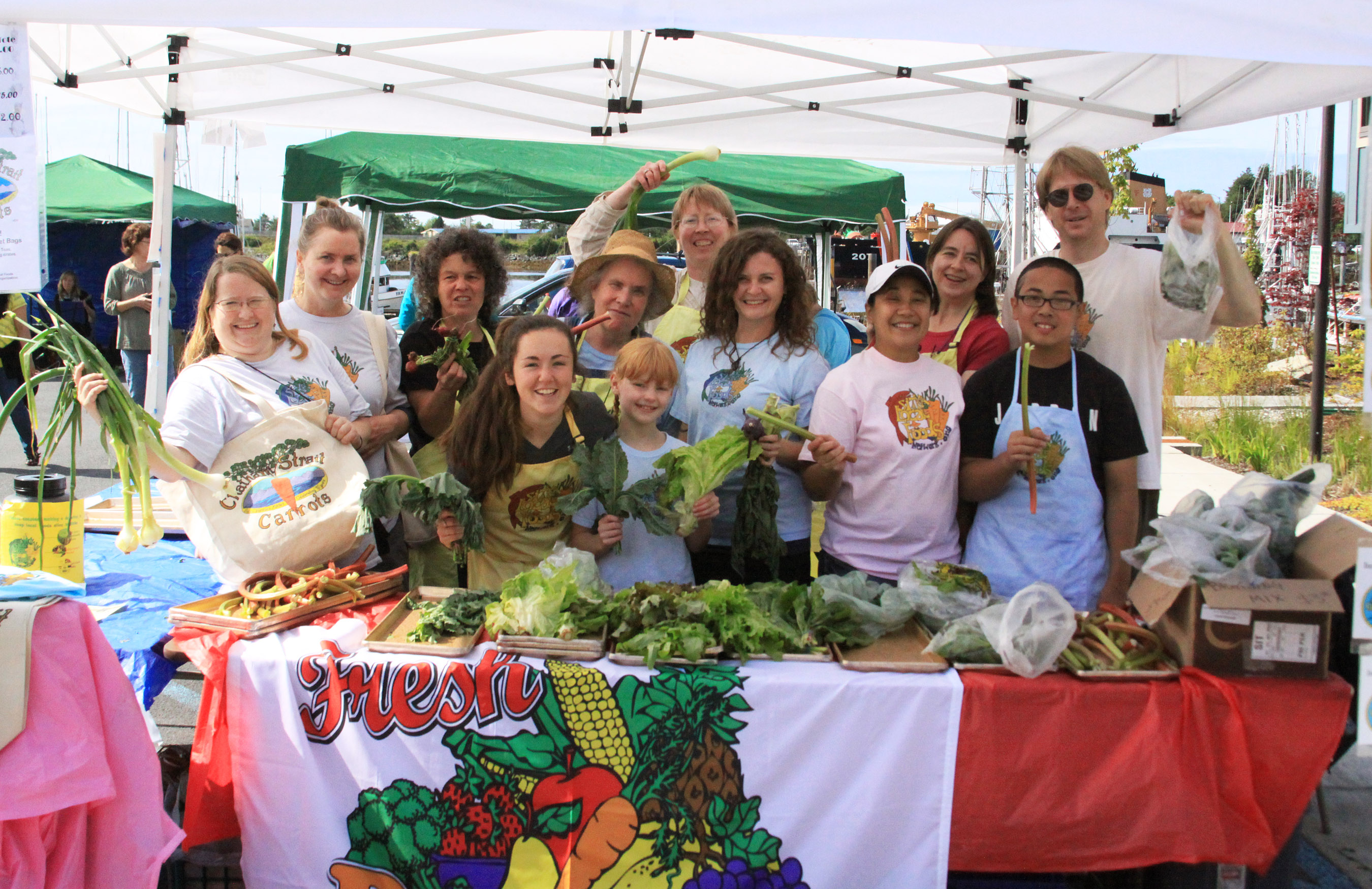
We lucked into a break in the rain and there was a pretty good crowd for the first market of the season. We had a lot of familiar booths selling fresh veggies, fish, baked goods, arts and crafts, plus some new faces joining the vendors.

The second market of the six planned this summer will be from 10 a.m. to 1 p.m. on Saturday, July 20, at ANB Founders Hall. To learn more, keep watching this site. A slideshow of scenes from the first market is below.

This slideshow requires JavaScript.

• Gov. Parnell signs executive order creating the Alaska Food Resource Working Group

AlaskaFoodPolicyCouncilLogoThe following is a note sent to members of the Alaska Food Policy Council listserv by Diane Peck, MPH, RD, a public health nutritionist with the Alaska Department of Health and Social Services Obesity Prevention and Control Program. Diane also is one of the lead contacts for the Alaska Food Policy Council.

Last Friday (June 28, 2013), at the Palmer Farmers Market, Gov. Sean Parnell signed Administrative Order No. 265 (http://gov.state.ak.us/admin-orders/265.html) to establish the Alaska Food Resource Working Group (AFRWG) to recommend policies and measures to increase the purchase and consumption of local wild seafood and farm products. This is a bit different than HCR 01. The AFRWG is composed of eight state agency commissioners or their designee. “The AFRWG shall collaborate with the Alaska Food Policy Council . . . and shall invite a member of the AFPC governing board to represent the AFPC at scheduled meetings.”

The goals of the group are:

  • Develop a mission statement that promotes increased use of locally grown and harvested foods within state and local agencies, institutions, and schools;
  • Identify factors that might discourage or prevent locally harvested and produced food from being purchased by federal, state and local agencies, institutions, and schools;
  • Review existing or proposed programs, policies, statutes, and regulations that impact the state’s food system and recommend to policymakers methods to improve coordination and implementation;
  • Identify research needed to support and encourage increased consumption and production of local foods within the state; and
  • Engage with the public to seek additional input on ways to promote the above-listed goals.

Lots of legislators and several commissioners were at the signing.  The governor said this elevates the group to “sub-cabinet” status.

To learn more about the Alaska Food Policy Council, go to its website or like its Facebook page. Sitka Local Foods Network board president Lisa Sadleir-Hart represents Sitka on the Alaska Food Policy Council.

• Alaska Food Policy Council press release about the executive order

• Sitka to host six farmers markets in 2013 starting on Saturday, July 6

SitkaFarmersMarketSignThe Sitka Local Foods Network will host its sixth summer of Sitka Farmers Markets with six markets this year starting on July 6 and taking place on alternate Saturdays through Sept. 14. The Sitka Farmers Markets give Sitka residents a chance to buy and sell locally produced food and crafts.

The Sitka Farmers Markets take place from 10 a.m. to 1 p.m. on Saturday, July 6, 20, Aug. 3, 17, 31, and Sept. 14 at the Alaska Native Brotherhood Founders Hall (235 Katlian St.). The markets feature local seafood (fresh, frozen, and cooked, ready to eat), locally grown and harvested fruits and vegetables, baked goods, locally made jams and jellies, live entertainment, locally brewed and roasted coffee, music, local arts and crafts, and a variety of other items gathered or made in Sitka. We emphasize local products and lots of fun. We are the first farmers market in Southeast Alaska to accept WIC coupons and Quest EBT for Food Stamps. You also can vote for the Sitka Farmers Market in the America’s Favorite Farmers Markets contest by following the links at http://www.sitkalocalfoodsnetwork.org/.

“The Sitka Farmers Market is a great way to connect with community members and support local entrepreneurs,” Sitka Local Foods Network Board President Lisa Sadleir-Hart said. “Circulating your dollars locally also has a multiplying effect and helps your neighbors.”

SLFNGroupwLindaThe Sitka Farmers Market started as a community wellness project that came out of a health priority planning meeting at the 2008 Sitka Health Summit. These events are sponsored by the Sitka Local Foods Network, Alaska Native Brotherhood Camp No. 1, Alaska Native Sisterhood Camp No. 4, Baranof Island Housing Authority, the Alaska Farmers Market Association and the SEARHC Health Promotion and Diabetes Prevention programs.

“We are excited to have Bridget Kaufmann, bread-baker extraordinaire and former vendor, as our new market manager,” Sadleir-Hart said. “Bridget brings loads of enthusiasm and some new ideas to the market and is focused on creating a sustainable market that can be in Sitka for the duration.” AmeriCorps volunteers Sabrina Cimerol and Garrett Bauer will assist Bridget and share co-market managing duties. “As always the market will be a place to support the growing local food movement in Sitka and learn more about how to eat more sustainably.”

Vendor fees are $30 for a 6-foot table, $40 for an 8-foot table and $20 for a 4-foot table. Vendors with their own tents pay $5 per foot. As always, we offer cost incentives for vendors growing locally produced food. The fees will help us cover the costs of renting ANB Founders Hall and its kitchen, hiring musicians and other expenses. To learn more about being a vendor or to sign up for a table, contact Sitka Farmers Market Coordinator, Bridget Kauffman at 738-8683 or by e-mail sitkafarmersmarket@gmail.com. Vendor rules, registration forms and other information for potential vendors can be found on the Documents page at http://www.sitkalocalfoodsnetwork.org/.

• Sitka Farmers Market among 11 farmers markets accepting Alaska Quest Cards

(The following is from a press release from the Alaska Department of Natural Resources Division of Agriculture)

EBTattheFarmersMarketPALMER, Alaska – Eleven farmers markets throughout Alaska, including the Sitka Farmers Market, are now accepting Quest Cards, enhancing the state’s efforts to make healthy, locally-grown food available to Alaska households. Six markets (including Sitka) accepted the cards in 2012, and two markets accepted them in 2011, according to the Division of Agriculture.

The Alaska Quest Card is used by households qualified through the Alaska Food Stamp Program to purchase food from farmers markets and grocery stores.

“This program improves access to fresh, local foods to community members who are struggling financially.  Additionally, the program helps increase understanding of food insecurity issues in our community and how produce and other food vendors can be part of the solution,” said Lisa Sadlier-Hart, manager of the Sitka Farmers Market (Editor’s note: A correction, Sadleir-Hart is president of the Sitka Local Foods Network board of directors, which hosts the Sitka Farmers Markets; Bridget Kauffman is the market manager).

Quest cards are accepted in the following locations:

Anchorage

  • Spenard Farmers Market; the Anchorage Farmers Market; and the South Anchorage Farmers Markets (Saturday and Wednesday)

Kenai Peninsula

  • Anchor Point Saturday Farmers Market & Swap Meet, and the Homer Farmers Market

Western Alaska

  • The Bethel Farm Stand and the Dillingham Farmers Market

Fairbanks

  • Downtown Fairbanks Market and Calypso School Garden Farm Stands

Southeast Alaska

  • Sitka Farmers Market

These markets will also host Match Days, when Quest card holders can get twice the amount of fresh, local food for the first $20 spent with their cards.   Match Days are listed below:

Anchorage and Kenai Peninsula

  • First market of the month (markets happening twice a week will have matching both days);

Western Alaska, Fairbanks and Southeast Alaska

  • Throughout the summer until funds run out.

Check the Alaska Division of Agriculture website at http://www.dnr.alaska.gov/ag/ag_FMI.htm for more information on Alaska’s farmers markets, including those that accept Quest Cards.  For more information on the Alaska Quest Card, go to http://www.akquest.alaska.gov.

See you at the market, where it’s Closer. Fresher. Better.

• Sitka Farmers Market vendor forms, information sheets and regulations for 2013 now available

SitkaFarmersMarketSignVendors looking to sell local food, arts and crafts, and other items at the 2013 Sitka Farmers Markets can find all the vendor forms, information sheets and regulations for this year by going to the Documents page on this site. The forms are in downloadable Acrobat PDF files.

The 2013 Sitka Farmers Markets will be managed by Bridget Kauffman, and she can be reached at sitkafarmersmarket@gmail.com or 738-8683 during the market season. Bridget’s co-managers will be Sabrina Cimerol for the first three markets and Garrett Bauer for the last three. Bridget is a former vendor (she used to sell home baked goods), so she should be a good fit for the manager position.

Our 2013 Sitka Farmers Markets will be from 10 a.m. to 1 p.m. on alternating Saturdays in July, August and September (July 6, 20, Aug. 3, 17, 31, and Sept. 14) at the Alaska Native Brotherhood Founders Hall on Katlian Street.

Bridget plans to host two pre-market meetings with potential vendors at 7 p.m. on Monday, June 10, and at 7 p.m. on Monday, June 24, at the See House behind St. Peter’s By The Sea Episcopal Church. This will be when she’s available to answer questions and make suggestions to help new and old vendors adjust to any food regulation changes from the Alaska Department of Environmental Conservation, changes in the Alaska Quest electronic benefits program, etc. For more information, contact Bridget.

• St. Peter’s Fellowship Farm schedules Saturday and Wednesday work parties through the summer

StPetersSignWithToDoListSignThe Sitka Local Foods Network will host several work parties on Saturdays and Wednesdays throughout the summer at St. Peter’s Fellowship Farm communal garden (located behind St. Peter’s By The Sea Episcopal Church on Lincoln Street).

Work parties are scheduled for 2-4 p.m. on several Saturdays this summer — on June 1, 8, 22, July 13, 27, Aug. 10, 24, and Sept. 7 and 21. Wednesday afternoon work parties take place from 4:30-6 p.m. on July 10, 24, Aug. 7, 21, and Sept. 4.

Produce grown at St. Peter’s Fellowship Farm is sold during the Sitka Farmers Markets to help fund Sitka Local Foods Network projects throughout the year. The work parties also are great for newer gardeners to learn about growing food in Sitka’s rainy climate.

During these work parties we usually need people to shovel dirt and sift soil, weed, mulch and spread fertilizer (seaweed) on the existing garden beds. Most garden tools will be provided, but we will need people to bring shovels and pick-axes if they have them. The work parties are kid-friendly, in case you want to teach your children about growing food.

For more information, contact St. Peter’s Fellowship Farm lead gardener Laura Schmidt at 623-7003 or 738-7009, or contact Lisa Sadleir-Hart at 747-5985. Fresh vegetables usually can be purchased during the work parties once crops start to ripen, and people who volunteer may be able to take some veggies with them when they go home.

• Deadline extended on Sitka Community Food Assessment to get more completed surveys

SitkaCommunityFoodAssessmentSign2

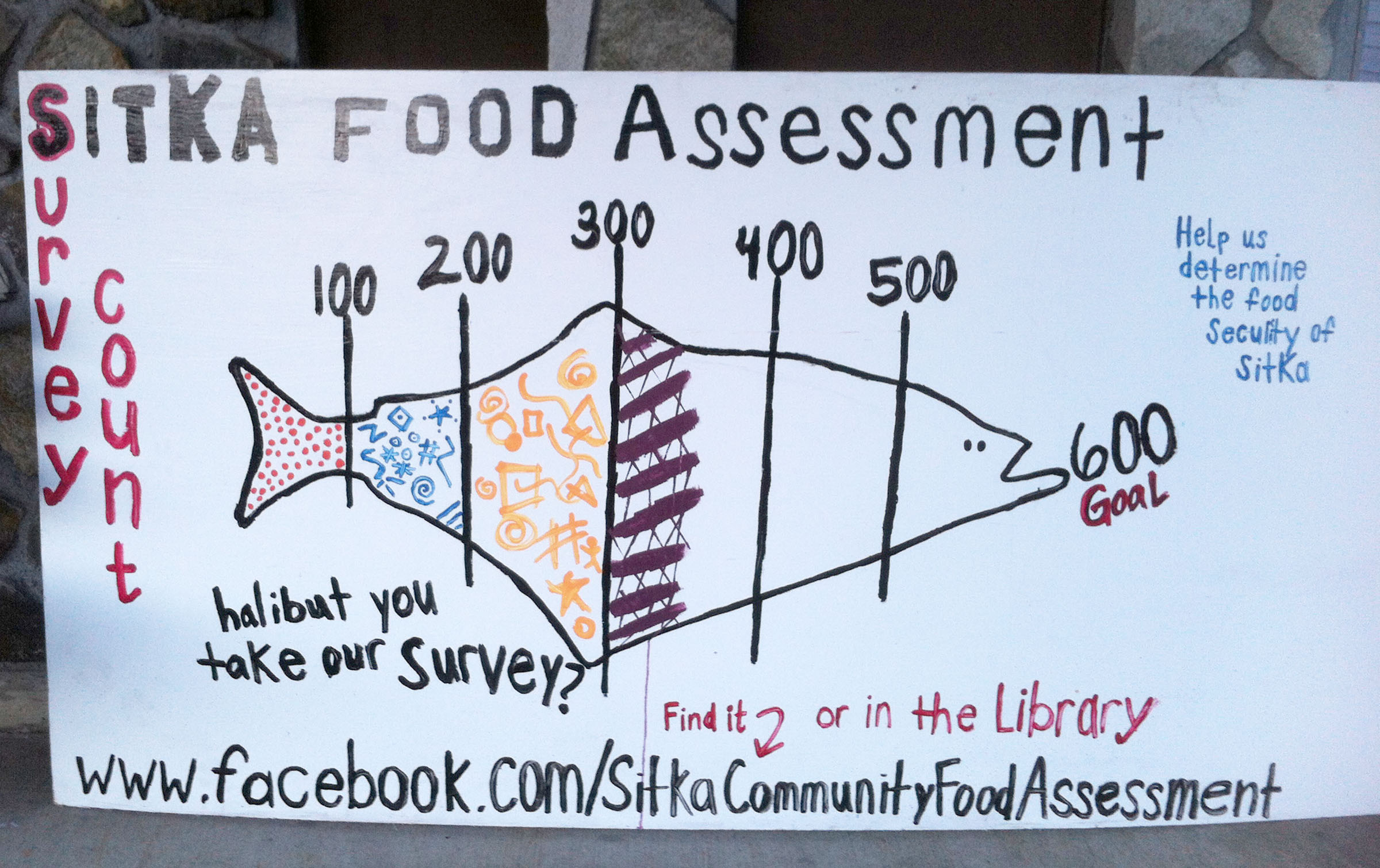
The deadline for surveys to be completed in the Sitka Community Food Assessment has been extended to the end of the month. Our goal is 600 completed surveys and as of Tuesday, May 21, we had 392 that had been recorded.

The Sitka Community Food Assessment is a 2012 Sitka Health Summit project designed to help shape food policy and improve Sitka’s food security. To learn more about the project, KCAW-Raven Radio hosted an interview with project coordinator Lisa Sadleir-Hart that aired on Monday, May 20.

Additional information can be found in this March 26 post on the Sitka Local Foods Network website, and in this April 9 article from the Daily Sitka Sentinel.

Surveys are available online at https://www.surveymonkey.com/s/MQTF22Q, or click the Sitka Community Food Assessment logo in the right column of this webpage. Printed copies are available at Kettleson Memorial Library. A sign has been posted at the corner of Lincoln and Lake streets to update people on the progress of the project.

• As you build your garden this spring, don’t forget to Plant A Row For The Hungry

(EDITOR’S NOTE: The following article first appeared on this site in April 2010. It is repeated because much of the information remains current and newsworthy.)

As you start to plan your garden for this spring and summer, don’t forget to Plant A Row For The Hungry. The Plant A Row For The Hungry program (also known as Plant A Row or PAR) is a national campaign by the Garden Writers Association of America that got its start in Alaska.

In the cold winter of 1994, Anchorage Daily News garden columnist and former Garden Writers Association of America President Jeff Lowenfels was returning to his hotel after a Washington, D.C., event when he was approached by a homeless person who asked for some money to buy food. Lowenfels said Washington, D.C., had signs saying, “Don’t give money to panhandlers,” so he shook his head and kept on walking. But the man’s reply, “I really am homeless and I really am hungry. You can come with me and watch me eat,” stayed with Lowenfels for the rest of his trip.

Jeff Lowenfels

Jeff Lowenfels

The encounter continued to bother Lowenfels, even as he was flying back to Anchorage. During the flight, Lowenfels came up with an idea when he started writing his weekly garden column (the longest continuously running garden column in the country, with no missed weeks since it started on Nov. 13, 1976). He asked his readers to plant one extra row in their gardens to grow food to donate to Bean’s Café, an Anchorage soup kitchen. The idea took off.

When Anchorage hosted the Garden Writers Association of America convention in 1995, Lowenfels took the GWAA members to Bean’s Café to learn about the Plant A Row For Bean’s Café program. The Garden Writers Association of America liked the idea, and it became the national Plant A Row For The Hungry campaign (also known as Plant A Row or PAR). In 2002, the Garden Writers Association Foundation was created as a national 501(c)(3) nonprofit to manage the Plant A Row For The Hungry program.

“I am not surprised by the growth of PAR,” Lowenfels wrote in an e-mail to the Sitka Local Foods Network. “It is now in all 50 states and across Canada and there are thousands of variations of the original program — from prison gardens for the hungry to botanical gardens donating their produce from public display gardens. This is because gardeners always share information and extra food, so the idea was a natural.”

It took five years for the program to reach its first million pounds of donated food, but the second million only took two years and the next eight years saw a million pounds of donated food (or more) each year. Since 1995, more than 14 million pounds of food have been donated. Not only that, the program is getting ready to expand overseas to Australia, England and other countries with avid gardeners.

“We have supplied something in the vicinity of enough food for 50 million meals,” Lowenfels wrote in his e-mail. “Gardeners can solve this hunger problem without the government. And we don’t need a tea party to do it! Or chemicals, I might add, as author of a book on organic gardening (Teaming With Microbes, written with Wayne Lewis)!” (Lowenfels recently released a second book, Teaming With Nutrients, which is a follow-up to his first book).

According to the U.S. Department of Agriculture, one out of every eight U.S. households experiences hunger or the risk of hunger. Many people skip meals or eat too little, sometimes going an entire day or more without food. About 33 million Americans, including 13 million children, have substandard diets or must resort to seeking emergency food because they can’t always afford to buy the food they need. In recent years the demand for hunger assistance has increased 70 percent, and research shows that hundreds of children and adults are turned away from food banks each year because of lack of resources.

While many people credit Lowenfels for creating the Plant A Row For The Hungry program, Lowenfels says the real heroes are the gardeners growing the extra food and donating it to local soup kitchens, senior programs, schools, homeless shelters and neighbors. You can hear him pass along the credit to all gardeners at the end of this interview last year with an Oklahoma television station (video also embedded below).

“One row. That’s all it takes. No rules other than the food goes to the hungry. You pick the drop-off spot or just give it to a needy friend or neighbor. Nothing slips between the lip and the cup, I say,” Lowenfels wrote in his e-mail.

For people wanting to Plant A Row For The Hungry in Sitka, there are several places that would love to help distribute some fresh locally grown veggies or berries to those who are less fortunate, such as the Salvation Army, Sitkans Against Family Violence (SAFV), local churches, Sitka Tribe of Alaska and other organizations. The food the Sitka Local Foods Network grows at St. Peter’s Fellowship Farm communal garden goes to the Sitka Farmers Market.

People who participate in the Alaska Food Stamp program can use their Alaska Quest Cards to purchase produce and fish at the Sitka Farmers Market and other farmers markets around the state. People who participate in the  WIC (Women, Infants, Children) supplemental food program (operated in Southeast Alaska by the SouthEast Alaska Regional Health Consortium or SEARHC) also can use special farmers market vouchers to buy fresh vegetables at the Sitka Farmers Market and other farmers markets in Alaska (this is part of the national WIC Farmers Market Nutrition Program).

The Sitka Local Foods Network also takes donations of local produce to sell at the Sitka Farmers Markets, and all proceeds are used to help pay for SLFN projects geared toward helping more people in Sitka grow and harvest local food. For more information, contact SLFN President Lisa Sadleir-Hart or one of the other board members at sitkalocalfoodsnetwork@gmail.com.

• 2011 Plant A Row For The Hungry marketing brochure

• 2009 Start a Local Plant A Row For The Hungry campaign brochure

• Blatchley Middle School students learn about local soils and local foods

(The following is a letter to the editor sent to the Daily Sitka Sentinel from Blatchley Middle School earth science teacher Karen Lucas. The letter ran in the Thursday, May 16, 2013, edition, and Karen provided the Sitka Local Foods Network with a copy to post on our site.)

Dear Editor,

For our soil conservation studies, the seventh grade earth science students at Blatchley Middle School had a local soils expert come to class.

On a very sunny Monday, a couple weeks ago, Kerry MacLane, clad in bib overalls and broad brimmed hat, with his loaded-up wheelbarrow with five types of local soil, mini-greenhouse, plant starts, a very informative visual presentation, a tubular water wall, and a scavenger hunt up his sleeve that included a solar electric panel, solar powered fan, kale plants, newest compost pile, garlic and raspberry canes, wheeled his way down the halls of Blatchley.

After a concise basic powerpoint on local soils, greenhouse productivity, where our food comes from, and how Sitka disposes of waste; and learning that optimum soil for Sitka is one-third native soils, one-third compost and one-third sand; that starfish and herring eggs are good for the garden, too, and the lively discussion therewith; two teams were supplied each with a different scavenger hunt, and the class departed for the Blatchley Community Garden behind the school to identify items on their list.

Students nibbled on chives, kale and rhubarb, and generally exulted in being outdoors on that fine day in spring. Returning to the classroom, discussion ensued about the Farmer’s Markets, community greenhouse project, and the Sitka Local Foods Network, and how students could get involved in local gardening at home or in the community.

Kerry has certainly helped raise the consciousness of Blatchley students, and Sitkans alike, has been, and continues to be, instrumental in helping Sitka to progress toward sustainability in growing our own food, promoting community gardens, spearheading the Sitka Farmers Markets, and local greenhouse project that is underfoot, for all this, and for spending that Monday with us in the indoor and outdoor classroom, the Blatchley Middle School seventh grade earth science students are grateful; so, on their behalf and mine,  thank you, Mr. MacLane, for sharing your knowledge with us about local soils, making relevant and useful, the ‘dirt on dirt.’

Karen Lucas
Earth Science Teacher
Blatchley Middle School