
Harmful algal bloom expands PSP advisory to several Southeast Alaska beaches

SEATORDataUpdate06102016

Seator-Logo-Best-June-30-2015-7pm-215x215The SouthEast Alaska Tribal Ocean Research (SEATOR) project, SouthEast Alaska Tribal Toxins (SEATT) partnership and the Sitka Tribe of Alaska Environmental Research Lab (STAERL) have expanded a recent paralytic shellfish poisoning (PSP) advisory to include more beaches in Southeast Alaska.

The advisory, initially announced on May 26, now includes multiple beaches in Sitka, Juneau, Craig, Petersburg, and Klawock. The PSP advisory is for bivalve shellfish — such as clams, mussels, oysters, cockles, scallops, geoducks, etc. — that have been recreationally or subsistence harvested. It does not apply to commercially harvested shellfish, which are tested before they enter the market. The advisory does not apply to other shellfish, such as crabs or shrimp, which do not carry PSP (unless you eat the crab butter/viscera).

According to a SEATOR press release, “Recent samples on June 6 confirmed elevated levels of Alexandrium, the phytoplankton species that produces saxtoxins causing PSP, have been observed at the following locations and shellfish from these sites should not be harvested at this time.” The affected beaches from June 6 are Auke Bay, Amalga Harbor, Eagle Beach, and Auke Rec beaches in Juneau; Cloud 9 and Graveyard beaches in Craig; Starrigavan beach in Sitka; and the Boat Ramp beach in Klawock.
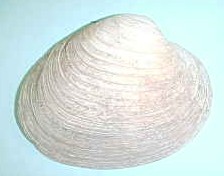
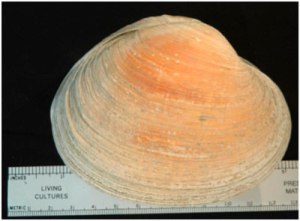
The butter clam has one set of rings that go one direction only, around the same center point (Photo courtesy of Alaska Department of Environmental Conservation)

The butter clam has one set of rings that go one direction only, around the same center point (Photo courtesy of Alaska Department of Environmental Conservation)

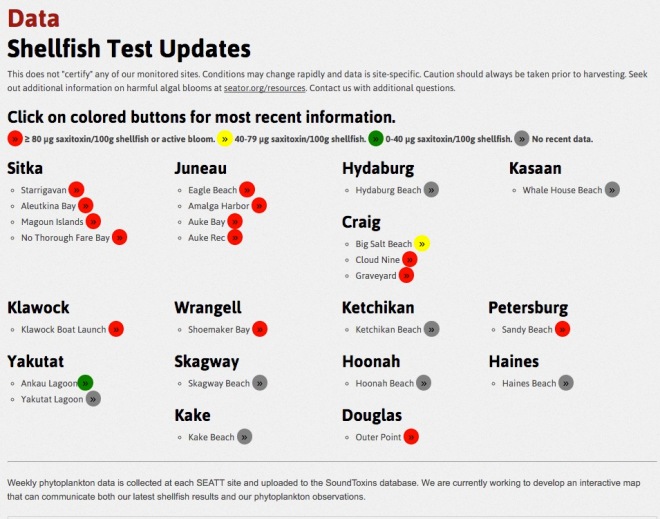
In addition, the press release said, “On June 9 shellfish from the following sites tested above the regulatory limit of 80µg/100g for saxitoxins and should not be harvested at this time.” The June 9 list of beaches includes Sandy Beach in Petersburg (butter clams only); Auke Bay, Amalga Harbor, Eagle Beach, and Auke Rec beaches in Juneau; Aleutkina Bay, No Through Fare Bay, Magoun Islands, and Starrigavan (butter clams only) beaches in Sitka; and the Boat Ramp beach in Klawock. The advisory is for all shellfish on all beaches, except where noted.

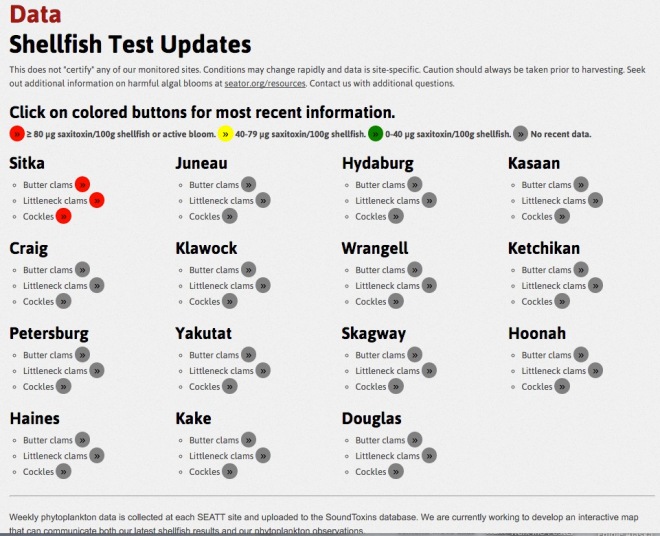
According to SEATOR, “This does not ‘certify’ any of our monitored sites. Conditions may change rapidly and data is site-specific. Caution should always be taken prior to harvesting.”

SEATOR posts updates and information to its website at seator.org/data, which can help provide Southeast Alaska residents with reliable information so they can choose whether or not to harvest shellfish. In addition to testing water samples weekly from certain Southeast beaches, STAERL also tests samples of butter clams, littleneck clams, and blue mussels (which is STAERL’s indicator species because of how quickly blue mussels absorb saxotoxins).

Since most beaches in Alaska aren’t tested for harmful algal blooms, SEATOR and the SEATT partnership were formed in October 2014 to train people to test beaches in Southeast Alaska. In April 2015, the Sitka Tribe of Alaska opened a regional lab on Katlian Street, so samples could be tested in Sitka without having to be sent to the Lower 48, which delayed results. By testing for harmful algal blooms, SEATOR and the SEATT partnership hope to be able to provide information so people can make informed choices whether or not to harvest or eat shellfish.

Harmful algal blooms, such as paralytic shellfish poisoning (PSP), typically have not been monitored in Southeast Alaska for subsistence and recreational harvesters of clams, mussels, oysters, cockles, and other bivalves (commercial harvests are tested). Even though many people in Southeast Alaska love to harvest shellfish, eating it comes with some risks. There have been several PSP outbreaks in recent years that sent people to the hospital, and in 2010 two deaths were attributed to PSP and other HABs, such as Alexandrium, Pseudo-nitzchia and Dinophysis.

To learn more about harmful algal blooms and how they can raise the risk for PSP and ASP (amnesic shellfish poisoning, which also can be fatal), go to SEATOR’s resources page. If you have shellfish you recently harvested and want to test it, click this link to learn what you need to do to have it tested by STAERL. Please contact STAERL at 747-7395 with any additional questions.

• June 10, 2016, press release about PSP advisory for Southeast Alaska

Harmful algal bloom warning listed for shellfish harvested at Sitka, Craig, Klawock and Petersburg

Clam diggers work the beach at Starrigavan in this file photo. The Sitka Tribe of Alaska is warning Sitkans against harvesting clams in the area due to a harmful algae detected Monday, June 8, 2015. (Daily Sitka Sentinel file photo by James Poulson)

Clam diggers work the beach at Starrigavan in this file photo. The Sitka Tribe of Alaska is warning Sitkans against harvesting clams in the area due to a harmful algae detected Tuesday, May 25, 2016. (Daily Sitka Sentinel file photo by James Poulson)

Seator-Logo-Best-June-30-2015-7pm-215x215The SouthEast Alaska Tribal Ocean Research (SEATOR) project coordinated by the Sitka Tribe of Alaska on Wednesday, May 26, issued a harmful algal bloom warning for shellfish harvested in four Southeast Alaska communities. The warning is for shellfish harvested on Starrigavan Beach in Sitka, Graveyard Beach in Craig, the Klawock Boat Launch, and Sandy Beach in Petersburg.

(Editor’s Note: On Thursday, June 2, SEATOR and the University of Alaska Fairbanks School of Fisheries and Ocean Sciences in Juneau announced a similar shellfish advisory for shellfish harvested on June 1 from several beaches in the Juneau area — Auke Bay, Point Louisa/Auke Rec, Amalga Harbor and Eagle Beach. For more information on Juneau, contact Elizabeth Tobin at 1-907-796- 5455 or edtobin@alaska.edu or Chris Whitehead of SEATOR at chris.whitehead@sitkatribe-nsn.gov. On June 3, SEATOR added Cloud 9 Beach in Craig to the list of beaches affected by the shellfish advisory.)

“The Sitka Tribe of Alaska Environmental Research Lab (STAERL) has been collecting shellfish samples to test for biotoxins, specifically paralytic shellfish poisoning (PSP),” STAERL announced in a press release. “Recent samples on May 25, 2016, confirm that clams at the following beaches have elevated levels of toxins above the FDA regulatory limit of 80µg/100g and should not be harvested at this time.”

The butter clam has one set of rings that go one direction only, around the same center point (Photo courtesy of Alaska Department of Environmental Conservation)

The butter clam has one set of rings that go one direction only, around the same center point (Photo courtesy of Alaska Department of Environmental Conservation)

SEATOR, the Southeast Alaska Tribal Toxins (SEATT) partnership, and the Sitka Tribe of Alaska have been monitoring saxitoxin on Starrigavan Beach in Sitka and other beaches around Southeast Alaska since late 2014. Saxitoxin is produced by the phytoplankton Alexandrium and can get highly concentrated in shellfish, leading to paralytic shellfish poisoning (PSP), which can be fatal.

SEATOR posts updates and information to its website at seator.org/data, which can help provide Southeast Alaska residents with reliable information so they can choose whether or not to harvest shellfish. On May 6, SEATOR announced an advisory for shellfish harvest on Starrigavan Beach in Sitka, when it found Alexandrium in its weekly phytoplankton samples and high levels of saxitoxin in butter clams, littleneck clams, and blue mussels. Because of the high levels, SEATOR advised Sitka residents not to harvest shellfish at the time.

Since most beaches in Alaska aren’t tested for harmful algal blooms, SEATOR and the SEATT partnership were formed in October 2014 to train people to test beaches in Southeast Alaska. In April 2015, the Sitka Tribe of Alaska opened a regional lab on Katlian Street, so samples could be tested in Sitka without having to be sent to the Lower 48, which delayed results. By testing for harmful algal blooms, SEATOR and the SEATT partnership hope to be able to provide information so people can make informed choices whether or not to harvest or eat shellfish.

Harmful algal blooms, such as paralytic shellfish poisoning (PSP), typically have not been monitored in Southeast Alaska for subsistence and recreational harvesters of clams, mussels, oysters, cockles, and other bivalves (commercial harvests are tested). Even though many people in Southeast Alaska love to harvest shellfish, eating it comes with some risks. There have been several PSP outbreaks in recent years that sent people to the hospital, and in 2010 two deaths were attributed to PSP and other HABs, such as Alexandrium, Pseudo-nitzchia and Dinophysis.

To learn more about harmful algal blooms and how they can raise the risk for PSP and ASP (amnesic shellfish poisoning, which also can be fatal), go to SEATOR’s resources page. If you have shellfish you recently harvested and want to test it, click this link to learn what you need to do to have it tested by STAERL.

• Press release about shellfish advisory, May 26, 2016

• Joint SEATOR/UAF School of Fisheries and Ocean Studies press release about Juneau shellfish advisory, June 2, 2016

• June 3, 2016, SEATOR press release updating the list of affected beaches

Harmful algal bloom warning listed for shellfish harvested at Starrigavan Beach

SEATORShellfishTestingLevels

The SouthEast Alaska Tribal Ocean Research (SEATOR) project coordinated by the Sitka Tribe of Alaska on Friday, May 6, issued a harmful algal bloom warning for shellfish harvested on Starrigavan Beach in Sitka.

SEATOR, the Southeast Alaska Tribal Toxins (SEATT) partnership, and the Sitka Tribe of Alaska have been monitoring saxitoxin on Starrigavan Beach in Sitka and other beaches around Southeast Alaska since late 2014. Saxitoxin is produced by the phytoplankton Alexandrium and can get highly concentrated in shellfish, leading to paralytic shellfish poisoning (PSP), which can be fatal.

According to SEATOR, “during our weekly phytoplankton sample last week, we noticed our first Alexandrium of the year. Immediately after, we tested saxitoxin levels in butter clams, littleneck clams and blue mussels, and found them all to have elevated levels of saxitoxin. We do not recommend that Sitkans harvest shellfish at this time, and ask them to look on seator.org/data for additional updates and information.”

Since most beaches in Alaska aren’t tested for harmful algal blooms, SEATOR and the SEATT partnership were formed in October 2014 to train people to test beaches in Southeast Alaska. In April 2015, the Sitka Tribe of Alaska opened a regional lab on Katlian Street, so samples could be tested in Sitka without having to be sent to the Lower 48, which delayed results. By testing for harmful algal blooms, SEATOR and the SEATT partnership hope to be able to provide information so people can make informed choices whether or not to harvest or eat shellfish.

Harmful algal blooms, such as paralytic shellfish poisoning (PSP), typically have not been monitored in Southeast Alaska for subsistence and recreational harvesters of clams, mussels, oysters, cockles, and other bivalves (commercial harvests are tested). Even though many people in Southeast Alaska love to harvest shellfish, eating it comes with some risks. There have been several PSP outbreaks in recent years that sent people to the hospital, and in 2010 two deaths were attributed to PSP and other HABs, such as Alexandrium, Pseudo-nitzchia and Dinophysis.

Third annual Sitka Herring Festival kicks off March 18 with month of events


Events_List

Spring is right around the corner in Sitka, and nothing says spring in Sitka like the arrival of the herring. The Sitka Tribe of Alaska‘s third annual Sitka Herring Festival kicks off on Friday, March 18, with a month of fantastic event for adults and kids alike.

This year the festival kicks off at 11 a.m. on Friday, March 18, with the Blessing of Herring Rock (Yaaw T’eiyí) in front of the Sheet’ka Kwáan Naa Kahídi. Herring Rock is a cultural landmark of the Kiks.ádi clan, and a member of the clan leads this annual ceremony. Please note this event date and time have changed since first announced.

Derby FlyerFor those kids who like a little competition, there’s the Sitka Herring Derby. As in previous years, the Herring Derby will be a fun event for kids and parents. The Derby starts on Saturday, March 19, and continues through Saturday, April 9. Weigh your biggest fish every day (from 9 a.m. to 5 p.m. on Monday through Friday and from 3-6 p.m. on Saturday and Sunday) at the Sitka Tribe of Alaska Resources Production Office at 429 Katlian Street. May the best (biggest) fish win. The awards ceremony will be April 12 at Blatchley Community Swim Pool.

Also on Saturday, March 19, is a herring-themed Discovery Days program at the Sitka Sound Science Center. Discovery Days is a youth educational program from 10 a.m. to noon that meets every other Saturday, and this event will feature Sitka Herring Festival coordinator Jessica Gill discussing the life cycle of herring.

The Sitka Whalefest and Sitka Sound Science Center will host the annual food web cruise fundraiser for the Whalefest from 9 a.m. to noon on Saturday, March 26. This is an Allen Marine harbor cruise that usually features some of the best whale-watching of the spring. The cost is $55 per person, which includes a light breakfast spread. Tickets are available at Old Harbor Books.

This year’s Wearable Arts Show, sponsored by the Greater Sitka Arts Council, will feature a new attraction as local artists team up to dedicate a piece about the growing problem of waste in our oceans.

On April 1, is the ArtiGras Art Walk and logos are due for local high school students to submit their Sitka Herring Festival logo designs. In addition to the usual art found in Sitka galleries and businesses during the art walk (hosted by the Greater Sitka Arts Council), the Sheet’ka Kwáan Naa Kahídi will host a variety of community artists and herring dishes from around the world from 5-8 p.m. on Friday, April 1.

Also like last year, Sitka Community Schools will host the Herring Fun Run. The run will start at 8:30 a.m. on Saturday, April 2, and will feature a couple of loops of the totem trails at Sitka National Historical Park. Herring swim in schools, so bring your friends.

The Sitka Herring Festival community potluck is from 6-8 p.m. on Thursday, April 7, at Sweetland Hall at the Sheldon Jackson Campus. Bring a dish to share. The guest speaker, Ilona Kemp-Noordeloos, is a PhD. student at University of Alaska Fairbanks who will give the presentation, “Herring and the Human Element in the Bristol Bay Fisheries.”

More info for all these events can be found online at http://sitkaherringfestival.wordpress.com or at the festival’s Facebook page. Or you can email sitkaherringfestival@gmail.com or call 747-7168 for info.

• 2016 Sitka Herring Festival calendar of events

• Sitka Herring Festival logo contest rules and entry form

• 2016 Sitka Herring Festival Kids’ Fishing Derby flier

• Sitka’s Fish to Schools program on international list of 16 innovative school lunch programs

SCS-031_smFishToSchoolsTaco

FoodTankLogoSitka’s Fish to Schools program is one of 16 school lunch programs from around the world making a difference, according to an international list released this month by the organization Food Tank.

The Fish to Schools program got its start at the 2010 Sitka Health Summit, when community members decided they wanted to see more locally harvested fish in school lunches. The Sitka Conservation Society coordinates the program, in partnership with local schools.

The program started off with a monthly local fish lunch choice at Blatchley Middle School, but the program quickly expanded to include weekly local fish lunch choices at all Sitka schools (including the state-run Mount Edgecumbe High School boarding school and the private The SEER School).

In addition to putting local fish on the school lunch menu, the program also includes education about the fishing industry and its impact on the community (about one in five adults in Sitka work in the fishing industry). Local fishermen and women periodically share lunches with the students, which helps the students connect with their local food system. Local fishermen also donate coho salmon to the program, to help keep it sustainable.

In May 2014, the Sitka Fish to Schools program released a guidebook so other school districts in Alaska could create similar programs. For more information about the Fish to Schools program in Sitka, contact Sophie Nethercut of the Sitka Conservation Society, sophie@sitkawild.org or 747-7509.

• UAS Sitka Campus offers ‘Flora of Southeast Alaska’ course as a hybrid

Salmonberries await picking near the entrance to Sitka National Historical Park

Salmonberries await picking near the entrance to Sitka National Historical Park

A newish biology class by University of Alaska Southeast Sitka Campus associate professor Kitty LaBounty will itself be a “hybrid”, and it’s back for its second year.

FloraOfSEAK_Poster11x17_2016The DNA of most traditional botany classes is to gather students around a table of samples and look at them in a face-to-face classroom setting. By offering Flora of Southeast Alaska as both a local and distance-delivery (eLearning) class, students from anywhere can get up to speed on how to identify the common native trees, shrubs and herbs of southeast and south central Alaska. Local students can participate in the lectures on campus, while students across Alaska can see the imagery online and hear the lectures either live or via digital recording.

Flora of Southeast Alaska is a one-credit, seven-week workshop. The focus will be on identification of common species and attaining an understanding of their place in the ecosystem of Southeast Alaska. Students will discover how these plants interact with other plants and animals, and how humans use these plants for food, fuel, medicine, or simply enjoyment.

In addition to illustrated weekly lectures, there will be written exercises and “check for understanding” activities. The class is available to any student without prerequisites. It does not count as credit toward a biology major at UAS.

Professor LaBounty brings her lifelong passion as a gardener and scientist to this topic, along with more than 25 years experience working on plant identification for state, federal and nonprofit agencies in Alaska.

The class will meet from 5:30-7 p.m. on Thursdays from Feb. 25 to April 30 — with time off for spring break. The cost is $187 for local students and $227 for eLearning (distance) students.

For more information, contact Kitty LaBounty at UAS Sitka Campus. 747-9432. To register, call 747-7700. or toll-free, 800-478-6653.

• The Inuit Circumpolar Council-Alaska (ICC-AK) releases report on Inuit food security

Food Security Summary and Reccomendations Report _Page_01
Drastic changes are occurring within the Arctic and Inuit are on the forefront of these changes. In recent years food security has increasingly become a topic of conversation and is gaining more attention. But what does food security mean to those that call the Arctic home?

Through this Inuit Circumpolar Council-Alaska (ICC-AK) project led by the Alaskan Inuit (Iñupiaq, St. Lawrence Island Yupik, Central Yup’ik and Cup’ik), the Alaskan Inuit Food Security Conceptual Framework: How to Access the Arctic from an Inuit Perspective report illuminates the meaning of Alaskan Inuit food security and lay out an assessment process.

In the report it is clear that Inuit food security is more than calories, more than nutrients, as explained by a contributing author:  “We are speaking about the entire Arctic ecosystem and the relationships between all components within; we are talking about how our language teaches us when, where and how to obtain, process, store and consume food; we are talking about the importance of dancing and potlucks to share foods and how our economic system is tied to this; we are talking about our rights to govern how we obtain, process, store and consume food; about our Indigenous knowledge and how it will aid in illuminating these changes that are occurring. We are talking about what food security means to us, to our people, to our environment and how we see this environment; we are talking about our culture.” — Executive Summary

The report is the product of 146 contributing Inuit authors, a 12-member advisory committee, ICC-AK and their membership organizations. A summary and recommendations report was created for those who are looking for a quick glimpse at what food security means to Alaskan Inuit, what it means to apply a food security lens to assessments, and recommendations for strengthening food security. For a deeper understanding and more in-depth discussion, a technical report has been created. Within both reports you will find: 1) recommendations, 2) key barriers, 3) the food security conceptual framework, and 4) drivers of food security and insecurity. The technical report also lays out a food security assessment process.

“To look at environmental health through an Inuit food security lens requires one to undergo a paradigm shift. One must be willing to attempt to understand the Inuit culture to know what Inuit mean when they talk about food security.” — James Stotts

ICC-Alaska hopes that the report will be of use to a broad spectrum of people. Villages may use the report to aid in communicating with those from outside their communities. Decision-makers, academics, environmentalists, policy-makers and industry may use the reports as a tool to enhance their understanding of the Arctic. The report is accessible on the ICC-Alaska website.

The food security report also is linked below:

• Inuit Circumpolar Council-Alaska Food Security Summary and Recommendations Report

• Inuit Circumpolar Council-Alaska Food Security Technical Report

• New biotoxin lab in Sitka allows for quicker, better monitoring of harmful algal blooms in Southeast Alaska

MichaelJamrosChrisWhiteheadEstherKennedyJohnDorothyOrbisonDeanOrbison

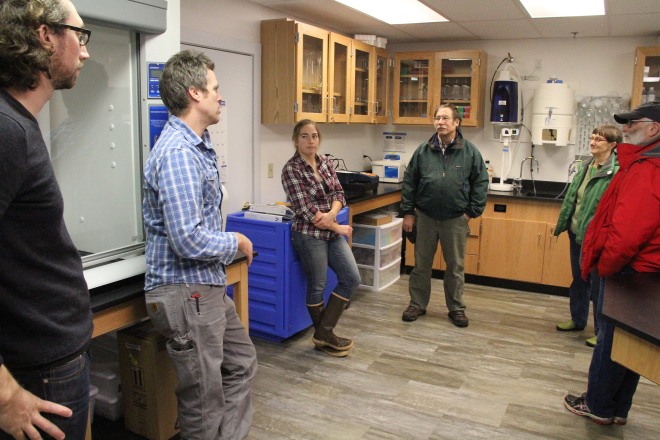
From left, Sitka Tribe of Alaska Environmental Lab Manager Michael Jamros, STA Environmental Program Manager Chris Whitehead, and STA Environmental Specialist Esther Kennedy discuss the new Sitka Biotoxin Lab with visitors to an open house on Monday, Nov. 30, 2015. The new lab will help Southeast subsistence and sport shellfish harvesters learn about harmful algal blooms in the region so they can avoid paralytic shellfish poisoning (PSP) or amnesic shellfish poisoning (ASP).

Most shellfish eaters are aware of the massive algal bloom that shut down many shellfish operations on the Pacific Coast this summer. The algal bloom even reached Sitka’s Starrigavan Beach with the June discovery of Pseudo-nitzchia, a species of plankton that sometimes produces domoic acid which can cause amnesic shellfish poisoning (ASP). ASP causes gastrointestinal issues in mild cases, such as nausea, vomiting, diarrhea, and abdominal cramps. In more severe cases there will be neurological problems, such as headaches, confusion, hallucinations, short-term memory loss, respiratory difficulty, seizures, coma, and in extreme cases, death.

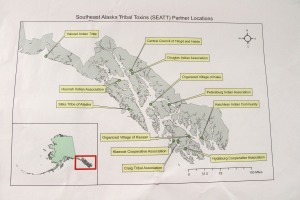
SEAKTribalToxinsSEATTPartnerLocationsUntil two years ago, Southeast Alaska beaches and subsistence- and sport-harvested shellfish weren’t tested for harmful biotoxins. That changed with the Southeast Alaska Tribal Testing (SEATT) program, a partnership of regional tribes coordinated by Sitka Tribe of Alaska, that began training technicians from six villages (now 12 villages) in the region on how to gather water samples so they could be tested. SEATT is part of a program called Southeast Alaska Tribal Ocean Research (SEATOR).

Now the project has moved to the next phase, the creation of a Sitka Biotoxin Lab, located at 429 Katlian Street, that can provide quicker and better testing results to people in the region who want to eat shellfish. Instead of sending samples to the Lower 48 for testing, which can take more than a week or two, samples from Southeast Alaska can be tested in Sitka and data can be available in less than 24 hours, Sitka Tribe of Alaska Environmental Program Manager Chris Whitehead said during an open house at the lab on Monday, Nov. 30. Before the lab opened, the program just took water samples. But now it will be able to actually test the shellfish for biotoxins.

Whitehead said one of the purposes of the lab is to give shellfish harvesters as much information as possible about possible harmful algal blooms so they can make informed decisions about if they still want to harvest and eat local shellfish. Harmful algal blooms spread a variety of biotoxins, such as domoic acid and saxitoxin, which can cause paralytic shellfish poisoning (PSP) and amnesic shellfish poisoning (ASP). PSP and ASP can be deadly, and in 2010 there were two people in Southeast Alaska who died from PSP.

Cockles-Alaska-Department-of-Health-and-Social-Services“The toxins can stay in butter clams for 2 1/2 to three years,” Whitehead said, disproving the common local myth that shellfish is safe to eat in months with R in the name. “We’re still seeing blooms in December.”

Whitehead said he’s hoping to eventually be able to do baseline sampling of a variety of beaches in Southeast Alaska. He said they are sampling bays for cyst beds by digging cores in the beach soil, and they’ve found cysts 3-4 meters (9-13 feet) below the surface. While the beach might be safe for now, if people start building piers or docks it can stir up the cyst beds and launch a harmful algal bloom.

The lab and testing program is funded by the Environmental Protection Agency (EPA) Indian Environmental General Assistance Program, the Bureau of Indian Affairs (BIA) and Tribal Cooperative Landscape Conservation Program, and the Administration for Native Americans’Environmental Regulatory Enhancement program. The National Oceanic and Atmospheric Administration (NOAA) Marine Biotoxin Programs from Seattle, Wash., and Charleston, S.C., provided training through workshops to help develop the SEATT program.

raw-clams-350Michael Jamros, PhD, was hired in October as the STA Environmental Lab Manager, and he will be handling most of the actual testing and diagnosis of the seawater and shellfish. He said right now the lab is focused on subsistence and sports harvests, but down the road it’s hoping to become FDA-certified so it can test commercial harvests.

Esther Kennedy is the STA Environmental Specialist, and she said “every week I go plankton hunting.” This summer all of her tests were at Starrigavan State Recreation Area, but now that the lab is open she will be able to test in more areas, “wherever you think people might harvest shellfish.”

pe-fig1“I think this will help our food security,” Kennedy said. “People will be able to see this abundant resource of shellfish, and now they’ll have better information about whether it’s safe to harvest.”

In addition to the Sitka staff, the program also trains monitors from 12 partner villages to test in their areas, which range from Ketchikan on the south to Yakutat on the north. These monitors come to Sitka twice a year for training, with their most recent training in early November. A slideshow of photos from the training is posted below.

This slideshow requires JavaScript.

• Scenes from the Sitka Kitch venison class hosted by UAF Cooperative Extension, SEARHC

22747125432_327d8c7356_o

kitch_logo_mainSitka residents love their venison, so the University of Alaska Fairbanks Cooperative Extension Service and the SouthEast Alaska Regional Health Consortium (SEARHC) WISEFAMILIES Traditional Foods program hosted a free class on canning, smoking, and making deer jerky on Oct. 30 at the Sitka Kitch community rental commercial kitchen.

The Oct. 30 class featured lessons on how to can venison in jars, taught by Ellen Ruhle, as well as info about how to prepare deer jerky and how to smoke venison roasts, taught by Jud Kirkness. Due to the popularity of the class, the Sitka Kitch is hoping to schedule a second class on deer/venison in the near future.

Below is a slideshow of photos taken during the class by Jasmine Shaw of the UAF Cooperative Extension Service Sitka District Office.

This slideshow requires JavaScript.


• Sitka Conservation Society to host its annual Wild Foods Potluck on Sunday, Nov. 15

Wild foods potluck poster 2015 - CRAB

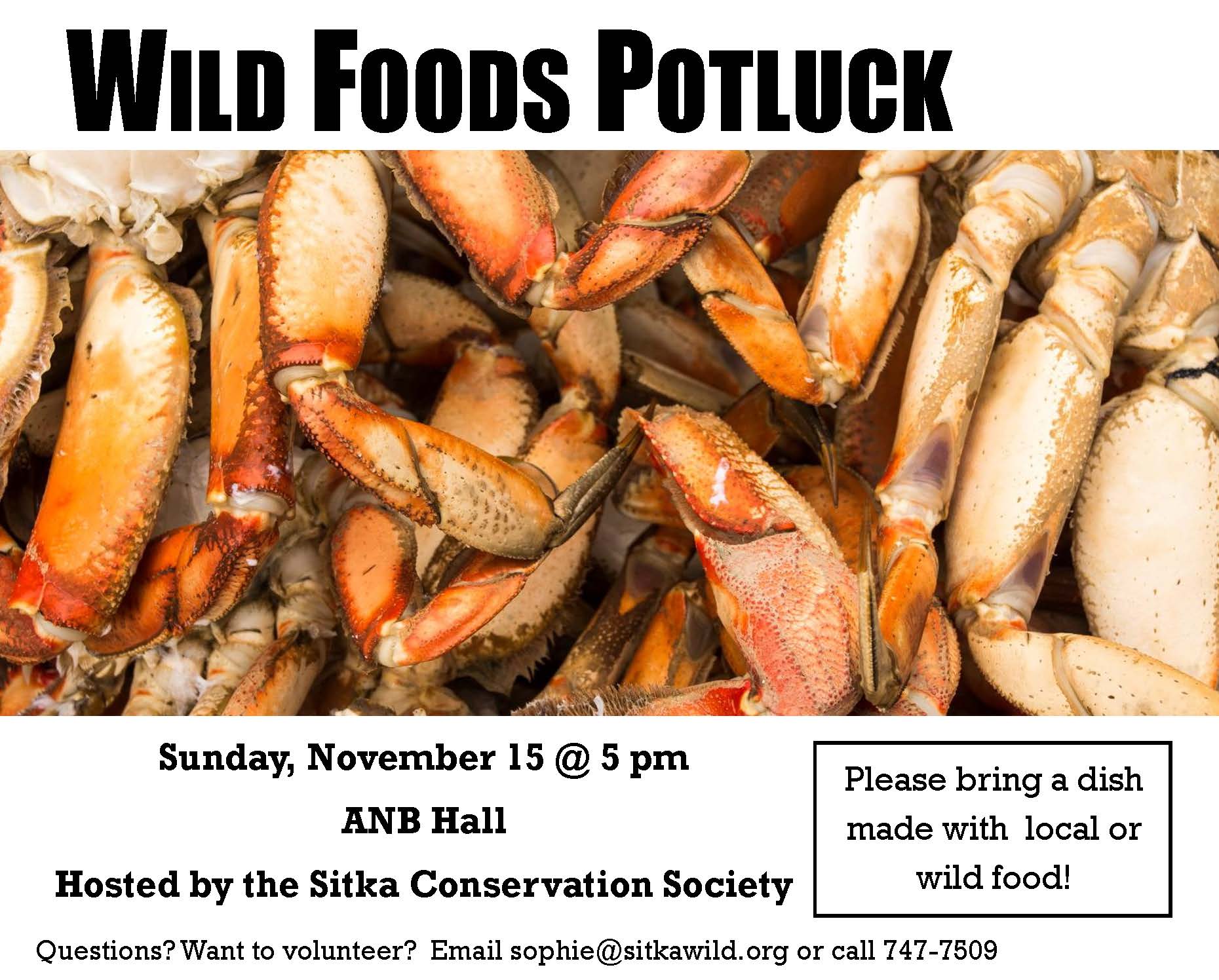
The Sitka Conservation Society will host its annual Wild Foods Potluck from 5-7 p.m. on Sunday, Nov. 15, at the Alaska Native Brotherhood Founders Hall (235 Katlian St.).

Please bring a dish featuring ingredients that were fished, foraged, hunted, or cultivated in Southeast Alaska. Prizes will be awarded for first place in the following categories — Best Dish, Best Dessert, and Most Creative.

The event will highlight subsistence stories and the work performed by the Sitka Conservation Society over the last year. SCS members can pick up their 2016 SCS Calendars at the potluck.

The potluck is open to SCS members, friends, family, and anyone else interested in learning about the Sitka Conservation Society. Come celebrate Alaska’s wild food bounty.

Interested in volunteering at the potluck or want more information? Contact Sophie Nethercut at sophie@sitkawild.org or call 747-7509.