• SEARHC, UAF Cooperative Extension Service to host deer/venison canning classes

Participants in Sitka's Alaska Way Of Life 4-H program, aka the Sitka Spruce Tips 4-H program, learn how to skin and butcher a deer. (Photo courtesy of the Sitka Conservation Society/Sitka Spruce Tips 4-H program)

Participants in Sitka’s Alaska Way Of Life 4-H program, aka the Sitka Spruce Tips 4-H program, learn how to skin and butcher a deer. (Photo courtesy of the Sitka Conservation Society/Sitka Spruce Tips 4-H program)

kitch_logo_mainThe SouthEast Alaska Regional Health Consortium (SEARHC) WISEFAMILIES Traditional Foods program and the University of Alaska Fairbanks Cooperative Extension Service are teaming up to offer a deer and venison workshop from 3-7 p.m. on Friday, Oct. 30, at the Sitka Kitch.

The Sitka Kitch is a rental community commercial kitchen project coordinated by the Sitka Conservation Society, in partnership with the Sitka Local Foods Network, located inside the First Presbyterian Church, 505 Sawmill Creek Road. The Sitka Kitch was a project from the 2013 Sitka Health Summit designed to improve food security in Sitka while also providing a space for people wanting to get into the cottage food business or wanting to preserve their harvest for storage in the home pantry. Sitka Kitch officially opened in March 2015 after a series of renovations to make it pass Alaska Department of Environmental Conservation commercial kitchen food safety standards.

The Oct. 30 class will feature lessons on how to can venison in jars, taught by Ellen Ruhle, as well as how to prepare deer jerky and how to smoke venison, taught by Jud Kirkness.

There is a possibility we will be able to harvest a deer next week, and if so we will add on a portion of the workshop to focus on butchering and meat care. And this time we are just offering the food preservation class (canning, jerky, and smoking hind quarters).

Thanks to a grant from the SEARHC WISEFAMILIES Traditional Foods program, all ingredients, jars, and equipment will be supplied in class.

The SEARHC WISEFAMILIES Traditional Foods program promotes healthy lifestyles by connecting Alaska Natives in Southeast Alaska to their culture. Members of the program learn how to harvest, cook, and preserve their traditional Alaska Native foods, which usually are healthier than heavily processed store-bought foods. In addition, participants learn traditional language, dancing, carving, weaving, and other skills that help reconnect them to their culture.

The UAF Cooperative Extension Service offers a variety of programs geared toward food, how to grow it, how to preserve it for storage, and how to make it into cottage foods you can sell. For those who can’t make the classes, the service offers a series of free online tutorials about home canning called Preserving Alaska’s Bounty.

Pre-registration is required for this class, and there are only 12 spots available. For more information and to pre-register, please contact Jasmine Shaw at 747-9440 or jdshaw2@alaska.edu.

• Alaska’s potential for increasing agricultural potential immense; hard work, clear vision needed

AlaskaFoodPolicyCouncilLogo

(The following is a commentary about increasing Alaska’s access to local food by Alaska Food Policy Council co-chairs Liz Snyder and Victoria Briggs. It originally ran in the Sept. 10, 2015, edition of the Homer News.)


If you’ve visited a local farmers market recently, you’ll appreciate the bounty of delicious, healthy food that Alaska can produce when cultivated by knowledgeable, dedicated hands.

The prospects for increasing this bounty are immense. To take full advantage of our agricultural potential, we will need political will, consumer advocacy, recruitment and education of new farmers, financial support and incentives and a long-term vision. This vision, of course, will also need to take into account the changing climate in which Alaska farmers grow our food.

Imagine a glacier that retreats, then expands for several years, only to retreat again, repeating this process over and over. Such has been the history of agriculture in Alaska. We’ve experienced several booms and busts of both enthusiasm and productivity since the early 1900s.

Booms were the result of such things as co-development with gold mining, collaboration with local businesses, federal support of farming settlements and agricultural innovations. Busts came when challenges (that still exist today) got the better of farmers — the temptation to grow too big too fast, unsustainable and mismanaged support mechanisms, high costs and resulting debt; competition from the Lower 48, infrastructure designed for resource development instead of agriculture, inexperience and being far from home, a lack of replacements for retiring farmers, and, of course, climate.

Today, farmers and consumers are enjoying a boom of interest and enthusiasm around local foods. While it’s true that we send about 1.9 billion Alaska dollars out of the state each year to import food (which supplements the impressive $900 million worth of subsistence and personal-use foods), the good news is that direct sales between farmers and consumers are strong (13 times greater than the national average), Alaska farmers are notoriously tenacious and innovative, and demand continues to motivate increases in supply.

What we have now is a fantastic opportunity to throw a wrench into the boom/bust cycle, expand on the status quo and ultimately pump about $2 billion into, instead of out of, the Alaska economy each year — in effect, supporting the local farmers we know and love, strengthening our food system, lowering food costs, and increasing food security and resilience.

Of course, strengthening our food system will require both short-term goals and long-term planning. When it comes to climate change and agriculture, we’ve got three courses of action to consider:

  1. reduce our impact;
  2. respond to current changes; and
  3. prepare for future changes.

In the Lower 48, agriculture is a major contributor to climate change with high fossil fuel use (to manufacture pesticides and fertilizers, and to operate machinery) and greenhouse gas emissions from concentrated animal feeding operations (CAFOs).

In Alaska, however, the relative scales of agriculture and pest pressure are small. Our primary agriculturally related contribution to climate change is through the importation of approximately 95 percent of our food, which requires the burning of fossil fuels to power transport. Just think of the impact we could have if we expanded Alaska agriculture in thoughtful, sustainable ways to simultaneously produce more food and reduce total greenhouse gas emissions.

With respect to responding to current changes in Alaska’s climate and preparing for the future, we have a host of actions that are either already being taken or need to be taken. These actions should use the best natural, economic and social science information available.

Such preparations include the conservation of arable land; crop diversification and expansion into new growing zones; anticipation of changes in water distribution and quality; measures to address changes in pest, disease and invasive species pressures; education and support of new farmers focused on sustainable agricultural development, and construction of weather-resistant food caches and transportation routes.

Of course, in reality there is an even longer list of recommendations that can be made to strengthen Alaska’s food system, but all of these recommendations will need to be made in light of the climate changes we’re experiencing now and those that lie ahead. The Alaska Food Policy Council is dedicated to helping develop, share and advocate for policies that will result in an Alaska food system that is sustainable, resilient and healthy — and we ask our local, state, and federal leaders to tune in to the issues of food security and climate change and make them a priority. The health of our great state depends on it.

Liz Snyder and Victoria Briggs are co-chairs of the Alaska Food Policy Council, or AFPC. To learn more about food security in Alaska, find the following research resources on the AFPC webpage (akfoodpolicycouncil.wordpress.com):

Building Food Security in Alaska (a report commissioned by AFPC).

• A three-part series of articles (Part I, Part II, Part III) on circumpolar agriculture by Stevenson et al. (2014) and

• An article entitled “Food in the Last Frontier” by Snyder and Meter (2015).

• Scenes from the 2015 Sitka Seafood Festival events held Saturday, Aug. 8

SonnyCropleyScoopsOutShrimp

ssflogo2There were tote races, a parade, a marathon/half-marathon, food booths, live music, canning classes, salmon-head bobbing, halibut-head tossing, the Sitka Highland Games, and scores of other events Saturday during the sixth annual Sitka Seafood Festival at Sheldon Jackson Campus.

There also was nice weather — a little cloudy with light rain for the marathon/half-marathon, followed by warm sunny weather for the tote races, parade, and marketplace events later in the day.

A few scenes from the 2015 Sitka Seafood Festival are in a slideshow below.

This slideshow requires JavaScript.

• Scenes from a series of Sitka Seafood Festival food preservation classes at the Sitka Kitch

JasmineShawMichellePutzLeslieShallcrossConsult

ssflogo2On Aug. 6-8, the Sitka Seafood Festival hosted Leslie Shallcross from the Anchorage District Office of the University of Alaska Fairbanks Cooperative Extension Service to teach a series of food preservation classes at the Sitka Kitch community rental commercial kitchen (Aug. 6-7) and Sweetland Hall on Sheldon Jackson Campus (Aug. 8).

Leslie taught a class on Thursday at the Sitka Kitch about how to make low-sugar jams and jellies (a class on preserving local garden greens was canceled), and on Friday she taught a class on making kelp pickles and sauerkraut and a class on canning salmon. On Saturday, she moved over to the Sweetland Hall to be closer to the Sitka Seafood Festival events and she taught another canning salmon class and a class on the process of smoking salmon.

For those who missed the classes but still want to learn more about home canning, the UAF Cooperative Extension Service has a series of online tutorials on its website called “Preserving Alaska’s Bounty.”

Also, don’t forget to make sure your pressure canner gauge is tested at least once a year. Jasmine Shaw from the Sitka District Office of the UAF Cooperative Extension Service has a tester in her office and you can call her at 747-9440 to schedule a test.

kitch_logo_mainSitka Kitch is a community wellness project from the 2013 Sitka Health Summit designed to improve food security in Sitka. The different parts of the project include creating a community kitchen Sitka residents can rent to prepare food for their small businesses or to preserve their family harvest of fish, game, or garden veggies; expanding Sitka’s emergency food storage capacity; and providing education about preserving food and building family emergency food pantries.

For more information about the Sitka Kitch project, go to the Sitka Kitch website or Facebook page. For rental information, contact Kristy Miller at sitkakitch@sitkawild.org. Click this link to take a quick tour of the facility.

A slideshow with scenes from the various classes is posted below.

This slideshow requires JavaScript.

• Food preservation classes to be offered in conjunction with Sitka Seafood Festival

Sitka food preservation classes

ssflogo2Leslie Shallcross from the University of Alaska Fairbanks Cooperative Extension Service‘s Anchorage District Office will be in Sitka to offer a series of food preservation classes on Aug. 6-8 as part of the Sitka Seafood Festival.

The classes on Thursday and Friday, Aug. 6-7, will take place at the Sitka Kitch community rental commercial kitchen (inside First Presbyterian Church, 505 Sawmill Creek Road), while the Saturday, Aug. 8, classes will be at Sweetland Hall on the Sheldon Jackson Campus. Each of the classes will cost $15, but jars and other materials will be provided by the Sitka Seafood Festival.

The class schedule is:

  • Thursday, Aug. 6, 2-4:30 p.m., at Sitka Kitch — Low-sugar jams and jellies — Learn how to use a boiling water bath canner for preserving fruit by making low-sugar jams and jellies.
  • Thursday, Aug. 6, 6-8 p.m., at Sitka Kitch — Local garden greens — Learn how to cook with and preserve your garden greens.
  • Friday, Aug. 7, 10 a.m. to noon, at Sitka Kitch — Kelp pickles and sauerkraut — Learn how to make kelp pickles. You will “start” some sauerkraut as well as learn some of the science of fermentation.
  • Friday, Aug. 7, 3-5 p.m., at Sitka Kitch — Canning salmon — Learn how to use a pressure canner for preserving fresh, frozen or smoked fish.
  • Saturday, Aug. 8, 10 a.m. to noon, at Sweetland Hall — Canning salmon — Learn how to use a pressure canner for preserving fresh, frozen or smoked fish.
  • Saturday, Aug. 8, 1-2:30 p.m., at Sweetland Hall — Process of smoking salmon — Learn the steps in smoking fish.

kitch_logo_mainFor those who might miss the classes but still want to learn more about home canning, the UAF Cooperative Extension Service has a series of online tutorials on its website called “Preserving Alaska’s Bounty.” Also, don’t forget to make sure your pressure canner gauge is tested at least once a year. Jasmine Shaw from the Sitka District Office of the UAF Cooperative Extension Service has a tester in her office and you can call her at 747-9440 to schedule a test.

To register for the classes, please contact Jasmine Shaw at 747-9440 or jdshaw2@alaska.edu.


• Scenes from a series of home canning and cottage foods classes July 16-18 at Sitka Kitch

SarahLewisPlacesLidOnAllAmericanCanner kitch_logo_mainOn July 16-18, the Sitka Kitch project hosted Sarah Lewis of the Juneau District Office of the University of Alaska Fairbanks Cooperative Extension Service to host four classes in Sitka on the cottage food industry and home canning. These classes were free and paid for by a grant from the SouthEast Alaska Regional Health Consortium (SEARHC) WISEFAMILIES Traditional Foods program. In addition, Sarah had a table at the Sitka Farmers Market on July 18 where she tested pressure canner gauges.

For those who missed the classes and want to learn more about home canning, the UAF Cooperative Extension Service has a series of online tutorials on its website called “Preserving Alaska’s Bounty.” In addition, Leslie Shallcross from the Anchorage District Office of the UAF Cooperative Extension Service will be in town during the Sitka Seafood Festival to teach canning classes on Thursday and Friday, Aug. 6-7, at Sitka Kitch, and on Saturday, Aug. 8, at Sweetland Hall on the Sheldon Jackson Campus. Watch for a class schedule to be posted soon (note, these classes will cost $15 each).

A reminder, pressure canner gauges should be tested at least once a year to make sure they are hitting the right pressures for safe food preservation. For those who couldn’t get to the July 18 Sitka Farmers Market for pressure canner gauge testing, the Sitka District Office of the UAF Cooperative Extension Service has a tester in its office and you can call Jasmine Shaw at 747-9440 to set up an appointment for testing. The office also has a variety of resources — many of them free — on home canning, gardening and other topics.

Sitka Kitch is a community wellness project from the 2013 Sitka Health Summit designed to improve food security in Sitka. The different parts of the project include creating a community kitchen Sitka residents can rent to prepare food for their small businesses or to preserve their family harvest of fish, game, or garden veggies; expanding Sitka’s emergency food storage capacity; and providing education about preserving food and building family emergency food pantries.

For more information about the Sitka Kitch project, go to the Sitka Kitch website or Facebook page. For rental information, contact Kristy Miller at sitkakitch@sitkawild.org. Click this link to take a quick tour of the facility.

Slideshows featuring scenes from Friday’s class on canning salmon and berries and Saturday’s class on canning soups and sauces are below. Also, KCAW-Raven Radio attended the pickling and fermenting class and filed this story (which also includes a slideshow at the bottom). The Alaska Dispatch News recently posted this link on how to can salmon.

This slideshow requires JavaScript.


Slideshow from the Friday, July 17, class about canning salmon and berries (above).


This slideshow requires JavaScript.


Slideshow from the Saturday, July 18, class about canning soups and sauces (above).

• Free pressure canner gauge testing offered at the Sitka Farmers Market on Saturday, July 18

Canner

SarahLewisTestsCannerGaugeThis is a great time of the year to be in Sitka. The fish are running, gardens are starting to produce, and berries are ripe for the picking.

Many Sitka residents have pressure canners to preserve their harvest, and this weekend Sarah Lewis of the Juneau District Office of the University of Alaska Fairbanks Cooperative Extension Service is in town to teach four classes about canning on Thursday, Friday and Saturday at the Sitka Kitch (a rental community commercial kitchen at First Presbyterian Church, 505 Sawmill Creek Road, note, all classes are full). She also provide free pressure canner gauge testing at the Sitka Farmers Market from 10 a.m. to 1 p.m. on Saturday, July 18, at the Alaska Native Brotherhood Founders Hall.

“People can bring the gauge or the lid with the gauge still attached,” Sarah said about the pressure canner gauge testing. “If they have any questions about the full canner (gaskets, damage, how to use, etc.) they can bring the whole thing.”

In addition to testing pressure canner gauges, Sarah plans to work with Jasmine Shaw of the Sitka District Office of the UAF Cooperative Extension Service to have a wide variety of publications available about home canning. In addition, the UAF Cooperative Extension Service has a series of online tutorials on its website called “Preserving Alaska’s Bounty.” Pressure canner gauges should be tested at least once a year to make sure they are hitting the right pressures for safe food preservation.

A reminder about the Sitka Farmers Market, due to health codes we can’t allow any pets other than licensed service dogs in the ANB Hall or the parking lot. We also don’t allow smoking at the Sitka Farmers Market (in ANB Hall or the parking lot) because this is a health event.

Also, if you are in Sitka and you can’t make the pressure canner gauge testing event at the Sitka Farmers Market, you can call Jasmine Shaw at 747-9440 at the Sitka office of the UAF Cooperative Extension Service to set up a time when you can stop by and have her test your gauge in the office. She now has a gauge and is trained on using it.

• Schedule firming up for 2015 Sitka Seafood Festival on Aug. 7-8

salmon boat header

ssflogo2While the official schedule for the 2015 Sitka Seafood Festival still hasn’t been posted on the event’s website at the Sheldon Jackson Campus, the schedule is firming up.

The Friday night, Aug. 7, Sitka Seafood Festival Extravaganza banquet is close to selling out, so if you haven’t gone online to reserve your tickets you better do it now. Tickets are $65 each for this special seafood dinner event (cooked by guest chefs) at Allen Hall on the Sheldon Jackson Campus, but there are only a handful left. This event starts at 6:30 p.m. and will feature a variety of seafood dishes prepared by guest chefs Caleb France of Indianapolis, Dave Thorne of Anchorage, Rob Kinneen of Anchorage, Jeren Schmidt of Sitka, and SSF culinary scholarship winner Adam Kanayurak. Don’t forget to get your VIP cocktail hour tickets ($35) from 5:30-6:30 p.m., too.

OK, got your banquet tickets? Here is information on the other events.

Sitka cooks can participate in the banquet by entering the dessert contest, which will feature cakes, cupcakes and pies (no refrigerated desserts, please). The desserts will be auctioned off at the banquet, and the top desserts will receive prizes. Rules and entry forms are at the link above. The entry forms must be submitted by Wednesday, Aug. 5. For more information, contact contest coordinator Megan Pasternak at 738-2290 or mwpstnk@ptialaska.net.

As usual, the bulk of the sixth annual Sitka Seafood Festival events take place on Saturday (Aug. 8, this year). The fish tote races usually start at 11 a.m. at Crescent Harbor, with the parade following afterward from Crescent Harbor to the Sheldon Jackson Campus.

The Sitka Seafood Festival Marketplace opens at noon, and this year all of the booths will be outdoors on the Sheldon Jackson Campus. The booths usually stay open until 6 p.m., but some may close earlier if they run out of product. You can find out more information about hosting a booth here.

highland gamesIn addition to the marketplace, there will be kids games on the lawn, live music and other entertainment until 5 p.m., and the Sitka Highland Games until 6 p.m. The highland games participants already are practicing their events, and potential participants can check out the Sitka Highland Games group on Facebook for practice times (usually 5-6:30 p.m. on Tuesday, Thursday and Sunday, depending on weather and work schedules).

There will be other events announced over the next week or two, and some may happen on Thursday, Aug. 6, or Sunday, Aug. 9.

The festival also is looking for volunteers to help prior, during and after the festival. There are countless ways to help, such as kitchen help, banquet help, parade, contests, games, highland games, booths, tent set-up and take down, stage help for bands and cooking demos, etc. If you are interested in volunteering, please contact Alicia Olson Haseltine at alaska_al33@hotmail.com. For more info on the festival, go to http://www.sitkaseafoodfestival.org.


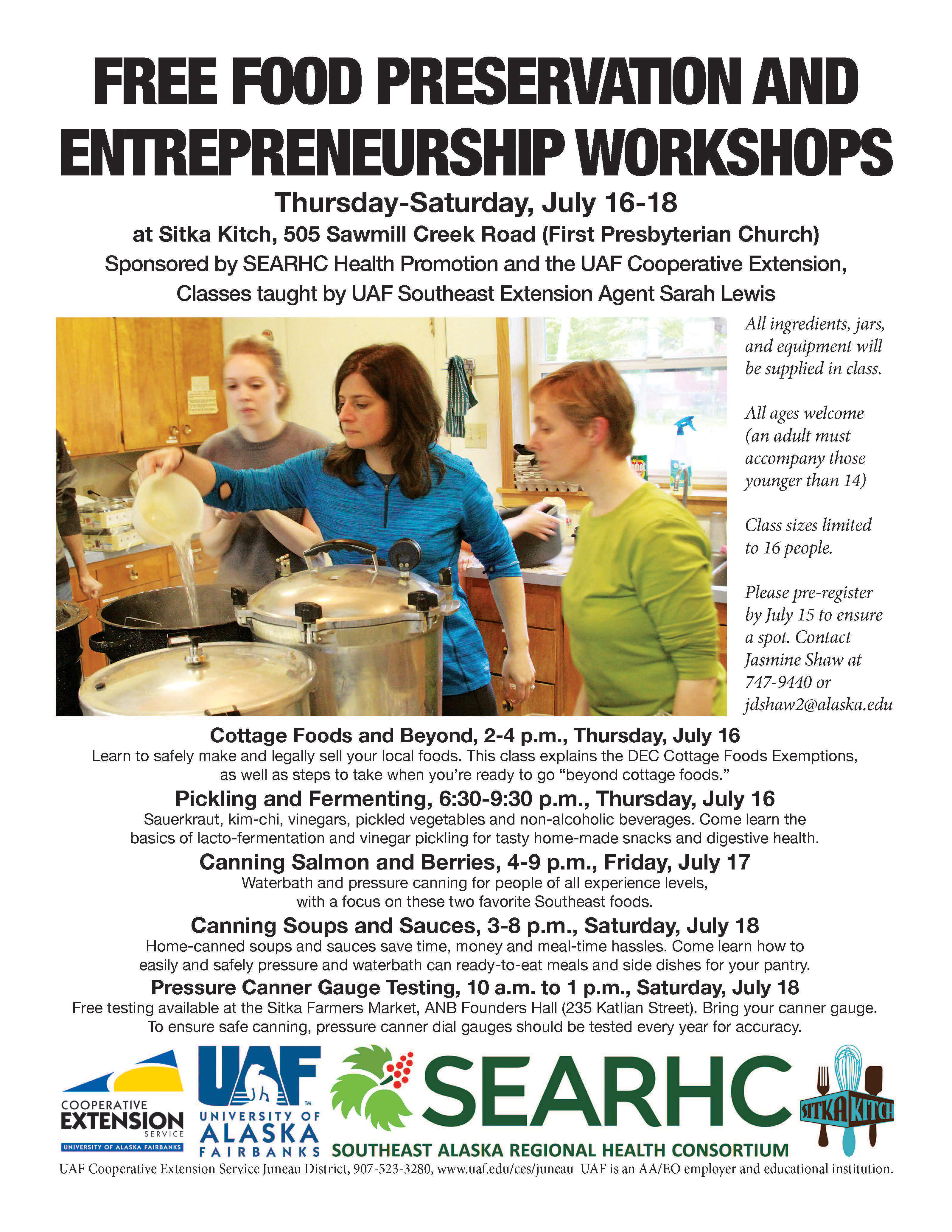
• SEARHC, Cooperative Extension to host free food preservation and entrepreneurship workshops at Sitka Kitch

SitkaKitch2015CanningClasses

The SouthEast Alaska Regional Health Consortium (SEARHC) WISEFAMILIES Traditional Foods program and the University of Alaska Fairbanks Cooperative Extension Service are teaming up to offer a series of four free food preservation and entrepreneurship workshops on Thursday through Saturday, July 16-18, at the Sitka Kitch. There also will be free pressure canner gauge testing at the Sitka Farmers Market on July 18.

The Sitka Kitch is a rental community commercial kitchen project coordinated by the Sitka Conservation Society, in partnership with the Sitka Local Foods Network, located inside the First Presbyterian Church, 505 Sawmill Creek Road. The Sitka Kitch was a project from the 2013 Sitka Health Summit designed to improve food security in Sitka while also providing a space for people wanting to get into the cottage food business or wanting to preserve their harvest for storage in the home pantry. Sitka Kitch officially opened in March 2015 after a series of renovations to make it pass Alaska Department of Environmental Conservation commercial kitchen food safety standards.

UAF Southeast Extension Agent Sarah Lewis of the Juneau District Office will teach four classes — Cottage Foods and Beyond, Pickling and Fermenting, Canning Salmon and Berries, and Canning Soups and Sauces. These classes are open to Sitka residents of all ages, but an adult must accompany those younger than 14 years old. Class sizes are limited to 16 people. Thanks to a grant from the SEARHC WISEFAMILIES Traditional Foods program, all ingredients, jars, and equipment will be supplied in class.

“The WISEFAMILIES Traditional Foods program is partnering with the UAF Cooperative Extension Service because their work complements our purposes, which is to help Native families reduce their risk for disease while working toward getting back to a traditional way of eating,” said SEARHC Health Educator Clara Gray, of the SEARHC WISEFAMILIES Traditional Foods program.

The SEARHC WISEFAMILIES Traditional Foods program promotes healthy lifestyles by connecting Alaska Natives in Southeast Alaska to their culture. Members of the program learn how to harvest, cook, and preserve their traditional Alaska Native foods, which usually are healthier than heavily processed store-bought foods. In addition, participants learn traditional language, dancing, carving, weaving, and other skills that help reconnect them to their culture.

SarahLewisWithBoilingPotsThe UAF Cooperative Extension Service offers a variety of programs geared toward food, how to grow it, how to preserve it for storage, and how to make it into cottage foods you can sell. For those who can’t make the classes, the service offers a series of free online tutorials about home canning called Preserving Alaska’s Bounty.

“As a UAF Cooperative Extension Agent, I try to teach that family and community resilience are strengthened when local foods are used to cook meals at home,” Lewis said. “Through my food preservation and entrepreneurship workshops I offer the knowledge and skills needed for people to discover the nutritional benefits and financial stability that come from making and preserving homemade meals with local ingredients.”

Here are the details and schedules of the four classes:

  • Cottage Foods and Beyond, 2-4 p.m., Thursday, July 16 — Learn to safely make and legally sell your local foods. This class explains the DEC Cottage Foods Exemptions, as well as steps to take when you’re ready to go “beyond cottage foods.”
  • Pickling and Fermenting, 6:30-9:30 p.m., Thursday, July 16 — Sauerkraut, kim-chi, vinegars, pickled vegetables and non-alcoholic beverages. Come learn the basics of lacto-fermentation and vinegar pickling for tasty home-made snacks and digestive health.
  • Canning Salmon and Berries, 4-9 p.m., Friday, July 17 — Waterbath and pressure canning for people of all experience levels, with a focus on these two favorite Southeast foods.
  • Canning Soups and Sauces, 3-8 p.m., Saturday, July 18 — Home-canned soups and sauces save time, money and meal-time hassles. Come learn how to easily and safely pressure and waterbath can ready-to-eat meals and side dishes for your pantry.

In addition to teaching the four classes, Lewis will offer free pressure canner gauge testing at the Sitka Farmers Market, from 10 a.m. to 1 p.m. on Saturday, July 18, at the Alaska Native Brotherhood Founders Hall, 235 Katlian Street. She also will provide other resources about home canning and food preservation. To ensure safe canning, pressure canner dial gauges should be tested every year for accuracy.

Due to limited class space, please pre-register by Wednesday, July 15, to ensure a spot. To pre-register, contact Jasmine Shaw of the Sitka District Office of the UAF Cooperative Extension Service at 747-9440 or jdshaw2@alaska.edu.

• Harmful algal bloom warning issued for shellfish harvested in Starrigavan Beach

Clam diggers work the beach at Starrigavan in this file photo. The Sitka Tribe of Alaska is warning Sitkans against harvesting clams in the area due to a harmful algae detected Monday, June 8, 2015. (Daily Sitka Sentinel file photo by James Poulson)

Clam diggers work the beach at Starrigavan State Recreation Area in this file photo. The Sitka Tribe of Alaska is warning Sitkans against harvesting clams in the area due to a harmful algae detected Monday, June 8, 2015. (Daily Sitka Sentinel file photo by James Poulson)

Southeast Alaska Tribal Ocean Research (SEATOR) on Monday, June 8, issued a warning that people should not be eating shellfish harvested at Starrigavan Beach in Sitka.

Pseudo-nitzchia“Yes, we are seeing a bloom of Pseudo-nitszchia. This species of plankton can produce domoic acid which can cause amnesic shellfish poisoning (ASP),” Sitka Tribe of Alaska Environmental Program Manager Chris Whitehead said.

Whitehead is coordinating SEATOR and the Southeast Alaska Tribal Toxins (SEATT) partnership program where seven tribes in Southeast Alaska are partnering to test shellfish for harmful algal booms that can cause problems such as paralytic shellfish poisoning (PSP) or other health issues. The SEATT partnership program and SEATOR were launched a little bit over a year ago because there is no harmful algal bloom testing of Southeast beaches by the state, even though there had been many recent cases of PSP outbreaks that resulted in people being hospitalized or even dying.

According to the SEATOR website, Pseudo-nitzchia spp is a genus of diatoms found worldwide. In North America, it can be found on the Pacific Northwest Coast from Alaska to mid-California, the Northeast Atlantic Coast of Canada, in North Carolina, and in the Gulf of Mexico. Domoic acid is a neurotoxin that binds glutamate receptors, which are involved in memory processing.

Amnesic shellfish poisoning (ASP) causes gastrointestinal and neurologic issues. Mild cases usually occur within 24 hours after eating shellfish exposed to the ASP toxin. Symptoms include nausea, vomiting, diarrhea, and abdominal cramps. In more severe cases there also will be neurological problems, such as headaches, confusion, hallucinations, short-term memory loss, respiratory difficulty, seizures, coma, and in extreme cases, death.

According to a recent story from Oregon Public Broadcasting’s KUOW/EarthFix program, there currently is a massive harmful algal bloom extending from Homer, Alaska, on the north to Monterey Beach, Calif., in the south. In addition to impacting shellfish, the toxic harmful algal bloom has caused problems in fish and marine mammals that ate infected shellfish.

If you recently have eaten shellfish harvested in the Starrigavan State Recreation Area and have any of the above symptoms, you should seek medical help immediately.