UAF Cooperative Extension Service updates Alaska’s Sustainable Gardening Handbook

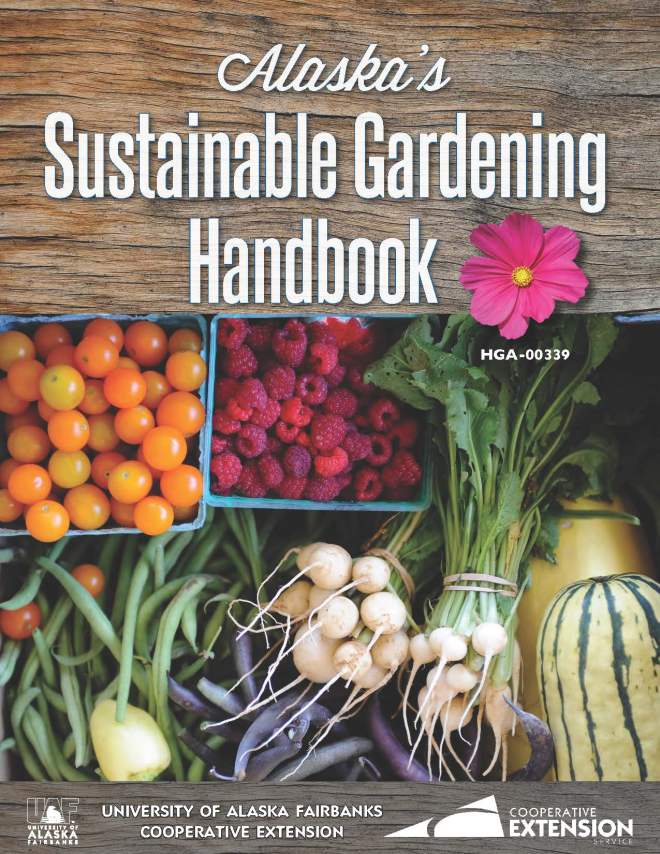
Sustainable Gardening 2015 cover

Alaska’s Sustainable Gardening Handbook” has been updated.

This publication was first produced in 2010 as an adaptation of “Sustainable Gardening: The Oregon-Washington Master Gardener Handbook” and this is the first revision. It is used as one component in Master Gardener training programs for University of Alaska Cooperative Extension Service volunteers in Alaska, but is also a must-have for all Alaska gardeners.

UAF Cooperative Extension Service agriculture and horticulture agents have contributed their expertise to provide information on topics such as basic botany, lawns, vegetable gardening, orchards, entomology, pest management and more.

Call 877-520-5211 (toll-free in Alaska) to order the handbook, or check with Jasmine Shaw of the Sitka District Office at 747-9440 to see if she has any copies available locally. The 490-page book costs $50.

UAF Cooperative Extension Service offers Certified Food Protection Manager class by videoconference Oct. 4 in Sitka

CFPMClass10042016

Tuesday, Sept. 20, is the registration deadline for a certified food protection manager workshop being taught on Tuesday, Oct. 4, by University of Alaska Fairbanks Cooperative Extension Service. This is an all-day statewide class that will be offered by videoconferencing to Bethel, Delta Junction, Fairbanks, Juneau, Kodiak, Palmer, Sitka and Valdez.

A certified food protection manager (CFPM) is responsible for monitoring and managing all food establishment operations to ensure that the facility is operating in compliance with food establishment regulations.

A CFPM is knowledgeable about food safety practices and uses this knowledge to provide consumers with safe food, protect public health and prevent food-borne illnesses. Alaska regulations require food establishments to have at least one CFPM on staff.

This course takes place from 8:30 a.m. to 5 p.m. (with a half-hour lunch), and participants will take a computer-based exam at the end of the class. The reason the deadline is two weeks before the class is to guarantee course materials reach all the students in time for the class. The cost is $200, and the course will be taught by Julie Cascio of Palmer. Students can register here.

The Sitka videoconference for the class will take place in Room 106 at the University of Alaska Southeast Sitka Campus. To learn more, contact Jasmine Shaw at the Sitka District Office of the UAF Cooperative Extension Service at 747-9440, or contact Julie Cascio at (907) 745-3360 (Palmer number) or jmcascio@alaska.edu. Note, this class is taught in English but textbooks are available in Korean, Chinese and Spanish, just contact Julie at least three weeks before the class.

Also, the ServSafe book ($70) and certification exam ($75) now are available online, if people want to order the book and study independently without taking the class. Just go to this website and purchase the book and exam items.

UAF Cooperative Extension Service to host forest and tree pest detector workshops in Sitka, Juneau

2016 First Detector Training_Southeast

Invasive pests threaten our natural areas and our community trees. The University of Alaska Fairbanks Cooperative Extension Service is launching a program to train First Detectors to be the first line of defense against invasive pests in their communities. Help prevent new pests from joining the green alder sawfly and spruce aphid as established pests in Southeast Alaska.

Learn about:

  • What makes forests healthy
  • What makes a species invasive
  • What to look for and important resources
  • Invasive forest insects of concern in Alaska
  • How to report and submit potential invasive species findings

The Sitka training is from 6-8 p.m. on Tuesday, Aug. 23, at the Sitka Public Library. The Juneau training is from 6-8 p.m. on Wednesday, Aug. 24, at the Mendenhall Valley Branch Library. Both training sessions are free.

For more information, contact Jessie Moan at 907-786-6309 or mjmoan@alaska.edu.

Sitka Spruce Tips 4H club to host 4H Fair at July 30 Sitka Farmers Market

4H Fair flyer

SitkaFarmersMarketSignThe Sitka Spruce Tips 4H club will host its inaugural 4H Fair at the Sitka Farmers Market from 10 a.m. to 1 p.m. on Saturday, July 30, at the Alaska Native Brotherhood Founders Hall (235 Katlian Street).

The Sitka Spruce Tips 4H club is co-sponsored by the University of Alaska Fairbanks Cooperative Extension Service and the Sitka Conservation Society. It provides a variety of programming promoting the Alaska Way of Life for youth and their families.

According to event organizer Jasmine Shaw of the UAF Cooperative Extension Service Sitka District Office, the 4H members are going to be submitting projects in six different divisions:

  • Division 1 — Food Preservation (jams, jellies, preserves, canned goods, smoked fish, jerky)
  • Division 2 — Baked Goods (pies, cakes, cookies, donuts/frybread, breads)
  • Division 3 — Produce (fruits and vegetables) and Flowers
  • Division 4 — Arts and Crafts (knitting, basketry, natural products, recycled crafts, woodworking, sewing)
  • Division 5 — Art (photography, drawings, paintings)
  • Division 6 — Presentations (posters, reports, displays)
Only one entry per individual per category is allowed, so we are asking members to choose your best item. Other items can be displayed but not entered for judging.
“This is a chance for community members to see what 4H has been up to all year and become involved if they want,” Shaw said. “(We will have registration forms).
“Some members will have items for sale alongside the fair display,” Shaw added. “I’m not sure all of what will be for sale yet, but I do some of our members in our natural product series will be making lotion and lip balm.”

Do you need to test your soil for a better garden? Sometimes you do

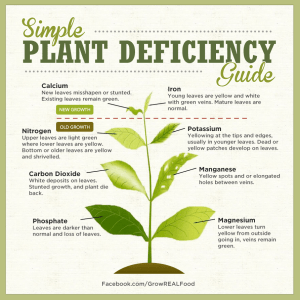
simple-plant-deficiency-guideHave you ever planted your garden and even though you’ve had plenty of sunny weather it just doesn’t seem to be growing the way it should? You might need to test your soil to see if you need to replenish some nutrients.

The University of Alaska Fairbanks Cooperative Extension Service has several publications and a video that can help you decide if you need to test your soil, and if yes, teach you how. Many gardeners test their soil at the end of the season, so they can amend their soil as needed to prepare for the next spring’s planting. But sometimes you might need to test during the growing season, which is what Sitka Local Foods Network Garden Mentor Program Coordinator Michelle Putz did last year when one of her student’s gardens wasn’t doing very well.

Soil testing is not always necessary,” Michelle said. “If you have several hours of direct sun and your garden is growing beautifully, then you may not need to test your soil. If you have sun but your garden is not doing so well, or if you have brand new soil, it might be worth testing the soil.

“One of our Garden Mentor families in 2015 grew beautiful but tiny plants that were struggling to get bigger, she added. “A simple soil test showed that their soil was low in nitrogen and needed a little acid. Once we added coffee grounds (for acid) and blood meal (for nitrogen), the plants grew substantially. Had we realized that our starting soil was so basic (not acidic enough) and nutrient poor, we could have made adjustments before the growing season and had a much more productive garden.”

In Southeast Alaska, our rain tends to wash a lot of the nutrients out of the soil. This is why it’s almost a requirement for gardeners to amend their soil with seaweed, compost, coffee grounds and other items to replenish the missing nutrients. It also helps to rotate your crops from one garden plot to the next, since different plants draw different nutrients as they grow (for example, potatoes use a lot of nitrogen while tomatoes use a lot of potassium).

To learn more about soil-testing, watch the video at the top of this story and read the three attached files below. The attached files and video will show you how to take a soil sample and how to send it to a lab for testing.

• Soil and Fertilizer Management for Healthy Gardens (UAF Cooperative Extension Service publication, HGA-0338)

• Factors to Consider in Selecting a Soil-Testing Laboratory (UAF Cooperative Extension Service publication, FGV-00045)

• Soil Sampling (UAF Cooperative Extension Service publication, FGV-00044)

Sitka Spruce Tips 4H Club to celebrate Arbor Day on May 20 with tree planting at Swan Lake

Arbor Day Flyer

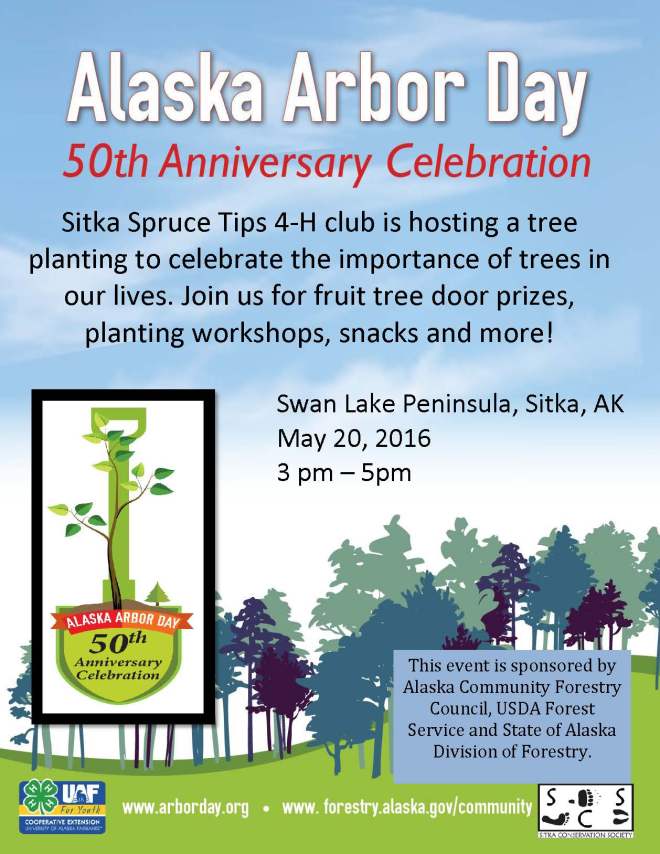
Friday, May 20, is the 50th anniversary of Arbor Day in Alaska, and the Sitka Spruce Tips 4H Club will celebrate by planting a few trees from 3-5 p.m. at the Swan Lake recreation area (near the corner of Lake Street and DeGroff).

We will be planting maples, but giving away fruit trees for people to plant at home, said Molly Johnson, who helps coordinate the Sitka Spruce Tips 4H Club for the Sitka Conservation Society, in partnership with the University of Alaska Fairbanks Cooperative Extension Service Sitka District Office.

“4H is excited to host a celebration in honor of Alaska Arbor Day to celebrate how important trees are in our lives,” Molly said. “We see the significance of trees in the clean air and great habitat they provide whenever we explore the Tongass (National Forest). This will be a fun event to honor that significance closer in town. It is a great opportunity to come together as a community and celebrate trees!”

This event is co-sponsored by the Alaska Community Forestry Council, the USDA Forest Service, and the Alaska Division of Forestry. Because of its commitment to trees in town, the City and Borough of Sitka has been recognized as one of the Tree City USA award-winners from the Arbor Day Foundation.

Scenes from the Safe Home Food Preservation certification course May 14-15 in Sitka

SarahLewisDiscussesTypesOfPressureCanners

Food preservation certificate flierIn an effort to train people to teach safe home food preservation classes in their Southeast Alaska communities, the University of Alaska Fairbanks Cooperative Extension Service hosted a series of certification courses around the region in recent months. The Sitka class on May 14-15 at Blatchley Middle School wrapped up the series, which featured several online lessons followed by two-day hands-on classes in Juneau, Ketchikan and Sitka.

The Sitka class was taught by UAF Cooperative Extension Service Associate Director Roxie Rodgers Dinstel of Fairbanks and Sarah Lewis, a Family and Community Development faculty member from Juneau. In addition to several Sitka residents, there also were students from Haines, Petersburg and Juneau in the Sitka class. The series was funded by a grant from the SouthEast Alaska Regional Health Consortium (SEARHC).

During the class, the 10 students learned which foods need waterbath canning vs. pressure canning, had a lesson on fermenting, tested pressure canner gauges, dehydrated fruits and veggies, made jerky, and learned how to find reliable resources to make sure their home food preservation practices are safe.

In addition to teaching classes, some of the students will use their new skills for cottage food businesses and home canning projects. One of the purposes of the class was to certify people in a variety of Southeast Alaska communities on how to teach safe home food preservation classes, so they don’t have to wait for a UAF Cooperative Extension Service faculty member from Juneau, Anchorage or Fairbanks to come to town to teach.

A slideshow of scenes from the two-day hands-on classes is below.

This slideshow requires JavaScript.


Alaska Growers School provides guidance for Native-run agriculture projects

AK-Growers-School-1

The University of Alaska Fairbanks Cooperative Extension Service is offering the Alaska Growers School this summer for Alaska Native-owned farms and ranches. This training is offered by webinar and is intended for Alaska Native tribes, Alaska Native corporations, or Alaska Natives who are currently farming or ranching or hope to start.

(Photo by Jeff Fay) Meriam Karlsson provides a tour of the greenhouse and hydroponic system near Pike's Waterfront Lodge.

(Photo by Jeff Fay for the UAF Cooperative Extension Service) Meriam Karlsson provides a tour of the greenhouse and hydroponic system near Pike’s Waterfront Lodge.

A total of nine lessons will be offered by webinar and teleconference from noon to 1:30 p.m. on Wednesdays, June 8 to Aug. 10. Those interested should register for CEPD F001 UX1 Alaska Growers School (CRN 51871). The cost of the course is $50, however tuition waivers are available. To apply for a waiver, first you must register, then you can complete the waiver (the link is available on the registration page).

This training is non-credit and will be taught by University of Alaska Fairbanks Cooperative Extension Service experts as well as experts from Arizona and Washington who are knowledgeable about Native American farming and ranching policies. This training is intended for Alaska Native tribes, Alaska Native corporations, or Alaska Natives who are currently or hope to start farming or ranching. Representatives or employees of Alaska Native owned corporations (regional or village) are also welcome to participate in the course. The course will address opportunities available to socially disadvantaged farmers and ranchers.

There are lots of reasons to think about starting a farm or ranch. With persistent, low oil prices, agriculture could be a diversification strategy. Starting a farm in a remote village could provide fresher, healthier food for a community as well as improved food security. It also could improve local economies by providing job opportunities and keeping more money in a particular community.

This class will provide the nuts and bolts of getting started farming or ranching in Alaska and will specifically address opportunities available to Alaska Native-owned farms and ranches who are considered socially disadvantaged by the USDA. We will showcase successful Alaska Native- and Native American-owned farms and discuss some of the most promising enterprises for Alaska, such as Rhodiola and peonies.

In the Summer 2016 Alaska Growers School, you will:

  • Learn about important considerations for starting or expanding a farm or ranch.
  • Consider opportunities to improve food security in remote Alaska Native villages
  • Learn about business mapping and how to choose a business structure
  • Establish your vision, goals, values, and strengths.
  • Assess your resources, skills, and motivations for farming.
  • Understand and learn how to manage the risks of starting or expanding a farm in remote Alaska.
  • Learn about other training opportunities, technical assistance, and resources.
  • Connect and learn with other Alaska Native and Native American growers.

The course will be offered using, Blackboard Collaborate.

Please contact the UAF Cooperative Extension Service for any questions about the Alaska Growers School.

This material is based upon work supported by the Office of Advocacy and Outreach, U.S. Department of Agriculture, under award # 59-2501-15-045. Any opinions, findings, conclusions, or recommendations expressed in this publication are those of the author(s) and do not necessarily reflect the views of the U.S. Department of Agriculture.

UAF Cooperative Extension Service to offer statewide online Alaska Master Gardener class

master_gardener

Are you interested in earning an Alaska Master Gardener certification? The University of Alaska Fairbanks Cooperative Extension Service is offering a statewide summer online Master Gardener class from May 23 through Aug. 12.

The Alaska Master Gardener online course is an intensive, sustainable gardening class specific to Alaska growing conditions. This is a non-credit, self-paced, online course offered through UAF eLearning using Blackboard Learn. The course fee is $375. Register here for the Summer 2016 Alaska Master Gardener online course — Course Number: ED F595P (50942) or NRM F595P (51014), choose either one when registering.

This curriculum for this online course includes lessons on botany, starting plants, soil, composting, season extension, greenhouses, landscaping, house plants, entomology, pest management, plant disease diagnostics and sustainable gardening. The course also covers growing vegetables, fruits, berries and flowers. The text for the course is Sustainable Gardening: Alaska Master Gardener Manual, which can be purchased for $50 a copy from this link. The text is optional for the course, but it is a good resource for any Alaska gardener even if you’re not taking the course.

Students complete 12 self-paced lessons and quizzes, a book report, participate in ongoing discussions, and complete a final exam. On average, the course takes students approximately three hours per week to complete. The course is pass/fail and the summer course is not for credit.

In addition to the coursework, students also pledge to volunteer at least 40 hours teaching what they’ve learned in their communities. Examples of how students can volunteer include helping with local school garden programs or 4H clubs, working with local foods groups, writing gardening blogs, and more.

The classroom-based Alaska Master Gardener course hasn’t been offered in Sitka for about three years, so the statewide online course is the only way Sitka gardeners can obtain the training until a new Cooperative Extension Service agent is hired in Sitka. Gardeners from Sitka can contact Jasmine Shaw at the Sitka District Office of the UAF Cooperative Extension Service (jdshaw2@alaska.edu or 747-9440) to see if there will be a local classroom at the University of Alaska Southeast Sitka Campus for the online course, otherwise they will need to take it from home.

For more information about the statewide online Alaska Master Gardener course, contact instructor Heidi Rader in Fairbanks at 907-452-8251, Ext. 3477, or by email at master.gardener@alaska.edu

UAF Cooperative Extension Service offers Certified Food Protection Manager class by videoconference May 5 in Sitka

CFPM flyer 5-5-16

Monday, April 18, is the registration deadline for a certified food protection manager workshop being taught on Thursday, May 5, by University of Alaska Fairbanks Cooperative Extension Service. This is an all-day statewide class that will be offered by videoconferencing to Fairbanks, Palmer, Haines, King Salmon and Sitka. The next class available for Sitka participation won’t be until this fall or winter.

A certified food protection manager (CFPM) is responsible for monitoring and managing all food establishment operations to ensure that the facility is operating in compliance with food establishment regulations.

A CFPM is knowledgeable about food safety practices and uses this knowledge to provide consumers with safe food, protect public health and prevent food-borne illnesses. Alaska regulations require food establishments to have at least one CFPM on staff.

This course takes place from 8:30 a.m. to 5 p.m. (with a half-hour lunch), and participants will take a computer-based exam at the end of the class. The reason the deadline is two weeks before the class is to guarantee course materials reach all the students in time for the class. The cost is $200, and the course will be taught by Julie Cascio of Palmer. Students can register here.

The Sitka videoconference for the class will take place in Room 110 at the University of Alaska Southeast Sitka Campus. To learn more, contact Jasmine Shaw at the Sitka District Office of the UAF Cooperative Extension Service at 747-9440, or contact Kathy McDougall at (907) 474-2420 (Fairbanks number) or kmmcdougall@alaska.edu. Note, this class is taught in English but textbooks are available in Korean, Chinese and Spanish, just contact Kathy at least three weeks before the class.

Also, the ServSafe book ($70) and certification exam ($75) now are available online, if people want to order the book and study independently without taking the class. Just go to this website and purchase the book and exam items.