Check out the February 2018 edition of the Sitka Local Foods Network newsletter

The Sitka Local Foods Network just sent out the February 2018 edition of its monthly newsletter. Feel free to click this link to get a copy.

This month’s newsletter has short articles about our new Sitka Food Business Innovation Contest, a request for volunteer gardening instructors this spring, a reminder about the Pick.Click.Give. donation program, information about our sponsorship program, and an invitation to join our board of directors. Each story has links to our website for more information.

You can sign up for future editions of our newsletter by clicking on the newsletter image in the right column of our website and filling in the information. If you received a copy but didn’t want one, there is a link at the bottom of the newsletter so you can unsubscribe. Our intention is to get the word out about upcoming events and not to spam people. We will protect your privacy by not sharing our email list with others. Don’t forget to like us on Facebooklike our new Sitka Farmers Market page on Facebook and follow us on Twitter (@SitkaLocalFoods).

SEARHC Mt. Edgecumbe Hospital patients now have traditional food options

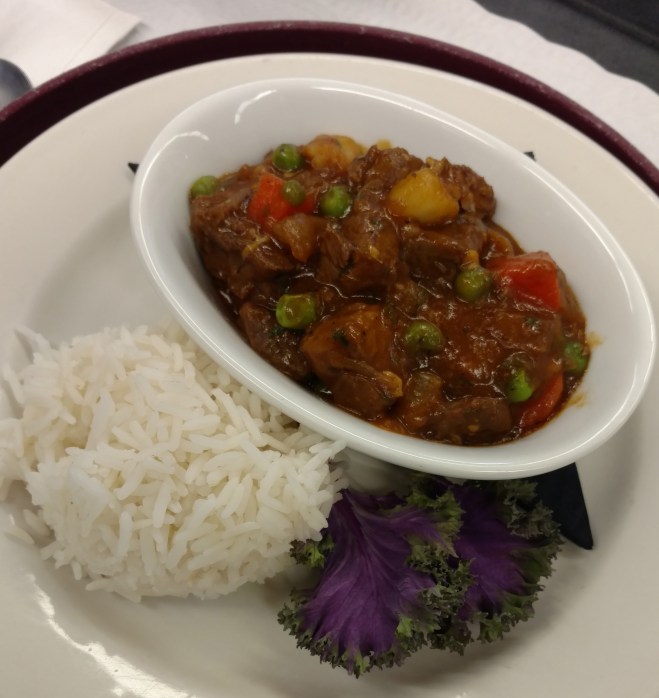
A bowl from venison stew served at the Mt. Edgecumbe Hospital cafeteria (Photos courtesy of SEARHC)

As part of the SouthEast Alaska Regional Health Consortium (SEARHC) Mt. Edgecumbe Hospital’s (MEH) overarching goal to provide the best care possible to individuals receiving medical care at MEH, the Hospital Nutrition staff, in partnership with food service contractor NMS, recently began making traditional food options available to inpatients.

NMS Chef Manager Lexie Smith holds deer hind quarters before preparing them for Mt. Edgecumbe Hospital patients as part of the hospital’s new traditional food options

Providing care means more than traditional medicine, it means comforting those that are not feeling well. One way Mt. Edgecumbe Hospital Nutrition staff thought they could provide additional comfort that was to add traditional foods such as local game, seafood, plants, and berries to the inpatient menu that feel like comfort food. However, adding traditional foods to the hospital’s menu required coordination with more than one Alaska State agency, including the Department of Environmental Conservation and the Department of Fish and Game.

Undaunted by the task and motivated by the inevitable outcome, the MEH Nutrition team set out to develop a policy that would satisfy the state and SEARHC. The Traditional Foods Policy they created took quite a while to finalize, but resulted in a system that now allows Mt. Edgecumbe Hospital to accept donations of locally harvested meat, seafood, vegetables, and berries to be used exclusively for inpatient meals.

“As a team, we truly believe that the food we serve, and the hospitality we provide aid in the healing process. NMS is proud to prepare traditional foods that bring comfort to Mt. Edgecumbe patients, and we are committed to doing so,” said Lexie Smith, NMS Chef Manager at Mt. Edgecumbe Hospital. “The menu is meant to engage our guests, honor tradition, and respect the land. The venison stew, in particular, is a recipe calling for fresh vegetables, herbs, and Sitka venison (as supplies are available). The stew is a popular menu option that many guests relate to and feel comforted by. Our Traditional Foods Policy allows the public to make donations of indigenous foods as long as it has been properly handled,” she added.

“This program is a win-win, great for the health of patients and great for community members who want to donate and be part of systems that emphasize living sustainably off the land and sea,” SEARHC Health Promotion Director Martha Pearson said.

For now, every Friday the MEH “Chef Special” for patients is venison stew. Ideally, however, if MEH were to receive donations of other items like fish, herring eggs, beach asparagus, fiddleheads, berries, reindeer, moose, etc. the Nutrition staff could incorporate those into the menu as well. They could also employ traditional methods of preserving. The hospital nutrition staff would very much like to see items such as local jams and pickles, herring egg salad, bone broths, and smoked fish on the patient menu in the future.

“Patient-centered medical care is a critical component of the way we deliver healthcare at SEARHC. Our Traditional Foods policy is an example of that and an enhancement to our vision of promoting a healthy balance of mind, body, and spirit,” SEARHC President/CEO Charles Clement said. “We are excited to explore ways to demonstrate our appreciation of the area and the local flavor in these offerings and are of course proud to be part of the future of healthcare delivery in the region.”

Additional information regarding traditional foods that may be donated and which are prohibited can be found online at http://dec.alaska.gov/eh/fss/Food/Traditional_Foods.html and reviewing the links under the “Requirements” section near the top of the page.

Individuals that have questions about donating traditional foods to Mt. Edgecumbe Hospital can contact NMS Food Service and Catering General Manager David Alexander at (907) 966-8325 or david.alexander@nmsusa.com, or NMS Chef Manager Lexie Smith at (907) 966-8470 or lexie.smith@nmsusa.com.

Sitka Tribe/SEATOR join new Alaska Ocean Acidification Network tribal research working group

Esther Kennedy at the SEATOR lab in Sitka.

While most people don’t know much about ocean acidification, it has become a major concern of Alaska fishing communities. Higher rates of CO2 means the ocean is 30 percent more acidic than it was three centuries ago, and that has impacted everything from how shellfish build their shells to causing harmful algal blooms that result in paralytic shellfish poisoning and other issues.

In order to monitor ocean acidification and its impact in Alaska coastal communities, the Sitka Tribe of Alaska (STA) and its partners in the Southeast Alaska Tribal Ocean Research (SEATOR) have joined the new Alaska Ocean Acidification Network (AOAN) tribal research working group.

Jeromy Grant, left, and Sean Williams of Hoonah Indian Association take water samples for SEATOR.

“Global warming increases the risk of shellfish toxins, while its partner ocean acidification directly threatens shellfish survival,” STA Environmental Specialist Esther Kennedy said. “We monitor ocean acidification and shellfish toxins at local beaches to ensure that shellfish remain a sustainable and safe wild food source despite ongoing environmental changes.”

The tribal working group was formed to coordinate ocean acidification research and monitoring activities, as well as local community outreach activities, between tribal organizations across Alaska. So far discussions have been on creating consistency in data collection, and expanding data collection to sites in the Arctic that are not currently adequately sampled.  This effort is about expanding tribal capacity for research and monitoring, and having tribes take the lead in some areas in Alaska which are under sampled by university and agency researchers, as well as partnering with those researchers to build local capacity.

In addition to Sitka Tribe of Alaska (STA), other members of the AOAN tribal working group include Alutiiq Pride Shellfish Hatchery in Seward, Sun’aq Tribe of Kodiak, the Native Village of Kotzebue, and Yakutat Tlingít Tribe. SEATOR includes 16 Southeast tribal partners, plus Sun’aq Tribe in Kodiak, with its lab located in Sitka. The Sitka Sound Science Center recently posted an online survey about ocean acidification for the AOAN.

“Over the past few years the Sitka Tribe of Alaska (STA) has become a leader in Alaska in monitoring for shellfish toxicity for communities,” said Davin Holen, who is coordinating the tribal working group for AOAN. “This includes working closely with communities throughout Southeast Alaska to monitor stocks important for subsistence harvests. This effort has lead to the establishment of the Southeast Alaska Tribal Ocean Research (SEATOR), which is housed in the environmental department of STA. Recently the STA lab installed equipment to monitor for ocean acidification. STA worked collaboratively with the Alutiiq Pride Shellfish Hatchery in Seward to set up monitoring protocols for ocean acidification. Using their existing SEATOR network for testing shellfish, STA is beginning to monitor ocean acidification levels throughout Southeast Alaska. Additional monitoring will occur in collaboration with the Sun’aq Tribe of Kodiak for Kodiak Archipelago communities, along with two sites under development in the Arctic. Tribal monitoring of environmental conditions in Southeast Alaska by STA through the SEATOR network has become a model for other areas of Alaska, making STA a vital partner for marine science in Alaska.”

The Sitka Tribe of Alaska continuously monitors the carbonate chemistry of Sitka Harbor and is beginning a discrete sample collection program modeled after the Alutiiq Pride Shellfish Hatchery’s existing program. The Sitka Tribe coordinates discrete sample collection and analysis with the SEATOR partnership’s existing weekly phytoplankton and shellfish biotoxin monitoring programs, including with the Hoonah Indian Association and other Southeast Alaska tribal partners.

Kennedy said SEATOR’s participation in the Alaska Ocean Acidification Network tribal working group is a natural extension of its shellfish testing work.

“We installed a Burke-o-Lator (BoL) in early June, which is an instrument that can continuously monitor the chemistry of water pumped through it and can measure individual preserved water samples,” Kennedy said. “While we’re still working to fully calibrate the individual water sample analysis portion of the instrument, we have started shipping kits of bottles and preservative to our partners. Since our partners are already collecting a phytoplankton sample every week and shellfish samples every two weeks, our goal is for partners to add OA-sample collection to their phytoplankton sampling routine and to ship us preserved samples with their clams every two weeks. Ocean acidification’s specific effects on nearshore ecosystems are still not well known, so we’re hoping that by pairing OA samples with phytoplankton assemblages and shellfish toxins, we’ll get a clearer picture of each community’s vulnerability. We are also interested in seeing whether the chemistry in our OA samples helps us to predict phytoplankton toxins, as work in California has suggested that domoic acid production is higher in more acidic waters.”

Alaska Longline Fishermen’s Association wins $142,500 for deckhand apprenticeship program

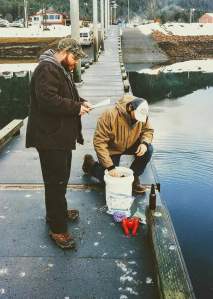
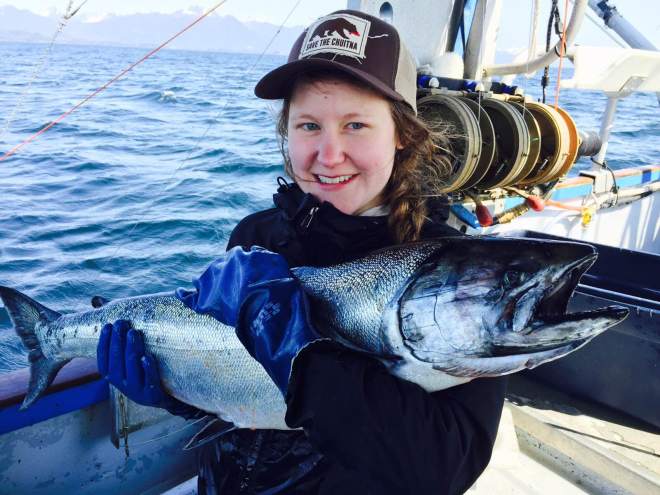
Sophie Nethercut is one of about 25 greenhorns who has served a short stint as a crew member on Eric Jordan’s troller, the I Gotta, in recent years. (PHOTOS COURTESY OF ERIC JORDAN)

Over the last couple of years, Sitka’s Eric Jordan has taken about two dozen young people commercial fishing on his troller, the I Gotta. Now, the Sitka-based Alaska Longline Fishermen’s Association (ALFA) has adopted this program and expanded it to other boats in an effort to counter the graying of the commercial fishing fleet.

Eric Jordan, back center, poses with crew members (l-r) Alyssa Russell, Sarah Jordan (his wife) and Anya Grenier in front of his troller, the I Gotta.

Last month, ALFA’s Supporting the Next Generation of Alaskan Fishermen through the Deckhand Apprentice Program received a $142,496 award ($69,996 grant and $72,500 matching funds) from the National Fish and Wildlife Foundation as part of its Sustainable Fisheries in the United States grant program. The ALFA grant was one of seven grants totaling $766,871 (with $840,887 in matching funds), for a total conservation impact of more than $1.6 million.

“The generous support from the National Fish and Wildlife Foundation will allow us to offer more young people an an entry level commercial fishing opportunity,” ALFA Executive Director Linda Behnken said. “Young fishermen face a host of challenges these days, and ALFA is doing what we can to support the next generation of commercial fishermen by supporting entry level opportunities and policy that safeguards the health of our ocean, fisheries and fishing communities.”

According to the report, “The Graying of the Alaskan Fishing Fleet,” in 2014, the average age of a limited entry permit holder was 50 years old, 10 years older than it was in the 1980s. In 2013, only 17 percent of current permits are held by fishermen younger than 40 years old, a decrease from 38 percent in 1980. This has raised concerns there won’t be enough young people to replace the older fishermen when they retire. Deckhand apprenticeships are one way ALFA and other groups are countering the graying of the fleet.

“With support from NFWF, we plan to expand the program to include more boats, crew, and communities,” Behnken said.”Giving young people the opportunity to participate in our commercial fisheries can help us to sustain our fishing communities and create the next generation of resource stewards.”

Cathryn Klusmeier, left, and Jacob Metzger are among the greenhorns who crewed on Eric Jordan’s troller, the I Gotta.

According to the grant profile, “Alaska Longline Fishermen’s Association will coordinate and expand a state-wide apprentice program to promote resource stewardship, community viability, and opportunity in Alaska’s commercial fisheries. The project will develop curriculum and resources to guide the program expansion, include additional vessels and fisheries, and promote entry level job opportunities.”

“Finding crew with some experience, who loves fishing in Alaska, is so critical to the future of our individual businesses in the industry as a whole,” Jordan said. “This program gives them the taste of it. Deckhands know they like it, and skippers can recommend them for future employment. It is a win-win for everyone.”

“We are currently developing the curriculum — one for skippers, and one for crew,” said ALFA Communications Coordinator Alyssa Russell, who has crewed on the I Gotta. “We want to give skippers the tools they need to mentor someone, and crew the skills they need to have a successful experience and continued employment.”

Check out the January 2018 edition of the Sitka Local Foods Network newsletter

The Sitka Local Foods Network just sent out the January 2018 edition of its monthly newsletter. Feel free to click this link to get a copy.

This month’s newsletter includes brief items about how you can support the SLFN through the Pick.Click.Give. program, an invitation to join us at our annual meeting and potluck dinner on Jan. 28, info about the 2018 sponsorship program for businesses and individuals, and an invitation to join our board of directors. Each story has links to our website for more information.

You can sign up for future editions of our newsletter by clicking on the newsletter image in the right column of our website and filling in the information. If you received a copy but didn’t want one, there is a link at the bottom of the newsletter so you can unsubscribe. Our intention is to get the word out about upcoming events and not to spam people. We will protect your privacy by not sharing our email list with others. Don’t forget to like us on Facebooklike our new Sitka Farmers Market page on Facebook and follow us on Twitter.

Sitka Local Foods Network to host annual meeting and potluck on Sunday, Jan. 28

The Sitka Local Foods Network will host its annual meeting and potluck dinner from 5-7 p.m. on Sunday, Jan. 28, at the Sitka Unitarian Universalist Fellowship Hall (408 Marine St., parking off of Spruce Street).

Participants are encouraged to bring a dish featuring local foods to share, and please bring your own utensils (note, this is a non-alcoholic event). This event is a good event to attend for people who want to learn more about the Sitka Local Foods Network and what we do around town. We also hope to have a silent auction, where people can bid on various gardening and food items (donations are welcome).

Attendees will hear about project updates, plus the current board will vote on by-law changes. We will introduce our new board members for 2017, and we will confirm the election of our officers. We also have a couple of openings on our board, and people wanting to learn more about joining can click this link for info and applications.

Individuals interested in learning more about the Sitka Local Foods Network can email sitkalocalfoodsnetwork@gmail.com to learn about our projects and volunteer opportunities.

Monday’s the day to start filing your PFD applications with Pick.Click.Give. donations

As 2017 winds to a close, many Alaskans already are thinking about applying for their 2018 Alaska Permanent Fund Dividend check in January. As usual, Alaskans can share their wealth with a variety of Alaska nonprofits, including the Sitka Local Foods Network, through the PFD’s Pick.Click.Give. program.

This is the fourth year the Sitka Local Foods Network will participate in the Pick.Click.Give. program, which allows people to donate in $25 increments to their favorite statewide and local 501(c)(3) nonprofit organizations when they file their PFD applications from Jan. 1 through March 31. We missed 2017 due to a clerical snafu, but we’re back in the program for 2018.

When you choose to donate part of your PFD to the Sitka Local Foods Network, you support the Sitka Farmers Market, St. Peter’s Fellowship Farm, education programs about growing and preserving food, the Sitka Kitch community rental commercial kitchen, Sitka Community Gardens, matching dollars at the Sitka Farmers Market for SNAP/WIC beneficiaries, the sustainable use of traditional foods, the Sitka Community Food Assessment, the Sitka Food Summit, and a variety of other projects designed to increase access to healthy local foods in Sitka.

In 2017 Alaskans contributed $2.7 million to 668 Alaska nonprofit organizations, and more than $18.5 million has been donated since the program started in 2009. Some Alaskans choose to donate to just one group, while others may spread several donations around to many groups. There now are more than 600 total 501(c)(3) nonprofit organizations participating in Pick.Click.Give. for 2017 (including multi-location nonprofits), including 23 from Sitka. In 2017, Alaskans donated $100,500 to Sitka-based nonprofits.

To encourage more Alaskans to donate through the Pick.Click.Give. program, the Double Your Dividend contest has been revised to encourage philanthropy. Anybody who makes a non-anonymous Pick.Click.Give. donation to at least one of the registered nonprofits will be entered into a contest where five lucky Alaskans will win a second PFD check for their favorite participating Pick.Click.Give. nonprofit (or couple of nonprofits). The winners no longer receive a second PFD for themselves, just one to donate to an organization. The winners will be announced in October, about the time the PFDs start hitting bank accounts.

So how do you make a donation to the Sitka Local Foods Network through the Pick.Click.Give. program? First, go fill out your Alaska Permanent Fund Dividend application at http://pfd.alaska.gov/. When you get to the section of the application asking if you want to participate in Pick.Click.Give. Charitable Contributions program, click on the PCG link and search for the Sitka Local Foods Network. You also can look for us by using the town search for Sitka.

The Pick.Click.Give. program is available only to people who file their PFD applications online, and not to those who file by mail. Even though you can’t file a new PFD application after March 31, you can go back into your application and update your Pick.Click.Give. donations through Aug. 31 each year.

You still can donate to the Sitka Local Foods Network if you aren’t from Alaska or aren’t eligible for a 2018 PFD. To donate, send your check to the Sitka Local Foods Network, 408D Marine St., Sitka, Alaska, 99835. You also can donate online by going to our online fundraising page on Razoo.com, and clicking the Donate button to make an online contribution. You also can send in a check or make an online donation if you are trying to make nonprofit donations before the end of the 2017 tax year. Please let us know if you need a receipt for tax purposes. For more information about donating, you can send an email to sitkalocalfoodsnetwork@gmail.com.

Thank you for supporting our mission of promoting and encouraging the growing, harvesting and eating of local foods in Sitka and Southeast Alaska.

Check out the December 2017 edition of the Sitka Local Foods Network newsletter

The Sitka Local Foods Network just sent out the December 2017 edition of its monthly newsletter. Feel free to click this link to get a copy.

This month’s newsletter includes brief items about our #GivingTuesday fundraising campaigns on Nov. 28, info about the 2018 sponsorship program for businesses and individuals, and an invitation to join our board of directors. Each story has links to our website for more information.

You can sign up for future editions of our newsletter by clicking on the newsletter image in the right column of our website and filling in the information. If you received a copy but didn’t want one, there is a link at the bottom of the newsletter so you can unsubscribe. Our intention is to get the word out about upcoming events and not to spam people. We will protect your privacy by not sharing our email list with others. Don’t forget to like us on Facebooklike our new Sitka Farmers Market page on Facebook and follow us on Twitter.

Sitka Fish and Game Advisory Committee to meet on Nov. 29 to discuss herring issues

The Sitka Fish and Game Advisory Committee will be holding a public meeting at 6 p.m. on Wednesday, Nov. 29, at Harrigan Centennial Hall.

The agenda includes Southeast Alaska finfish/herring proposals to the Alaska Board of Fisheries. For more information on the proposals, go to this link.

The Alaska Board of Fisheries will meet Jan. 11-23 in Sitka, with shellfish issues discussed on Jan. 11-14 and finfish issues on Jan. 15-23. A full list and explanation of Southeast Alaska Board of Fish proposals can be found at http://www.adfg.alaska.gov/index.cfm?adfg=fisheriesboard.main.

The Alaska Board of Fisheries consists of seven members serving three-year terms. The board’s primary role is to conserve and develop the fishery resources of the state.

The Sitka Fish and Game Advisory Committee is one of 84 local advisory committees made up of local stakeholders who are knowledgable on local fisheries and resource use. Local advisory committees can advise and give comments to the Alaska Board of Fisheries and represent local knowledge and insights. An member of the public also can comment on specific proposals to the Alaska Board of Fisheries.

For further information, contact Lena Gilbertson at the Department of Fish & Game at 907-465-4046.

Advisory committees are local groups that meet to discuss fishing and wildlife issues and to provide recommendations to Alaska Board of Fisheries and Alaska Board of Game. All meetings are open to the public. Advisory committees are intended to provide a local forum on fish and wildlife issues. Their purpose includes: 1) developing regulatory proposals, 2) evaluating regulatory proposals and making recommendations to the appropriate board, 3) providing a local forum for fish and wildlife conservation and use, including matters relating to habitat, 4) advising the appropriate regional council on resources, and 5) consulting with individuals, organizations, and agencies.

If you are a person who needs a special accommodation in order to participate in any of these public meetings, please contact Boards Support at 907-465-4110 no later than 48 hours prior to the meeting, to make any necessary arrangements.

For more information, contact Lena Gilbertson, Boards Support Section, PO Box 115526, Juneau AK 99811-5526, phone 907-465-4046, fax 907-465-6094, email address lena.gilbertson@alaska.gov.


Like what we do? Now you or your business can sponsor the Sitka Local Foods Network in 2018

The Sitka Local Foods Network created a sponsorship program to help promote our mission, and Sitka businesses and individuals are welcome to join for 2018. The goal of the sponsorship program is to make the projects we undertake (Sitka Farmers Market, St. Peter’s Fellowship Farm, gardening education, etc.) more sustainable.

“Sitka has a precarious position when it comes to food security, and the Sitka Local Foods Network is trying to improve our food security through our mission to increase the amount of locally harvested and produced foods in the diets of Southeast Alaskans,” Sitka Local Foods Network president Charles Bingham said. “Sponsors of the Sitka Local Foods Network are working with an organization and a farmers market that values local food and businesses, fun, premium quality goods and experiences.”

In recent years, the Sitka Local Foods Network has hosted seven Sitka Farmers Markets during the summer (from July to September). We haven’t set our 2018 dates yet, but we anticipate we will have seven markets again this summer. In addition, we grow most of the local produce sold at the markets at St. Peter’s Fellowship Farm communal garden and a couple of other locations in town. We also offer a variety of garden education classes in the spring. One way we ensure fresh, local produce is available to lower-income Sitkans is through our matching program for WIC and SNAP beneficiaries (the first $20 spent on produce at the farmers market). This year we also hope to launch a new food business innovation contest to inspire food entrepreneurs in Sitka.

There are four levels of sponsorship available, and each has its own set of perks.

  • Grower ($2,500-plus) — We’ll hang your banner at ANB Hall during the Sitka Farmers Markets, include your logo and company name prominently in our merchandise and advertisements, and thank you on our social media and web pages. If appropriate for the Sitka Farmers Market, you may set up a free promotional booth.
  • Harvester ($1,000-$2,499) — We’ll hang your banner at ANB Hall during the Sitka Farmers Markets and include your logo and company name in our merchandise and advertisements.
  • Planter ($250-$999) — Your banner will hang at ANB Hall during the Sitka Farmers Markets.
  • Friend ($50-$249) — You are listed on our online sponsor page.

We have limited space for banners at the Sitka Farmers Markets, so please contact us before May 1 to guarantee your spot. To learn more about the sponsorship program, click the link below for details and a registration form. For more information, contact Charles Bingham at (907) 623-7660 or by email at charleswbingham3@gmail.com, or email us at sitkalocalfoodsnetwork@gmail.com.

• 2018 Sitka Local Foods Network sponsorship program details and registration form