• HB92 will require labeling of GMOs for food sold in Alaska

GMOOMGflier

As a food consumer you want to know what’s in your food. Has it been soaked with chemical pesticides? Was it created using genetically modified organisms (GMOs)? How nutritious is it? Unfortunately, current laws don’t require labeling of GMOs, so you don’t know if you’re buying Frankenfoods.

Rep. Geran Tarr, along with co-sponsors Rep. Scott Kawasaki and Rep. Chris Tuck, introduced a bill, HB92, to require labeling of genetically modified food. HB 92 is being heard by the House Resources Committee on Monday, March 9, and Rep. Tarr needs you to provide a letter of support. Can you send Rep. Tarr a letter of support for GMO labels?

Please email a short, from-the-heart letter about why you want the right to know about GMOs to Rep. Tarr at Rep.Geran.Tarr@akleg.gov. She’ll forward it along to the committee members.

Also, the timing is great because this week Rep. Tarr is sponsoring “Alaska Food Security Awareness Week,” with special showings of the movie, GMO OMG, in Anchorage, Juneau, Sitka and Fairbanks. GMO OMG is a film that addresses how GMOs affect our children, the health of our planet, and our freedom of choice when it comes to the foods we eat.

Join us to watch GMO OMG in:

  • FAIRBANKS – Tuesday, March 10, 5:30 p.m. at the Blue Loon
  • ANCHORAGE – Wednesday, March 11, 7 p.m. at the Anchorage Museum
  • SITKA – Thursday, March 12, 5:30 p.m. at the Coliseum Theater, Downtown
  • JUNEAU – Friday, March 13, noon-1 p.m., Lunch and Learn at the State Capitol, Butrovich Room, GMO OMG film screening, Butrovich Room, 6-8 p.m.

Here is the link to the Facebook invite. If you could share this with your friends, that would be great.

Rep. Tarr was the sponsor of HJR 5, passed in 2013, to oppose GMO salmon. With your help, she can win the right to know about GMOs for Alaska. Please email her your letter of support today at Rep.Geran.Tarr@akleg.gov.

• Second annual Sitka Herring Festival kicks off March 16 with month of events

Festival Flyer

You feel it in the air; you see it in the lengthening days; you smell it with the changing tides. That’s right, herring season (and Spring!) is right around the corner. And with the arrival of the herring comes the Sitka Tribe of Alaska‘s second annual Sitka Herring Festival, a month of fantastic event for adults and kids alike.

First, for the adults. This year, we’ve been able to bring an excellent speaker from Stonybrook University in New York thanks to a generous donation from Sealaska. At the community potluck from 6-9 p.m. on Tuesday, April 7, at Harrigan Centennial Hall, Dr. Ellen Pikitch will present on herring management and conservation throughout the world. Dr. Pikitch was one of the leading scientists on the Lenfest Forage Fish Task Force, is a pioneer in ocean conservation, and is a leader in ecosystem-based management of fisheries. This event will be a potluck style, so please bring a dish to share. We’re very excited to have her here during the herring season.

In addition to the community potluck, there will be a talk at the University of Alaska Southeast Sitka Campus from Dr. Shingo Hamada. Dr. Hamada is an anthropologist at the Research Institute for Humanity and Nature in Kyoto, Japan. His talk will be on Herring Fisheries and Food Culture in Japan. Mark your calendars for 7:30 p.m. on Monday, March 23, in UAS Sitka Campus Room 218. This is a partnership from the Natural History Seminar Series with UAS and the Sitka Sound Science Center. All are welcome, but be sure to bring your questions.

But what would a festival be without fun activities for the kids? This year’s festival will also include Yaa Khusgé Yaaw Woogoo — The Knowledge of Herring Camp, hosted by the Sitka School District and the Outdoor Foundation, in partnership with Sitka Tribe of Alaska and Sitka National Historical Park. This is a free, hands-on spring break camp connecting kids to culture that will take place from March 16-20 at Sitka National Historical Park. Middle school youth (grades 6-8) are welcome and encouraged to participate in this free camp. More information can be found at Sitka National Historical Park. Feel free to or pick up an application at the main office of STA or at the Sitka National Historical Park Visitor Center.

Derby FlyerFor those who like a little competition, there’s the Herring Derby and the Herring Run. Like last year, the Herring Derby will be a fun event for kids and parents. The Derby starts on Friday, March 20, and continues through Monday, April 6. Weigh your biggest fish every day (from 9 a.m. to 4:30 p.m. on Monday through Friday and from 5-7 p.m. on Saturday and Sunday) at the Sitka Tribe of Alaska Resources Production Office at 429 Katlian Street. May the best (biggest) fish win. Also like last year, Sitka Community Schools will host the Herring Run. The run will start at 11 a.m. on Saturday, April 4, at Harrigan Centennial Hall and will wind through the Totem Park trails before returning to Centennial Hall. Herring swim in schools, so bring your friends.

There will be more fun and educational events during the Festival, including a 4-H class through Sitka Conservation Society, Herring in the Hallway at Keet Gooshi Heen Elementary School, Discovery Days at the Sitka Sound Science Center, and the showing of a herring film showing at 7 p.m. on Friday, March 27, and at 2 p.m. on Saturday, March 28, at the Sitka National Historical Park  For the dancers among us, there will also be a Herring Hop from 6-11 p.m. on Saturday, March 28, at the Alaska Native Brotherhood Fellowship Hall. The Herring Hop is a fundraiser for the Cape Decision Lighthouse Society. The Herring Festival will also feature a Food Web Cruise on Saturday, March 21, as a fundraiser for another fantastic festival, the Sitka Whalefest.

More info for all these events can be found online at http://sitkaherringfestival.wordpress.com or at our Facebook page. Or you can email sitkaherringfestival@gmail.com or call 747-7168.

• 2015 Sitka Herring Fest calendar of events

• Check out the March 2015 edition of the Sitka Local Foods Network newsletter

March2015SLFNNewsletterScreenshot

The Sitka Local Foods Network just sent out the March 2015 edition of its newly launched monthly newsletter. Feel free to click this link to get a copy.

This edition of the newsletter has brief stories about Sitka neighbors forming chicken coop co-ops, our open manager and assistant manager positions for the Sitka Farmers Market, some upcoming spring garden and livestock classes, and the 2015 Pick.Click.Give. fundraising campaign. Each story has links to our website for more information.

You can sign up for future editions of our newsletter by clicking on the registration form image in the right column of our website and filling in the information. If you received a copy but didn’t want one, there is a link at the bottom of the newsletter so you can unsubscribe. Our intention is to get the word out about upcoming events and not to spam people. We will not share our email list with others to protect your privacy.

• It’s time to … mark your calendars and get ready for spring with these garden and livestock education classes

SLFNSpringGardenClassesFEB2015

Thinking about your garden, especially with our warm winter? It’s time to mark your calendars with several upcoming Spring 2015 garden classes offered by the Sitka Local Foods Network Education Committee.

GreensInHoopHouseStPetersThese free classes will cover a variety of topics, from gardening basics and choosing what veggies to grow in Sitka to learning about fruit tree pruning, composting and seed-starting. But wait, there’s more. We recently added classes on raising chickens and rabbits. Some of the classes have limited space and require preregistration, so sign up early.

We will be adding more classes to this list as they become available, so check the website for updates. We plan to post individual class announcements as we get closer to the actual class dates.

And now, here’s the list of classes so far:

  • Everyone Can Compost — 6:30-8 p.m., Wednesday, March 4, Sitka Unitarian Universalist Fellowship Hall (408 Marine Street, parking off Spruce Street), teacher Jennifer Carter, no preregistration required.
  • Fruit Tree Pruning Basics Workshop — 10 a.m., Saturday, March 7, St. Peter’s Fellowship Farm (behind St. Peter’s By The Sea Episcopal Church), teacher Jud Kirkness, no preregistration required.
  • Growing and Fertilizing Rhubarb — 11 a.m., Saturday, March 14, at the home of Perry Edwards/Michelle Putz (131 Shelikof), teachers Perry Edwards and Michelle Putz, no preregistration required.
  • Raising Chickens 101 — 6:30-8 p.m., Wednesday, March 25, Sitka Unitarian Universalist Fellowship Hall (408 Marine Street, parking off Spruce Street), teacher Bobbi Daniels, no preregistration required.
  • Starting Vegetable Seedlings Workshop — 6:30 p.m., Tuesday, March 31, Harrigan Centennial Hall, teacher Jennifer Carter, learn how to start seedlings and go home with a tray of planted seeds, class limited to 15 people, preregistration required.
  • Raising Rabbits 101 — 6:30-8 p.m., Wednesday, April 8, Sitka Unitarian Universalist Fellowship Hall (408 Marine Street, parking off Spruce Street), teacher Bobbi Daniels, no preregistration required.
  • Seed-Starting Basics — 2 p.m., Saturday, April 11, call for location (Michelle Putz, 747-2708), teacher Linda Wilson, class limited to 8-10 people, preregistration required.

We had 55 people attend our first two classes in January and February, kicking off a year-long series of education events on a variety of topics related to vegetable gardening, livestock, and food preservation in Sitka. Our garden mentor program classes also will be open to the public, once they start in April.

For more information or to sign up for classes requiring preregistration, contact Jennifer Carter at 747-0520 or 1-850-491-2666 (cell), or Michelle Putz at 747-2708.

• Spring 2015 garden education classes from the Sitka Local Foods Network (opens as PDF)

• Registration opens for Southeast Alaska Farm and Fish to School Conference on April 2-3 in Juneau

FlyerPromoDecPoster-page-001

Registration has begun for the inaugural Southeast Alaska Farm and Fish to Schools Conference, which takes place April 2-3 at Centennial Hall in Juneau.

This event will be the first regional opportunity focused on building connections between Alaska’s school systems and local food entrepreneurs. Anyone interested in bringing more local foods into our school system is invited to collaborate and connect with regional experts to strengthen fish and farm to school programming across the state.

Southeast Conference, the regional economic development organization, is coordinating the conference in conjunction with the newly formed Sustainable Southeast Partnership, a diverse network of organizations working together on community sustainability in Southeast Alaska.

Farm&Fish-logo-on-photos Cropped“Often we find that the barriers to achieving access to local, healthy foods can be overcome if we work together as a region to make this initiative a priority,” said Alana Peterson, program director of the Sustainable Southeast Partnership, Haa Aani, Community Development Fund Inc. “By bringing all the key players together for a conference we are hoping to achieve just that.”

Fish and farm to school programming offers significant economic, environmental cultural and nutritional opportunities to our rural communities and region.

“Schools in southeast received more than $500,000 last year to buy Alaskan produced foods through the Nutritional Alaska Foods to Schools grant program.” said Shelly Wright, Executive Director of Southeast Conference. “However, schools are often limited by what they can procure. There are untapped opportunities for, farmers, fishermen and small business in our region. We are eager to break down barriers and grow the opportunities for everyone.”

Online registration and more detailed conference information is available at http://www.seconference.org/southeast-farm-and-fish-schools-conference. Register before Feb. 28 to be eligible for a travel stipend. For more information, contact Lia Heifetz at growsoutheast@gmail.com.

• Sitka residents team up to run neighborhood chicken coop co-ops

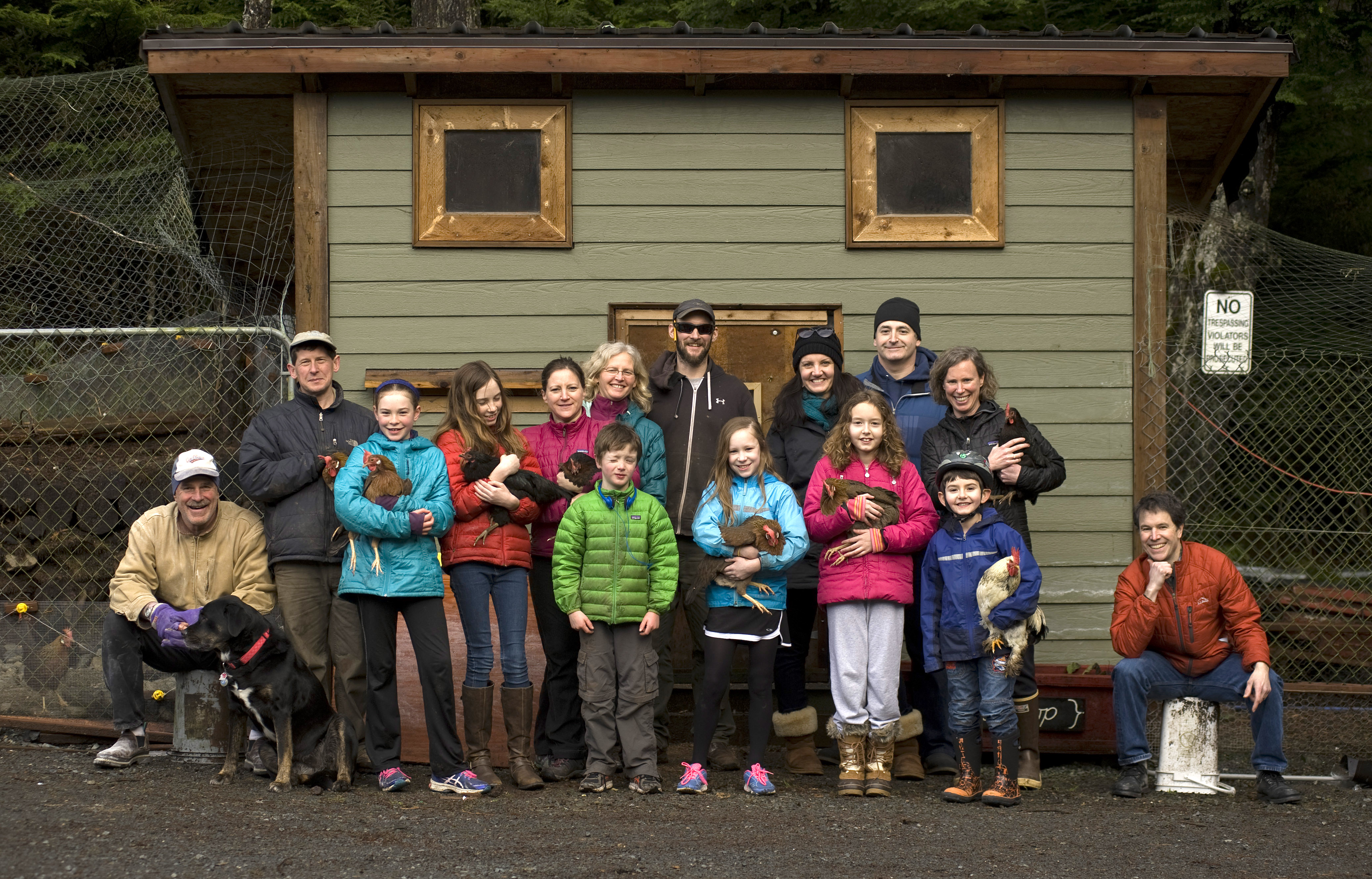
Some of the members of Le Coop, one of Sitka's chicken coop co-ops, pose with a few of their birds. (Daily Sitka Sentinel Photo by James Poulson, other photos in story are by Charles Bingham)

Some of the members of Le Coop, one of Sitka’s chicken coop co-ops, pose with a few of their birds. (Daily Sitka Sentinel Photo by James Poulson, other photos in story are by Charles Bingham)

Many Sitka families joined the backyard agriculture movement by starting gardens, but they hesitated when it came time to take the next step — raising chickens.

Chickens require daily feeding and watering, protection from predators, and other care that can be daunting for novices. However, a few Sitka families found an easier way. There now are a couple of chicken coop-co-ops in town, where neighbors or friends team up to share the duties and expense of raising chickens.

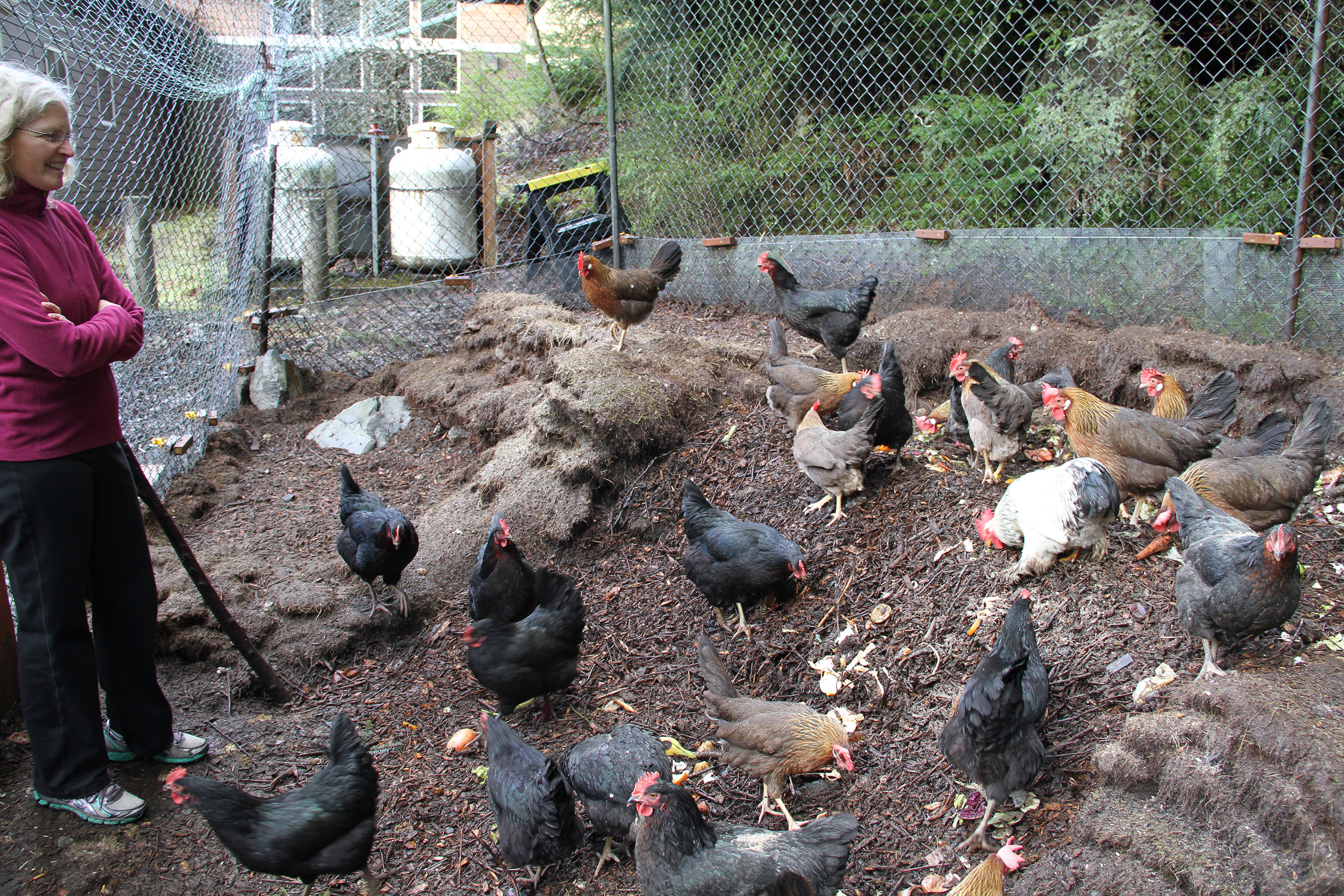
LeCoopOne of these chicken coop co-ops, Le Coop, is hidden in a back corner of the Sheldon Jackson Campus, where seven families are raising about 30 hens and one rooster. Le Coop is about 15 feet by 80 feet, with a hen house flanked by two outdoor chicken runs. The fence surrounding Le Coop is electrified (buried at least a foot below the surface to keep out varmints), with netting over the top to protect the chickens from eagles and other raptors. Inside the hen house are a dust bath for the hens, food and water buckets, an egg-laying box, and shelf space to store supplies such as extra feed.

“The advantage are only being responsible one day a week for regular chores such as feed, water, opening/closing, etc. Everything else is done at the whim of individual enthusiasms, and occasional work parties,” said Jud Kirkness, one of the co-op members. “Plus seven families means that many more people finding useful materials and resources and splitting the feed bill seven ways.”
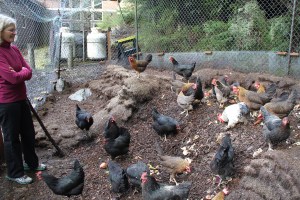
LauraSchmidtWatchesChickensFeedLaura Schmidt, who Jud called the lead organizer/treasurer of the group, said there are six families of four and one couple, so 26 people. “About one person per hen,” she said. ” Each family typically gets about 18-30 eggs on their chicken duty day, with the hens laying more eggs in the summer.

Most of the hens were purchased as chicks last spring, and there are 15 each of red leghorns and black stars. The white rooster is of indeterminate origin, and he was added to the flock when another coop was culling its flock. Many people who raise chickens don’t like to keep roosters, but Laura said this one is small and the hens seem to be able to handle him.

The members of Le Coop have various levels of experience with raising chickens, and Erika Knox said Laura and Jud are the most experienced so they have been mentoring the other families. Erika said she wouldn’t be able to raise chickens at her house because there isn’t enough space, and lately she had to stop composting at home due to rats and other varmints getting into it.
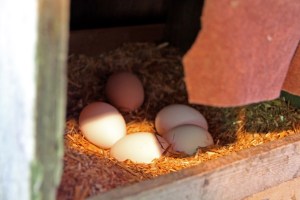
EggsInLayingBox“This is a nice place to bring my compost, and the chickens love it,” Erika said. “It’s nice to have eggs that are fresh and organic. I give some away.”

Roger Schmidt and Kristen Homer called themselves the weak links of the group. “We just collect eggs,” Kristen said. “We let them (Laura and Jud) tell us what needs to be done.”

“It’s great because we have chicken experts like Jud and Laura, and we’ve got building experts,” said Roger, Laura’s brother and the director of the Sitka Fine Arts Camp, which owns the Sheldon Jackson Campus where Le Coop is located. He said there have been a couple of occasions when he was in a meeting on campus and suddenly remembered he had chicken duty that day.

RedLeghornAndRoosterBesides being able to share duties and costs with the chicken coop co-op, another advantage to having Le Coop on campus is the learning experiences it provides.

“It’s good for the kids. They learn a lot about chickens,” Roger said. “I bring the Head Start kids back here all the time to check on the chickens.”

“The kids love it,” Kristen said. “Razie Guillory (Laura’s daughter) did a science project charting the growth of the hens, and Asa Dow is doing a project about the economics of the co-op.”

Jud said as soon as he gets this chicken coop to where he wants it, he plans to start another chicken coop co-op for other Sitka families. “I hope it provides some inspiration.”

This slideshow requires JavaScript.

• Rabbit, goat highlight Sawmill Farm’s farm-to-table dinner at Ludvig’s Bistro

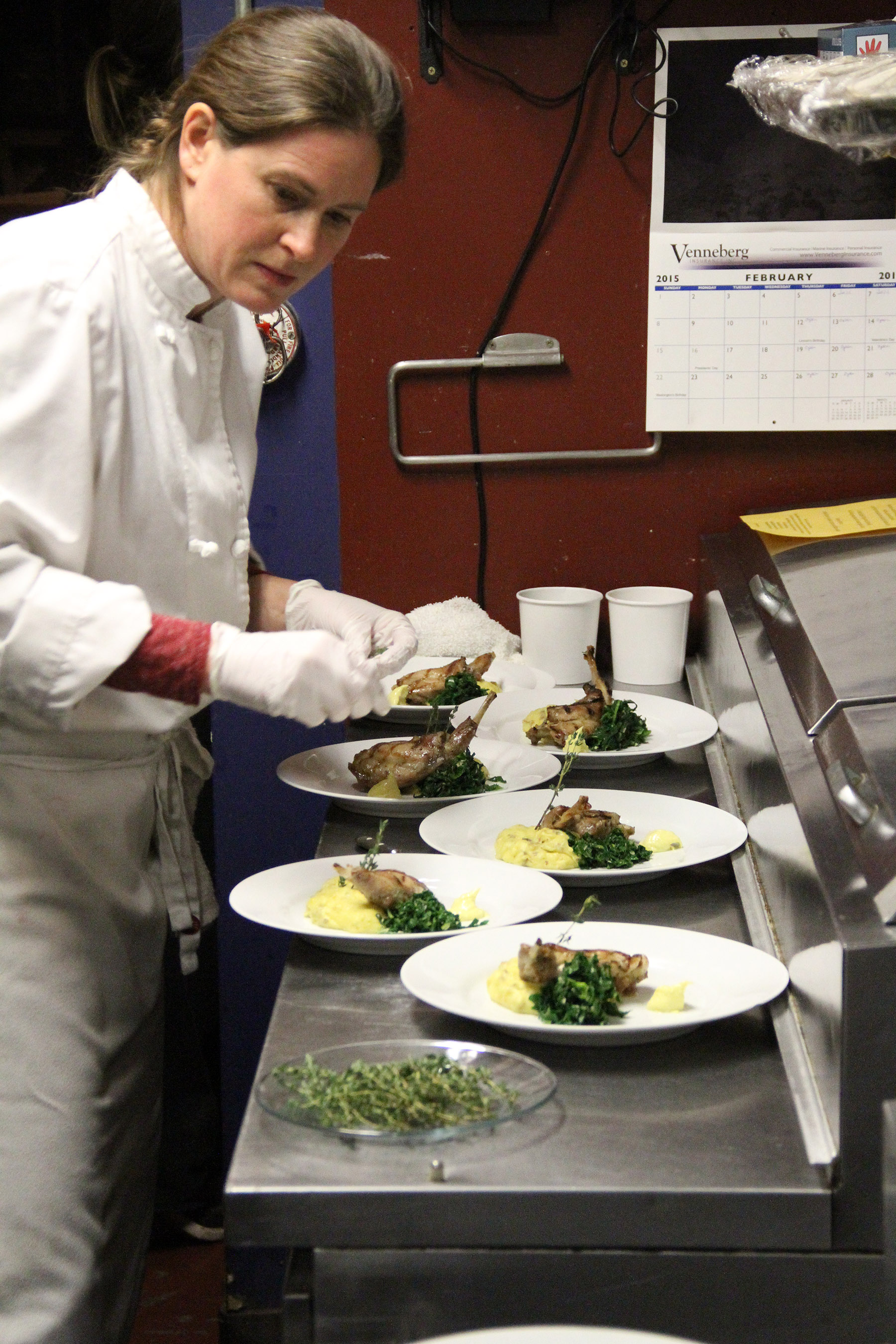
ColetteGarnishesRabbitThighs

Locally raised rabbit and goat meat from Ketchikan were the highlights of a fundraising farm-to-table dinner for the Sawmill Farm on Jan. 31 at Ludvig’s Bistro.

In an effort to raise seed money for her Sawmill Farm project, Bobbi Daniels worked with Ludvig’s Bistro owner/chef Colette Nelson to create a five-course meal featuring locally sourced food from Sitka and Southeast Alaska. Tickets were $75 per plate for the function.

Bobbi already is raising rabbits in town, and she said goats also do well in Sitka. Bobbi hopes to find a large enough lot so she can grow enough rabbits to supply local stores with meat. She said rabbit meat is one of the cleanest meats as far as toxins, and it only takes 10 weeks to raise a rabbit to harvest size. The Sawmill Farm was one of 12 semifinalists in the recent Path to Prosperity economic development contest sponsored by the Nature Conservancy and Haa Aaní Community Development Fund, and now is competing for the people’s choice award.

Working with local farmers and gardeners, Bobbi and Colette created five-course meal that featured:

  • rabbit terrine with farm egg, beach asparagus and mustard;
  • leek, heirloom tomato, zucchini and rabbit consommé with sprouted wheat bread;
  • Moroccan goat stew with ginger, preserved lemons, potatoes, dates and almonds, served with white satin carrot salad and balsamic beets;
  • grilled rabbit thigh served with aioli, Inca Bella potato purée and sautéed garlic kale; and
  • Russian pavlova with huckleberry, rhubarb, currants and Sitka rose sugar.

A variety of gardens and farms provided the food used for the meal. The Sawmill Farm supplied the rabbits and wheat berries, Sivertsen Farm in Ketchikan provided the goat, Lori Adams of Down-To-Earth U-Pick Garden supplied winter kale, Sara Taranof provided farm eggs, Linda Walker provided garlic, huckleberries, rhubarb and currants, and Florence Welsh of Forget-Me-Not Garden supplied white satin and orange carrots, heirloom tomatoes, red rose potatoes, Inca Bella potatoes, leeks, zucchini, beets, raspberry preserves and beach asparagus.

Scenes from the meal are in a slideshow below:

This slideshow requires JavaScript.

• Yaa Khusgé Yaaw Woogoo will teach middle school students about herring during spring break

2006 Herring collection 007

HerringBranchesThe Sitka School District and the Outdoor Foundation, in partnership with the Sitka Tribe of Alaska and Sitka National Historical Park, will host a free, week-long marine science and culture camp during spring break, March 16-20, for 20 sixth-grade, middle-school students. (NOTE: On Feb. 23, this program was opened up to all middle school students, grades 6-8, and the priority deadline was extended to March 6.)

Yaa Khusgé Yaaw Woogoo — Knowledge-of-Herring Camp — provides students the chance to explore the cultural and ecological importance of herring in a hands-on camp. Participants will use cutting-edge technology while working with renowned marine ecologist Michelle Ridgway to study Pacific herring in the field and in the lab. Students who participate in the camp will gain valuable experience conducting scientific research and will gain a deeper understanding of the critical role herring play in Southeast Alaska’s marine ecosystem, as well as the cultural significance of this keystone species.

Daily camp activities will include observing herring and other marine wildlife during marine field trips, conducting research throughout Sitka Sound and in the lab, learning about herring’s cultural significance from Native elders and culture bearers, exploring Sitka’s coastline to learn about critical herring habitat and using advanced scientific technology. Each daily session, held from 12:30-5:30 p.m., will conclude with a presentation or field activity lead by scientists, Native elders or local herring experts.

Applications are available at the Sitka National Historical Park visitors center, 106 Metlakatla St., at Blatchley Middle School, or they can be downloaded at http://www.nps.gov/sitk. All applicants must be in the sixth grade. Interested participants should submit an application by Feb. 20 to receive priority consideration. Completed applications should be returned to staff at Sitka National Historical Park’s visitor center. The hours of operation for the visitor center are Tuesday-Saturday from 9 a.m. to 3 p.m. For additional information, please contact Ryan Carpenter at 747-0121.

• The Sawmill Farm to host Farm-to-Table Dinner on Jan. 31 at Ludvig’s Bistro

Bobbi Daniels of The Sawmill Farm grooms a rabbit at The Sawmill Farm Feed and Fiber store on Katlian Street. Bobbi raises some rabbits for their hair (to make yarn) and others for meat.

Bobbi Daniels of The Sawmill Farm grooms a rabbit at The Sawmill Farm Feed and Fiber store on Katlian Street. Bobbi raises some rabbits for their hair (to make yarn) and others for meat.

Want to see and taste some of the local food possibilities in Sitka? The Sawmill Farm will host a Farm-to-Table Dinner with two seatings (at 5:30 p.m. and 7:30 p.m.) on Saturday, Jan. 31, at Ludvig’s Bistro (256 Katlian St.). Ludvig’s Bistro owner/chef Colette Nelson will be preparing the meals.

“We will be featuring locally grown foods as much as possible,” said Bobbi Daniels, co-owner of The Sawmill Farm. “This will include rabbit, eggs and vegetables, among other things.”

Tickets are $75 each, and seating is limited with only 25 people per session. To make reservations, call Bobbi at 738-4481 or send a message to The Sawmill Farm’s Facebook page.

p2p-bobbi-daniels-560x400The Sawmill Farm is bringing commercial agriculture to Sitka, and supporting Sitkans who are maintaining their own backyard operations. The farm will raise rabbits, chickens, goats, pigs, and more. It also has a feed store. The Sawmill Farm is one of 12 semifinalists for fledgling Southeast Alaska businesses in the Path to Prosperity contest sponsored by The Nature Conservancy and Haa Aaní LLC (the economic development arm of Sealaska). The three winners, which will be announced in late January, will each receive $40,000 to help their businesses grow.

“The Sawmill Farm is working to produce locally and humanely raised, hormone and antibiotic free livestock and poultry in Sitka using the cast-off food from the grocery stores and restaurants,” Bobbi said. “Currently the city is paying highest disposal rate that is charged to have this food barged as ‘non-recyclable garbage’ to a landfill in eastern Washington. The bottom line is Sitka pays out a fortune to barge perfect pig food to Washington and then we barge corporate factory farmed pork chops back to Sitka. The Sawmill Farm wants to stop the insanity, keep that food and money local, create jobs and produce healthy meat.

“The Sawmill Farm also will support Sitkans who have their own backyard poultry and livestock. We will be selling feed, hay and straw, along with poultry chicks, and baby and adult rabbits. We have started carrying Scratch and Peck organic poultry and goat feeds, and will shortly be adding hay and straw.”

The Sawmill Farm Feed and Fiber store opened in August 2014, on Katlian Street, across from the Alaska Native Brotherhood Founders Hall. A photo slideshow of The Sawmill Farm Feed and Fiber Store is posted below.

“The feed store is stocked with assorted organic poultry and goat feeds, and straight grains for mixing feeds, to supplement livestock diets or for growing fodder,” Bobbi said. “We also have non-organic rabbit feed, hay and straw, and supplemental products such as poultry grit and diatomaceous earth (DE). We still do not have any set retail hours so, again, message us on Facebook or call 738-4481 and we’ll meet the customer there and get them taken care of.”

• The Sawmill Farm Feed and Fiber price list from August 2014

This slideshow requires JavaScript.

• Sitka Tribe of Alaska hosts regional training on paralytic shellfish poisoning and other marine biotoxins

DSCN4202 2

Shellfish lovers in Southeast Alaska have a lot to be thankful for this year, as the Sitka Tribe of Alaska hosted a regional training on how to detect paralytic shellfish poisoning and other marine biotoxins Nov. 20-21 in Sitka.

This workshop brought to town several technicians from seven different regional tribes for the first training since the Southeast Alaska Tribal Toxins (SEATT) partnership to study harmful algal blooms (HABs) was announced in October. SEATT partners include Sitka Tribe of Alaska, the Klawock Cooperative Association, Craig Tribal Association, Yakutat Tlingít Tribe, Petersburg Indian Association, Organized Village of Kasaan, and the Central Council of Tlingít and Haida Indian Tribes of Alaska (CCTHITA). In addition to the grant to create the partnership, Sitka Tribe of Alaska also received a second grant to create a regional lab in Sitka to help monitor HABs in Southeast Alaska.

Harmful algal blooms, such as paralytic shellfish poisoning (PSP), typically have not been monitored in Southeast Alaska for subsistence and recreational harvesters of clams, mussels, oysters, cockles, and other bivalves (commercial harvests are tested). Even though many people in Southeast Alaska love to harvest shellfish, eating it comes with some risks. There have been several PSP outbreaks in recent years that sent people to the hospital, and in 2010 two deaths were attributed to PSP and other HABs, such as Alexandrium, Pseudonitzchia and Dinophysis.

Being able to put trained monitors in several Southeast Alaska communities, the hope is the health risk can be reduced. Each technician will make weekly reports to the lab, which will help harvesters have better information as to the safety of their shellfish. To learn more about the training, check out this link from the Sitka Conservation Society website and this link from the National Oceanic and Atmospheric Administration (NOAA) Coastal Science website.

This slideshow requires JavaScript.