• Sitka herring researcher Heather Meuret-Woody makes her case for better management

(EDITOR’S NOTE: On Tuesday, May 15, the Sitka Tribe of Alaska hosted the Sitka Herring Summit to discuss issues regarding the management, or mismanagement, of herring stocks in Southeast Alaska. Sitka herring researcher Heather Meuret-Woody made this presentation, which also appeared as a shorter letter to the editor in the Daily Sitka Sentinel on May 18. The opinions expressed are Heather’s alone, though the Sitka Local Foods Network has written letters supporting the Sitka Tribe of Alaska in its bid to get the Alaska Department of Fish and Game to reduce the commercial quota for herring in Sitka Sound.)

Sitka Sound Herring Summit

May 15, 2012

Heather Meuret-Woody

Sitka Sound Herring Researcher

I have been a Sitka Sound herring researcher for about 10 years. I have decided to share my few thoughts on the Sitka Sound herring population. With this said, in my opinion there was not 144,143 tons of the predicted mature herring biomass returning to Sitka Sound. An overestimate of the biomass seems to be the suspect.

Managers of forage fish know that traditional stock management techniques do not work well with forage fish. The reason for the failure of traditional stock assessment techniques is that the “catchability” of forage fish increases as the stock declines. However, due to the schooling nature of forage fish and their vulnerability to modern acoustics and fishing gear, catch rates remain constant, even when the stock is rapidly falling in size (Beverton, 1990). Thus declines in stock size will not be apparent to managers or to the fishing industry, based on catch per unit effort statistics. Management of forage fish stocks requires direct measurement of stock size. This can be accomplished by surveying fish abundance during the spawning season, or by conducting scientifically designed acoustic surveys of schools of forage fish. Failure to monitor the stock directly will result in the inability to determine changes, even severe declines, in forage fish abundance. With that said, ADF&G does not measure the Sitka Sound herring stock directly. They may do acoustic surveys and aerial surveys but the data is not used for determining stock size in the ASA model. ADF&G relies almost entirely upon spawn deposition estimates to determine the spawning biomass. Hebert, 2010 states, “Estimates of total egg deposition on Macrocystis kelp may be highly variable, and transects that cross Macrocystis kelp beds could result in very high egg deposition estimates, resulting in high uncertainty around total estimates of egg deposition.” ADF&G also notes in this report that they have issues with diver calibration. One diver may visually estimate more or less eggs compared to another diver. Individual calibration factors can have a potentially large impact on spawn deposition estimates of biomass.

Accurate and regular estimates of fecundity are important for “ground-truthing” assumptions used by ADF&G. Fecundity estimates are used to convert estimates of herring egg deposition into mature biomass, and is used quite commonly among world-wide herring managers. ADF&G has only measured fecundity 4 times since the 1970s (Hulson et al., 2008). Since then, they just estimate fecundity based on weights, so large female herring lay approximately 40,000 eggs and small female herring lay approximately 20,000 eggs. Using un-validated parameters is extremely risky. For example, a 10% change in the egg per gram measurement used to convert spawn to fish, can result in a 20% change in the number of fish estimated.

In 2007, 2008, and 2009, spawning herring were sampled for Ichthyophonus prevalences in Sitka Sound. The results showed that 27% – 40% were positive for Ichthyophonus. All of this data is provided by Hershberger, Winton, and Purcell, from USGS Marrowstone Marine Field Station. The results of the 2010 and 2011 data from this ongoing research were not available at the time of this letter. Sitka Sound herring have had the Ichthyophonus disease for years and ADF&G has not incorporated this data into their current management. The ASA model does not account for disease, just “natural mortality.” However, this “natural mortality” is not based on observed data, but has been estimated by picking a random, but “conservative” number and applying it to the herring stock.

Sitka Sound herring follow the Pacific Decadal Oscillation (PDO) which is a 14-year oscillatory cycle and is highly correlated with an annual index of zooplankton biomass. Strong negative values of the PDO were observed in autumn 2011: “If these values persist through winter and early spring 2011-2012, they could result in the best ocean conditions observed in decades,” according to the 2011 annual update for the Ocean Ecosystem Indicators of Salmon Marine Survival in the Northern California Current research project, which has been ongoing since 1998. Additionally, “These negative values are expected to continue into spring 2012, which suggests that the northern North Pacific Ocean will also remain cold through spring 2012, giving rise to continuation of good ocean conditions.” So it is hard to imagine with this optimal ocean condition that Sitka Sound herring experienced mass mortality since last year. This winter we experienced the Arctic Oscillation which is essentially a pressure pattern that drives the jet stream, and controls how strong its winds are and where the jet stream position is. This winter, the jet stream trough, which tends to push the jet stream far to the north, helped drive storms into Alaska.

From 2006-2010, ADF&G has been trying to convince the public that the Sitka Sound herring had changed their maturation rates. They claimed that the herring were maturing later. Instead of herring reaching maturity at age-3 and age-4 they were not maturing until age-5, age-6, and age-7. Of course this was not actual observed data. ADF&G did not base this on ovarian histology or anything concrete, instead the changes were based on a number estimate to make the ASA model fit the data rather than using field data to fix the model. No other herring stocks along the Pacific Coast have herring delaying maturation, so it shouldn’t surprise anyone that Sitka’s herring are maturing at their usual rate. Additionally, ADF&G claimed that the herring were surviving longer, and the survivability rate they have been using is 87%. Again this was not based on anything managers actually observed, but was again a random number forced to make the ASA model fit the data. Even Hebert, 2010 states “External estimates of age-specific survival would improve the ASA model and provide more accurate forecasts of spawning biomasses.” If the Sitka Sound herring actually had 87% survivability rate, then the only way herring could have died was to be eaten by a predator or get caught in a purse seine net.

In 2008, I did a co-study with the ADF&G Age Determination Laboratory in Juneau. ADF&G collected 50 herring from the winter bait fishery and aged the herring via scale reading. I then received those 50 herring and aged them via otolith aging – and this is not the break and burn method, this is the thin-sectioning method that is widely recognized world-wide and even used by the California Department of Fish and Game on herring stocks. The herring aged via otolith actually aged 2 years younger on the average than the scale aging methodology. If you recall, ADF&G announced 12/16/2010 that their aging assessments were wrong for the period of 1999-2010. Once they re-aged all of the archived samples, they too came up with an average of 2 years difference. Additionally, because the ASA model used by ADF&G to forecast the mature biomass requires a long time series of reliable age estimates, the department chose not to use the ASA model, but instead relied on a biomass accounting model to forecast the 2011 Sitka Sound mature herring population.

Significant fisheries-induced evolutionary change has been researched in Norway in Baltic herring and has lead to the entrainment hypothesis: an explanation for the persistence and innovation in spawning herring migrations and life cycle spatial patterns (Petitgas et al. 2006). This research is quite intriguing and deserves more consideration. In 2008, the commercial fishery occurred along the entire Kruzof Island shore line in very shallow water. While the herring schools were being fished upon, a large percentage of the spawning biomass seemed to avoid the purse seiners and hit the first shoreline available, Kruzof, and spawned. Now if you review ADF&G spawn maps that go back to 1964 you will know that there has been less than 15 times that the herring biomass used the Kruzof shoreline as spawning habitat. The Kruzof Island shoreline is not very suitable spawning habitat as newly hatched larvae would be swept up in the currents and advected out of Sitka Sound, causing low survivability (Sundberg, 1981). However, if herring spawn on the islands, i.e. Middle Island, Kasiana, or along the road system, the currents in Sitka Sound keep the hatched larvae in the inner bays and water ways which are excellent for retention and increases survivability. Keeping in mind that herring recruit into a mature cohort at around age-4, the 2008 commercial sac roe fishery may have reduced the amount of recruits that we would have seen this year in 2012. Unfortunately we will never know because ADF&G does not measure immature herring. I have researched juvenile herring populations in Sitka Sound for several years and found that one of the most important rearing areas is along the Halibut Point Road shoreline from Katlian Bay and Nakwasina in the north to Halibut Point Marine and Cove Marina in the south (Meuret-Woody and Bickford, 2009). Unfortunately, the new dock at Halibut Point Marine will soon become a place for net pen-rearing of hatchery salmon smolts – with no consideration on the impacts it could have on juvenile herring populations.

Finally I’d like to point out that ADF&G staff has been quoted saying that herring only seem to spawn in Salisbury Sound when there is such a large biomass that extra spawning habitat is needed. So basically they claim Salisbury Sound is a spill-over spawning habitat, although they have no data to support this assertion. If this were actually true, based on biomass size, then where was the huge spill-over of spawning biomass in Salisbury Sound in 2011 and 2012 – both of which were huge forecast biomass years? In my published paper, Identifying Essential Habitat (Source vs. Sink Habitat) for Pacific Herring in Sitka Sound Using Otolith Microchemistry (Meuret-Woody and Bickford, 2009) it appears that Salisbury Sound actually supports a small discrete population of herring (10%), separate from Sitka Sound herring. Salisbury Sound may also be a source population for Hoonah Sound, supplying approximately 14% of the population for Hoonah Sound. Why doesn’t ADF&G rely on published data instead of relying on guesses made by their managers?

• Join us at the Fish to Schools benefit dinner on Wednesday, April 25

Come help Sitkans support the award-winning Fish to Schools program by attending a benefit dinner from 5:30-7:30 p.m. on Wednesday, April 25, at Sweetland Hall on the Sheldon Jackson Campus.

This benefit dinner will include a presentation of the grand prize of the Alaska Farm to Schools Challenge for the 2011-12 school year, which will be presented by Johanna Herron of the Alaska Department of Resources. The benefit features a local seafood dinner of crispy oven-baked rockfish prepared by chef Colette Nelson of Ludvig’s Bistro and students from Pacific High School’s food services program.

Tickets are $20 for adults, $15 for seniors and students, and $5 for youth age 18 and younger, and they can be purchased at Old Harbor Books. All proceeds benefit the Sitka Fish to Schools program that brings regular fish meal choices to students at Blatchley Middle School, Keet Gooshi Heen Elementary School and Pacific High School.

The Fish to Schools program (link goes to April 15 Juneau Empire article) was a community health project from the 2010 Sitka Health Summit, and the Sitka Conservation Society has been managing the 2-year-old program in partnership with the Sitka School District, local fishermen and other community partners. For more information about the Fish to Schools program, contact Tracy Gagnon of the Sitka Conservation Society at 747-7509 or tracy@sitkawild.org.

• Alaskans Own™ community supported fisheries program announces season subscriptions for Sitka and Juneau

Sitka-based Alaskans Own seafood recently announced its subscription prices for its 2012 Community Supported Fisheries (CSF) program in Sitka and Juneau. Alaskans Own was the first CSF program in the state, modeling its program after the successful Community Supported Agriculture (CSA) programs that let customers deal directly with harvesters so they can buy subscription shares to the year’s crop/catch.

This is the third year of the Alaskans Own CSF program, and this year there are four-month and six-month subscriptions. The six-month subscriptions are new this year, and they will allow people to keep receiving freshly caught seafood through October instead of August. Half-subscriptions also are available. Subscriptions include a mix of locally caught black cod (sablefish), halibut, king salmon, coho salmon, lingcod and miscellaneous rockfish, depending on the commercial fishing season.

In Sitka, pick-ups take place on the fourth Wednesday of the month (May through August for four-month subscriptions, May through October for six-month subscriptions) at the Mill Building at the Sitka Sound Science Center. A pick-up location for Juneau will be announced at a later date. Registration for 2012 subscriptions opened on April 13, and the first pick-up is scheduled for Wednesday, May 23. Subscriptions are limited, so sign up early. For those who miss out on subscriptions, Alaskans Own frequently has a booth at the Sitka Farmers Markets.

The four-month summer subscription price (May through August) is $430 plus tax for 40 pounds of seafood total, while the half-subscription price is $230 plus tax for 20 pounds. The four-month share will have two pounds of blackcod and 10 pounds of miscellaneous rockfish in May, eight pounds of lingcod and four pounds of halibut in June, six pounds of king salmon in July and 10 pounds of coho salmon in August. The half-subscription has half shares of each fish species.

The six-month summer subscription price (May through October) is $635 plus tax for 60 pounds of seafood, while the half-subscription price is $335 plus tax for 30 pounds of seafood. The six-month share will be the same as the four-month share for May through August, with September adding one pound of blackcod, five pounds of miscellaneous rockfish and four pounds of lingcod, and October including two pounds of halibut, three pounds of king salmon and five pounds of coho salmon. The half-subscription matches the four-month half-subscription through August, then adds one pound of black cod, three pounds of miscellaneous rockfish and two pounds of lingcod in September, and one pound of halibut, one pound of king salmon and two pounds of coho salmon in October.

The mix outlined is subject to change, as Alaskans Own bases its costs on estimated dock prices that can fluctuate throughout the season. For example, if July king salmon prices are higher than expected, you’ll receive a little bit less of that species and get additional pounds of coho salmon. The bottom line is you get the best mix of seafood possible for the subscription price.

For more information, go to the CSF page on the Alaskans Own website, or call 738-3360 in Sitka. You can contact Alaskans Own by e-mail in Sitka at info@alaskansown.com or in Juneau at alaskansown@gmail.com.

• Recent paralytic shellfish poisoning (PSP) serve as reminder to not eat certain types of locally harvested shellfish

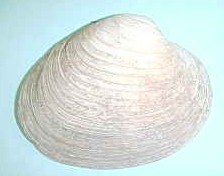
The butter clam has one set of rings that go one direction only, around the same center point (Photo courtesy of Alaska Department of Environmental Conservation)

The butter clam has one set of rings that go one direction only, around the same center point (Photo courtesy of Alaska Department of Environmental Conservation)

This past week, there were four suspected cases of paralytic shellfish poisoning (PSP) reported in Juneau. These four cases, combined with a couple of PSP cases in the Ketchikan/Metlakatla areas this winter and record-high levels of the PSP toxin found in shellfish last summer should serve as reminders that the state discourages eating recreationally and subsistence-harvested shellfish on most beaches in Alaska.

The first three PSP cases reported to the Alaska Section on Epidemiology last week involved clams harvested over the Easter weekend near Juneau — the first case reported April 10 involved razor clams from Admiralty Island and the next two cases reported April 12 involved butter clams from either Lincoln Island or Ralston Island. On April 13, another case was reported where a person ate pink neck clams (also known as surf clams) harvested from Shelter Island.

The littleneck clam has two sets of rings that cross each other at 90 degree angles (Photo courtesy of Alaska Department of Environmental Conservation)

The littleneck clam has two sets of rings that cross each other at 90 degree angles (Photo courtesy of Alaska Department of Environmental Conservation)

In each case, the people who ate the clams experienced classic PSP toxin symptoms — tingling and numbness of the mouth and tongue that eventually can extend into the extremities and then the rest of the body. Once the toxin moves into the body, it can paralyze the heart and lungs, causing them to stop and leading to intensive care treatment and possibly death (PSP deaths were reported in Juneau and Haines in 2010). If people experience these symptoms, they should get to the hospital immediately because sometimes a hospital respirator can save a life.

PSP can cause severe health problems and even death, and there is no antidote. The toxin is not visible, and requires special testing to be detected. It can occur during any month of the year, and the toxin can remain in affected shellfish for as long as two years. There is no antidote to the toxin. PSP generally affects bivalves that filter food when they eat, such as clams, cockles, mussels, oysters or scallops. Crab meat does not carry the PSP toxin, but crab guts can have the toxin since crab eat bivalves.

A cockle has deep ridges similar to a Ruffles potato chip (Photo courtesy of Alaska Department of Environmental Conservation)

A cockle has deep ridges similar to a Ruffles potato chip (Photo courtesy of Alaska Department of Environmental Conservation)

Southeast Alaska beaches, like most beaches in the state frequented by recreational and subsistence harvesters, are not tested by the state for the PSP toxin. The state does check commercially harvested shellfish for the toxin, but in recent months at least one commercial geoduck season was closed because of the toxin’s presence.

To learn more about PSP, here is an informational page created by the SouthEast Alaska Regional Health Consortium (SEARHC) after last year’s extremely high levels of PSP toxin were discovered. This page features information about how PSP is formed, what types of shellfish can carry the PSP toxin, basic first aid for PSP symptoms and more.

• Paralytic Shellfish Poisoning Fact Sheet from the State of Alaska

• Sitka’s ‘Fish to Schools’ project to be honored during Wednesday’s fish lunch at Keet Gooshi Heen Elementary School

Sitka’s Fish to Schools project will be honored with the grand prize of the Alaska Farm to School Challenge during the fish lunch from 11:20 a.m. to 12:30 p.m. on Wednesday, April 11, at Keet Gooshi Heen Elementary School. Alaska First Lady Sandy Parnell and Alaska Division of Agriculture Director Franci Havermeister will be in attendance to present the award.

Sitka’s Fish to Schools project came out of the 2010 Sitka Health Summit, when increasing access to locally harvest fish in school menus was chosen as one of the community’s top four health priorities for the year. The project started with a monthly fish lunch entrée option at Blatchley Middle School, then expanded to Keet Gooshi Heen Elementary and Pacific High School. The program now is twice-monthly, and it has grown with the support of the Sitka Conservation Society, Sitka School District, local fishermen, and other community members. The program has become a successful model for what can be done in other parts of the state.

“We are excited to honor Sitka in its efforts, and appreciate that First Lady Sandy Parnell also see the value in projects like this that highlight both Alaska’s youth and natural resource bounty,” Havermeister said in a press release.

For more information about Sitka’s Fish to Schools program, contact Tracy Gagnon at 747-7509 or tracy@sitkawild.org.

• Sitka Maritime Heritage Society to host a presentation on the importance of herring in Southeast Alaska

Herring is an important food source in Sitka and the rest of Southeast Alaska. Not only are there huge commercial and subsistence harvests of the fish, and it is an important food source for salmon, halibut, whales, sea lions and other animals in the region.

The Sitka Maritime Heritage Society will host the presentation “Herring: Rakes, Reduction Plants and the Fisheries: A Night of History” during its annual meeting at 7 p.m. on Sunday, Feb. 12, at Harrigan Centennial Hall.

The program features a panel discussion about the importance of herring in Southeast Alaska, from the booming commercial sac roe herring fishery to traditional gathering of herring eggs on hemlock branches. Another panel topic includes the herring reduction plants that once were scattered throughout Southeast Alaska. There also have been recent community discussions about possibly starting a whole-fish herring fishery that won’t target roe. Members of the public will be invited to share their memories of herring fishing and roe harvests. Photos and artifacts will be on hand.

For more information, contact sitkamaritime@gmail.com.

• Sitka Local Foods Network board of directors to meet on Monday, Feb. 6

The 2011-12 Sitka Local Foods Network Board of Directors at its winter board retreat on Dec. 3, 2011. From left are Lisa Sadleir-Hart, Doug Osborne, Maybelle Filler, Cathy Lieser, Robin Grewe, Linda Wilson and Kerry MacLane. Not pictured are Johanna Willingham-Guevin and Tom Crane.

The 2011-12 Sitka Local Foods Network Board of Directors at its winter board retreat on Dec. 3, 2011. From left are Lisa Sadleir-Hart, Doug Osborne, Maybelle Filler, Cathy Lieser, Robin Grewe, Linda Wilson and Kerry MacLane. Not pictured are Johanna Willingham-Guevin and Tom Crane.

The Sitka Local Foods Network board of directors will hold its monthly meeting from 6:30-8 p.m. on Monday, Feb. 6, at the Sitka Unitarian Universalist Fellowship Building, 408 Marine St. (parking lot is off Spruce Street).

Key topics for the meeting include planning for the Let’s Grow Sitka on March 11, a recap of the Jan. 21 Sitka Local Foods Network annual meeting and potluck, an update on the Sitka Community Greenhouse and Education Center, an update on the Sitka Food Co-op, an update on recent work by the Alaska Food Policy Council, an update on the Sitka Composting Project (Sick-a-Waste), our new logo and t-shirts, planning for spring planting at St. Peter’s Fellowship Farm and other community gardens, planning for upcoming events such as the Sitka Farmers Markets on alternating Saturdays from July 7-Sept. 15, and more.

Board meetings are free and open to the general public, usually once a month (except summer). We always welcome new volunteers interested in helping out with our various projects. For more information, contact Kerry MacLane at 752-0654 or 747-7888.

• Sitka Conservation Society hosts wild foods potluck on Wednesday, Nov. 2

The Sitka Conservation Society will host its second annual wild foods potluck on Wednesday, Nov. 2, at Harrigan Centennial Hall. Doors open at 5:30 p.m., with food served at 6 p.m.

Come celebrate Alaska’s bounty with friends and family. Bring a dish featuring food fished, foraged, hunted or cultivated in Southeast. If you don’t have any wild foods to share, just garnish your dish with a local plant. After dinner is served there will be a short presentation by SCS Community Sustainability Coordinator Tracy Gagnon about the Fish To Schools program.

There also will be presentation by Sitka High School musicians and booths from the Sitka Local Foods Network, the Slow Food Southeast Alaska group, the Sitka Sound Science Center, Sitka Trail Works, Recycle Sitka, Sitka Bicycle Friendly Community Coalition, Sitka 4H Club, Sitka Maritime Heritage Society, Southeast Alaska Conservation Council, Mt. Edgecumbe High School Youth for Environmental Action, Sitka Seafood Festival and more.

Prizes will be given for first place in the following categories: Best Entree, Best Side, Best Dessert, Most Creative, and Incorporation of the Most Local Ingredients. Entries should include a wild/local food. Pick up an entry form at the front table when you arrive at the potluck.

This event is open to the entire community; you do not need to be a Sitka Conservation Society member to attend. Non-alcoholic hot drinks will be provided.

For more information, contact Ashley Bolwerk at the Sitka Conservation Society office at 747-7509.

• Wild Foods Potluck flier (opens as PDF file)

• Fish to Schools program to serve fish lunches at two schools twice a month

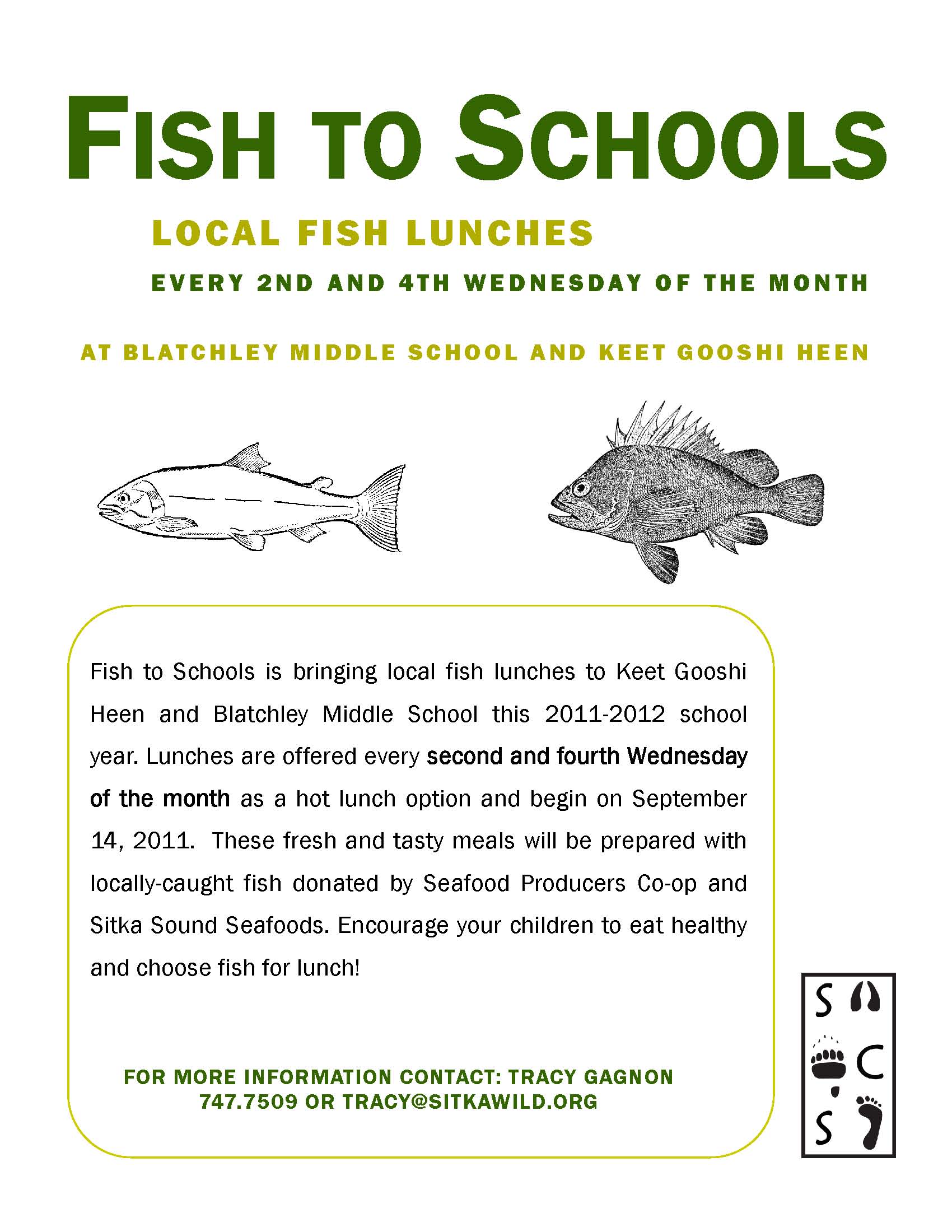
The Fish to Schools program will kick off this year’s schedule of serving fish lunches at school on Wednesday, Sept. 14.

Local fish lunches will be served every second and fourth Wednesday of the month at Keet Gooshi Heen Elementary and Blatchley Middle School as a hot lunch option. This is a Sitka Health Summit project that got started last year with once-a-month fish meals at Blatchley, so this is a major expansion of the program. The goal is to get more wild, local fish into school lunches.

These fresh and tasty meals will be prepared with locally caught fish donated by Seafood Producers Cooperative and Sitka Sound Seafoods. Encourage your children to eat healthy and choose fish for lunch. It’s yummy and good for you.

Sitka Conservation Society Community Sustainability Organizer Tracy Gagnon was interviewed about the program on Aug. 22 on KCAW-Raven Radio, and you can listen to the interview at this link. For more information about the project, contact Tracy at 747-7509 or tracy@sitkawild.org.

• Sitka Seafood Festival steering committee to meet Aug. 23 to plan 2012 festival

The Sitka Seafood Festival will host a planning (or “see if we can make this festival happen again”) meeting at 7 p.m. on Tuesday, Aug. 23, in the fireplace pit at the Westmark Sitka Hotel (330 Seward St.).

The third annual Sitka Seafood Festival is tentatively planned for Aug 3-4, 2012, but there is a lot we need to figure out to make sure this can actually happen. If you are interested in any capacity, please either attend the meeting, or get ahold of Alicia Olson prior to the meeting.

Alicia will have specific job descriptions and tasks to try and delegate, and the steering committee will discuss the possibility of merging or piggybacking so this event can be sustainable in the future. If your organization would like to be involved, please send a rep or contact Alicia as well.

“I have heard nothing but positive, amazing comments regarding this festival, and I know we would all like to see it continue to grow, so spread the word,” Alicia said. “Thanks again to everyone for so much hard work and effort … and see you on Tuesday.”

For more information about the Sitka Seafood Festival, contact Alicia Olson at Alicia Olson at 1-928-607-4845 or sitkaseafoodfestival@gmail.com.