
Harmful algal bloom expands PSP advisory to several Southeast Alaska beaches

SEATORDataUpdate06102016

Seator-Logo-Best-June-30-2015-7pm-215x215The SouthEast Alaska Tribal Ocean Research (SEATOR) project, SouthEast Alaska Tribal Toxins (SEATT) partnership and the Sitka Tribe of Alaska Environmental Research Lab (STAERL) have expanded a recent paralytic shellfish poisoning (PSP) advisory to include more beaches in Southeast Alaska.

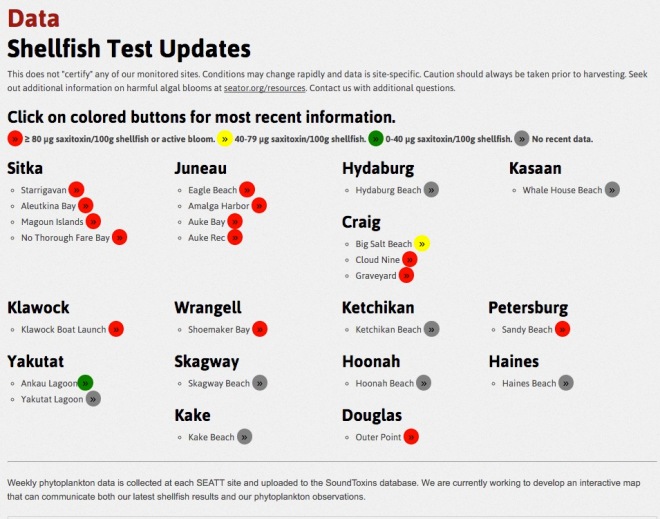
The advisory, initially announced on May 26, now includes multiple beaches in Sitka, Juneau, Craig, Petersburg, and Klawock. The PSP advisory is for bivalve shellfish — such as clams, mussels, oysters, cockles, scallops, geoducks, etc. — that have been recreationally or subsistence harvested. It does not apply to commercially harvested shellfish, which are tested before they enter the market. The advisory does not apply to other shellfish, such as crabs or shrimp, which do not carry PSP (unless you eat the crab butter/viscera).

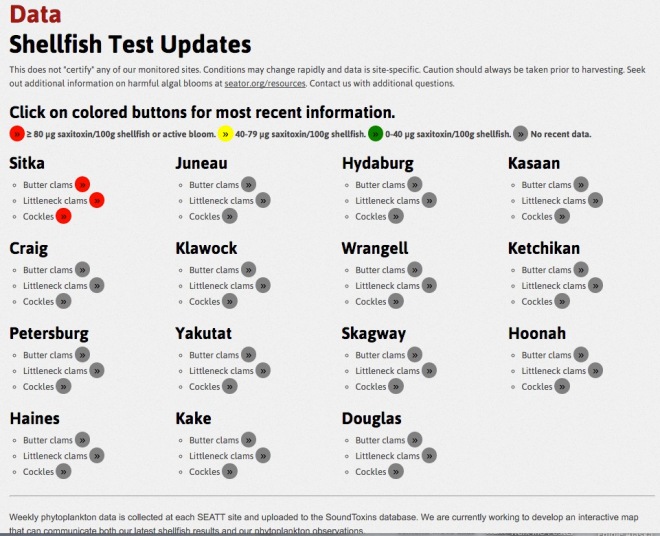
According to a SEATOR press release, “Recent samples on June 6 confirmed elevated levels of Alexandrium, the phytoplankton species that produces saxtoxins causing PSP, have been observed at the following locations and shellfish from these sites should not be harvested at this time.” The affected beaches from June 6 are Auke Bay, Amalga Harbor, Eagle Beach, and Auke Rec beaches in Juneau; Cloud 9 and Graveyard beaches in Craig; Starrigavan beach in Sitka; and the Boat Ramp beach in Klawock.
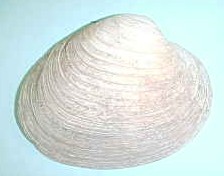
The butter clam has one set of rings that go one direction only, around the same center point (Photo courtesy of Alaska Department of Environmental Conservation)

The butter clam has one set of rings that go one direction only, around the same center point (Photo courtesy of Alaska Department of Environmental Conservation)

In addition, the press release said, “On June 9 shellfish from the following sites tested above the regulatory limit of 80µg/100g for saxitoxins and should not be harvested at this time.” The June 9 list of beaches includes Sandy Beach in Petersburg (butter clams only); Auke Bay, Amalga Harbor, Eagle Beach, and Auke Rec beaches in Juneau; Aleutkina Bay, No Through Fare Bay, Magoun Islands, and Starrigavan (butter clams only) beaches in Sitka; and the Boat Ramp beach in Klawock. The advisory is for all shellfish on all beaches, except where noted.

According to SEATOR, “This does not ‘certify’ any of our monitored sites. Conditions may change rapidly and data is site-specific. Caution should always be taken prior to harvesting.”

SEATOR posts updates and information to its website at seator.org/data, which can help provide Southeast Alaska residents with reliable information so they can choose whether or not to harvest shellfish. In addition to testing water samples weekly from certain Southeast beaches, STAERL also tests samples of butter clams, littleneck clams, and blue mussels (which is STAERL’s indicator species because of how quickly blue mussels absorb saxotoxins).

Since most beaches in Alaska aren’t tested for harmful algal blooms, SEATOR and the SEATT partnership were formed in October 2014 to train people to test beaches in Southeast Alaska. In April 2015, the Sitka Tribe of Alaska opened a regional lab on Katlian Street, so samples could be tested in Sitka without having to be sent to the Lower 48, which delayed results. By testing for harmful algal blooms, SEATOR and the SEATT partnership hope to be able to provide information so people can make informed choices whether or not to harvest or eat shellfish.

Harmful algal blooms, such as paralytic shellfish poisoning (PSP), typically have not been monitored in Southeast Alaska for subsistence and recreational harvesters of clams, mussels, oysters, cockles, and other bivalves (commercial harvests are tested). Even though many people in Southeast Alaska love to harvest shellfish, eating it comes with some risks. There have been several PSP outbreaks in recent years that sent people to the hospital, and in 2010 two deaths were attributed to PSP and other HABs, such as Alexandrium, Pseudo-nitzchia and Dinophysis.

To learn more about harmful algal blooms and how they can raise the risk for PSP and ASP (amnesic shellfish poisoning, which also can be fatal), go to SEATOR’s resources page. If you have shellfish you recently harvested and want to test it, click this link to learn what you need to do to have it tested by STAERL. Please contact STAERL at 747-7395 with any additional questions.

• June 10, 2016, press release about PSP advisory for Southeast Alaska

Sitka Local Foods Network to launch informal garden club for Sitka gardeners on July 15

GreensLowTunnelAtStPeters

Do you grow vegetables or fruit or want to? Would you like to meet and learn from other gardeners in Sitka and visit their gardens?

Then come to Sitka Local Foods Network’s first informal, unofficial Garden Club meeting from 7-9 p.m. on Friday, July 15, at 131 Shelikof Way. This is a chance for Sitka gardeners to share successes and discuss problems they may be having with their gardens.

Perry Edwards and Michelle Putz will share their garden and homemade wine (if you are older than 21). Participants will decide the next location and club meeting date (so bring your calendars). If parking looks tight, please walk up from SeaMart. For more information, contact Michelle at 747-2708.

Check out the June 2016 edition of the Sitka Local Foods Network newsletter

June2016SLFNNewsletterScreenshot

The Sitka Local Foods Network just sent out the June 2016 edition of its newly launched monthly newsletter. Feel free to click this link to get a copy.

This edition of the newsletter has brief stories about a couple of Sitka commercial trollers starting the Edible Alaska magazine, our recruiting new board members, the dates for the 2016 Sitka Farmers Markets, the second batch of classes for the garden mentor program, and a recent shellfish advisory issued for several beaches in Southeast Alaska. Each story has links to our website for more information.

You can sign up for future editions of our newsletter by clicking on the registration form image in the right column of our website and filling in the information. If you received a copy but didn’t want one, there is a link at the bottom of the newsletter so you can unsubscribe. Our intention is to get the word out about upcoming events and not to spam people. We will protect your privacy by not sharing our email list with others.

Harmful algal bloom warning listed for shellfish harvested at Sitka, Craig, Klawock and Petersburg

Clam diggers work the beach at Starrigavan in this file photo. The Sitka Tribe of Alaska is warning Sitkans against harvesting clams in the area due to a harmful algae detected Monday, June 8, 2015. (Daily Sitka Sentinel file photo by James Poulson)

Clam diggers work the beach at Starrigavan in this file photo. The Sitka Tribe of Alaska is warning Sitkans against harvesting clams in the area due to a harmful algae detected Tuesday, May 25, 2016. (Daily Sitka Sentinel file photo by James Poulson)

Seator-Logo-Best-June-30-2015-7pm-215x215The SouthEast Alaska Tribal Ocean Research (SEATOR) project coordinated by the Sitka Tribe of Alaska on Wednesday, May 26, issued a harmful algal bloom warning for shellfish harvested in four Southeast Alaska communities. The warning is for shellfish harvested on Starrigavan Beach in Sitka, Graveyard Beach in Craig, the Klawock Boat Launch, and Sandy Beach in Petersburg.

(Editor’s Note: On Thursday, June 2, SEATOR and the University of Alaska Fairbanks School of Fisheries and Ocean Sciences in Juneau announced a similar shellfish advisory for shellfish harvested on June 1 from several beaches in the Juneau area — Auke Bay, Point Louisa/Auke Rec, Amalga Harbor and Eagle Beach. For more information on Juneau, contact Elizabeth Tobin at 1-907-796- 5455 or edtobin@alaska.edu or Chris Whitehead of SEATOR at chris.whitehead@sitkatribe-nsn.gov. On June 3, SEATOR added Cloud 9 Beach in Craig to the list of beaches affected by the shellfish advisory.)

“The Sitka Tribe of Alaska Environmental Research Lab (STAERL) has been collecting shellfish samples to test for biotoxins, specifically paralytic shellfish poisoning (PSP),” STAERL announced in a press release. “Recent samples on May 25, 2016, confirm that clams at the following beaches have elevated levels of toxins above the FDA regulatory limit of 80µg/100g and should not be harvested at this time.”

The butter clam has one set of rings that go one direction only, around the same center point (Photo courtesy of Alaska Department of Environmental Conservation)

The butter clam has one set of rings that go one direction only, around the same center point (Photo courtesy of Alaska Department of Environmental Conservation)

SEATOR, the Southeast Alaska Tribal Toxins (SEATT) partnership, and the Sitka Tribe of Alaska have been monitoring saxitoxin on Starrigavan Beach in Sitka and other beaches around Southeast Alaska since late 2014. Saxitoxin is produced by the phytoplankton Alexandrium and can get highly concentrated in shellfish, leading to paralytic shellfish poisoning (PSP), which can be fatal.

SEATOR posts updates and information to its website at seator.org/data, which can help provide Southeast Alaska residents with reliable information so they can choose whether or not to harvest shellfish. On May 6, SEATOR announced an advisory for shellfish harvest on Starrigavan Beach in Sitka, when it found Alexandrium in its weekly phytoplankton samples and high levels of saxitoxin in butter clams, littleneck clams, and blue mussels. Because of the high levels, SEATOR advised Sitka residents not to harvest shellfish at the time.

Since most beaches in Alaska aren’t tested for harmful algal blooms, SEATOR and the SEATT partnership were formed in October 2014 to train people to test beaches in Southeast Alaska. In April 2015, the Sitka Tribe of Alaska opened a regional lab on Katlian Street, so samples could be tested in Sitka without having to be sent to the Lower 48, which delayed results. By testing for harmful algal blooms, SEATOR and the SEATT partnership hope to be able to provide information so people can make informed choices whether or not to harvest or eat shellfish.

Harmful algal blooms, such as paralytic shellfish poisoning (PSP), typically have not been monitored in Southeast Alaska for subsistence and recreational harvesters of clams, mussels, oysters, cockles, and other bivalves (commercial harvests are tested). Even though many people in Southeast Alaska love to harvest shellfish, eating it comes with some risks. There have been several PSP outbreaks in recent years that sent people to the hospital, and in 2010 two deaths were attributed to PSP and other HABs, such as Alexandrium, Pseudo-nitzchia and Dinophysis.

To learn more about harmful algal blooms and how they can raise the risk for PSP and ASP (amnesic shellfish poisoning, which also can be fatal), go to SEATOR’s resources page. If you have shellfish you recently harvested and want to test it, click this link to learn what you need to do to have it tested by STAERL.

• Press release about shellfish advisory, May 26, 2016

• Joint SEATOR/UAF School of Fisheries and Ocean Studies press release about Juneau shellfish advisory, June 2, 2016

• June 3, 2016, SEATOR press release updating the list of affected beaches

Sitka Spruce Tips 4H Club to celebrate Arbor Day on May 20 with tree planting at Swan Lake

Arbor Day Flyer

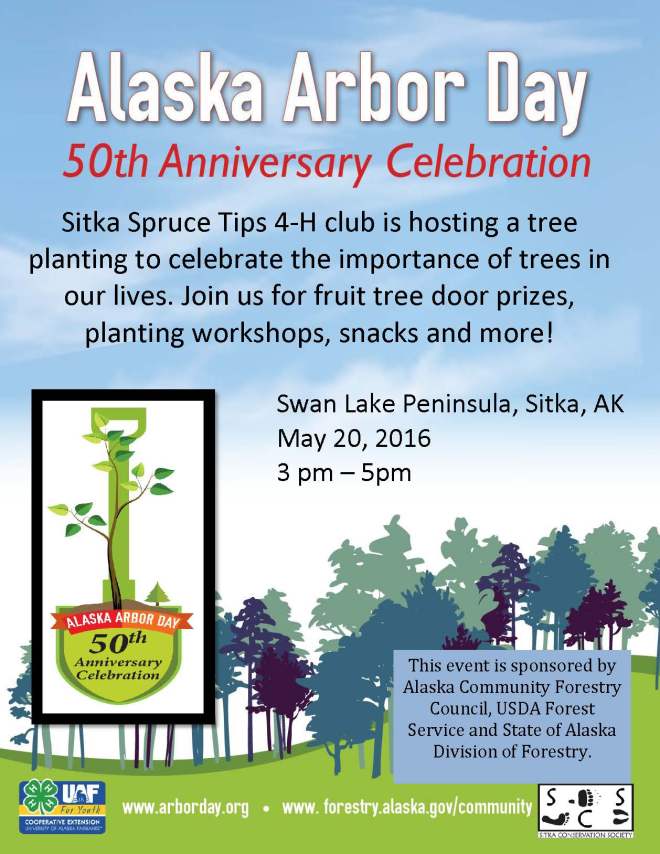
Friday, May 20, is the 50th anniversary of Arbor Day in Alaska, and the Sitka Spruce Tips 4H Club will celebrate by planting a few trees from 3-5 p.m. at the Swan Lake recreation area (near the corner of Lake Street and DeGroff).

We will be planting maples, but giving away fruit trees for people to plant at home, said Molly Johnson, who helps coordinate the Sitka Spruce Tips 4H Club for the Sitka Conservation Society, in partnership with the University of Alaska Fairbanks Cooperative Extension Service Sitka District Office.

“4H is excited to host a celebration in honor of Alaska Arbor Day to celebrate how important trees are in our lives,” Molly said. “We see the significance of trees in the clean air and great habitat they provide whenever we explore the Tongass (National Forest). This will be a fun event to honor that significance closer in town. It is a great opportunity to come together as a community and celebrate trees!”

This event is co-sponsored by the Alaska Community Forestry Council, the USDA Forest Service, and the Alaska Division of Forestry. Because of its commitment to trees in town, the City and Borough of Sitka has been recognized as one of the Tree City USA award-winners from the Arbor Day Foundation.

Scenes from the Safe Home Food Preservation certification course May 14-15 in Sitka

SarahLewisDiscussesTypesOfPressureCanners

Food preservation certificate flierIn an effort to train people to teach safe home food preservation classes in their Southeast Alaska communities, the University of Alaska Fairbanks Cooperative Extension Service hosted a series of certification courses around the region in recent months. The Sitka class on May 14-15 at Blatchley Middle School wrapped up the series, which featured several online lessons followed by two-day hands-on classes in Juneau, Ketchikan and Sitka.

The Sitka class was taught by UAF Cooperative Extension Service Associate Director Roxie Rodgers Dinstel of Fairbanks and Sarah Lewis, a Family and Community Development faculty member from Juneau. In addition to several Sitka residents, there also were students from Haines, Petersburg and Juneau in the Sitka class. The series was funded by a grant from the SouthEast Alaska Regional Health Consortium (SEARHC).

During the class, the 10 students learned which foods need waterbath canning vs. pressure canning, had a lesson on fermenting, tested pressure canner gauges, dehydrated fruits and veggies, made jerky, and learned how to find reliable resources to make sure their home food preservation practices are safe.

In addition to teaching classes, some of the students will use their new skills for cottage food businesses and home canning projects. One of the purposes of the class was to certify people in a variety of Southeast Alaska communities on how to teach safe home food preservation classes, so they don’t have to wait for a UAF Cooperative Extension Service faculty member from Juneau, Anchorage or Fairbanks to come to town to teach.

A slideshow of scenes from the two-day hands-on classes is below.

This slideshow requires JavaScript.


Harmful algal bloom warning listed for shellfish harvested at Starrigavan Beach

SEATORShellfishTestingLevels

The SouthEast Alaska Tribal Ocean Research (SEATOR) project coordinated by the Sitka Tribe of Alaska on Friday, May 6, issued a harmful algal bloom warning for shellfish harvested on Starrigavan Beach in Sitka.

SEATOR, the Southeast Alaska Tribal Toxins (SEATT) partnership, and the Sitka Tribe of Alaska have been monitoring saxitoxin on Starrigavan Beach in Sitka and other beaches around Southeast Alaska since late 2014. Saxitoxin is produced by the phytoplankton Alexandrium and can get highly concentrated in shellfish, leading to paralytic shellfish poisoning (PSP), which can be fatal.

According to SEATOR, “during our weekly phytoplankton sample last week, we noticed our first Alexandrium of the year. Immediately after, we tested saxitoxin levels in butter clams, littleneck clams and blue mussels, and found them all to have elevated levels of saxitoxin. We do not recommend that Sitkans harvest shellfish at this time, and ask them to look on seator.org/data for additional updates and information.”

Since most beaches in Alaska aren’t tested for harmful algal blooms, SEATOR and the SEATT partnership were formed in October 2014 to train people to test beaches in Southeast Alaska. In April 2015, the Sitka Tribe of Alaska opened a regional lab on Katlian Street, so samples could be tested in Sitka without having to be sent to the Lower 48, which delayed results. By testing for harmful algal blooms, SEATOR and the SEATT partnership hope to be able to provide information so people can make informed choices whether or not to harvest or eat shellfish.

Harmful algal blooms, such as paralytic shellfish poisoning (PSP), typically have not been monitored in Southeast Alaska for subsistence and recreational harvesters of clams, mussels, oysters, cockles, and other bivalves (commercial harvests are tested). Even though many people in Southeast Alaska love to harvest shellfish, eating it comes with some risks. There have been several PSP outbreaks in recent years that sent people to the hospital, and in 2010 two deaths were attributed to PSP and other HABs, such as Alexandrium, Pseudo-nitzchia and Dinophysis.

Celebrate local farmers and gardeners on Alaska Agriculture Day on Tuesday, May 3

AlaskaGrownImpact

AgDayProclamationMay32016Alaskans will celebrate Alaska Agriculture Day on Tuesday, May 3. On this day, Alaskans are encouraged to support local agriculture by seeking out and purchasing products produced in Alaska and educating youth about the vital role that agriculture plays in our economy.

Here are a few ideas from the Division of Agriculture on how to celebrate Alaska Agriculture Day:

  • Join the 49,005 people who “like” the Alaska Grown Facebook page at https://www.facebook.com/dnr.alaskagrown and learn about the exciting things Alaskans are producing around the state.
  • Contact your local agriculture groups/chapters (such as FFA, Farm Bureau, Agriculture in the Classroom etc.) to see if they are hosting an event in your area.
  • Sign up for a Community Supported Agriculture (CSA) program at a local farm.
  • Buy and incorporate Alaska Grown products into your meals.
  • If you are a farmer, consider asking a local school if you can visit a classroom to educate children about your operation and Alaska agriculture.
  • Visit and thank a local farmer in person. To find a farm near you, check the Alaska Grown Source Book at http://dnr.alaska.gov/ag/sourcebook/sourcebookindex2014.html.

ak ag day flyerIn Sitka, you can celebrate Alaska Agriculture Day by starting a food garden (even a couple of containers on your deck can provide you with potatoes, carrots or greens). Teachers are encouraged to offer a lesson plan or two about the importance of agriculture in Alaska and in Sitka. Here’s a link to an article about how Sitka was Alaska’s original garden city back in the late 19th and early 20th Centuries. Also, click here to listen to a Sitka History Minute feature about the potato in Sitka from KCAW-Raven Radio).

During the growing season, please support the Sitka farmers and production gardeners listed in the Alaska Grown Source Book (chief contact in parentheses) — Anam Cara Family Garden (Lisa Sadleir-Hart), Blatchley Community Gardens (David Nuetzel), Down To Earth U-Pick Garden (Lori Adams), Finn Island Farm (Keith Nyitray), Sprucecot Gardens (Judy Johnstone), and St. Peter’s Fellowship Farm (Laura Schmidt). There also are a few Sitka farms and production gardens not listed in the Alaska Grown Source Book, such as Sea View Garden (Linda Wilson), The Sawmill Farm (Bobbi Daniels), Sitka Seedling Farms (Matthew Jackson) and Welsh Family Forget-Me-Not Garden (Florence Welsh). Many of these farms and gardens will be vendors during the Sitka Farmers Markets, which start on July 2 this summer.

Check out the May 2016 edition of the Sitka Local Foods Network newsletter

May2016SLFNNewsletterScreenshot

The Sitka Local Foods Network just sent out the May 2016 edition of its newly launched monthly newsletter. Feel free to click this link to get a copy.

This edition of the newsletter has brief stories about our recruiting new board members, the dates for the 2016 Sitka Farmers Markets, the first classes for the garden mentor program, a garden party at St. Peter’s Fellowship Farm, and a reminder to Plant A Row for the Hungry. Each story has links to our website for more information.

You can sign up for future editions of our newsletter by clicking on the registration form image in the right column of our website and filling in the information. If you received a copy but didn’t want one, there is a link at the bottom of the newsletter so you can unsubscribe. Our intention is to get the word out about upcoming events and not to spam people. We will protect your privacy by not sharing our email list with others.

St. Peter’s Fellowship Farm communal garden work party takes place on Saturday, May 7

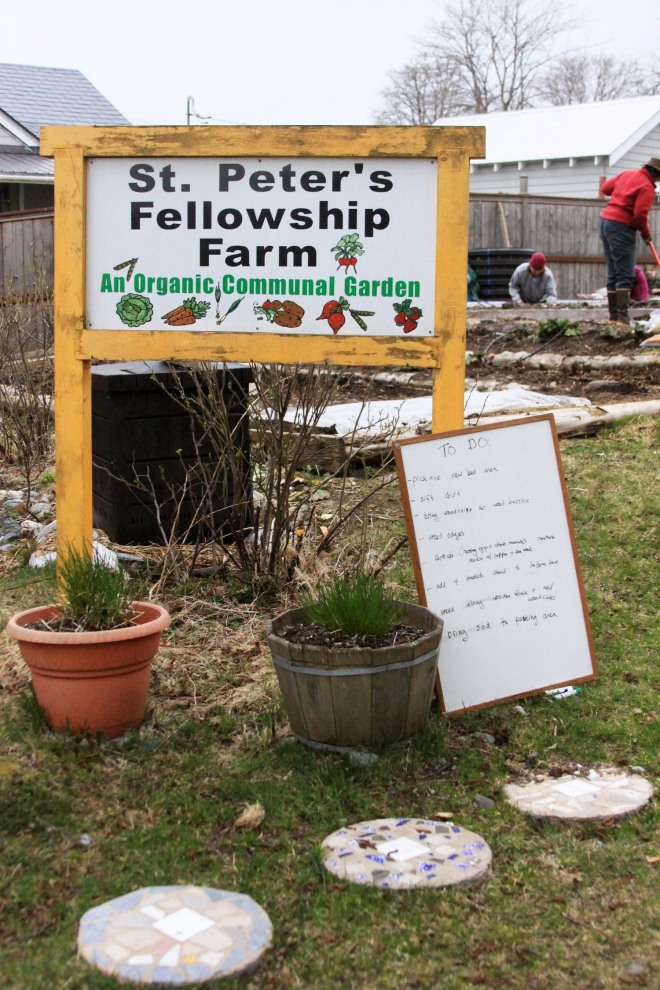
A to-do list of chores at the St. Peter's Fellowship Farm communal garden

A to-do list of chores at the St. Peter’s Fellowship Farm communal garden

A group of kids harvests garlic during an Aug. 12, 2011, work party at St. Peter's Fellowship Farm.

A group of kids harvests garlic during an Aug. 12, 2011, work party at St. Peter’s Fellowship Farm.

Are you interested in meeting other Sitka gardeners and learning about how to grow food in Sitka’s rainy climate? Then join us for a garden party from 2-4 p.m. on Saturday, May 7, at St. Peter’s Fellowship Farm.

St. Peter’s Fellowship Farm is located behind St. Peter’s By The Sea Episcopal Church, 611 Lincoln Street (the brown church with the steeple above Crescent Harbor). It is a communal garden that grows food to be sold at the Sitka Farmers Markets, at a table when Chelan Produce is in town, and used for various school lunch and hunger programs around town. This year’s Sitka Farmers Markets are from 10 a.m. to 1 p.m. on Saturdays, July 2, July 16, July 30, Aug. 13, Aug. 20, Sept. 3, and Sept. 10, at the Alaska Native Brotherhood Founders Hall (235 Katlian St.).

“We will be putting starts in the ground, weeding and prepping beds for planting,” St. Peter’s Fellowship Farm lead gardener Laura Schmidt said.

The garden work parties are kid-friendly, so feel free to bring the munchkins to help.

To learn more, call St. Peter’s Fellowship Farm lead gardener Laura Schmidt at 738-7009 or 623-7003.