PHOTO COURTESY OF SITKA LOCAL FOODS NETWORK Sitka Farmers Market Manager Bridget Kauffman, left, and co-managers Garrett Bauer, second from left, and Sabrina Cimerol, right, present the Table Of The Day Award to Erin Keenan of Bear Buns during the first market of the summer on July 6 at the Alaska Native Brotherhood Founders Hall. Erin makes cloth diapers and similar products for babies. She received a gift bag with fresh produce, chocolate and a copy of the Alaska Farmers Market Cookbook. This is the sixth year of Sitka Farmers Markets, hosted by the Sitka Local Foods Network. The next market is from 10 a.m. to 1 p.m. on Saturday, July 20, at the ANB Founders Hall, 235 Katlian St. For more information about the Sitka Farmers Markets and Sitka Local Foods Network, go to http://www.sitkalocalfoodsnetwork.org/.
The Sitka Farmers Market kicked off its sixth season on Saturday, July 6, at the Alaska Native Brotherhood Founders Hall, 235 Katlian St.
We lucked into a break in the rain and there was a pretty good crowd for the first market of the season. We had a lot of familiar booths selling fresh veggies, fish, baked goods, arts and crafts, plus some new faces joining the vendors.
The second market of the six planned this summer will be from 10 a.m. to 1 p.m. on Saturday, July 20, at ANB Founders Hall. To learn more, keep watching this site. A slideshow of scenes from the first market is below.
Last Friday (June 28, 2013), at the Palmer Farmers Market, Gov. Sean Parnell signed Administrative Order No. 265 (http://gov.state.ak.us/admin-orders/265.html) to establish the Alaska Food Resource Working Group (AFRWG) to recommend policies and measures to increase the purchase and consumption of local wild seafood and farm products. This is a bit different than HCR 01. The AFRWG is composed of eight state agency commissioners or their designee. “The AFRWG shall collaborate with the Alaska Food Policy Council . . . and shall invite a member of the AFPC governing board to represent the AFPC at scheduled meetings.”
The goals of the group are:
Develop a mission statement that promotes increased use of locally grown and harvested foods within state and local agencies, institutions, and schools;
Identify factors that might discourage or prevent locally harvested and produced food from being purchased by federal, state and local agencies, institutions, and schools;
Review existing or proposed programs, policies, statutes, and regulations that impact the state’s food system and recommend to policymakers methods to improve coordination and implementation;
Identify research needed to support and encourage increased consumption and production of local foods within the state; and
Engage with the public to seek additional input on ways to promote the above-listed goals.
Lots of legislators and several commissioners were at the signing. The governor said this elevates the group to “sub-cabinet” status.
To learn more about the Alaska Food Policy Council, go to its website or like its Facebook page. Sitka Local Foods Network board president Lisa Sadleir-Hart represents Sitka on the Alaska Food Policy Council.
(The following is from a press release from the Alaska Department of Natural Resources Division of Agriculture)
PALMER, Alaska – Eleven farmers markets throughout Alaska, including the Sitka Farmers Market, are now accepting Quest Cards, enhancing the state’s efforts to make healthy, locally-grown food available to Alaska households. Six markets (including Sitka) accepted the cards in 2012, and two markets accepted them in 2011, according to the Division of Agriculture.
The Alaska Quest Card is used by households qualified through the Alaska Food Stamp Program to purchase food from farmers markets and grocery stores.
“This program improves access to fresh, local foods to community members who are struggling financially. Additionally, the program helps increase understanding of food insecurity issues in our community and how produce and other food vendors can be part of the solution,” said Lisa Sadlier-Hart, manager of the Sitka Farmers Market (Editor’s note: A correction, Sadleir-Hart is president of the Sitka Local Foods Network board of directors, which hosts the Sitka Farmers Markets; Bridget Kauffman is the market manager).
Quest cards are accepted in the following locations:
Anchorage
Spenard Farmers Market; the Anchorage Farmers Market; and the South Anchorage Farmers Markets (Saturday and Wednesday)
Kenai Peninsula
Anchor Point Saturday Farmers Market & Swap Meet, and the Homer Farmers Market
Western Alaska
The Bethel Farm Stand and the Dillingham Farmers Market
Fairbanks
Downtown Fairbanks Market and Calypso School Garden Farm Stands
Southeast Alaska
Sitka Farmers Market
These markets will also host Match Days, when Quest card holders can get twice the amount of fresh, local food for the first $20 spent with their cards. Match Days are listed below:
Anchorage and Kenai Peninsula
First market of the month (markets happening twice a week will have matching both days);
The Sitka Local Foods Network will host several work parties on Saturdays and Wednesdays throughout the summer at St. Peter’s Fellowship Farm communal garden (located behind St. Peter’s By The Sea Episcopal Church on Lincoln Street).
Work parties are scheduled for 2-4 p.m. on several Saturdays this summer — on June 1, 8, 22, July 13, 27, Aug. 10, 24, and Sept. 7 and 21. Wednesday afternoon work parties take place from 4:30-6 p.m. on July 10, 24, Aug. 7, 21, and Sept. 4.
Produce grown at St. Peter’s Fellowship Farm is sold during the Sitka Farmers Markets to help fund Sitka Local Foods Network projects throughout the year. The work parties also are great for newer gardeners to learn about growing food in Sitka’s rainy climate.
During these work parties we usually need people to shovel dirt and sift soil, weed, mulch and spread fertilizer (seaweed) on the existing garden beds. Most garden tools will be provided, but we will need people to bring shovels and pick-axes if they have them. The work parties are kid-friendly, in case you want to teach your children about growing food.
For more information, contact St. Peter’s Fellowship Farm lead gardener Laura Schmidt at 623-7003 or 738-7009, or contact Lisa Sadleir-Hart at 747-5985. Fresh vegetables usually can be purchased during the work parties once crops start to ripen, and people who volunteer may be able to take some veggies with them when they go home.
Diagnosing Tree Health Problems
Monday, June 3, 6:00 – 8:30 pm
Bob Gorman, UAF Cooperative Extension Service Sitka Office
Natural Resources & Community Development Faculty
Learn to observe signs and symptoms and to gather information about the biological, environmental, and cultural factors that affect a tree’s health.
Tree Selection, Planting, & Care
Tuesday, June 4, 6:00 – 8:30 pm
Patricia Joyner, Alaska Division of Forestry
Community Forestry Program Manager and certified arborist
Learn to select the right site, choose a high quality tree, and plant and maintain it.
Plant a Tree
Wednesday, June 5, 6:00 – 8:00 pm
Patricia Joyner
Help plant trees in a city park. Apply what you learned in Wednesday’s class in the real world.
The classes will be held at Harrigan Centennial Hall on Monday and Tuesday and will meet at Centennial Hall on Wednesday before going to Sealing Cove for a tree planting. For information, contact the Division of Forestry at patricia.joyner@alaska.gov, 907-269-8465, or Lynne Brandon, Sitka Parks and Recreation, at 747-1852.
The Blatchley Community Gardens and Blatchley Middle School will host a memorial for Kathy Swanberg in the community garden behind the school at 1:30 p.m. on Friday, May 24.
A bench built by Blatchley teachers will be dedicated in her honor. Family and friends are invited to attend, and a short reception will follow in the library.
Kathy Swanberg passed away in November 2012. She was the longtime secretary at the middle school and a gardener in the community gardens.
To learn more about the memorial and Blatchley Community Gardens, contact Dave Nuetzel at 738-8732 or community.garden@hotmail.com, or go to the Blatchley Community Gardens’ Facebook page.
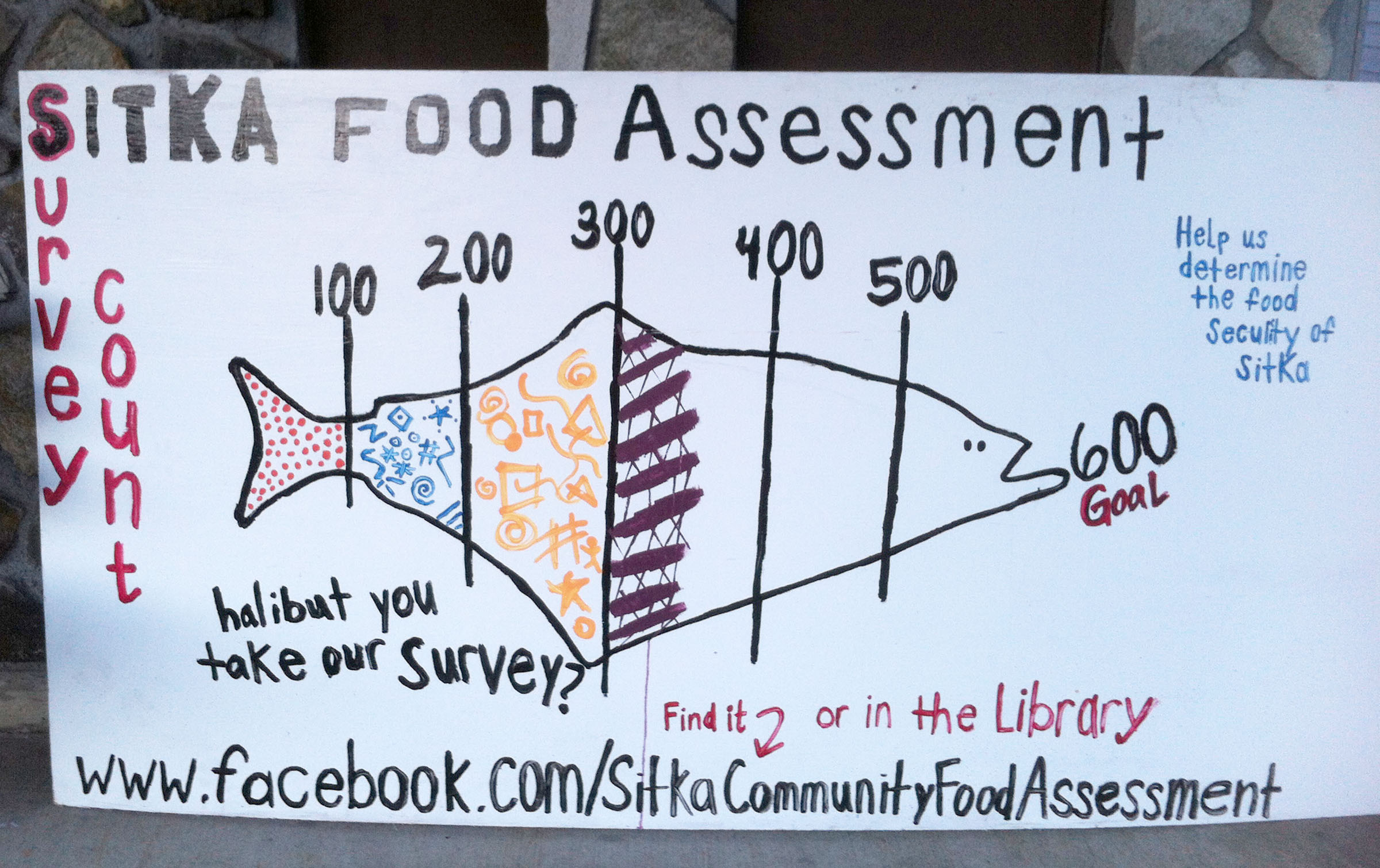
The deadline for surveys to be completed in the Sitka Community Food Assessment has been extended to the end of the month. Our goal is 600 completed surveys and as of Tuesday, May 21, we had 392 that had been recorded.
The Sitka Community Food Assessment is a 2012 Sitka Health Summit project designed to help shape food policy and improve Sitka’s food security. To learn more about the project, KCAW-Raven Radio hosted an interview with project coordinator Lisa Sadleir-Hart that aired on Monday, May 20.
Surveys are available online at https://www.surveymonkey.com/s/MQTF22Q, or click the Sitka Community Food Assessment logo in the right column of this webpage. Printed copies are available at Kettleson Memorial Library. A sign has been posted at the corner of Lincoln and Lake streets to update people on the progress of the project.
Millions of people around the world, including several in Sitka, will take a stand by hosting a local March Against Monsanto. The Sitka march takes place at 2 p.m. on Saturday, May 25, at Castle Hill. So far, more than 370 marches around the world are planned on May 25.
The Sitka March Against Monsanto is being organized by Brett Wilcox, who has created a Facebook page with more details. Brett and his 14-year-old son, David, will take things a step (OK, many steps) further when they start a transcontinental run across the country in January to raise awareness about some of the ethically challenged practices of the agri-business Monsanto. These include creating GMO (genetically modified) foods that are unlabeled and untested, putting patents on crop seed so farmers have to pay high fees to plant food, and more.
In addition to the march, various Sitka residents will speak on a variety of topics, such as how GMO-food causes health problems, the number of former Monsanto executives who now work for our government, farmer suicides in India due to Monsanto practices, the Monsanto Protection Act slipped into the recently passed US Farm Bill, etc.
This month, Brett hosted free Monsanto Movie Nights at 7 p.m. on Fridays, May 10, 17 and 24, at Harrigan Centennial Hall.
According to a press release about the event:
Sitka’s March Against Monsanto will be held on Castle Hill, the location where Russia sold the vast territory of Alaska—land it did not own—to the U.S.A.
March organizer, Brett Wilcox, chose Castle Hill for Sitka’s March Against Monsanto for its symbolic significance. “There are many similarities between the original ‘Land Grab’ that took place with the first European expansion and Monsanto’s current global ‘Seed Grab,'” Wilcox states. “Both involve the privatization of Nature, a concept that was largely foreign to Native Americans and Alaska Natives. And both have resulted in loss of freedom and loss of life. The difference is that Monsanto’s seed grab not only further disenfranchises Native Americans; it disenfranchises all nations and all people. The citizens of the world are, as it were, sitting in our canoes in Sitka Sound, watching powerful people and corporations claim and repackage life as their own, thereby stealing our seed sovereignty and seed freedom.”
Chuck Miller, a Tlingit “Elder in Training”, will preside at the event. “My grandmother used to teach my family that we need to treat our food with respect or it will not provide for us,” Miller states. “My ancestors’ teachings are still a very big part of my life and I want to be able to pass that on to my children, grandchildren and those yet to come. GMOs are not the way to treat Mother Earth and the generations yet to come. I urge all the Native people of Alaska and our non-Native brothers and sisters to come and support this cause.”
“Sitka’s March Against Monsanto will not be a traditional march,” says Wilcox. “Sitka’s event will be a ceremony to honor nature as well as the indigenous people of Alaska and the Americas. We will stand on Castle Hill united with the people of the world in defense and protection of life and nature.”
For more information about the Sitka March Against Monsanto, contact Brett Wilcox at 747-7437 or brett@runningthecountry.com, or contact Chuck Miller at 752-9955 or cohomojo25@yahoo.com. KCAW-Raven Radio aired a story on Tuesday, May 21, about Brett’s and David’s plans to run across the country and to host this march. Brett also recorded a commentary for KCAW-Raven Radio.
(EDITOR’S NOTE: The following article first appeared on this site in April 2010. It is repeated because much of the information remains current and newsworthy.)
As you start to plan your garden for this spring and summer, don’t forget to Plant A Row For The Hungry. The Plant A Row For The Hungry program (also known as Plant A Row or PAR) is a national campaign by the Garden Writers Association of America that got its start in Alaska.
In the cold winter of 1994, Anchorage Daily News garden columnist and former Garden Writers Association of America President Jeff Lowenfels was returning to his hotel after a Washington, D.C., event when he was approached by a homeless person who asked for some money to buy food. Lowenfels said Washington, D.C., had signs saying, “Don’t give money to panhandlers,” so he shook his head and kept on walking. But the man’s reply, “I really am homeless and I really am hungry. You can come with me and watch me eat,” stayed with Lowenfels for the rest of his trip.
Jeff Lowenfels
The encounter continued to bother Lowenfels, even as he was flying back to Anchorage. During the flight, Lowenfels came up with an idea when he started writing his weekly garden column (the longest continuously running garden column in the country, with no missed weeks since it started on Nov. 13, 1976). He asked his readers to plant one extra row in their gardens to grow food to donate to Bean’s Café, an Anchorage soup kitchen. The idea took off.
When Anchorage hosted the Garden Writers Association of America convention in 1995, Lowenfels took the GWAA members to Bean’s Café to learn about the Plant A Row For Bean’s Café program. The Garden Writers Association of America liked the idea, and it became the national Plant A Row For The Hungry campaign (also known as Plant A Row or PAR). In 2002, the Garden Writers Association Foundation was created as a national 501(c)(3) nonprofit to manage the Plant A Row For The Hungry program.
“I am not surprised by the growth of PAR,” Lowenfels wrote in an e-mail to the Sitka Local Foods Network. “It is now in all 50 states and across Canada and there are thousands of variations of the original program — from prison gardens for the hungry to botanical gardens donating their produce from public display gardens. This is because gardeners always share information and extra food, so the idea was a natural.”
It took five years for the program to reach its first million pounds of donated food, but the second million only took two years and the next eight years saw a million pounds of donated food (or more) each year. Since 1995, more than 14 million pounds of food have been donated. Not only that, the program is getting ready to expand overseas to Australia, England and other countries with avid gardeners.
“We have supplied something in the vicinity of enough food for 50 million meals,” Lowenfels wrote in his e-mail. “Gardeners can solve this hunger problem without the government. And we don’t need a tea party to do it! Or chemicals, I might add, as author of a book on organic gardening (Teaming With Microbes, written with Wayne Lewis)!” (Lowenfels recently released a second book, Teaming With Nutrients, which is a follow-up to his first book).
According to the U.S. Department of Agriculture, one out of every eight U.S. households experiences hunger or the risk of hunger. Many people skip meals or eat too little, sometimes going an entire day or more without food. About 33 million Americans, including 13 million children, have substandard diets or must resort to seeking emergency food because they can’t always afford to buy the food they need. In recent years the demand for hunger assistance has increased 70 percent, and research shows that hundreds of children and adults are turned away from food banks each year because of lack of resources.
While many people credit Lowenfels for creating the Plant A Row For The Hungry program, Lowenfels says the real heroes are the gardeners growing the extra food and donating it to local soup kitchens, senior programs, schools, homeless shelters and neighbors. You can hear him pass along the credit to all gardeners at the end of this interview last year with an Oklahoma television station (video also embedded below).
“One row. That’s all it takes. No rules other than the food goes to the hungry. You pick the drop-off spot or just give it to a needy friend or neighbor. Nothing slips between the lip and the cup, I say,” Lowenfels wrote in his e-mail.
For people wanting to Plant A Row For The Hungry in Sitka, there are several places that would love to help distribute some fresh locally grown veggies or berries to those who are less fortunate, such as the Salvation Army, Sitkans Against Family Violence (SAFV), local churches, Sitka Tribe of Alaska and other organizations. The food the Sitka Local Foods Network grows at St. Peter’s Fellowship Farm communal garden goes to the Sitka Farmers Market.
The Sitka Local Foods Network also takes donations of local produce to sell at the Sitka Farmers Markets, and all proceeds are used to help pay for SLFN projects geared toward helping more people in Sitka grow and harvest local food. For more information, contact SLFN President Lisa Sadleir-Hart or one of the other board members at sitkalocalfoodsnetwork@gmail.com.
(The following is a letter to the editor sent to the Daily Sitka Sentinel from Blatchley Middle School earth science teacher Karen Lucas. The letter ran in the Thursday, May 16, 2013, edition, and Karen provided the Sitka Local Foods Network with a copy to post on our site.)
Dear Editor,
For our soil conservation studies, the seventh grade earth science students at Blatchley Middle School had a local soils expert come to class.
On a very sunny Monday, a couple weeks ago, Kerry MacLane, clad in bib overalls and broad brimmed hat, with his loaded-up wheelbarrow with five types of local soil, mini-greenhouse, plant starts, a very informative visual presentation, a tubular water wall, and a scavenger hunt up his sleeve that included a solar electric panel, solar powered fan, kale plants, newest compost pile, garlic and raspberry canes, wheeled his way down the halls of Blatchley.
After a concise basic powerpoint on local soils, greenhouse productivity, where our food comes from, and how Sitka disposes of waste; and learning that optimum soil for Sitka is one-third native soils, one-third compost and one-third sand; that starfish and herring eggs are good for the garden, too, and the lively discussion therewith; two teams were supplied each with a different scavenger hunt, and the class departed for the Blatchley Community Garden behind the school to identify items on their list.
Students nibbled on chives, kale and rhubarb, and generally exulted in being outdoors on that fine day in spring. Returning to the classroom, discussion ensued about the Farmer’s Markets, community greenhouse project, and the Sitka Local Foods Network, and how students could get involved in local gardening at home or in the community.
Kerry has certainly helped raise the consciousness of Blatchley students, and Sitkans alike, has been, and continues to be, instrumental in helping Sitka to progress toward sustainability in growing our own food, promoting community gardens, spearheading the Sitka Farmers Markets, and local greenhouse project that is underfoot, for all this, and for spending that Monday with us in the indoor and outdoor classroom, the Blatchley Middle School seventh grade earth science students are grateful; so, on their behalf and mine, thank you, Mr. MacLane, for sharing your knowledge with us about local soils, making relevant and useful, the ‘dirt on dirt.’
Karen Lucas Earth Science Teacher Blatchley Middle School


 The Sitka Farmers Market kicked off its sixth season on Saturday, July 6, at the Alaska Native Brotherhood Founders Hall, 235 Katlian St.





 Sitka Local Foods Network
You must be logged in to post a comment.