• As you build your garden this spring, don’t forget to Plant A Row For The Hungry

(EDITOR’S NOTE: The following article first appeared on this site in April 2010. It is repeated because much of the information remains current and newsworthy.)

As you start to plan your garden for this spring and summer, don’t forget to Plant A Row For The Hungry. The Plant A Row For The Hungry program (also known as Plant A Row or PAR) is a national campaign by the Garden Writers Association of America that got its start in Alaska.

In the cold winter of 1994, Anchorage Daily News garden columnist and former Garden Writers Association of America President Jeff Lowenfels was returning to his hotel after a Washington, D.C., event when he was approached by a homeless person who asked for some money to buy food. Lowenfels said Washington, D.C., had signs saying, “Don’t give money to panhandlers,” so he shook his head and kept on walking. But the man’s reply, “I really am homeless and I really am hungry. You can come with me and watch me eat,” stayed with Lowenfels for the rest of his trip.

Jeff Lowenfels

Jeff Lowenfels

The encounter continued to bother Lowenfels, even as he was flying back to Anchorage. During the flight, Lowenfels came up with an idea when he started writing his weekly garden column (the longest continuously running garden column in the country, with no missed weeks since it started on Nov. 13, 1976). He asked his readers to plant one extra row in their gardens to grow food to donate to Bean’s Café, an Anchorage soup kitchen. The idea took off.

When Anchorage hosted the Garden Writers Association of America convention in 1995, Lowenfels took the GWAA members to Bean’s Café to learn about the Plant A Row For Bean’s Café program. The Garden Writers Association of America liked the idea, and it became the national Plant A Row For The Hungry campaign (also known as Plant A Row or PAR). In 2002, the Garden Writers Association Foundation was created as a national 501(c)(3) nonprofit to manage the Plant A Row For The Hungry program.

“I am not surprised by the growth of PAR,” Lowenfels wrote in an e-mail to the Sitka Local Foods Network. “It is now in all 50 states and across Canada and there are thousands of variations of the original program — from prison gardens for the hungry to botanical gardens donating their produce from public display gardens. This is because gardeners always share information and extra food, so the idea was a natural.”

It took five years for the program to reach its first million pounds of donated food, but the second million only took two years and the next eight years saw a million pounds of donated food (or more) each year. Since 1995, more than 14 million pounds of food have been donated. Not only that, the program is getting ready to expand overseas to Australia, England and other countries with avid gardeners.

“We have supplied something in the vicinity of enough food for 50 million meals,” Lowenfels wrote in his e-mail. “Gardeners can solve this hunger problem without the government. And we don’t need a tea party to do it! Or chemicals, I might add, as author of a book on organic gardening (Teaming With Microbes, written with Wayne Lewis)!” (Lowenfels recently released a second book, Teaming With Nutrients, which is a follow-up to his first book).

According to the U.S. Department of Agriculture, one out of every eight U.S. households experiences hunger or the risk of hunger. Many people skip meals or eat too little, sometimes going an entire day or more without food. About 33 million Americans, including 13 million children, have substandard diets or must resort to seeking emergency food because they can’t always afford to buy the food they need. In recent years the demand for hunger assistance has increased 70 percent, and research shows that hundreds of children and adults are turned away from food banks each year because of lack of resources.

While many people credit Lowenfels for creating the Plant A Row For The Hungry program, Lowenfels says the real heroes are the gardeners growing the extra food and donating it to local soup kitchens, senior programs, schools, homeless shelters and neighbors. You can hear him pass along the credit to all gardeners at the end of this interview last year with an Oklahoma television station (video also embedded below).

“One row. That’s all it takes. No rules other than the food goes to the hungry. You pick the drop-off spot or just give it to a needy friend or neighbor. Nothing slips between the lip and the cup, I say,” Lowenfels wrote in his e-mail.

For people wanting to Plant A Row For The Hungry in Sitka, there are several places that would love to help distribute some fresh locally grown veggies or berries to those who are less fortunate, such as the Salvation Army, Sitkans Against Family Violence (SAFV), local churches, Sitka Tribe of Alaska and other organizations. The food the Sitka Local Foods Network grows at St. Peter’s Fellowship Farm communal garden goes to the Sitka Farmers Market.

People who participate in the Alaska Food Stamp program can use their Alaska Quest Cards to purchase produce and fish at the Sitka Farmers Market and other farmers markets around the state. People who participate in the  WIC (Women, Infants, Children) supplemental food program (operated in Southeast Alaska by the SouthEast Alaska Regional Health Consortium or SEARHC) also can use special farmers market vouchers to buy fresh vegetables at the Sitka Farmers Market and other farmers markets in Alaska (this is part of the national WIC Farmers Market Nutrition Program).

The Sitka Local Foods Network also takes donations of local produce to sell at the Sitka Farmers Markets, and all proceeds are used to help pay for SLFN projects geared toward helping more people in Sitka grow and harvest local food. For more information, contact SLFN President Lisa Sadleir-Hart or one of the other board members at sitkalocalfoodsnetwork@gmail.com.

• 2011 Plant A Row For The Hungry marketing brochure

• 2009 Start a Local Plant A Row For The Hungry campaign brochure

• Blatchley Middle School students learn about local soils and local foods

(The following is a letter to the editor sent to the Daily Sitka Sentinel from Blatchley Middle School earth science teacher Karen Lucas. The letter ran in the Thursday, May 16, 2013, edition, and Karen provided the Sitka Local Foods Network with a copy to post on our site.)

Dear Editor,

For our soil conservation studies, the seventh grade earth science students at Blatchley Middle School had a local soils expert come to class.

On a very sunny Monday, a couple weeks ago, Kerry MacLane, clad in bib overalls and broad brimmed hat, with his loaded-up wheelbarrow with five types of local soil, mini-greenhouse, plant starts, a very informative visual presentation, a tubular water wall, and a scavenger hunt up his sleeve that included a solar electric panel, solar powered fan, kale plants, newest compost pile, garlic and raspberry canes, wheeled his way down the halls of Blatchley.

After a concise basic powerpoint on local soils, greenhouse productivity, where our food comes from, and how Sitka disposes of waste; and learning that optimum soil for Sitka is one-third native soils, one-third compost and one-third sand; that starfish and herring eggs are good for the garden, too, and the lively discussion therewith; two teams were supplied each with a different scavenger hunt, and the class departed for the Blatchley Community Garden behind the school to identify items on their list.

Students nibbled on chives, kale and rhubarb, and generally exulted in being outdoors on that fine day in spring. Returning to the classroom, discussion ensued about the Farmer’s Markets, community greenhouse project, and the Sitka Local Foods Network, and how students could get involved in local gardening at home or in the community.

Kerry has certainly helped raise the consciousness of Blatchley students, and Sitkans alike, has been, and continues to be, instrumental in helping Sitka to progress toward sustainability in growing our own food, promoting community gardens, spearheading the Sitka Farmers Markets, and local greenhouse project that is underfoot, for all this, and for spending that Monday with us in the indoor and outdoor classroom, the Blatchley Middle School seventh grade earth science students are grateful; so, on their behalf and mine,  thank you, Mr. MacLane, for sharing your knowledge with us about local soils, making relevant and useful, the ‘dirt on dirt.’

Karen Lucas
Earth Science Teacher
Blatchley Middle School

• Sitka Local Foods Network to host April 24 meeting to discuss Sitka Community Greenhouse and Education Center

This is the inside of a community greenhouse built above the Arctic Circle in Inuvik, Northwest Territories, Canada, that has been one of the models for the Sitka Community Greenhouse and Education Center (Photo from http://www.cityfarmer.org/inuvik.html).

This is the inside of a community greenhouse built above the Arctic Circle in Inuvik, Northwest Territories, Canada, that has been one of the models for the Sitka Community Greenhouse and Education Center (Photo from http://www.cityfarmer.org/inuvik.html).

Are you interested in helping Sitka increase its access to fresh, locally grown produce all year round? The Sitka Local Foods Network will host a gathering from 7-8:30 p.m. on Wednesday, April 24, at Harrigan Centennial Hall to discuss plans for the Sitka Community Greenhouse and Education Center.

Building a community greenhouse and education center was a community wellness goal from the 2008 Sitka Health Summit, but over the years there were a few problems bringing the project to fruition (usually with securing land). We are looking to build a 30-foot–by-52-foot greenhouse on a couple of possible sites, including on the Sheldon Jackson Campus or near the University of Alaska Southeast Sitka Campus, among other locations around town. This is the closest we’ve come to being able to start building a community greenhouse, which will help provide Sitka residents with more local produce, and it also will work with schools and local residents to teach gardening and horticulture.

In addition to the availability of land, we have been offered locally harvested wood to build the greenhouse frame, which will be modeled after another successful greenhouse built near Sitka in 2011.

For more information, contact Kerry MacLane at 752-0654 or Doug Osborne at 966-8734.

• Sitka Local Foods Network board reorganizes; recruiting three new board members and other volunteers

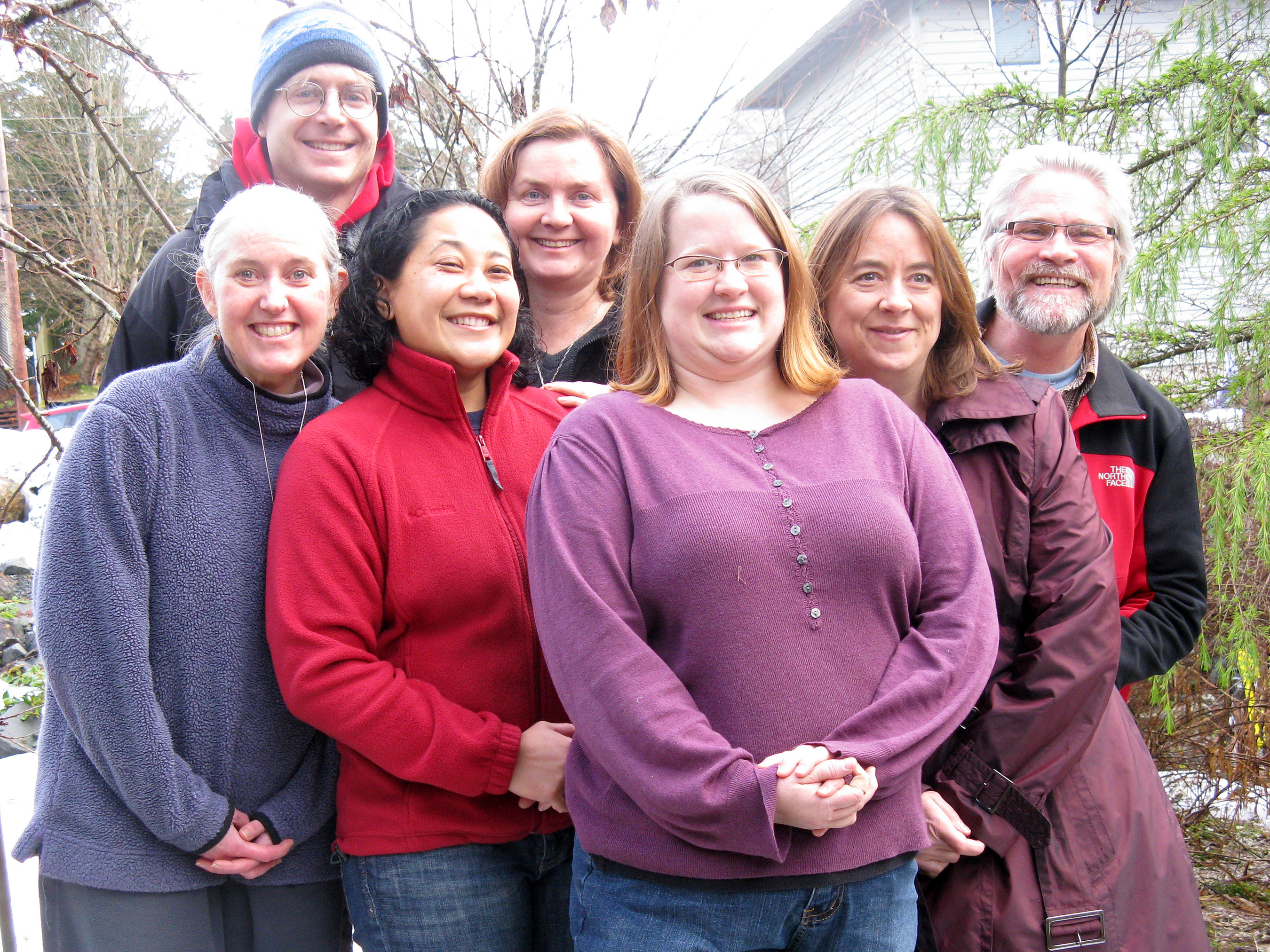
The 2011-12 Sitka Local Foods Network Board of Directors at its winter board retreat on Dec. 3, 2011. From left are Lisa Sadleir-Hart, Doug Osborne, Maybelle Filler, Cathy Lieser, Robin Grewe, Linda Wilson and Kerry MacLane. Not pictured is Tom Crane.

The 2011-12 Sitka Local Foods Network Board of Directors at its winter board retreat on Dec. 3, 2011. From left are Lisa Sadleir-Hart, Doug Osborne, Maybelle Filler, Cathy Lieser, Robin Grewe, Linda Wilson and Kerry MacLane. Not pictured is Tom Crane.

The Sitka Local Foods Network Board of Directors has a new president. Lisa Sadleir-Hart has taken the spot following the recent resignation by founding president Kerry MacLane, who wants to devote more time to getting the Sitka Community Greenhouse and Education Center built and other projects.

Joining Lisa as board officers for 2013 are Cathy Lieser as vice president, Linda Wilson as secretary and Maybelle Filler as treasurer. Kerry remains on the board, for now, but will leave the board once replacement board members are found. The Sitka Local Foods Network currently needs three new board members to complete the board of directors. In addition to Kerry’s planned departure, we recently had two board members move out of town.

Board members are concerned about increasing access to local food for all Sitka residents. They also are concerned about rising food prices in Sitka, and they want to advocate for more community and family gardens in Sitka.

Board members help direct the Sitka Local Foods Network, a non-profit that promotes the harvest and use of local food in Sitka. In addition to setting the focus of the group, board members also help on a wide variety of projects such as the Sitka Farmers Market, St. Peter’s Fellowship Farm, Blatchley Community Garden, Let’s Grow Sitka, the Sick-A-Waste compost project, the Sitka Community Food Assessment project, Sitka Fish-To-Schools, other school education projects and more.

To apply for a spot on the board, please fill out the attached application and submit it to sitkalocalfoodsnetwork@gmail.org. For more information, contact Lisa Sadleir-Hart at 747-5985.

We also are looking to increase our pool of volunteers who will help out during the various projects hosted by the network each year (no formal application needed, just send us your name/contact info and what types of projects you enjoy).

The next Sitka Local Foods Network board meeting is at 6:30 p.m. on Tuesday, May 14, at the Sitka Unitarian Universalists Fellowship Hall (408 Marine St.). The board generally meets from 6:30-8 p.m. on the first Tuesday of each month, except during the summer when board members are busy working with the Sitka Farmers Market and St. Peter’s Fellowship Farm communal garden.

• Sitka Local Foods Network board of directors application

• Sitka Local Foods Network to host March 26 meeting to discuss Sitka Community Greenhouse and Education Center

Sitka residents interested in building a Sitka Community Greenhouse and Education Center pose with Shane Smith of the Cheyenne, Wyo., Botanic Gardens (front row, second from right) after he spoke at a March 12, 2013, meeting about the greenhouse.

Sitka residents interested in building a Sitka Community Greenhouse and Education Center pose with Shane Smith of the Cheyenne, Wyo., Botanic Gardens (front row, second from right) after he spoke at a March 12, 2013, meeting about the greenhouse.

The Sitka Local Foods Network will host a meeting from 7-8:30 p.m. on Tuesday, March 26, at Harrigan Centennial Hall to continue discussions about creating a Sitka Community Greenhouse and Education Center.

The construction of a community greenhouse will help Sitka increase its access to fresh, locally grown produce all year round. The greenhouse also will serve as an education center, helping local residents learn about what it takes to grow fruits and veggies in Sitka, Alaska. This was a Sitka Health Summit project from 2008 that recently regained momentum.

The group currently is looking to build a 30-foot-by-52-foot greenhouse, possibly at the Sheldon Jackson Campus near the Hames Athletic and Wellness Center. Other locations are being considered, but this has been the best potential offer of a site since the start of the project. To learn more, contact Doug Osborne at 966-8734 or Kerry MacLane at 752-0654.

• Sitka Local Foods Network to host March 12 meeting to discuss Sitka Community Greenhouse and Education Center

Shane-SmithAre you interested in helping Sitka increase its access to fresh, locally grown produce all year round? The Sitka Local Foods Network will host a gathering from 7-8:30 p.m. on Tuesday, March 12, at Harrigan Centennial Hall to discuss plans for the Sitka Community Greenhouse and Education Center.

Building a community greenhouse and education center was a community wellness goal from the 2008 Sitka Health Summit, but over the years there were a few problems (usually with securing land) bringing the project to fruition. It now appears the Sitka Fine Arts Camp will allow us to build a 30-foot–by-52-foot greenhouse on the Sheldon Jackson Campus, next to the Hames Athletic and Wellness Center. This is the closest we’ve come to being able to start building a greenhouse.

In addition to the availability of land, we have been offered locally harvested wood to build the greenhouse frame, which will be modeled after another successful greenhouse built near Sitka in 2011.

Please join us on Tuesday to learn more about this exciting project. In addition, Shane Smith, the executive director and founder of the Cheyenne (Wyo.) Botanic Gardens and author of the Greenhouse Gardener’s Companion, will be at the meeting to provide advice based on his experiences building a similar project. Shane Smith also will give a presentation on greenhouses and high tunnels from 11 a.m. to 12:30 p.m. on Saturday, March 9, at the University of Alaska Southeast Sitka Campus Room 229, and he’ll have a booth at the Let’s Grow Sitka garden education event from noon to 3 p.m. on Sunday, March 10, at the Alaska Native Brotherhood Founders Hall, 235 Katlian St.

“The Sitka Community Greenhouse and Education Center would be a tremendous asset to our town and we’ve never been closer to making that dream become a reality,” Sitka Local Foods Network President Kerry MacLane said.  “Having Shane’s expertise and guidance to draw from just puts us that much closer to making this happen this year.”

For more information, contact Kerry MacLane at 752-0654.

• Help wanted: Sitka Community Food Assessment seeks project coordinator

The Sitka Community Food Assessment project is looking to hire a quarter-time project coordinator to oversee the collection of and analysis of data about Sitka’s food supply and demand.

The Sitka Community Food Assessment project is one of this year’s three Sitka Health Summit community wellness projects, which were decided by local residents back in October. The project already has applied for and received a sub-award grant from the SEARHC Community Transformation Grant program to help facilitate the gathering of data about where Sitkans get their food and how much they need.

The project coordinator will work about 10 hours a week at $23 an hour for one year. Depending on other funding and job requirements, there is a possibility the job may expand from quarter-time to half-time.

This new and exciting position will create and support the Community Food Assessment for a Food Resilient Sitka. In order to understand Sitka’s food security, we need to first conduct an assessment. The assessment will be used to develop a Strategic Action Plan to ensure the resiliency of Sitka’s food future. The successful candidate will report to the Sitka Community Food Assessment committee co-chairs.

A copy of the job description is linked below. To apply, please submit a resumé and cover letter. Applications are due by Friday, Nov. 30, and the job starts on Jan. 7. To learn more or to submit your application, please contact Kerry MacLane at maclanekerry@yahoo.com or Andrianna Natsoulas at anatsoulas@thealaskatrust.org.

• Sitka Community Food Assessment project coodinator job description

• Running of the Boots raises funds for Sitka Local Foods Network

It’s time to dig your XtraTufs out of the closet and gussy them up. The 18th annual Running of the Boots begins at 10 a.m. on Saturday, Sept. 29, at the Crescent Harbor shelter.

So what is the Running of the Boots? It’s Southeast Alaska’s answer to Spain’s “Running of the Bulls.” Sitkans wear zany costumes and XtraTufs — Southeast Alaska’s distinctive rubber boots (aka, Sitka Sneakers). The Running of the Boots raises funds for the Sitka Local Foods Network, a non-profit group that hosts the Sitka Farmers Market and advocates for community gardens, a community greenhouse, sustainable uses of traditional subsistence foods and education for Sitka gardeners. The network also has a representative on the Alaska Food Policy Council.

The Running of the Boots is a short race for fun and not for speed, even though one of the many prize categories is for the fastest boots. Other prize categories include best-dressed boots, zaniest costume, best couple, best kids group and more. The course involves a run from Crescent Harbor to the corner of Katlian and Lincoln streets and back, with a short course for kids looping around St. Michael’s Cathedral.

The entry fee for the Running of the Boots is $5 per person and $20 per family, and people can register for the race starting at 10 a.m. Costume judging starts about 10:30 a.m. There is no longer a lip synch contest after the race. Prizes will be awarded right after the race so folks will have time to get to the free Season’s End Celebration food booths on Lincoln Street, which are being sponsored by the Alaska Cruise Association and the Greater Sitka Chamber of Commerce.

Local merchants have donated bushels of prizes for the costume contest, including a flightseeing trip for three from Harris Air and a new pair of XtraTufs from Russell’s. Honeywell, the maker of XtraTuf boots, is helping sponsor the event and all prize winners will be provided with a new pair of XtraTuf boots (Honeywell is providing 50 pairs of boots). The Sitka Local Foods Network will host a Sitka Farmers Market booth with fresh veggies for sale. The booth will be able to take debit cards, WIC vouchers and Quest cards.

“This is a really fun way to advance the Sitka Farmers Market and our other Sitka Local Foods Network projects,” Sitka Local Foods Network Board President Kerry MacLane said. “This is a must-see annual change-of-the season tradition in Sitka.”

To learn more about the Running of the Boots, contact Kerry MacLane at 752-0654 or by e-mail at maclanekerry@yahoo.com. Historical information about the race (through 2005) can be found online at http://www.runningoftheboots.org/, and info about the Sitka Local Foods Network and more recent Running of the Boots events (2008-11) is online at http://www.sitkalocalfoodsnetwork.org/ (type Running of the Boots into the search bar at the top of the page).

• 2012 Running of the Boots flier (feel free to print a few copies and post them around town)

• Celebrity food adventurer Andrew Zimmern stops by the Sitka Farmers Market

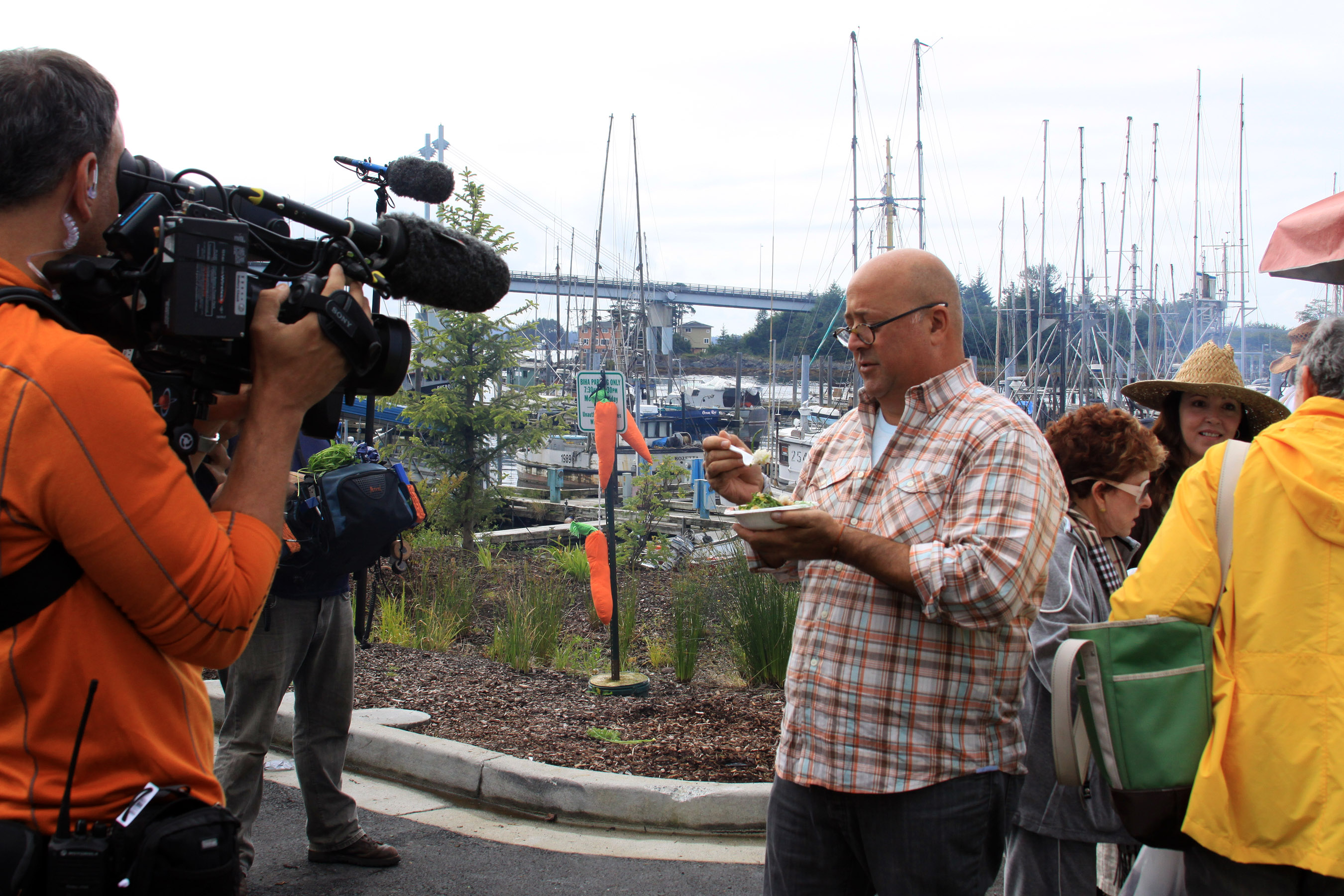
TV personality Andrew Zimmern is filmed as he samples some blackcod tips during the Aug. 18, 2012, Sitka Farmers Market.

TV personality Andrew Zimmern is filmed as he samples some blackcod tips during the Aug. 18, 2012, Sitka Farmers Market.

Celebrity food adventurer Andrew Zimmern was in Sitka this weekend, and he stopped by the Aug. 18 Sitka Farmers Market to film interviews for his three Travel Channel television showsBizarre Foods With Andrew Zimmern, Andrew Zimmern’s Bizarre World and his new show, Bizarre Foods America.

Andrew Zimmern tries a salmon crepe from Keri Fish.

Andrew Zimmern tries a salmon crepe from Keri Fish.

Zimmern is a noted TV personality, chef, food writer and teacher, but he’s most known for traveling the world sampling bizarre foods that most Americans have either neither heard of or had the guts to try (or both). None of the food he sampled at the Sitka Farmers Market on Saturday falls under the category of bizarre (unless you’re not used to eating a little beach asparagus on your blackcod tips or kelp pickles on your salmon crepes). But he’ll sample stinkfish and other Tlingít delicacies this week when he heads to Kake. Andrew’s website is subtitled “Experiencing Food, Sharing Culture.”

While he was at the Sitka Farmers Market, he interviewed Sitka Local Foods Network president Kerry MacLane and sampled some of Kerry’s blackcod tips. He also sampled a salmon crepe with kelp pickles from Keri Fish’s booth, he checked out some of the jams and jellies from Renée Pierce’s Simple Pleasures booth and bought fry bread from Grace Larson. On Monday, he Tweeted about and posted an Instragram photo of his bagel from the Highliner Coffee shop.

It’s unknown when Zimmern’s Alaska show(s) will air, but his Bizarre Foods With Andrew Zimmern show airs on Monday nights on the Travel Channel.

• Sitka Local Foods Network to host six Sitka Farmers Markets in 2012

The Sitka Local Foods Network will host its fifth summer of Sitka Farmers Markets with six markets that start on July 7 and take place on alternate Saturdays through Sept. 15. The Sitka Farmers Markets give Sitka residents a chance to buy and sell locally produced food and crafts.

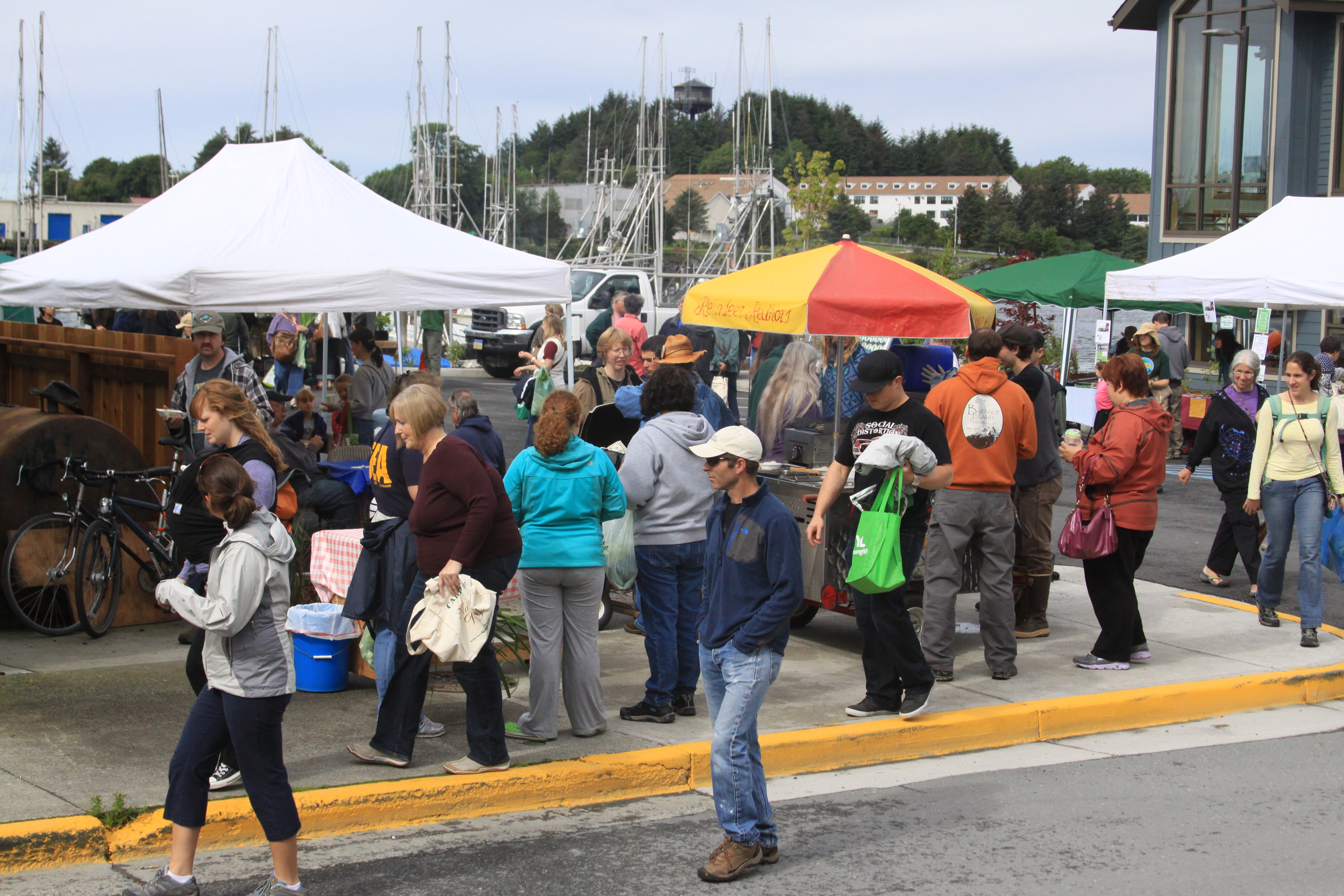
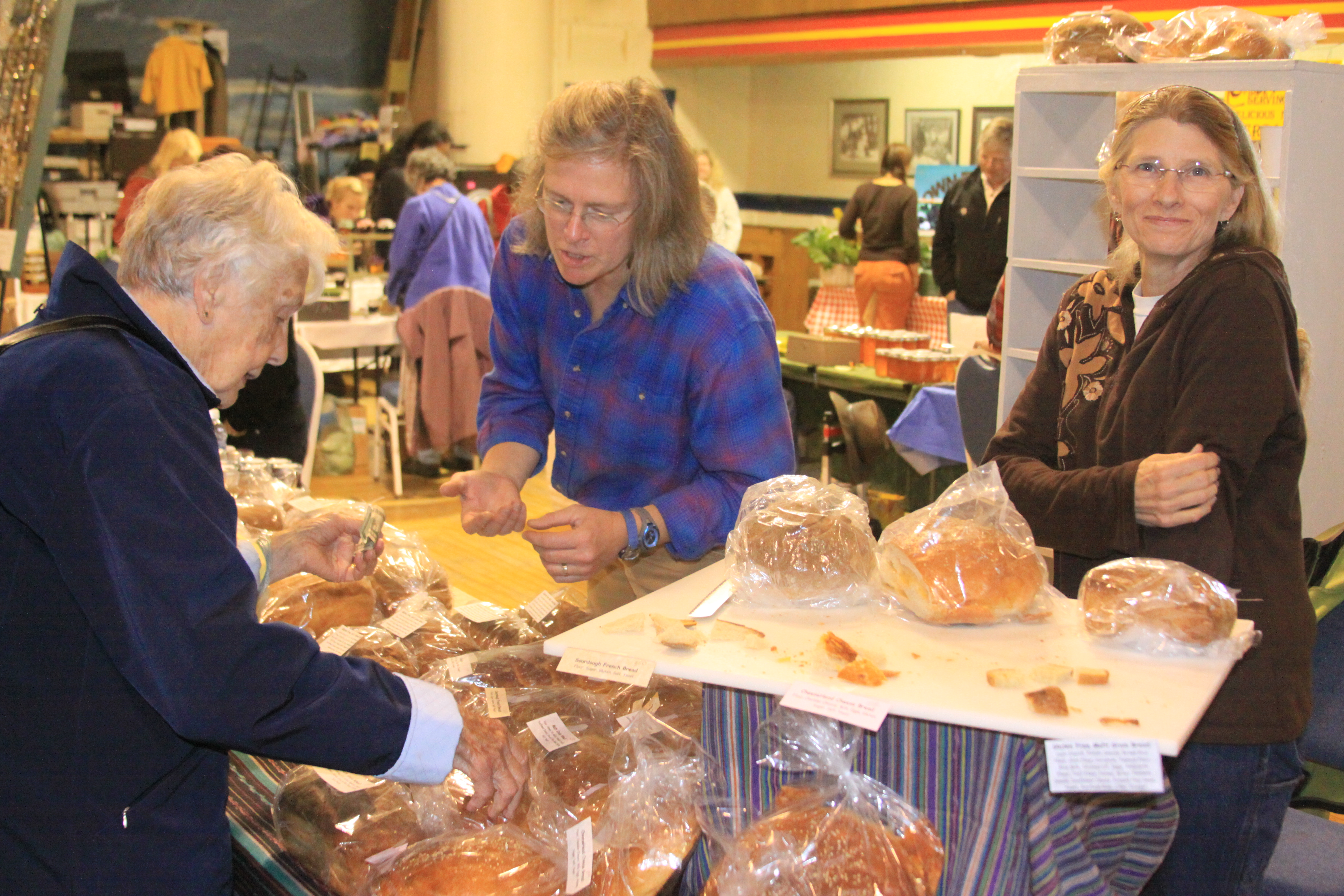
The Sitka Farmers Markets take place from 10 a.m. to 2 p.m. on Saturday, July 7, 21, Aug. 4, 18, Sept. 1 and Sept. 15 at the Alaska Native Brotherhood Hall (235 Katlian St.). The markets feature local seafood (fresh, frozen, and cooked, ready to eat), locally grown and harvested fruits and vegetables, baked bread, locally made jams and jellies, cooking demonstrations, live entertainment, locally brewed and roasted coffee, music, local arts and crafts, and a variety of other items gathered or made in Sitka. We emphasize local products and lots of fun. We are the first farmers market in Southeast Alaska to accept WIC coupons. You also can vote for the Sitka Farmers Market in the America’s Favorite Farmers Markets contest by following the links at http://www.sitkalocalfoodsnetwork.org/.

“The Sitka Farmers Market is like a carnival every other Saturday,” Sitka Local Foods Network Board President Kerry MacLane said. “It’s a fun community space to enjoy with your family or to meet your friends for fresh coffee and baked goods. There is live music, cooking demonstrations, art, and, of course, fresh veggies, fruit and seafood.”

The Sitka Farmers Market started as a community project that came out of a health priority planning meeting at the 2008 Sitka Health Summit. This event is sponsored by the Sitka Local Foods Network, Alaska Native Brotherhood Camp No. 1, Alaska Native Sisterhood Camp No. 4, Baranof Island Housing Authority, Sitka Conservation Society, the Alaska Farmers Market Association and the SEARHC Health Promotion and Diabetes Prevention programs.

“Thanks to our creative and enthusiastic vendors, the Sitka Farmers Market will be celebrating its fifth successful year.” said Johanna Willingham, Sitka Local Foods Network Board Member and Sitka Farmers Market Coordinator. “We have delighted in watching our market grow over the years and due to popular demand we are beginning our market two weeks earlier this year. Outdoor vendors and musicians will still be able to enjoy the newly paved parking lot with landscaping, thanks to BIHA. A tent will be set up for outdoor dining where you can listen to live music and enjoy some great food. Some new items will be added to some familiar vendors’ tables — dried sea veggies, sea asparagus and sea salt. Look forward to fresh snap and snow peas for snacking, ready-to-eat salads, handmade tamales and, as always, fresh black cod tips.”

Vendor fees are $20 for a 6-foot table, $30 for an 8-foot table and $15 for a 4-foot table. Vendors with their own tents pay $2 per foot. As always, we offer cost incentives for vendors growing locally produced food. The fees will help us cover the costs of renting ANB Hall and its kitchen, hiring musicians and other expenses. To learn more about being a vendor or to sign up for a table, contact Sitka Farmers Market Coordinator Johanna Willingham at 738-8336 or by e-mail johanna.willingham@gmail.com. Vendor rules, registration forms and other information for potential vendors can be found at http://www.sitkalocalfoodsnetwork.org/.