• Free pressure canner gauge testing offered at the Sitka Farmers Market on Saturday, July 18

Canner

SarahLewisTestsCannerGaugeThis is a great time of the year to be in Sitka. The fish are running, gardens are starting to produce, and berries are ripe for the picking.

Many Sitka residents have pressure canners to preserve their harvest, and this weekend Sarah Lewis of the Juneau District Office of the University of Alaska Fairbanks Cooperative Extension Service is in town to teach four classes about canning on Thursday, Friday and Saturday at the Sitka Kitch (a rental community commercial kitchen at First Presbyterian Church, 505 Sawmill Creek Road, note, all classes are full). She also provide free pressure canner gauge testing at the Sitka Farmers Market from 10 a.m. to 1 p.m. on Saturday, July 18, at the Alaska Native Brotherhood Founders Hall.

“People can bring the gauge or the lid with the gauge still attached,” Sarah said about the pressure canner gauge testing. “If they have any questions about the full canner (gaskets, damage, how to use, etc.) they can bring the whole thing.”

In addition to testing pressure canner gauges, Sarah plans to work with Jasmine Shaw of the Sitka District Office of the UAF Cooperative Extension Service to have a wide variety of publications available about home canning. In addition, the UAF Cooperative Extension Service has a series of online tutorials on its website called “Preserving Alaska’s Bounty.” Pressure canner gauges should be tested at least once a year to make sure they are hitting the right pressures for safe food preservation.

A reminder about the Sitka Farmers Market, due to health codes we can’t allow any pets other than licensed service dogs in the ANB Hall or the parking lot. We also don’t allow smoking at the Sitka Farmers Market (in ANB Hall or the parking lot) because this is a health event.

Also, if you are in Sitka and you can’t make the pressure canner gauge testing event at the Sitka Farmers Market, you can call Jasmine Shaw at 747-9440 at the Sitka office of the UAF Cooperative Extension Service to set up a time when you can stop by and have her test your gauge in the office. She now has a gauge and is trained on using it.

• Scenes from the first Sitka Farmers Market of the 2015 summer

Sitka Local Foods Network Board Secretary Alli Gabbert, left, and Sitka Farmers Market Manager Debe Brincefield, right, present the Table Of The Day Award to Jennifer "Springer" Black of Charlee Oh Creations at the first Sitka Farmers Market of the 2015 summer on Saturday, July 4, at the Alaska Native Brotherhood Founders Hall in Sitka. Springer is a new vendor at the Sitka Farmers Market and she sold handmade soft-soled shoes for babies and toddlers, some with matching bibs. Springer received a gift bag with fresh greens, fresh rhubarb, fresh mint, and some handmade earrings donated by Taylor Ihde. This is the eighth year of Sitka Farmers Markets, hosted by the Sitka Local Foods Network. The next market is from 10 a.m. to 1 p.m. on Saturday, July 18, at the Alaska Native Brotherhood Founders Hall, 235 Katlian St. Bring your canner pressure gauge to this market to have it checked. For more information about the Sitka Farmers Markets and Sitka Local Foods Network, go to http://www.sitkalocalfoodsnetwork.org/ or check out our Facebook page at https://www.facebook.com/SitkaLocalFoodsNetwork. (PHOTO COURTESY OF SITKA LOCAL FOODS NETWORK)

Sitka Local Foods Network Board Secretary Alli Gabbert, left, and Sitka Farmers Market Manager Debe Brincefield, right, present the Table Of The Day Award to Jennifer “Springer” Black of Charlee Oh Creations at the first Sitka Farmers Market of the 2015 summer on Saturday, July 4, at the Alaska Native Brotherhood Founders Hall in Sitka. Springer is a new vendor at the Sitka Farmers Market and she sold handmade soft-soled shoes for babies and toddlers, some with matching bibs. Springer received a gift bag with fresh greens, fresh rhubarb, fresh mint, and some handmade earrings donated by Taylor Ihde. This is the eighth year of Sitka Farmers Markets, hosted by the Sitka Local Foods Network. The next market is from 10 a.m. to 1 p.m. on Saturday, July 18, at the Alaska Native Brotherhood Founders Hall, 235 Katlian St. Bring your canner pressure gauge to this market to have it checked. For more information about the Sitka Farmers Markets and Sitka Local Foods Network, go to http://www.sitkalocalfoodsnetwork.org/ or check out our Facebook page at https://www.facebook.com/SitkaLocalFoodsNetwork. (PHOTO COURTESY OF SITKA LOCAL FOODS NETWORK)

Sitka celebrated its independence from over-processed store-bought food with the first Sitka Farmers Market of the season on Saturday, July 4, at the Alaska Native Brotherhood Founders Hall.

We were greeted by gorgeous sunny weather, a Sitka rarity for the Fourth of July, and several new booths. A reminder, due to health codes we can’t allow any pets in the ANB Hall or the parking lot other than service dogs. We also don’t allow smoking at the Sitka Farmers Market because this is a health event.

The second Sitka Farmers Market of the summer is from 10 a.m. to 1 p.m. on Saturday, July 18, at ANB Founders Hall, 235 Katlian Street. Don’t forget to bring your pressure canner gauge and lid because Sarah Lewis of the University of Alaska Fairbanks Cooperative Extension Service Juneau District Office will be in town offering free pressure canner gauge testing. You should have your pressure canner gauge tested once a year to make sure it’s safe.

A slideshow from the first Sitka Farmers Market is posted below.

This slideshow requires JavaScript.

• SEARHC, Cooperative Extension to host free food preservation and entrepreneurship workshops at Sitka Kitch

SitkaKitch2015CanningClasses

The SouthEast Alaska Regional Health Consortium (SEARHC) WISEFAMILIES Traditional Foods program and the University of Alaska Fairbanks Cooperative Extension Service are teaming up to offer a series of four free food preservation and entrepreneurship workshops on Thursday through Saturday, July 16-18, at the Sitka Kitch. There also will be free pressure canner gauge testing at the Sitka Farmers Market on July 18.

The Sitka Kitch is a rental community commercial kitchen project coordinated by the Sitka Conservation Society, in partnership with the Sitka Local Foods Network, located inside the First Presbyterian Church, 505 Sawmill Creek Road. The Sitka Kitch was a project from the 2013 Sitka Health Summit designed to improve food security in Sitka while also providing a space for people wanting to get into the cottage food business or wanting to preserve their harvest for storage in the home pantry. Sitka Kitch officially opened in March 2015 after a series of renovations to make it pass Alaska Department of Environmental Conservation commercial kitchen food safety standards.

UAF Southeast Extension Agent Sarah Lewis of the Juneau District Office will teach four classes — Cottage Foods and Beyond, Pickling and Fermenting, Canning Salmon and Berries, and Canning Soups and Sauces. These classes are open to Sitka residents of all ages, but an adult must accompany those younger than 14 years old. Class sizes are limited to 16 people. Thanks to a grant from the SEARHC WISEFAMILIES Traditional Foods program, all ingredients, jars, and equipment will be supplied in class.

“The WISEFAMILIES Traditional Foods program is partnering with the UAF Cooperative Extension Service because their work complements our purposes, which is to help Native families reduce their risk for disease while working toward getting back to a traditional way of eating,” said SEARHC Health Educator Clara Gray, of the SEARHC WISEFAMILIES Traditional Foods program.

The SEARHC WISEFAMILIES Traditional Foods program promotes healthy lifestyles by connecting Alaska Natives in Southeast Alaska to their culture. Members of the program learn how to harvest, cook, and preserve their traditional Alaska Native foods, which usually are healthier than heavily processed store-bought foods. In addition, participants learn traditional language, dancing, carving, weaving, and other skills that help reconnect them to their culture.

SarahLewisWithBoilingPotsThe UAF Cooperative Extension Service offers a variety of programs geared toward food, how to grow it, how to preserve it for storage, and how to make it into cottage foods you can sell. For those who can’t make the classes, the service offers a series of free online tutorials about home canning called Preserving Alaska’s Bounty.

“As a UAF Cooperative Extension Agent, I try to teach that family and community resilience are strengthened when local foods are used to cook meals at home,” Lewis said. “Through my food preservation and entrepreneurship workshops I offer the knowledge and skills needed for people to discover the nutritional benefits and financial stability that come from making and preserving homemade meals with local ingredients.”

Here are the details and schedules of the four classes:

  • Cottage Foods and Beyond, 2-4 p.m., Thursday, July 16 — Learn to safely make and legally sell your local foods. This class explains the DEC Cottage Foods Exemptions, as well as steps to take when you’re ready to go “beyond cottage foods.”
  • Pickling and Fermenting, 6:30-9:30 p.m., Thursday, July 16 — Sauerkraut, kim-chi, vinegars, pickled vegetables and non-alcoholic beverages. Come learn the basics of lacto-fermentation and vinegar pickling for tasty home-made snacks and digestive health.
  • Canning Salmon and Berries, 4-9 p.m., Friday, July 17 — Waterbath and pressure canning for people of all experience levels, with a focus on these two favorite Southeast foods.
  • Canning Soups and Sauces, 3-8 p.m., Saturday, July 18 — Home-canned soups and sauces save time, money and meal-time hassles. Come learn how to easily and safely pressure and waterbath can ready-to-eat meals and side dishes for your pantry.

In addition to teaching the four classes, Lewis will offer free pressure canner gauge testing at the Sitka Farmers Market, from 10 a.m. to 1 p.m. on Saturday, July 18, at the Alaska Native Brotherhood Founders Hall, 235 Katlian Street. She also will provide other resources about home canning and food preservation. To ensure safe canning, pressure canner dial gauges should be tested every year for accuracy.

Due to limited class space, please pre-register by Wednesday, July 15, to ensure a spot. To pre-register, contact Jasmine Shaw of the Sitka District Office of the UAF Cooperative Extension Service at 747-9440 or jdshaw2@alaska.edu.

• What you put on your fork matters in seventh annual Farmers Market Celebration

FARMMARKETCELEB_LOGO_D

What you put on your fork matters. That’s the message behind American Farmland Trust’s seventh annual Farmers Market Celebration. The celebration calls on shoppers to help identify the cream of the crop — the best of America’s farmers markets — and in Alaska we think that’s the Sitka Farmers Market.

SitkaFarmersMarketSignThe celebration calls on shoppers to help identify the best of America’s farmers markets. The summer-long event launched June 21 and runs through Sept. 23. The first Sitka Farmers Market of the summer is from 10 a.m. to 1 p.m. on Saturday, July 4, at the Alaska Native Brotherhood Founders Hall. The other five Sitka Farmers Markets this summer are on Saturdays, July 18, Aug. 1, Aug. 15, Aug. 29, and Sept. 12.

“The Celebration encourages market customers, family farmers, community activists – anyone who believes they’ve got the best farmers market in the country – to endorse their market in four special areas: Focus on Farmers, Healthy Food for All, Pillar of the Community, and Champion for the Environment,” said Susan Sink, American Farmland Trust vice president of development and external relations.

Shoppers are encouraged to use Instagram and join the local food community in saving farmland with their forks, as part of AFT’s “#OnMyFork” social media campaign. Supporters are encouraged to post pictures or videos of their farmers market to Instagram using the hashtag #OnMyFork. If you do post something about the Sitka Farmers Market, please tag our Sitka Local Foods Network page on Facebook, https://www.facebook.com/SitkaLocalFoodsNetwork.

“While farmers markets have been growing in popularity, keeping family farmers on farmland remains a nationwide challenge,” Sink says. “Many family farmers are struggling to stay financially afloat and face daily pressure from development to sell their land. Farmers markets provide a wonderful opportunity for family farmers to sell directly to consumers and to help make a living on their land.”

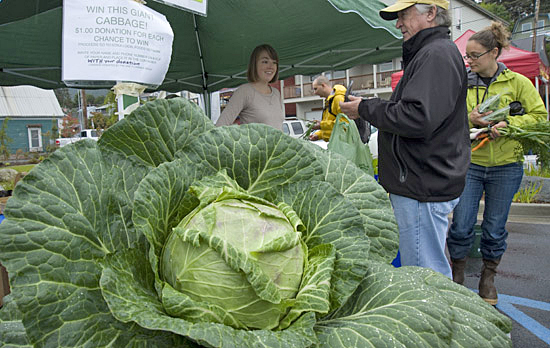
bigcabbagewsFarmers markets have a lot to offer. Beyond the beautiful array of fresh and local food, farmers markets help family farmers thrive, connect us as a community and can be catalysts for both environmental and social good. That is why American Farmland Trust is giving away awards to farmers markets who are the Best in Class in four special areas — Focus on Farmers, Healthy Food for All, Pillar of the Community, and Champion for the Environment.

If you have ever been to the Sitka Farmers Market, you may already know that they are the gold standard for farmers markets in these areas. If you haven’t been to the market before, here are a few reasons why the Sitka Farmers Market deserves to be named one of America’s top markets:

  • Focus on Farmers — The Sitka Local Foods Network, which sponsors the Sitka Farmers Market, has been working with local gardeners and small farmers to increase the amount of locally grown fruits and veggies in Sitka. Not only is locally grown food fresher and better tasting, but it’s better on the environment because it doesn’t have to travel thousands of miles to get to Alaska. The Sitka Farmers Market also is a good place to participate in the $5 Per Week Alaska Grown Challenge to help improve Alaska’s food security.
  • Healthy Food for All — The Sitka Farmers Market was the first farmers market in Southeast Alaska to accept SNAP (food stamps/Alaska Quest cards) and WIC vouchers for people benefitting from those programs. In addition, we have matching dollars of up to $20 per person per market available for SNAP-eligible foods (produce, fish, baked goods, barley products, etc.). This year we are partnering with SEARHC on a program where SEARHC beneficiaries with chronic diseases such as diabetes are prescribed vouchers for fresh produce.
  • Pillar of the Community — The Sitka Farmers Market not only serves as a community gathering place, but it also is a business incubator. It’s a good place for budding entrepreneurs to test ideas and products before going into full production. The Sitka Farmers Market emphasizes local, local, local, which helps put the focus on products from Sitka.
  • Champion for the Environment — It’s estimated that Alaska residents import about 90-95 percent of their food from the Lower 48 or foreign countries. By encouraging people to grow or harvest food locally, we’re cutting down on thousands of miles of transportation costs. That means less fuel is used, and fewer pollutants in the air.

To help shine a light on the Sitka Farmers Market, just go to http://markets.farmland.org/market/sitka-farmers-market/ and recommend our market. In past Farmers Market Celebrations, sponsored by the American Farmland Trust, the Sitka Farmers Market has been at or near the top among the Alaska rankings. Those rankings also helped us crack the recently released 101 Best Farmers Markets in America list compiled by TheDailyMeal.com.

• Sitka Farmers Market makes 101 Best Farmers Markets in America 2015 list

101-farmers-markets

TheDailyMeal.com has ranked the Sitka Farmers Market on its 101 Best Farmers Markets in America 2015 list.

The Sitka Farmers Market ranks 99th in the national rankings. The Homer Farmers Market ranked 60th (although it was incorrectly listed as being from Arkansas) and was the only other Alaska market in the rankings.

#99 Sitka Farmers Market, Sitka, Alaska

Besides being a wonderful farmers market, the Sitka Market provides healthy eating education and entertainment for the community as a part of the Sitka Local Foods Network. The market is open Saturdays from July to September.

The Sitka Farmers Market will take place six times this summer, from 10 a.m. to 1 p.m. on alternate Saturdays, July 4, July 18, Aug. 1, Aug. 15, Aug. 29, and Sept. 12, at the Alaska Native Brotherhood Founders Hall, 235 Katlian St. We offer a wide variety of locally grown produce, locally caught seafood, locally baked bread, and locally made arts and crafts. We also feature live music, and lots of family fun.

• Sitka Local Foods Network to host six Sitka Farmers Market events in 2015

2015SitkaFarmersMarketFlier

Celebrate your independence from store-bought and factory-processed food this year by joining the Sitka Local Foods Network as it hosts the eighth summer of Sitka Farmers Markets in 2015. There will be six markets this year, starting on July 4 and taking place on alternate Saturdays through Sept. 12. The Sitka Farmers Markets give Sitka residents a chance to buy and sell locally produced food and crafts.

The Sitka Farmers Markets take place from 10 a.m. to 1 p.m. on Saturday, July 4, July 18, Aug. 1, Aug. 15, Aug. 29, and Sept. 12 at the Alaska Native Brotherhood Founders Hall (235 Katlian St.). The markets feature local seafood (fresh, frozen, and cooked, ready to eat), locally grown and harvested fruits and vegetables, baked goods, locally made jams and jellies, live entertainment and music, local arts and crafts, and a variety of other items gathered or made in Sitka. We emphasize local products and lots of fun. We are the first farmers market in Southeast Alaska to accept WIC coupons and Alaska Quest EBT for SNAP (food stamp) users. Debe Brincefield is the Sitka Farmers Market manager, with Francis Wegman-Lawless serving as assistant manager.

“The Sitka Farmers Market is a great way to connect with community members and support local entrepreneurs,” Sitka Local Foods Network Board President Lisa Sadleir-Hart said. “Spending your dollars locally has a multiplying effect and helps your neighbors. We also encourage Sitkans to join the $5 Per Week Alaska Grown Challenge and support your local producers each week with $5. Dollars spent locally multiply in our community to the tune of about $3 for each dollar spent. So you get great local food and support your neighbors by spending locally.”

The Sitka Farmers Market started as a community wellness project that came out of a health priority planning meeting at the 2008 Sitka Health Summit. The markets are sponsored by the Sitka Local Foods Network, Alaska Native Brotherhood Camp No. 1, Alaska Native Sisterhood Camp No. 4, Baranof Island Housing Authority, the Alaska Farmers Market Association, the Alaska Division of Public Health Cancer Control Program, and the SEARHC Health Promotion and Diabetes Prevention programs.

“As with the past three seasons, we invite Sitkans who participate in food stamps to use their QUEST card at the market and we will match up to $20 per market for each food stamp participant in a household until resources are exhausted,” Sadleir-Hart said. “So for a family of four that could mean up to $80 extra dollars to shop at each market. Additionally, the St. Peter’s Fellowship Farm stand will be working with the SEARHC Health Promotion program to debut a new fruit and vegetable prescription program at the market. SEARHC’s nutritionist will provide eligible beneficiaries with $5 vouchers to use at the farm stand to access local, fresh produce. The farm stand also will accept WIC farmers market and fruits and vegetable vouchers (FVV).”

To learn more about the market and how to be a vendor, contact Sitka Farmers Market Manager Debe Brincefield at 738-8683 or by e-mail sitkafarmersmarket@gmail.com. Vendor rules, registration forms and other info for potential vendors can be found on the Documents page at http://www.sitkalocalfoodsnetwork.org/.

• Vote for the Sitka Local Foods Network and help us win $15,000 for St. Peter’s Fellowship Farm

GardensForGood

StPetersSignWithToDoListSignHelp us grow the St. Peter’s Fellowship Farm communal garden program by voting for the Sitka Local Foods Network in the Nature’s Path Organic Foods Gardens For Good contest.

People can vote once per day from Monday, June 22, through 10:59 a.m. (Alaska time) on Monday, July 6. The top three vote-getters (two from the United States, one from Canada) will win $15,000 each to support their urban gardening efforts. We are the only project from Alaska among the 120 entrants.

“The Gardens for Good program is a way to fund the terrific things we are doing in Sitka through the Sitka Local Foods Network to get healthy, fresh and local produce into the mouths of Sitkans,” Sitka Local Foods Network Board President Lisa Sadleir-Hart said. “Take time to vote once a day so we can make it into the final nine. We could really do a lot with $15,000!”

The St. Peter’s Fellowship Farm communal garden was built in 2008, shortly after that year’s Sitka Health Summit, when a majority of Sitkans said they wanted to see more community gardens/greenhouses in Sitka and they wanted a local foods market. The Sitka Farmers Market was launched a couple of months later, with produce grown at St. Peter’s Fellowship Farm for sale to Sitka residents.

A group of kids harvests garlic during an Aug. 12, 2011, work party at St. Peter's Fellowship Farm.

A group of kids harvests garlic during an Aug. 12, 2011, work party at St. Peter’s Fellowship Farm.

Since then St. Peter’s Fellowship Farm (located behind St. Peter’s By The Sea Episcopal Church, 611 Lincoln St.) has grown and it now produces several times the amount of local produce as what was for sale that first year. We also have added a few satellite gardens to help us grow even more produce in Sitka, and we still sell it at the Sitka Farmers Markets. People with Alaska Quest (SNAP) and WIC benefits can purchase the local produce using matching funds, so they can double the value of their vouchers. St. Peter’s Fellowship Farm produce is sold to school lunch programs, and we host a table during non-market weekends at the Chelan Produce stand.

In addition to growing local produce to sell to Sitka residents, St. Peter’s Fellowship Farm has been used to teach locals about gardening. It’s also a fun place for kids to become more connected to their food. We also will use the $15,000 to continue our garden mentor program for another year or two and to help support the development of the Sitka Kitch community commercial kitchen project.

Don’t forget to vote for us once per day now through the morning of July 6. Your support is greatly appreciated. Please use this link, http://wshe.es/fZ1TjYIj, to share on your social media sites, letting people know where they need to go to vote for us.

• Take the $5 Per Week Alaska Grown Challenge and help improve Alaska’s food security

AlaskaGrown2_Graphic

AlaskaGrown3_GraphicThe Alaska Farm Bureau announces the $5 Per Week Alaska Grown Challenge – a statewide campaign to increase consumer spending on Alaska Grown products with the goal of strengthening local economies and increasing Alaska’s food security.

The Kenai Peninsula Chapter of the Alaska Farm Bureau, in partnership with the Kenai Soil and Water Conservation District and several other local organizations (including the Sitka Local Foods Network), launched the $5 Per Week Alaska Grown Challenge on May 5, in honor of Alaska Agriculture Day. Now the Challenge is going statewide with the help of social media, Alaska Farm Bureau chapters, and local food advocates across the state.

“We’d like to see the state investing in agriculture the way it invests in the resource extraction industries,” said Heidi Chay, district manager of the Kenai Soil and Water Conservation District. “After all, everyone needs to eat, and Alaska is at the end of a very long and vulnerable food chain. The signs of agriculture’s growth potential are all around us. … However, if the state can’t or won’t invest in agriculture the way it should, it’s on Alaskan consumers to take the lead. That’s why the District joined with local partners last month to launch the $5 Per Week Alaska Grown Challenge. We’re calling on Alaskans to invest a small part of their food dollars in the future of Alaskan agriculture, by spending $5 per week per person year-round. Farmers market season is a great time to start.”

Sitka residents will be able to participate in the Challenge by purchasing local veggies at the Sitka Farmers Markets this summer. The markets take place from 10 a.m. to 1 p.m. on alternate Saturdays, July 4, July 18, Aug. 1, Aug. 15, Aug. 29, and Sept. 12, at the Alaska Native Brotherhood Founders Hall, 235 Katlian St.

“I’m excited by the prospect of growing local producers pocketbooks with the $5 Per Week Alaska Grown Challenge in Sitka,” said Lisa Sadleir-Hart, Sitka Local Foods Network Board President. “It’s about supporting local foods and your neighbors as well as giving your body the benefit of fresh food. I plan on spending at least $5 a week on local food and doing it at the Sitka Farmers Market makes absolute sense.”

The Challenge calls on Alaskans to spend $5 per week per person on Alaska Grown products year-round. With farmers market season just around the corner, this is the perfect time for Alaskans to commit to investing a portion of their consumer dollars in the future of Alaskan agriculture.

graphic1Agriculture has played an important role in Alaska’s history. Today it is a growing industry with increasing numbers of farms producing food, forage and fiber for local consumers, as well as peonies and rhodiola for sale around the world.

Although farm production is rising, the economic potential of Alaskan farms is far from realized.  More than 95 percent of Alaska’s food is imported, which means that most of our food dollars are leaving the state.

Are Alaska farmers prepared to scale up to meet increasing demand? Yes. According to the Alaska Division of Agriculture, 67 percent of Alaska farmers surveyed indicate that they would increase production if they had more market options. Meanwhile, a warming climate and the rapid adoption of season-extension technologies such as high tunnels are creating more favorable conditions for agriculture.

The Alaska Farm Bureau is calling on every resident in Alaska to join the $5 Per Week Alaska Grown Challenge. If every Alaskan spent $5 per week on Alaska Grown products, year-round, it would have a $188 million dollar impact.

Why buy Alaska grown? Not only are you supporting Alaskans and boosting our economy, you’re also getting a fresher, tastier, more nutritious product. In a blind taste test, 82 percent of Alaskans surveyed could taste the difference between products grown here and those shipped up. Adults and kids say Alaska grown is sweeter, fresher-tasting and crispier.

The $5 Per Week Alaska Grown Challenge isn’t hard. The key, simply enough, is to eat what grows here. You can find a wide variety of produce and value-added products like bread, jam and pickles at farmers markets throughout the summer. Alaska Grown carrots, potatoes, cabbage, milk and barley products (flour, couscous and even pancake mix!) are available year-round in local grocery stores, joined by lettuce, tomatoes, cucumbers and broccoli during the growing season. Local farms produce meat, poultry, eggs and honey, which are available direct from the farm and at locally-owned retailers. Farmers grow more than just food; Alaska also has cut flower and natural fiber industries with products available. Local restaurants, breweries, distilleries and wineries purchase local products to use in their recipes. And don’t forget our local seafood products.

Not sure where to find Alaska Grown? Check out the $5 Per Week Alaska Grown Challenge website (http://www.alaskafb.org/challenge/) where you will find links to local and statewide resources including the Alaska Grown Source Book, a list of local producers and farmers markets. Be sure to ask for Alaska Grown when you are eating out as well.

Take the challenge: $5 per person per week. You’ll help local farmers, boost the local economy, increase Alaska’s food security, and eat better too. Sign up for the challenge here, http://www.alaskafb.org/challenge.

• Taste of Alaska white paper

• USDA offers cost-share assistance program to help farms get certified as organic

Carrots2

2000px-USDA_organic_seal.svgWith the growth of the local foods movement in recent years, many consumers are more aware of the health benefits of eating organically grown food. But in Alaska, getting certified as organic is a challenge due to high costs and no accredited certifying agents being in the state.

In an effort to meet the growing demand for organic food, the U.S. Department of Agriculture (USDA) introduced two cost-share assistance programs to increase the number of farmers and manufacturers working with organic products. The programs cover three-quarters of the certification costs, up to $750 per category (up to $3,000 total), for each of the four categories of organic food — crops, livestock, processed products, and wild crops.

“The organic industry saw record growth in 2014, accounting for over $39 billion in retail sales in the United States,” said Agriculture Secretary Tom Vilsack. “The organic certification cost-share programs help more organic businesses succeed and take advantage of economic opportunities in this growing market.”

The USDA Agriculture Marketing Service National Organic Program (NOP) has allocated approximately $11.9 million to participating state departments of agriculture to help defray the costs of organic certification incurred by organic producers and processors. Reimbursements to organic operations will be made under the Agricultural Management Assistance (AMA) Certification Cost Share Program or the National Organic Certification Cost Share Program (NOCCSP).

The cost-share programs were included in the 2014 Farm Bill. NOCCSP has approximately $11 million available for producers and processors in participating states, U.S. territories and the District of Columbia. AMA has $900,000 for producers in 16 participating states (Alaska is not in the AMA program).

Each state has its own application process, and Barbara Hanson from the Alaska Division of Agriculture in Palmer is Alaska’s contact for the NOCCSP program. She can be contacted at (907) 761-3854 or barbara.hanson@alaska.gov. The program this year is for organic certification costs incurred between Oct. 1, 2014, and Sept. 30, 2015.

Organic certification is important because no food can claim to be organic without the certification, even if it’s grown or processed following organic standards. In Alaska, this has been a challenge because it’s difficult to get a USDA-accredited certifying agent out to our farms and there are none based in our state. So many Alaska farms go without the label. Click this link to learn more about the process for becoming certified as an organic farm.

• 2014 Alaska USDA organic certification cost-share program letter

• 2014 Alaska USDA organic certification cost-share program application

• What Is Organic Certification Fact Sheet

• USDA Organic Cost-Share Programs Information Sheet

• USDA Natural Resources Conservation Service offers funding support program for high tunnels

picture8

The deadline is coming up for the next round of applications for the U.S. Department of Agriculture’s Natural Resources Conservation Service (NRCA) cost-sharing program. This program enables qualifying landowners who produce food to build high tunnels with financial assistance from the USDA.

The next NRCA Alaska program deadline is June 15. However, the program usually sets two applications deadlines a year so applications can be batched and ranked. Applications that miss the June 15 deadline will be held for the next deadline (usually Sept. 15, but it hasn’t yet been posted online).

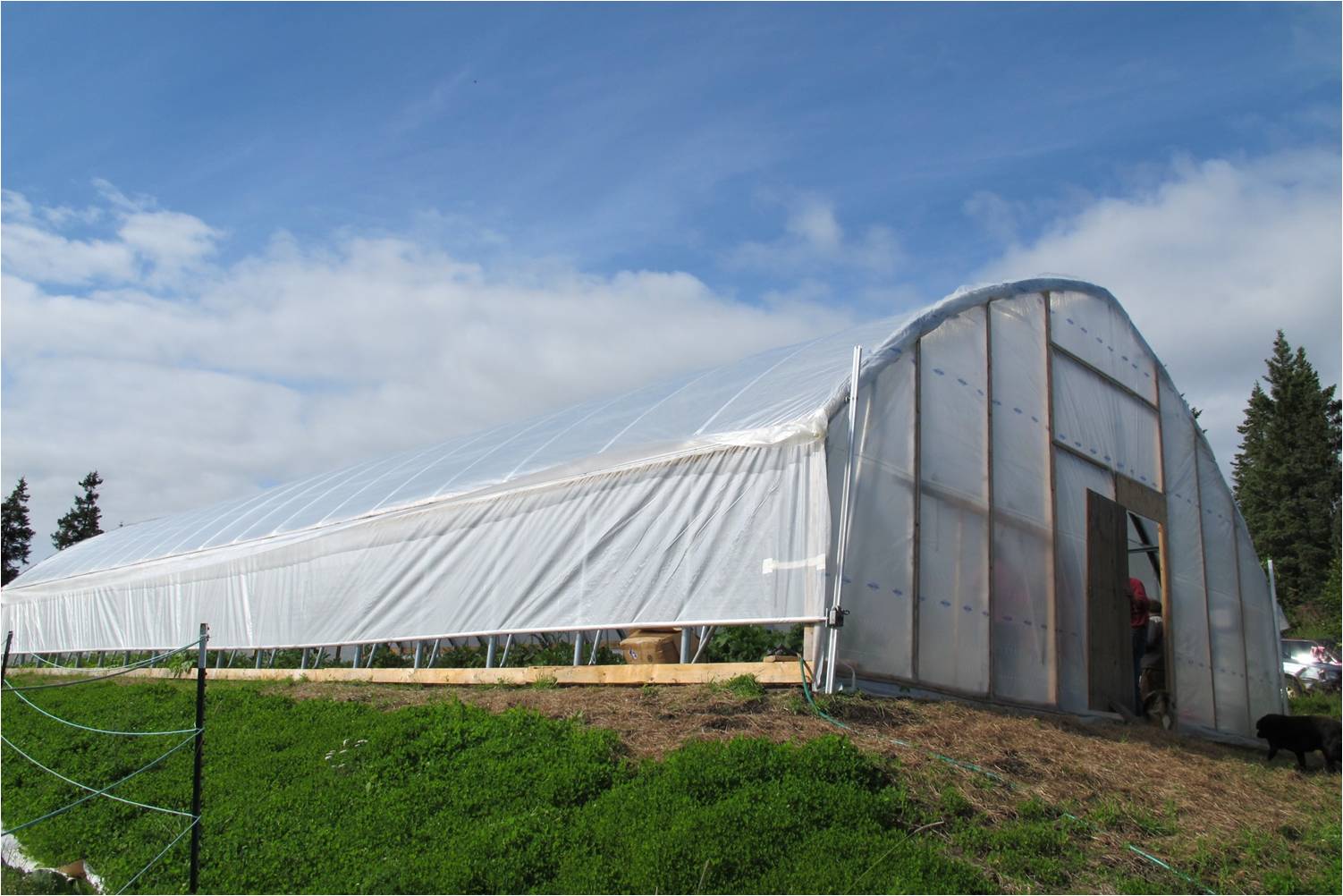
High tunnels, also known as hoop houses or temporary greenhouses, extend the growing season so more food is produced before and after the traditional weather dates for growing stuff outdoors. They also can help with irrigation and drainage, and with pest control.

High tunnels are different than greenhouses in that they are passively heated by the sun, so they have lower energy costs than greenhouses. High tunnels are at least six-feet tall, so people can walk upright in them. Low tunnels, which usually involve some PVC pipe bent over a garden bed and covered with row cover, aren’t eligible in this program. Food in high tunnels is planted either directly into the ground or in raised beds. To learn more about the USDA’s high tunnel program, click here, and click here to get information about the application procedure. This link has frequently asked questions and answers about seasonal high tunnel systems for crops.

Picture10This program started a couple of years ago as a pilot program, but now is a permanent part of of the NRCS EQIP (Environmental Quality Incentive Programs). The program recently was revamped, and one major change is there now is no size restriction on the structures NRCS provides cost-sharing funds (previously it was limited to up to 2,178 square feet, or 5 percent of one acre). Also, geodesic domes are now eligible. Both the land owner and land must meet certain eligibility requirements.

Funding is provided on a reimbursable status once the high tunnel is installed and certified to meet NRCS standards. In 2012 there was just one high tunnel in Sitka, but in 2013 there were six. Other areas of the state, such as Homer, have built dozens of high tunnels through the program.

For information regarding the NRCS technical service or program participation in Southeast Alaska, please contact Samia Savell or Will Murray at the Juneau field office at (907) 586-7220 or 586-7208, or send email to samia.savell@ak.usda.gov or william.murray@ak.usda.gov. The June 15 deadline is the first deadline for the Fiscal Year 2016 funding cycle. Click here for a link to the Alaska NRCS page. Click here for an interview with Samia Savell on KRBD-FM (Ketchikan) about the program.

• High Tunnel In Alaska Fact Sheet (March 2014)

• Flier about Southeast Alaska cost-sharing program for FY2016 (March 2015)