The Sitka Local Foods Network just sent out the April 2015 edition of its newly launched monthly newsletter. Feel free to click this link to get a copy.
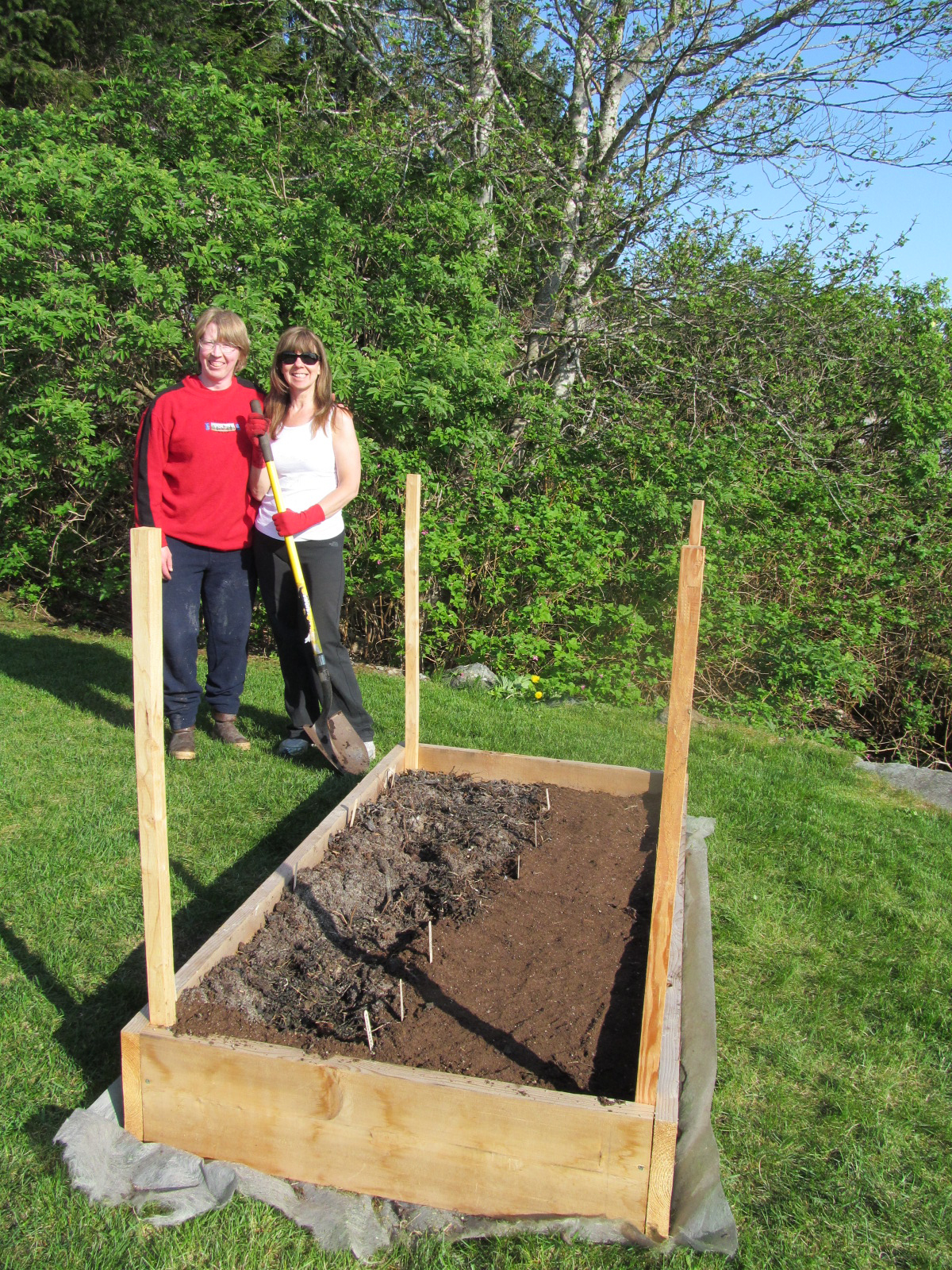
This edition of the newsletter has brief stories about how to build a simple raised garden bed, the Plant a Row for the Hungry program, our open manager and assistant manager positions for the Sitka Farmers Market, some upcoming garden mentor program and other free garden classes, and the 2015 Pick.Click.Give. fundraising campaign. Each story has links to our website for more information.
You can sign up for future editions of our newsletter by clicking on the registration form image in the right column of our website and filling in the information. If you received a copy but didn’t want one, there is a link at the bottom of the newsletter so you can unsubscribe. Our intention is to get the word out about upcoming events and not to spam people. We will not share our email list with others to protect your privacy.
The first two classes for the 2015 Sitka Local Foods Network garden mentor program have been set for each of our four participating first-year families, and the classes will be open to the public. The classes will be similar at each location, except one where we will be planting a container garden instead of our usual raised garden beds.
For three of the four families, the first class will focus on site selection, garden preparation, building planter beds, simple vegetables and soil preparation. The second class will be about simple vegetables and planting. For our first-year gardener families, we teach them how to grow four hardy crops for Sitka — kale, lettuce, potatoes and rhubarb. These classes are essentially the same, so feel free to attend the Class 1 and Class 2 that best fits your schedule.
The class schedule and location for these three families is:
A.J. Bastian, 207 Brady St. — CLASS 1: 5:30 p.m. on Tuesday, April 7; CLASS 2: 5:30 p.m. on Thursday, April 30.
Rebecca Kubacki, 1202 Halibut Point Rd. — CLASS 1: 9 a.m. on Saturday, April 11; CLASS 2: 7 p.m. on Wednesday, May 6.
Breezy, 616 Sawmill Creek Rd. — CLASS 1: 3 p.m. on Saturday, April 11; CLASS 2: 6 p.m. on Tuesday, May 5.
Our fourth family — Josephine Dasalla, 1709 Halibut Point Rd., No. 31 (green trailer) — will feature a combined Class 1 and Class 2 at 5:30 p.m. on Wednesday, April 15. In this combined class, we will teach the family about containers, soil for containers, plant needs, and we will plant lettuce, kale, potatoes and raspberries (rhubarb is our usual fourth crop, but it is not an option at this location).
This is the second year of the garden mentor program, and our two families from last year — Anna Bradley and Tami O’Neill — are back for a second year where they will learn how to grow a few more difficult crops for Sitka, such as carrots and onions. We will announce those classes when they become available.
Michelle Putz has been contracted to coordinate the program and design lesson plans, after the Sitka Local Foods Network received a community development grant from First Bank. We also have about a half-dozen experienced Sitka gardeners who serve as mentors for the program. For more information, please contact Michelle at 747-2708.
(EDITOR’S NOTE: The following article first appeared on this site in April 2010. It is repeated because much of the information remains current and newsworthy.)
In the cold winter of 1994, Anchorage Daily News (now called the Alaska Dispatch News) garden columnist and former Garden Writers Association of America President Jeff Lowenfels was returning to his hotel after a Washington, D.C., event when he was approached by a homeless person who asked for some money to buy food. Lowenfels said Washington, D.C., had signs saying, “Don’t give money to panhandlers,” so he shook his head and kept on walking. But the man’s reply, “I really am homeless and I really am hungry. You can come with me and watch me eat,” stayed with Lowenfels for the rest of his trip.
Jeff Lowenfels
The encounter continued to bother Lowenfels, even as he was flying back to Anchorage. During the flight, Lowenfels came up with an idea when he started writing his weekly garden column (the longest continuously running garden column in the country, with no missed weeks since it started on Nov. 13, 1976). He asked his readers to plant one extra row in their gardens to grow food to donate to Bean’s Café, an Anchorage soup kitchen. The idea took off.
When Anchorage hosted the Garden Writers Association of America convention in 1995, Lowenfels took the GWAA members to Bean’s Café to learn about the Plant A Row For Bean’s Café program. The Garden Writers Association of America liked the idea, and it became the national Plant A Row For The Hungry campaign (also known as Plant A Row or PAR). In 2002, the Garden Writers Association Foundation was created as a national 501(c)(3) nonprofit to manage the Plant A Row For The Hungry program.
“I am not surprised by the growth of PAR,” Lowenfels wrote in an e-mail to the Sitka Local Foods Network. “It is now in all 50 states and across Canada and there are thousands of variations of the original program — from prison gardens for the hungry to botanical gardens donating their produce from public display gardens. This is because gardeners always share information and extra food, so the idea was a natural.”
It took five years for the program to reach its first million pounds of donated food, but the second million only took two years and the next eight years saw a million pounds of donated food (or more) each year. Since 1995, more than 14 million pounds of food have been donated. Not only that, the program is getting ready to expand overseas to Australia, England and other countries with avid gardeners.
“We have supplied something in the vicinity of enough food for 50 million meals,” Lowenfels wrote in his e-mail. “Gardeners can solve this hunger problem without the government. And we don’t need a tea party to do it! Or chemicals, I might add, as author of a book on organic gardening (Teaming With Microbes, written with Wayne Lewis)!” (Lowenfels recently released a second book, Teaming With Nutrients, which is a follow-up to his first book).
According to the U.S. Department of Agriculture, one out of every eight U.S. households experiences hunger or the risk of hunger. Many people skip meals or eat too little, sometimes going an entire day or more without food. About 33 million Americans, including 13 million children, have substandard diets or must resort to seeking emergency food because they can’t always afford to buy the food they need. In recent years the demand for hunger assistance has increased 70 percent, and research shows that hundreds of children and adults are turned away from food banks each year because of lack of resources.
While many people credit Lowenfels for creating the Plant A Row For The Hungry program, Lowenfels says the real heroes are the gardeners growing the extra food and donating it to local soup kitchens, senior programs, schools, homeless shelters and neighbors. You can hear him pass along the credit to all gardeners at the end of this 2009 interview with an Oklahoma television station (video also embedded below).
“One row. That’s all it takes. No rules other than the food goes to the hungry. You pick the drop-off spot or just give it to a needy friend or neighbor. Nothing slips between the lip and the cup, I say,” Lowenfels wrote in his e-mail.
For people wanting to Plant A Row For The Hungry in Sitka, there are several places that would love to help distribute some fresh locally grown veggies or berries to those who are less fortunate, such as the Salvation Army, Sitkans Against Family Violence (SAFV), local churches, Sitka Tribe of Alaska and other organizations. The food the Sitka Local Foods Network grows at St. Peter’s Fellowship Farm communal garden goes to the Sitka Farmers Market, school lunches and other programs.
The Sitka Local Foods Network also takes donations of local produce to sell at the Sitka Farmers Markets, and all proceeds are used to help pay for SLFN projects geared toward helping more people in Sitka grow and harvest local food. For more information, contact SLFN President Lisa Sadleir-Hart or one of the other board members at sitkalocalfoodsnetwork@gmail.com.
Palmer Extension agent Steve Brown will teach the free workshop from 1 to 5 p.m. in Palmer and by videoconference in Kenai, Homer, Nome and Fairbanks. At the request of Sitka residents, on Wednesday, March 25, Sitka was added as an additional site for the videoconference.
The 2014 farm bill authorized $30 million annually for grants to be awarded nationally through the U.S. Department of Agriculture’s Farmers Market and Local Food Promotion Program. The program awards competitive grants to develop new market opportunities for farm and ranch operations serving local and regional markets. According to USDA, farmers market grants will support farmers markets and other producer-to-consumer activities, while the local food promotion grants will support enterprises that aggregate, store, distribute and process local and regional food.
The workshop will be offered at the Matanuska Experiment Farm in Palmer, the Kenai Community Library, Kenai Peninsula College in Homer, the district Extension office in Fairbanks at 724 27th Ave. and the Northwest Campus, B West, in Nome. The Sitka location for the workshop is Room 106 of the University of Alaska Southeast Sitka Campus.
The preferred registration deadline is Friday, March 27, but since Sitka was added as a site so close to the presentation walk-in participants will be allowed at this location. For more information or to register, call the Palmer Extension office at 907-745-3360. Sitka residents should pre-register by contacting Jasmine Shaw at 747-9440 or jdshaw2@alaska.gov.
Vendors looking to sell local food, arts and crafts, and other items at the 2015 Sitka Farmers Markets can find all the vendor forms, information sheets and regulations for this year by going to the Documents page on this site, or look at the bottom of this post for the documents. The forms are in downloadable Adobe Acrobat PDF or Microsoft Word DOC files. In addition, potential vendors should note two upcoming meetings to go over rules and regulations, fees, and other information they’ll need for this summer’s markets.
The 2015 Sitka Farmers Market manager and assistant manager will be hired soon, and they can be reached at sitkafarmersmarket@gmail.com or 738-8683 during the market season. Our 2015 Sitka Farmers Markets will be from 10 a.m. to 1 p.m. on six alternating Saturdays starting in late June (July 4, July 18, Aug. 1, 15, 29, and Sept. 12) at the Alaska Native Brotherhood Founders Hall at 235 Katlian Street.
The Sitka Local Foods Network will host two pre-market meetings for potential market vendors, and all potential vendors are encouraged to attend at least one of the two meetings. The first meeting will be from 5:45-7:45 p.m. on Monday, March 30, at Harrigan Centennial Hall, and the second meeting is 5:45-7:45 p.m. on Tuesday, April 7, at Harrigan Centennial Hall. (NOTE: The Monday, March 30, meeting has been postponed to a date TBA.)
Sitka Local Foods Network board members will be available to answer questions and to make suggestions that will help new and returning vendors adjust to any food regulation changes from the Alaska Department of Environmental Conservation, updates to the Alaska Quest electronic benefits program, and any other changes. For more information, contact Maybelle Filler at 738-1982 or mocampo25@hotmail.com, Brandie Cheatham at vista_brandie@yahoo.com, or you can email the Sitka Local Foods Network Board of Directors at sitkalocalfoodsnetwork@gmail.com.
The Sitka Local Foods Network just sent out a special PFD application edition of its newly launched newsletter. Feel free to click this link to get a copy.
This special edition of the newsletter has just one story in it, a reminder that the Alaska Permanent Fund Dividend application deadline is one week away (March 31). We encourage Alaskans to participate in the 2015 Pick.Click.Give. charitable giving program that’s part of the PFD application, and we appreciate your support of the Sitka Local Foods Network through the program. A regular monthly newsletter will come out on or near April 1.
You can sign up for future editions of our newsletter by clicking on the registration form image in the right column of our website and filling in the information. If you received a copy but didn’t want one, there is a link at the bottom of the newsletter so you can unsubscribe. Our intention is to get the word out about upcoming events and not to spam people. We will not share our email list with others to protect your privacy.
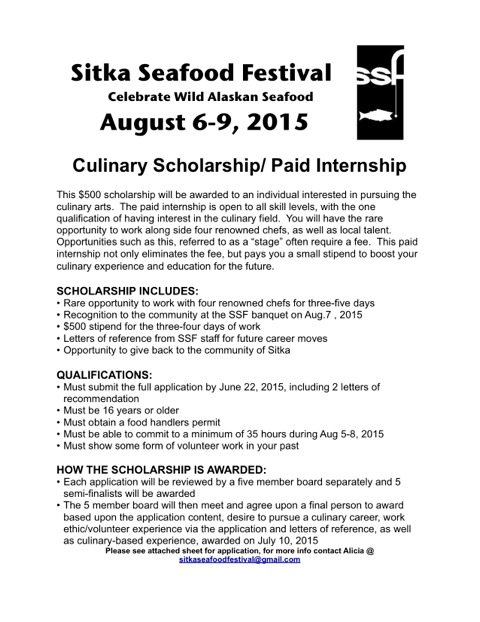
Are you a budding chef from Sitka who’d like an opportunity to work with some top-notch chefs from around the country? The Sitka Seafood Festival is offering its culinary scholarship and paid internship again for 2015. The application deadline is Monday, June 22.
This $500 scholarship will be awarded to an individual interested in pursuing the culinary arts. The program includes the opportunity to work with renowned chefs for 3-5 days, a $500 stipend for three days of work, letters of recommendation from Sitka Seafood Festival staff for future career moves, and recognition to the community during the Sitka Seafood Festival community banquet on Friday, Aug. 7. This is a great opportunity to give back to the community of Sitka.
This year’s guest chefs haven’t been announced yet. But last year the executive guest chef was Caleb France, with returning guest chefs Seth Caswell from Seattle, Mickey Neely from Chicago, Robert Kinneen from Anchorage, and Jeren Schmidt from Sitka.
This year’s Sitka Seafood Festival takes place on Thursday-Sunday, Aug. 6-9, with a variety of activities around Sitka. This year’s event schedule hasn’t been announced yet, but typically there is a community banquet featuring a variety of local seafood on Friday night, while Saturday’s activities include fish-tote races at Crescent Harbor, a parade down Lincoln Street, Scottish Highland Games at the Sitka Fine Arts Camp, live music, cooking demonstrations, and a variety of food, informational and artist booths in the marketplace at the Sitka Fine Arts Camp.
For more information, go to the Sitka Seafood Festival website, or contact the festival at sitkaseafoodfestival@gmail.com. You also can contact Alicia Haseltine at (928) 607-4845.
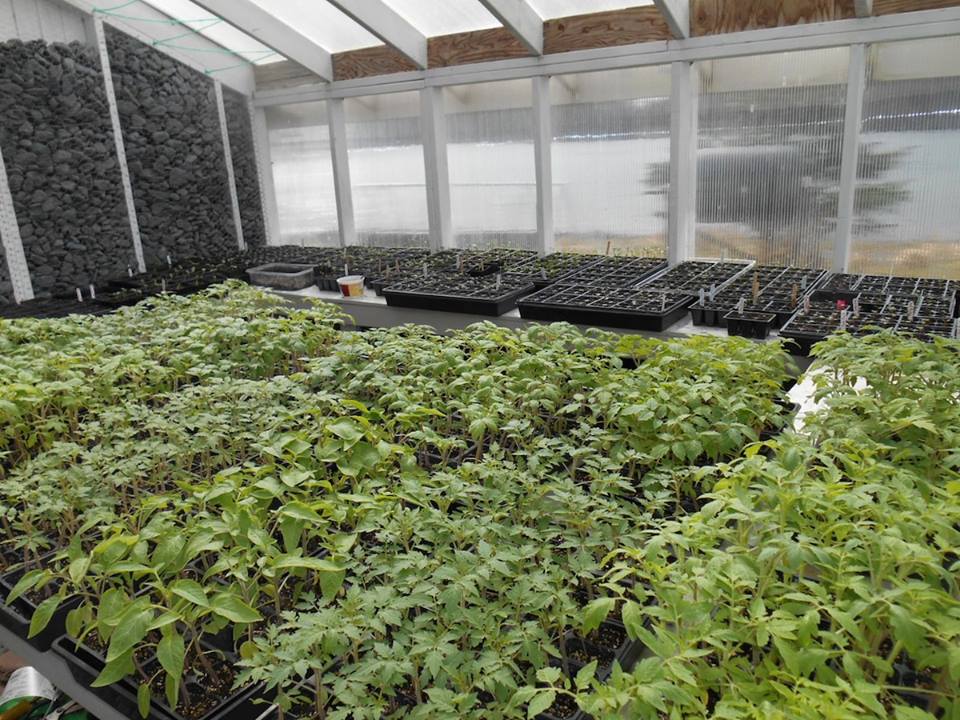
Spring 2014 plant starts in Sitka gardener Keith Nyitray’s Finn Island Farm greenhouse.
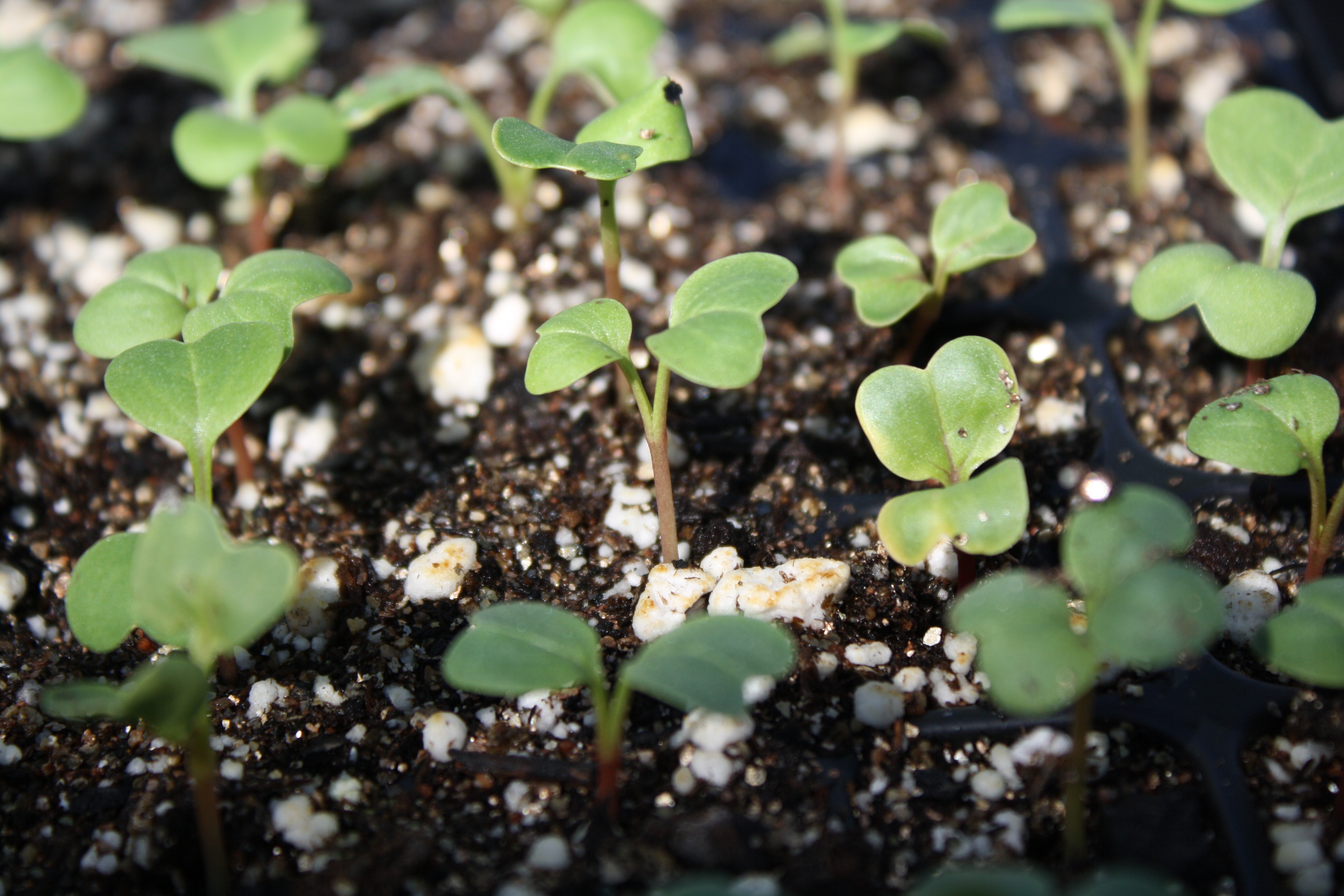
It’s the end of March, which means many people in Sitka are already planning their spring vegetable gardens. While it’s still too early to plant most crops outdoors, this is the perfect time to start some seeds indoors to you can transplant them into your garden in May.
The Sitka Local Foods Network is offering two free classes this spring about starting seeds. Both classes will be limited in size, so preregistration is required. Click here to check out the radio PSA.
The first one will be taught by Jennifer Carter, and it takes place from 6:30-8 p.m. on Tuesday, March 31, at Harrigan Centennial Hall. In this class, which is limited to 15 people, participants will learn how to mix seed-starting soil (potting soil usually is too rich for seedlings), and they will plant a few seeds to take home and grow.
The second class will be taught by longtime Sitka gardener Linda Wilson at 2 p.m. at her home. This class will be limited to 8-10 people, and you will receive the address when you call Michelle Putz or Jennifer Carter (see numbers below) to preregister.
Also, the next meeting of the Sitka Local Foods Network education committee is from 6:30-8 p.m. on Wednesday, April 1, at the Sitka Unitarian Universalist Fellowship Hall, 408 Marine Street (parking off Spruce Street). We will be brainstorming ideas for upcoming classes, and we welcome local gardeners who want to teach classes to join our list of educators. Just give us a topic, best date and time, and we can help you find a venue.
For more information about Sitka Local Foods Network education classes, contact Jennifer Carter at 747-0520 or 1-850-491-2666 (cell), or Michelle Putz at 747-2708. These are two of the many free classes being offered this year by the Sitka Local Foods Network education committee. Click here to get a full list of our upcoming spring classes.
The new community commercial kitchen came out of a food security project from the 2013 Sitka Health Summit. Sitka residents decided a community kitchen would serve several functions as a place to teach cooking and nutrition classes, a place to teach food preservation classes, a place for small cottage food businesses to have access to a rental commercial kitchen, etc. It is a place for education, business incubation, and community cultivation about food in Sitka.
During the ribbon-cutting ceremony, Marjorie Hennessy of the Sitka Conservation Society and Sustainable Southeast Partnership discussed the history of the project and some of its goals. Then she and Cyndy Gibson, representing Sitka First Presbyterian Church, cut the ribbon.
Please check out the linked brochure for the current rental rates, which are tiered depending upon the planned use of the facility. This kitchen does meet Alaska Department of Environmental Conservation commercial kitchen food safety standards, but renters are required to get all of their other required permits (business license, food-handling permits, etc.) before renting the kitchen. Groups that already regularly use the facility for deliveries, such as the Sitka Food Co-op and Everything Organic Sitka, will continue to use the facility.
For more information about Sitka Kitch rentals, check the website, contact sitkakitch@sitkawild.org or call the Sitka Conservation Society at 747-7509. Eventually the management will switch over to the church.
A slideshow is posted below the brochure with photos from the ribbon-cutting ceremony.
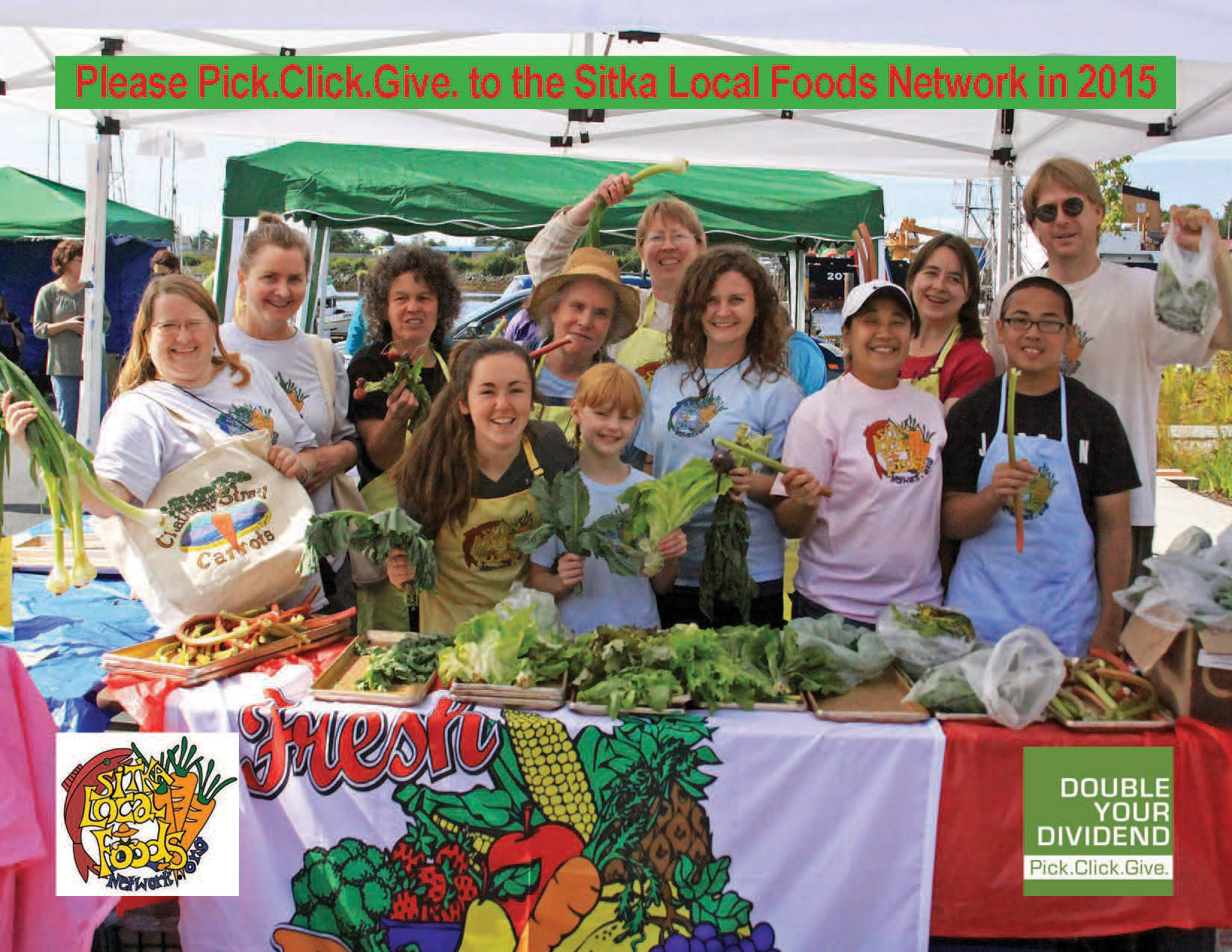
We’re halfway through March, which means there’s just over two weeks left for Alaskans to file for their 2015 Alaska Permanent Fund Dividend check (the PFD application deadline is March 31). As usual, Alaskans can share their wealth with a variety of Alaska nonprofits, including the Sitka Local Foods Network, through the PFD’s Pick.Click.Give. program.
This is the second year the Sitka Local Foods Network will participate in the Pick.Click.Give. program, which allows people to donate in $25 increments to their favorite statewide and local 501(c)(3) nonprofit organizations when they file their PFD applications from Jan. 1 through March 31. We thank the 56 donors who pledged $2,900 to the Sitka Local Foods Network in 2014, and we appreciate your support again in 2015.
When you choose to donate part of your PFD to the Sitka Local Foods Network, you support the Sitka Farmers Market, St. Peter’s Fellowship Farm, Blatchley Community Gardens, education programs about growing and preserving food, the sustainable use of traditional foods, the Sitka Community Food Assessment, the Sitka Food Summit, and a variety of other projects designed to increase access to healthy local foods in Sitka.
In 2014 a record 26,773 Alaskans gave $2.77 million to their favorite nonprofit organizations, up from $545,000 donated by 5,175 people in the program’s first year of 2009. Some Alaskans choose to donate to just one group, while others may spread several donations around to many groups. There now are more than 500 total 501(c)(3) nonprofit organizations participating in Pick.Click.Give. for 2015, including 22 from Sitka.
To encourage more Alaskans to donate through the Pick.Click.Give. program, this will be the second year of the Double Your Dividend contest. Anybody who makes a non-anonymous Pick.Click.Give. donation of $25 or more to at least one of the registered nonprofits will be entered into a contest where 10 lucky Alaskans will win a second PFD check. The winners will be announced in October, about the time the PFDs start hitting bank accounts.
So how do you make a donation to the Sitka Local Foods Network through the Pick.Click.Give. program? First, go to http://pfd.alaska.gov/ and fill out your PFD application. When you get to the section of the application asking if you want to participate in Pick.Click.Give. Charitable Contributions program, click on the PCG link and search for the Sitka Local Foods Network. You also can look for us by using the town search for Sitka.
The Pick.Click.Give. program is available only to people who file their PFD applications online, and not to those who file by mail. Even though you can’t file a new PFD application after March 31, you can go back into your application and update your Pick.Click.Give. donations through Aug. 31 each year.
You still can donate to the Sitka Local Foods Network if you aren’t from Alaska or aren’t eligible for a 2015 PFD. To donate, send your check to the Sitka Local Foods Network, 408D Marine St., Sitka, Alaska, 99835, or go to our page on Razoo.com, http://www.razoo.com/story/Sitka-Local-Foods-Network, and click the Donate button to make an online contribution. Please let us know if you need a receipt for tax purposes. For more information about donating, you can send an email to sitkalocalfoodsnetwork@gmail.com.
Thank you for supporting our mission of promoting and encouraging the growing, harvesting and eating of local foods in Sitka and Southeast Alaska.












 Sitka Local Foods Network
You must be logged in to post a comment.