Alaska Native Sisterhood Culinary Academy graduates first class of students

ANSCAGrads

The first graduating class of the ANS Culinary Academy. Back row: Paulette Moreno, Jenna Martin, Dorothy Gordon, Jessie Natkong, Joy Wood, Marie Lawson, Amy Sutton, Teresa Moses. Front row: Jaiden Martin, Duane Lindoff, Mykle Potter, Zackery Loewen, Chad Titell, Andrew Roberts, Russell James (with Camden). Floor level: Lydia May, Gary May. Not pictured: Adam Geiger, David Thomas, Sarah Smith.

Seventeen students of the new Alaska Native Sisterhood Culinary Academy graduated from the program on Saturday, July 16, at the Alaska Native Brotherhood Founders Hall.

The graduates learned basic culinary skills, and also earned SafeServ and Certified Food Protection Manager (CFPM) certifications. The instructor was Gary May, the owner of New Creations Mobile Bistro and one of a handful of chefs in Alaska qualified to teach CFPM classes. The Alaska Native Sisterhood (ANS) Camp 4 in Sitka, the Alaska Native Brotherhood (ANB) Camp 1 in Sitka, and Faith Mountain Ministries sponsored the classes.

“The vision of the ANS is to have a commercial kitchen at ANB Founders Hall to be here for our people, for koo.éex’ or holiday dinners,” ANS Camp 4 President Paulette Moreno said. “We also want it to be a place of training. The vision of our elders is to get our people in jobs where they can earn an income all year. We also have traditional foods we need people to know how to safely handle.”

Paulette said the ANS already has a waiting list for the next series of classes, which will probably take place this fall. Gary said the training was about 20 hours, and the students had to pass a couple of tests to earn their certifications, which will allow them to get jobs in just about any kitchen in the state..

The graduates were Paulette Moreno, Jenna Martin, Dorothy Gordon, Jessie Natkong, Joy Wood, Marie Lawson, Amy Sutton, Teresa Moses, Duane Lindoff, Mykle Potter, Zackery Loewen, Chad Titell, Andrew Roberts, and Russell James (Teresa’s and Russell’s month-old baby, Camden, received a special certificate for attending all of the classes with his parents). Adam Geiger, David Thomas, and Sarah Smith also graduated from the class but weren’t able to attend the ceremony.

A slideshow of scenes from the graduation ceremony is posted below.
This slideshow requires JavaScript.

Sitka Kitch to offer Preserving the Harvest class series this summer


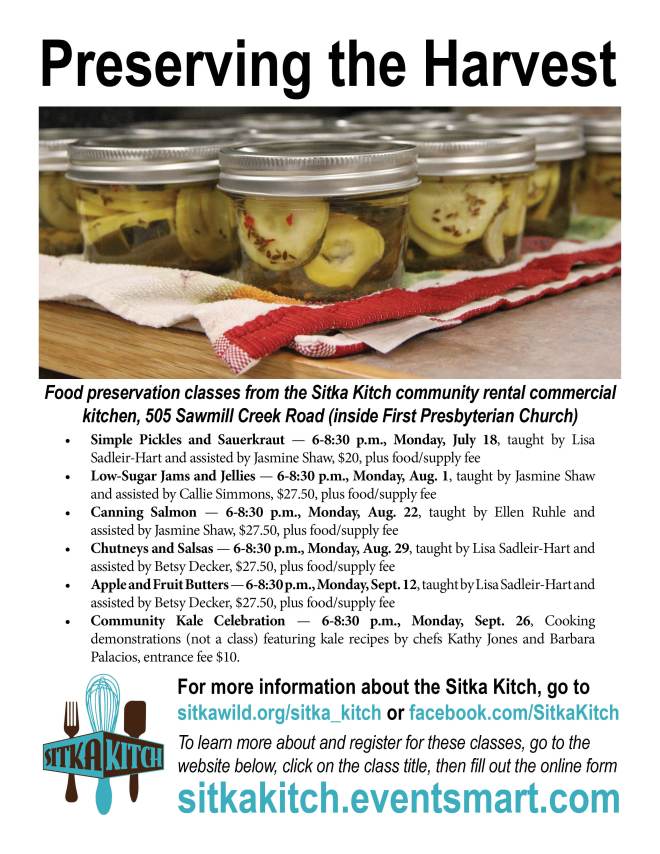
PreservingTheHarvestFlier

kitch_logo_mainYou grew it, harvested it and/or caught it, so now what do you do? The Sitka Kitch community rental commercial kitchen will be offering the Preserving the Harvest class series to teach Sitkans how to store the summer’s bounty so they can use it during the winter.

This class series features six classes covering a variety of food preservation methods. Students will learn how to safely preserve their food, so it won’t spoil or cause illness. The classes on schedule are:

  • Simple Pickles and Sauerkraut 6-8:30 p.m., Monday, July 18, taught by Lisa Sadleir-Hart and assisted by Jasmine Shaw, $20, plus food/supply fee
  • Low-Sugar Jams and Jellies 6-8:30 p.m., Monday, Aug. 1, taught by Jasmine Shaw and assisted by Callie Simmons, $27.50, plus food/supply fee
  • Canning Salmon6-8:30 p.m., Monday, Aug. 22, taught by Ellen Ruhle and assisted by Jasmine Shaw, $27.50, plus food/supply fee
  • Chutneys and Salsas6-8:30 p.m., Monday, Aug. 29, taught by Lisa Sadleir-Hart and assisted by Betsy Decker, $27.50, plus food/supply fee
  • Apple and Fruit Butters6-8:30 p.m., Monday, Sept. 12, taught by Lisa Sadleir-Hart and assisted by Betsy Decker, $27.50, plus food/supply fee
  • Community Kale Celebration6-8:30 p.m., Monday, Sept. 26, Cooking demonstrations featuring kale recipes by chefs Kathy Jones and Barbara Palacios (not a class), entrance fee $10.

The Sitka Kitch was a project of the 2013 Sitka Health Summit, and the project is coordinated by the Sitka Conservation Society in partnership with the Sitka Local Foods Network. The Sitka Kitch can be rented to teach cooking and food preservation classes, by local cottage food industry entrepreneurs who need a commercial kitchen to make their products, and for large groups needing a large kitchen for a community dinner. To learn more about how to rent the Sitka Kitch, please go to the website at http://www.sitkawild.org/sitka_kitch.

To register for classes, go to our online registration page at http://sitkakitch.eventsmart.com/ and click on the class name. We now have a PayPal option so people can pay the registration fees before the class. There are food/supply fees for most of the classes, which are split between the students, and those are paid by cash or check (made out to the Sitka Conservation Society) at the class. Other than for the Kale Celebration event, each class has a limited number of spots available, so register early. Registration for each class closes at 11:55 p.m. on the Friday before the class.

If you have any questions about the class series, please email sitkakitch@sitkawild.org.

Harmful algal bloom expands PSP advisory to several Southeast Alaska beaches

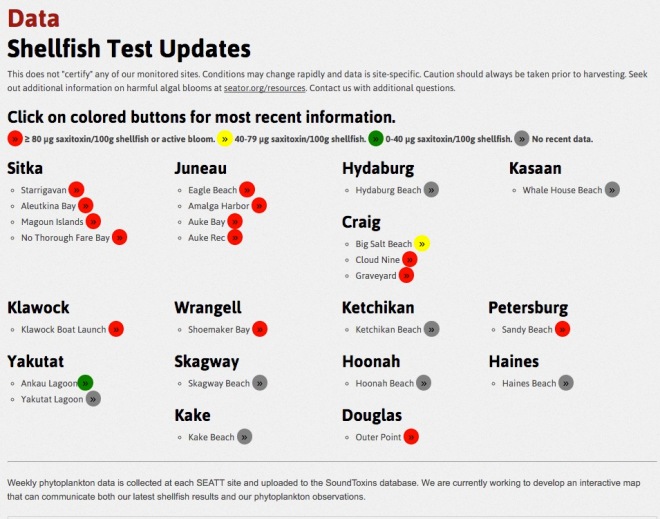
SEATORDataUpdate06102016

Seator-Logo-Best-June-30-2015-7pm-215x215The SouthEast Alaska Tribal Ocean Research (SEATOR) project, SouthEast Alaska Tribal Toxins (SEATT) partnership and the Sitka Tribe of Alaska Environmental Research Lab (STAERL) have expanded a recent paralytic shellfish poisoning (PSP) advisory to include more beaches in Southeast Alaska.

The advisory, initially announced on May 26, now includes multiple beaches in Sitka, Juneau, Craig, Petersburg, and Klawock. The PSP advisory is for bivalve shellfish — such as clams, mussels, oysters, cockles, scallops, geoducks, etc. — that have been recreationally or subsistence harvested. It does not apply to commercially harvested shellfish, which are tested before they enter the market. The advisory does not apply to other shellfish, such as crabs or shrimp, which do not carry PSP (unless you eat the crab butter/viscera).

According to a SEATOR press release, “Recent samples on June 6 confirmed elevated levels of Alexandrium, the phytoplankton species that produces saxtoxins causing PSP, have been observed at the following locations and shellfish from these sites should not be harvested at this time.” The affected beaches from June 6 are Auke Bay, Amalga Harbor, Eagle Beach, and Auke Rec beaches in Juneau; Cloud 9 and Graveyard beaches in Craig; Starrigavan beach in Sitka; and the Boat Ramp beach in Klawock.

The butter clam has one set of rings that go one direction only, around the same center point (Photo courtesy of Alaska Department of Environmental Conservation)

The butter clam has one set of rings that go one direction only, around the same center point (Photo courtesy of Alaska Department of Environmental Conservation)

In addition, the press release said, “On June 9 shellfish from the following sites tested above the regulatory limit of 80µg/100g for saxitoxins and should not be harvested at this time.” The June 9 list of beaches includes Sandy Beach in Petersburg (butter clams only); Auke Bay, Amalga Harbor, Eagle Beach, and Auke Rec beaches in Juneau; Aleutkina Bay, No Through Fare Bay, Magoun Islands, and Starrigavan (butter clams only) beaches in Sitka; and the Boat Ramp beach in Klawock. The advisory is for all shellfish on all beaches, except where noted.

According to SEATOR, “This does not ‘certify’ any of our monitored sites. Conditions may change rapidly and data is site-specific. Caution should always be taken prior to harvesting.”

SEATOR posts updates and information to its website at seator.org/data, which can help provide Southeast Alaska residents with reliable information so they can choose whether or not to harvest shellfish. In addition to testing water samples weekly from certain Southeast beaches, STAERL also tests samples of butter clams, littleneck clams, and blue mussels (which is STAERL’s indicator species because of how quickly blue mussels absorb saxotoxins).

Since most beaches in Alaska aren’t tested for harmful algal blooms, SEATOR and the SEATT partnership were formed in October 2014 to train people to test beaches in Southeast Alaska. In April 2015, the Sitka Tribe of Alaska opened a regional lab on Katlian Street, so samples could be tested in Sitka without having to be sent to the Lower 48, which delayed results. By testing for harmful algal blooms, SEATOR and the SEATT partnership hope to be able to provide information so people can make informed choices whether or not to harvest or eat shellfish.

Harmful algal blooms, such as paralytic shellfish poisoning (PSP), typically have not been monitored in Southeast Alaska for subsistence and recreational harvesters of clams, mussels, oysters, cockles, and other bivalves (commercial harvests are tested). Even though many people in Southeast Alaska love to harvest shellfish, eating it comes with some risks. There have been several PSP outbreaks in recent years that sent people to the hospital, and in 2010 two deaths were attributed to PSP and other HABs, such as Alexandrium, Pseudo-nitzchia and Dinophysis.

To learn more about harmful algal blooms and how they can raise the risk for PSP and ASP (amnesic shellfish poisoning, which also can be fatal), go to SEATOR’s resources page. If you have shellfish you recently harvested and want to test it, click this link to learn what you need to do to have it tested by STAERL. Please contact STAERL at 747-7395 with any additional questions.

• June 10, 2016, press release about PSP advisory for Southeast Alaska

Check out the June 2016 edition of the Sitka Local Foods Network newsletter

June2016SLFNNewsletterScreenshot

The Sitka Local Foods Network just sent out the June 2016 edition of its newly launched monthly newsletter. Feel free to click this link to get a copy.

This edition of the newsletter has brief stories about a couple of Sitka commercial trollers starting the Edible Alaska magazine, our recruiting new board members, the dates for the 2016 Sitka Farmers Markets, the second batch of classes for the garden mentor program, and a recent shellfish advisory issued for several beaches in Southeast Alaska. Each story has links to our website for more information.

You can sign up for future editions of our newsletter by clicking on the registration form image in the right column of our website and filling in the information. If you received a copy but didn’t want one, there is a link at the bottom of the newsletter so you can unsubscribe. Our intention is to get the word out about upcoming events and not to spam people. We will protect your privacy by not sharing our email list with others.

Harmful algal bloom warning listed for shellfish harvested at Sitka, Craig, Klawock and Petersburg

Clam diggers work the beach at Starrigavan in this file photo. The Sitka Tribe of Alaska is warning Sitkans against harvesting clams in the area due to a harmful algae detected Monday, June 8, 2015. (Daily Sitka Sentinel file photo by James Poulson)

Clam diggers work the beach at Starrigavan in this file photo. The Sitka Tribe of Alaska is warning Sitkans against harvesting clams in the area due to a harmful algae detected Tuesday, May 25, 2016. (Daily Sitka Sentinel file photo by James Poulson)

Seator-Logo-Best-June-30-2015-7pm-215x215The SouthEast Alaska Tribal Ocean Research (SEATOR) project coordinated by the Sitka Tribe of Alaska on Wednesday, May 26, issued a harmful algal bloom warning for shellfish harvested in four Southeast Alaska communities. The warning is for shellfish harvested on Starrigavan Beach in Sitka, Graveyard Beach in Craig, the Klawock Boat Launch, and Sandy Beach in Petersburg.

(Editor’s Note: On Thursday, June 2, SEATOR and the University of Alaska Fairbanks School of Fisheries and Ocean Sciences in Juneau announced a similar shellfish advisory for shellfish harvested on June 1 from several beaches in the Juneau area — Auke Bay, Point Louisa/Auke Rec, Amalga Harbor and Eagle Beach. For more information on Juneau, contact Elizabeth Tobin at 1-907-796- 5455 or edtobin@alaska.edu or Chris Whitehead of SEATOR at chris.whitehead@sitkatribe-nsn.gov. On June 3, SEATOR added Cloud 9 Beach in Craig to the list of beaches affected by the shellfish advisory.)

“The Sitka Tribe of Alaska Environmental Research Lab (STAERL) has been collecting shellfish samples to test for biotoxins, specifically paralytic shellfish poisoning (PSP),” STAERL announced in a press release. “Recent samples on May 25, 2016, confirm that clams at the following beaches have elevated levels of toxins above the FDA regulatory limit of 80µg/100g and should not be harvested at this time.”

The butter clam has one set of rings that go one direction only, around the same center point (Photo courtesy of Alaska Department of Environmental Conservation)

The butter clam has one set of rings that go one direction only, around the same center point (Photo courtesy of Alaska Department of Environmental Conservation)

SEATOR, the Southeast Alaska Tribal Toxins (SEATT) partnership, and the Sitka Tribe of Alaska have been monitoring saxitoxin on Starrigavan Beach in Sitka and other beaches around Southeast Alaska since late 2014. Saxitoxin is produced by the phytoplankton Alexandrium and can get highly concentrated in shellfish, leading to paralytic shellfish poisoning (PSP), which can be fatal.

SEATOR posts updates and information to its website at seator.org/data, which can help provide Southeast Alaska residents with reliable information so they can choose whether or not to harvest shellfish. On May 6, SEATOR announced an advisory for shellfish harvest on Starrigavan Beach in Sitka, when it found Alexandrium in its weekly phytoplankton samples and high levels of saxitoxin in butter clams, littleneck clams, and blue mussels. Because of the high levels, SEATOR advised Sitka residents not to harvest shellfish at the time.

Since most beaches in Alaska aren’t tested for harmful algal blooms, SEATOR and the SEATT partnership were formed in October 2014 to train people to test beaches in Southeast Alaska. In April 2015, the Sitka Tribe of Alaska opened a regional lab on Katlian Street, so samples could be tested in Sitka without having to be sent to the Lower 48, which delayed results. By testing for harmful algal blooms, SEATOR and the SEATT partnership hope to be able to provide information so people can make informed choices whether or not to harvest or eat shellfish.

Harmful algal blooms, such as paralytic shellfish poisoning (PSP), typically have not been monitored in Southeast Alaska for subsistence and recreational harvesters of clams, mussels, oysters, cockles, and other bivalves (commercial harvests are tested). Even though many people in Southeast Alaska love to harvest shellfish, eating it comes with some risks. There have been several PSP outbreaks in recent years that sent people to the hospital, and in 2010 two deaths were attributed to PSP and other HABs, such as Alexandrium, Pseudo-nitzchia and Dinophysis.

To learn more about harmful algal blooms and how they can raise the risk for PSP and ASP (amnesic shellfish poisoning, which also can be fatal), go to SEATOR’s resources page. If you have shellfish you recently harvested and want to test it, click this link to learn what you need to do to have it tested by STAERL.

• Press release about shellfish advisory, May 26, 2016

• Joint SEATOR/UAF School of Fisheries and Ocean Studies press release about Juneau shellfish advisory, June 2, 2016

• June 3, 2016, SEATOR press release updating the list of affected beaches

Scenes from the Safe Home Food Preservation certification course May 14-15 in Sitka

SarahLewisDiscussesTypesOfPressureCanners

Food preservation certificate flierIn an effort to train people to teach safe home food preservation classes in their Southeast Alaska communities, the University of Alaska Fairbanks Cooperative Extension Service hosted a series of certification courses around the region in recent months. The Sitka class on May 14-15 at Blatchley Middle School wrapped up the series, which featured several online lessons followed by two-day hands-on classes in Juneau, Ketchikan and Sitka.

The Sitka class was taught by UAF Cooperative Extension Service Associate Director Roxie Rodgers Dinstel of Fairbanks and Sarah Lewis, a Family and Community Development faculty member from Juneau. In addition to several Sitka residents, there also were students from Haines, Petersburg and Juneau in the Sitka class. The series was funded by a grant from the SouthEast Alaska Regional Health Consortium (SEARHC).

During the class, the 10 students learned which foods need waterbath canning vs. pressure canning, had a lesson on fermenting, tested pressure canner gauges, dehydrated fruits and veggies, made jerky, and learned how to find reliable resources to make sure their home food preservation practices are safe.

In addition to teaching classes, some of the students will use their new skills for cottage food businesses and home canning projects. One of the purposes of the class was to certify people in a variety of Southeast Alaska communities on how to teach safe home food preservation classes, so they don’t have to wait for a UAF Cooperative Extension Service faculty member from Juneau, Anchorage or Fairbanks to come to town to teach.

A slideshow of scenes from the two-day hands-on classes is below.

This slideshow requires JavaScript.


Harmful algal bloom warning listed for shellfish harvested at Starrigavan Beach

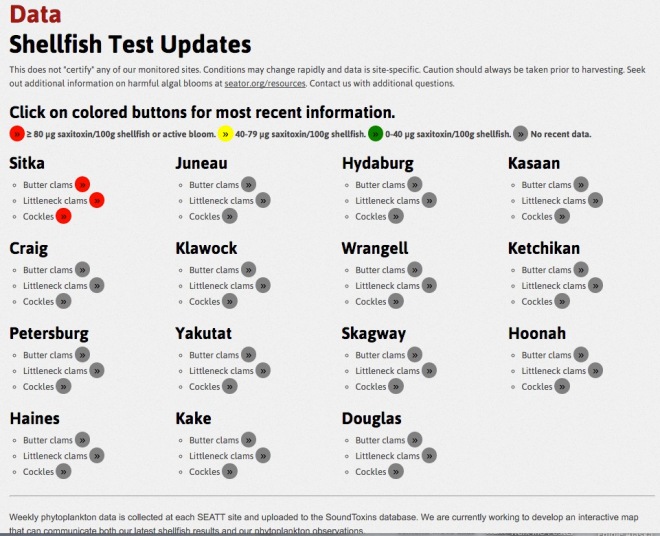
SEATORShellfishTestingLevels

The SouthEast Alaska Tribal Ocean Research (SEATOR) project coordinated by the Sitka Tribe of Alaska on Friday, May 6, issued a harmful algal bloom warning for shellfish harvested on Starrigavan Beach in Sitka.

SEATOR, the Southeast Alaska Tribal Toxins (SEATT) partnership, and the Sitka Tribe of Alaska have been monitoring saxitoxin on Starrigavan Beach in Sitka and other beaches around Southeast Alaska since late 2014. Saxitoxin is produced by the phytoplankton Alexandrium and can get highly concentrated in shellfish, leading to paralytic shellfish poisoning (PSP), which can be fatal.

According to SEATOR, “during our weekly phytoplankton sample last week, we noticed our first Alexandrium of the year. Immediately after, we tested saxitoxin levels in butter clams, littleneck clams and blue mussels, and found them all to have elevated levels of saxitoxin. We do not recommend that Sitkans harvest shellfish at this time, and ask them to look on seator.org/data for additional updates and information.”

Since most beaches in Alaska aren’t tested for harmful algal blooms, SEATOR and the SEATT partnership were formed in October 2014 to train people to test beaches in Southeast Alaska. In April 2015, the Sitka Tribe of Alaska opened a regional lab on Katlian Street, so samples could be tested in Sitka without having to be sent to the Lower 48, which delayed results. By testing for harmful algal blooms, SEATOR and the SEATT partnership hope to be able to provide information so people can make informed choices whether or not to harvest or eat shellfish.

Harmful algal blooms, such as paralytic shellfish poisoning (PSP), typically have not been monitored in Southeast Alaska for subsistence and recreational harvesters of clams, mussels, oysters, cockles, and other bivalves (commercial harvests are tested). Even though many people in Southeast Alaska love to harvest shellfish, eating it comes with some risks. There have been several PSP outbreaks in recent years that sent people to the hospital, and in 2010 two deaths were attributed to PSP and other HABs, such as Alexandrium, Pseudo-nitzchia and Dinophysis.

Scenes from the second Basic Culinary Skills class at the Sitka Kitch

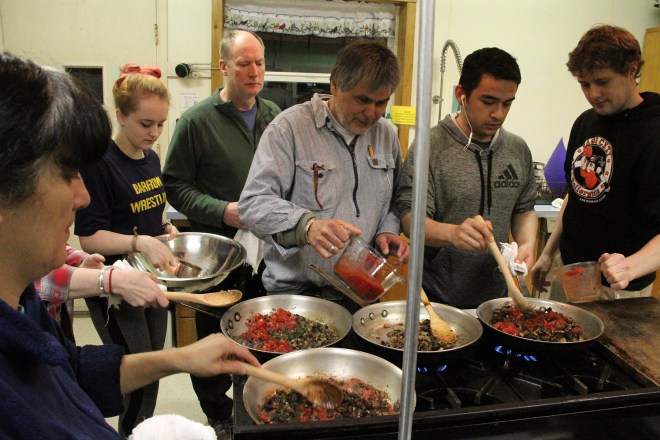
StudentsAddTomatoesToMushrooms

kitch_logo_mainStudents made cucumber raita, mushroom ragout, and a Caesar dressing during the second of four Basic Culinary Skills classes offered on Mondays in March at the Sitka Kitch community rental commercial kitchen.

The class series is designed to help people gain the kitchen skills they need for restaurant jobs, but many of the students are taking the series to improve their home kitchen chops.

These classes are taught by Kathy Jones, executive chef at the Westmark Sitka Hotel and the Totem Square Inn, with assistance by her sous chef, Barbara Palacios. The classes are modeled after a similar basic culinary skills program Chef Kathy knows from Indianapolis offered by a food relief nonprofit called Second Helpings.

In the first class the students worked on chopping skills, and also learned about basic kitchen sanitation and a variety of kitchen tools. The second class featured basic cooking techniques, basic nutrition, and sauces, soups and stocks Part 1. The cucumber raita is a sauce used in Indian dishes to cool spicy dishes, and it goes well with fish, vegetables and can be used as a dip. The mushroom ragout goes well with game meat (venison, goat, lamb, etc.).

The third class on March 21 will focus on sauces, soups and stocks Part 2, salads, and measurements. The fourth class on March 28 will focus on poultry, meats, and the Alaska Department of Environmental Conservation (DEC) safe food handler’s card.

KathyShowsPatHowToDiceGarlicThe classes take place from 6-8:30 p.m. on each Monday in March (March 7, 14, 21, and 28) at the Sitka Kitch, which is located inside the First Presbyterian Church (505 Sawmill Creek Road). The classes are full, with only wait-list spots available.

The Basic Culinary Skills class series is supported by a grant from the Northwest Farm Credit Services rural community grant program.

The Sitka Kitch was a project of the 2013 Sitka Health Summit, and the project is coordinated by the Sitka Conservation Society in partnership with the Sitka Local Foods Network. The Sitka Kitch can be rented to teach cooking and food preservation classes, by local cottage food industry entrepreneurs who need a commercial kitchen to make their products, and for large groups needing a large kitchen for a community dinner. To learn more about how to rent the Sitka Kitch, please go to the website at http://www.sitkawild.org/sitka_kitch.

For more information about the Sitka Kitch and the classes, please email sitkakitch@sitkawild.org. You also can go to our class registration page at https://sitkakitch.eventsmart.com/ to see all of the available classes (click on the class titles to register).

A slideshow of scenes from the second class of the series can be found below.

This slideshow requires JavaScript.


UAF Cooperative Extension Service offers Certified Food Protection Manager class by videoconference May 5 in Sitka

CFPM flyer 5-5-16

Monday, April 18, is the registration deadline for a certified food protection manager workshop being taught on Thursday, May 5, by University of Alaska Fairbanks Cooperative Extension Service. This is an all-day statewide class that will be offered by videoconferencing to Fairbanks, Palmer, Haines, King Salmon and Sitka. The next class available for Sitka participation won’t be until this fall or winter.

A certified food protection manager (CFPM) is responsible for monitoring and managing all food establishment operations to ensure that the facility is operating in compliance with food establishment regulations.

A CFPM is knowledgeable about food safety practices and uses this knowledge to provide consumers with safe food, protect public health and prevent food-borne illnesses. Alaska regulations require food establishments to have at least one CFPM on staff.

This course takes place from 8:30 a.m. to 5 p.m. (with a half-hour lunch), and participants will take a computer-based exam at the end of the class. The reason the deadline is two weeks before the class is to guarantee course materials reach all the students in time for the class. The cost is $200, and the course will be taught by Julie Cascio of Palmer. Students can register here.

The Sitka videoconference for the class will take place in Room 110 at the University of Alaska Southeast Sitka Campus. To learn more, contact Jasmine Shaw at the Sitka District Office of the UAF Cooperative Extension Service at 747-9440, or contact Kathy McDougall at (907) 474-2420 (Fairbanks number) or kmmcdougall@alaska.edu. Note, this class is taught in English but textbooks are available in Korean, Chinese and Spanish, just contact Kathy at least three weeks before the class.

Also, the ServSafe book ($70) and certification exam ($75) now are available online, if people want to order the book and study independently without taking the class. Just go to this website and purchase the book and exam items.

• Sitka Kitch to offer Basic Culinary Skills classes in March for those seeking restaurant work


BasicCulinarySkillsFlier

Are you seeking work in the restaurant or catering industry this summer but feel you need to beef up your skills? The Sitka Kitch community rental commercial kitchen will offer a series of four Basic Culinary Skills classes in March designed to help you develop the skills you need to work in the field.

These classes will be taught by Kathy Jones, executive chef at the Westmark Sitka Hotel and the Totem Square Inn. They are modeled after a similar basic culinary skills program Chef Kathy knows from Indianapolis offered by a food relief nonprofit called Second Helpings.

Cutting slices of fresh cucumber. Cucumbes, food prep, knife, cooking, vegetables. UF/IFAS Photo by Tyler Jones.

The classes take place from 6-8:30 p.m. on each Monday in March (March 7, 14, 21, and 28) at the Sitka Kitch, which is located inside the First Presbyterian Church (505 Sawmill Creek Road). Each class costs $25, plus a small materials fee. There is a $20 discount for those students who register for all four classes and pay at the first class. To learn more about each class, click the class titles below (which will take you to our registration page; you pay with cash or check at the class, with checks made out to the Sitka Conservation Society).

Since class size is limited, we ask anybody who can’t make the class to please let us know so we can let someone from the waiting list into the class. Registration for each class closes at 5 p.m. the Friday before each class so supplies can be purchased, or the class can be canceled if not enough people sign up, so please register early.

  • Basic Culinary Skills 1 — 6-8:30 p.m., Monday, March 7, this class will focus on basic kitchen sanitation, beginning knife skills and basic kitchen tools.
  • Basic Culinary Skills 2 — 6-8:30 p.m., Monday, March 14, this class will focus on basic cooking techniques, basic nutrition, and sauces, soups and stocks part 1.
  • Basic Culinary Skills 3 — 6-8:30 p.m., Monday, March 21, the class will focus on sauces, soups and stocks part 2, salads, and measurements.
  • Basic Culinary Skills 4 — 6-8:30 p.m., Monday, March 28, the class will focus on poultry, meats, and the Alaska DEC safe food handler’s card.

The Basic Culinary Skills class series is supported by a grant from the Northwest Farm Credit Services rural community grant program.

IMG_0861In addition to the Basic Culinary Skills class series, there still are spots open in the Sitka Kitch’s winter Cooking From Scratch series of classes in February. All of the classes are open to the general public.

The Sitka Kitch was a project of the 2013 Sitka Health Summit, and the project is coordinated by the Sitka Conservation Society in partnership with the Sitka Local Foods Network. The Sitka Kitch can be rented to teach cooking and food preservation classes, by local cottage food industry entrepreneurs who need a commercial kitchen to make their products, and for large groups needing a large kitchen for a community dinner. To learn more about how to rent the Sitka Kitch, please go to the website at http://www.sitkawild.org/sitka_kitch.

For more information about the Sitka Kitch and the classes, please email sitkakitch@sitkawild.org. You also can go to our class registration page at https://sitkakitch.eventsmart.com/ to see all of the available classes (click on the class titles to register).