• Sitka added as site for UAF Cooperative Extension Service agriculture grant-writing seminar

GrantWritingLocalFood

The University of Alaska Fairbanks Cooperative Extension Service will offer a free grant-writing workshop from 1-5 p.m. on Monday, March 30, to help Alaskans apply for federal grants relating to local food production and farmers markets.

Palmer Extension agent Steve Brown will teach the free workshop from 1 to 5 p.m. in Palmer and by videoconference in Kenai, Homer, Nome and Fairbanks. At the request of Sitka residents, on Wednesday, March 25, Sitka was added as an additional site for the videoconference.

The 2014 farm bill authorized $30 million annually for grants to be awarded nationally through the U.S. Department of Agriculture’s Farmers Market and Local Food Promotion Program. The program awards competitive grants to develop new market opportunities for farm and ranch operations serving local and regional markets. According to USDA, farmers market grants will support farmers markets and other producer-to-consumer activities, while the local food promotion grants will support enterprises that aggregate, store, distribute and process local and regional food.

The workshop will be offered at the Matanuska Experiment Farm in Palmer, the Kenai Community Library, Kenai Peninsula College in Homer, the district Extension office in Fairbanks at 724 27th Ave. and the Northwest Campus, B West, in Nome. The Sitka location for the workshop is Room 106 of the University of Alaska Southeast Sitka Campus.

The preferred registration deadline is Friday, March 27, but since Sitka was added as a site so close to the presentation walk-in participants will be allowed at this location. For more information or to register, call the Palmer Extension office at 907-745-3360. Sitka residents should pre-register by contacting Jasmine Shaw at 747-9440 or jdshaw2@alaska.gov.
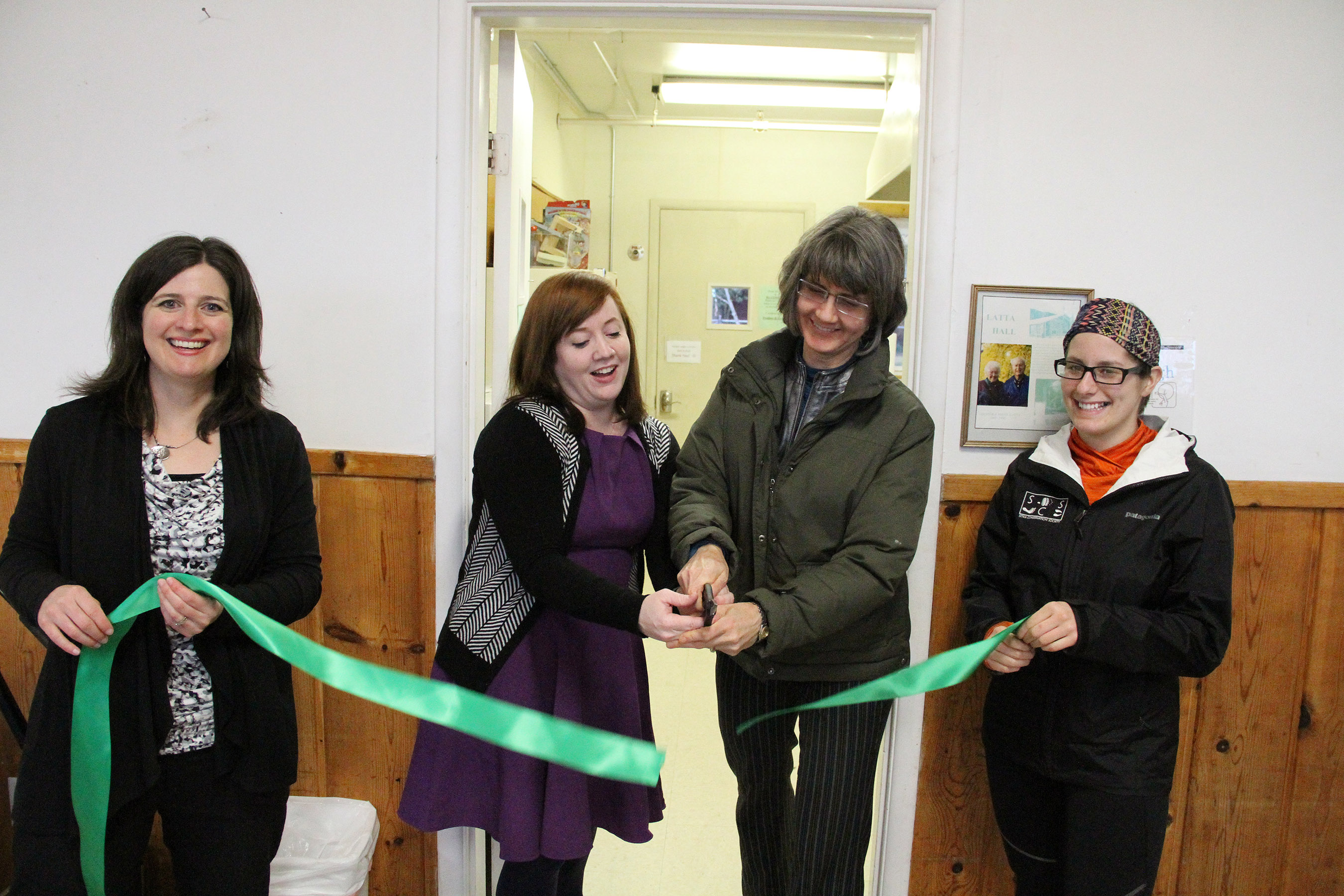
• Scenes from the March 9 ribbon-cutting celebration for the Sitka Kitch community commercial kitchen

MarjorieHennessyAndCyndyGibsonCutRibbon

kitch_logo_mainOn Monday, March 9, a couple of dozen people attended a ribbon-cutting ceremony for the new Sitka Kitch community commercial kitchen, located at Sitka First Presbyterian Church (505 Sawmill Creek Road).

The new community commercial kitchen came out of a food security project from the 2013 Sitka Health Summit. Sitka residents decided a community kitchen would serve several functions as a place to teach cooking and nutrition classes, a place to teach food preservation classes, a place for small cottage food businesses to have access to a rental commercial kitchen, etc. It is a place for education, business incubation, and community cultivation about food in Sitka.

The Sitka Kitch project (note, new website for scheduling) is a partnership between the Sitka Conservation Society, Sitka First Presbyterian Church, Sitka Local Foods Network, Sitka Food Co-op, Sitka Health Summit, Sustainable Southeast Partnership, and the University of Alaska Fairbanks Cooperative Extension Service (Sitka District Office). The kitchen recently was renovated after the church received a $13,000 community blessings grant from the Northwest Coast Presbytery.

sikta_kitch_sheet-791x1024During the ribbon-cutting ceremony, Marjorie Hennessy of the Sitka Conservation Society and Sustainable Southeast Partnership discussed the history of the project and some of its goals. Then she and Cyndy Gibson, representing Sitka First Presbyterian Church, cut the ribbon.

Please check out the linked brochure for the current rental rates, which are tiered depending upon the planned use of the facility. This kitchen does meet Alaska Department of Environmental Conservation commercial kitchen food safety standards, but renters are required to get all of their other required permits (business license, food-handling permits, etc.) before renting the kitchen. Groups that already regularly use the facility for deliveries, such as the Sitka Food Co-op and Everything Organic Sitka, will continue to use the facility.

For more information about Sitka Kitch rentals, check the website, contact sitkakitch@sitkawild.org or call the Sitka Conservation Society at 747-7509. Eventually the management will switch over to the church.

A slideshow is posted below the brochure with photos from the ribbon-cutting ceremony.

• Sitka Kitch informational brochure

This slideshow requires JavaScript.

• Ribbon-cutting event March 9 to celebrate launch of Sitka Kitch community kitchen at First Presbyterian Church


The Sitka Health Summit congratulates the folks at Sitka Kitch and First Presbyterian Church on their $13,000 grant. The funds will go a long way towards renovation of their community kitchen. "Sitka Kitch is a community collaboration to augment and strengthen Sitka's workforce through the development of food-based curriculum and training." It is an initiative of the Sitka Health Summit. From left are Patrick Williams, Marjorie Hennessy, Clara Gray, Cheri Hample, Martina Kurzer, Suzan Brawnlyn, Cyndy Gibson, and Betsy Decker. (Photo Courtesy of the Sitka Health Summit)

The Sitka Health Summit congratulates the folks at Sitka Kitch and First Presbyterian Church on their $13,000 grant. The funds will go a long way towards renovation of their community kitchen. “Sitka Kitch is a community collaboration to augment and strengthen Sitka’s workforce through the development of food-based curriculum and training.” It is an initiative of the Sitka Health Summit. From left are Patrick Williams, Marjorie Hennessy, Clara Gray, Cheri Hample, Martina Kurzer, Suzan Brawnlyn, Cyndy Gibson, and Betsy Decker. (Photo Courtesy of the Sitka Health Summit)

kitch_logo_mainThe Sitka First Presbyterian Church and the Sitka Conservation Society are pleased to announce the official opening of the Sitka Kitch, a new community commercial kitchen for Sitka.

Please join us to commemorate this exciting event. A ribbon-cutting ceremony will be held at 6 p.m. on Monday, March 9, at the Sitka Kitch, in the First Presbyterian Church, 505 Sawmill Creek Road. Light refreshments courtesy of the Back Door Café will be served.

Sitka Kitch is a community initiative that arose from the 2013 Sitka Health Summit, and is a truly collaborative and partner-rich project. The Sitka Conservation Society, First Presbyterian Church, Sitka Local Foods Network, Sitka Food Co-op, Sitka District Office of the University of Alaska Fairbanks Cooperative Extension Service, and the Sustainable Southeast Partnership have all contributed to turn Sitka’s dream of a community kitchen into reality. Sitka Kitch received $13,000 from the Northwest Coast Presbytery Community Blessings Grant. These funds went directly towards renovating the church’s kitchen so that ‘Sitka Kitch’ could meet the requirements of becoming an Alaska Department of Environmental Conservation (DEC)-certified commercial kitchen.

sikta_kitch_sheet-791x1024The Sitka Kitch now is ready to function as a shared-use community kitchen. Our goal is to provide food-based education, at various levels, to the greater Sitka community. With these renovations completed, the Kitch can offer a DEC-certified commercial kitchen to local entrepreneurs and small businesses for an affordable hourly rate. Instructors interested in developing and offering food-based classes may also rent the kitchen and space. The Kitch also hopes to develop and provide career and technical training, and community canning events.

Through multi-use access to a commercial kitchen, Sitka Kitch’s goals are to support a sustainable local foods culture, spark local foods entrepreneurship and empower the community to become more independent and food secure. This will continue to be the delivery location for the Sitka Food Co-op and Everything Organic Sitka. Sitka Farmers Market and other cottage food industry vendors who need to process food products in a commercial kitchen now will have a place they can rent.

For more information on using Sitka Kitch, please contact sitkakitch@sitkawild.org.

• ‘Flora of Southeast Alaska’ class offered by UAS Sitka Campus to be a hybrid

Salmonberries await picking near the entrance to Sitka National Historical Park

Salmonberries await picking near the entrance to Sitka National Historical Park

A new biology class by University of Alaska Southeast Sitka Campus associate professor Kitty LaBounty will itself be a “hybrid”.

klabountyThe DNA of most traditional botany classes is to gather students around a table of samples and look at them in a face-to-face classroom setting. By offering Flora of Southeast Alaska as both a local and distance class, students from anywhere can get up to speed on how to identify the common native trees, shrubs and herbs of southeast and south central Alaska. Local students can participate in the lectures on campus, while students across Alaska can see the imagery online and hear the lectures either live or via digital recording.

Flora of Southeast Alaska is a one-credit, seven-week workshop. The focus will be on identification of common species and attaining an understanding of their place in the ecosystem of Southeast Alaska. Students will discover how these plants interact with other plants and animals, and how humans use these plants for food, fuel, medicine, or simply enjoyment.

In addition to illustrated weekly lectures, there will be written exercises and “check for understanding” activities. The class is available to any student without prerequisites. It does not count as credit toward a biology major at UAS.

Professor LaBounty brings her lifelong passion as a gardener and scientist to this topic, along with more than 25 years experience working on plant identification for state, federal and non-profit agencies in Alaska.

The class will meet from 5:30-7 p.m. on Thursdays from March 5 to April 30 — with March 19th off for spring break. The cost is $187 for local students and $227 for eLearning (distance) students.

For more information, contact Kitty LaBounty at UAS Sitka Campus. 747-9432. To register, call 747-7700. or toll-free, 800-478-6653.

• Registration opens for Southeast Alaska Farm and Fish to School Conference on April 2-3 in Juneau

FlyerPromoDecPoster-page-001

Registration has begun for the inaugural Southeast Alaska Farm and Fish to Schools Conference, which takes place April 2-3 at Centennial Hall in Juneau.

This event will be the first regional opportunity focused on building connections between Alaska’s school systems and local food entrepreneurs. Anyone interested in bringing more local foods into our school system is invited to collaborate and connect with regional experts to strengthen fish and farm to school programming across the state.

Southeast Conference, the regional economic development organization, is coordinating the conference in conjunction with the newly formed Sustainable Southeast Partnership, a diverse network of organizations working together on community sustainability in Southeast Alaska.

Farm&Fish-logo-on-photos Cropped“Often we find that the barriers to achieving access to local, healthy foods can be overcome if we work together as a region to make this initiative a priority,” said Alana Peterson, program director of the Sustainable Southeast Partnership, Haa Aani, Community Development Fund Inc. “By bringing all the key players together for a conference we are hoping to achieve just that.”

Fish and farm to school programming offers significant economic, environmental cultural and nutritional opportunities to our rural communities and region.

“Schools in southeast received more than $500,000 last year to buy Alaskan produced foods through the Nutritional Alaska Foods to Schools grant program.” said Shelly Wright, Executive Director of Southeast Conference. “However, schools are often limited by what they can procure. There are untapped opportunities for, farmers, fishermen and small business in our region. We are eager to break down barriers and grow the opportunities for everyone.”

Online registration and more detailed conference information is available at http://www.seconference.org/southeast-farm-and-fish-schools-conference. Register before Feb. 28 to be eligible for a travel stipend. For more information, contact Lia Heifetz at growsoutheast@gmail.com.

• Sitka to host three-day Gathering in conjunction with two-week Introduction to Ethnobotany course

Salmonberries await picking near the entrance to Sitka National Historical Park

Salmonberries await picking near the entrance to Sitka National Historical Park

This month Sitka will host a two-week Introduction to Ethnobotany course on May 19-30, and as part of that course there will be a three-day UAF Kuskokwim Campus Ethnobotany Program All-Hands Gathering for stakeholders on May 29-31 held in conjunction with the class. As part of the Gathering, there will be a couple of events open to Sitka residents interested in ethnobotany and the uses of local plants.

The Gathering is sponsored by the Ethnobotany Certification Program of the University of Alaska Fairbanks Kuskokwim Campus (Bethel), and the Gathering will serve as a chance for stakeholders (students, instructors, elders, colleagues) to to get together to celebrate the program’s first five years, plan the next five years, and network with each other.

The schedule is still being finalized, but the first public event will be on Thursday, May 29, when the 10 ethnobotany class students will make their presentations from 3-5 and 6-8 p.m. (with a break for a bring-your-own dinner) in Room 229 of the University of Alaska Southeast Sitka Campus.

At 9:30-10:30 a.m. on Saturday morning, May 31, keynote speaker Anore Jones (author of Plants That We Eat) will  share her passion for traditional foods of the subarctic. This event will be at the Yaw Classroom at the Sitka Fine Arts Campus.

The Gathering will conclude at 5:30-9 p.m. on Saturday, May 31, with a community potluck dinner/local foods feast and Native dancing at the Sheet’ká Kwáan Naa Kahídi. This event will feature a Native chant from our Hawaiian friends, vending tables, as well as music from the Sitka rock band Slack Tide. The Gathering will provide a main course, some desserts and beverages for this event, and people are encouraged to bring side dishes featuring local food.

For more information, contact Kuskokwim Campus Ethnobotany Program Coordinator Rose Meier, PhD, at 1-907-474-6935 (voice), 1-907-474-5952 (fax) or by email at rameier@alaska.edu.

EBOT Public Flyer final

• Sitka to host two-week Introduction to Ethnobotany course for college credit

EBOT 100 flyer 2014

Sitka will be the site of a two-week Introduction to Ethnobotany summer fieldwork course May 19-30 offered by the University of Alaska Fairbanks Kuskokwim Campus (Bethel).

The Ethnobotany Certificate Program operated by the UAF Kuskokwim Campus is the first such program in this state and only one of a handful that are currently being offered in the entire United States. Ethnobotany is integral to life in Alaska because it recognizes cultural knowledge and deepens our connection with the expansive and exceptional natural world at our doorstep.

Students enrolled in the EBOT program will learn basic plant biology and floral ecology of Alaska, economic applications of ethnobotany, basic applied chemistry of plants, research methods for local specific projects, as well as traditional and new uses of Alaska native plants. These skills will prepare Alaska Native students for employment in wildlife and cultural management agencies, education, and other rural-based jobs, as well as further college milestones such as the associate’s and bachelor’s of
science degrees.

The Sitka-based class EBOT 100, “Introduction to Ethnobotany,” will discuss the relationships between people and plants in the Sitka region as well as other parts of Alaska and the rest of the world. People relate to plants in many ways, for example, by eating them, using them as medicine, naming them and telling stories about them.

To give you an idea of the types of things we’ll discuss, we have included a few sample pages from our ethnobotany program’s upcoming book on the ethnobotany of the Yukon-Kuskokwim region, in Western Alaska. This will give you a feeling for how people of a different region relate to a few species you may also have in your area. Please read the descriptions on the EBOT program website of fireweed, Labrador tea and cloud berry. Then you can take a short quiz to see what you learned, and what you already know about plants and the study of how people use them.

The three-credit class (biology credits) costs $600 for tuition, books and materials, but there are scholarships available for Alaska-based students enrolled in the EBOT certificate program. In addition to the class, there will be a three-day program stakeholder meeting that will end on May 31 with a local foods dinner.

Registration forms for the class and the ethnobotany program are linked below. For more information, contact Kuskokwim Campus Ethnobotany Program Coordinator Rose Meier, PhD, at 1-907-474-6935 (voice), 1-907-474-5952 (fax) or by email at rameier@alaska.edu.

• Kuskokwim Campus Introduction to Ethnobotany 100 (Sitka) course application 2014

• Kuskokwim Campus Ethnobotany Program Application 2014

• UAF College of Rural and Community Development Registration Form

• Sitka Community Food Assessment Indicators Report helps define Sitka’s food culture

Food Assessment Indicator Report web version_Page_01

SitkaCommunityFoodAssessmentLogoThe Sitka Community Food Assessment Indicators Report was released on Monday, and the findings will help guide future food system planning in Sitka.

A 2012 Sitka Health Summit project, the Sitka Community Food Assessment has examined where Sitka residents get their food, what types they eat, what they grow, what they hunt and fish for, where they shop, what type of access people have to healthy food, and other questions about Sitka’s food supply. The findings of the food assessment will help Sitka improve its food security.

After Sitka residents chose the Sitka Community Food Assessment as a project at the September 2012 Sitka Health Summit, the work group received a grant to hire a coordinator and contract with a data person. A revised version of a questionnaire from a similar project on the Kenai Peninsula was posted online, available at the library, and discussed in focus groups, with more than 400 residents answering the 36 questions. In November 2013, some of the initial data was presented at the Sitka Food Summit, where about 60 residents discussed the results and noted any further research that needed to be done. Since then, the work group, in partnership with The Island Institute and others, fine-tuned the data before writing and editing the indicators report.

“We hope the Sitka Community Food Assessment Indicators Report can guide future food system planning and plant seeds for innovative responses that will strengthen Sitka’s food landscape,” project coordinator Lisa Sadleir-Hart wrote in the 26-page document’s introduction. “The Sitka Community Food Assessment Indicators Report uncovers many weaknesses in our food system as well as some incredible assets that define Sitka’s food culture — a rich ecosystem filled with nutritious gems from the land and sea plus a generous spirit of sharing with our neighbors. Now that we’ve defined the current foodscape in Sitka, let’s work together to build a more resilient food system that can deeply nourish the entire community for generations to come.”

The Sitka Community Food Assessment Indicators Report opens with Sitka’s demographics and several Sitka food facts. It then features data about how many people in Sitka hunt, fish, gather, and/or grow their own food, as well as some barriers. Next is information about where people in Sitka shop for their food, followed by how many people in Sitka are on some form of food assistance. The report also includes information about food in the schools, and local food manufacturing.

The findings will be presented to the community during an upcoming meeting of the Sitka Assembly, and the report will be posted online here (see below) and on The Island Institute’s website.

• Sitka Community Food Assessment Indicator Report (April 14, 2014, opens as PDF file)

• Alaskans Own community-supported fisheries program announces 2014 season subscription prices

AO flier no tags

Sitka-based Alaskans Own seafood recently announced its subscription prices for its 2014 community-supported fisheries (CSF) program in Sitka, Juneau, and Anchorage. The prices appear to have gone down a tiny bit since the 2013 season.

Alaskans Own was the first CSF program in the state, modeling its program after the successful community-supported agriculture (CSA) programs that let customers deal directly with harvesters so they can buy subscription shares to the year’s crop/catch. In addition to the CSF program, Alaskans Own usually has a table at the Sitka Farmers Markets during the summer.

ErinFultonAshiaLaneAlaskansOwnSeafoodThis is the fifth year of the Alaskans Own CSF program, and there are four-month and six-month subscriptions available. The six-month subscriptions  allow people to keep receiving freshly caught seafood through October instead of August, when the traditional four-month subscriptions end. Half-subscriptions also are available. Subscriptions include a mix of locally caught black cod (sablefish), halibut, king salmon, coho salmon, lingcod and miscellaneous rockfish, depending on the commercial fishing season and prices.

The Alaskans Own program is associated with the Alaska Sustainable Fisheries Trust. The Alaska Sustainable Fisheries Trust’s mission is to strengthen Alaskan fishing communities and marine resources through scientific research, education, and economic opportunity.

Here is Alaskans Own CSF program information for 2014 provided in a recent email sent to the program’s past subscribers and other interested folk:

Hello, Sitka!

It’s that time of year again. The days are getting longer, the herring are back, and Alaskans Own CSF is gearing up for our 2014 season.

This summer looks to be another season filled with even better quality seafood than before. We’d love to have you join us and get access to the great local seafood the Sitka has to offer.

It is difficult to tell, at this point, how prices will trend through the season. Please be assured that we will always bring you the very best value, highest quality seafood that we can, meeting or exceeding the total number of pounds for the plan that you choose. We will make adjustments in specific items to preserve this value. Our small staff gratefully receives assistance from a number of volunteers to help keep costs down. Any and all ‘profits’ go to support the scientific work of the Fishery Conservation Networks.

  • Six months, Full share: $760 (60 pounds, ~ 10 lb. /month)
  • Six months, Half share: $400 (30 pounds, ~ 5 lb./month)s
  • Four months, Full share: $520 (40 pounds, ~ 10 lb./month)
  • Four months, Half share: $280 (20 pounds, ~ 5 lb./month)

To renew your subscription with Alaskans Own, please send me an email, or give me a call on the Alaskans Own phone 907-738-2275(*). Subscriptions can be paid for using cash, check or credit card. You can learn more about what we offer and the work we do on our website: www.alaskansown.com.

Thank you for all your support. I hope you’ll join Alaskans Own again this season to enjoy the best seafood from the finest fishermen in Southeast Alaska.

Cheers,
Erin Fulton, Programs Coordinator, Alaska Sustainable Fisheries Trust

* With the Sitka Sound Science Center under construction, we won’t be in our normal office space — email and the new AO phone will be the best way to reach us, and to schedule an ‘in person’ meeting.

• Sitka Community Food Assessment findings to be presented Nov. 14 at inaugural Sitka Food Summit

Sitka Food Summit Flyer

SitkaCommunityFoodAssessmentLogoThe Sitka Community Food Assessment work group will present its findings during the inaugural Sitka Food Summit, from 6-9 p.m. on Thursday, Nov. 14, at Harrigan Centennial Hall.

A 2012 Sitka Health Summit project, the Sitka Community Food Assessment has examined where Sitka residents get their food, what types they eat, what they grow, what they hunt and fish for, where they shop, what type of access people have to healthy food, and other questions about Sitka’s food supply. The findings of the food assessment will help Sitka improve its food security.

“The Sitka Community Food Assessment work group decided early on that there needed to be an opportunity for Sitka to engage with the food data and shape the writing of the food assessment indicator report,” project coordinator Lisa Sadleir-Hart said. “The inaugural Sitka Food Summit will use a format that was first tested in the late 1990s when the Island Institute was developing Sitka’s initial indicator report.  We’ll interact individually with the data, then use a conversation café model to discuss what the data brings up for us as Sitkans.  The working group wanted to create a venue that meets the needs of a wide range of citizens.”

The event sponsors include the Sitka Community Food Assessment Work Group from the Sitka Health Summit, Alaskans Own Seafood, the Sitka Food Co-op, Sitka Community Hospital, the SouthEast Alaska Regional Health Consortium (SEARHC) Community Transformation Grant and Diabetes Prevention programs, the Sitka Local Foods Network, the Southeast Soil and Water Conservation District, and Sitka Tribe of Alaska. There also will be refreshments thanks to Sitka Community Hospital’s Basement Bistro, St Peter’s Fellowship Farm and Sitka Conservation Society staff.

For more information, contact Lisa Sadleir-Hart at 747-5895 or sitkafoodassessment@gmail.com. (Editor’s note: A few photos from the Sitka Food Summit are posted below.)

This slideshow requires JavaScript.