The SitNiks will provide musical entertainment during the third Sitka Farmers Market of the season, from 10 a.m. to 2 p.m. on Saturday, Aug. 4, at the Alaska Native Brotherhood Hall (235 Katlian St.).
The SitNiks, who will play from 10 a.m. to noon, perform music from Russian and other Eastern European countries. Members of the group include, from left, Ritch Phillips on bass, John Fulton on concertina, Pattie Skannes on balalaika, Bree Hack on fiddle, Jeanne Stolberg on balalaika, Kris Fulton on fiddle and Mike Litman on accordion (not pictured is J Bradley on various stringed instruments).
The Sitka Farmers Market is happy to provide a showcase for local musicians. Musical acts for future Sitka Farmers Markets this year will be announced later. For more information about providing musical entertainment, contact market coordinator Johanna Willingham at 738-8336.
The Sitka Local Foods Network also is seeking volunteers to help set up tables and tents before the market starts, and to tear down and pack up the market after it ends. We need volunteers for all of the remaining markets (Aug. 4, 18, Sept. 1 and 15). If you have a strong back and helping hands, please contact Johanna at the number above.
In addition, the Sitka Local Foods Network needs people to help harvest veggies from St. Peter’s Fellowship Farm to sell at the Sitka Farmers Market. Work/harvest parties will take place from 4-5 p.m. on Friday, Aug. 3, and from 8-9 a.m. on Saturday, Aug. 4, at St. Peter’s Fellowship Farm (located behind St. Peter’s By The Sea Episcopal Church on Lincoln Street). We expect to have lots of veggies to harvest for Saturday’s market, so we hope to have several people help with the picking.
Mandolin player/guitarist/fiddler Ted Horner and pianist Julie Schmitt will provide musical entertainment during the second Sitka Farmers Market of the season, from 10 a.m. to 2 p.m. on Saturday, July 21, at Alaska Native Brotherhood Hall (235 Katlian St.).
Ted and Julie also performed during the first Sitka Farmers Market of the season on July 7. The SitNiks will perform music from Russia and other countries during the third Sitka Farmers Market of the summer on Aug. 4. The rest of the season’s musical lineup will be announced later.
Musicians interested in performing at future Sitka Farmers Markets can call market manager Johanna Willingham at 738-8836 or by e-mail at johanna.willingham@gmail.com.
Table of the Day: Natalie Sattler of Alaskans Own Seafood, center, receives the Table of the Day award from Sitka Farmers Market Manager/Sitka Local Foods Network Board Member Johanna Willingham, left, and Sitka Local Foods Network Board Member Doug Osborne during the first Sitka Farmers Market of the season on Saturday, July 7, 2012, at the Alaska Native Brotherhood Hall in Sitka. At each market a vendor is honored by the Sitka Local Foods Network, which sponsors the Sitka Farmers Market. The next market is from 10 a.m. to 2 p.m. on Saturday, July 21, 2012, at ANB Hall, 235 Katlian St.
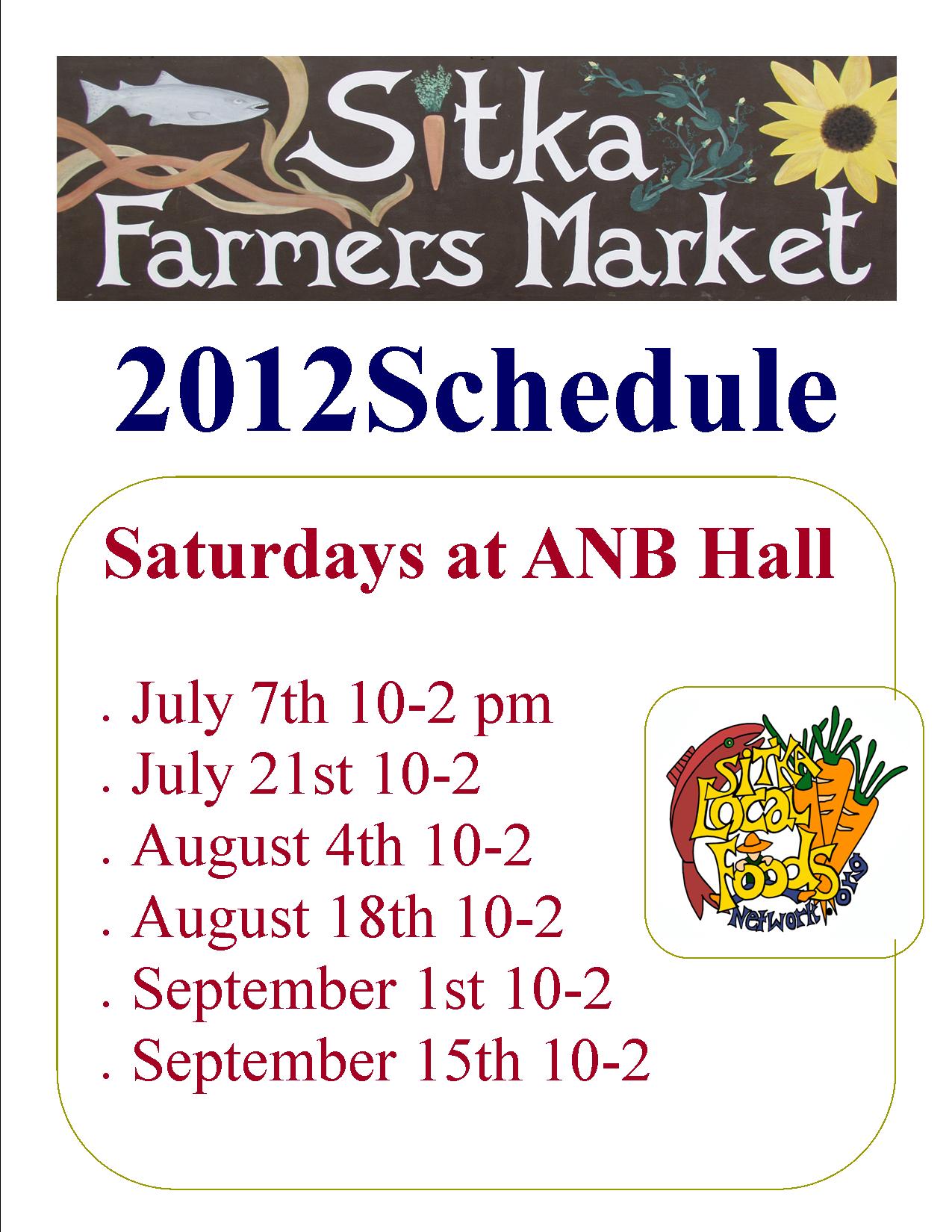
The Sitka Local Foods Network will host its fifth summer of Sitka Farmers Markets with six markets that start on July 7 and take place on alternate Saturdays through Sept. 15. The Sitka Farmers Markets give Sitka residents a chance to buy and sell locally produced food and crafts.
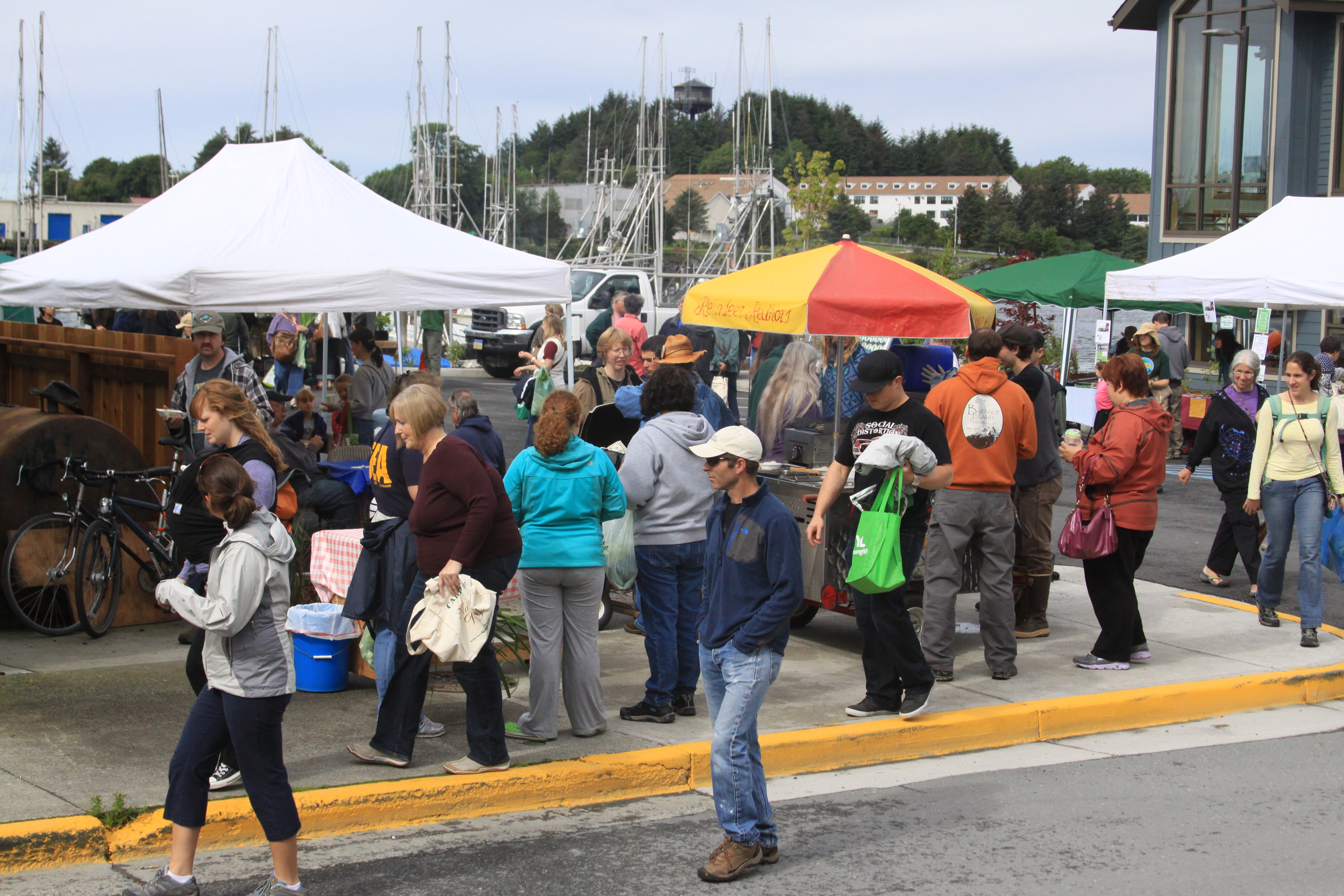
The Sitka Farmers Markets take place from 10 a.m. to 2 p.m. on Saturday, July 7, 21, Aug. 4, 18, Sept. 1 and Sept. 15 at the Alaska Native Brotherhood Hall (235 Katlian St.). The markets feature local seafood (fresh, frozen, and cooked, ready to eat), locally grown and harvested fruits and vegetables, baked bread, locally made jams and jellies, cooking demonstrations, live entertainment, locally brewed and roasted coffee, music, local arts and crafts, and a variety of other items gathered or made in Sitka. We emphasize local products and lots of fun. We are the first farmers market in Southeast Alaska to accept WIC coupons. You also can vote for the Sitka Farmers Market in the America’s Favorite Farmers Markets contest by following the links at http://www.sitkalocalfoodsnetwork.org/.
“The Sitka Farmers Market is like a carnival every other Saturday,” Sitka Local Foods Network Board President Kerry MacLane said. “It’s a fun community space to enjoy with your family or to meet your friends for fresh coffee and baked goods. There is live music, cooking demonstrations, art, and, of course, fresh veggies, fruit and seafood.”
The Sitka Farmers Market started as a community project that came out of a health priority planning meeting at the 2008 Sitka Health Summit. This event is sponsored by the Sitka Local Foods Network, Alaska Native Brotherhood Camp No. 1, Alaska Native Sisterhood Camp No. 4, Baranof Island Housing Authority, Sitka Conservation Society, the Alaska Farmers Market Association and the SEARHC Health Promotion and Diabetes Prevention programs.
“Thanks to our creative and enthusiastic vendors, the Sitka Farmers Market will be celebrating its fifth successful year.” said Johanna Willingham, Sitka Local Foods Network Board Member and Sitka Farmers Market Coordinator. “We have delighted in watching our market grow over the years and due to popular demand we are beginning our market two weeks earlier this year. Outdoor vendors and musicians will still be able to enjoy the newly paved parking lot with landscaping, thanks to BIHA. A tent will be set up for outdoor dining where you can listen to live music and enjoy some great food. Some new items will be added to some familiar vendors’ tables — dried sea veggies, sea asparagus and sea salt. Look forward to fresh snap and snow peas for snacking, ready-to-eat salads, handmade tamales and, as always, fresh black cod tips.”
Vendor fees are $20 for a 6-foot table, $30 for an 8-foot table and $15 for a 4-foot table. Vendors with their own tents pay $2 per foot. As always, we offer cost incentives for vendors growing locally produced food. The fees will help us cover the costs of renting ANB Hall and its kitchen, hiring musicians and other expenses. To learn more about being a vendor or to sign up for a table, contact Sitka Farmers Market Coordinator Johanna Willingham at 738-8336 or by e-mail johanna.willingham@gmail.com. Vendor rules, registration forms and other information for potential vendors can be found at http://www.sitkalocalfoodsnetwork.org/.
The fifth season for the Sitka Farmers Market doesn’t open until July 7, but you can vote for us now in the fourth annual America’s Favorite Farmers Markets contest. The contest is sponsored by the American Farmland Trust, a non-profit organization dedicated to preserving America’s agricultural resources.
To vote, click here and then search for the Sitka Farmers Market by typing in the Sitka Farmers Market name or by using the zip code or state directories. You also can vote by clicking the contest logo at the top of this site’s right column or the contest logo at the bottom of this post. Voting opened on June 22, and the deadline to vote is midnight EST on Monday, Sept. 3 (8 p.m. Alaska time on Sunday, Sept. 2). The online voting form asks what you like best about the market, so be prepared to type something in the box. The top boutique, small, medium and large markets win a large quantity of “No Farms, No Food” totebags to distribute at a market in September, in addition to other prizes to help organizers run a better market. Click here for more information about the contest, and click here for a FAQ page with more details.
By the way, the summer’s first Sitka Farmers Market is from 10 a.m. to 2 p.m. on Saturday, July 7, at Alaska Native Brotherhood Hall (235 Katlian St.). Other markets are scheduled for alternate Saturdays — July 21 Aug. 4, Aug. 18, Sept. 1 and Sept. 15. There also will be a small Sitka Farmers Market produce booth at the Running of the Boots fundraiser for the Sitka Local Foods Network on Sept. 29 at the Crescent Harbor covered shelter. We’re looking forward to seeing you at the markets.
Our markets feature a variety of vendors with locally grown produce, locally caught fish, baked bread, prepared foods and arts and crafts. We usually have musicians on stage and a table with children’s activities. After construction two summers ago kept us from being outside, this summer we will be able to host many of our usual booths outdoors in the ANB Hall/Baranof Island Housing Authority parking lot. To learn more about reserving booths for the Sitka Farmers Market, contact Johanna Willingham at 738-8336 or by e-mail at johanna.willingham@gmail.com. Vendor rules and other information can be found at this link.
If you have extra produce from your garden, the Sitka Local Foods Network table (outside ANB Hall by the Sitka Farmers Market sign) gladly accepts donations and will buy some produce to sell at its booth. The Sitka Local Foods Network sells produce grown at the St. Peter’s Fellowship Farm communal garden and a few other local gardens at its Sitka Farmers Market booth. All money raised by the Sitka Local Foods Network booth goes into various projects sponsored by the network — a 501(c)(3) non-profit group — including the Sitka Farmers Market, community gardens, the proposed Sitka Community Greenhouse and Education Center and other projects.
The vendor forms for the 2012 Sitka Farmers Markets are finally ready so prospective vendors can review them and familiarize themselves with the food safety, market and sales tax rules.
This year the Sitka Farmers Markets take place from 10 a.m. to 2 p.m. on alternate Saturdays starting on July 7 and running through Sept. 15 (July 7, 21, Aug. 4, 18, Sept. 1 and 15) at the historic Alaska Native Brotherhood Hall located at 235 Katlian St. This year we have a new market manager, Johanna Willingham-Guevin, and she will be assisted by Jasmine Shaw. Please remember that our focus is on locally grown or produced items at the market (no goods produced outside Alaska allowed, except for certain food items that are to be consumed at the market).
Prospective vendors can send their completed forms to Johanna Willingham, P.O. Box 6235, Sitka, Alaska 99835. Johanna’s e-mail address is johanna.willingham@gmail.com, and her cell number is 738-8336. All forms can be downloaded as Adobe Acrobat (PDF) files. These forms also are posted on our Forms page.
(EDITOR’S NOTE: The following article first appeared on this site in April 2010. It is repeated because much of the information remains current and newsworthy.)
As you start to plan your garden for this spring and summer, don’t forget to Plant A Row For The Hungry. The Plant A Row For The Hungry program (also known as Plant A Row or PAR) is a national campaign by the Garden Writers Association of America that got its start in Alaska.
In the cold winter of 1994, Anchorage Daily News garden columnist and former Garden Writers Association of America President Jeff Lowenfels was returning to his hotel after a Washington, D.C., event when he was approached by a homeless person who asked for some money to buy food. Lowenfels said Washington, D.C., had signs saying, “Don’t give money to panhandlers,” so he shook his head and kept on walking. But the man’s reply, “I really am homeless and I really am hungry. You can come with me and watch me eat,” stayed with Lowenfels for the rest of his trip.
Jeff Lowenfels
The encounter continued to bother Lowenfels, even as he was flying back to Anchorage. During the flight, Lowenfels came up with an idea when he started writing his weekly garden column (the longest continuously running garden column in the country, with no missed weeks since it started on Nov. 13, 1976). He asked his readers to plant one extra row in their gardens to grow food to donate to Bean’s Café, an Anchorage soup kitchen. The idea took off.
When Anchorage hosted the Garden Writers Association of America convention in 1995, Lowenfels took the GWAA members to Bean’s Café to learn about the Plant A Row For Bean’s Café program. The Garden Writers Association of America liked the idea, and it became the national Plant A Row For The Hungry campaign (also known as Plant A Row or PAR). In 2002, the Garden Writers Association Foundation was created as a national 501(c)(3) nonprofit to manage the Plant A Row For The Hungry program.
“I am not surprised by the growth of PAR,” Lowenfels wrote in an e-mail to the Sitka Local Foods Network. “It is now in all 50 states and across Canada and there are thousands of variations of the original program — from prison gardens for the hungry to botanical gardens donating their produce from public display gardens. This is because gardeners always share information and extra food, so the idea was a natural.”
It took five years for the program to reach its first million pounds of donated food, but the second million only took two years and the next eight years saw a million pounds of donated food (or more) each year. Since 1995, more than 14 million pounds of food have been donated. Not only that, the program is getting ready to expand overseas to Australia, England and other countries with avid gardeners.
“We have supplied something in the vicinity of enough food for 50 million meals,” Lowenfels wrote in his e-mail. “Gardeners can solve this hunger problem without the government. And we don’t need a tea party to do it! Or chemicals, I might add, as author of a book on organic gardening (Teaming With Microbes, written with Wayne Lewis)!”
According to the U.S. Department of Agriculture, one out of every eight U.S. households experiences hunger or the risk of hunger. Many people skip meals or eat too little, sometimes going an entire day or more without food. About 33 million Americans, including 13 million children, have substandard diets or must resort to seeking emergency food because they can’t always afford to buy the food they need. In recent years the demand for hunger assistance has increased 70 percent, and research shows that hundreds of children and adults are turned away from food banks each year because of lack of resources.
While many people credit Lowenfels for creating the Plant A Row For The Hungry program, Lowenfels says the real heroes are the gardeners growing the extra food and donating it to local soup kitchens, senior programs, schools, homeless shelters and neighbors. You can hear him pass along the credit to all gardeners at the end of this interview last year with an Oklahoma television station (video also embedded below).
“One row. That’s all it takes. No rules other than the food goes to the hungry. You pick the drop-off spot or just give it to a needy friend or neighbor. Nothing slips between the lip and the cup, I say,” Lowenfels wrote in his e-mail.
The Sitka Local Foods Network also takes donations of local produce to sell at the Sitka Farmers Markets, and all proceeds from the Sitka Farmers Markets are used to help pay for Sitka Local Foods Network projects geared toward helping more people in Sitka grow and harvest local food. For more information, contact Sitka Local Foods Network President Kerry MacLane (maclanekerry@yahoo.com), Sitka Local Foods Network Vice President Linda Wilson (lawilson87@hotmail.com) or Sitka Farmers Market Coordinator Johanna Willingham-Guevin (johanna.willingham@gmail.com).
Mark your calendars, because the 2012 “Let’s Grow Sitka” gardening education event opens at noon and runs until 3 p.m. on Sunday, March 11, at the Alaska Native Brotherhood Hall on Katlian Street. Don’t forget to set your clocks to spring forward so you can get ready to grow.
This annual event brings together local garden supply stores, local gardeners, landscapers and anybody who is interested in learning how to grow food and/or flowers. Sitka Local Foods Network Vice President Linda Wilson, who is coordinating the event with SLFN Board Member Cathy Lieser, was interviewed during the Morning Edition show Thursday on KCAW-Raven Radio and she provided more details about this event (click the link to listen to the interview), which helps Sitka residents get excited about the upcoming garden season.
There will be a wide variety of individuals and businesses with booths for the event, with some booths providing gardening information geared toward and others selling gardening supplies. Lunch will be available for purchase. Here is a tentative list of some of those planning to host booths:
Linda Wilson, Sitka Farmers Market, Grow a Row for the Market
Cathy Lieser, Let’s Grow Sitka, Sitka Local Foods Network
Doug Osborne. Sitka Local Foods Network?
Johanna Willingham, Pacific H.S./Sitka Farmers Market backup.
Jud Kirkness, Sicka Waste compost project, Fruit tree map
Tom Hart, compost, NZ composter ?
Kerry MacLane. Pest management
Lisa Sadleir-Hart. St. Peter’s Fellowship Farm
Laura Schmidt, St. Peter’s Fellowship Farm/Seed swap & share
Maybelle Filler, ???
Stanley Schoening, Chickens, fig trees, UAF Cooperative Extension Service
Judy Johnstone, High Tunnel program
David Lendrum, Guest speaker 3:15, info on new/unusual varieties for Southeast Alaska
Jeren Schmidt, Sitka Spruce Catering, lunch for purchase
Robert Gorman, UAF Cooperative Extension Service, history of Experimental Station
Andrianna Natsoulas, Food Sovereignty
Tracy Gagnon, Sitka 4H Club
Eve Grutter, Chickens, produce
Adam Chinalski, Model greenhouse
Penny Brown, Garden Ventures – products for sale
Amanda Grearson, True Value – products for sale
Lowell Frank, Spenard Building Supply Garden Center ??
Rick Peterson, Gardening 101 – easiest to grow, need to amend soil, etc…
Lori Adams, Down-to-Earth U-Pick Garden – garden promotion and information
Mike Tackaberry/Robin Grewe, White’s Inc. – products for sale
Mandy Summers, Pacific High School
Kelly Smitherman, National Park Service – garden at Bishops House, etc…
Lisa Teas, Sitka Farmers Market art debut
Florence Welsh, Forget-Me-Not Gardens, local garden booklet, possible plant starts
Hope Merritt, Gimbal Botanicals herbal teas – info on wild herbs and herbs to grow
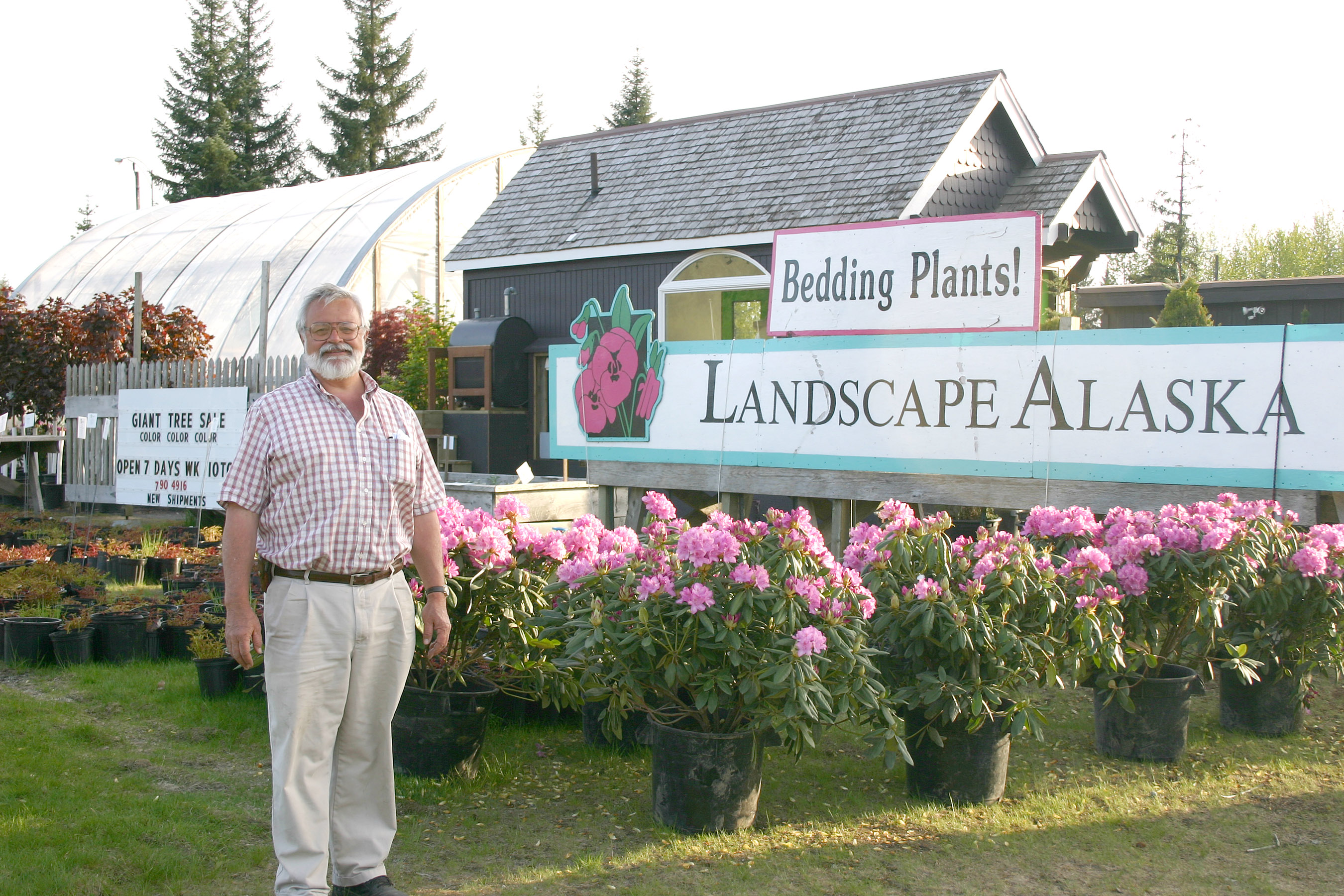
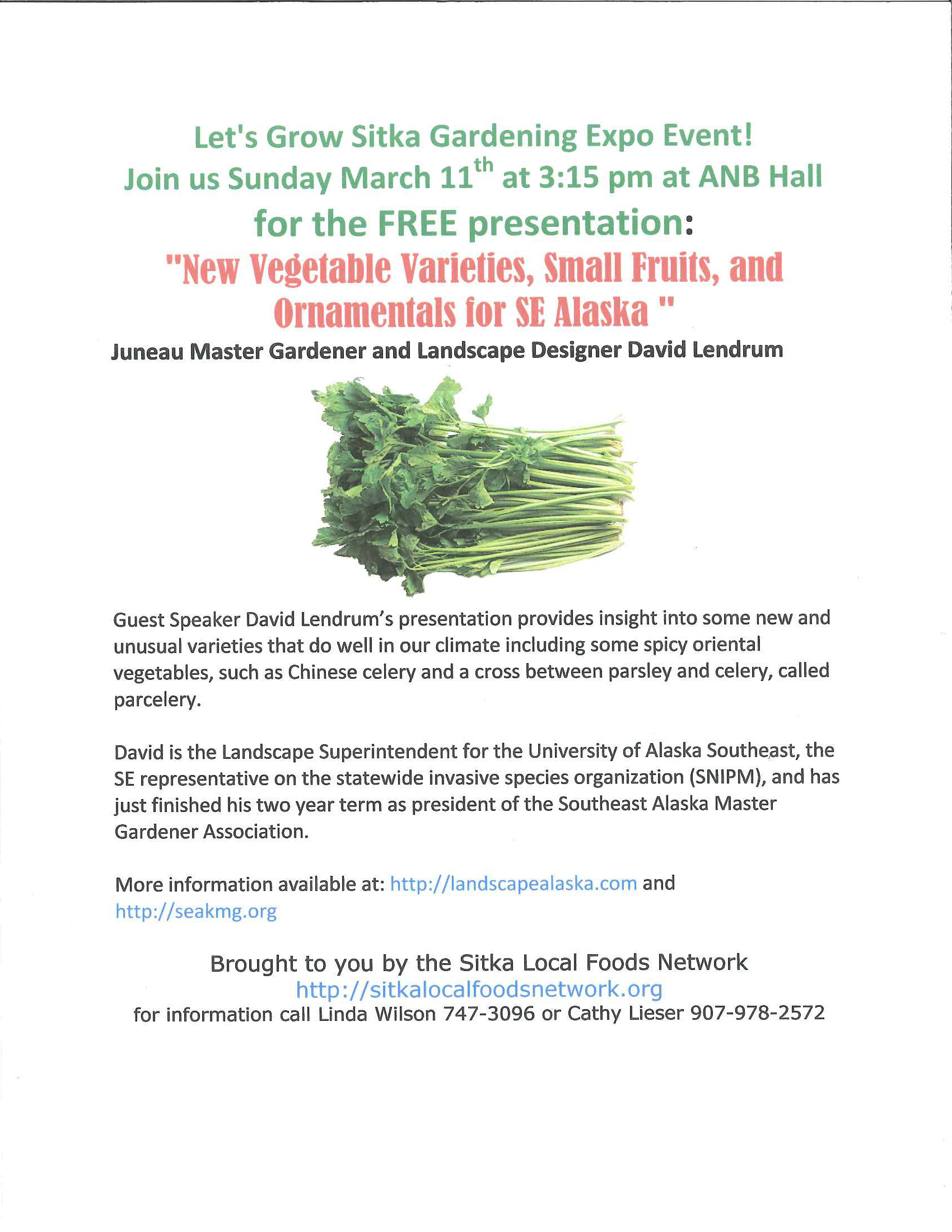
Right after the three-hour Let’s Grow Sitka event ends, guest speaker Dave Lendrum of Juneau will speak at 3:15 p.m. on “New Vegetable Varieties, Small Fruits, and Ornamentals for Southeast Alaska.” Lendrum is a landscape designer who just finished a two-year term as president of the Southeast Alaska Master Gardener Association and with his landscape architect wife, Margaret Tharp, owns Landscape Alaska.
Dave’s life has evolved in partnership with the natural world. He grew up in California on an organic u-pick vegetable farm, learning horticulture from his parents and the 4H club. He did nursery work and continued his post-college adventure in Ecuador by starting a fresh market produce business. After being a city horticulturist at the Eugene (Ore.) Parks Department, Dave started his first nursery, Western Oregon Perennials. A few years later, he found himself in a high-temperature photosynthesis lab at Stanford. In the Pacific Northwest, Dave restored old estate gardens. When he heard Alaska’s call, he moved north to Elfin Cove. Dave and his wife started Landscape Alaska in Juneau 28 years ago. They design and build landscapes on every scale and have won numerous awards both locally and nationally. In addition, Dave is the landscape superintendent for the University of Alaska Southeast and the Southeast representative on the statewide invasive species organization (SNIPM).
For more information about Let’s Grow Sitka, contact Linda Wilson at 747-3096 (evenings, weekends) or lawilson87@hotmail.com, or Cathy Lieser at 978-2572. The two event fliers for this event are posted below as Adobe Acrobat files (PDF files).
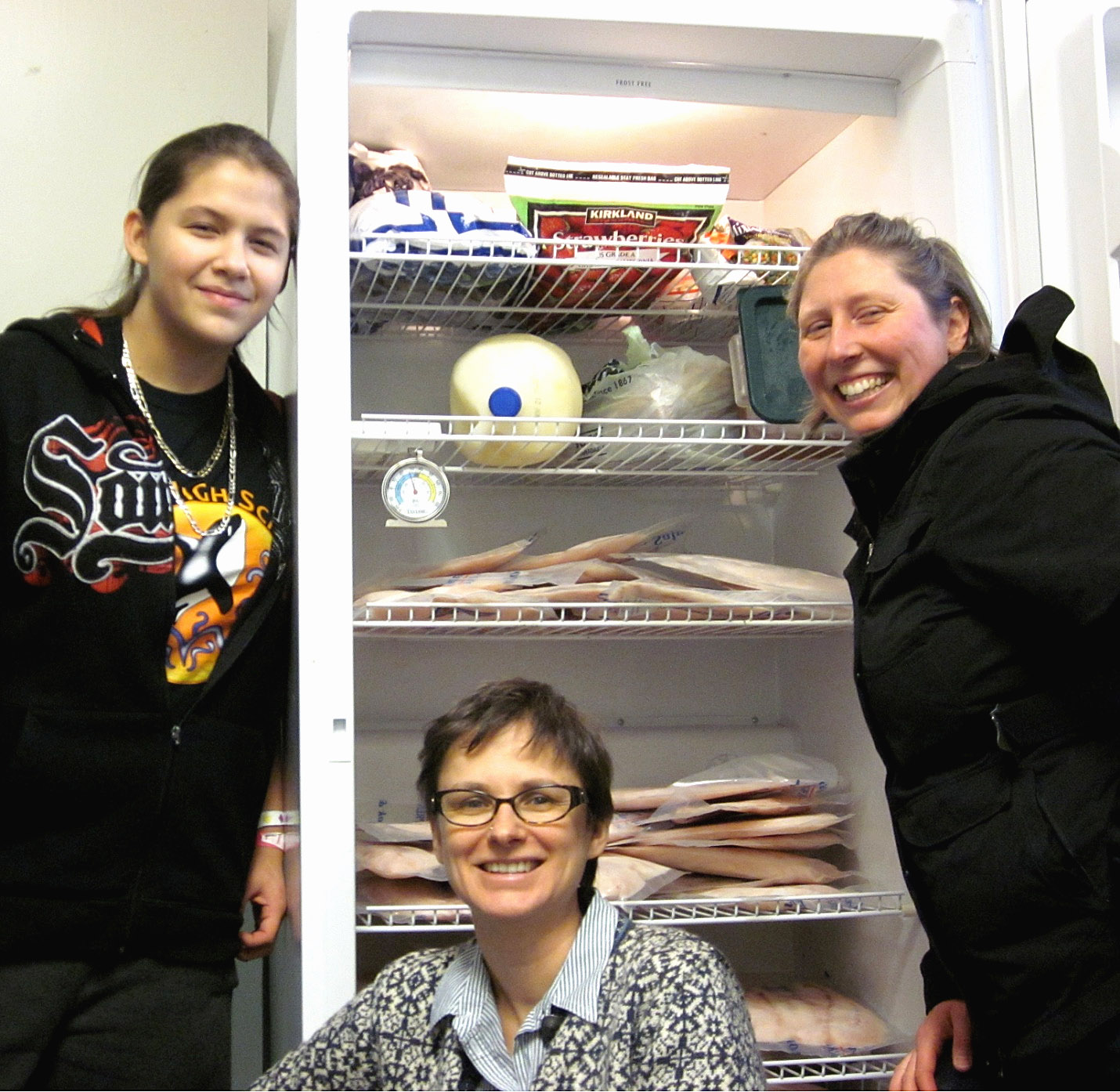
Pacific High School student Jessie Young, left, co-principal Sarah Ferrency, center, and lunch coordinator Johanna Willingham load rockfish into the freezer at Pacific High School. an alternative high school in Sitka, Alaska. (PHOTO COURTESY OF TRACY GAGNON / SITKA CONSERVATION SOCIETY)
Pacific High School now serves local seafood in the cafeteria and joins the growing ranks of schools connecting to local foods. Starting Wednesday, Feb. 1, Pacific High students will have a choice of local seafood dishes twice a month due to a partnership with the Sitka Conservation Society.
Sitka, Alaska, is the ninth largest fishing port in the country, but only recently did school children have access to the abundance of local seafood in school lunches. The project began in 2010 after getting more fish in school lunches was voted on as one of Sitka’s four health priorities at the Sitka Health Summit. The Sitka Conservation Society took the lead on the project and partnered with Blatchley Middle School in the winter of 2010-11 school year and then with Keet Gooshi Heen Elementary School in 2011-12 to launch a Fish to Schools program. Due to the success of that program, it has evolved and spread to another school in the community.
Tracy Gagnon, Fish to Schools coordinator at Sitka Conservation Society said, “To kick off the new partnership, SCS’s Fish to Schools program will cook with Pacific High students to rally support for local fish lunches. A favorite recipe will be chosen for an upcoming Fish to Schools benefit.”
LOCALLY MADE– Americorps Volunteer Lauren Hahn, left, and Pacific High School students in the culinary arts program, Brendan Didrickson and Jenny Jeter, prepare a lunch of Caribbean rockfish with sweet potato fries, baked apples and wild rice at the school on Wednesday, Feb. 1. This was the first Pacific High lunch in the Fish to Schools program. The program began in 2010 as a Sitka Health Summit project when Sitka Conservation Society joined Blatchley Middle School to serve locally caught fish in school lunches. Since then, Keet Gooshi Heen Elementary School and now Pacific High have joined the twice-monthly program. On Wednesday, Feb. 8, SCS is inviting commercial fishers to join students at Keet for lunch. (Daily Sitka Sentinel photo by James Poulson, printed in the Tuesday, Feb. 7, 2012, edition)
Unlike at the middle and elementary schools, Pacific High (the Sitka School District’s alternative high school) has more flexibility in the dishes it prepares with local fish. For example, the first Pacific High local seafood lunch will be Caribbean rockfish with sweet potato fries, baked apples and wild rice. Students help prepare the meals through the school’s culinary arts program. Every student earns their food handlers’ card and annually they cycle through a six-week cooking class. Students graduate high school with enough experience to enter into the cooking industry, bringing with them the knowledge to prepare scratch meals with healthy and local ingredients.
“We are striving to change the system by incorporating more local and traditional foods that the students want to eat,” said Johanna Willingham, Pacific High School lunch coordinator. “Through our innovative food-based meal program, the students are learning valuable life skills by developing recipes they enjoy and cooking with their local bounty.”
The Fish to Schools program creates new partnerships by uniting the local conservation organization and high school with community-based processors and fishermen. That partnership allows more students access to healthy lunches, as fish are packed with vitamins, proteins and omega-3 fatty acids that promote healthy hearts and healthy brains.
“Our community depends on the fish that comes out of the ocean, yet our school lunches were so disconnected from our local resources,” said Beth Short-Rhoads, Fish to Schools volunteer organizer, mother and fishing woman. “Thanks to Fish to Schools, our children now have access to local seafood. The fact that it is incredibly healthy is an even bigger bonus.”
There are more than 9,000 schools across the United States involved with local Farm to Schools programs. The majority of the programs serve land-based foods in the cafeterias, so Pacific High adds another layer by providing local seafood to students. “This is an exciting opportunity to be part of the growing farm — or fish — to school movement across the country,” Gagnon said.
The Fish to Schools program also serves up local fish dishes at Blatchley Middle School and Keet Gooshi Heen Elementary School on the second and fourth Wednesdays during the school year. On Wednesday, Feb. 8, the program is honoring local commercial fishermen by inviting them to join the students at lunch so they can share the meal and answer questions the students may have about the fish. (Editor’s note: On Feb. 6, Tracy Gagnon, Beth Short-Rhoads and students Grace Gjertsen, Zofia Danielson and Sienna Reid were interviewed by Robert Woolsey about the We Love Our Fishermen! promotion on the Morning Edition show on KCAW-Raven Radio.)
The Sitka Conservation Society has been working to protect the temperate rain forest of Southeast Alaska and Sitka’s quality of life since 1967. SCS is based in the small coastal town of Sitka, in the heart of the Tongass National Forest, the nation’s largest national forest. For more information, go to http://www.sitkawild.org. To learn more about the Fish to Schools program, contact Tracy Gagnon at tracy@sitkawild.org or 747-7509.
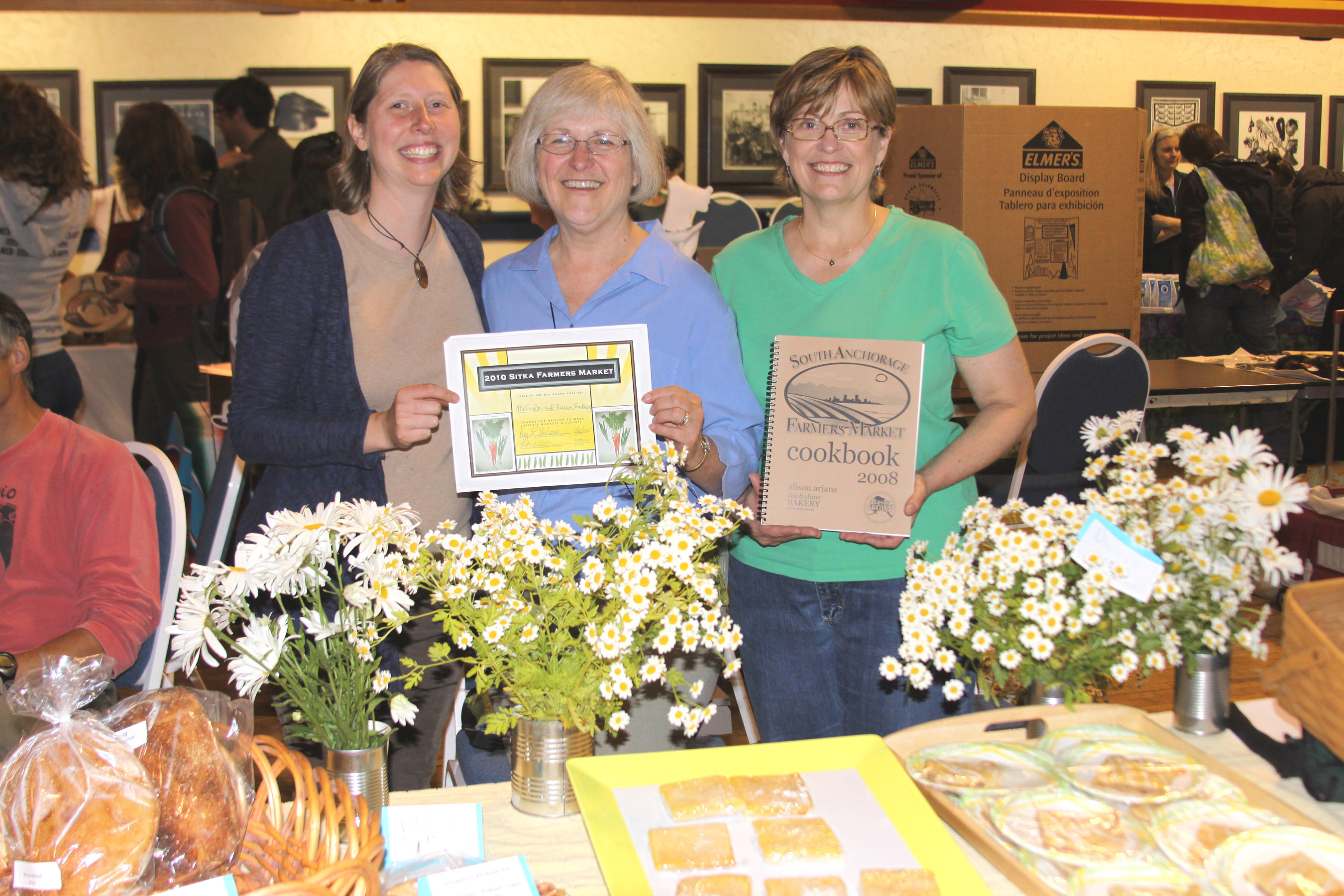
Sitka Local Foods Network boardmember Johanna Willingham, left, presents Karen Christner, center, and Malinda Bonsen, right, of Malinda and Karen's Bakery with the Table of the Day award at the second Sitka Farmers Market of the summer on July 31 at Alaska Native Brotherhood Hall in Sitka.
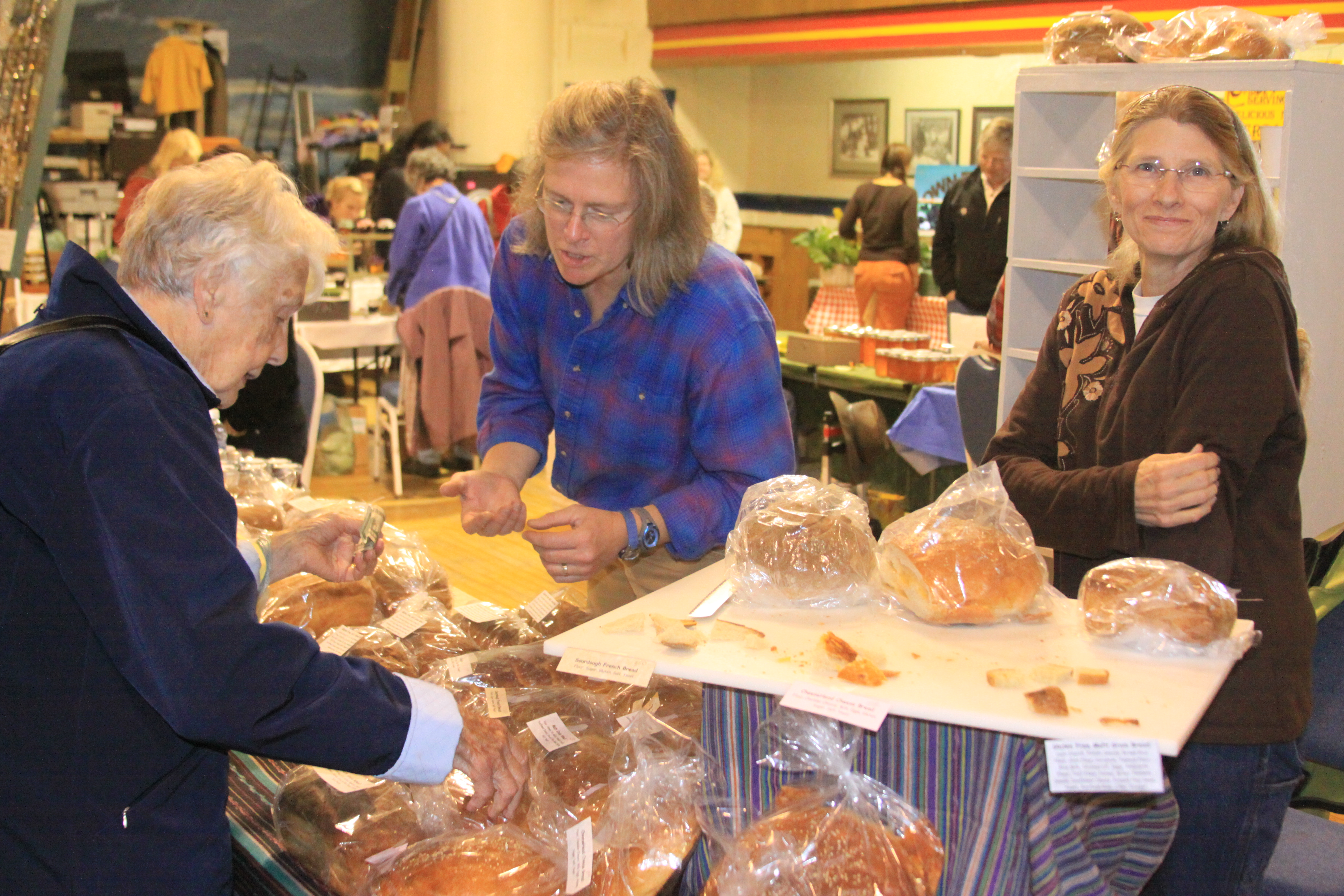
Karen Christner and Malinda Bonsen of Malinda and Karen’s Bakery won the Table of the Day award at the second Sitka Farmers Market of the summer on July 31 at Alaska Native Brotherhood Hall.
The two local home bakers were presented with a certificate, $25 cash and a farmers market cookbook by Sitka Local Foods Network boardmember Johanna Willingham. Karen and Malinda baked bread, cinnamon rolls and other desserts to sell at the July 31 market. They also sold some flowers and vegetables from their home gardens.
One vendor at each of the five scheduled Sitka Farmers Markets this season will receive a similar prize. The next markets are from 10 a.m. to 2 p.m. on alternate Saturdays, Aug. 14, Aug. 28 and Sept. 11, at historic ANB Hall. We look forward to seeing you at our next market.
A slideshow of photos from the second Sitka Farmers Market is posted below, and a similar slideshow can be found on our Shutterfly site.
Voting is broken down into four categories based on the number of vendors at each farmers market. The four categories are Boutique (15 or fewer vendors), Small (16-30 vendors), Medium (31-55 vendors) and Large (more than 56 vendors). The Sitka Farmers Market competes in the Boutique category, and we need about two dozen votes to climb into the national top-20 ranking for our category.
Even though the Sitka Farmers Market is in the smallest size category, it was the leading vote-getter for Alaska as of Thursday, July 29. But a flurry of voting that night vaulted HomeGrown Market of Fairbanks (a Medium market) well ahead of us in the battle for the top market in the state. Voting continues through the end of August so we need your votes to close the gap.


 The SitNiks will provide musical entertainment during the third Sitka Farmers Market of the season, from 10 a.m. to 2 p.m. on Saturday, Aug. 4, at the Alaska Native Brotherhood Hall (235 Katlian St.).








 Sitka Local Foods Network
You must be logged in to post a comment.