(EDITOR’S NOTE: On Tuesday, May 15, the Sitka Tribe of Alaska hosted the Sitka Herring Summit to discuss issues regarding the management, or mismanagement, of herring stocks in Southeast Alaska. Sitka herring researcher Heather Meuret-Woody made this presentation, which also appeared as a shorter letter to the editor in the Daily Sitka Sentinel on May 18. The opinions expressed are Heather’s alone, though the Sitka Local Foods Network has written letters supporting the Sitka Tribe of Alaska in its bid to get the Alaska Department of Fish and Game to reduce the commercial quota for herring in Sitka Sound.)
Sitka Sound Herring Summit
May 15, 2012
Heather Meuret-Woody
Sitka Sound Herring Researcher
 I have been a Sitka Sound herring researcher for about 10 years. I have decided to share my few thoughts on the Sitka Sound herring population. With this said, in my opinion there was not 144,143 tons of the predicted mature herring biomass returning to Sitka Sound. An overestimate of the biomass seems to be the suspect.
Managers of forage fish know that traditional stock management techniques do not work well with forage fish. The reason for the failure of traditional stock assessment techniques is that the “catchability” of forage fish increases as the stock declines. However, due to the schooling nature of forage fish and their vulnerability to modern acoustics and fishing gear, catch rates remain constant, even when the stock is rapidly falling in size (Beverton, 1990). Thus declines in stock size will not be apparent to managers or to the fishing industry, based on catch per unit effort statistics. Management of forage fish stocks requires direct measurement of stock size. This can be accomplished by surveying fish abundance during the spawning season, or by conducting scientifically designed acoustic surveys of schools of forage fish. Failure to monitor the stock directly will result in the inability to determine changes, even severe declines, in forage fish abundance. With that said, ADF&G does not measure the Sitka Sound herring stock directly. They may do acoustic surveys and aerial surveys but the data is not used for determining stock size in the ASA model. ADF&G relies almost entirely upon spawn deposition estimates to determine the spawning biomass. Hebert, 2010 states, “Estimates of total egg deposition on Macrocystis kelp may be highly variable, and transects that cross Macrocystis kelp beds could result in very high egg deposition estimates, resulting in high uncertainty around total estimates of egg deposition.” ADF&G also notes in this report that they have issues with diver calibration. One diver may visually estimate more or less eggs compared to another diver. Individual calibration factors can have a potentially large impact on spawn deposition estimates of biomass.
 Accurate and regular estimates of fecundity are important for “ground-truthing” assumptions used by ADF&G. Fecundity estimates are used to convert estimates of herring egg deposition into mature biomass, and is used quite commonly among world-wide herring managers. ADF&G has only measured fecundity 4 times since the 1970s (Hulson et al., 2008). Since then, they just estimate fecundity based on weights, so large female herring lay approximately 40,000 eggs and small female herring lay approximately 20,000 eggs. Using un-validated parameters is extremely risky. For example, a 10% change in the egg per gram measurement used to convert spawn to fish, can result in a 20% change in the number of fish estimated.
In 2007, 2008, and 2009, spawning herring were sampled for Ichthyophonus prevalences in Sitka Sound. The results showed that 27% – 40% were positive for Ichthyophonus. All of this data is provided by Hershberger, Winton, and Purcell, from USGS Marrowstone Marine Field Station. The results of the 2010 and 2011 data from this ongoing research were not available at the time of this letter. Sitka Sound herring have had the Ichthyophonus disease for years and ADF&G has not incorporated this data into their current management. The ASA model does not account for disease, just “natural mortality.” However, this “natural mortality” is not based on observed data, but has been estimated by picking a random, but “conservative” number and applying it to the herring stock.
Sitka Sound herring follow the Pacific Decadal Oscillation (PDO) which is a 14-year oscillatory cycle and is highly correlated with an annual index of zooplankton biomass. Strong negative values of the PDO were observed in autumn 2011: “If these values persist through winter and early spring 2011-2012, they could result in the best ocean conditions observed in decades,” according to the 2011 annual update for the Ocean Ecosystem Indicators of Salmon Marine Survival in the Northern California Current research project, which has been ongoing since 1998. Additionally, “These negative values are expected to continue into spring 2012, which suggests that the northern North Pacific Ocean will also remain cold through spring 2012, giving rise to continuation of good ocean conditions.” So it is hard to imagine with this optimal ocean condition that Sitka Sound herring experienced mass mortality since last year. This winter we experienced the Arctic Oscillation which is essentially a pressure pattern that drives the jet stream, and controls how strong its winds are and where the jet stream position is. This winter, the jet stream trough, which tends to push the jet stream far to the north, helped drive storms into Alaska.
 From 2006-2010, ADF&G has been trying to convince the public that the Sitka Sound herring had changed their maturation rates. They claimed that the herring were maturing later. Instead of herring reaching maturity at age-3 and age-4 they were not maturing until age-5, age-6, and age-7. Of course this was not actual observed data. ADF&G did not base this on ovarian histology or anything concrete, instead the changes were based on a number estimate to make the ASA model fit the data rather than using field data to fix the model. No other herring stocks along the Pacific Coast have herring delaying maturation, so it shouldn’t surprise anyone that Sitka’s herring are maturing at their usual rate. Additionally, ADF&G claimed that the herring were surviving longer, and the survivability rate they have been using is 87%. Again this was not based on anything managers actually observed, but was again a random number forced to make the ASA model fit the data. Even Hebert, 2010 states “External estimates of age-specific survival would improve the ASA model and provide more accurate forecasts of spawning biomasses.” If the Sitka Sound herring actually had 87% survivability rate, then the only way herring could have died was to be eaten by a predator or get caught in a purse seine net.
In 2008, I did a co-study with the ADF&G Age Determination Laboratory in Juneau. ADF&G collected 50 herring from the winter bait fishery and aged the herring via scale reading. I then received those 50 herring and aged them via otolith aging – and this is not the break and burn method, this is the thin-sectioning method that is widely recognized world-wide and even used by the California Department of Fish and Game on herring stocks. The herring aged via otolith actually aged 2 years younger on the average than the scale aging methodology. If you recall, ADF&G announced 12/16/2010 that their aging assessments were wrong for the period of 1999-2010. Once they re-aged all of the archived samples, they too came up with an average of 2 years difference. Additionally, because the ASA model used by ADF&G to forecast the mature biomass requires a long time series of reliable age estimates, the department chose not to use the ASA model, but instead relied on a biomass accounting model to forecast the 2011 Sitka Sound mature herring population.
Significant fisheries-induced evolutionary change has been researched in Norway in Baltic herring and has lead to the entrainment hypothesis: an explanation for the persistence and innovation in spawning herring migrations and life cycle spatial patterns (Petitgas et al. 2006). This research is quite intriguing and deserves more consideration. In 2008, the commercial fishery occurred along the entire Kruzof Island shore line in very shallow water. While the herring schools were being fished upon, a large percentage of the spawning biomass seemed to avoid the purse seiners and hit the first shoreline available, Kruzof, and spawned. Now if you review ADF&G spawn maps that go back to 1964 you will know that there has been less than 15 times that the herring biomass used the Kruzof shoreline as spawning habitat. The Kruzof Island shoreline is not very suitable spawning habitat as newly hatched larvae would be swept up in the currents and advected out of Sitka Sound, causing low survivability (Sundberg, 1981). However, if herring spawn on the islands, i.e. Middle Island, Kasiana, or along the road system, the currents in Sitka Sound keep the hatched larvae in the inner bays and water ways which are excellent for retention and increases survivability. Keeping in mind that herring recruit into a mature cohort at around age-4, the 2008 commercial sac roe fishery may have reduced the amount of recruits that we would have seen this year in 2012. Unfortunately we will never know because ADF&G does not measure immature herring. I have researched juvenile herring populations in Sitka Sound for several years and found that one of the most important rearing areas is along the Halibut Point Road shoreline from Katlian Bay and Nakwasina in the north to Halibut Point Marine and Cove Marina in the south (Meuret-Woody and Bickford, 2009). Unfortunately, the new dock at Halibut Point Marine will soon become a place for net pen-rearing of hatchery salmon smolts – with no consideration on the impacts it could have on juvenile herring populations.
Finally I’d like to point out that ADF&G staff has been quoted saying that herring only seem to spawn in Salisbury Sound when there is such a large biomass that extra spawning habitat is needed. So basically they claim Salisbury Sound is a spill-over spawning habitat, although they have no data to support this assertion. If this were actually true, based on biomass size, then where was the huge spill-over of spawning biomass in Salisbury Sound in 2011 and 2012 – both of which were huge forecast biomass years? In my published paper, Identifying Essential Habitat (Source vs. Sink Habitat) for Pacific Herring in Sitka Sound Using Otolith Microchemistry (Meuret-Woody and Bickford, 2009) it appears that Salisbury Sound actually supports a small discrete population of herring (10%), separate from Sitka Sound herring. Salisbury Sound may also be a source population for Hoonah Sound, supplying approximately 14% of the population for Hoonah Sound. Why doesn’t ADF&G rely on published data instead of relying on guesses made by their managers?

 The fifth season for the Sitka Farmers Market doesn’t open until July 7, but you can vote for us now in the fourth annual America’s Favorite Farmers Markets contest. The contest is sponsored by the American Farmland Trust, a non-profit organization dedicated to preserving America’s agricultural resources.
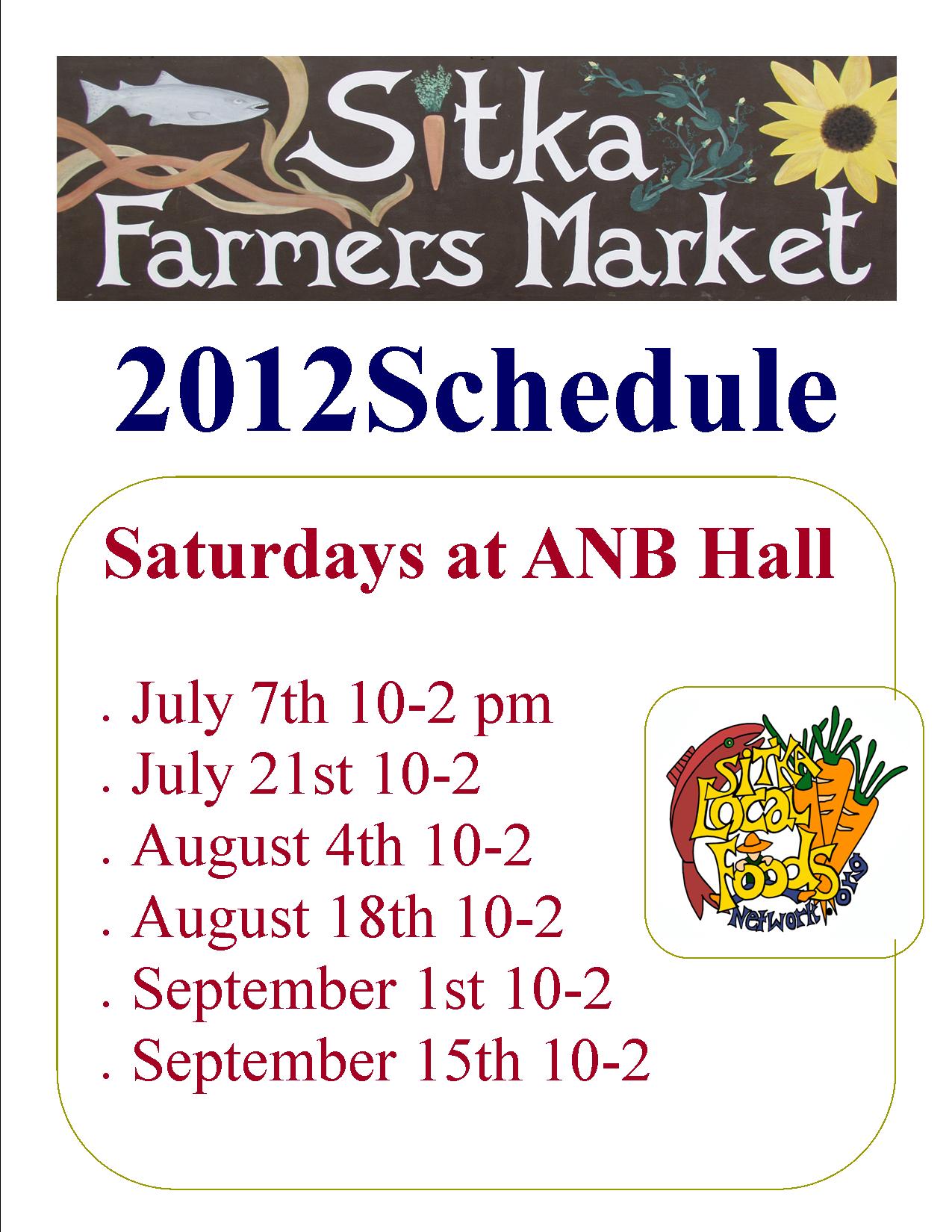 By the way, the summer’s first Sitka Farmers Market is from 10 a.m. to 2 p.m. on Saturday, July 7, at Alaska Native Brotherhood Hall (235 Katlian St.). Other markets are scheduled for alternate Saturdays — July 21 Aug. 4, Aug. 18, Sept. 1 and Sept. 15. There also will be a small Sitka Farmers Market produce booth at the Running of the Boots fundraiser for the Sitka Local Foods Network on Sept. 29 at the Crescent Harbor covered shelter. We’re looking forward to seeing you at the markets.




 Sitka Local Foods Network
You must be logged in to post a comment.