• Sitka Farmers Market prepares for eighth summer of fresh, local veggies

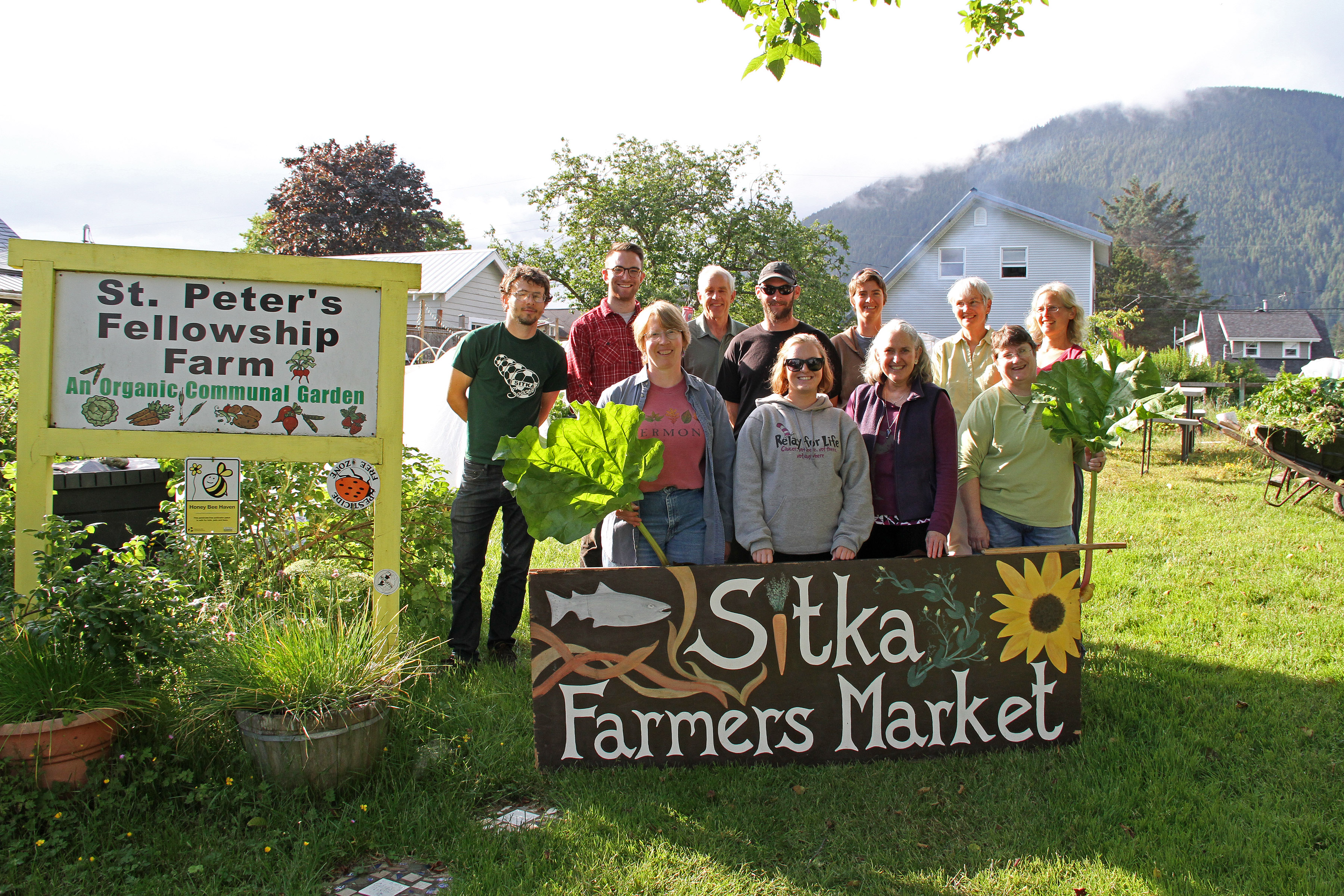
PHOTO COURTESY OF SITKA LOCAL FOODS NETWORK Sitka Local Foods Network board members and supporters pose at the St. Peter's Fellowship Farm communal garden on Monday. St. Peter's Fellowship Farm supplies most of the local produce sold at the Sitka Farmers Markets during the summer. The first Sitka Farmers Market of the season is from 10 a.m. to 1 p.m. on Saturday, July 4, at the Alaska Native Brotherhood Founders Hall, 235 Katlian St. The other five Sitka Farmers Market dates are July 18, Aug. 1, Aug. 15, Aug. 29, and Sept. 12. Pictured are, front row from left, Michelle Putz, Muriel Sadleir-Hart, Lisa Sadleir-Hart, and Kathy Jones. Back row, Matthew Jackson, Jonathan Adler, Peter Gorman, Jud Kirkness, Brandie Cheatham, Mary Therese Thomson, and Laura Schmidt.

PHOTO COURTESY OF SITKA LOCAL FOODS NETWORK
Sitka Local Foods Network board members and supporters pose at the St. Peter’s Fellowship Farm communal garden on Monday. St. Peter’s Fellowship Farm supplies most of the local produce sold at the Sitka Farmers Markets during the summer. The first Sitka Farmers Market of the season is from 10 a.m. to 1 p.m. on Saturday, July 4, at the Alaska Native Brotherhood Founders Hall, 235 Katlian St. The other five Sitka Farmers Market dates are July 18, Aug. 1, Aug. 15, Aug. 29, and Sept. 12. Pictured are, front row from left, Michelle Putz, Muriel Sadleir-Hart, Lisa Sadleir-Hart, and Kathy Jones. Back row, Matthew Jackson, Jonathan Adler, Peter Gorman, Jud Kirkness, Brandie Cheatham, Mary Therese Thomson, and Laura Schmidt.

Sitka Local Foods Network uses St. Peter’s Fellowship Farm and Sitka Farmers Market to improve food security in Sitka

During the stormy months of winter, most people in Sitka aren’t thinking about their gardens. But that’s when St. Peter’s Fellowship Farm Lead Gardener Laura Schmidt is trying to figure out which vegetables to plant in which garden bed, starting seeds, and (if the soil isn’t frozen) amending the soil with seaweed and other nutrients to get an early start on the garden.

As the lead gardener since 2011, a contract position with the Sitka Local Foods Network, Schmidt is responsible for growing most of the fresh, local vegetables sold during the Sitka Farmers Markets each summer. She oversees food production at the St. Peter’s Fellowship Farm communal garden, located behind St. Peter’s By The Sea Episcopal Church, and at an extension garden located at Pat Arvin’s house.

Schmidt and her volunteer gardeners have about 3,000 square feet in production. Last year they grew about 300 pounds of rhubarb and 100 pounds of kale. “That’s a lot of kale,” Schmidt said. Besides kale and rhubarb, they also grow garlic, onions, potatoes, kohlrabi, cabbage, broccoli, fava beans, spinach, carrots, beets, nasturtiums, zucchini, cucumbers, and more.

“It’s fun to have it all come together. It’s nice to see it turn into food,” Schmidt said. “It’s a fun puzzle because every year is different, and how do we make it more productive.”

2015SitkaFarmersMarketFlierSitka residents will have a chance to celebrate their independence from store-bought and overly processed food at the first Sitka Farmers Market of the summer, which takes place from 10 a.m. to 1 p.m. on Saturday, July 4, at the Alaska Native Brotherhood Founders Hall. The other five markets will be on July 18, Aug. 1, Aug. 15, Aug. 29, and Sept. 12.

“It’s very important. People come for the produce. It’s the prime attraction,” Sitka Farmers Market Manager Debe Brincefield said. “We have jams and jellies, bread, fish, and arts and crafts, but people bring their produce bags and are happy to fill them.”

The Sitka Farmers Market and St. Peter’s Fellowship Farm are two of the main projects of the Sitka Local Foods Network, and both projects came out of the second Sitka Health Summit, which took place in April 2008. The first garden beds were built and planted at St. Peter’s Fellowship Farm by May 2008, and food grown at St. Peter’s was available for sale at the first Sitka Farmers Market in August 2008. Since then, both projects have been a growing concern.

These two projects came about because many in Sitka were concerned about food security, especially as the country entered a major recession in 2008. It’s estimated about 90-95 percent of the food eaten in Alaska is shipped here from the Lower 48 or foreign countries, and artificially cheap transportation made it easier for people to buy their food from the store than to grow or harvest it themselves, which was the norm in Sitka until the 1950s and 1960s. With so little food being grown locally, Sitka residents worried what might happen if fuel prices went up or if we had a natural disaster that destroyed our ports and/or airport.

There also were worries about how much longer residents could afford store-bought food, especially as Sitka food prices went up 43.6 percent from September 2003 to 2011, according to the Sitka Community Food Assessment Indicators Report (a 2012 Sitka Health Summit project). The report also noted that 1,410 Sitka residents participated in the food stamp program in 2013, about one-sixth of Sitka’s population of about 9,000. Sitka residents redeemed $1,645,702 in food stamp dollars in 2012, an increase of $201,000 from 2011.

The Sitka Farmers Market and St. Peter’s Fellowship Farm are two key elements for improving food security in Sitka, with education about gardening and food preservation being another key element.

“It helps people to connect the food to the market, and hopefully realize the Sitka Local Foods Network is the umbrella organization,” Sitka Local Foods Network Board President Lisa Sadleir-Hart said. “We knew if we had a market, we had to have food to sell. We have a lead gardener in Laura who has grown and expanded the St. Peter’s Fellowship Farm and our extension garden at Pat Arvin’s every year. And we have generous people who donate produce from their gardens for us to sell, such as Jud Kirkness, Linda Wilson and my family.”

AK 2015 FMNP Poster SLFNTo help families struggling with food security, the Sitka Farmers Market became the first farmers market in Southeast Alaska to accept SNAP (food stamps) and WIC nutrition benefits, including the Alaska Quest electronic benefits transfer cards used for SNAP. The Sitka Farmers Market also matches dollars spent on SNAP-approved foods (produce, fish, baked goods, barley products, etc.), which allows Alaska Quest card users to double their purchase by as much as $20 per person per market. That means a family of four with SNAP benefits can be matched up to $80. This year, the Sitka Farmers Market will partner with the SouthEast Alaska Regional Health Consortium (SEARHC) on a new program where SEARHC beneficiaries with chronic disease are prescribed vouchers for fruits and vegetables.

And the growing is spreading.

“As I was taking a walk around town the other day, I identified three new gardens,” Sadleir-Hart said. “They also have a new garden at the Pioneer Home where they’re growing food.”

For more information about the Sitka Local Foods Network, Sitka Farmers Market and St. Peter’s Fellowship Farm, go to http://www.sitkalocalfoodsnetwork.org/ or email sitkalocalfoodsnetwork@gmail.com. To learn about being a vendor at the Sitka Farmers Market, contact Debe Brincefield at sitkafarmersmarket@gmail.com or call 738-8683.

(Editor’s note: The story above appeared in the Weekender section of the July 2, 2015, edition of the Daily Sitka Sentinel. It was written by Sitka Local Foods Network board member/communications director Charles Bingham.)

• Please remember those people in Sitka in need during this Thanksgiving season

SalvationArmyTunaShelf

As we approach Thanksgiving, many families are gathering their supplies for the traditional feast. But there are a lot of people in Sitka who are struggling just to put food on the table.

In Sitka, the Salvation Army serves as the USDA-designated food bank and distribution point for commodity food. Maj. Turnie Wright (who teams up with his wife, Maj. Evadne Wright to run the local Salvation Army) said there are many items the Sitka Salvation Army can use to keep up with Sitka’s growing hunger needs. He said they served 77 meals at the soup kitchen the other day. You can learn more about Sitka’s growing number of people who need food assistance in the Sitka Community Food Assessment Indicators Report released in April 2014 (note, the number of people using the Salvation Army food bank and soup kitchen already is much higher than the numbers listed in the report).

Here’s a list:

  • gloves/mittens, hats, and coats (especially kids sizes)
  • sample-size toiletry kits
  • diapers (all sizes)
  • vegetables (canned, if possible, due to limited freezer space, or fresh for the soup kitchen)
  • cereals (avoid the sugar-laden junk masquerading as cereal)
  • peanut butter
  • potted meat (spreadable, such as Libby’s)
  • Ramen noodles
  • powdered milk
  • canned meats (such as chicken, salmon, Spam, etc.)
  • pork and beans
  • soups
  • spaghetti and other pasta
  • spaghetti sauce
  • fish (any type, frozen is preferred for the soup kitchen and canned for the food bank)
  • wild game (for the soup kitchen)
  • six-packs of Ocean Spray or other juices
  • bottled water/tea
  • raisins (preferably in the snack boxes)

Maj. Turnie Wright said the Salvation Army can break down bulk sizes of different foods for the food bank. He also said they accept grocery gift cards from the local stores and Costco. In addition, they can work with people who are taking their vehicles to Juneau on the ferry and have room to bring stuff back from the Southeast Food Bank or Costco (this helps Salvation Army avoid freight charges). Finally, when you design your garden this year, don’t forget to Plant A Row For The Hungry.

The Salvation Army is one of several food assistance programs in Sitka, with others being centered around local churches, the Sitka Tribe of Alaska, and Sitkans Against Family Violence. The Salvation Army will assist the Sitka Tlingít and Haida Community, Sitka Tribe of Alaska, and the Alaska Native Brotherhood/Alaska Native Sisterhood to host the annual community Thanksgiving dinner on Thursday, Nov. 27, at ANB Founders Hall. Doors open at 1 p.m., and food will start being served at 2 p.m. until it runs out (probably about 4 p.m.). Volunteers are needed, and donations of side dishes and desserts are appreciated (call Rachel Moreno at 738-6595 for details on the dinner).

For more information about how to help with the Salvation Army food bank and soup kitchen, contact Maj. Turnie Wright at 738-5854.

• ‘Building Food Security in Alaska’ report released during Alaska Food Festival and Conference

14-09-17_building-food-security-in-ak_exec-summary-recommendations_Page_01

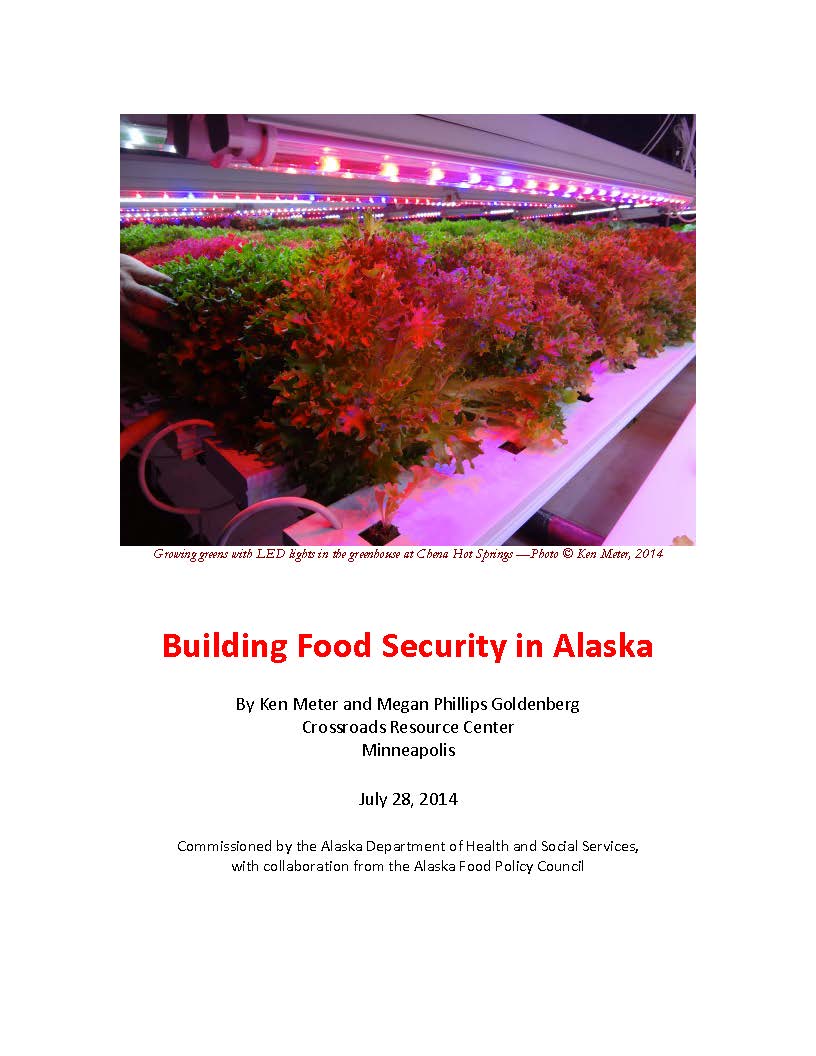
The release of a new report, “Building Food Security in Alaska,” was one of the highlights of the recent Alaska Food Festival and Conference (Nov. 7-9 at the University of Alaska Lucy Anchorage Cuddy Center). This is one of the first comprehensive statewide food security reports compiled for Alaska.

The report was written by Ken Meter and Megan Phillips Goldenberg of the Crossroads Resource Center in Minneapolis, which has done six in-depth statewide food assessments over the past five years and 14 statewide food assessments overall. The report was commissioned by the Alaska Department of Health and Social Services, with collaboration from the Alaska Food Policy Council.

The Crossroads Resource Center website provides this summary of the report:

Like most other states, Alaska imports about 95 percent of the food it purchases. Yet this state is more distant from prevailing food production regions than other states. Alaskans feel a special sense of vulnerability. Despite a rich history in dairy and cattle production, most of these foods are now imported. Much of the arable farmland has been paved over by development. Moreover, Alaskans who wish to purchase some of the $3 billion of seafood harvested from its ocean waters typically have no choice but to buy through Seattle vendors.

Still, farms produce a rich variety of crops and livestock. Direct sales from farmers to household consumers run at 13 times the national average, amounting to one of every six dollars farmers earn selling food to humans. Lettuce, peppers, and cucumbers are available year-round from indoor farms. Chickens are grown inside greenhouses that rely upon surplus heat from nearby buildings.

In no other state is harvesting wild foods as important. Subsistence and personal use hunters bring in an estimated $900 million worth of salmon, caribou, moose, foraged greens and berries, and other foods. Yet even here, hunters and gatherers face special challenges: a decline of hunting skills, weakening ice, changing migrations, and radioactive fallout.

Our study, written by Ken Meter and Megan Phillips Goldenberg, offers practical steps for building a more reliable food supply by growing, storing, and marketing more Alaska-grown food to Alaskans. Commissioned by the Alaska Department of Health and Social Services.

Copies of the full 180-page report and a shorter executive summary and recommendations are linked below. In addition, most of the presentations and panel discussions from the Alaska Food Festival and Conference can be found here. This link includes a keynote presentation by Sitka Local Foods Network Board President Lisa Sadleir-Hart about the experience of compiling the Sitka Community Food Assessment, plus Sitka residents Keith Nyitray of the Sitka Food Co-op and Gordon Blue of the Alaska Sustainable Fisheries Trust participated in panel discussions about food cooperatives and community-based fisheries, respectively.

In addition, earlier this year two locally focussed food assessments were released. Copies of the Sitka Community Food Assessment Indicators Report (released in April 2014) and the Southeast Alaska Food System Assessment (released in February 2014) can be found in the Documents section of our website.

• Building Food Security in Alaska, Executive Summary and Recommendations, by Ken Meter and Megan Phillips Goldenberg (released November 2014)

• Building Food Security in Alaska, by Ken Meter and Megan Phillips Goldenberg (released November 2014)

• Inaugural Alaska Food Festival and Conference to feature Sitka speakers

AlaskaFoodFestivalAndConferenceCard

AlaskaFoodPolicyCouncilLogoThree Sitka residents will have prominent roles during the inaugural Alaska Food Festival and Conference on Friday through Sunday, Nov. 7-9, at the University of Alaska Anchorage’s Lucy Cuddy Center. This event is hosted by the Alaska Food Policy Council.

Sitka Local Foods Network Board President Lisa Sadleir-Hart will deliver one of the two keynote speeches during lunch on Friday, when she will discuss food security and the results of the Sitka Community Food Assessment.

Keith Nyitray, president of the Sitka Food Co-op board, will participate in a panel discussion Friday afternoon about the future of food cooperatives in Alaska. Gordon Blue, the president/executive director of the Alaska Sustainable Fisheries Trust (which operates the Alaskans Own Seafood community supported fishery program), will participate in a Friday afternoon panel discussion about innovations to enhancing local fishing livelihoods in coastal Alaska.

This event has a different theme for each of the three days. Friday is the Alaska Food Policy Conference, which features local and national speakers who will present and lead discussions on a variety of food security, production, business and community issues. Saturday is the Alaska Food Festival, which gives participants to sample a variety of Alaska food products, attend short classes on various food topics, shop at the farmers market, etc. The event wraps up Sunday with the Food System Open House, where participants can visit sites in Anchorage that are doing exciting work in our food system.

To register for the Alaska Food Festival and Conference use this link, http://akfoodpolicycouncil.wordpress.com/conference/register/. Registration is $125, or $75 for students. For questions or more information, please feel free to contact the Alaska Food Policy Council at 1-907-269-8072 or akfoodpolicycouncil@gmail.com.

• Sitka Health Summit planning day is Oct. 3 at Harrigan Centennial Hall

Planning Day Flyer 1 - 2014NewSitkaHealthSummitLogoJoin us for the eighth annual Sitka Health Summit planning day, which takes place from 8:30 a.m. to 4:30 p.m. on Friday, Oct. 3, at Harrigan Centennial Hall.

The Sitka Health Summit got its start in 2007 when then-Sitka Community Hospital CEO Moe Chaudry and then-SouthEast Alaska Regional Health Consortium (SEARHC) Vice President of Hospital Services Frank Sutton decided they needed to bridge the gaps between Sitka’s largest two health services. They launched the Sitka Health Summit, with the help of other supporters in Sitka, as a way to improve community wellness, honor local wellness champions, and more.

One of the highlights of the Sitka Health Summit has been the annual community wellness planning day. During planning day, Sitka residents get together to discuss the health needs of the community and create community wellness projects to address these needs.

Over the years there have been a variety of Sitka Health Summit projects — create a local market for local fish and produce, build a Sitka community greenhouse, become a Bicycle Friendly Community, become a Walk Friendly Community, encourage more kids and families to get outdoors for recreation, support a community health and wellness center (Hames), plant fruit trees around town, get more local fish into school lunches, build a Choose Respect mural, Revitalize Sitka, the Sick-a-Waste compost project, the Sitka Community Food Assessment, and Park Prescriptions. The 2013 Sitka Health Summit projects were Together for a Meth-Free Sitka and Sitka Kitch (a project to create a community rental kitchen and improve Sitka’s emergency food storage capacity). The 2014 Sitka Health Summit will choose two new projects, which will receive $2,000 in seed money to get started.

To register for the Sitka Heath Summit planning day, go to http://www.sitkahealthsummitak.org/ or call 738-0468. A free lunch with locally sourced food will be provided.


• Learn about where your Sitka Farmers Market produce is grown

WhereOurFoodIsGrown

SitkaFarmersMarketSignWhen people stop at the Sitka Local Foods Network booth at the Sitka Farmers Market to buy produce a common question people ask is where is the food grown.

Most of the produce sold at the Sitka Local Foods Network booth is grown here in Sitka and comes from three main sources — the St. Peter’s Fellowship Farm communal garden (Laura Schmidt is lead gardener), some land in Pat Arvin’s Garden she donates to the Sitka Local Foods Network to grow potatoes and carrots, and Anam Cara Garden owned by Tom Hart and SLFN president Lisa Sadleir-Hart. We also receive donations from other family gardens in town with extra produce.

All of the funds raised selling produce at the Sitka Local Foods Network booth are used to support SLFN projects during the year. These include hosting the six Sitka Farmers Markets each summer, operating St. Peter’s Fellowship Farm, providing a variety of education opportunities about local foods and gardening in Sitka, and supporting other projects in town that promote local foods (such as the Sitka Community Food Assessment, Fish to Schools, Sitka Kitch, etc.).

Don’t forget the last Sitka Farmers Market of the summer is from 10 a.m. to 1 p.m. on Saturday, Sept. 6, at Alaska Native Brotherhood Founders Hall (235 Katlian St.). If you live near Sawmill Creek Apartments (9:45 a.m. pick-up), Indian River housing (9:50 a.m.), or the Swan Lake Senior Center (10 a.m.), we have free transportation to the market through a contract with Sitka Tours. The shuttle bus picks up at the times listed, and makes its return trip at noon from ANB Hall. We do plan a small produce table at the Running of the Boots on Saturday, Sept. 27, near St. Michael’s Russian Orthodox Cathedral.

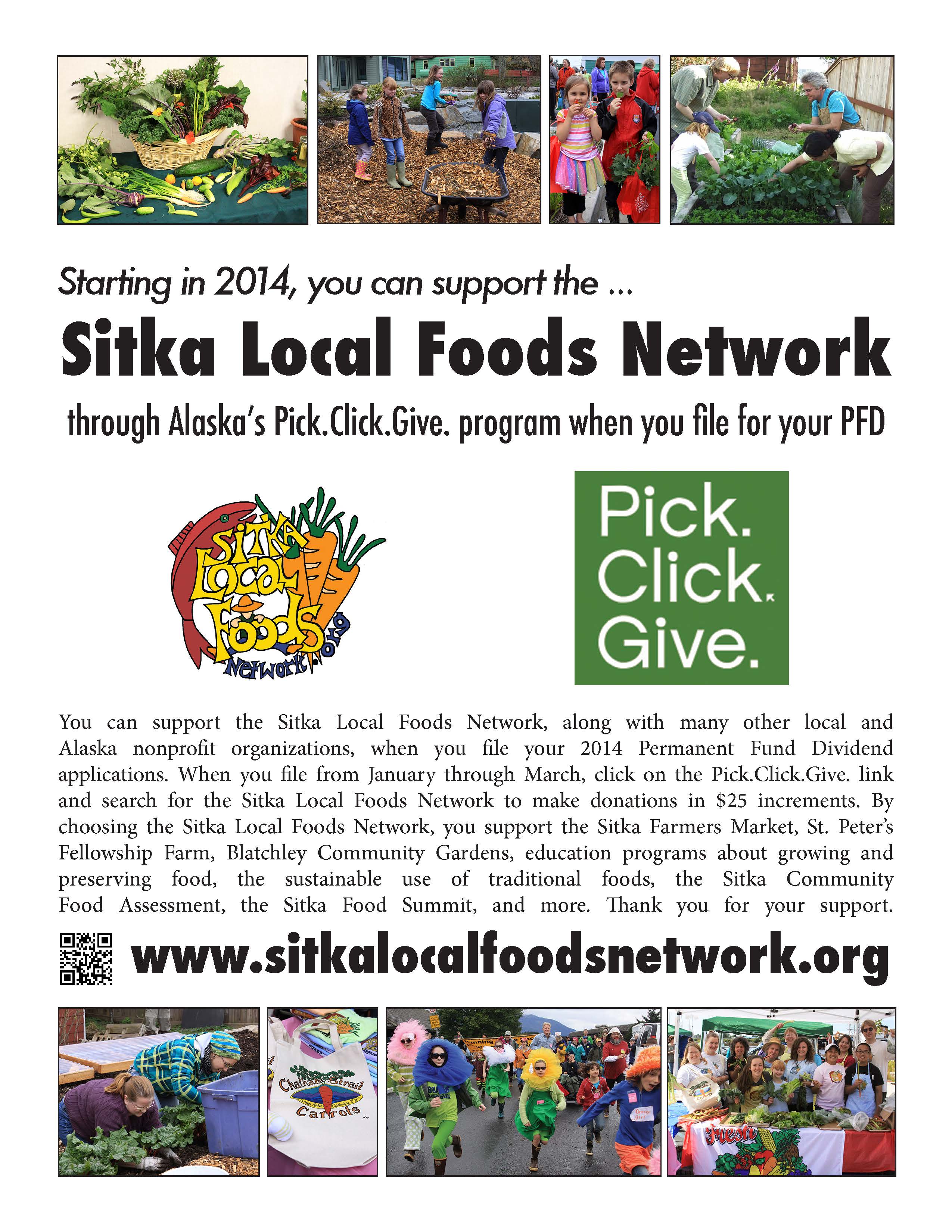
• Don’t forget Sunday’s the deadline to add Pick.Click.Give. donations to your PFD application

PickClickGiveFlier2PRINT

Lovalaska FB Square PhotoGrid Tag (1)If you’re like most Alaskans you probably filed your 2014 Alaska Permanent Fund Dividend (PFD) application before the March deadline. But did you know you still can add Pick.Click.Give. donations to your 2014 application through Sunday, Aug. 31? If you haven’t already, please consider making a Pick.Click.Give. donation to the Sitka Local Foods Network.

Here’s how to add or change your Pick.Click.Give. donations. First, go to the Alaska Permanent Fund Dividend application website, http://pfd.alaska.gov/, and find the green bar in the right column. Click the green bar, and follow the directions. You’ll need to enter your driver’s license number, Social Security number, and birthday to access your application, but once on the page you’ll be able to see your current Pick.Click.Give. donations (if any) and you can add or change them.

This is the first year the Sitka Local Foods Network is participating in the Pick.Click.Give. program, which allows people to donate in $25 increments to their favorite statewide and local 501(c)(3) nonprofit organizations when they file their PFD applications. When you choose to donate part of your PFD to the Sitka Local Foods Network, you support the Sitka Farmers Market, St. Peter’s Fellowship Farm, Blatchley Community Gardens, education programs about growing and preserving food, the sustainable use of traditional foods, the Sitka Community Food Assessment, the Sitka Food Summit, and a variety of other projects designed to increase access to healthy local foods in Sitka.

You still can donate to the Sitka Local Foods Network if you aren’t from Alaska or aren’t eligible for a 2014 PFD. To donate, send your check to the Sitka Local Foods Network, 408 Marine St., Suite D, Sitka, Alaska, 99835. Our EIN is 26-4629930. Please let us know if you need a receipt for tax purposes. For more information about donating, you can send an email to sitkalocalfoodsnetwork@gmail.com.

Thank you to everybody making a Pick.Click.Give. donation to your Sitka Local Foods Network. We appreciate your support.

• Sitka Community Food Assessment Indicators Report helps define Sitka’s food culture

Food Assessment Indicator Report web version_Page_01

SitkaCommunityFoodAssessmentLogoThe Sitka Community Food Assessment Indicators Report was released on Monday, and the findings will help guide future food system planning in Sitka.

A 2012 Sitka Health Summit project, the Sitka Community Food Assessment has examined where Sitka residents get their food, what types they eat, what they grow, what they hunt and fish for, where they shop, what type of access people have to healthy food, and other questions about Sitka’s food supply. The findings of the food assessment will help Sitka improve its food security.

After Sitka residents chose the Sitka Community Food Assessment as a project at the September 2012 Sitka Health Summit, the work group received a grant to hire a coordinator and contract with a data person. A revised version of a questionnaire from a similar project on the Kenai Peninsula was posted online, available at the library, and discussed in focus groups, with more than 400 residents answering the 36 questions. In November 2013, some of the initial data was presented at the Sitka Food Summit, where about 60 residents discussed the results and noted any further research that needed to be done. Since then, the work group, in partnership with The Island Institute and others, fine-tuned the data before writing and editing the indicators report.

“We hope the Sitka Community Food Assessment Indicators Report can guide future food system planning and plant seeds for innovative responses that will strengthen Sitka’s food landscape,” project coordinator Lisa Sadleir-Hart wrote in the 26-page document’s introduction. “The Sitka Community Food Assessment Indicators Report uncovers many weaknesses in our food system as well as some incredible assets that define Sitka’s food culture — a rich ecosystem filled with nutritious gems from the land and sea plus a generous spirit of sharing with our neighbors. Now that we’ve defined the current foodscape in Sitka, let’s work together to build a more resilient food system that can deeply nourish the entire community for generations to come.”

The Sitka Community Food Assessment Indicators Report opens with Sitka’s demographics and several Sitka food facts. It then features data about how many people in Sitka hunt, fish, gather, and/or grow their own food, as well as some barriers. Next is information about where people in Sitka shop for their food, followed by how many people in Sitka are on some form of food assistance. The report also includes information about food in the schools, and local food manufacturing.

The findings will be presented to the community during an upcoming meeting of the Sitka Assembly, and the report will be posted online here (see below) and on The Island Institute’s website.

• Sitka Community Food Assessment Indicator Report (April 14, 2014, opens as PDF file)

• Sitka Community Food Assessment findings to be presented Nov. 14 at inaugural Sitka Food Summit

Sitka Food Summit Flyer

SitkaCommunityFoodAssessmentLogoThe Sitka Community Food Assessment work group will present its findings during the inaugural Sitka Food Summit, from 6-9 p.m. on Thursday, Nov. 14, at Harrigan Centennial Hall.

A 2012 Sitka Health Summit project, the Sitka Community Food Assessment has examined where Sitka residents get their food, what types they eat, what they grow, what they hunt and fish for, where they shop, what type of access people have to healthy food, and other questions about Sitka’s food supply. The findings of the food assessment will help Sitka improve its food security.

“The Sitka Community Food Assessment work group decided early on that there needed to be an opportunity for Sitka to engage with the food data and shape the writing of the food assessment indicator report,” project coordinator Lisa Sadleir-Hart said. “The inaugural Sitka Food Summit will use a format that was first tested in the late 1990s when the Island Institute was developing Sitka’s initial indicator report.  We’ll interact individually with the data, then use a conversation café model to discuss what the data brings up for us as Sitkans.  The working group wanted to create a venue that meets the needs of a wide range of citizens.”

The event sponsors include the Sitka Community Food Assessment Work Group from the Sitka Health Summit, Alaskans Own Seafood, the Sitka Food Co-op, Sitka Community Hospital, the SouthEast Alaska Regional Health Consortium (SEARHC) Community Transformation Grant and Diabetes Prevention programs, the Sitka Local Foods Network, the Southeast Soil and Water Conservation District, and Sitka Tribe of Alaska. There also will be refreshments thanks to Sitka Community Hospital’s Basement Bistro, St Peter’s Fellowship Farm and Sitka Conservation Society staff.

For more information, contact Lisa Sadleir-Hart at 747-5895 or sitkafoodassessment@gmail.com. (Editor’s note: A few photos from the Sitka Food Summit are posted below.)

This slideshow requires JavaScript.

• Seventh annual Sitka Health Summit helps celebrate a culture of wellness in Sitka

Layout 1

The seventh annual Sitka Health Summit is coming up, and this year’s event features health fair, lunch-and-learn, community planning day and community wellness awards.

This annual event got its start in 2007, when leaders from Sitka Community Hospital and the SouthEast Alaska Regional Health Consortium (SEARHC) got together to try and build bridges between their health organizations. Working with other partners, they created the Sitka Health Summit as a way to help improve the health culture in Sitka.

Summit_LogoThis year’s summit opens with the Sitka Community Health Fair, which takes place from 8:30 a.m. to 12:30 p.m. on Saturday, Sept. 21, at Sweetland Hall on the Sheldon Jackson Campus. This event features workers from the Alaska Health Fair Inc., who will provide a variety of medical tests such as cholesterol checks, glucose tests, vision screenings, flu shots, and more. It also includes informational booths from a variety of health-related programs in Sitka.

At noon on Monday, Sept. 23, at Kettleson Memorial Library will be a lunch-and-learn with Dr. Don Lehmann, a local physician and sports medicine specialist. He will give a brief talk called “Whistle While You Walk,” which will feature highlights about Sitka’s trail system. Participants can enter for a chance to win a set of walking sticks.

The “Community Planning Day: Selecting Sitka’s Wellness Goals” is from 8:30 a.m. to 4:30 p.m. on Friday, Sept. 27, at Sweetland Hall. This all-day event is when members of the community get together and select two community wellness projects to work on this year. The two projects will receive $1,500 in seed money, plus facilitation to help get the project going. Last year’s three winning projects included the Sitka Downtown Revitalization project, Walk Sitka‘s work in applying for a Walk Friendly Communities award, and the Sitka Community Food Assessment. Some of the top projects from previous years include the Sitka Bicycle Friendly Community award applications in 2008 and 2012, the Choose Respect mural at Blatchley Middle School to raise awareness about sexual and domestic violence, the Sitka Outdoor Recreation Coalition’s Get Out, Sitka! project to get more families and kids outdoors, supporting the Hames Athletic and Wellness Center as a community resource, etc. There also have been several projects related to local foods, such as creating a Sitka Farmers Market, expanding community gardens and building a community greenhouse, planting dozens of fruit trees around town, promoting more local fish in school lunches, community composting,, and more. The first 65 people to RSVP will receive a free lunch (contact Clara Gray at clara.gray@searhc.org).

Finally, this year’s Sitka Community Wellness Champion Awards will be presented as part of the Monthly Grind at 7 p.m. on Friday, Oct. 5, at the Sheet’ká Kwáan Naa Kahídi on Katlian Street. The awards are made in a variety of categories, such as physical fitness, nutrition, tobacco control and policy, holistic health, injury prevention, and general wellness.

For more information, call Doug Osborne at 966-8734 or go to the Sitka Health Summit’s website at http://www.sitkahealthsummitak.org/.