Fish to Schools program seeks donations of coho salmon from commercial fishermen

Spencer2

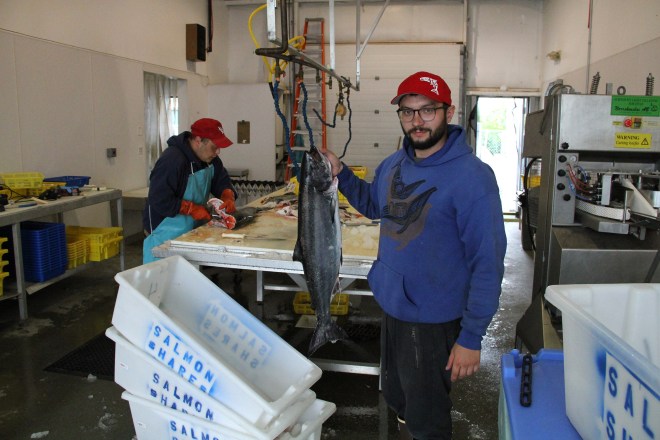
The Fish to Schools program needs help from Sitka’s commercial fishermen. The program needs a few hundred pounds of coho salmon to help make Fish to Schools meals for Sitka students during the upcoming 2016-17 school year. The program also is seeking photos of commercial fishermen at work, which can be used to teach the students more about how the fish got to their plates.

The coho salmon donation period is Wednesday. Aug. 17, through Tuesday, Aug. 23. To donate, commercial fishermen can sign up and indicate how many pounds they want to donate when they offload at Seafood Producers Cooperative or Sitka Sound Seafoods during the donation period. The program can only accept commercially caught fish (no sport or subsistence fish). The hope is to get enough coho donated that locally caught salmon can be offered to students at least once a week. Sign-up sheets will be posted at the scale shacks and in the main offices. Coho salmon is preferred.

Excited red haired kidThe Sitka Fish To Schools project (click here to see short video) got its start as a community wellness project at the 2010 Sitka Health Summit, and now is managed by the Sitka Conservation Society. It started by providing a monthly fish dish as part of the school lunch as Blatchley Middle School, and since then has grown to feature regular fish dishes as part of the lunch programs at Baranof Elementary School, Keet Gooshi Heen Elementary SchoolBlatchley Middle School, Sitka High SchoolPacific High School (where the alternative high school students cook the meals themselves), the SEER School, and Mount Edgecumbe High School.

In addition to serving locally caught fish meals as part of the school lunch program, the Fish To Schools program also brings local fishermen, fisheries biologists and chefs to the classroom to teach the kids about the importance of locally caught fish in Sitka. The program received an innovation award from the Alaska Farm To Schools program during a community celebration dinner in May 2012, and now serves as a model for other school districts from coastal fishing communities. In May 2014, the Fish to Schools program released a guidebook so other school districts in Alaska could create similar programs.

For more information, contact Sophie Nethercut of the Sitka Conservation Society at sophie@sitkawild.org or 747-7509.

Scenes from the fourth Sitka Farmers Market of the 2016 summer

DownToEarthUPickGardenLoriAdamsKickedBack

SitkaFarmersMarketSignLast week was National Farmers Market Week (Aug. 7-13), but someone forgot to tell the weatherman. So we had a bit of rain and inclement weather during our fourth of seven Sitka Farmers Markets of the 2016 summer on Saturday, Aug. 13, at the Alaska Native Brotherhood Founders Hall.

Things will be a bit different, as we host another Sitka Farmers Market from 10 a.m. to 1 p.m. on Saturday, Aug. 20, at the ANB Founders Hall (235 Katlian Street). That’s right, we’re having markets on back-to-back Saturdays for the first time in history.

SalvationArmyBreadDavidKitkaMajorTurnieWrightWe always welcome new vendors who want to sell produce they’ve grown, fish they’ve caught, and local cottage food products they’ve made. To learn more about how to be a vendor, contact Matthew Jackson at (907) 821-1412 or jackson.mw08@gmail.com.

The other markets this summer are on Saturdays, Sept. 3, and Sept. 10. The Sitka Farmers Markets receive sponsorship funding from the SouthEast Alaska Regional Health Consortium (SEARHC). Don’t forget to vote for the Sitka Farmers Market in the American Farmland Trust’s eighth annual Farmers Market Celebration.

A slideshow of scenes from the fourth Sitka Farmers Market of the 2016 summer is below.

This slideshow requires JavaScript.

Sitka Salmon Shares brings Southeast Alaska fish to Midwest markets

MarshSkeeleHoldsSalmonAsGuyFilletsBehind

Sitka Salmon Shares vice president-fisherman Marsh Skeele holds up a chinook salmon during a recent tour of the company’s new plant on Smith Street in Sitka.

NicolaasMinkWithBookOnSalmon

Sitka Salmon Shares founder-president Nicolaas Mink holds a copy of his book “Salmon: A Global History” during a 2014 visit to Sitka.

What started out as a one-off fundraiser for a Sitka nonprofit has grown into a thriving business with sales approaching $4 million, with 2,500 members and 100 wholesale accounts spread out over six states.

Sitka Salmon Shares is a community-supported fishery (CSF) program, where members buy shares in the harvest similar to the process of a community-supported agriculture (CSA) program. But instead of the members being local to Sitka, where most of the fish is caught, the members of Sitka Salmon Shares live in Indiana, Illinois, Wisconsin, Michigan, Minnesota and Iowa.

“Each member gets a five-pound box of fish delivered to their door nine months of the year,” said Marsh Skeele, who serves as Sitka Salmon Shares vice president/co-founder and one of its 13 fishermen-owners. “A lot of them are former Alaskans or from Seattle, so they know good fish. The fish in the grocery stores there tends to have poor quality.”
SitkaSalmonSharesSignThe company distributes four types of salmon (chinook, coho, sockeye and chum), rockfish, ling cod, halibut, spot prawns, Pacific cod and blackcod, with most of the fish caught out of Sitka or Juneau. Sitka Salmon Shares also sells fish at 23 different farmers markets around the Midwest. Last year, Sitka Salmon Shares bought the former Big Blue Fisheries plant in Sitka, and is renovating it so the company can keep up with the special processing and freezing needs of its growing customer base while also developing new value-added products such as smoked salmon to add to the mix.

Sitka Salmon Shares got its start in 2011, when founder-president Nicolaas “Nic” Mink was in Sitka with a couple of his Knox College students working on a sustainable fishing and food-sourcing project with the Sitka Conservation Society. Mink, who still teaches environmental science part-time at Knox (he had a brief stint at Butler University a couple of years ago), decided to take some fish back with him to Galesburg, Ill., which he personally delivered to customers. Then those customers asked for more fish, and Sitka Salmon Shares was born.

TraysOfSalmonPortions“I think that first load of 750 pounds of fish raised about $10,000,” Mink said. “This year, our sixth, we sold more than 100,000 pounds of fish, just under $4 million.”

Some people laughed at his business plan when Mink decided to sell fish more than 2,000 miles away from its source, with a headquarters in a landlocked Midwest town away from most fish markets. But Mink and his partners found out that even people in the Midwest want high-quality fish from sustainable sources, fish that’s well-treated along the journey so it’s still in good shape when it reaches its customers.

“They want to be fish-eaters, but they don’t know how,” Mink said. “Sitka Salmon Shares gives them steps to know how, and it gave us a lot of opportunities to sell fish. Midwesterners are used to eating farmed salmon, but they heard about wild salmon. They want to eat wild, because it’s more resilient and sustainable than farmed.”

GuysFilletingFishEducation is a big part of the Sitka Salmon Shares story. In addition to providing the monthly boxes of fish, there is a newsletter with information about the fishermen-owners, where and how the fish is caught, and a variety of recipes geared toward wild fish and not farmed. The recipes come from four sources — Sitka Salmon Shares members, our chefs, the Alaska Seafood Marketing Institute (ASMI) Cook It Frozen site and from online sources.

“If you take a piece of coho (aka, silver salmon) and cook it as long as a piece of farmed salmon, the flesh becomes mealy and doesn’t taste good,” Mink said. “There’s a lot of education. With farmed salmon, the flesh is soft and thicker than wild salmon, so people need to cook it twice as long as wild salmon. We know wild salmon doesn’t need a lot of time on the grill, and that’s been one of the biggest hurdles.”

“We provide a lot of information,” Skeele said. “They definitely want to know more when you provide them with quality fish. We teach them about pressure bleeding, flash freezing, accountability and traceability. They want to know as much information as we can tell them about the fish that comes through our plant.”
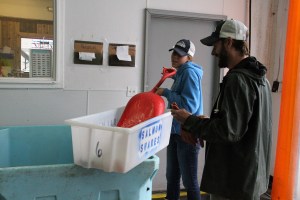
AriannaShovelsIceIntoToteWithJasonCroftThe owner-fishermen are longliners and trollers, for the most part, with some who gillnet sockeye and use pots to catch the spot prawns. Skeele said all of the fishermen are owners in the company, “so they have some skin in the game.” By having skin in the game, the fishermen are more likely to treat the fish better once it comes onto the boat, so it maintains its high quality.

Right now, Sitka Salmon Shares doesn’t sell a lot of its fish in Sitka, although it does sell fish to a couple of local restaurants such as the Westmark HotelTotem Square Inn and Sitka Hotel. Sitka Salmon Shares doesn’t want to compete locally with the Alaskans Own Seafood CSF program that sells to members in Alaska. But now that Sitka Salmon Shares has its own plant, it does offer local processing of fish to charter fishing operations, personal-use and sport fishermen from Sitka, and to commercial fishermen who sell their own fish to various markets around the country.

“We’d like to sell more locally, and it would be great to have our fish in Sea Mart,” Mink said. “We’re excited about our community processing program, and we’re trying to do more processing for Sitka fishermen.”
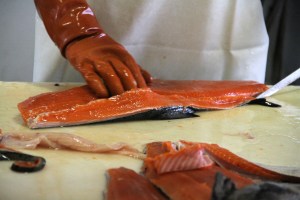
CloseUpOfSalmonFilletingIn recent years, Sitka Salmon Shares has received national exposure with articles in Food & Wine, New Food Economy, Entrepreneur and Forbes, plus a variety of regional publications and Sitka exposure with a story on KCAW-Raven Radio. Mink said there is still more Sitka Salmon Shares can do in the Midwest and Alaska.

“With our plant, we have our own ice and our own value-added room,” Mink said. “We have a talented individual, Pat Glabb, rebuilding Big Blue. He built Silver Bay Seafoods plant. Right now we’re focused on the Midwest, and we have a ways to go to develop our markets there. But we have assets on the ground and systems in place and tons of room to grow. We think there are a lot of cool things to do with value-added. For example, we have Chris Eley, a chef-butcher from the Smoking Goose Meatery in Indianapolis, developing some salmon sausages for us.”

Fishermen wanting to learn more about the Sitka Salmon Shares community processing program can call Jason Croft at 966-9999, or stop by the plant on Smith Street (across from Baranof Island Brewing Company). You also can visit the Sitka Salmon Shares website at http://www.sitkasalmonshares.com/.

This slideshow requires JavaScript.

Building a Local Food System: Andrea Fraga and Middle Island Organic Produce

MiddleIslandOrganicProduceAndreaFragaKalebAldred

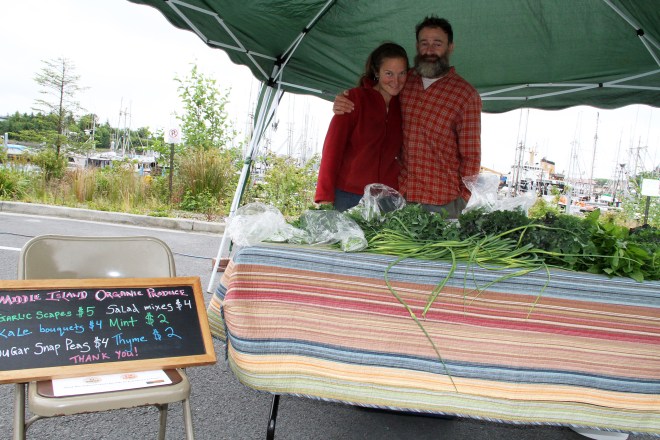
Andrea Fraga, left, and partner Kaleb Aldred, hosted their Middle Island Organic Produce booth at the July 16 Sitka Farmers Market.

(Editor’s Note: The Sitka Local Foods Network’s Bulldog on Baranof intern this summer, Claire Chang, is writing the Building a Local Food System series of articles about Sitkans working to improve food security. This is the fourth article of the series.)

WP_20160704_11_00_23_ProAndrea Fraga grew up in Hawaii and lived in Oregon for 10 years before she moved to Sitka. While in Oregon, she met a friend from Sitka who invited her to visit, and after her third trip she decided to embrace the rainy weather and move here. Sitka’s tremendous opportunities for subsistence appealed to her desire to become more self-sufficient. “I had been really interested in leading more of a subsistence lifestyle for a while” Fraga said.

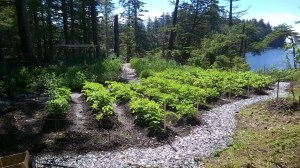
Fraga lives on Middle Island with her partner, Kaleb Aldred. They started with a small garden on the beach, and then established a garden with a greenhouse behind their home. They have since expanded to a lot due south of their house. “We had always lusted to have that space as an ideal garden spot,” she said.

Creating the “small farm or large garden” on Middle Island was not an easy task. They had to cut down trees and rent a machine to pull the stumps out. When they tried to dig the stumps out by hand, removing one stump took a whole week. The machine that removed the stumps compacted the soil, so they then had to dig a trench and fill it with gravel to provide the boggy field with adequate drainage. “I never thought I’d be someone to say, ‘Yeah, let’s cut down all the trees,’ but it’s necessary if you want to garden here,” Fraga said. Removing trees created a sunnier space and also has enabled Fraga to plant fruit trees along the perimeter of her garden.

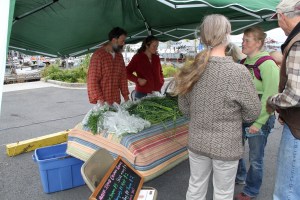
MiddleIslandOrganicProduceKalebAldredAndreaFragaWithCustomersOn occasion, Fraga sells vegetables at the Sitka Farmers Market through their Middle Island Organic Produce stand. She and Aldred hope to grow garlic commercially one day, although they are well aware that “weather and crop failure coalesce and can slow plans down.”

Currently, they have planted about a quarter of their garden in garlic so that they can harvest enough to plant a larger area in the future. Seed garlic costs about $25 dollars a pound from most sources, so generating seed on site will help save a significant amount of money. Fraga said growing garlic commercially makes sense because deer and slugs do not eat it and it is not highly perishable. Furthermore, unlike most garden vegetables she plants in the spring, garlic goes in the ground in the fall, so she can distribute her labor throughout the year.

At a commercial growers conference last spring, Fraga learned about using plastic mulch on garlic to control moisture levels and minimize weeds. The infrared- transmitting plastic transmits heat wavelengths of sunlight that warm the soil and absorbs the wavelengths that plants require for photosynthesis, so weeds cannot grow beneath it. Fraga has begun using the plastic mulch on her own garden this year.

Having farmed in Oregon where one can cultivate a wider variety of plants with greater ease than in Sitka, Fraga does find adapting to Sitka’s weather challenging. Living on an island also has its challenges. For example, in the fall and winter, storms and darkness can restrict travel to and from town. However, Fraga views these challenges as small tradeoffs that allow her to live and garden in a “beautiful, quiet place away from all the noises and distractions of town” and where she is “more in touch with the environment.”

WP_20160707_18_03_42_ProExperiencing beauty is, in large part, what Fraga finds so appealing about subsistence. She explained that gardens, berry thickets, and areas where she forages for mushrooms and seaweed are all beautiful places to spend time. For her, gardening “is just such a beautiful process.” She appreciates the exercise and fresh air involved in gardening, as well as the taste and nutritional value of fresh food. Fraga especially appreciates when she can refer to her dinner as a “Middle Island meal” because all of its components, apart from perhaps the fish,” came from the island that is her home. “It’s really satisfying to eat something that’s entirely grown or harvested yourself.”

Fraga is also a part of a gardening group that meets at one member’s garden every week to work there together. “It’s really great because garden projects that seem daunting end up being fun when you have people to work with,” Fraga said.

For those who find the prospect of starting a garden daunting, Fraga recommends “starting small and simple.” For example, one could begin by growing hearty plants like kale and potatoes that do not require extremely fertile soil. Learning about wild edibles also intimidates many people. Fraga took a class on mushroom identification through University of Alaska Southeast, but she also pointed out one can learn by reading field guides and talking with individuals who willing to share their knowledge on the subject. Gardening and foraging “are really rewarding,” she said. “They don’t have to be discouraging.”

For questions about her garden on Middle Island, contact Andrea Fraga at 738-5135.

Check out the August 2016 edition of the Sitka Local Foods Network newsletter

August2016SLFNNewsletterScreenshot

The Sitka Local Foods Network just sent out the August 2016 edition of its newly launched monthly newsletter. Feel free to click this link to get a copy.

This edition of the newsletter has brief stories about the Sitka Farmers Markets, a series of ‘Building A Local Food System’ articles by intern Claire Chang, a reminder that you can still add Pick.Click.Give. donations to your Alaska Permanent Fund Dividend application through Aug. 31, and an update on the Sitka Local Foods Network board of directors. Each story has links to our website for more information.

You can sign up for future editions of our newsletter by clicking on the registration form image in the right column of our website and filling in the information. If you received a copy but didn’t want one, there is a link at the bottom of the newsletter so you can unsubscribe. Our intention is to get the word out about upcoming events and not to spam people. We will protect your privacy by not sharing our email list with others.

Help celebrate National Farmers Market Week by attending the Sitka Farmers Market on Aug. 13

SLFNNationalFarmersMarketWeekPoster

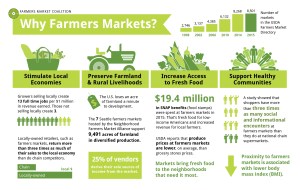
WhyMarkets_2016The 17th annual National Farmers Market Week is Aug. 7-13 this year, so stop by the Sitka Farmers Market to join the celebration, from 10 a.m. to 1 p.m. on Saturday, Aug. 13, at the Alaska Native Brotherhood Founders Hall.

The annual National Farmers Market Week celebration is the first full week of August, when growing season is peaking around the country. This year’s theme is “Farmers Markets and Community Education,” which highlights how farmers markets help communities reconnect to and learn about their food sources (from farms and farmers to local food relief programs). Click here to read this year’s National Farmers Market Week proclamation from U.S. Secretary of Agriculture Thomas Vilsack.

SitkaFarmersMarketSignThe number of farmers markets in the country has tripled since 1998, growing from 2,746 markets in 1998 to more than 8,500 in 2015. There has been similar growth in Alaska, and now markets can be found in many Bush communities from Bethel to Thorne Bay. This growth has improved Alaska’s food security while also serving as an incubator for new businesses.

According to the Farmers Market Coalition, farmers markets …

  • Preserve America’s rural livelihoods and farmland. Farmers markets provide one of the only low-barrier entry points for beginning farmers, allowing them to start small, test the market, and grow their businesses.
  • Stimulate local economies. Growers selling locally create 13 full-time farm operator jobs per $1 million in revenue earned. Those growers that do not sell locally create three jobs.
  • Increase access to fresh, nutritious food. Several  studies have found lower prices for conventional and organic produce at farmers markets than at supermarkets. Due to this and other factors, 52 percent more SNAP households shop at farmers markets and from direct marketing farmers today than in 2011. The Sitka Farmers Market was the first market in Southeast Alaska to accept SNAP and WIC benefits.
  • Support healthy communities. Farmers market vendors educate their shoppers. Four out of five farmers selling at markets discuss farming practices with their customers, and three in five discuss nutrition and how to prepare food.
  • Promote sustainability. Three out of every four farmers selling at farmers markets say they use practices consistent with organic standards.

Don’t forget, you still can add Pick.Click.Give. donations to your 2016 PFD application through Aug. 31

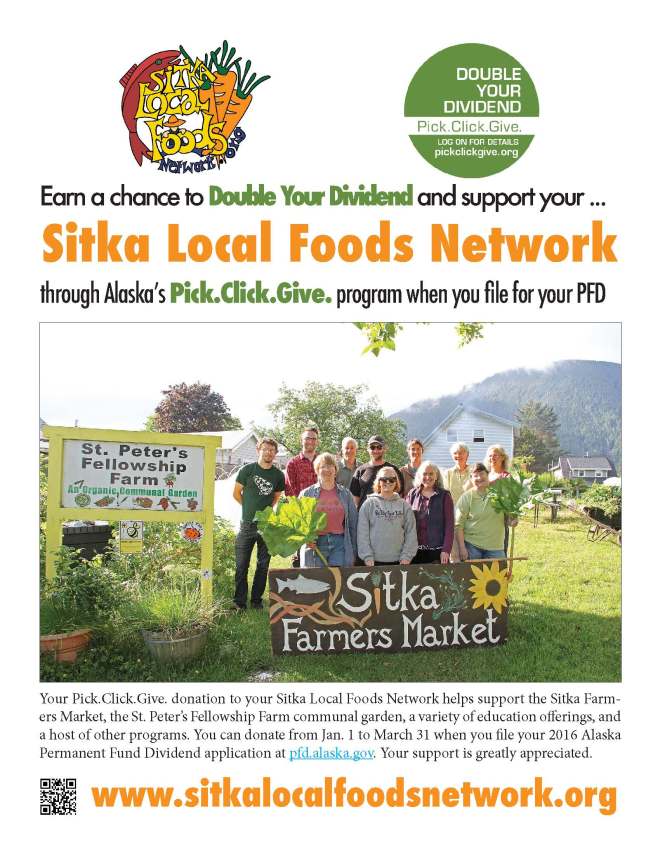
2016PickClickGiveFlier

PCGFarmersMarket2016NEWIf you’re like most Alaskans you probably filed your 2016 Alaska Permanent Fund Dividend (PFD) application before the March deadline and haven’t given it a second thought since. But did you know you still can add Pick.Click.Give.donations to your 2016 application through Monday, Aug. 31? If you haven’t already, please consider making a Pick.Click.Give. donation to the Sitka Local Foods Network.

Here’s how to add or change your Pick.Click.Give. donations. First, go to the Alaska Permanent Fund Dividend application website, http://pfd.alaska.gov/, and find the green “Add A Pick.Click.Give. Donation” bar in the right column. Click the green bar, and follow the directions. You’ll need to enter your driver’s license number, Social Security number, and birthday to access your application, but once on the page you’ll be able to see your current Pick.Click.Give. donations (if any) and you can add or change them. Click here for an FAQ page about making Pick.Click.Give. donations.

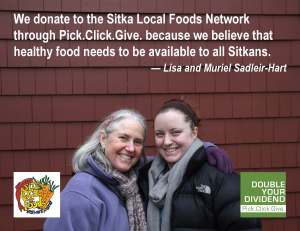
PCGTestemonialLisaAndMurielSadleirHart2016Unfortunately, new donations made after the March 31 Alaska Permanent Fund Dividend filing deadline do not qualify for entry into the Double Your Deadline Sweepstakes, where 10 lucky Alaskans will win the equivalent of a second PFD. But you still get the satisfaction of sharing the wealth with the more than 600 Alaska nonprofit organizations participating in the Pick.Click.Give. program, including 24 from Sitka.

This is the third year the Sitka Local Foods Network is participating in the Pick.Click.Give. program, which allows people to donate in $25 increments to their favorite statewide and local 501(c)(3) nonprofit organizations when they file their PFD applications. When you choose to donate part of your PFD to the Sitka Local Foods Network, you support the Sitka Farmers Market, St. Peter’s Fellowship Farm, education programs about growing and preserving food, the Sitka Kitch community rental commercial kitchen, Blatchley Community Gardens, the sustainable use of traditional foods, the Sitka Community Food Assessment, the Sitka Food Summit, the Fish-To-Schools program, and a variety of other projects designed to increase access to healthy local foods in Sitka.

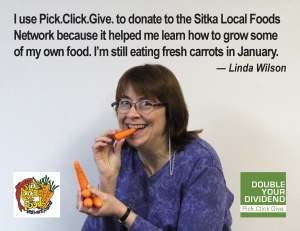
PCGTestemonialLindaWilson2016You still can donate to the Sitka Local Foods Network if you aren’t from Alaska or aren’t eligible for a 2016 PFD. To donate, send your check to the Sitka Local Foods Network, 408 Marine St., Suite D, Sitka, Alaska, 99835. Our EIN is 26-4629930. You also can make an online donation through our Razoo.com crowdfunding page. Please let us know if you need a receipt for tax purposes. The Sitka Local Foods Network now has a Bronze rating from the GuideStar Nonprofit Profile Service, and we are listed with the Benevity Causes Portal used by larger corporations for employee giving programs. For more information about donating, you can send an email to sitkalocalfoodsnetwork@gmail.com.

Thank you to everybody making a Pick.Click.Give. donation to your Sitka Local Foods Network. We appreciate your support.