• Sitka Tribe of Alaska, six other tribes partner to build lab to monitor shellfish biotoxins such as PSP

Cockles-Alaska-Department-of-Health-and-Social-Services

The Sitka Tribe of Alaska (STA) has formed the Southeast Alaska Tribal Toxins (SEATT) partnership with six other Southeast tribes to monitor harmful algal blooms (HABs) in Southeast Alaska. In addition, STA has been awarded a grant to build a lab to monitor biotoxins, which frequently impact clams, mussels, cockles, and other shellfish harvested in the region.
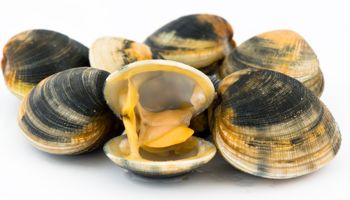
raw-clams-350SEATT will unify Southeast Alaska tribes in monitoring HAB events that pose a human health risk to the subsistence shellfish harvester, such as paralytic shellfish poisoning (PSP). This monitoring effort will provide weekly data on the timing and distribution of HABs, along with measurements of environmental conditions, indicators, and potential mechanisms that trigger HAB events.

In addition to STA, SEATT partners include the Klawock Cooperative Association, Craig Tribal Association, Yakutat Tlingít Tribe, Petersburg Indian Association, Organized Village of Kasaan, and the Central Council of Tlingít and Haida Indian Tribes of Alaska (CCTHITA).

The National Oceanic and Atmospheric Administration (NOAA) Marine Biotoxin Programs from Seattle, Wash., and Charleston, S.C., have committed to provide training through workshops to help develop the SEATT program. The Sitka Tribe of Alaska is hosting a workshop in November for SEATT to provide training on sample collection techniques and data entry. NOAA staff will help facilitate the trainings using previously established protocols used by other HAB monitoring groups throughout nation.

Each SEATT tribe received funding through the Environmental Protection Agency (EPA) Indian General Assistance Program (IGAP) totaling $210,000 for fiscal year 2015, with plans to continue through 2017. The Sitka Tribe of Alaska also received an additional $150,000 to support SEATT with the bi-annual technical workshops and conduct cellular toxin analysis.

Ipe-fig1n addition, the Sitka Tribe of Alaska received $527,000 for the development of a marine biotoxin lab in Sitka from the Administration for Native Americans’ Environmental Regulatory Enhancement program. The lab will provide the SEATT partners the ability to assess their communities’ vulnerability for human health risks following with the same regulatory standards used by other state and federal agencies.

The STA lab will conduct toxin analysis on shellfish using the new Receptor Binding Assay (RBA) technique developed at the NOAA Charleston laboratory. The RBA was just recently accepted as a regulatory method used to determine toxin levels in shellfish by the Interstate Shellfish Sanitation Conference (ISSC) and has been adopted into the National Shellfish Sanitation Program (NSSP).

• Sitka Health Summit planning day is Oct. 3 at Harrigan Centennial Hall

Planning Day Flyer 1 - 2014NewSitkaHealthSummitLogoJoin us for the eighth annual Sitka Health Summit planning day, which takes place from 8:30 a.m. to 4:30 p.m. on Friday, Oct. 3, at Harrigan Centennial Hall.

The Sitka Health Summit got its start in 2007 when then-Sitka Community Hospital CEO Moe Chaudry and then-SouthEast Alaska Regional Health Consortium (SEARHC) Vice President of Hospital Services Frank Sutton decided they needed to bridge the gaps between Sitka’s largest two health services. They launched the Sitka Health Summit, with the help of other supporters in Sitka, as a way to improve community wellness, honor local wellness champions, and more.

One of the highlights of the Sitka Health Summit has been the annual community wellness planning day. During planning day, Sitka residents get together to discuss the health needs of the community and create community wellness projects to address these needs.

Over the years there have been a variety of Sitka Health Summit projects — create a local market for local fish and produce, build a Sitka community greenhouse, become a Bicycle Friendly Community, become a Walk Friendly Community, encourage more kids and families to get outdoors for recreation, support a community health and wellness center (Hames), plant fruit trees around town, get more local fish into school lunches, build a Choose Respect mural, Revitalize Sitka, the Sick-a-Waste compost project, the Sitka Community Food Assessment, and Park Prescriptions. The 2013 Sitka Health Summit projects were Together for a Meth-Free Sitka and Sitka Kitch (a project to create a community rental kitchen and improve Sitka’s emergency food storage capacity). The 2014 Sitka Health Summit will choose two new projects, which will receive $2,000 in seed money to get started.

To register for the Sitka Heath Summit planning day, go to http://www.sitkahealthsummitak.org/ or call 738-0468. A free lunch with locally sourced food will be provided.


• Meet your vendors: Carole Knuth and Peter Apathy of Reindeer Redhots

TableOfTheDayPeterApathyCaroleKnuthReindeerRedhots

Peter Apathy, second from left, and Carole Knuth, third from left, of Reindeer Redhots won the Table of the Day Award for the Aug. 26, 2013, Sitka Farmers Market.

SitkaFarmersMarketSign(This is part of a new series of “Meet your vendors” articles, where Sitka Local Foods Network Intern McLane Ritzel is writing features about our regular Sitka Farmers Market vendors.) 

Nine years ago, Carole Knuth, co-owner and operator of Reindeer Redhots, was having a mid-life crisis. So, she and her husband, Peter Apathy, decided to do something totally different than anything they had done in the past. They bought the Reindeer Redhots stand, a business that had been in operation for one year. At the time, they had two young children, who Carole says thrived in the Reindeer Redhots working environment. “It was important for the children to experience.” Other kids in the community also participated in operating the business, and according to Carole, the experience taught the kids work ethic and good conversation skills. Carol says, “The business served other needs too.”

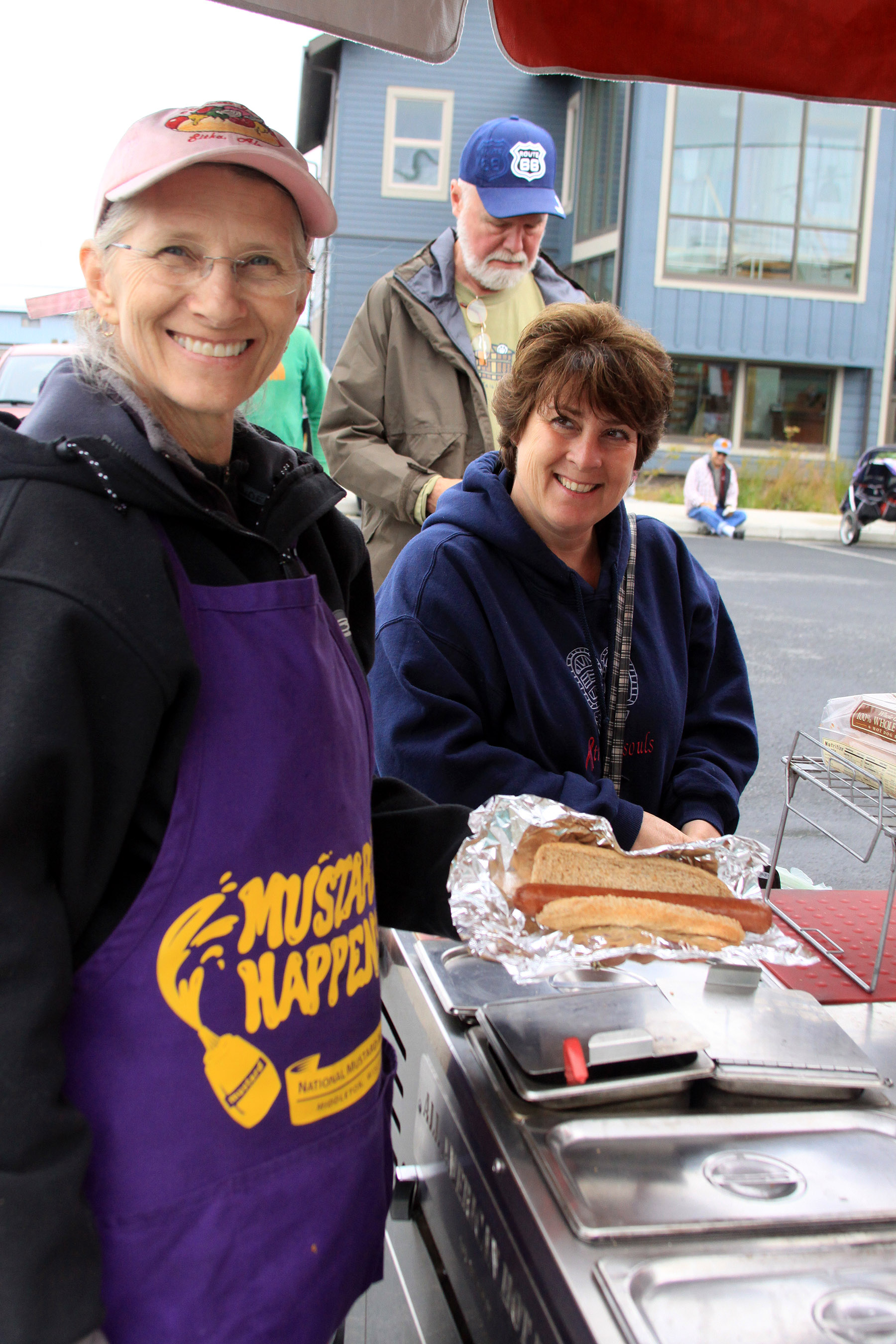
CaroleKnuthWithReindeerPolishDogReindeer Redhots serves hotdogs with reindeer meat and a wide variety of condiments including; sauerkraut, onion, shredded cheddar cheese, ketchup, mustard, no-bean chili, sweet relish, and sriracha sauce. The meat comes from Nunivak Island, where Dr. Sheldon Jackson started a reindeer herd in the 1800s. After the slaughtering on Nunivak, the reindeer meat is sold for processing in Anchorage, where it is produced into a wide variety of products. Reindeer Redhots sells the regular reindeer hotdogs and the mild Polish sausage at their stand. Carole and Peter have dealt with many obstacles in operating their own business, and Carole says that they have “learned a lot about people through the process.”

Today, the dynamic Knuth and Apathy duo run the Reindeer Redhots stand with their son Ryan, who just finished high school. You may have noticed Ryan’s involvement and talent shine in performances around Sitka. Ryan just graduated from the Interlochen Center of the Arts, a competitive arts boarding school in Interlochen, Mich. He also plays the trombone, and is attending the University of Puget Sound this fall. His older sister, Erika, also comes from an artistic background, as a ballet dancer. She currently is studying elementary education at UAS, and just gave birth to a beautiful baby boy named Noah.

PeterApathyOfReindeerRedhotsBoth Carole and Peter are heavily involved in their children’s lives and activities. They are a family that values and supports the arts in many capacities. Carole made costumes for the Nutcracker this past year and has made costumes for other performances around Sitka. She also loves gardening and the family has their own garden at home. As if all of this hasn’t kept her busy enough, she just finished her master’s thesis in public health, which covered a needs assessment for an adult day center in Sitka. She is interested in implementing a kind of senior center in town that offers social and physical activities. When they aren’t serving up delicious hotdogs, supporting their children, or helping out the community, Carole and Peter can be found working at SEARHC. Carole as a physician assistant, and Peter as a electronic health records project manager. Peter also plays bass in the bands Slack Tide and Fishing For Cats.

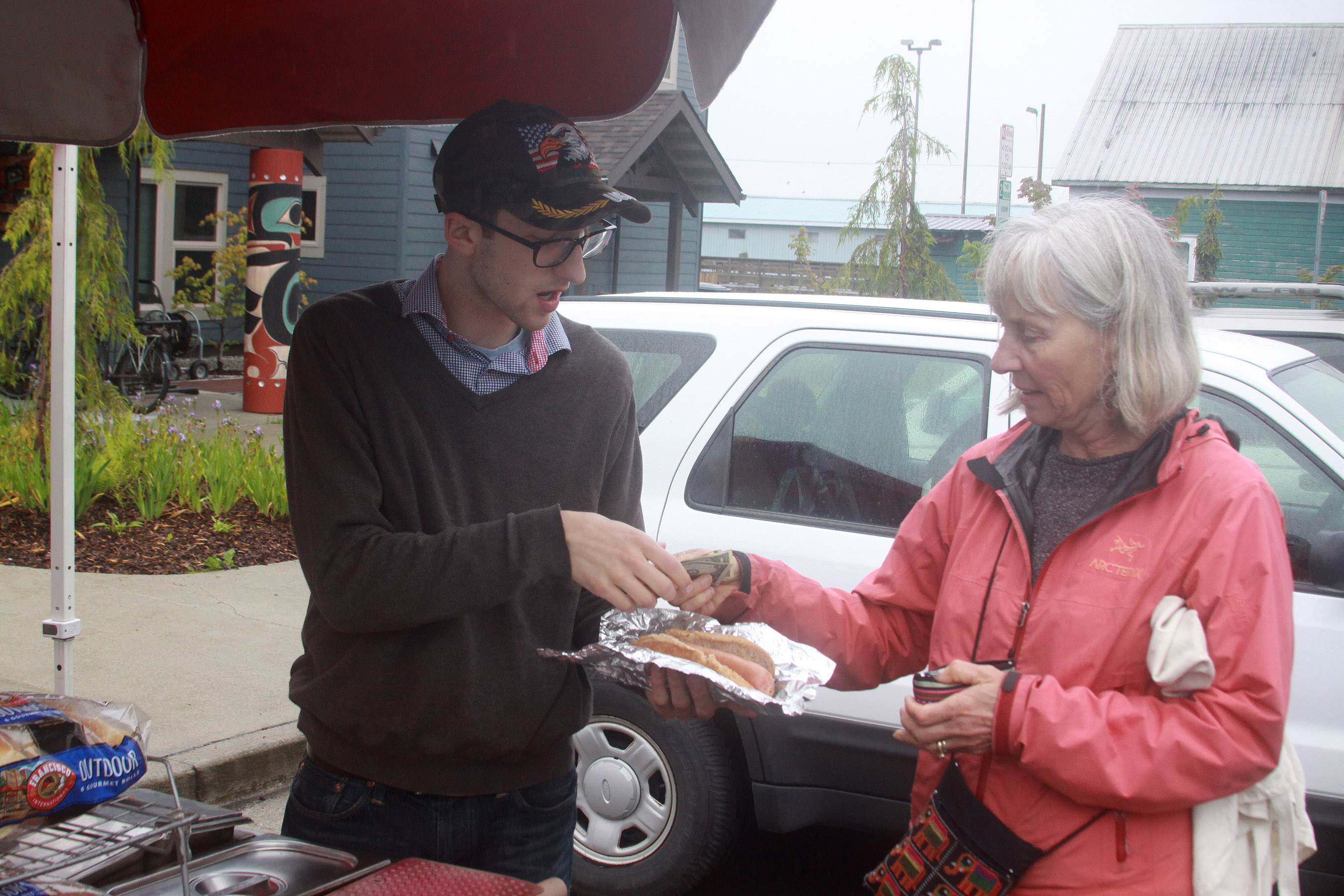
RyanApathySellsPhyllisHackettReindeerRedhotReindeer Redhots has created quite a following. The alternative hotdog stand has been featured in high-quality public relations outlets including: Food and Wine, Costco, and Sunset magazines. In addition to the stand’s occasional appearances at the Sitka Farmers Market, on large ship days, you can find Carole, Peter, or Ryan serving Reindeer Redhots at the corner of Lake and Lincoln Streets. The stand operates from 10 a.m. to 3 p.m., from May to September, though the operation is very weather-dependent.

Stop by the Reindeer Redhots stand this month on large ship days to try a steaming reindeer hotdog. They also offer gluten-free and whole wheat buns.

• Meet your vendors: Erin Fulton of Alaskans Own Seafood and the Alaska Sustainable Fisheries Trust

ErinFultonAlaskansOwnSeafood

SitkaFarmersMarketSign(This is part of a new series of “Meet your vendors” articles, where Sitka Local Foods Network Intern McLane Ritzel is writing features about our regular Sitka Farmers Market vendors.) 

Walking past the Alaskans Own Seafood booth at the farmers market, you may have noticed a kind and bright-eyed brunette with black-rimmed glasses selling extra frozen fish from the first community supported fishery (CSF) program in Alaska. 

Alaskans Own Seafood is similar to a community supported agriculture organization, or “CSA program,” where on the last Wednesday of each month, they ship fish to participating individuals or families in Seattle, Wash., Juneau, Anchorage, and host a pick-up day for members from Sitka. 

ErinFultonAlaskansOwnSeafoodErin is program coordinator of the Alaska Sustainable Fisheries Trust, but her job entails working with many fishery organizations around Sitka, including the Alaska Longline Fishermen’s Association (ALFA) and their Fishery Conservation Networks (FCN) which engage fishermen in both research and conservation initiatives. Alaskans Own Seafood is part of the Alaska Sustainable Fisheries Trust.

Sitka had always been at the back of her mind as her family took a cruise around Alaska 10 years ago. Despite the fact that they were only in town for one day, they kayaked Sitka Sound and determined it their favorite spot on the trip. Laughing, Fulton says, “I need space. I need more trees than people.”

Most of her family still lives in her hometown of Mahtomedi, Minn., a suburb of St. Paul. Her father is the president of a steel-casting firm and works with the mining industry, and her mother stayed home to raise her and her younger brother, Alex. Alex attended Duke University for graduate school and is now a mechanical engineer for Polaris Industries. 

ErinFultonAshiaLaneAlaskansOwnSeafoodIn 2009, Fulton graduated from St. Olaf College in Northfield, Minn., with two degrees in biology and environmental studies. When she wasn’t studying, she played the contra alto clarinet for the St. Olaf band (“a 90-member family”) when it went on 10-day tours around the United States. Concerned about the environmental effects of their carbon footprint while traveling around the country, Fulton began a carbon-offset initiative for local farmers. 

After St. Olaf, Fulton attended graduate school at Duke University’s Nicholas School of the Environment and graduated with two master’s degrees in environmental management and forestry. According to Fulton, at Duke, there are 7,000 acres of timberland. Her master’s thesis involved getting carbon-offset, surveying the forest, and examining afforestation, reforestation, improved forest management, and avoided deforestation. 

AO_LogoHaving never worked in or pursued an education in the fisheries industry, Fulton took a job in Sitka as a Tongass Forest Resident with the Sitka Conservation Society. She was very interested in resource management in Alaska, because unlike the Lower 48 which is “locked in” with strict laws and regulations, Alaska is an active and dynamic place with constantly changing laws and continued resource extraction. Also, given her background in forest management, she is fascinated by the life cycle of salmon and its role as a “great fertilizer for the trees and forest.” She drove from her home in Minnesota to Alaska with a friend, through the Canadian Rockies and took a ferry to Sitka from Prince Rupert, British Columbia. 

Here in Sitka, Fulton is a member of the local roller derby team Sitka Sound Slayers. Last year, she broke her leg twice, but is looking forward to getting back to the sport stronger than ever this season. And from 9-10 a.m. on Friday mornings, you can catch Erin on KCAW-Raven Radio’s Good Day Show.

Come meet Erin and check out Alaska’s Own at the next Sitka Farmers Market from 10 a.m. to 1 p.m. on Saturday, Aug. 23, at the Alaska Native Brotherhood Founders Hall (235 Katlian St.).

• Kathy Hope Erickson’s salmon/potato patties win top honors in Fish To Schools recipe contest

Members of the panel of judges sample one of the recipes in the Fish To Schools Recipe Contest at the Sitka Seafood Festival on Saturday, Aug. 2, 2014, at the Sheldon Jackson Campus/Sitka Fine Arts Camp.

Members of the panel of judges sample one of the recipes in the Fish To Schools Recipe Contest at the Sitka Seafood Festival on Saturday, Aug. 2, 2014, at the Sheldon Jackson Campus/Sitka Fine Arts Camp.

Recipe Contest FinalKathy Hope Erickson claimed top honors in the Fish To Schools recipe contest during the Sitka Seafood Festival, and two younger chefs tied for second place.

Kathy submitted a recipe for salmon and potato patties, which she served with a special chili ketchup, and won a gift certificate to Ludvig’s Bistro for her efforts. Tying for second place were Zoe Trafton, age 8, with her recipe for salmon mac and cheese, and Ava Newell (with her father Mike), age 8, with her recipe for coconut pecan rockfish with a blueberry dipping sauce. Zoe and Ava both won t-shirts. A panel of nine judges, including a couple of students, rated the recipes.

In all, eight local chefs submitted recipes for the contest, which was hosted by the Sitka Conservation Society, which coordinates the Sitka Fish To Schools Program to put more healthy local seafood into school lunches. The other recipes included sesame-veggie salmon cakes with tangy apple slaw by Beth Short-Rhoads and her daughter Kat Rhoads, age 6; salmon pinwheels from Judi Ozment; healthy salmon fish fingers from Anna Bisaro; baked salmon with dill from Matt Jones; and salmon-veggie wraps from Charles Bingham.

The purpose of the contest was to collect kid-friendly fish entree recipes that can be made for school lunches as part of the Fish to Schools program. The dishes should be healthy and easy to make (no special appliances). Baking the fish is preferred over frying, and recipes should be low in sodium and fat. The top seafood dishes will be used in school lunches at the Sitka School District, the state-run Mount Edgecumbe High School, and the private SEER School.

The top three recipes are posted below, and all eight recipes can be found in the attachment. For more information about the recipe contest and the Sitka Fish To Schools Program, click this link or call Sophie Nethercut or Tracy Gagnon of the Sitka Conservation Society at 747-7509.

• 2014 Fish To Schools Recipe Contest Submissions (attachment includes all eight recipes)

School Lunch Salmon Patties With Chili Ketchup (Makes 12)

Winning Recipe submitted by Kathy Hope Erickson, Sitka

  • KathyHopeErickson1 pint jar salmon
  • 2 cups cooked potatoes
  • 1/3 cup chopped onions
  • 1 egg
  • 1 teaspoon garlic seasoning
  • 1 teaspoon onion seasoning
  • 1/2 teaspoon salad herbs – dried
  • 12 Ritz crackers

Mix all, form into patties, fry in heated vegetable oil, or alternatively, spray with cooking spray and bake in 400-degree oven.

Chili Ketchup

For dipping fish patties: Combine 2 teaspoons chili powder, 1/2 teaspoon cumin, 4 1/2 teaspoon onion, and 3/4 cup ketchup.


Coconut Pecan Rockfish With Blueberry Dipping Sauce

2nd place: Submitted by Mike and Ava Newell (age 8), Sitka

  • MikeAndAvaNewel1 lb. rockfish fillets
  • 1 T coconut milk
  • salt and pepper
  • 1/2 C pecans, chopped
  • 1/2 C shredded coconut
  • 2 T plain breadcrumbs

Preheat oven to 400 degrees. Place rockfish on baking sheet. Pour coconut milk over fish. Sprinkle fish with salt and pepper. Combine pecans, coconut, and bread crumbs in a bowl. Press coconut mixture onto top of fish fillets. Bake for 15-20 minutes, just until fish is opaque throughout

Blueberry Dipping Sauce

  • 1 C wild blueberries, rinsed
  • 1/4 C water
  • 1/4 C coconut milk
  • 1/2 T cornstarch
  • salt

Place blueberries and water in small saucepan. Simmer until berries burst. Strain berries through fine mesh sieve into small bowl. Add coconut milk to bowl. Pour sauce back into saucepan. Mix cornstarch with a little bit of cold water until smooth. Add cornstarch mixture to sauce. Stir and heat until boiling. Continue to boil until desired thickness. Serve with rockfish


Salmon Mac ‘n Cheese
2nd place: Submitted by Zoe Trafton (age 8), Sitka

  • ZoeTrafton1 cup cooked salmon, chopped
  • 2 cups shredded cheese (cheddar and jack recommended)
  • 2 cups shell pasta
  • ½ cup finely chopped onions
  • ½ cup finely chopped mushrooms
  • 1 teaspoon basil
  • ½ cup Alfredo sauce
  • 1 tablespoon Frank’s Red Hot sauce
  • 1 teaspoon chili powder

Boil shells in medium pot. Sauté onions and mushrooms for three minutes. Add salmon to mushrooms and onions. Drain water and add pasta. Add cheese. Add Alfredo sauce and hot sauce. Mix carefully. Add spices and serve.

• Scenes from the fifth annual Sitka Seafood Festival

WaitingInLineForFish

ssflogo2Beautiful weather greeted the fifth annual Sitka Seafood Festival on July 31-Aug. 3, with a nice sunny day on Saturday, Aug. 2, when most of the events took place.

Saturday’s events included a marathon and half-marathon, parade, fish tote races, Island Highland Games, marketplace, cooking demonstrations, and a Fish To Schools recipe contest at the Sheldon Jackson Campus/Sitka Fine Arts Camp.

In addition, there was a garden tour and showing of the film Red Gold on Thursday, the annual five-course banquet dinner on Friday, a concert featuring the Yup’ik soul group Pamyua on Saturday night, and a golf tournament on Sunday.

Below is a slideshow featuring scenes from Saturday’s events.

This slideshow requires JavaScript.

• Scenes from the Sitka Kitch class on canning the harvest


SarahLewisWatchesBetsyDeckerAddWaterToCooker

Sarah Lewis, right, watches as Betsy Decker adds water to a pressure cooker before jars of produce are added to start the canning process.

kitch_logo_mainOn July 25-27, the Sitka Kitch project hosted Sarah Lewis of the Juneau District Office of the University of Alaska Fairbanks Cooperative Extension Service to host three classes in Sitka on the cottage food industry and home canning. In addition, Sarah had a table at the Sitka Farmers Market on July 26 where she tested pressure canner gauges.

The slideshow below features photos from Saturday’s Canning The Harvest class at First Presbyterian Church. For those who missed the classes and want to learn more about home canning, the UAF Cooperative Extension Service has a series of online tutorials on its website called “Preserving Alaska’s Bounty.” Pressure canner gauges should be tested at least once a year to make sure they are hitting the right pressures for safe food preservation. The Sitka District Office of the UAF Cooperative Extension Service also has a variety of resources on home canning, gardening and other topics.

Sitka Kitch is a community wellness project from the 2013 Sitka Health Summit designed to improve food security in Sitka. The different parts of the project include creating a community kitchen Sitka residents can rent to prepare food for their small businesses or to preserve their family harvest of fish, game, or garden veggies; expanding Sitka’s emergency food storage capacity; and providing education about preserving food and building family emergency food pantries.

For more information about the Sitka Kitch project, contact Marjorie Hennessy at marjorie@sitkawild.org or 747-7509.

This slideshow requires JavaScript.


• Fish to Schools program seeks donations of coho salmon from commercial fishermen

SCS-031_smFishToSchoolsTaco

The Fish to Schools program needs help from Sitka’s commercial fishermen. The program needs 500 pounds of coho salmon to help make Fish to Schools meals for Sitka students during the upcoming school year.

“Please donate a few of your fish at the closure of the second king opener to Fish to Schools this August and help us meet our goal to get locally caught coho in all Sitka schools,” Fish to Schools program coordinator Tracy Gagnon said. “We’re also collecting photos of you (fishermen) in action — please email a photo of you on the water.”

The Sitka Fish To Schools project (click here to see short video) got its start as a community wellness project at the 2010 Sitka Health Summit, and now is managed by the Sitka Conservation Society. It started by providing a monthly fish dish as part of the school lunch as Blatchley Middle School, and since then has grown to feature regular fish dishes as part of the lunch programs at Baranof Elementary School, Keet Gooshi Heen Elementary School,Blatchley Middle School, Sitka High School, Pacific High School (where the alternative high school students cook the meals themselves), the SEER School, and Mount Edgecumbe High School.

In addition to serving locally caught fish meals as part of the school lunch program, the Fish To Schools program also brings local fishermen, fisheries biologists and chefs to the classroom to teach the kids about the importance of locally caught fish in Sitka. The program received an innovation award from the Alaska Farm To Schools program during a community celebration dinner in May 2012, and now serves as a model for other school districts from coastal fishing communities. In May 2014, the Fish to Schools program released a guidebook so other school districts in Alaska could create similar programs.

To donate, sign up in the main offices at Seafood Producers Cooperative or Sitka Sound Seafoods. The program can only accept commercially caught fish (no sport or subsistence fish).

For more information, contact Tracy Gagnon at Sitka Conservation Society, tracy@sitkawild.org or 747-7509.

• Fish to Schools seafood recipe contest seeks kid-friendly dishes at Sitka Seafood Festival

Recipe Contest FinalDo you have a favorite kid-friendly and healthy fish entree recipe that uses local seafood? The program wants you to enter your dish in its recipe contest at the .

Do you have a favorite kid-friendly and healthy fish entree recipe that uses local seafood? The Fish to Schools program wants you to enter your dish in its recipe contest at the Sitka Seafood Festival.

The contest is free, just type up your recipe and email it to Sophie Nethercut of the Sitka Conservation Society at sophie@sitkawild.org. You also will be asked to make up a batch for sampling. A panel of local residents will judge the recipes at 4:30 p.m. on Saturday, Aug. 2, at the Sitka Seafood Festival’s main tent on the Sheldon Jackson Campus, and the winners receive prizes (including a gift certificate for Ludvig’s Bistro for the grand prize).

2014SSFSchedule5The purpose of the contest is to collect kid-friendly fish entree recipes that can be made for school lunches as part of the Fish to Schools program. The dishes should be healthy and easy to make (no special appliances). Baking the fish is preferred over frying, and recipes should be low in sodium and fat. The top seafood dishes will be used in school lunches at the Sitka School District, the state-run Mount Edgecumbe High School, and the private SEER School.

Samples of the dish (enough for at least 15 people to nibble) should be brought by 4:15 p.m. on Saturday to the Sitka Seafood Festival main tent at Sheldon Jackson Campus for judging. Entrants are encouraged to print out a copy of the recipe to include with your samples, and bring a photo of you making the dish (if possible).

For more information, click this link or call Sophie at 747-7509. This is one of many events as part of this year’s Sitka Seafood Festival, which has events on July 31-Aug. 2 at various locations around Sitka. Additional info about the Sitka Seafood Festival can be found here.


• State of Alaska updates safe seafood consumption guidelines

FishConsumptionCalc

Eat all the salmon you want, but limit your amount of salmon shark, the Alaska Section of Epidemiology (part of the Division of Public Health) said when it recently updated its safe seafood consumption guidelines.

The Section of Epidemiology, in partnership with the Alaska Department of Environmental Conservation, started testing Alaska seafood for toxic heavy metals, such as mercury, and other pollutants, such as pesticides, back in 2001. The main reason for the research was to determine safe levels of seafood consumption for pregnant women, nursing mothers, infants, and others. According to the Alaska Dispatch News, the research involved testing fish, and using human hair samples to see how the heavy metals moved from species to species.

The Division of Public Health Division recommends eating fish at least twice a week. Medical research shows salmon are high in omega 3 fatty acids, which are believed to improve cholesterol and fight heart disease. Many types of Alaska seafood also are part of the traditional Alaska Native diet.

The good news is Alaska’s five salmon varieties (chinook/king, sockeye/red, coho/silver, chum/keta/dog, and humpy/pink) all tested as safe for everybody, with no limitations for pregnant women or others, as did halibut smaller than 40 pounds and Alaska pollock (commonly found in fish sticks and fast food fishburgers). This year’s expanded testing increased the number of safe-for-all species to 23 from 11 in 2007 (see chart above for complete list).

However, there were some seafood species where the Office of Epidemiology suggests consumption limits. Alaskans should use a point system, where people can eat up to 12 points a week (the safe species get zero points), with points based on six-ounce portions. Halibut (40-80 pounds), lingcod (35-40 inches) and lake trout are worth three points. Halibut (80-140 pounds), lingcod (40-45 inches) and longnose skate are worth four points. Halibut (140-220 pounds) and yelloweye rockfish are worth six points. Halibut (220 pounds or larger), lingcod (45 inches or longer), salmon shark and spiny dogfish are worth 12 points and should only be eaten once per week.