UAF Cooperative Extension Service offers Certified Food Protection Manager class by videoconference Feb. 22 in Sitka

Thursday, Feb. 8, is the registration deadline for a certified food protection manager workshop being taught on Thursday, Feb. 22, by University of Alaska Fairbanks Cooperative Extension Service. This is an all-day statewide class that will be offered by videoconferencing to Delta Junction, Fairbanks, Juneau, Palmer and Sitka.

A certified food protection manager (CFPM) is responsible for monitoring and managing all food establishment operations to ensure that the facility is operating in compliance with food establishment regulations.

A CFPM is knowledgeable about food safety practices and uses this knowledge to provide consumers with safe food, protect public health and prevent food-borne illnesses. Alaska regulations require food establishments to have at least one CFPM on staff.

This course takes place from 8:30 a.m. to 5:30 p.m. (with a half-hour lunch), and participants will take a computer-based exam at the end of the class. The reason the deadline is two weeks before the class is to guarantee course materials reach all the students in time for the class. The cost is $200, and the course will be taught by Julie Cascio of Palmer. Students can register here.

The Sitka videoconference for the class will take place in Room 106 at the University of Alaska Southeast Sitka Campus. To learn more, contact Jasmine Shaw at the Sitka District Office of the UAF Cooperative Extension Service at 747-9440, or contact Julie Cascio at (907) 745-3677 (Palmer number) or jmcascio@alaska.edu, or Melissa Clampitt at (907) 745-3551 or mrclampitt@alaska.edu. Note, this class is taught in English but textbooks are available in Korean, Chinese and Spanish, just contact Julie or Melissa at least three weeks before the class.

Also, the ServSafe book ($70) and certification exam ($75) now are available online, if people want to order the book and study independently without taking the class. Just go to this website and purchase the book and exam items.

Alaska Longline Fishermen’s Association wins $142,500 for deckhand apprenticeship program

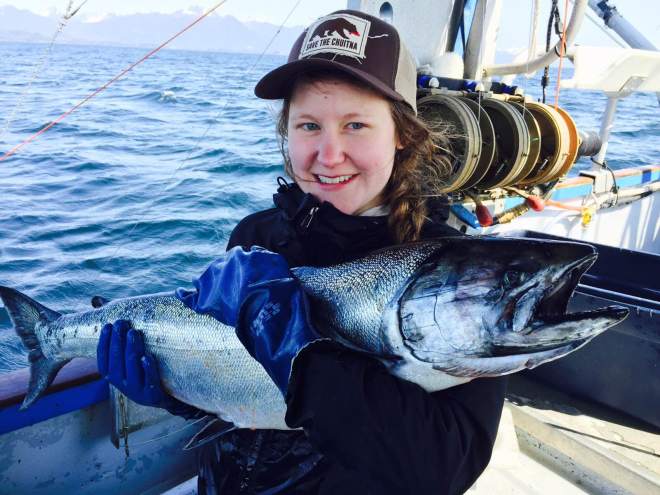
Sophie Nethercut is one of about 25 greenhorns who has served a short stint as a crew member on Eric Jordan’s troller, the I Gotta, in recent years. (PHOTOS COURTESY OF ERIC JORDAN)

Over the last couple of years, Sitka’s Eric Jordan has taken about two dozen young people commercial fishing on his troller, the I Gotta. Now, the Sitka-based Alaska Longline Fishermen’s Association (ALFA) has adopted this program and expanded it to other boats in an effort to counter the graying of the commercial fishing fleet.

Eric Jordan, back center, poses with crew members (l-r) Alyssa Russell, Sarah Jordan (his wife) and Anya Grenier in front of his troller, the I Gotta.

Last month, ALFA’s Supporting the Next Generation of Alaskan Fishermen through the Deckhand Apprentice Program received a $142,496 award ($69,996 grant and $72,500 matching funds) from the National Fish and Wildlife Foundation as part of its Sustainable Fisheries in the United States grant program. The ALFA grant was one of seven grants totaling $766,871 (with $840,887 in matching funds), for a total conservation impact of more than $1.6 million.

“The generous support from the National Fish and Wildlife Foundation will allow us to offer more young people an an entry level commercial fishing opportunity,” ALFA Executive Director Linda Behnken said. “Young fishermen face a host of challenges these days, and ALFA is doing what we can to support the next generation of commercial fishermen by supporting entry level opportunities and policy that safeguards the health of our ocean, fisheries and fishing communities.”

According to the report, “The Graying of the Alaskan Fishing Fleet,” in 2014, the average age of a limited entry permit holder was 50 years old, 10 years older than it was in the 1980s. In 2013, only 17 percent of current permits are held by fishermen younger than 40 years old, a decrease from 38 percent in 1980. This has raised concerns there won’t be enough young people to replace the older fishermen when they retire. Deckhand apprenticeships are one way ALFA and other groups are countering the graying of the fleet.

“With support from NFWF, we plan to expand the program to include more boats, crew, and communities,” Behnken said.”Giving young people the opportunity to participate in our commercial fisheries can help us to sustain our fishing communities and create the next generation of resource stewards.”

Cathryn Klusmeier, left, and Jacob Metzger are among the greenhorns who crewed on Eric Jordan’s troller, the I Gotta.

According to the grant profile, “Alaska Longline Fishermen’s Association will coordinate and expand a state-wide apprentice program to promote resource stewardship, community viability, and opportunity in Alaska’s commercial fisheries. The project will develop curriculum and resources to guide the program expansion, include additional vessels and fisheries, and promote entry level job opportunities.”

“Finding crew with some experience, who loves fishing in Alaska, is so critical to the future of our individual businesses in the industry as a whole,” Jordan said. “This program gives them the taste of it. Deckhands know they like it, and skippers can recommend them for future employment. It is a win-win for everyone.”

“We are currently developing the curriculum — one for skippers, and one for crew,” said ALFA Communications Coordinator Alyssa Russell, who has crewed on the I Gotta. “We want to give skippers the tools they need to mentor someone, and crew the skills they need to have a successful experience and continued employment.”

Check out the January 2018 edition of the Sitka Local Foods Network newsletter

The Sitka Local Foods Network just sent out the January 2018 edition of its monthly newsletter. Feel free to click this link to get a copy.

This month’s newsletter includes brief items about how you can support the SLFN through the Pick.Click.Give. program, an invitation to join us at our annual meeting and potluck dinner on Jan. 28, info about the 2018 sponsorship program for businesses and individuals, and an invitation to join our board of directors. Each story has links to our website for more information.

You can sign up for future editions of our newsletter by clicking on the newsletter image in the right column of our website and filling in the information. If you received a copy but didn’t want one, there is a link at the bottom of the newsletter so you can unsubscribe. Our intention is to get the word out about upcoming events and not to spam people. We will protect your privacy by not sharing our email list with others. Don’t forget to like us on Facebooklike our new Sitka Farmers Market page on Facebook and follow us on Twitter.

Sitka Local Foods Network to host annual meeting and potluck on Sunday, Jan. 28

The Sitka Local Foods Network will host its annual meeting and potluck dinner from 5-7 p.m. on Sunday, Jan. 28, at the Sitka Unitarian Universalist Fellowship Hall (408 Marine St., parking off of Spruce Street).

Participants are encouraged to bring a dish featuring local foods to share, and please bring your own utensils (note, this is a non-alcoholic event). This event is a good event to attend for people who want to learn more about the Sitka Local Foods Network and what we do around town. We also hope to have a silent auction, where people can bid on various gardening and food items (donations are welcome).

Attendees will hear about project updates, plus the current board will vote on by-law changes. We will introduce our new board members for 2017, and we will confirm the election of our officers. We also have a couple of openings on our board, and people wanting to learn more about joining can click this link for info and applications.

Individuals interested in learning more about the Sitka Local Foods Network can email sitkalocalfoodsnetwork@gmail.com to learn about our projects and volunteer opportunities.

Monday’s the day to start filing your PFD applications with Pick.Click.Give. donations

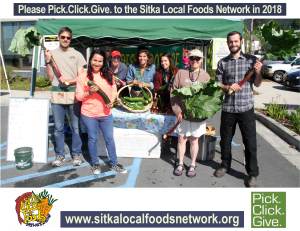
As 2017 winds to a close, many Alaskans already are thinking about applying for their 2018 Alaska Permanent Fund Dividend check in January. As usual, Alaskans can share their wealth with a variety of Alaska nonprofits, including the Sitka Local Foods Network, through the PFD’s Pick.Click.Give. program.

This is the fourth year the Sitka Local Foods Network will participate in the Pick.Click.Give. program, which allows people to donate in $25 increments to their favorite statewide and local 501(c)(3) nonprofit organizations when they file their PFD applications from Jan. 1 through March 31. We missed 2017 due to a clerical snafu, but we’re back in the program for 2018.

When you choose to donate part of your PFD to the Sitka Local Foods Network, you support the Sitka Farmers Market, St. Peter’s Fellowship Farm, education programs about growing and preserving food, the Sitka Kitch community rental commercial kitchen, Sitka Community Gardens, matching dollars at the Sitka Farmers Market for SNAP/WIC beneficiaries, the sustainable use of traditional foods, the Sitka Community Food Assessment, the Sitka Food Summit, and a variety of other projects designed to increase access to healthy local foods in Sitka.

In 2017 Alaskans contributed $2.7 million to 668 Alaska nonprofit organizations, and more than $18.5 million has been donated since the program started in 2009. Some Alaskans choose to donate to just one group, while others may spread several donations around to many groups. There now are more than 600 total 501(c)(3) nonprofit organizations participating in Pick.Click.Give. for 2017 (including multi-location nonprofits), including 23 from Sitka. In 2017, Alaskans donated $100,500 to Sitka-based nonprofits.

To encourage more Alaskans to donate through the Pick.Click.Give. program, the Double Your Dividend contest has been revised to encourage philanthropy. Anybody who makes a non-anonymous Pick.Click.Give. donation to at least one of the registered nonprofits will be entered into a contest where five lucky Alaskans will win a second PFD check for their favorite participating Pick.Click.Give. nonprofit (or couple of nonprofits). The winners no longer receive a second PFD for themselves, just one to donate to an organization. The winners will be announced in October, about the time the PFDs start hitting bank accounts.

So how do you make a donation to the Sitka Local Foods Network through the Pick.Click.Give. program? First, go fill out your Alaska Permanent Fund Dividend application at http://pfd.alaska.gov/. When you get to the section of the application asking if you want to participate in Pick.Click.Give. Charitable Contributions program, click on the PCG link and search for the Sitka Local Foods Network. You also can look for us by using the town search for Sitka.

The Pick.Click.Give. program is available only to people who file their PFD applications online, and not to those who file by mail. Even though you can’t file a new PFD application after March 31, you can go back into your application and update your Pick.Click.Give. donations through Aug. 31 each year.

You still can donate to the Sitka Local Foods Network if you aren’t from Alaska or aren’t eligible for a 2018 PFD. To donate, send your check to the Sitka Local Foods Network, 408D Marine St., Sitka, Alaska, 99835. You also can donate online by going to our online fundraising page on Razoo.com, and clicking the Donate button to make an online contribution. You also can send in a check or make an online donation if you are trying to make nonprofit donations before the end of the 2017 tax year. Please let us know if you need a receipt for tax purposes. For more information about donating, you can send an email to sitkalocalfoodsnetwork@gmail.com.

Thank you for supporting our mission of promoting and encouraging the growing, harvesting and eating of local foods in Sitka and Southeast Alaska.

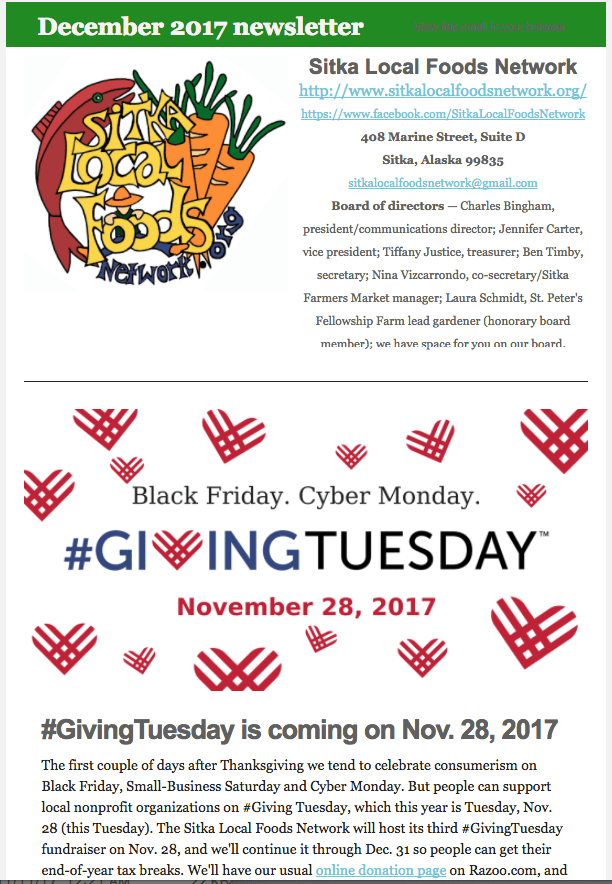
Check out the December 2017 edition of the Sitka Local Foods Network newsletter

The Sitka Local Foods Network just sent out the December 2017 edition of its monthly newsletter. Feel free to click this link to get a copy.

This month’s newsletter includes brief items about our #GivingTuesday fundraising campaigns on Nov. 28, info about the 2018 sponsorship program for businesses and individuals, and an invitation to join our board of directors. Each story has links to our website for more information.

You can sign up for future editions of our newsletter by clicking on the newsletter image in the right column of our website and filling in the information. If you received a copy but didn’t want one, there is a link at the bottom of the newsletter so you can unsubscribe. Our intention is to get the word out about upcoming events and not to spam people. We will protect your privacy by not sharing our email list with others. Don’t forget to like us on Facebooklike our new Sitka Farmers Market page on Facebook and follow us on Twitter.

Like what we do? Now you or your business can sponsor the Sitka Local Foods Network in 2018

The Sitka Local Foods Network created a sponsorship program to help promote our mission, and Sitka businesses and individuals are welcome to join for 2018. The goal of the sponsorship program is to make the projects we undertake (Sitka Farmers Market, St. Peter’s Fellowship Farm, gardening education, etc.) more sustainable.

“Sitka has a precarious position when it comes to food security, and the Sitka Local Foods Network is trying to improve our food security through our mission to increase the amount of locally harvested and produced foods in the diets of Southeast Alaskans,” Sitka Local Foods Network president Charles Bingham said. “Sponsors of the Sitka Local Foods Network are working with an organization and a farmers market that values local food and businesses, fun, premium quality goods and experiences.”

In recent years, the Sitka Local Foods Network has hosted seven Sitka Farmers Markets during the summer (from July to September). We haven’t set our 2018 dates yet, but we anticipate we will have seven markets again this summer. In addition, we grow most of the local produce sold at the markets at St. Peter’s Fellowship Farm communal garden and a couple of other locations in town. We also offer a variety of garden education classes in the spring. One way we ensure fresh, local produce is available to lower-income Sitkans is through our matching program for WIC and SNAP beneficiaries (the first $20 spent on produce at the farmers market). This year we also hope to launch a new food business innovation contest to inspire food entrepreneurs in Sitka.

There are four levels of sponsorship available, and each has its own set of perks.

  • Grower ($2,500-plus) — We’ll hang your banner at ANB Hall during the Sitka Farmers Markets, include your logo and company name prominently in our merchandise and advertisements, and thank you on our social media and web pages. If appropriate for the Sitka Farmers Market, you may set up a free promotional booth.
  • Harvester ($1,000-$2,499) — We’ll hang your banner at ANB Hall during the Sitka Farmers Markets and include your logo and company name in our merchandise and advertisements.
  • Planter ($250-$999) — Your banner will hang at ANB Hall during the Sitka Farmers Markets.
  • Friend ($50-$249) — You are listed on our online sponsor page.

We have limited space for banners at the Sitka Farmers Markets, so please contact us before May 1 to guarantee your spot. To learn more about the sponsorship program, click the link below for details and a registration form. For more information, contact Charles Bingham at (907) 623-7660 or by email at charleswbingham3@gmail.com, or email us at sitkalocalfoodsnetwork@gmail.com.

• 2018 Sitka Local Foods Network sponsorship program details and registration form

A Q&A about growing garlic in Sitka with Andrea Fraga of Middle Island Gardens

In recent years, Andrea Fraga and her partner, Kaleb Aldred, have been growing garlic at Middle Island Gardens, which they sell at Sitka Farmers Markets and on Sitka Food Co-Op pick-up days. They also are selling some of their garlic to local restaurants. Recently, Andrea responded to some questions about Middle Island Gardens.

Q: What prompted you to start Middle Island Gardens? Also, please tell me some of the basics about how you started the operation.

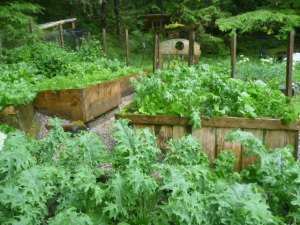
A: Kaleb and I began gardening as a means to be more self-sufficient, and after finding it immensely satisfying, we expanded our efforts into every semi-flat, semi-sunny spot. We even got away with growing unfenced potatoes before the deer developed a taste for them. So, one garden became two, then three years ago we were able to expand our efforts to a third, much larger and sunnier spot, and the idea to grow food commercially naturally arose. The hard work that stood between us and our goal was encouraged by the excitement of a shared vision to grow lots of local produce in a place where food security is a real consideration. At the same time, we got to create an artistic edible space together that we are both rather addicted to spending time in, and when someone eats our produce they get to share in that beauty a bit.
beach garden

Q: Did you have much of a farming or gardening background before you started Middle Island Gardens? If not, how did you learn about growing garlic in Southeast Alaska?

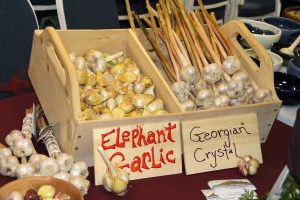
A: We both come from grandparents who worked the soil, though Kaleb took to fishing the seas as a young adult. Meanwhile, I was dabbling in gardening down in southern Oregon, and working on a few farms as well. When I moved to Sitka I was eager to continue in this vein, which seemed especially important considering how far fruits and veggies have to travel to get here. Kaleb likes to be helpful, so he whacked together a couple of raised beds, and we were off. Luckily there are some great local resources for a gardener adapting to Southeast Alaska’s soggy climate, and I remember reading Juneau Garden Club’s Gardening in Southeast Alaska and discovering Juneau master gardener Joe Orsi’s article Growing Garlic in Rain Country, as well as Florence Welsh’s excellent blog “Sitkavores.” She very generously donated some planting stock to us after I asked her which varieties she recommends (Georgian crystal and Persian Star, a.k.a Samarkand).  Washington grower Ron Engeland also wrote the very informative book Growing Great Garlic.

Q: What types of garlic do you grow, and what are the differences?

A: There are two main types of garlic. The softneck, or non-bolting type, and the hardneck type which produces a flowering scape.  We grow hardneck garlic, as it is hardier, more delicious, and produces those tasty scapes too. Among the hardneck garlics there are several subcategories — rocambole are most sought after for flavor; porcelain types have fewer, but larger cloves (2-6); then there are the purple-striped. We grow Killarney red, German red, Russian red and carpathian (rocambole), Georgian crystal, music and Russian giant (porcelain) chesnok red (purple stripe), and purple glazer (glazed purple stripe), as well as elephant garlic.

Q: What other crops do you grow and how have they done?

A: We grow just about everything that can tolerate this cool, wet, short season climate — potatoes, kale, carrots, peas, parsley, fava beans, broccoli, beets, lettuce, raspberries, strawberries, blueberries, gooseberries. We have also planted hardy kiwi vines, apple, plum and cherry trees, but they are still in their unfruitful adolescence at this point. One challenge I have noticed in the past couple of years is the arrival of a few different defoliating caterpillars. They seem to prefer berry bushes, especially raspberry canes, but will also eat apple leaves and even kale. It’s been a challenge that we have been dealing with by squishing them so far.
Q: Do you have any secrets for growing garlic in Southeast Alaska you’d like to share? (Andrea taught a growing garlic class Sept. 14 and her handout is linked at the bottom of this Q&A.)

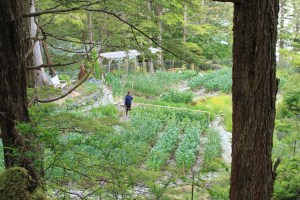
A: We have had such wonderful results by using IRT (infrared-transmitting) plastic. Because garlic spends 10 months in the ground, many of which involve torrential rains, planting through this plastic mulch protects the soil from erosion, while also suppressing weed growth and warming the soil.  We’ve also increased the plant spacing from 4×4” to 6×8” and noticed a major increase in bulb size, which could also be a result of planting a couple of weeks earlier …. in late September. Mixing a nitrogenous cover crop such as vetch into the soil may also help, as it provides slow-release nitrogen and a loose, fluffy soil environment for bulbs to grow in.

Q: How hard is it to make a small garden/farm work in Southeast Alaska? What kinds of barriers and rewards are there?

A: The climate is by far the most challenging aspect of growing food here, but the landscape is also rather unsuitable. As many Southeast Alaska gardeners know, it can be difficult to come up with enough soil to get started, and then this soil must be heavily amended every year to counteract the incredible rinsing it receives. Kaleb and I are constantly carrying loads of seaweed and shell sand uphill to gardens, but the rewards are well worth it – nutritious food, lovely gardens, mandatory exercise, and spending time in beautiful places.

Q: You are growing garlic on one of Sitka’s barrier islands? Does that help give you better sun exposure, soil, etc.? Does it also make things harder when you need to bring product into town?

A: I think Middle Island may be just a couple of degrees warmer than Baranof Island at times.  Other than that, we are just fortunate to have the majority of our growing space be in a rather sunny spot, though we did work hard clearing trees to achieve this. We are also fortunate in that we don’t have any farming neighbors to compete with when it comes to collecting seaweed off the beaches after a storm. As far as bringing produce into town, I do often envy the farmer who’s able to park a pickup in the field, fill it up and drive it directly to the market. Lately I have made sure to provide a sort of mattress pad for the garlic to sit on in its tote as we skiff to town over autumn’s bumpy seas.

Q: Do you have any mentors who have helped you in your business?

A: Speaking of bringing produce to town, Bo Varsano and Marja Smets of Farragut Farm (outside Petersburg) have a much more challenging situation to overcome.  They live and farm up a tidal slough, and sometimes have to get up in the middle of the night to load their boat for the four-hour journey to Petersburg.  Those folks have definitely been an inspiration to us, as have Sally Boisvert and Rafe McGuire of Four Winds Farm in Haines, Joe Orsi of Orsi Organic Produce in Juneau, and of course Florence Welsh of Sitka, who is so incredibly generous with both her knowledge and her plants. Keith Nyitray of the Sitka Food Co-Op has been very encouraging and helpful, providing us a space to sell veggies and promoting our produce to boot. And, of course, we appreciate the Sitka Local Foods Network doing the same.

Q: How large is your operation and what is your ultimate goal?

A: We have approximately 4,500 square feet in production, minus paths, and are definitely eying every reasonable area for expansion. Though this is ridiculously tiny for agriculture, for Sitka we feel blessed to have so much space, and while we may not be able to ever make our entire living off of it, we’re going to try our best and just have fun along the way, meanwhile providing Sitkans as much nutritious food as the land and our efforts will allow.

Q: Do you have any other comments about Middle Island Gardens you think might interest others in Sitka and Southeast Alaska about your business?

A: I urge everyone to read the incredibly eye-opening book Eating on the Wild Side by Jo Robinson. The premise of the book is that modern-day produce varieties, which have been bred primarily for storage, shipping and appearance, have inadvertently become less tasty and nutritious. In fact, some veggies, such as broccoli, lose a lot of nutrients in transit. This great book recommends specific varieties of plants to grow to maximize your nutrient intake, and Middle Island Gardens will be selecting next year’s varieties with this in mind. Also, when you eat local produce, grown with the seaweed, sand, fish and rain of this place, you are yourself made of this place, which is a really cool thing.

• Growing Garlic In Sitka handout from Middle Island Gardens

Check out the October 2017 edition of the Sitka Local Foods Network newsletter

The Sitka Local Foods Network just sent out the October 2017 edition of its monthly newsletter. Feel free to click this link to get a copy.

This month’s newsletter includes brief items about the Sitka Farmers Markets being named the top market in Alaska in online national voting, the Sitka Health Summit taking place on Oct. 11-13, and an invitation to join our board of directors. Each story has links to our website for more information.

You can sign up for future editions of our newsletter by clicking on the newsletter image in the right column of our website and filling in the information. If you received a copy but didn’t want one, there is a link at the bottom of the newsletter so you can unsubscribe. Our intention is to get the word out about upcoming events and not to spam people. We will protect your privacy by not sharing our email list with others. Don’t forget to like us on Facebooklike our new Sitka Farmers Market page on Facebook and follow us on Twitter.

USDA Farmers Market Promotion Program awards two major grants to Alaska food projects

Two Alaska food projects were among 52 nationally to share in $13.4 million in grants from the U.S. Department of Agriculture (USDA) Farmers Market and Local Food Promotion Program announced this past weekThe competitive grants work to increase domestic consumption of, and access to, locally and regionally produced foods, and to develop new market opportunities for food production operations serving local markets.

Homer-based Cook Inletkeeper was awarded $403,334 to relaunch the Alaska Farmers Market Association and provide a support network for farmers and market managers. Sitka-based Alaska Longline Fishermen’s Association (ALFA) won $91,141 to promote the benefits of flash-frozen seafood and marketing for rural seafood producers.

ALFA will provide support for consumer education on the environmental and quality benefits of purchasing frozen seafood, as well as to expand markets for and access to locally-caught seafood. ALFA has been working to study and change American attitudes towards frozen seafood since the 2009 launch of its Community Supported Fishery (CSF) program, Alaskans Own. Alaskans Own provides high quality, frozen seafood to customers in Alaska and the Lower 48.

“Many Alaskans are used to putting up seafood for the winter in their own freezers, and understand the high quality of carefully handled flash-frozen fish,” said Linda Behnken, Executive Director of ALFA.“However, many Americans hold onto the stereotype that fresh is always better than frozen when it comes to seafood. We have been working to show consumers why choosing frozen can be a better choice for quality — and for the environment.”

According to Ecotrust, a conservation organization based in Portland, “23 percent of seafood at supermarkets never makes it the dinner plate and goes to waste.” Frozen seafood often has increased quality and freshness, can reduce waste, and has a lower carbon footprint.

ALFA and community-based fishing partners at Port Orford Seafood and Real Good Fish worked with Ecotrust, Oregon State University, Seafood Analytics, and the Oregon Food Innovation Lab to compare consumer reactions to seafood in a blind taste test. The study allowed consumers to compare “frozen” and “fresh” seafood. The study utilized a new device, created by Seafood Analytics, that uses an electric current to measures freshness.

The results, according to Ecotrust, were telling; “not only did consumers prefer the frozen fish, but the flash-frozen products also rated higher in quality and freshness, as measured by the CQR (Certified Quality Reader).”

With these results in hand and support from USDA, ALFA will create a multi-media toolkit to help seafood producers, processors, and sellers share information on the advantages of flash frozen seafood, helping to establish or diversify their businesses. It will also provide training to producers and fishermen on using the CQR tool to develop quality assurance programs. ALFA will also work with partners at the Alaska Sustainable Fisheries Trust launch a market-place portal where users can find and purchase local seafood and other sustainably-sourced goods.

The other Alaska grant, to Cook Inletkeeper, will help relaunch the Alaska Farmers Market Association, which was dormant for several years until this spring. The Sitka Local Foods Network submitted a letter of support for this grant proposal, which will provide some support to the Sitka Farmers Market.

“It’s an amazing step forward for local food programs in Alaska,” said Robbi Mixon, Local Foods Director at Cook Inletkeeper and Director of the Homer Farmers Market. “These new funds will be focused on market and producer sustainability, helping markets throughout the state assist participating producers, as well as the markets’ outreach to consumers.”

The project will recreate the Alaska Farmers Market Association, a statewide collaboration, with a targeting pilot effort across the Kenai Peninsula, will identify farmers’ market producer needs and provide specific trainings and support for those networks. The Alaska Farmers Market Association will also provide funding for market manager and farmer trainings, annual statewide conferences, and shared marketing, while collecting baseline data on a number of market metrics.

“Increasing food security and reducing food miles are vitally important to the sustained well-being of our communities around the state,” Mixon said. Mixon also manages the Kenai Peninsula and Anchorage Food Hub, a program of Cook Inletkeeper that provides an online market for 100 percent local foods and crafts. Mixon said, “95 percent of Alaska’s food is currently imported. Purchasing local food supports farms, increases our region’s food security, protects the environment, creates jobs and boosts the local economy.”

Since its creation in 2002, FMPP funding has assisted local producers to grow their businesses by helping them connect directly with the shoppers at farmers markets, roadside stands and through Community Supported Agriculture (CSA) programs. During that time, the number of farmers markets in America has more than doubled from 3,137 to over 8,684 today. FMPP grantees report an average 27 percent increase in vendor sales since receiving their grant, and 94 percent report an increase in first-time market customers.