• Two new books from UAF Cooperative Extension Service encourage kids to eat more veggies

FNH-00540KaleRecipes_Page_01 FNH-00557AKkidsVeggieCookbook_Page_01So you’ve got a nice garden but your kids don’t want to eat their veggies? What is a parent to do? Two new books by Sarah Lewis of the Juneau District Office of the University of Alaska Fairbanks Cooperative Extension Service can help get your kids eating their veggies. And they’re available for free downloads.

Sarah is the Family and Community Development Agent for Southeast Alaska, she travels throughout the region giving cooking and canning classes. She will be back in Sitka in mid-July to test pressure canner gauges and teach several classes yet to be determined.

“Sitka’s 4-H Cloverbuds Club helped me refine a few of the recipes after we had a wonderful time in the kitchen together last year,” Sarah said. “Talk about some fun publications to do research for.” (Note: contact the Sitka Conservation Society for more information about Sitka 4-H clubs.)

The first book is Time for a Kale-abration! Introducing the wonders of kale to Alaskan kids. The free 12-page booklet is all about a garden plant that grows well in Sitka, but one some people have trouble eating. The book features information about the varieties of kale, nutritional info, and several kid-friendly recipes from main courses to desserts.

The second book is The Alaska Kids’ Healthy Harvest Cookbook: Alaska kids grow, cook, eat and love vegetables. This free 12-page booklet lists several common vegetables found in Alaska gardens (kale, carrots, peas, zucchini and potatoes) and provides a variety of recipes using these veggies. It also includes recipes for venison stew and salmon chowder (both heavy with Alaska veggies).

According to the UAF Cooperative Extension Service, “Research shows that helping kids have fun with vegies, even ones they say ‘eeewww’ to, increases the chance they’ll try and like then as they get older. For this reason, our very own Sarah Lewis, Family and Community Development Agent for Southeast Alaska, has written two publications to introduce veggies (especially Alaska Grown ones!) to kids. Time for a Kale-abration and Alaska Kids’ Healthy Harvest Cookbook offer simple and tasty recipes that can be cooked with or by kids, with a menu for a kale-themed party or a harvest festival. Sarah has held local food parties and festivals with 4-H kids and Girl Scouts throughout Southeast Alaska, and now you can hold some with your kids, class, or youth group.”

• UAF Cooperative Extension Service offers Certified Food Protection Manager class by videoconference April 1 in Sitka

CFPM flyer 4-1-15

Friday, March 20, is the registration deadline for a certified food protection manager workshop being taught on Wednesday, April. 1, by University of Alaska Fairbanks Cooperative Extension Service. This is an all-day statewide class that will be offered by videoconferencing to Fairbanks, Palmer, Barrow, Kotzebue, and Sitka.

A certified food protection manager (CFPM) is responsible for monitoring and managing all food establishment operations to ensure that the facility is operating in compliance with food establishment regulations.

A CFPM is knowledgeable about food safety practices and uses this knowledge to provide consumers with safe food, protect public health and prevent food-borne illnesses. Alaska regulations require food establishments to have at least one CFPM on staff.

This course takes place from 9 a.m. to 5 p.m. (with a half-hour lunch), and participants will take a computer-based exam at the end of the class. The reason the deadline is two weeks before the class is to guarantee course materials reach all the students in time for the class. The cost is $200, and the course will be taught by Marsha Munsell of Fairbanks and Julie Cascio of Palmer. Students can register here (scroll down and select the April 1 item).

The Sitka videoconference for the class will take place in Room 218 at the University of Alaska Southeast Sitka Campus. To learn more, contact Jasmine Shaw at the Sitka District Office of the UAF Cooperative Extension Service at 747-9440, or contact Kathy McDougall at (907) 474-2420 (Fairbanks number) or kmmcdougall@alaska.edu. Note, this class is taught in English but textbooks are available in Korean, Chinese and Spanish, just contact Kathy at least three weeks before the class.

• Check out the March 2015 edition of the Sitka Local Foods Network newsletter

March2015SLFNNewsletterScreenshot

The Sitka Local Foods Network just sent out the March 2015 edition of its newly launched monthly newsletter. Feel free to click this link to get a copy.

This edition of the newsletter has brief stories about Sitka neighbors forming chicken coop co-ops, our open manager and assistant manager positions for the Sitka Farmers Market, some upcoming spring garden and livestock classes, and the 2015 Pick.Click.Give. fundraising campaign. Each story has links to our website for more information.

You can sign up for future editions of our newsletter by clicking on the registration form image in the right column of our website and filling in the information. If you received a copy but didn’t want one, there is a link at the bottom of the newsletter so you can unsubscribe. Our intention is to get the word out about upcoming events and not to spam people. We will not share our email list with others to protect your privacy.

• Ribbon-cutting event March 9 to celebrate launch of Sitka Kitch community kitchen at First Presbyterian Church


The Sitka Health Summit congratulates the folks at Sitka Kitch and First Presbyterian Church on their $13,000 grant. The funds will go a long way towards renovation of their community kitchen. "Sitka Kitch is a community collaboration to augment and strengthen Sitka's workforce through the development of food-based curriculum and training." It is an initiative of the Sitka Health Summit. From left are Patrick Williams, Marjorie Hennessy, Clara Gray, Cheri Hample, Martina Kurzer, Suzan Brawnlyn, Cyndy Gibson, and Betsy Decker. (Photo Courtesy of the Sitka Health Summit)

The Sitka Health Summit congratulates the folks at Sitka Kitch and First Presbyterian Church on their $13,000 grant. The funds will go a long way towards renovation of their community kitchen. “Sitka Kitch is a community collaboration to augment and strengthen Sitka’s workforce through the development of food-based curriculum and training.” It is an initiative of the Sitka Health Summit. From left are Patrick Williams, Marjorie Hennessy, Clara Gray, Cheri Hample, Martina Kurzer, Suzan Brawnlyn, Cyndy Gibson, and Betsy Decker. (Photo Courtesy of the Sitka Health Summit)

kitch_logo_mainThe Sitka First Presbyterian Church and the Sitka Conservation Society are pleased to announce the official opening of the Sitka Kitch, a new community commercial kitchen for Sitka.

Please join us to commemorate this exciting event. A ribbon-cutting ceremony will be held at 6 p.m. on Monday, March 9, at the Sitka Kitch, in the First Presbyterian Church, 505 Sawmill Creek Road. Light refreshments courtesy of the Back Door Café will be served.

Sitka Kitch is a community initiative that arose from the 2013 Sitka Health Summit, and is a truly collaborative and partner-rich project. The Sitka Conservation Society, First Presbyterian Church, Sitka Local Foods Network, Sitka Food Co-op, Sitka District Office of the University of Alaska Fairbanks Cooperative Extension Service, and the Sustainable Southeast Partnership have all contributed to turn Sitka’s dream of a community kitchen into reality. Sitka Kitch received $13,000 from the Northwest Coast Presbytery Community Blessings Grant. These funds went directly towards renovating the church’s kitchen so that ‘Sitka Kitch’ could meet the requirements of becoming an Alaska Department of Environmental Conservation (DEC)-certified commercial kitchen.

sikta_kitch_sheet-791x1024The Sitka Kitch now is ready to function as a shared-use community kitchen. Our goal is to provide food-based education, at various levels, to the greater Sitka community. With these renovations completed, the Kitch can offer a DEC-certified commercial kitchen to local entrepreneurs and small businesses for an affordable hourly rate. Instructors interested in developing and offering food-based classes may also rent the kitchen and space. The Kitch also hopes to develop and provide career and technical training, and community canning events.

Through multi-use access to a commercial kitchen, Sitka Kitch’s goals are to support a sustainable local foods culture, spark local foods entrepreneurship and empower the community to become more independent and food secure. This will continue to be the delivery location for the Sitka Food Co-op and Everything Organic Sitka. Sitka Farmers Market and other cottage food industry vendors who need to process food products in a commercial kitchen now will have a place they can rent.

For more information on using Sitka Kitch, please contact sitkakitch@sitkawild.org.

• Sitka Local Foods Network garden education classes for Winter/Spring 2015 get strong launch

SLFNSpringGardenClasses2

The first two classes from the Winter/Spring 2015 schedule of the Sitka Local Foods Network Education Committee are in the books and more than 50 students attended. The Vegetable Gardening 101 class on Jan. 27 had 33 people in attendance, while the Choosing What Veggies to Grow in Sitka class on Feb. 3 had 22 students.

These classes show Sitka has a hunger for learning more about how to grow and raise its own food, and we’re hoping to offer a wide variety of classes that help accomplish that goal. Our next class is Everyone Can Compost, taught by Jennifer Carter at 6:30-8 p.m. on Wednesday, March 4, at the Sitka Unitarian Universalist Fellowship Hall (408 Marine St., parking is off Spruce Street). Other upcoming classes include Fruit Tree Pruning Basics on March 7, Growing and Fertilizing Rhubarb on March 14, Starting Vegetable Seedlings on on March 31, and Seed-Starting Basics on April 11. The full schedule is attached, and the link above has more details.

We also are looking for more teachers who feel comfortable teaching an aspect of gardening they know well and is suited for Sitka. If you think you can teach a class, please contact Michelle Putz at 747-2708 or michelleputzfood@yahoo.com. Below are handouts related to the first two classes, plus a slideshow of photos from the first class.

• Winter/Spring 2015 garden education classes from the Sitka Local Foods Network (opens as PDF)

• Vegetable Gardening 101 Handout

• Vegetable Garden Varieties for Southeast Alaska (from UAF Cooperative Extension Service)

• Vegetable Gardening in Southeast Alaska (from UAF Cooperative Extension Service)

• Raised-Bed Gardening in Alaska (from UAF Cooperative Extension Service)

This slideshow requires JavaScript.

• Sitka Food Co-op to host third annual membership meeting on Saturday, Feb. 21

Snip20150206_1

SitkaFoodCoOpLogoThe Sitka Food Co-op will host its third annual membership meeting and potluck dinner at 5 p.m. on Saturday, Feb. 21, at Sprucecot Cabin (308 Peterson St.). The meeting is open to all Sitka residents, regardless of co-op membership.

This meeting will give members and prospective members a chance to learn what the co-op is doing, where its going and how it plans to get there. There also will be elections for the board of directors (four seats are open, must be a co-op member to run or vote), amendments to the by-laws, and there will be several new and important committees created. Co-op officers encourage people to attend and take part in building the co-op to the next level.

The Sitka Food Co-op was incorporated on Sept. 26, 2011, as a way to bring good food and community together. The purposes of the Sitka Food Co-op are to:

  • Create a community-based, member-owned buying service;
  • Make available wholesome natural and organic foods and products as inexpensively as possible;
  • Support and encourage local growing of fresh organic foods;
  • Purchase and purvey, whenever feasible, the goods or services of local and regional growers and producers; and
  • Serve as a center for activities and services which otherwise enrich the life of the community.

Please note that the Sitka Food Co-op is a separate organization than the Sitka Local Foods Network, even though we share some of the same goals.

To learn more about the Sitka Food Co-op and its annual meeting, email sitkafoodcoop@gmail.com or go to http://sitkafoodcoop.org/. Potential board members should submit an email to sitkafoodcoop@gmail.com by Friday, Feb. 20, telling a little bit about yourself and why you want to serve on the board of directors.

• Registration opens for Southeast Alaska Farm and Fish to School Conference on April 2-3 in Juneau

FlyerPromoDecPoster-page-001

Registration has begun for the inaugural Southeast Alaska Farm and Fish to Schools Conference, which takes place April 2-3 at Centennial Hall in Juneau.

This event will be the first regional opportunity focused on building connections between Alaska’s school systems and local food entrepreneurs. Anyone interested in bringing more local foods into our school system is invited to collaborate and connect with regional experts to strengthen fish and farm to school programming across the state.

Southeast Conference, the regional economic development organization, is coordinating the conference in conjunction with the newly formed Sustainable Southeast Partnership, a diverse network of organizations working together on community sustainability in Southeast Alaska.

Farm&Fish-logo-on-photos Cropped“Often we find that the barriers to achieving access to local, healthy foods can be overcome if we work together as a region to make this initiative a priority,” said Alana Peterson, program director of the Sustainable Southeast Partnership, Haa Aani, Community Development Fund Inc. “By bringing all the key players together for a conference we are hoping to achieve just that.”

Fish and farm to school programming offers significant economic, environmental cultural and nutritional opportunities to our rural communities and region.

“Schools in southeast received more than $500,000 last year to buy Alaskan produced foods through the Nutritional Alaska Foods to Schools grant program.” said Shelly Wright, Executive Director of Southeast Conference. “However, schools are often limited by what they can procure. There are untapped opportunities for, farmers, fishermen and small business in our region. We are eager to break down barriers and grow the opportunities for everyone.”

Online registration and more detailed conference information is available at http://www.seconference.org/southeast-farm-and-fish-schools-conference. Register before Feb. 28 to be eligible for a travel stipend. For more information, contact Lia Heifetz at growsoutheast@gmail.com.

• Sitka residents team up to run neighborhood chicken coop co-ops

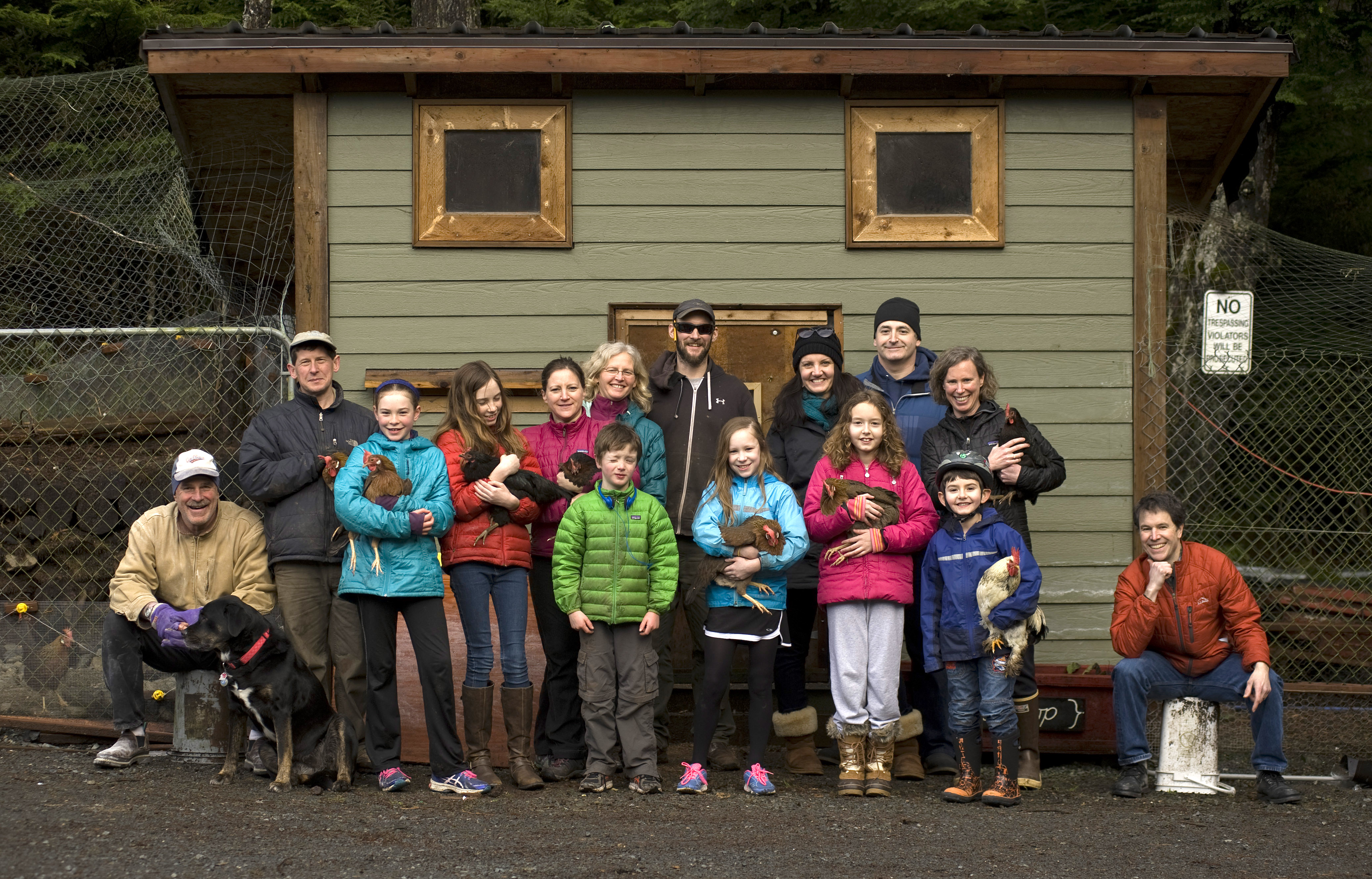
Some of the members of Le Coop, one of Sitka's chicken coop co-ops, pose with a few of their birds. (Daily Sitka Sentinel Photo by James Poulson, other photos in story are by Charles Bingham)

Some of the members of Le Coop, one of Sitka’s chicken coop co-ops, pose with a few of their birds. (Daily Sitka Sentinel Photo by James Poulson, other photos in story are by Charles Bingham)

Many Sitka families joined the backyard agriculture movement by starting gardens, but they hesitated when it came time to take the next step — raising chickens.

Chickens require daily feeding and watering, protection from predators, and other care that can be daunting for novices. However, a few Sitka families found an easier way. There now are a couple of chicken coop-co-ops in town, where neighbors or friends team up to share the duties and expense of raising chickens.

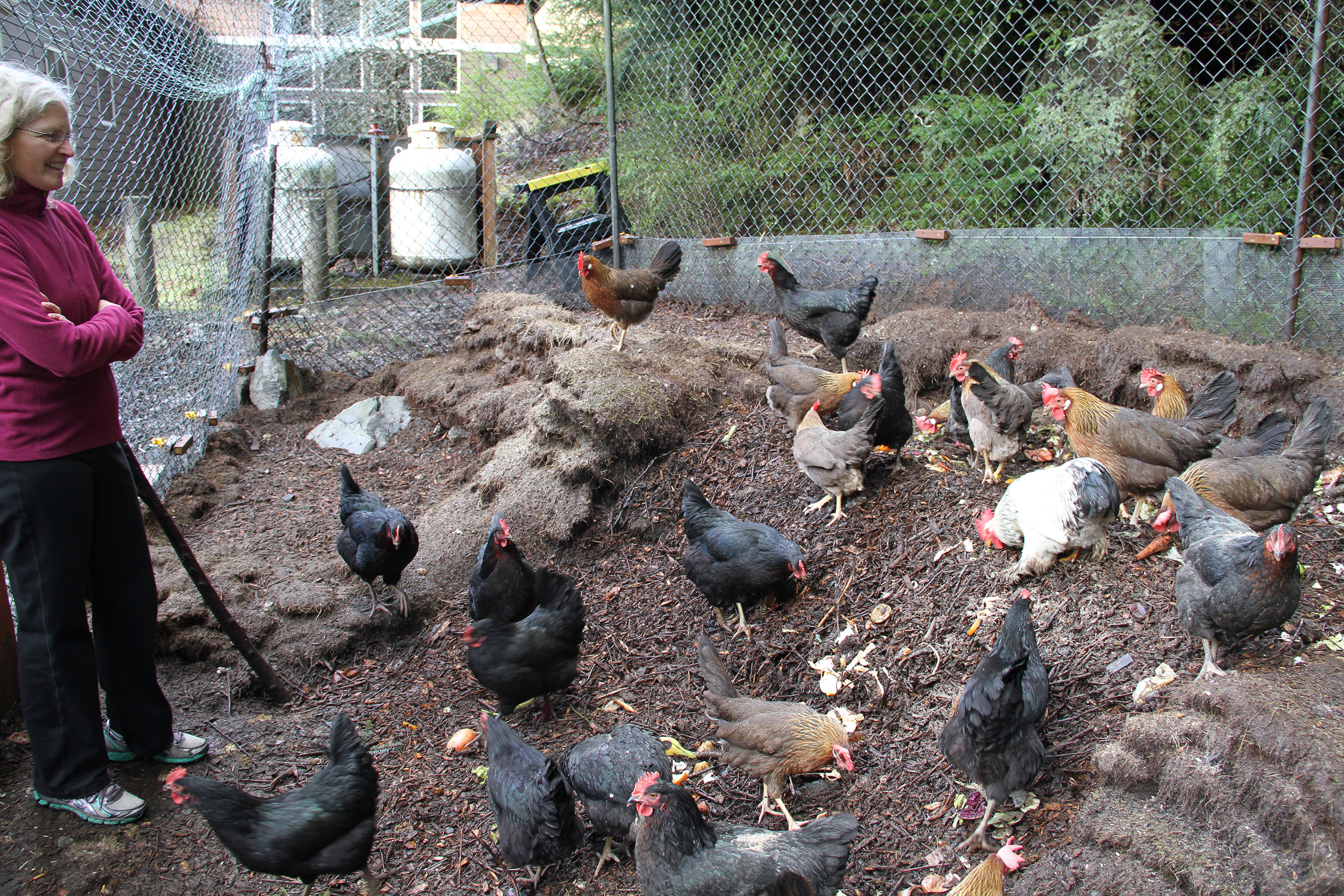
LeCoopOne of these chicken coop co-ops, Le Coop, is hidden in a back corner of the Sheldon Jackson Campus, where seven families are raising about 30 hens and one rooster. Le Coop is about 15 feet by 80 feet, with a hen house flanked by two outdoor chicken runs. The fence surrounding Le Coop is electrified (buried at least a foot below the surface to keep out varmints), with netting over the top to protect the chickens from eagles and other raptors. Inside the hen house are a dust bath for the hens, food and water buckets, an egg-laying box, and shelf space to store supplies such as extra feed.

“The advantage are only being responsible one day a week for regular chores such as feed, water, opening/closing, etc. Everything else is done at the whim of individual enthusiasms, and occasional work parties,” said Jud Kirkness, one of the co-op members. “Plus seven families means that many more people finding useful materials and resources and splitting the feed bill seven ways.”

LauraSchmidtWatchesChickensFeedLaura Schmidt, who Jud called the lead organizer/treasurer of the group, said there are six families of four and one couple, so 26 people. “About one person per hen,” she said. ” Each family typically gets about 18-30 eggs on their chicken duty day, with the hens laying more eggs in the summer.

Most of the hens were purchased as chicks last spring, and there are 15 each of red leghorns and black stars. The white rooster is of indeterminate origin, and he was added to the flock when another coop was culling its flock. Many people who raise chickens don’t like to keep roosters, but Laura said this one is small and the hens seem to be able to handle him.

The members of Le Coop have various levels of experience with raising chickens, and Erika Knox said Laura and Jud are the most experienced so they have been mentoring the other families. Erika said she wouldn’t be able to raise chickens at her house because there isn’t enough space, and lately she had to stop composting at home due to rats and other varmints getting into it.

EggsInLayingBox“This is a nice place to bring my compost, and the chickens love it,” Erika said. “It’s nice to have eggs that are fresh and organic. I give some away.”

Roger Schmidt and Kristen Homer called themselves the weak links of the group. “We just collect eggs,” Kristen said. “We let them (Laura and Jud) tell us what needs to be done.”

“It’s great because we have chicken experts like Jud and Laura, and we’ve got building experts,” said Roger, Laura’s brother and the director of the Sitka Fine Arts Camp, which owns the Sheldon Jackson Campus where Le Coop is located. He said there have been a couple of occasions when he was in a meeting on campus and suddenly remembered he had chicken duty that day.

RedLeghornAndRoosterBesides being able to share duties and costs with the chicken coop co-op, another advantage to having Le Coop on campus is the learning experiences it provides.

“It’s good for the kids. They learn a lot about chickens,” Roger said. “I bring the Head Start kids back here all the time to check on the chickens.”

“The kids love it,” Kristen said. “Razie Guillory (Laura’s daughter) did a science project charting the growth of the hens, and Asa Dow is doing a project about the economics of the co-op.”

Jud said as soon as he gets this chicken coop to where he wants it, he plans to start another chicken coop co-op for other Sitka families. “I hope it provides some inspiration.”

This slideshow requires JavaScript.

• Rabbit, goat highlight Sawmill Farm’s farm-to-table dinner at Ludvig’s Bistro

ColetteGarnishesRabbitThighs

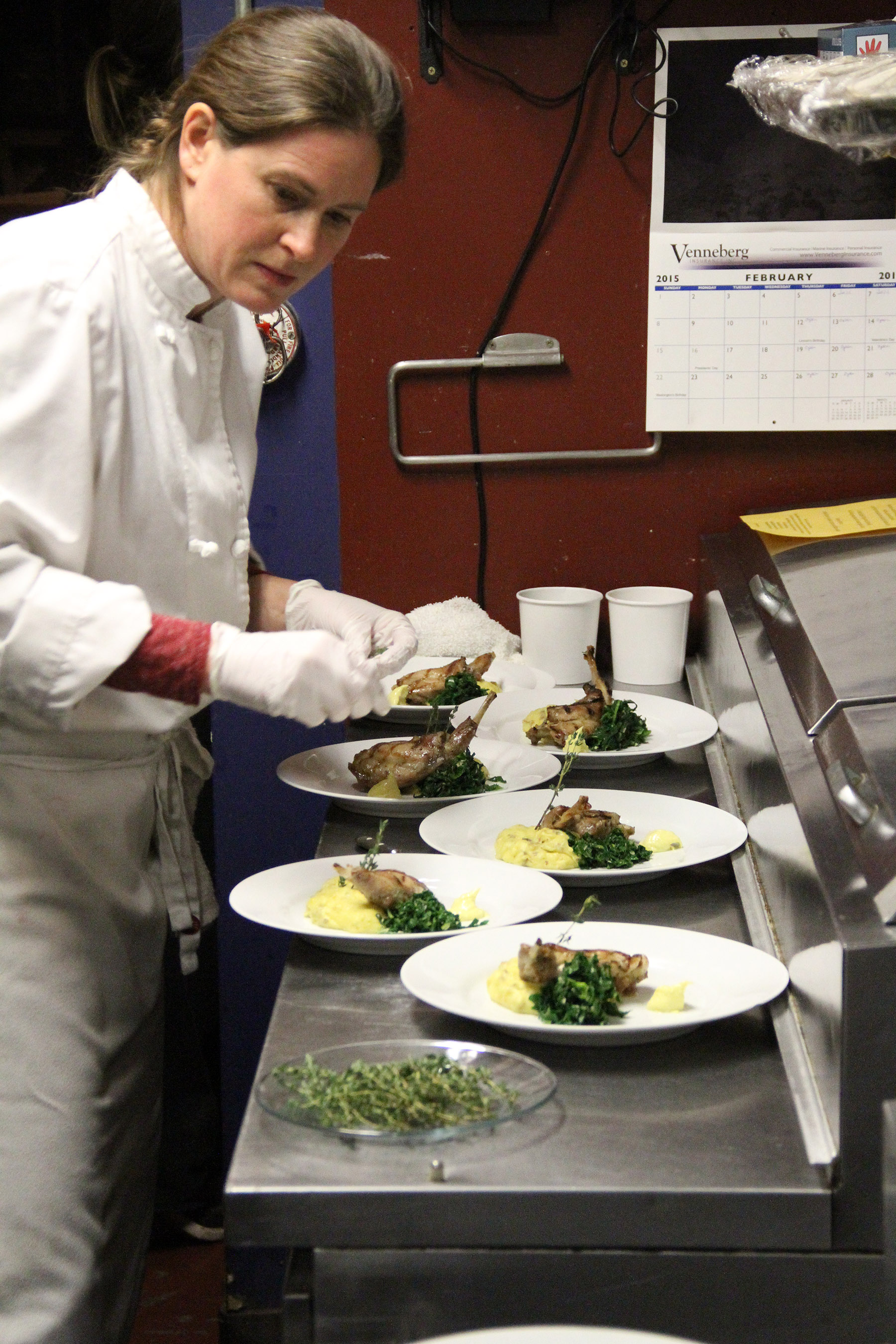
Locally raised rabbit and goat meat from Ketchikan were the highlights of a fundraising farm-to-table dinner for the Sawmill Farm on Jan. 31 at Ludvig’s Bistro.

In an effort to raise seed money for her Sawmill Farm project, Bobbi Daniels worked with Ludvig’s Bistro owner/chef Colette Nelson to create a five-course meal featuring locally sourced food from Sitka and Southeast Alaska. Tickets were $75 per plate for the function.

Bobbi already is raising rabbits in town, and she said goats also do well in Sitka. Bobbi hopes to find a large enough lot so she can grow enough rabbits to supply local stores with meat. She said rabbit meat is one of the cleanest meats as far as toxins, and it only takes 10 weeks to raise a rabbit to harvest size. The Sawmill Farm was one of 12 semifinalists in the recent Path to Prosperity economic development contest sponsored by the Nature Conservancy and Haa Aaní Community Development Fund, and now is competing for the people’s choice award.

Working with local farmers and gardeners, Bobbi and Colette created five-course meal that featured:

  • rabbit terrine with farm egg, beach asparagus and mustard;
  • leek, heirloom tomato, zucchini and rabbit consommé with sprouted wheat bread;
  • Moroccan goat stew with ginger, preserved lemons, potatoes, dates and almonds, served with white satin carrot salad and balsamic beets;
  • grilled rabbit thigh served with aioli, Inca Bella potato purée and sautéed garlic kale; and
  • Russian pavlova with huckleberry, rhubarb, currants and Sitka rose sugar.

A variety of gardens and farms provided the food used for the meal. The Sawmill Farm supplied the rabbits and wheat berries, Sivertsen Farm in Ketchikan provided the goat, Lori Adams of Down-To-Earth U-Pick Garden supplied winter kale, Sara Taranof provided farm eggs, Linda Walker provided garlic, huckleberries, rhubarb and currants, and Florence Welsh of Forget-Me-Not Garden supplied white satin and orange carrots, heirloom tomatoes, red rose potatoes, Inca Bella potatoes, leeks, zucchini, beets, raspberry preserves and beach asparagus.

Scenes from the meal are in a slideshow below:

This slideshow requires JavaScript.

• Check out the February 2015 edition of the Sitka Local Foods Network newsletter

Feb2015NewsletterScreenGrab

The Sitka Local Foods Network just sent out the February 2015 edition of its newly launched monthly newsletter. Feel free to click this link to get a copy.

This edition of the newsletter has brief stories about the Sitka Farmers Market, some upcoming winter and spring garden classes, and the 2015 Pick.Click.Give. fundraising campaign. Each story has links to our website for more information.

You can sign up for future editions of our newsletter by clicking on the registration form image in the right column of our website and filling in the information. If you received a copy but didn’t want one, there is a link at the bottom of the newsletter so you can unsubscribe. Our intention is to get the word out about upcoming events and not to spam people. We will not share our email list with others to protect your privacy.